


Radiations and male fertility
- PMID: 30445985
- PMCID: PMC6240172
- DOI: 10.1186/s12958-018-0431-1
Radiations and male fertility
Abstract
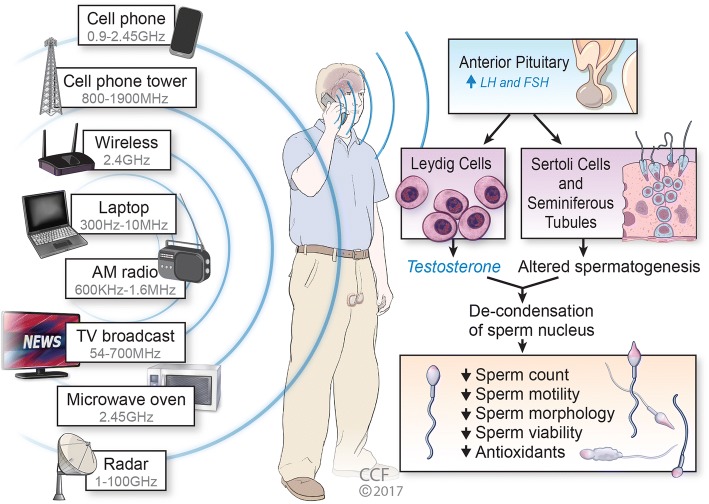
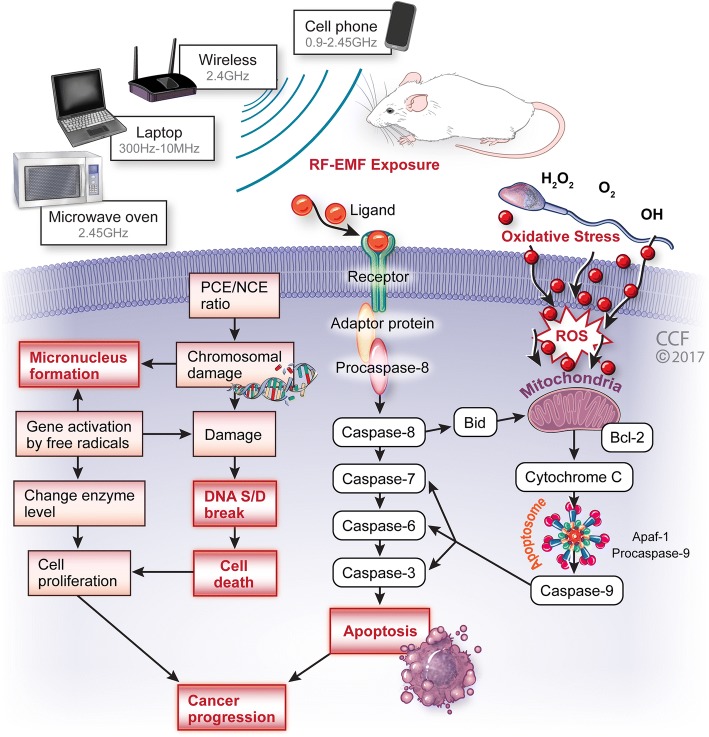
During recent years, an increasing percentage of male infertility has to be attributed to an array of environmental, health and lifestyle factors. Male infertility is likely to be affected by the intense exposure to heat and extreme exposure to pesticides, radiations, radioactivity and other hazardous substances. We are surrounded by several types of ionizing and non-ionizing radiations and both have recognized causative effects on spermatogenesis. Since it is impossible to cover all types of radiation sources and their biological effects under a single title, this review is focusing on radiation deriving from cell phones, laptops, Wi-Fi and microwave ovens, as these are the most common sources of non-ionizing radiations, which may contribute to the cause of infertility by exploring the effect of exposure to radiofrequency radiations on the male fertility pattern. From currently available studies it is clear that radiofrequency electromagnetic fields (RF-EMF) have deleterious effects on sperm parameters (like sperm count, morphology, motility), affects the role of kinases in cellular metabolism and the endocrine system, and produces genotoxicity, genomic instability and oxidative stress. This is followed with protective measures for these radiations and future recommendations. The study concludes that the RF-EMF may induce oxidative stress with an increased level of reactive oxygen species, which may lead to infertility. This has been concluded based on available evidences from in vitro and in vivo studies suggesting that RF-EMF exposure negatively affects sperm quality.
Conflict of interest statement
Ethics approval and consent to participate
This is a review and did not need ethical clearance.
Consent for publication
All mentioned authors were involved in the writing of this review and gave consent for its publication.
Competing interests
The authors declare that they have no competing interests.
Publisher’s Note
Springer Nature remains neutral with regard to jurisdictional claims in published maps and institutional affiliations.
Figures
Similar articles
- The effects of radiofrequency exposure on male fertility: A systematic review of human observational studies with dose-response meta-analysis.Environ Int. 2024 Aug;190:108817. doi: 10.1016/j.envint.2024.108817. Epub 2024 Jun 11.Environ Int. 2024.PMID: 38880061
- Radiofrequency radiation: A possible threat to male fertility.Reprod Toxicol. 2021 Mar;100:90-100. doi: 10.1016/j.reprotox.2021.01.007. Epub 2021 Jan 23.Reprod Toxicol. 2021.PMID: 33497741Review.
- Association between reproductive health and nonionizing radiation exposure.Electromagn Biol Med. 2021 Jan 2;40(1):92-102. doi: 10.1080/15368378.2021.1874973. Epub 2021 Jan 20.Electromagn Biol Med. 2021.PMID: 33471575Review.
- Radio frequency electromagnetic radiation (RF-EMR) from GSM (0.9/1.8GHz) mobile phones induces oxidative stress and reduces sperm motility in rats.Clinics (Sao Paulo). 2009;64(6):561-5. doi: 10.1590/s1807-59322009000600011.Clinics (Sao Paulo). 2009.PMID: 19578660Free PMC article.
- Effects of radiofrequency electromagnetic field (RF-EMF) exposure on male fertility: A systematic review of experimental studies on non-human mammals and human sperm in vitro.Environ Int. 2024 Mar;185:108509. doi: 10.1016/j.envint.2024.108509. Epub 2024 Feb 19.Environ Int. 2024.PMID: 38492496
Cited by
- Decrease in Sperm Parameters in the 21st Century: Obesity, Lifestyle, or Environmental Factors? An Updated Narrative Review.J Pers Med. 2024 Feb 11;14(2):198. doi: 10.3390/jpm14020198.J Pers Med. 2024.PMID: 38392631Free PMC article.Review.
- Oxidative stress and male infertility: current knowledge of pathophysiology and role of antioxidant therapy in disease management.Cell Mol Life Sci. 2020 Jan;77(1):93-113. doi: 10.1007/s00018-019-03253-8. Epub 2019 Aug 3.Cell Mol Life Sci. 2020.PMID: 31377843Free PMC article.Review.
- Men with genetic predisposition face greater fertility challenges when exposed to electromagnetic radiation.Mol Biol Rep. 2025 Jul 31;52(1):773. doi: 10.1007/s11033-025-10882-9.Mol Biol Rep. 2025.PMID: 40742570
- Histomorphometry and sperm quality in male rats exposed to 2.45 GHz Wi-Fi.Reproduction. 2025 Apr 18;169(5):e250048. doi: 10.1530/REP-25-0048. Print 2025 May 1.Reproduction. 2025.PMID: 40192818Free PMC article.
- Environmental and Genetic Traffic in the Journey from Sperm to Offspring.Biomolecules. 2023 Dec 7;13(12):1759. doi: 10.3390/biom13121759.Biomolecules. 2023.PMID: 38136630Free PMC article.Review.
References
-
- Bullock J, Boyle J, Wang MB, Ajello RR. Physiology. Pennsylvania: Harwal Publishing Company; 1984.
Publication types
MeSH terms
LinkOut - more resources
Full Text Sources
Other Literature Sources
Medical
