



They probably don’t. Fears of a population collapse are unfounded.
If you spend enough time in right-wing circles, you’ll hear a lot of concerns about population collapse and replacement rates. The argument is essentially that the current replacement rate is below two; therefore, the population will be hollowed out by X many years.


You see left-wingers eating up this argument too sometimes, but mostly as a way to justify increasing the level of welfare to mothers and children. Right-wingers have equally mundane ‘solutions’ to this, which include but are not limited to pro-natalist incentives and upholding traditional family values. Not exactly a fan of either.
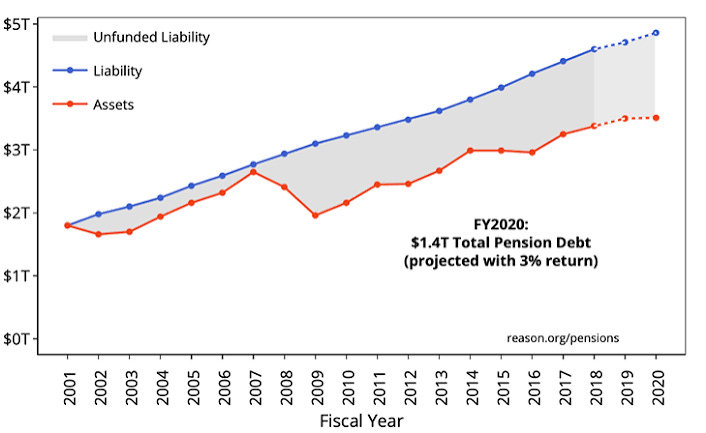
It gets worse, though, some arguments about low fertility end up being concerns about transfer program solvency, think social security and public pensions. These systems require a large working-age population, preferably one that outnumbers a comparatively smaller retired population. If the population shrinks, then the ratio tips the scales, you get fewer workers than retirees, and the unfunded pension liabilities start to stack up. If that’s truly a problem, then it seems more sensible to simply restructure & cut pension programs rather than attempt to engineer a second baby boom via subsidies or appeals to traditional values.
Every two years, the United Nations Population Division publishes several projections based on different fertility assumptions. Essentially, it’s a ‘what-if’ scenario analysis. The high-fertility versions are 0.5 children higher than the medium projections, and the low-fertility versions are 0.5 lower than the medium projections. They also publish a range of population trajectories forecasting to 2100.
It’s important to remember that forecasts like these are laughably uncertain. Moreover, external researchers have made critical objections to the narrowness of the forecasts. There’s such a wide range of possibilities here that hyper-fixing on the most alarming projections seems to be no better than blatant cherry-picking.
A 2023 opinion piece, for example, famously displayed a graphic of a downward population spiral, marking the apparent end of humanity. Scary! And then the UN published a projection of 10 billion humans, i.e., a population increase. Oops.
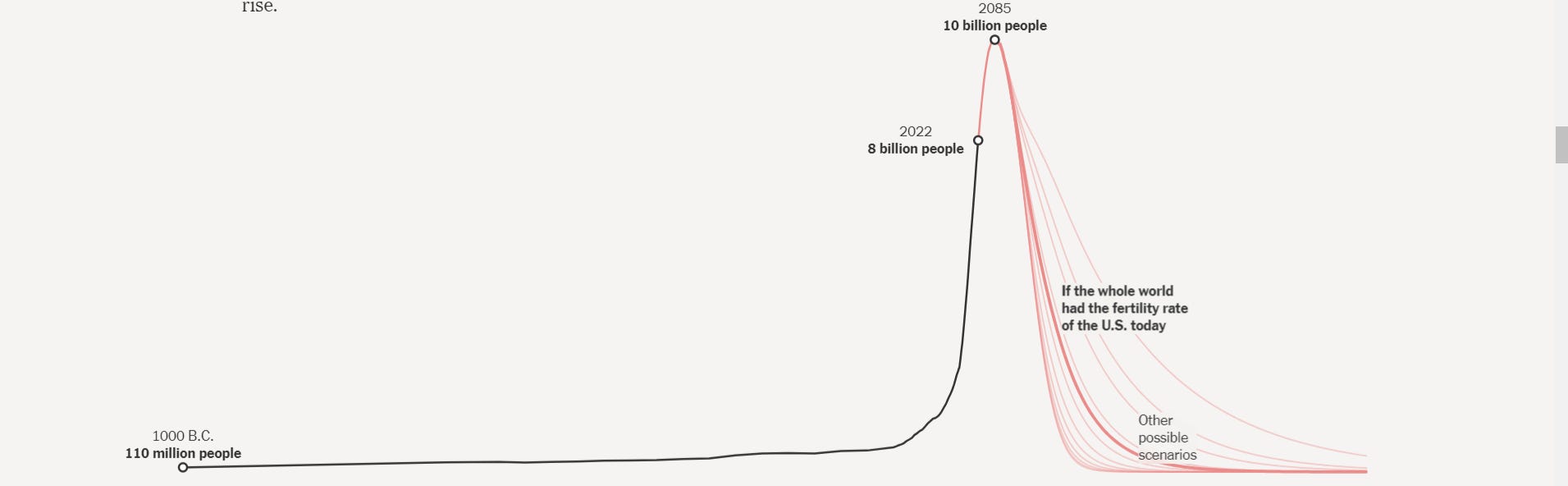
Turns out that ‘population collapse’ graph you see above is actually shoddy guesswork about a population decline over TWO MILLENIA (that would extend to 4100).
It makes you wonder how many people here are doing motivated math. Demographic projections that crudely extrapolate current trends into the future always later ‘discover’ that we’re headed towards extinction. As if the ship only steers in one direction and is headed straight for an iceberg. Of course, we need to steer away from the iceberg, but we don’t necessarily need a modicum of weird traditional values instilled in us, or even more bread and circuses for the poor to stay afloat.
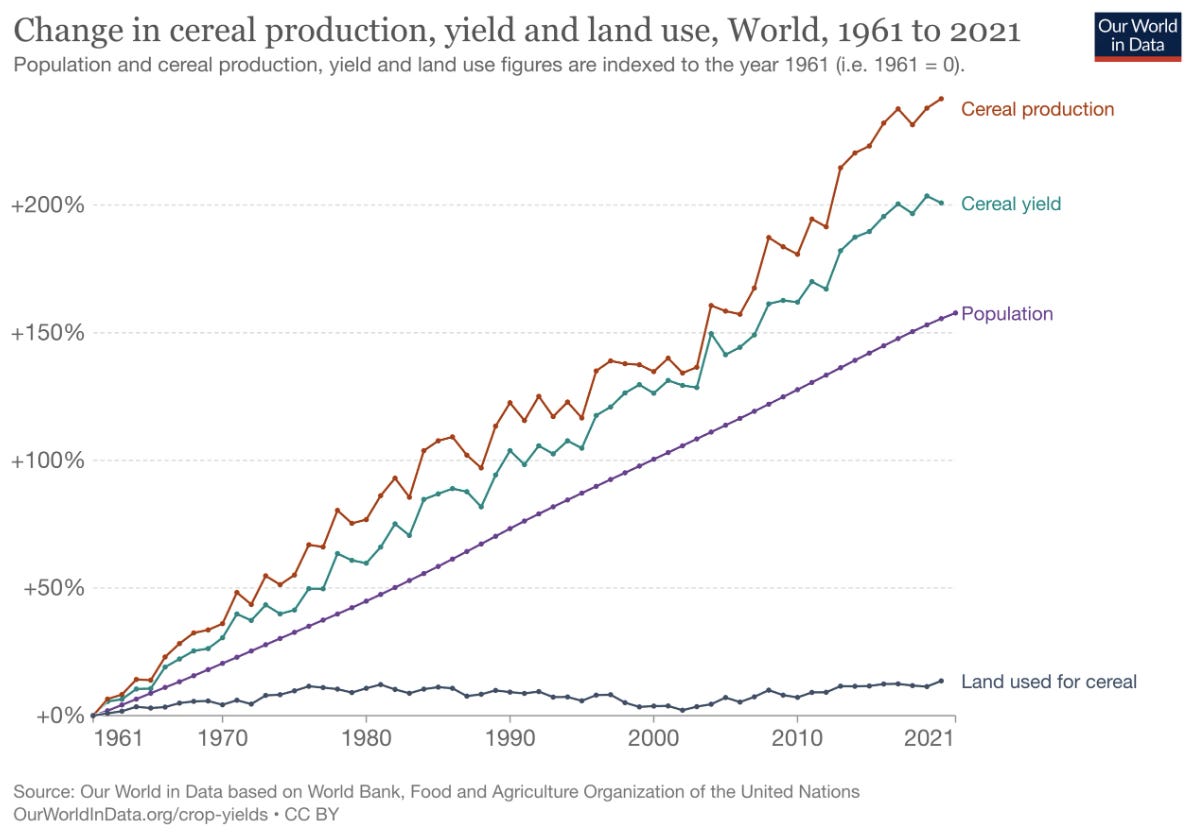
Existential-risk doomers have been around for longer than Twitter, though. Thomas Malthus’ original essay “The Principle of Population” predicted that exponential population growth would outstrip the supply of food, leading to mass starvation. By the early 20th century, people were in a semi-frenzy over overpopulation. After WWII, the ‘baby boom’ occurred and populations surged in the US, UK, Canada, Australia, Korea and so on. Turns out food concerns were just quietly swept under the rug once crop yields multiplied due to innovative seed techniques & cross breeding initiatives.
It’s almost as if people respond dynamically to economic conditions! And by 1960, the US replacement rate was 3.65.
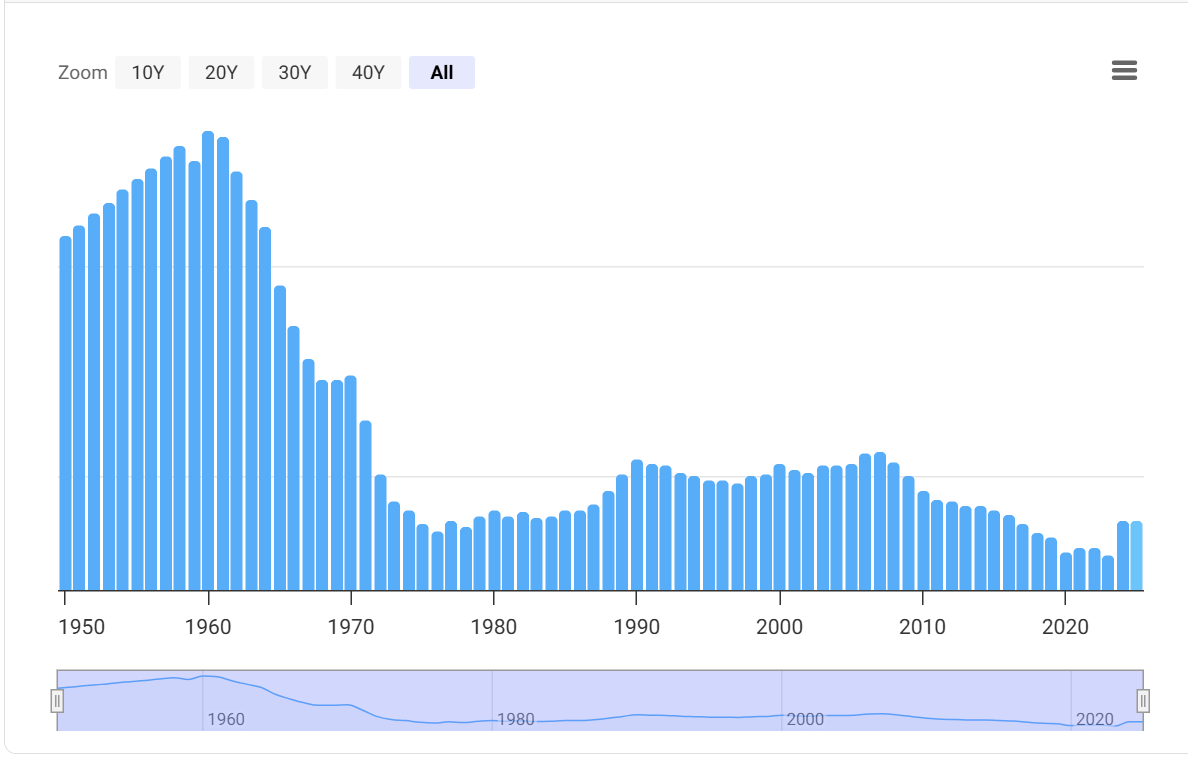
Fast forward to 2024, and that figure has dwindled to just below 2, meaning we’re just barely below the neutral replacement rate. I’m still unconvinced that this is an issue given the non-linear nature of changes in the replacement rate.
And a large chunk of the literature seems to agree. In a low mortality environment, extrapolations are often inaccurate. The alarmist thing to point out is that “two-thirds of the world’s population (about 5.8 billion people) in 2025 live in countries with below-replacement fertility, whereas only a tiny share did in 1950”. South Korea looks especially bad and is frequently invoked by doomers.
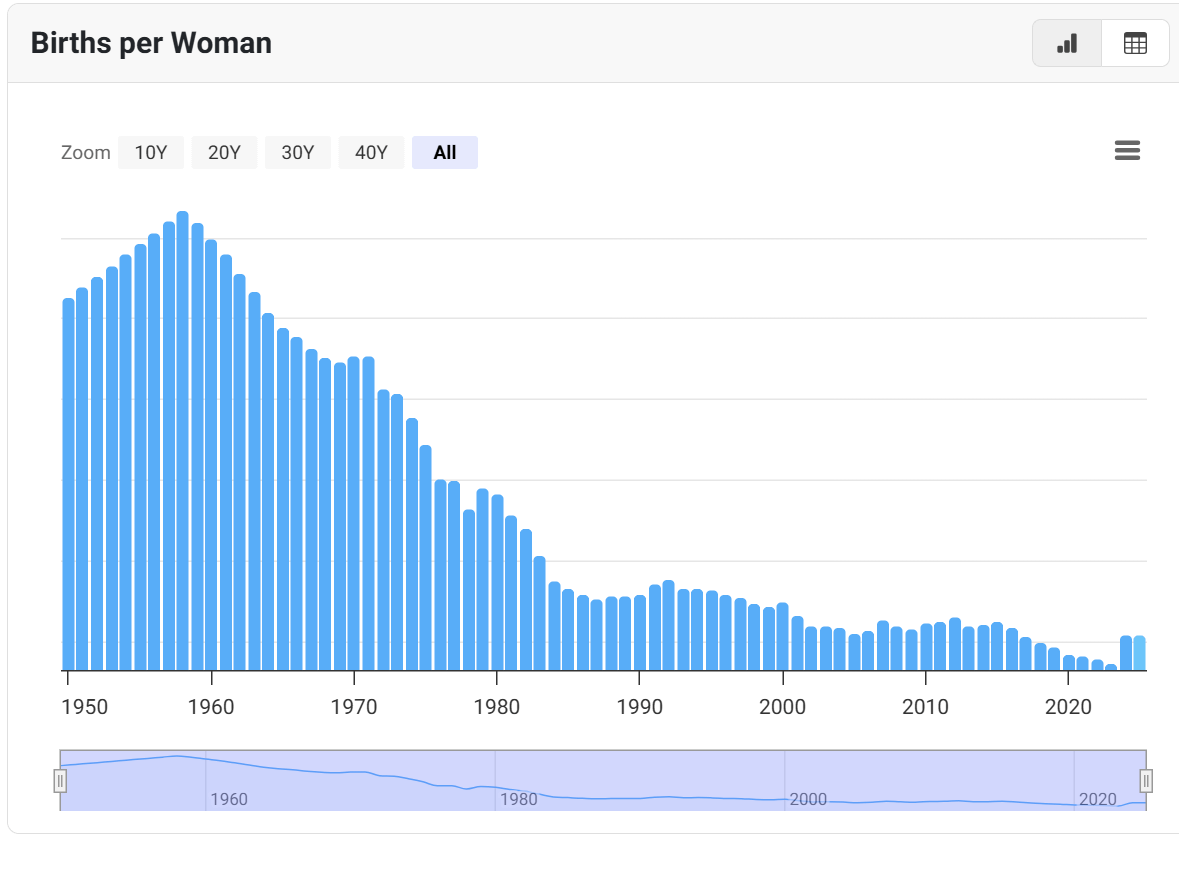
Of course, we don’t want to be making a composition fallacy error by zeroing in on South Korea and making claims about the whole. In any case, I put little stock in the doomers who make claims about some kind of overall population collapse. Demographers and crystal ball crackheads have been burned time and time again. The population boom wasn’t predicted. The Green Revolution wasn’t predicted. No one is predicting these things, but the one common denominator in all these outcomes is that humanity prevailed, humanity came out massively better off, and all the doomers were embarrassingly wrong.
In the very long run, fertility stays in the gene pool. People who don’t continue their dynastic bloodline get systematically wiped out of the gene pool; thus, in the long run, fertility wins out. Some structural models correspond to this idea. Collins & Page (2019) build out an evolutionary demography fertility model, arguing that because fertility is a heritable gene, in the long run, fertility increases over time. The implication here is that forecasts that discount fertility heritability will systematically underestimate future fertility. As a quick caveat, I don’t have the expertise to tell you how heritable fertility is, but some of the papers I went through seem to agree that fertility is “moderately heritable”.
This doesn’t mean that fertility decline carries no costs. Innovation and other non-scarce public goods could always use more human capital. Humankind can always expand further. The point is that the mere fact that fertility is below the optimal replacement rate today does not imply that civilization is on the brink of collapse. Forecasts are largely fantasy buried under dozens of fragile assumptions. People adapt to changing economic conditions, to institutional evolution, and to unknowable future technological advancements that routinely alter constraints that doomers love.
And yeah, perhaps some countries (I’m looking at you, South Korea) could use a reshuffling of incentives, though I’m rather optimistic about the future, and I think you should be too. So maybe don’t go telling women to “breed more”.


Pretty lazy article, not a lot of data. Doesn't address important and obvious economic points. Reads like an 8th grade essay.
It seems flippant to suggest we can just restructure and cut pensions. How is that supposed in societies dominated by senescent electorates? This is not a trivial problem.