

It’s a great morning to crank “No Brakes” by The Offspring. Why? Because the United States government has officially blown through $40 trillion in national debt, another milestone that would almost be impressive if it weren’t so outright grotesque. Our debt machine literally has “no brakes”.
According to Treasury data, total U.S. debt crossed $40 trillion this week, only about five months after it crossed $39 trillion in March, while government spending continues to exceed revenue by more than $2 trillion annually.
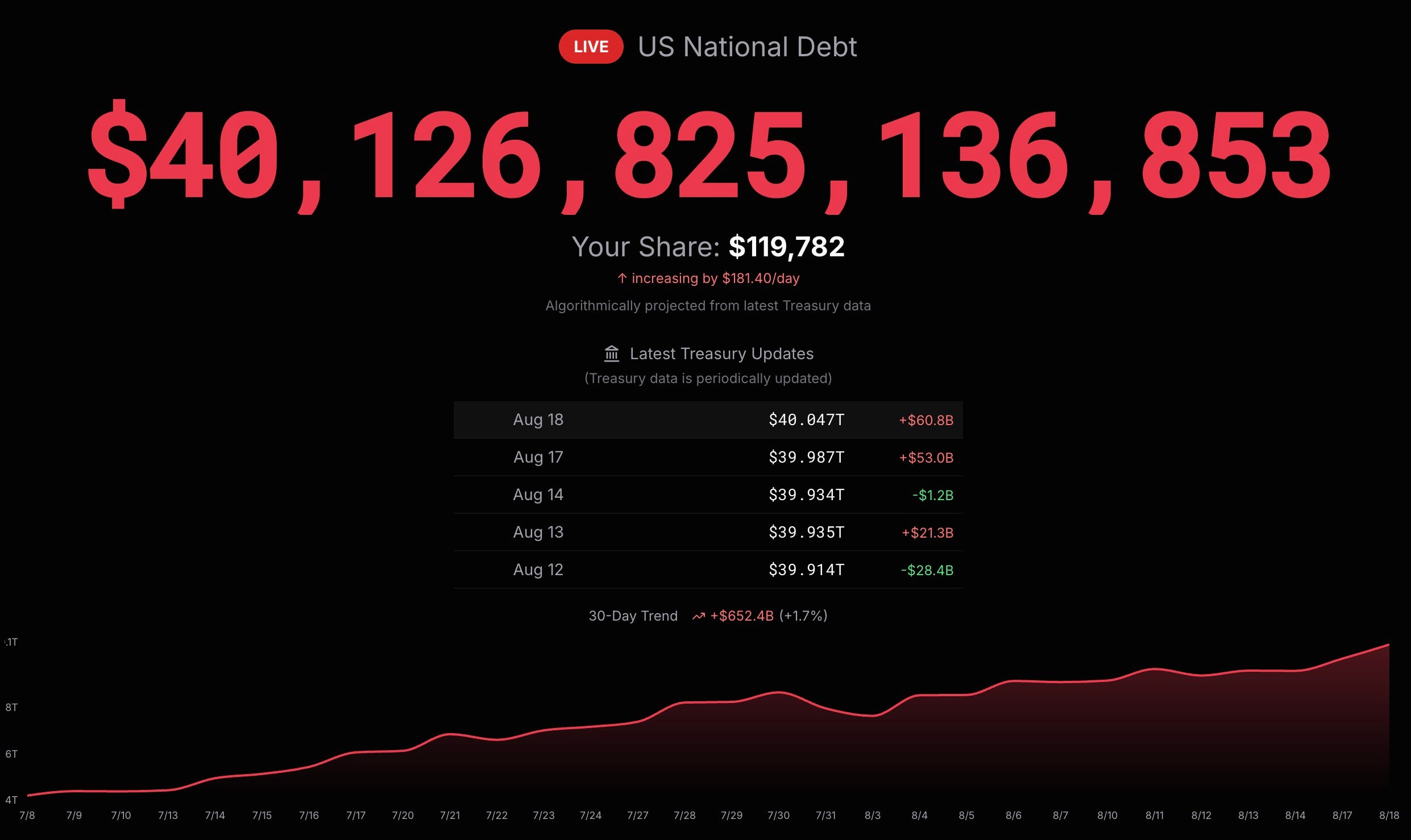
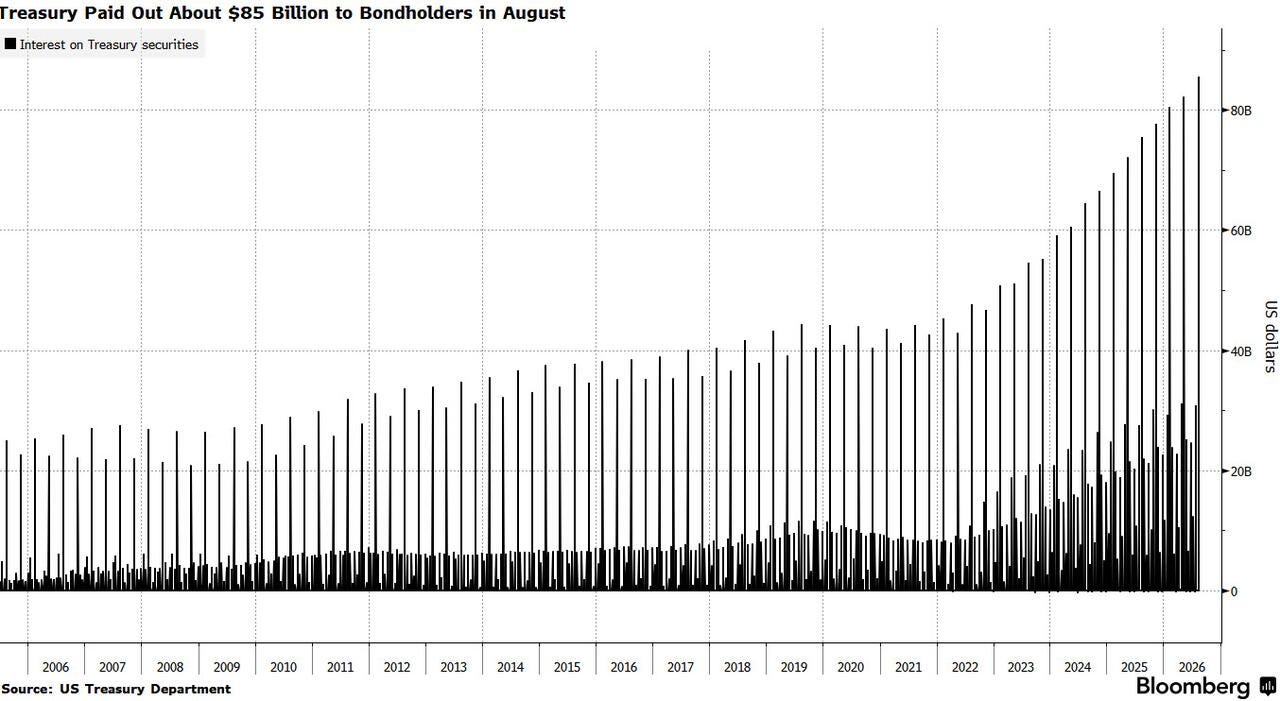
Ten years ago, the debt was around $19 trillion, meaning we have managed to more than double the national credit card balance in roughly a decade. Meanwhile, interest expense has become the government’s second largest expense behind Social Security, and interest costs through the first ten months of this fiscal year were already 15% higher than during the same period last year.
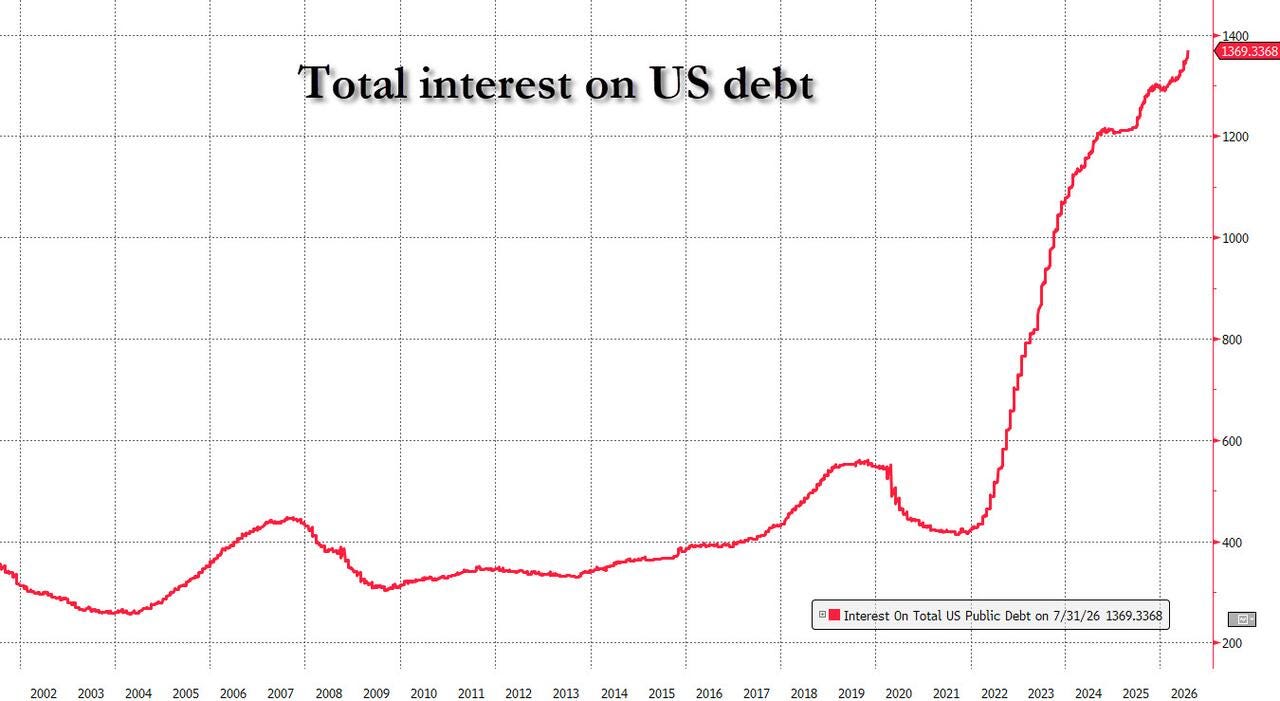
In other words, the U.S.’s financial statements are starting to represent those of a third world country. And once we start buying our own bonds, the transformation will be complete.
The speed at which the odometer is turning is perhaps even more disturbing than the $40 trillion headline itself, because it took the United States 192 years to accumulate its first $1 trillion of national debt, which it finally crossed in 1981. We crossed $30 trillion in 2022, $38 trillion in October 2025, $39 trillion in March 2026 and now $40 trillion roughly five months later.
At the beginning of July, the Joint Economic Committee calculated that the debt had increased by $3.16 trillion in just the previous twelve months, equivalent to more than $8.6 billion per day and about $100,000 every second. We used to measure trillion dollar increases in generations, then we measured them in years, and now apparently we are going to measure them in months.
I also think that smug idiots who joke about the debt, dismissing it as some meaningless nominal number that simply goes up forever, are missing the most alarming part of the story.
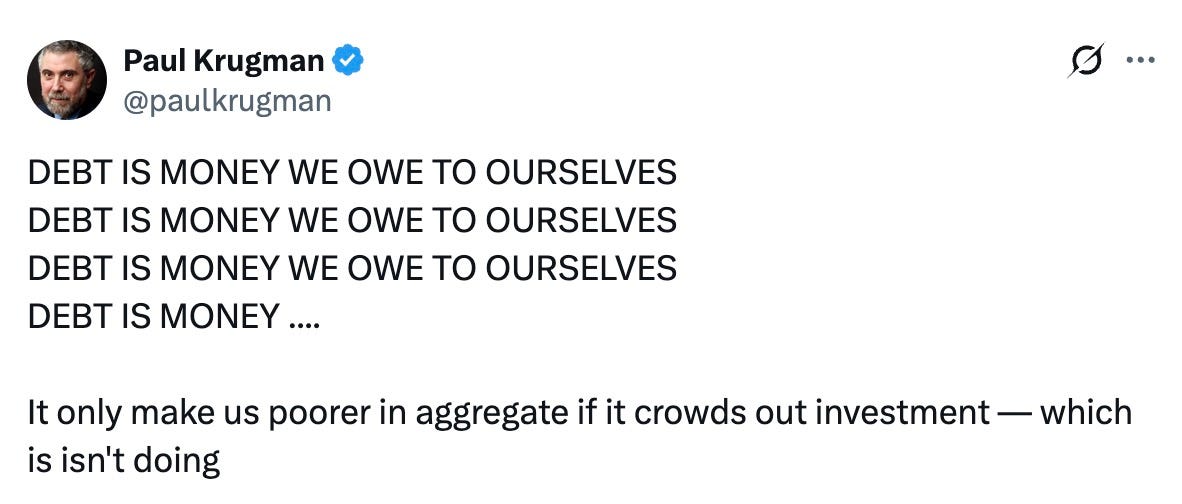
The problem isn’t that $40 trillion sounds scary in isolation, because in a growing economy virtually every nominal number gets larger over time, but rather the extraordinary rate at which the debt itself is now accelerating, with the total having more than doubled from roughly $19.4 trillion just ten years ago.
At this trajectory there are no visible brakes, and the increasingly popular argument that America can simply grow its way out of the problem becomes harder to take seriously when the debt is expanding faster than the economic base expected to support it.
Growth can absolutely make a large debt burden more manageable, but growth cannot solve a fiscal trajectory in which borrowing and interest expense continually compound faster than the economy, which is why the acceleration rather than the headline number is what should scare the hell out of people.
If nothing else, crossing $40 trillion should finally put to bed the idea that the Trump administration’s fiscal policy bears any meaningful resemblance to the cost cutting, budget balancing and fiscal restraint that was talked about before (and right after) the election with DOGE and the likes.
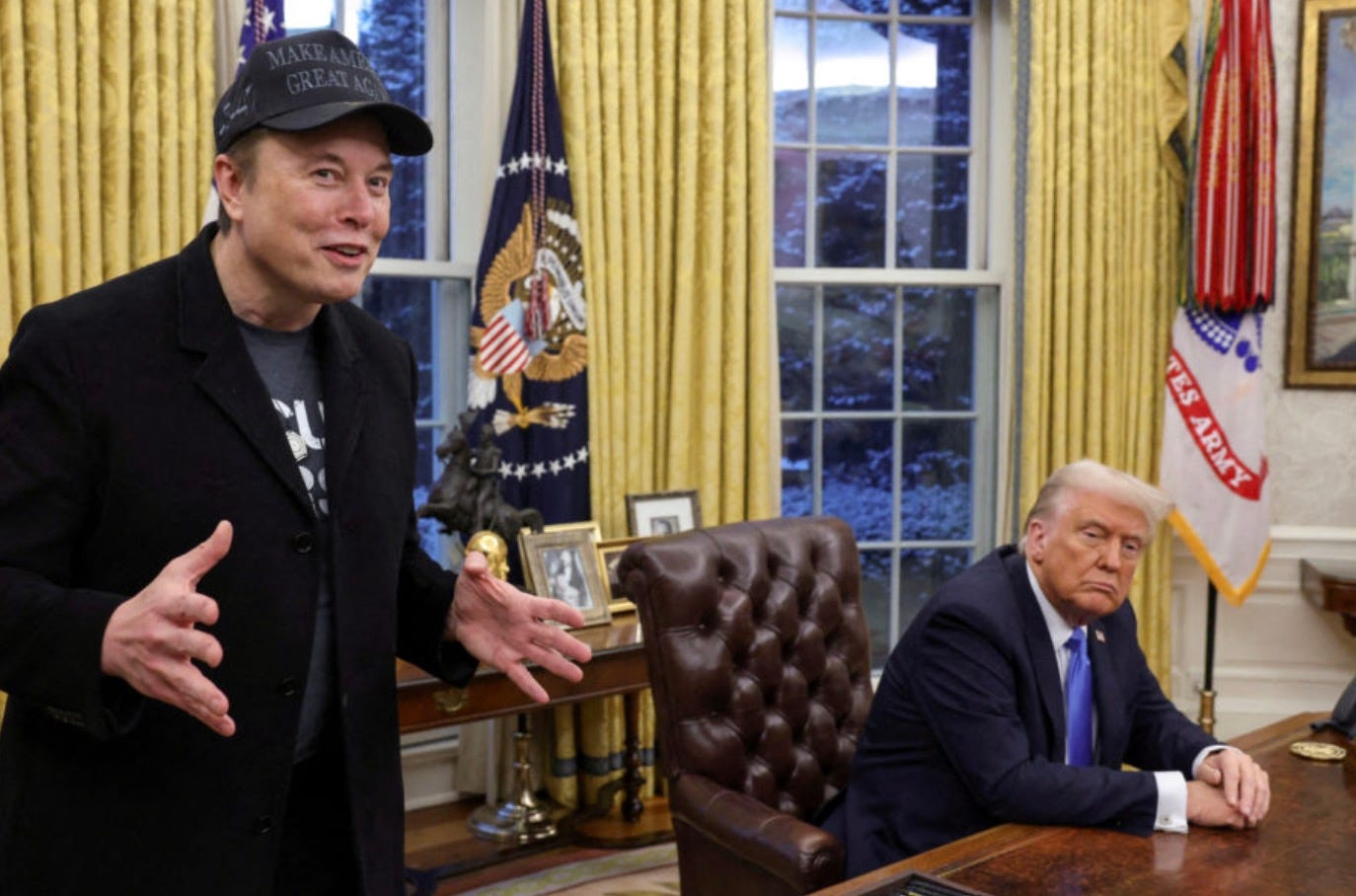
Whatever your opinion of Trump, and readers know I have supported plenty of his policies, the numbers are the numbers, and there is no serious definition of fiscal conservatism under which adding debt at this pace qualifies.
The federal government is still spending dramatically more than it takes in, annual deficits remain enormous, interest expense is compounding into one of Washington’s largest expenditures and there remains no credible political constituency willing to cut spending deeply enough to change the trajectory.
At some point this stops being an argument about whether Republicans or Democrats are more irresponsible and becomes an argument about whether the political system itself is capable of imposing austerity voluntarily before the bond market imposes it involuntarily. It’s why I called monetary (and now fiscal) policy in this country the devil that neither political party can name.

That brings me back to something I’ve been writing about repeatedly, which is that eventually I believe the bond market is going to force the government and Federal Reserve into some form of yield curve control. The problem isn’t simply that the United States owes $40 trillion, because a sovereign government issuing debt in its own currency can obviously continue borrowing for a very long time.
The problem arrives when the marginal buyer of that debt begins demanding an interest rate that the government, economy and financial system cannot comfortably tolerate, particularly when trillions of dollars of existing debt must continually be refinanced at those higher rates. Once the price demanded by the bond market collides with the price Washington can afford to pay, somebody eventually has to blink, and history tells me it probably isn’t going to be Washington voluntarily deciding to default.
We may have gotten our first meaningful glimpse of that conflict yesterday, when Treasury Secretary Scott Bessent announced that Treasury would double the size of certain buyback operations involving longer dated Treasuries from $2 billion to at least $4 billion per operation. The operations cover debt in the 10 to 30 year portion of the curve and came after the 30 year Treasury yield reached 5.34%, its highest level since 2007, as investors wrestled with inflation, enormous government financing requirements and the broader deterioration in America’s fiscal position.
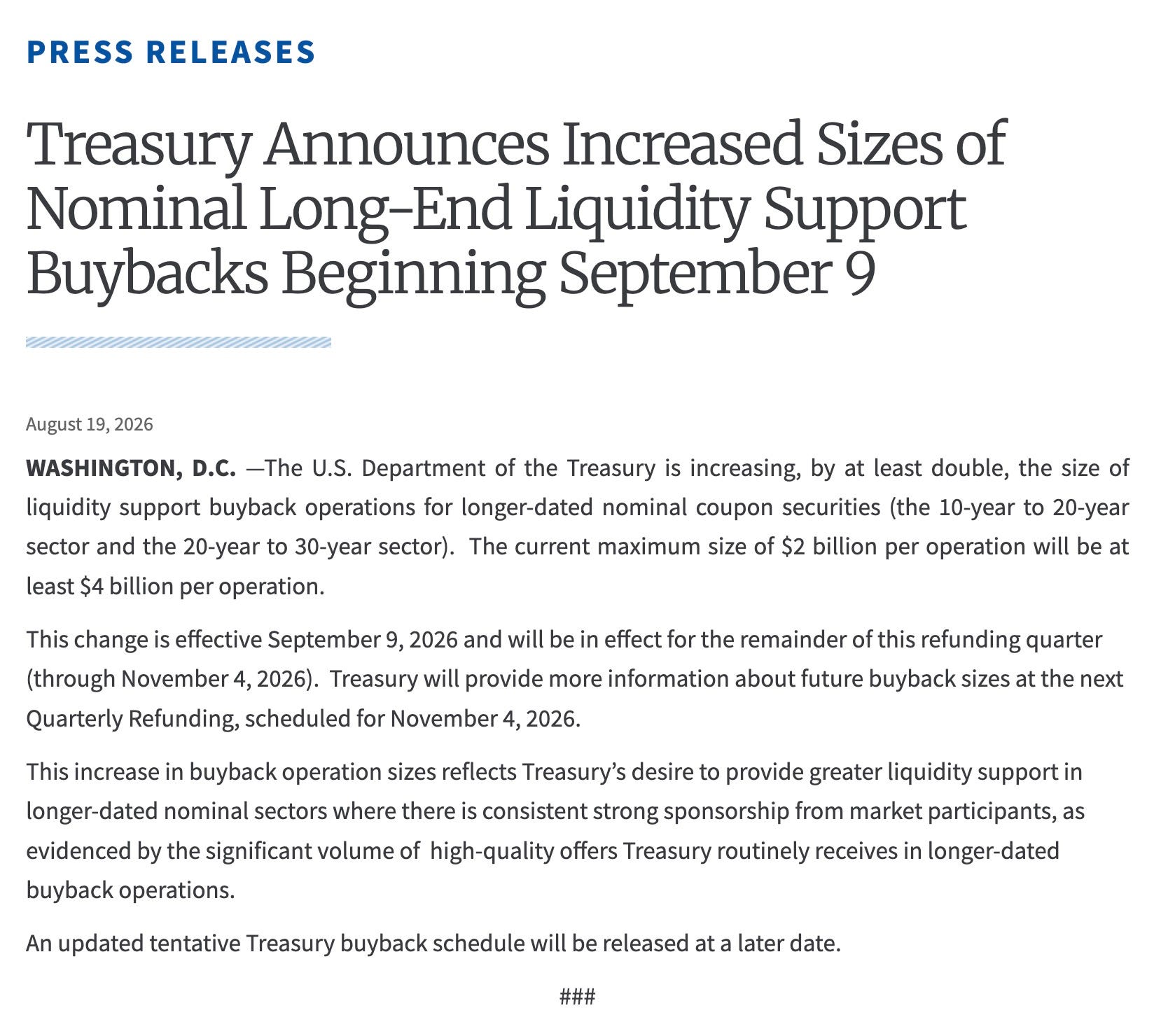
The reaction was immediate, with long duration Treasury yields dropping sharply and the 30 year falling back toward 5.18%, while the dollar weakened and gold exploded higher. Gold surged more than 3% on Wednesday as the market immediately interpreted the announcement through the lens of easier financial conditions and potential government support for the bond market.
Some people are already describing Treasury’s move as a kind of stealth yield curve control. I think that description may slightly get ahead of what has actually happened. A $4 billion Treasury buyback is still tiny relative to a Treasury market containing more than $30 trillion of marketable debt, and Treasury itself isn’t technically setting a ceiling on yields or promising unlimited purchases at a particular price.
What matters to me isn’t necessarily the size of yesterday’s intervention, but rather the signal it sends about how uncomfortable policymakers have become with what is happening at the long end of the curve. Treasury has now shown the market that sufficiently violent increases in long term borrowing costs can provoke a policy response, and I am not convinced bond traders are going to interpret that exclusively as a demonstration of strength.
In fact, I think there is another possibility that is far more interesting and potentially much more dangerous…and I think could actually happen.
