Jews Are NOT Oppressed: The Myth of Systemic Antisemitism
Jews today are not a systemically oppressed group; they are extremely privileged. Antisemitism is not systemic oppression. This narrative only serves Zionism.

This is a comprehensive, living document. It will be updated on an irregular basis. You can also explore smaller, focused sections of this article broken up in the archive.
Original publish date: August 2025 | Latest update: July 2026
At the heart of every argument within the spectrum of Zionism lies the uncritically accepted belief that Jews are an eternally oppressed people and that antisemitism is a constant, rampant threat. The charge of antisemitism often functions as a thought-terminating cliché, deployed not only by staunch Zionists but even by well-meaning individuals who identify as pro-Palestine. Yet few pause to critically examine this assumption. What is the actual reality of Jewish oppression today, and how does contemporary antisemitism compare to the narrative so widely accepted?
By any objective measure, Jews are not a marginalized or oppressed group. Rather than facing structural or systemic oppression, they represent one of the most privileged demographics globally. The Jewish population is overwhelmingly concentrated in wealthy Western nations and their own ethnostate, societies that dominate the global imperial order. Within these power centers, Jewish communities consistently rank among the most affluent and highly educated groups, outperforming nearly all other demographics in measures of economic success and social mobility. While antisemitism persists in individualized forms, it does not constitute the kind of institutionalized, state-enforced oppression experienced by truly marginalized groups. The material conditions of Jewish life worldwide contradict any claim of systemic disadvantage.
This article critically debunks several widely held assumptions in Western discourse through a materialist lens: the notion that Jews are systemically oppressed, that antisemitism represents a unique form of bigotry, the alleged uniqueness of the Holocaust in human history, and assertions that Zionism lacks broad support among Jewish communities. By analyzing demographic patterns, socioeconomic data and historical comparisons, these narratives collapse under evidentiary scrutiny, revealing how the perpetual “antisemitism crisis” discourse primarily serves to shield Israel from criticism while justifying its policies of occupation, apartheid and genocide. The material conditions of global Jewish communities demonstrate privilege rather than persecution, even as this myth of universal, eternal victimhood gets weaponized to suppress Palestinian solidarity movements worldwide.
Table of Contents
Privileged Reality of Jewish Demographics
Yes, Most Jews are in fact Zionists
Zionism Dominates Jewish Organizations
Zionism: A Project of the Rich, not Refugees
Institutional Jewish Exceptionalism
The “Rising Antisemitism Crisis” Hoax
Jews vs Roma: Perceived vs Real Marginalization
Arabs and Muslims: The Real Victims of Modern Antisemitism
What Is Systemic Oppression?
Before continuing, it is important to emphasize the difference between individualized/interpersonal bigotry and systemic oppression and discrimination in order to understand how, in this day and age, antisemitism does not fall into the latter category.
Systemic oppression refers to top-down institutional and structural systems that perpetuate discrimination, marginalization, and inequality against specific groups. Unlike individual bigotry (personal prejudice or hateful acts), systemic oppression is:
Institutional – Embedded in laws, policies, and practices at the organization level.
Structural – Reinforced by societal hierarchies (socioeconomic, political, cultural, legal) across institutions and across history that privilege dominant groups and result in disadvantages of other groups.
Top-down – Perpetuated by governments, corporations, police, schools, healthcare systems and other socioeconomic power structures rather than just individual actions.
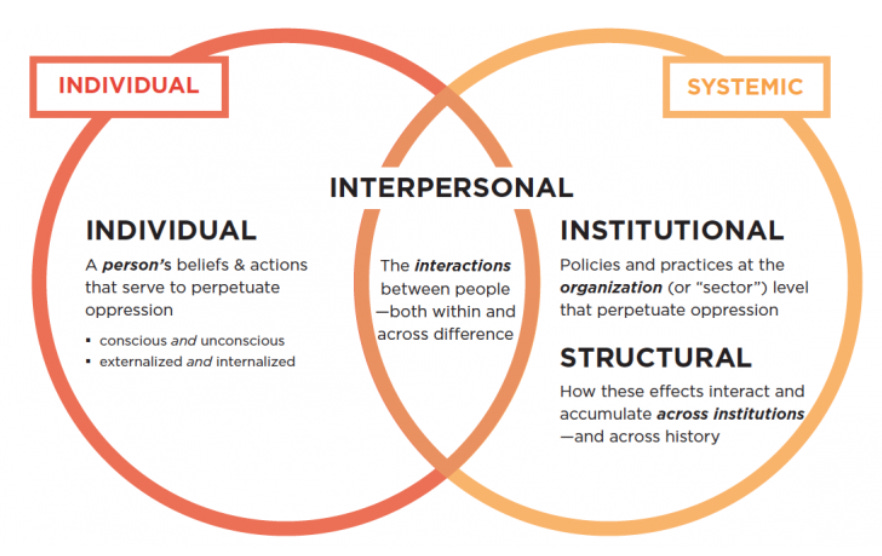
Individual acts of discrimination and prejudice such as hate crimes or targeted violence can be devastating in their brutality, with targeted mass shootings and mob lynchings being the most extreme examples. However, systemic oppression operates on a deeper, more pervasive level. Unlike personal bigotry, it is enforced top-down through laws, institutions, and cultural norms, often invisibly woven into the fabric of society. Its power lies in its normalization and historical roots born from colonialism, capitalism, and centuries of exploitation that entrenched racial and class hierarchies.
This structural entrenchment makes systemic oppression far harder to identify, address, and dismantle, as it persists not just through overt malice, but through policies and power structures that privilege dominant groups while marginalizing others.
African American civil rights leaders Kwame Ture and Charles V. Hamilton, who coined the term institutional racism, address the key differences with the example of racism experienced by black people in the U.S.:
Racism is both overt and covert. It takes two, closely related forms: individual whites acting against individual blacks, and acts by the total white community against the black community. We call these individual racism and institutional racism. The first consists of overt acts by individuals, which cause death, injury or the violent destruction of property. This type can be recorded by television cameras; it can frequently be observed in the process of commission. The second type is less overt, far more subtle, less identifiable in terms of specific individuals committing the acts. But it is no less destructive of human life. The second type originates in the operation of established and respected forces in the society, and thus receives far less public condemnation than the first type.
When white terrorists bomb a black church and kill five black children, that is an act of individual racism, widely deplored by most segments of the society. But when in that same city—Birmingham, Alabama—five hundred black babies die each year because of the lack of proper food, shelter and medical facilities, and thousands more are destroyed and maimed physically, emotionally and intellectually because of conditions of poverty and discrimination in the black community, that is a function of institutional racism. When a black family moves into a home in a white neighborhood and is stoned, burned or routed out, they are victims of an overt act of individual racism which many people will condemn—at least in words. But it is institutional racism that keeps black people locked in dilapidated slum tenements, subject to the daily prey of exploitative slumlords, merchants, loan sharks and discriminatory real estate agents. The society either pretends it does not know of this latter situation, or is in fact incapable of doing anything meaningful about it. We shall examine the reasons for this in a moment.
Institutional racism relies on the active and pervasive operation of anti-black attitudes and practices. A sense of superior group position prevails: whites are “better” than blacks; therefore blacks should be subordinated to whites. This is a racist attitude and it permeates the society, on both the individual and institutional level, covertly and overtly.
— Kwame Ture & Charles V. Hamilton, Black Power: The Politics of Liberation In America (1967)
The evidence presented in this article definitively demonstrates how antisemitism today does not constitute a form of institutional discrimination. Rather, the opposite is true: Jews enjoy advantages rather than disadvantages for their group.
Privileged Reality of Jewish Demographics
First, let's start with some facts:
There are nearly 16 million Jews worldwide.
The vast majority (~85%) live in just two countries: 40% in the United States and 45% in Israel.
The next largest populations (totaling ~7%) are in France, Canada, and the UK.
The remaining ~7% are scattered across other nations, each with fewer than 200,000 Jews.
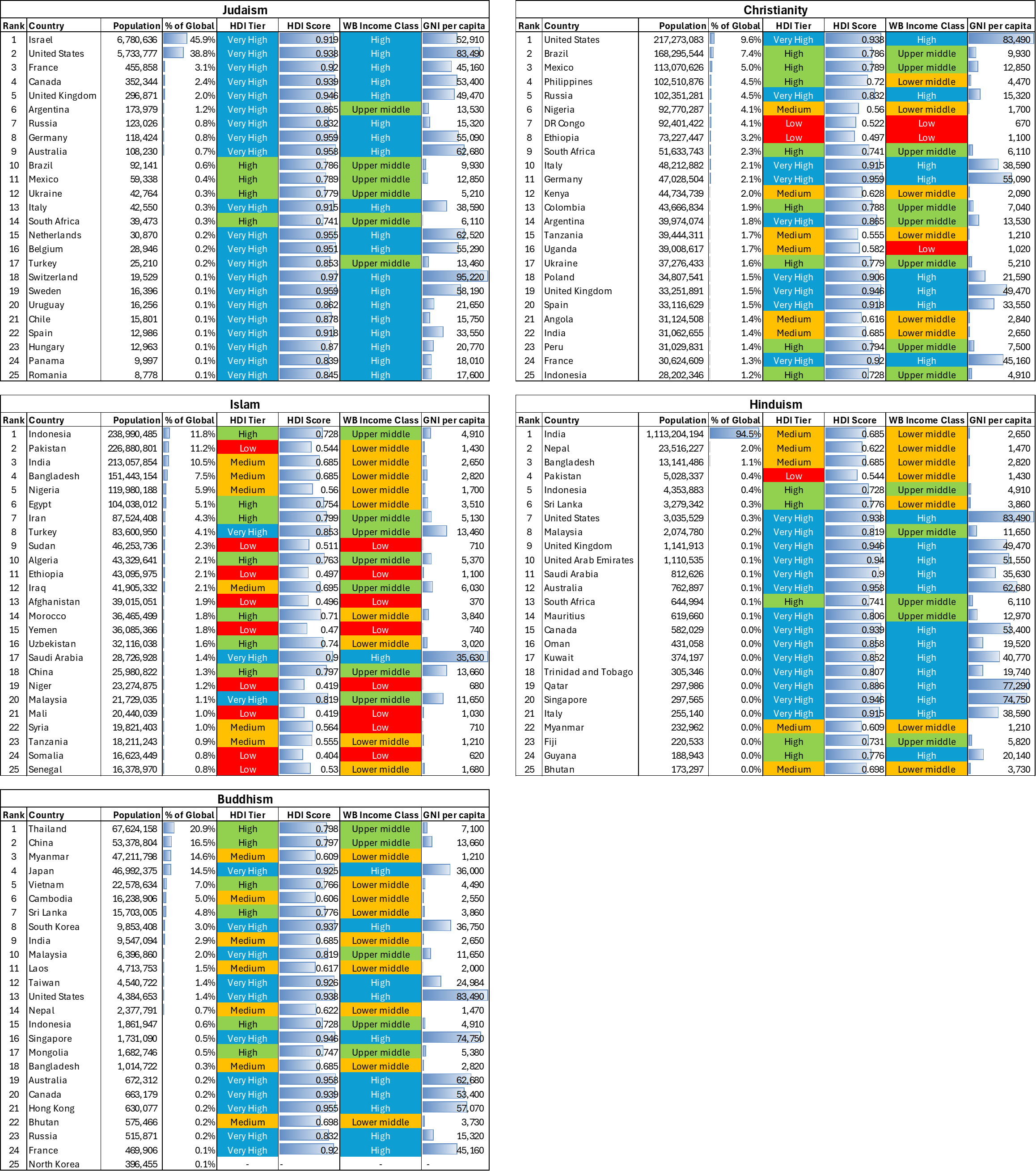
All top 5 countries with significant Jewish populations are ‘high-income nations’ with a very high ‘Human Development Index’ by the standards of the World Bank, IMF and OECD.
Within these countries, Jews consistently rank towards the top in living standards including income and education.
Global socioeconomic snapshot
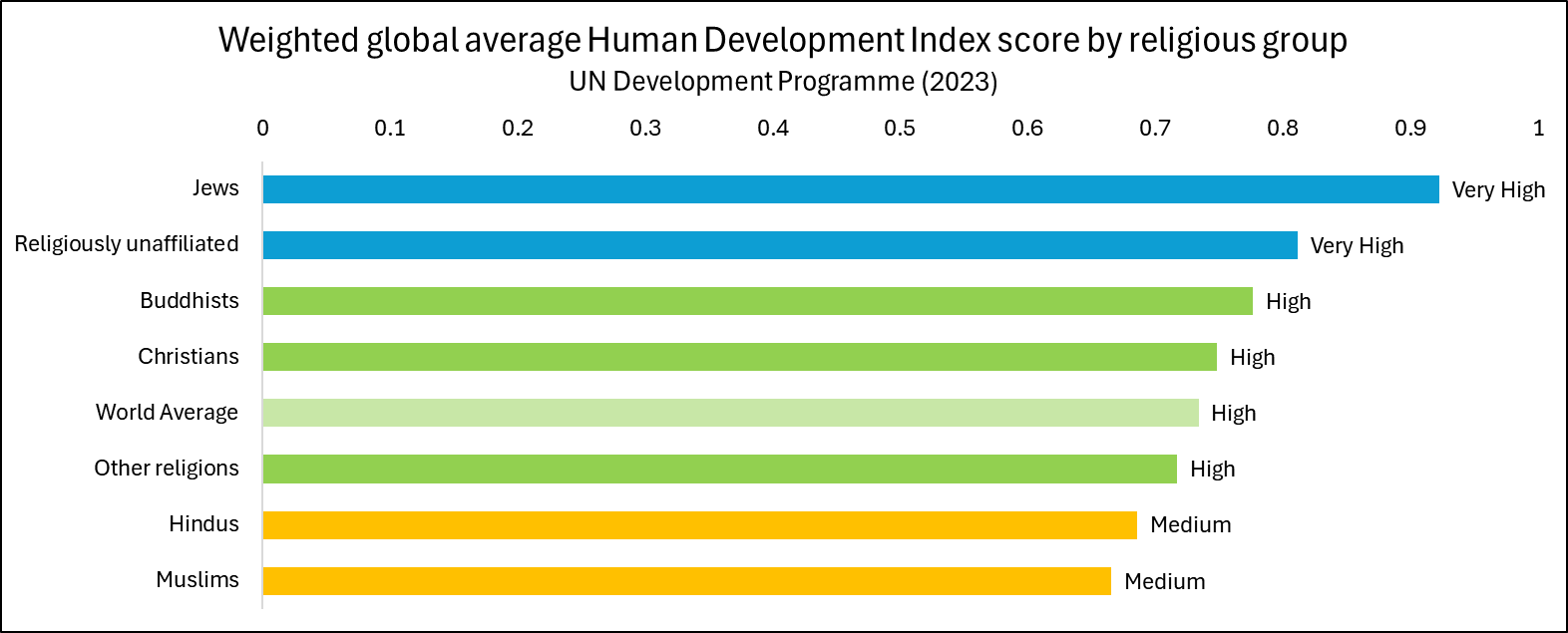
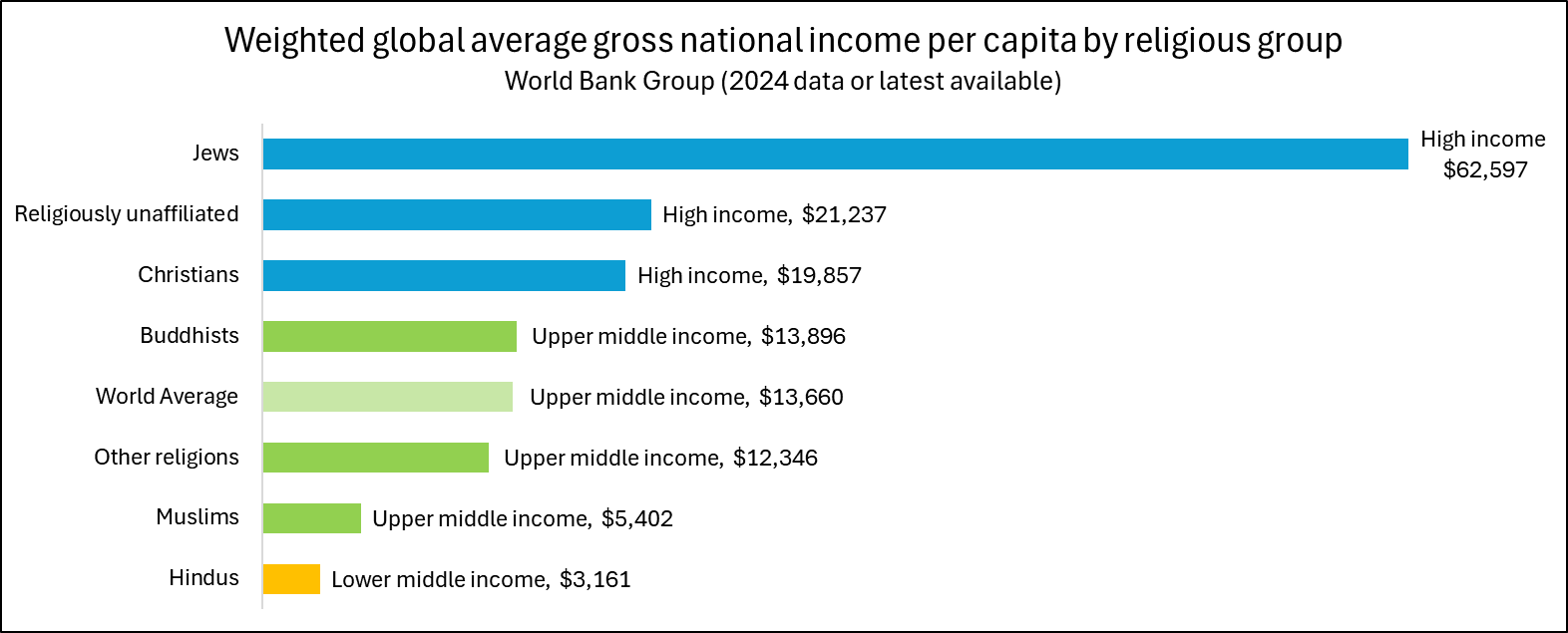
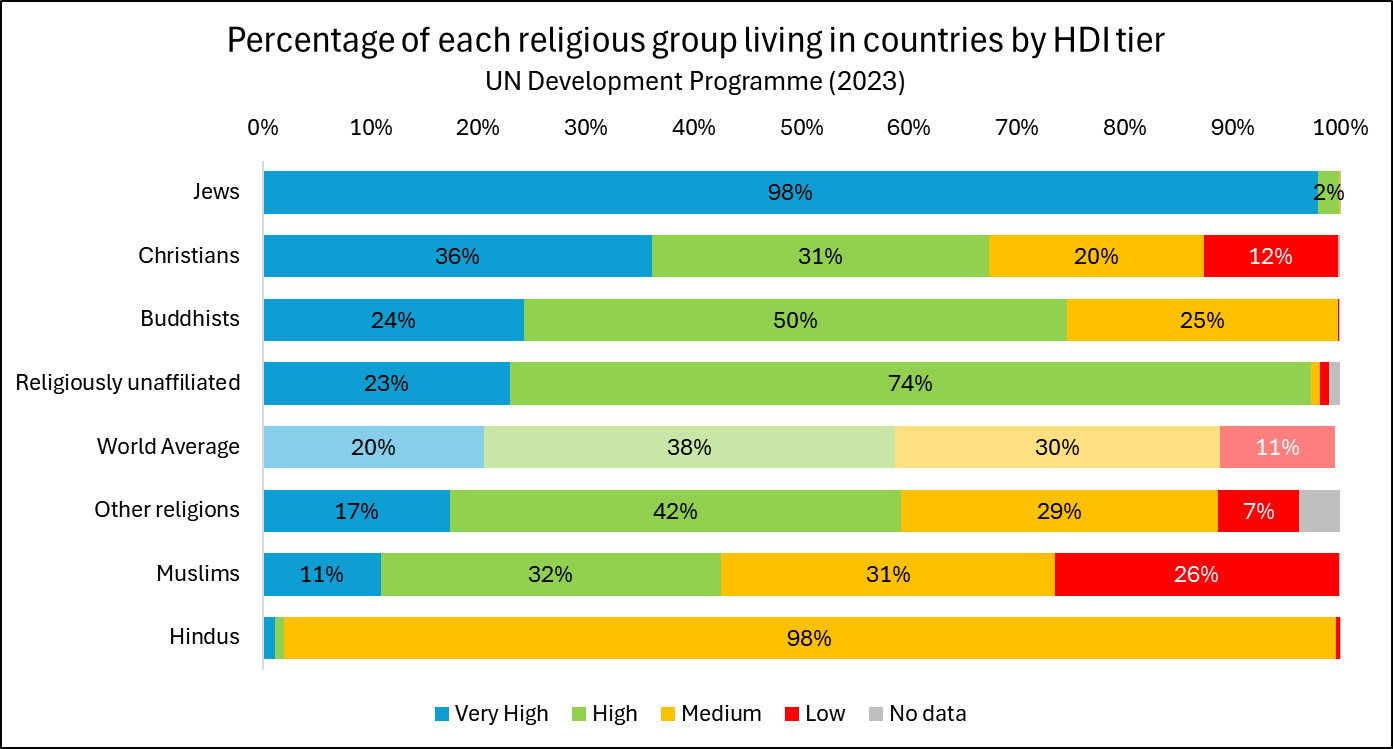
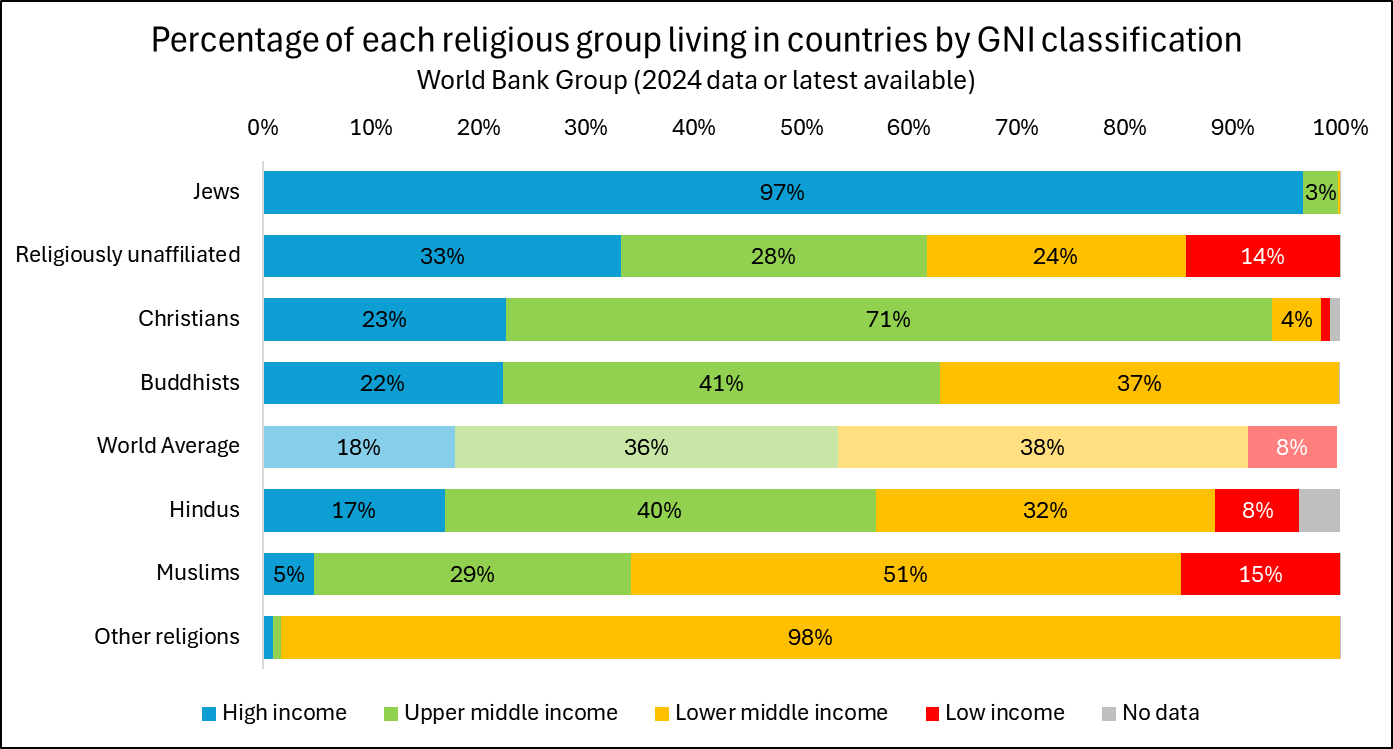
The following analysis combines latest available global data to compare socioeconomic indicators across religious demographics and provide a rough global snapshot. Data includes:
Religious composition by country (Pew Research Center, 2020)
Human Development Index (HDI) (UN Development Programme, 2023)
Gross National Income (GNI) per capita (World Bank Group, 2024 or latest)
The religious composition data, which includes the populations of each religious group per country, was used to calculate the weighted averages:
Pi = Population of religious group in each country
Xi = HDI or GNI of each country
The following findings can be drawn from the data:
Jews reside in countries with the highest average HDI score, 14% higher than the next-ranking group, ‘religiously unaffiliated.’
Jews have by far the highest average GNI per capita, which is three times greater than that of the next group, ‘religiously unaffiliated.’
Nearly all Jews (98%) live in countries classified as “Very High” on the HDI scale. The next highest group, Christians, stands at 36%.
Nearly all Jews (97%) live in countries classified as “High income” by GNI.
The next highest group, ‘religiously unaffiliated’, stands at 33%.
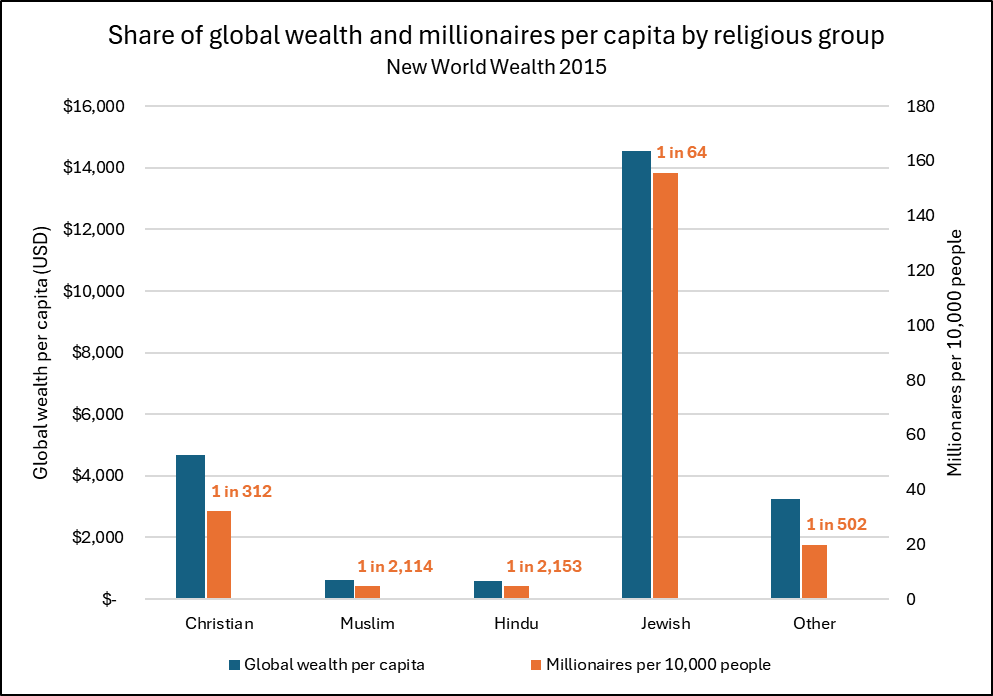
According to a study from 2015 by New World Wealth, although Christians hold the largest amount of total world wealth in total, Jews hold by far the largest amount per capita, eclipsing Christians by a factor of over 3 times. Jews also have the highest number of millionaires per capita, almost 5 times as much as Christians.
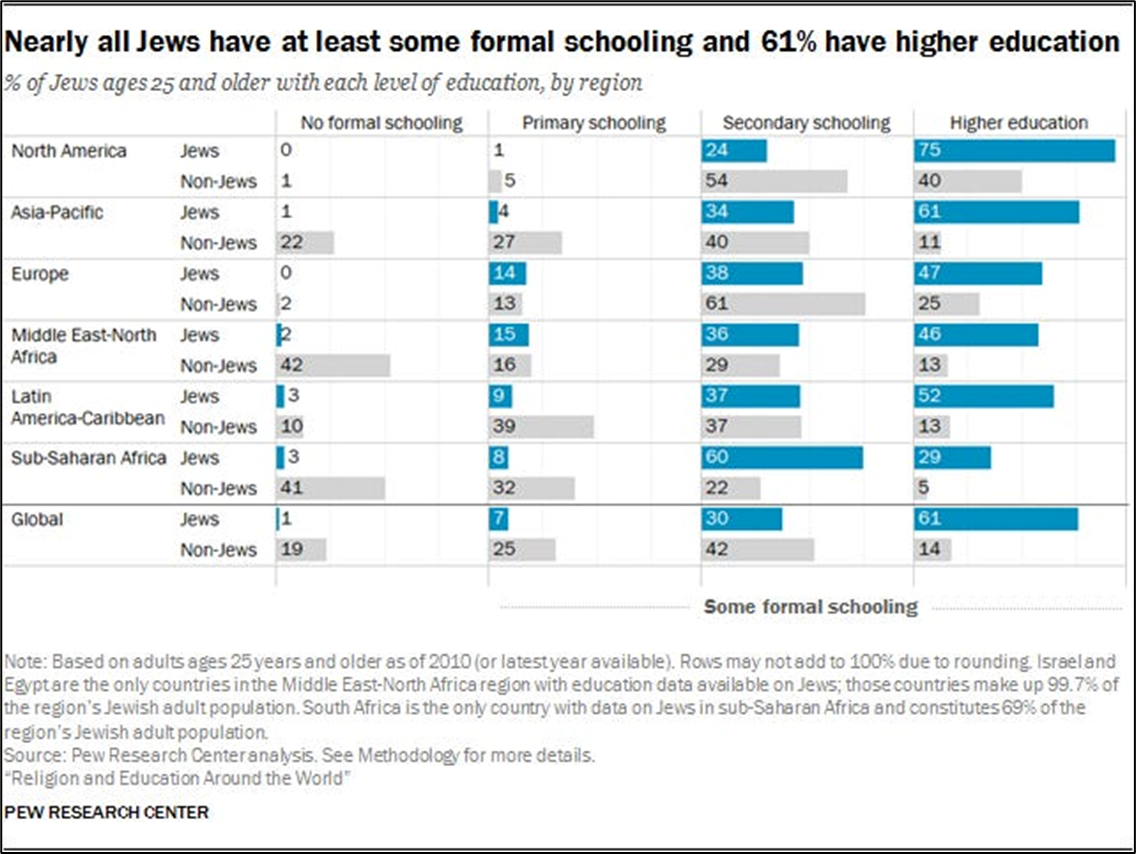
According to a Pew Research Center poll from 2016, Jews are the most highly educated of the world’s major religious groups with nearly all adults 25 and older (99%) having at least a primary education, and a majority (61%) have post-secondary degrees, which is over 4 times the global average.
Socioeconomic status in the U.S.
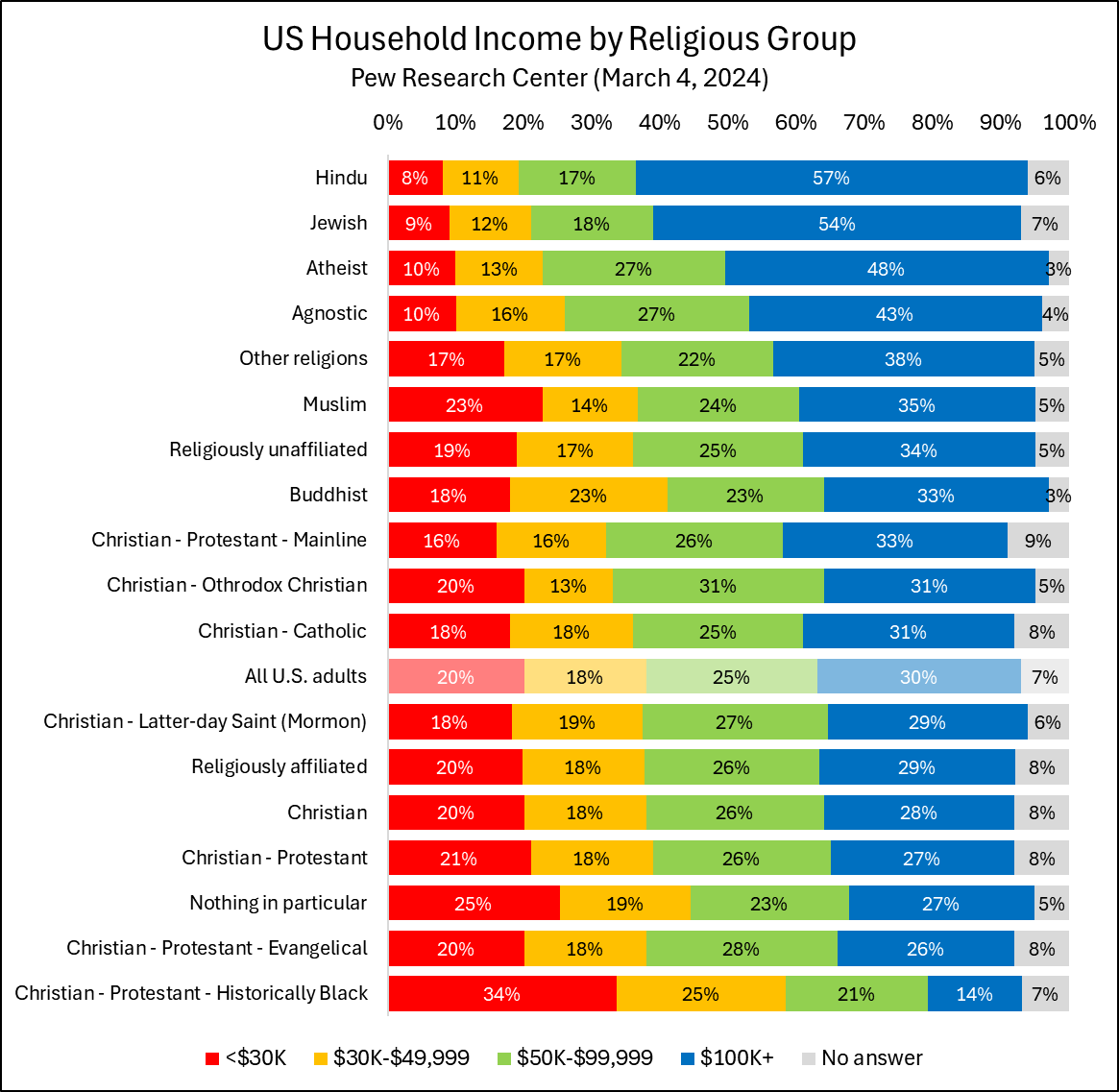
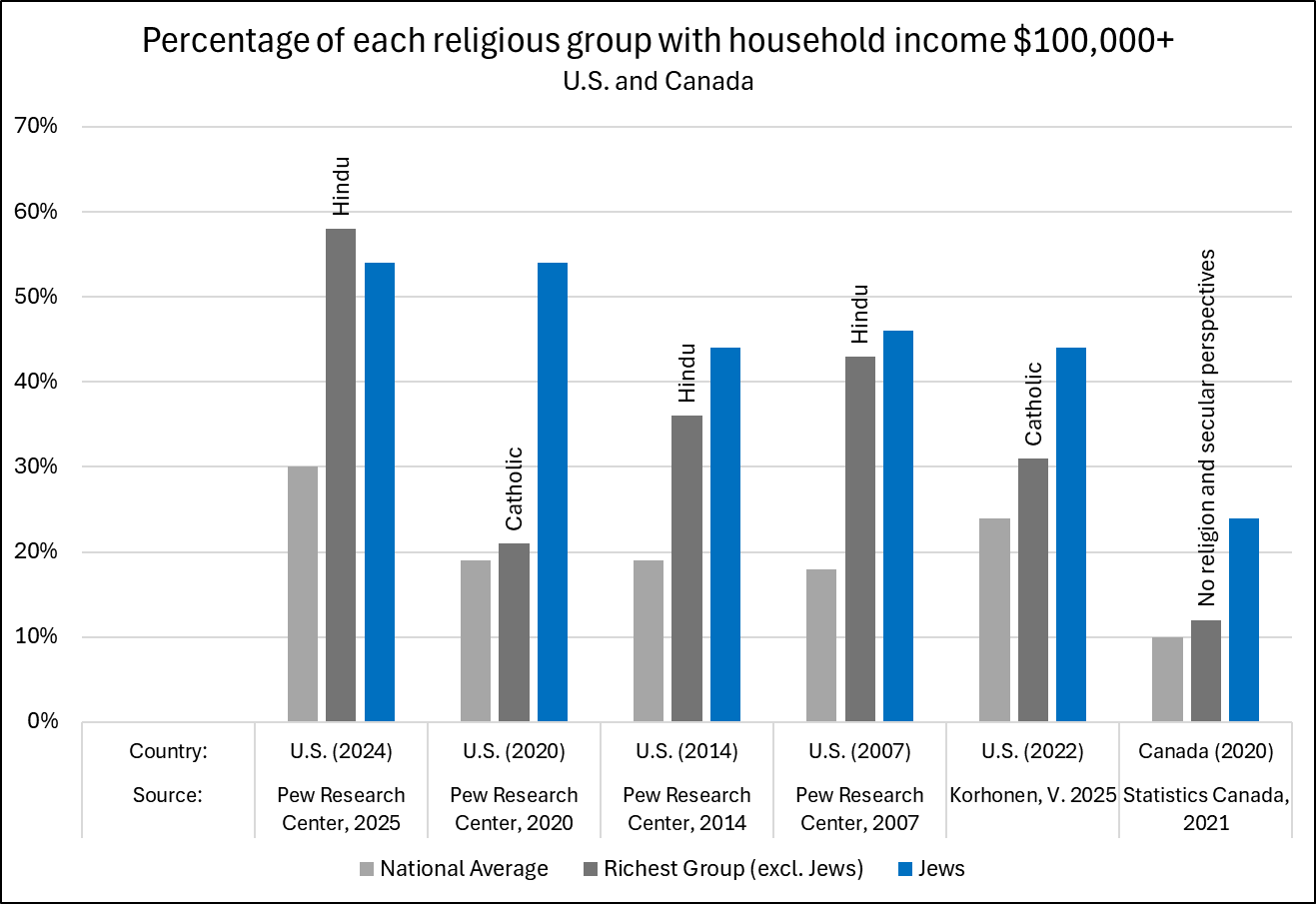
In the U.S., which holds the second largest number of Jews after Israel, according to a Pew Research Center poll conducted in 2024, 54% of American Jews report household incomes of over $100K compared to the national average of 30%, and only 9% report household incomes of under $30K compared to the national average of 20%. They are the second wealthiest demographic by religion after Hindus. Note that American Hindus make up less than 0.3% of the total world Hindu population; about 95% of Hindus live in India, while American Jews make up 40% of the total world Jewish population.
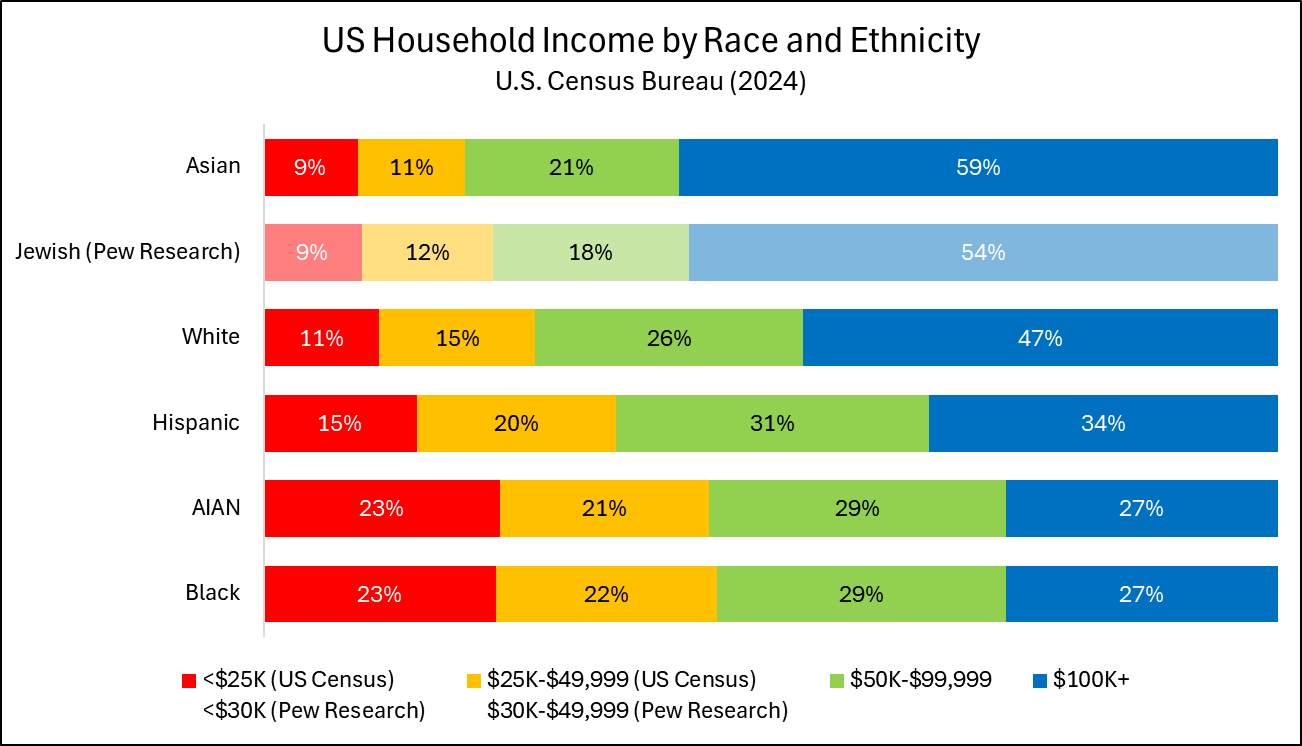
Comparing this to the breakdown of household income by race and ethnicity from the U.S. Census Bureau data from 2024 shows that Jewish households are still better off than White households which 47% of report household incomes of over $100K. It should be noted once again that, although Asians are at the top similar to Hindus in the previous graph, only 0.5% of the world’s Asians live in the U.S. compared to 40% of the total world Jewish population.
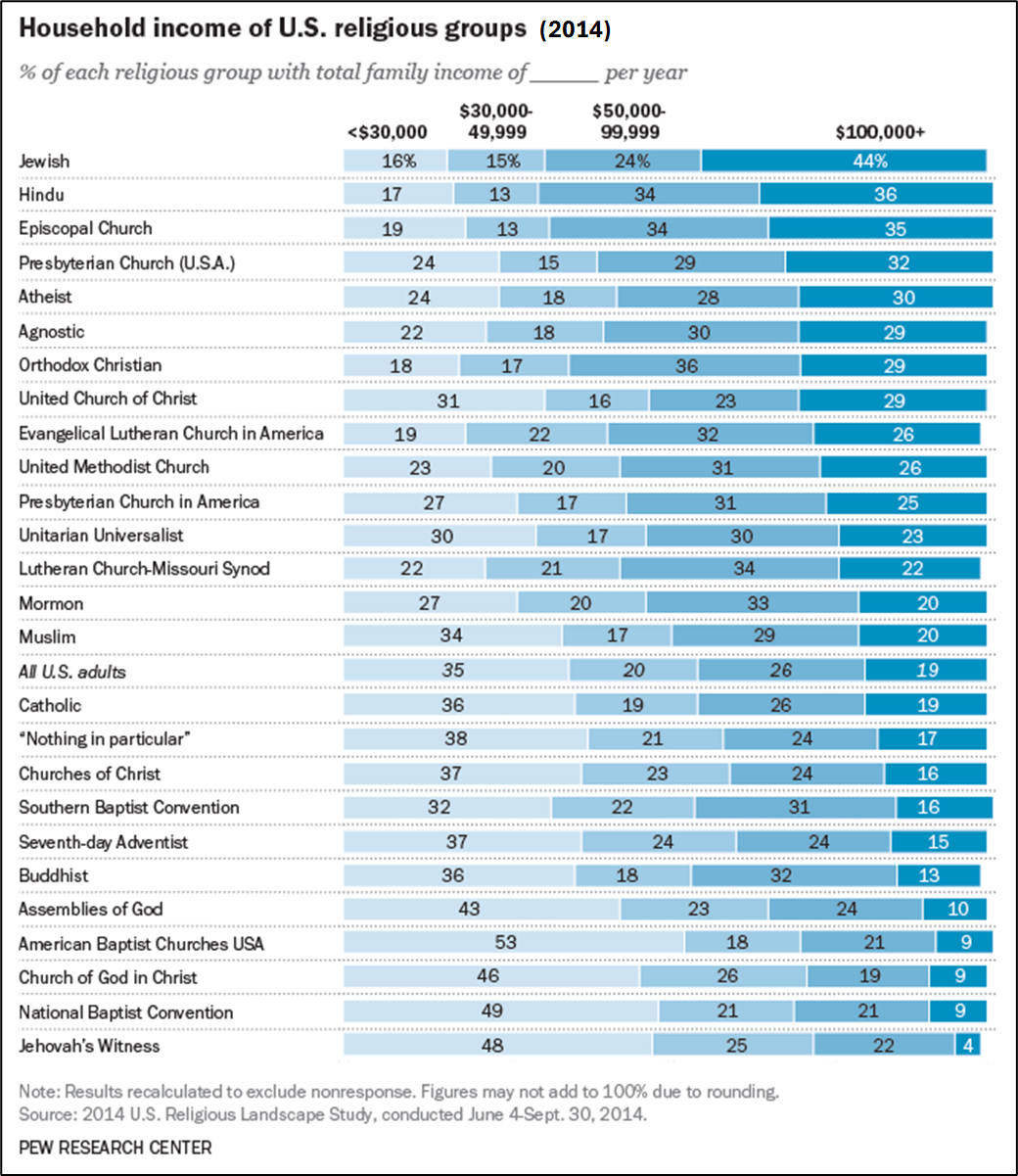
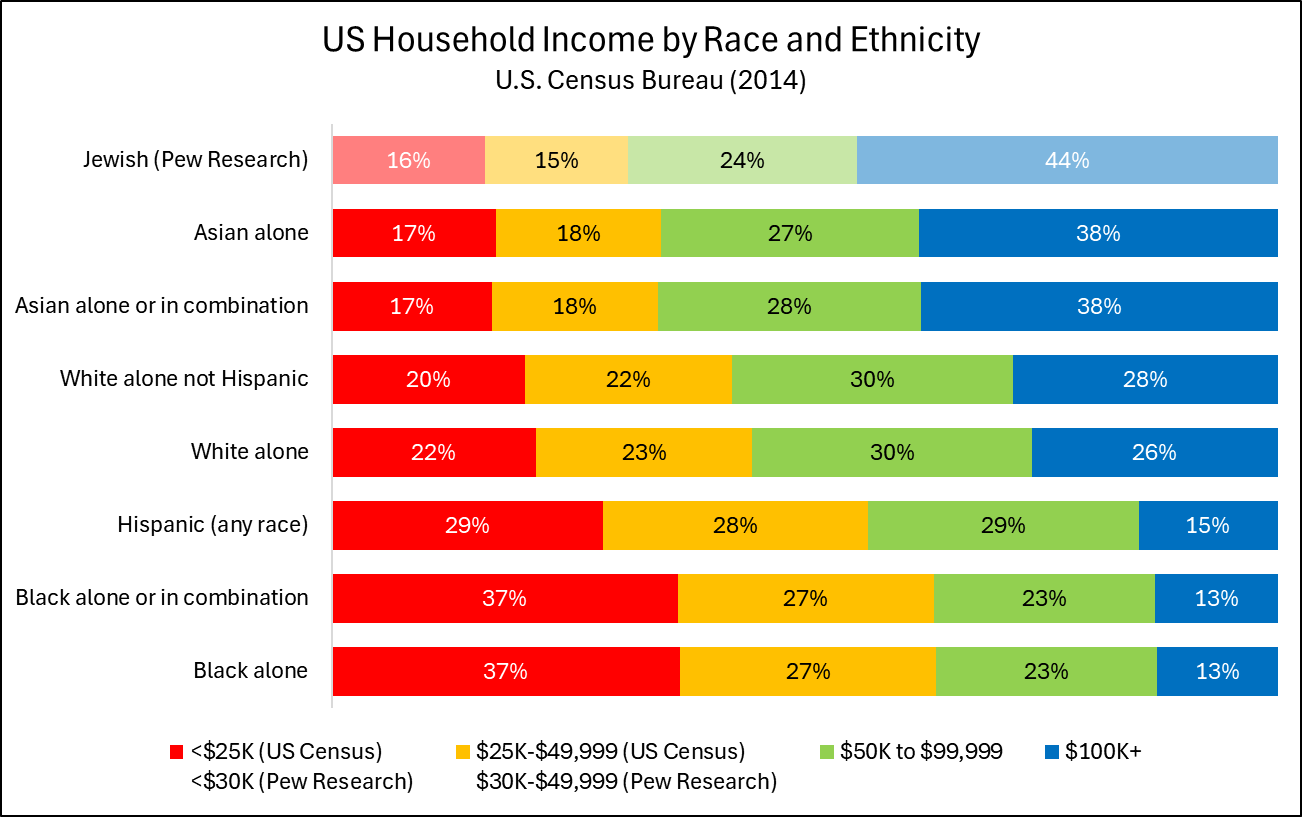
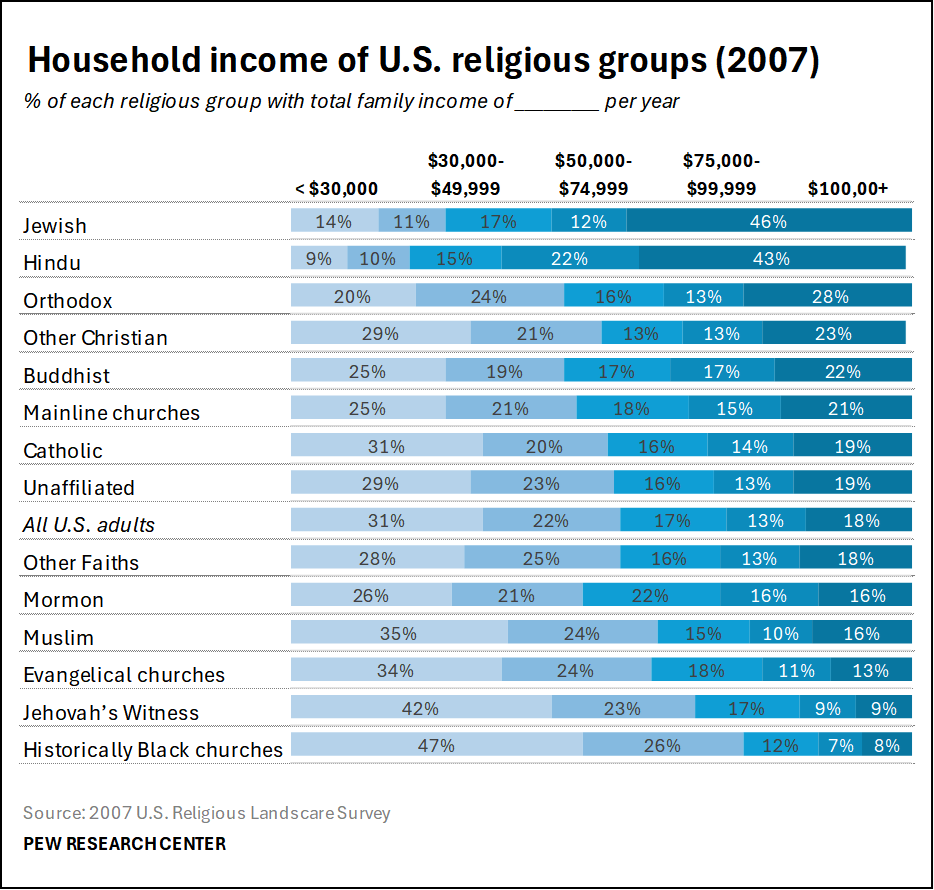
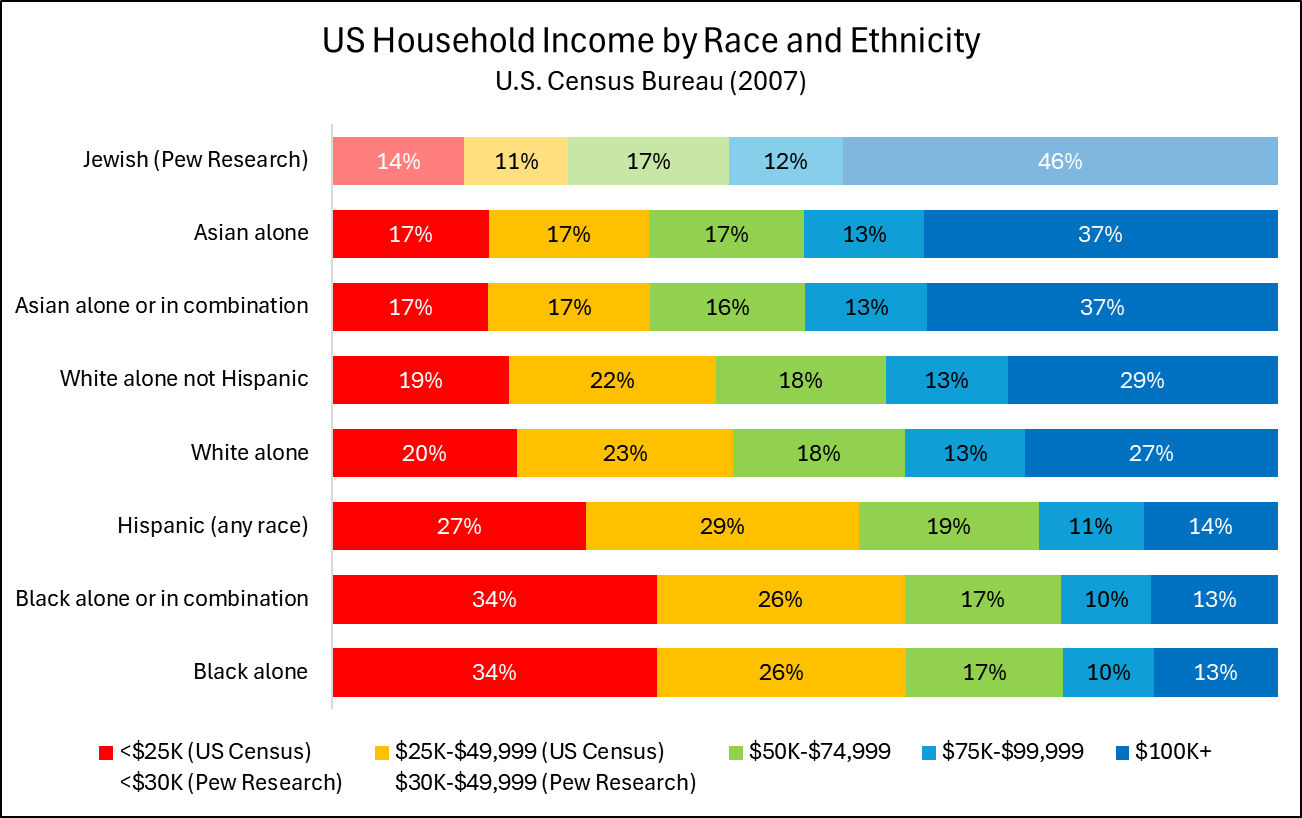
Previous surveys conducted by Pew Research Center in 2014 and 2007 show very consistent results with Jewish and Hindu Americans consistently sitting in the top two positions, with 44-46% of American Jews reporting family incomes of over $100K per year. Cross-checking this against the U.S. Census Bureau data of household income by race and ethnicity also shows consistency with Jewish households sitting firmly at the top ahead of Asian and White households.
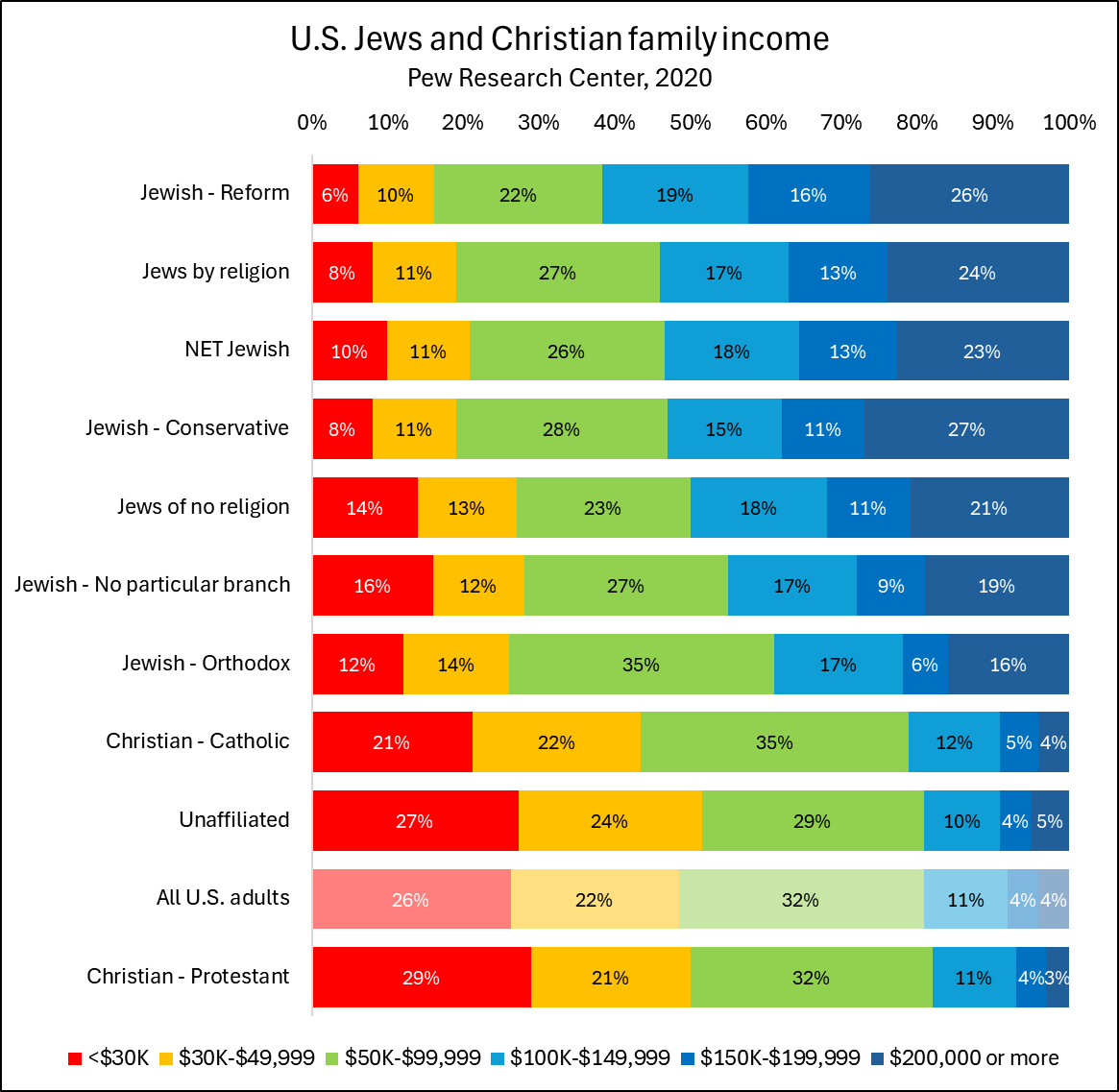
According to another Pew Research Center poll conducted in 2020, this wealth disparity is true across all branches of Jewish Americans, with all branches of Jews surveyed—Reform, Conservative, Orthodox, and no particular branch—reporting family incomes significantly higher than the U.S. average. Even among Orthodox Jews, the ‘poorest’ branch of American Jews, 39% report household incomes of over $100K, compared to the national average of 19%. It should be noted that according to the same study, Orthodox Jews make up only 9% of U.S. Jews, whereas Reform Jews, the wealthiest sub-group, make up 37%.
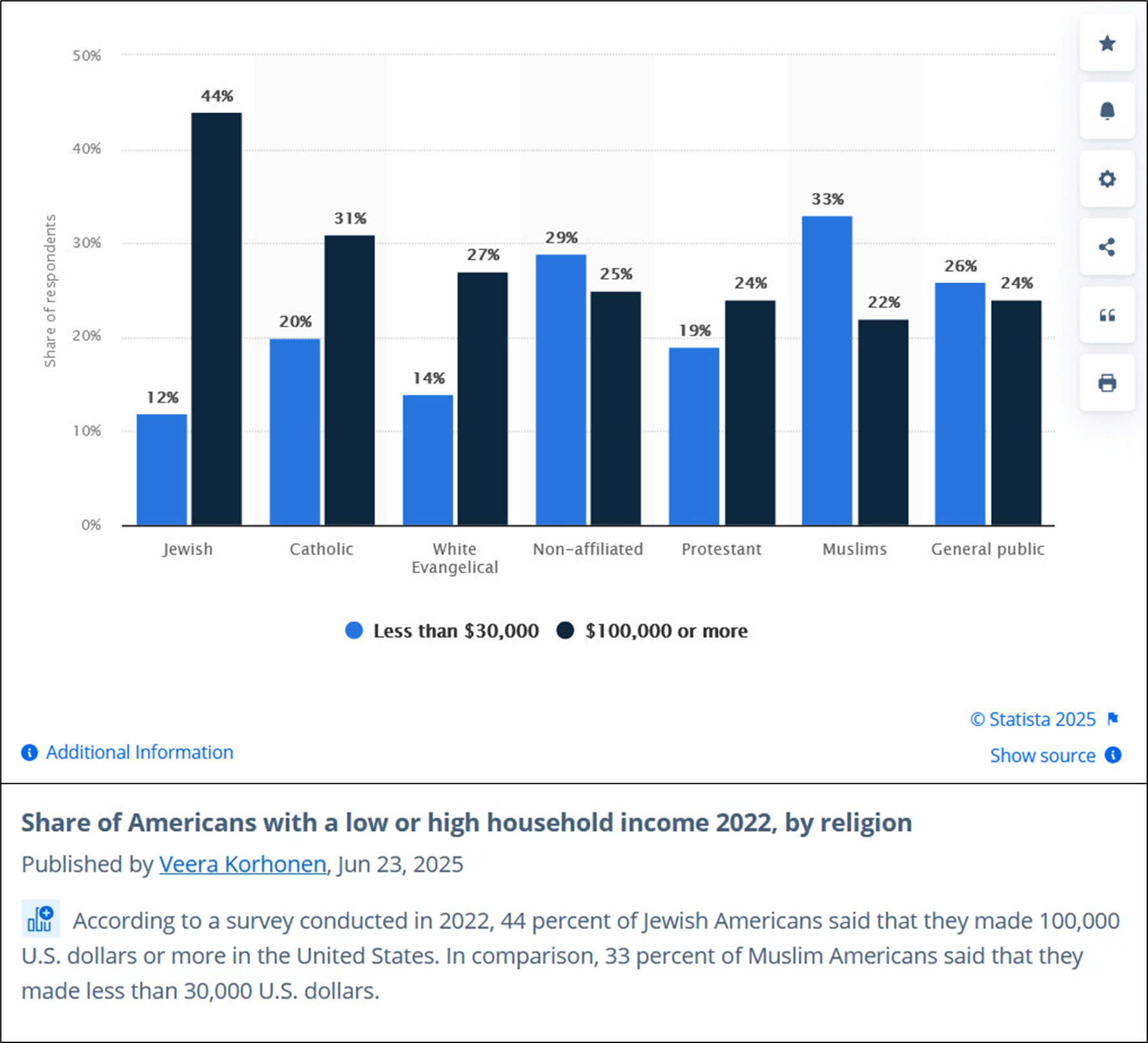
A survey from 2022 for household income by religion in the U.S. showed similar results with 44% of Jewish Americans making over $100K compared to the national average of 24%, the largest of any group by a margin of 13%.
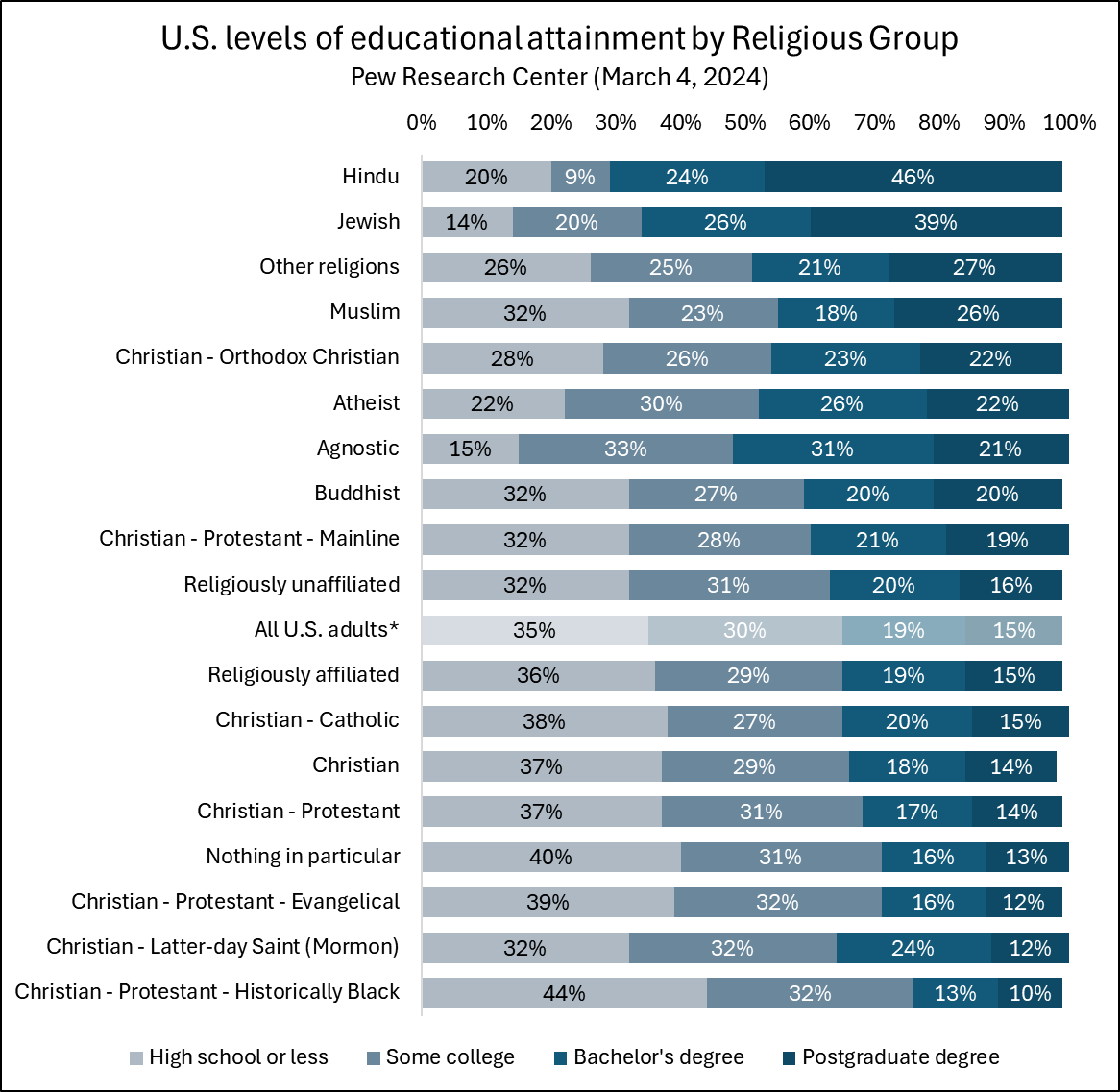
According to the 2024 Pew Research Center poll, American Jews are on average the second most highly educated religious group after Hindus with roughly two-thirds of Jews having a bachelor’s degree or higher compared to the national average of one-third. They are also the group with the least percentage of people with an educational attainment level of only ‘high school or less.’
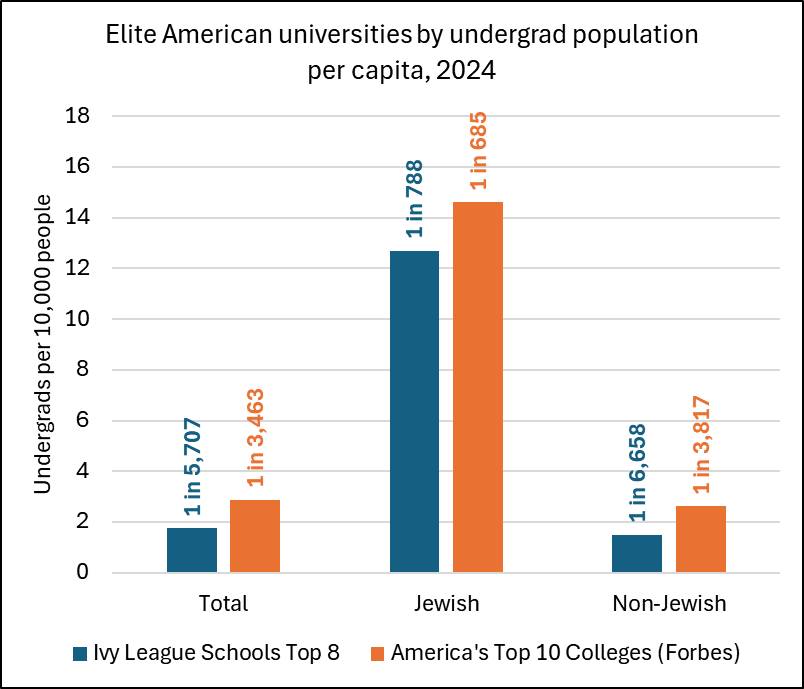
As aggregated by Hillel College Guide Magazine, the eight Ivy League Schools, which are considered some of the most prestigious and well-funded universities in the world, collectively have about 16% Jewish undergraduates as of 2024 (lowest being 9%; highest 24%). Forbes “America’s Top Colleges” of 2024 collectively have about 11% Jewish undergraduates (lowest 4%; highest 23%). These figures are significantly higher proportions than the total proportion of American Jewish population of 2.4% and eclipses the non-Jewish undergraduate population by a factor of 6 to 9 times per capita. In simpler terms, this roughly breaks down to:
1 in every 3,500-5,700 American enrolled in an elite college
1 in every 3,800-6,700 non-Jewish American enrolled in an elite college
1 in every 700-800 American Jew enrolled in an elite college
Socioeconomic status in the UK, Canada, France and elsewhere
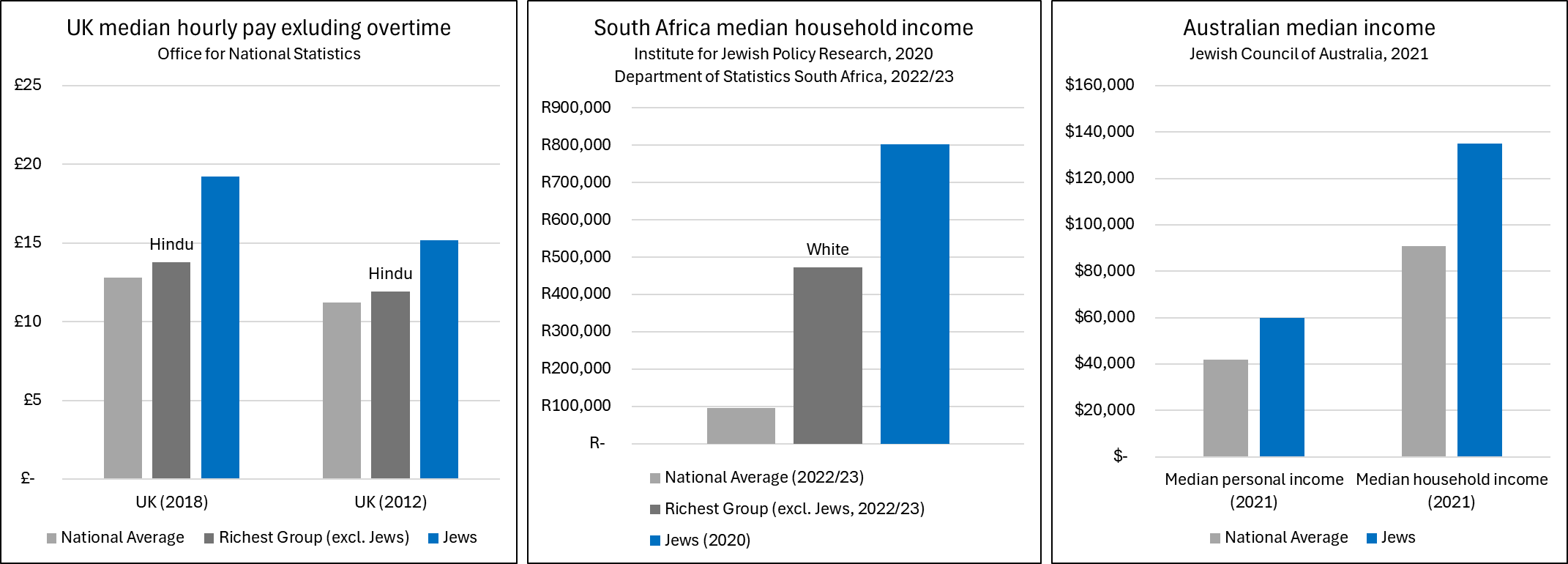
Similar trends appear in the UK and Canada. Based on the latest UK government census data for 2018, Jews had:
The highest median hourly pay by a significant margin.
The highest representation in high-skill level occupations.
The highest proportion in managerial positions by a significant margin.
The second highest level of educational attainment after Hindus.
In Canada, based on data from the official government's 2021 Census of Population:
24% of Jews report household incomes of over $100K, compared to the national average of 10%, the highest of any other group by a factor of 2 times.
53% of Jews have attained a Bachelor’s degree or higher, compared to the national average of 27%, the highest of any other group.
In France, finding this type of data is much harder as French law prohibits the collection of any data based on race, ethnicity or religion. However, in a survey conducted in 2015 by the French Institute of Public Opinion (IFOP), results showed:
French Jews were more likely to report managing easily with their income (31%) than the general French population (17%).
Fewer Jewish respondents reported financial difficulty (28% vs 37% of the general population).
An article by JFeed estimates that around 65%-70% of Jewish children in France attend private education, whether Jewish or non-Jewish schools, compared to only 20% across the general French population.
In Australia, a study of 2021 census data by the Jewish Council of Australia (JCA) showed that Australian Jews have a median household income 49% higher than the rest of the population.
The disparity between Jews and other demographics is particularly stark when looking at Global South nations. A 2020 survey by the Institute for Jewish Policy Research found that the median household income of South African Jews was R803,000. For comparison, South Africa’s Income & Expenditure Survey (2022/23) reports a national median household income of R95,770, meaning Jewish households earned over eight times the national median. The figure is also significantly higher than the median income of white households (R472,788) and almost ten times that of black African households (R81,290).
Negligible hiring discrimination
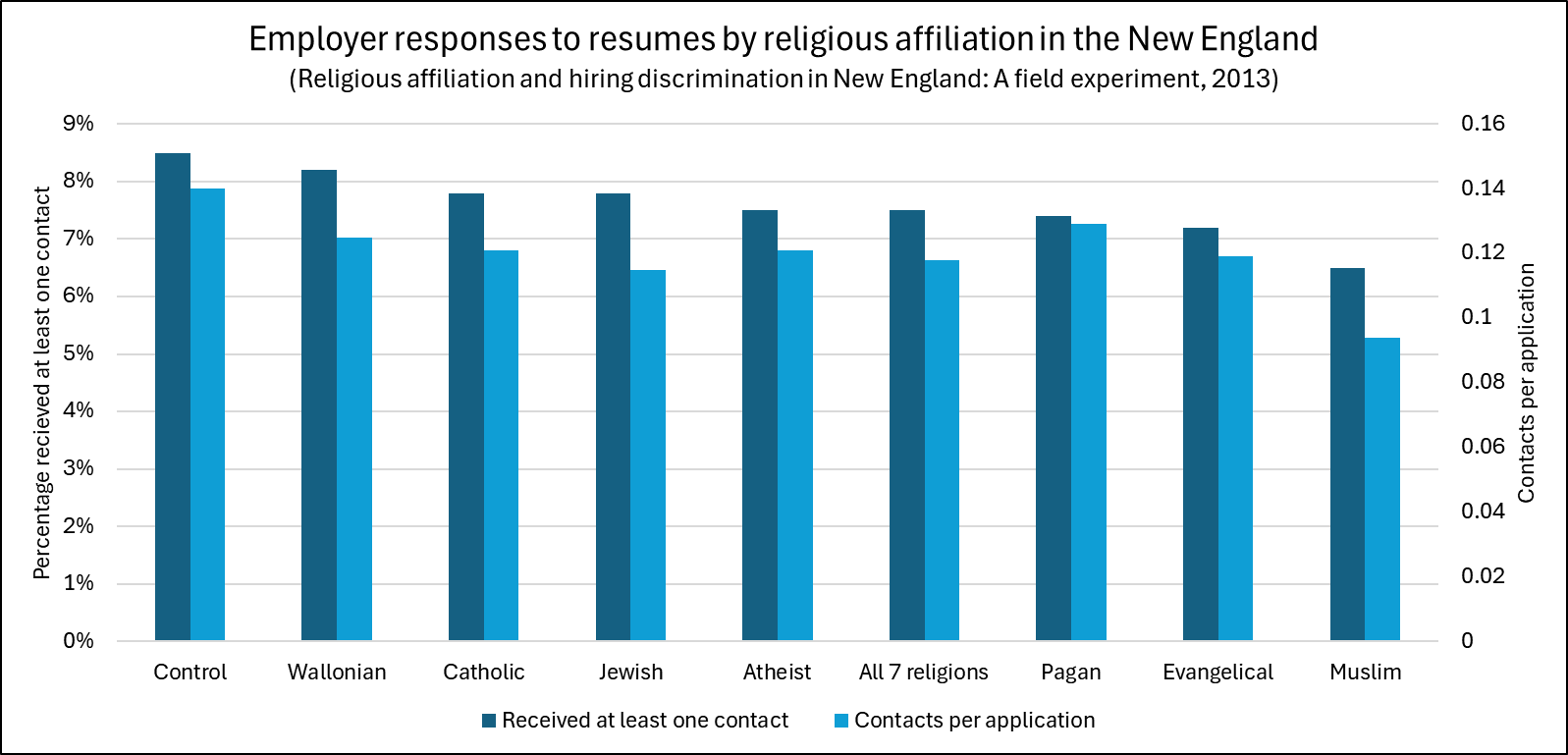
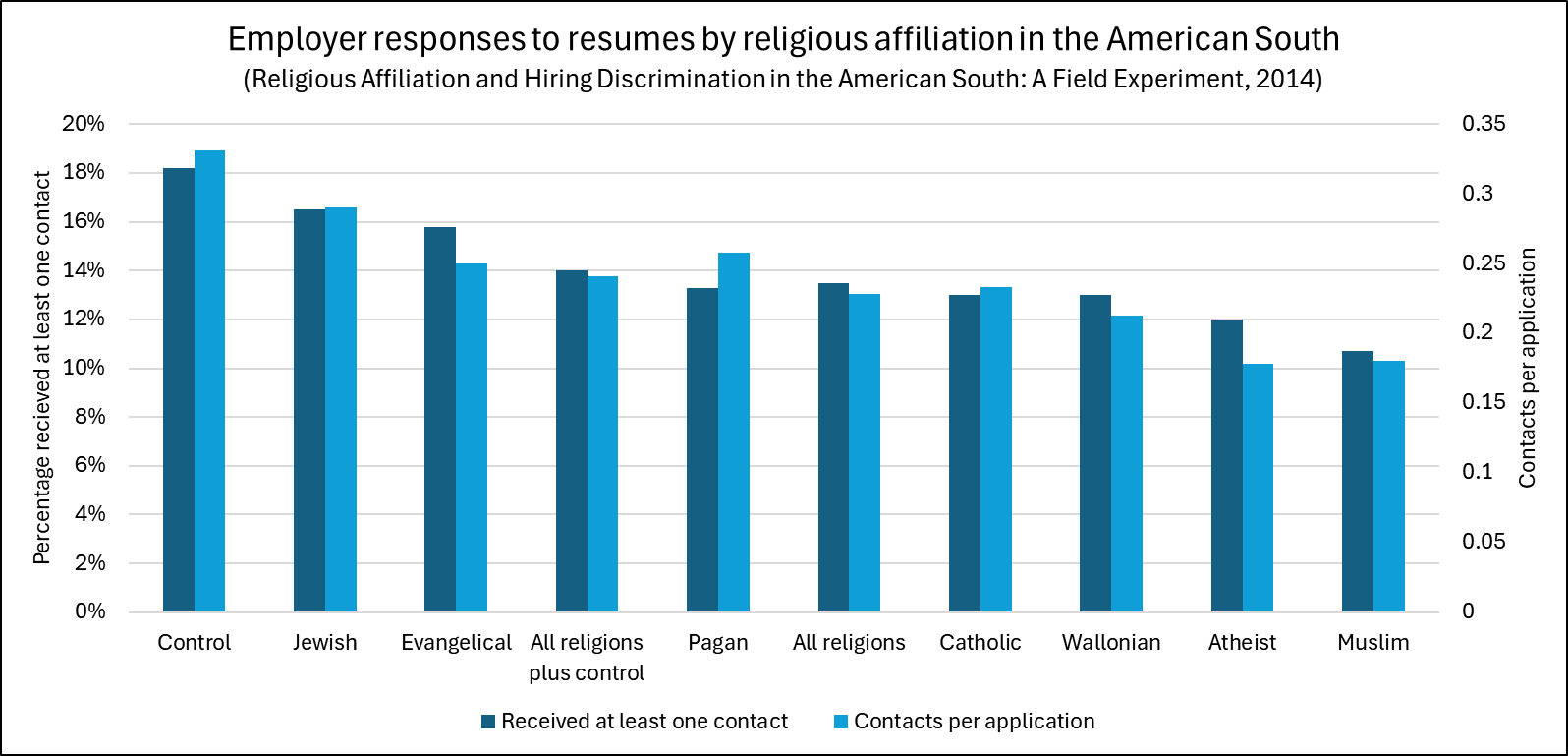
In 2013 and 2014, researchers at the University of Connecticut conducted two large field experiments examining the effect of religious affiliation on hiring discrimination in the United States. The studies, carried out in New England and the American South, involved sending thousands of fictitious resumes to real job advertisements with otherwise identical qualifications but different religious signals, including Jewish, Muslim, Christian, atheist and “Wallonian” (a fictitious religion) affiliations, as well as a control group with no religious affiliation listed. Across both studies, applicants identifying with any religion generally received fewer responses than applicants who listed no religious affiliation, with religious identifiers overall being about 24–26% less likely to receive phone calls from employers.
In both studies, Jewish applicants showed “little-to-no evidence of receiving discrimination,” with researchers describing Jews as having “escaped totally unscathed” by the broader pattern of religious penalties. By contrast, Muslim applicants consistently experienced some of the strongest negative effects. In the New England study, Muslim applicants were 38% less likely to receive a phone call than the non-religious control group (3.4% versus 5.5%), received 41% fewer total phone calls, were 24% less likely to receive any contact from employers, and received 33% fewer total contacts overall. Similar patterns appeared in the Southern study, where Muslims again experienced among the highest levels of hiring discrimination, while Jewish applicants remained the only religious group largely unaffected by the broader reduction in employer responses.
A field experiment in France conducted between 2013 and 2014 examined religious discrimination in hiring by sending fictitious resumes of comparable Catholic, Jewish, and Muslim applicants to employers. The study found that Catholic applicants received an interview invitation after approximately five applications, Jewish applicants after about six, and Muslim applicants after roughly ten, indicating a substantially larger penalty for Muslim candidates. The results also showed that signalling a more secular (non-practicing) identity significantly improved the chances of Muslim applicants receiving callbacks, whereas no comparable effect was observed for Catholic or Jewish applicants.
Over-representation of Jews among the upper strata
On January 2025, Forbes Israel proudly published a list of the World’s Jewish Billionaires. The list includes 276 names; Forbes in 2025 recorded a total of 3,028 billionaires, equating to over 9% of all billionaires being Jews. For reference, there are 902 billionaires from the U.S. on the list, equating to about 30% of all billionaires. Comparing these numbers to their respective populations, that equates to approximately one out of every 385,000 Americans being a billionaire vs one out of every 57,000 Jews worldwide being a billionaire.
Further analyzing the data shows the extreme over-representation of Jews among billionaires particularly at the very top, with 40% of the top 5 world’s wealthiest people being Jewish; half of the top 10; almost a quarter of the top 50 and over a fifth of the top 100.
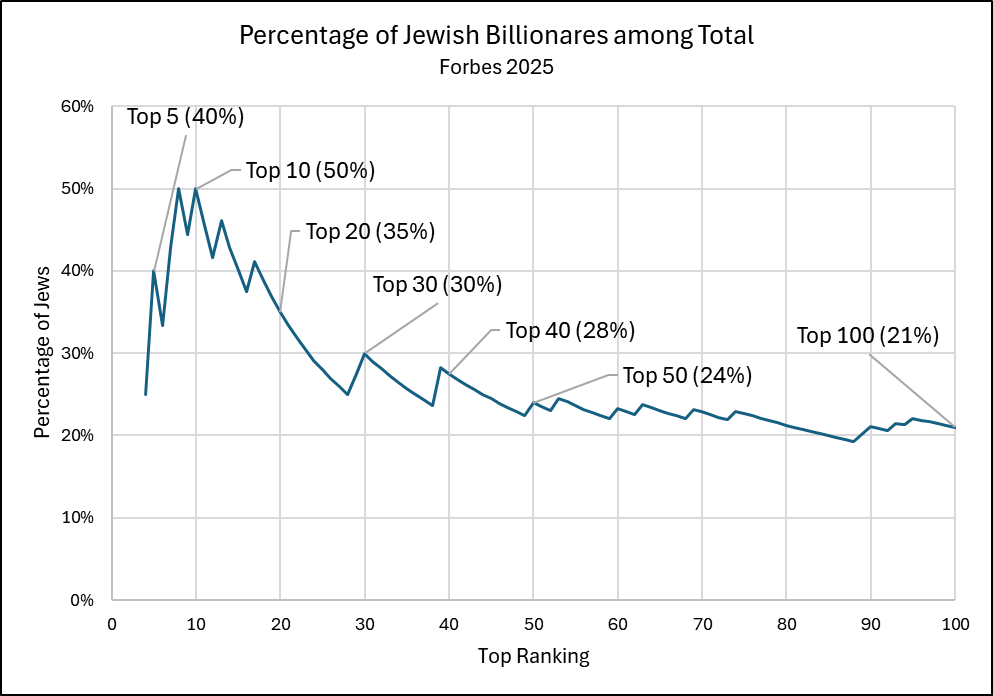
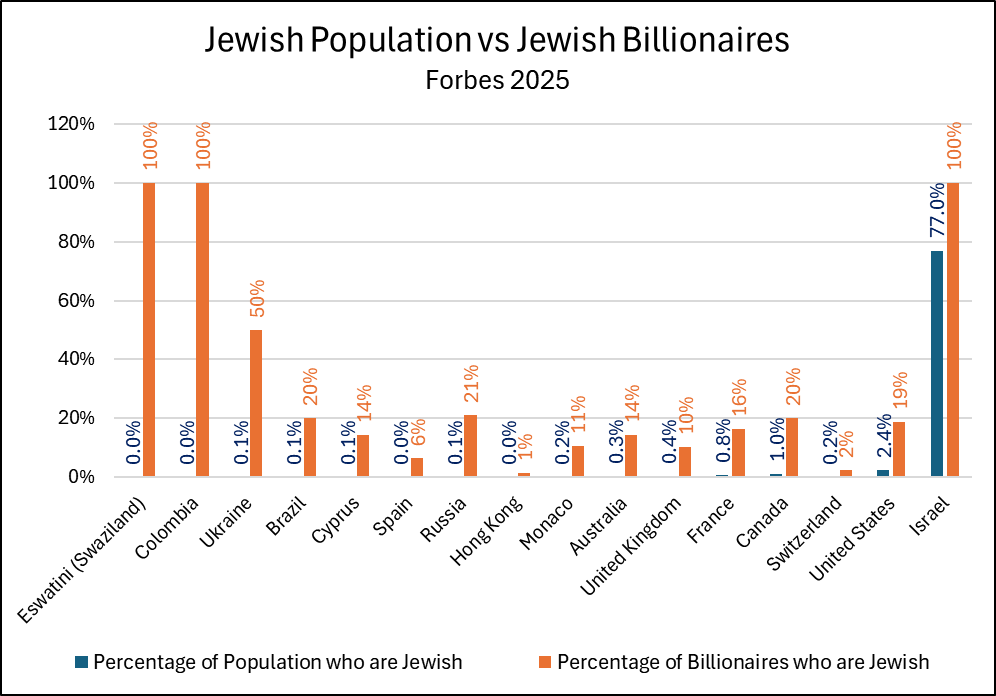
Breaking down the data by country shows the extreme disparity between the proportion of Jews in each country compared to the proportion of Jews among the billionaires of each country. Countries like Eswatini in Africa and Colombia in South America which only have one billionaire each, that billionaire happens to be a Jewish person. In countries like Ukraine, Russia, Brazil, Cyprus and Australia who have a Jewish population of less than 0.5%, between 15-50% of their billionaires are Jewish. On multiple occasions, the South African Jewish Report has openly bragged about how Jews consistently make up between 20-26% of the wealthiest individuals in South Africa despite being around 0.1% of the population.
Jewish attorneys in the U.S. represent about 15% of the lawyer population. Jewish senators in the U.S. Senate make up 9% of senators as of 2025, a higher relative representation to the country’s population than Christians or other religions and unaffiliated. Between 1901 and 2024, Jews and people of half- or three-quarters-Jewish ancestry account for 22% of Nobel Prize laureates (36% of American recipients) despite making up only 0.2% of the world’s population, with the lowest being 8% in the Peace category and highest being 40% in Economics. Other awards with a high representation of Jewish award holders include:
Japan’s Kyoto Prize: 24% of recipients are Jewish
US National Medal of Science: 38% of recipients are Jewish
Grande Médaille of the French Academy of Sciences: 48% of recipients are Jewish
Foreign Membership in the British Royal Society: 25% of total members are Jewish
In a paper published in 2007 by Richard Lynn of the University of Ulster and Satoshi Kanazawa of the London School of Economics titled How to explain high Jewish achievement: The role of intelligence and values, the following was summarized regarding Jewish over-representation among elites even going back to the early 20th century:
Jews have been greatly over-represented among intellectual elites, in the professions, the universities, among business leaders and the very rich in 20th century. Weyl and Possony (1963, p. 142) calculated that in the period 1901–1962 16% of Nobel prize-winners for science were Jewish. They estimated the world population of Jews in 1938 at 18 million and the world population of European gentiles at 718 million, and calculated that Jews were over-represented by a factor of approximately 6.6. Jews have been about half of the world’s top rated chess grandmasters between 1851 and 2000 (Rubinstein, 2004) and of the champion American bridge players and theoreticians (Storfer, 1990).
In the 20th century, Jews have been greatly over-represented in a number of countries among intellectual elites and in the higher socio-economic status occupations. In Austria in the years between the two World Wars Jews were approximately 3.5% of the population but were 27.3% of university professors (Fraenkel, 1967). In Germany between 1918 and 1933 Jews were 0.78% of the population but were 16% of the doctors, 15% of the dentists, 25% of the lawyers, 50% of the theatre directors and occupied 80% of the leading positions in the Berlin stock exchange (Gordon, 1984, Slezkine, 2004). In Poland in 1931 Jews were 10.2% of the population but were 56% of the doctors in private practice, 33% of the lawyers, and 24% of the pharmacists (Slezkine, 2004). In Russia during the period 1917–1939 Jews were approximately 1.8% of the population, while Jews were 9% of the officers in military academies, 15% of the university graduates, 11% of the doctors and 14% of the university professors (Slezkine, 2004).
In Britain, the numbers of Jews and gentiles possessing large wealth in the period from 1809–1939 have been examined from probate returns on death by Rubinstein (2000). He has found 199 such individuals of whom 28 were Jews (14.1%). The average number of Jews in the population during this period was approximately 0.4%, so Jews were 28.4 times over-represented among the very wealthy. Prais and Schmool (1975) calculated that 10% of Jews and 4% of gentiles were in the higher professions in 1961, and hence Jews were over-represented by a factor of 2.5. In a later study, Tropp (1991) examined the numbers and proportions of Jews in eleven of the major professions around 1985. He found that the percentage of Jews ranged from 1.3% among chartered surveyors to 7.8 among opthalmic opticians. At this time there were approximately 322,000 Jews in the United Kingdom in the total population of 56,379,000 (the figure in the 1981 census). Thus, in 1985 Jews were approximately 0.6% of the population. Even among chartered surveyors Jews were over-represented by a factor of 2.2, while among opthalmic opticians Jews were over-represented by a factor of 13.0.
Finally, the largest population of Jews outside Israel in the 20th century has been in the United States and here also Jews have done well. As early as 1908 Jews began to outperform gentiles in the entrance tests for universities that were first constructed by the College Entrance Examination Board in 1899. Increasing numbers were gaining admission to the Ivy League colleges. In 1908 the percentages of Jews in all colleges and at Harvard were 7% and 6%, respectively, and by 1919 this had increased to 20% of the students at Harvard and about the same figure at Yale, Brown and Pennsylvania, while at Columbia 40% of the students were Jewish (Slezkine, 2004).
From 1957 through 1990 the average annual earnings of Jewish men were about 130% of those of white gentiles (in 1990 $36,700 for Jews and $28,080 for white gentiles) (Chiswick, 1985, Kosmin and Lachman, 1993). By the 1990s Jews were hugely over-represented among the very wealthy, when they comprised more than a quarter of the people on the Forbes Magazine list of the richest four hundred Americans, 45% of the top 40 richest Americans, and one-third of all American multimillionaires (Silbiger, 2000).
It has been found that Jews are considerably over-represented among the eminent in the United States. Weyl (1966) calculated that Jews were over-represented by a factor of 4.48 in seven reference books of the eminent (e.g. Who’s Who in America, American Men and Women of Science, Who’s Who in Finance and Industry, etc.). In an updated analysis of Who’s Who in America for the years 1994–5, McDermott (2002) has calculated that Jews were over-represented by a factor of 16.62.
— Richard Lynn and Satoshi Kanazawa, How to explain high Jewish achievement: The role of intelligence and values (2008)
Israel: A Settler-Colonial Project by Jews, for Jews
Additionally, Jews have their own ethnostate, Israel, a settler-colonial project explicitly run by Jews, for Jews, at the expense of non-Jews, backed militarily, financially, and diplomatically by the world’s most powerful governments.
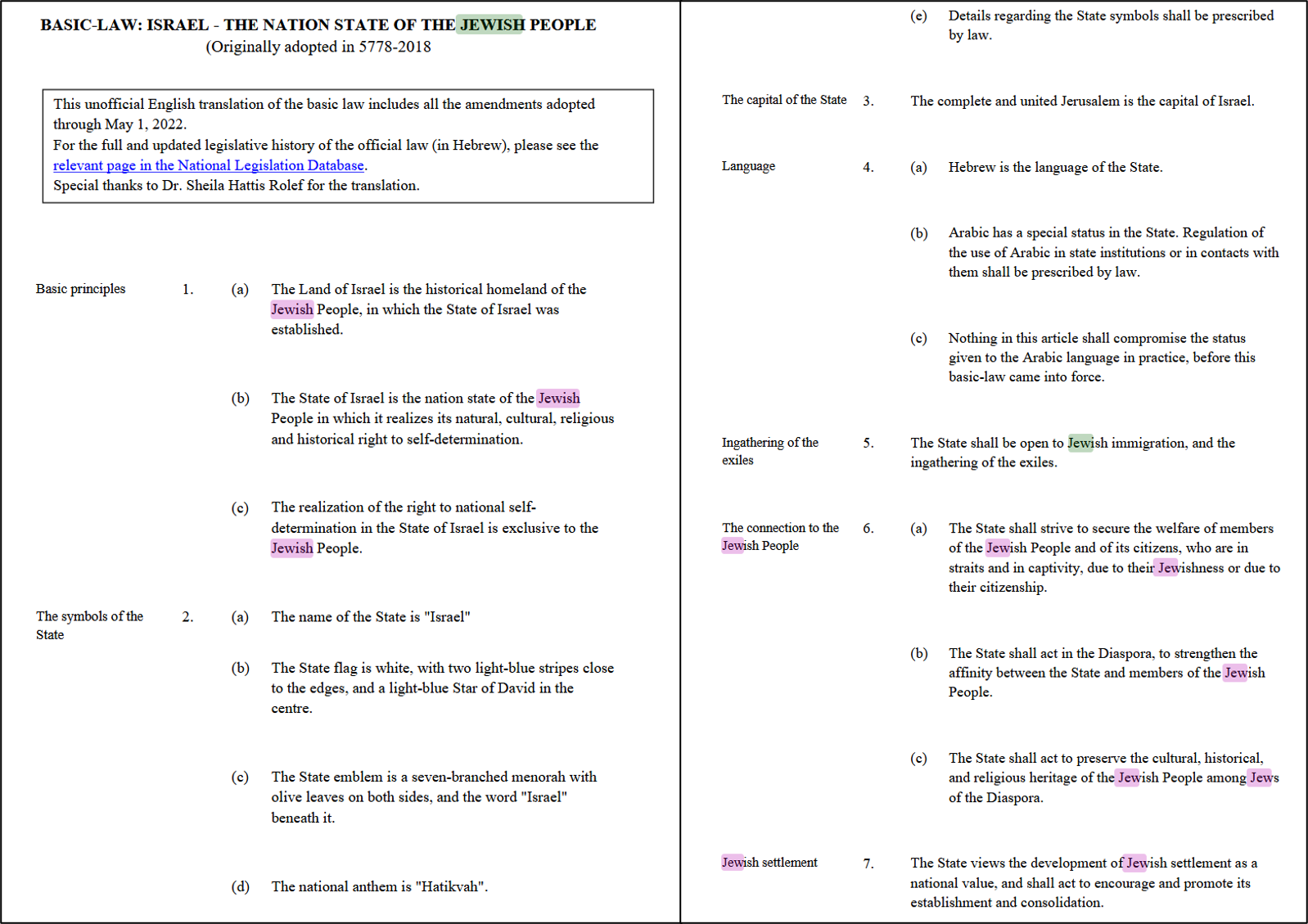
The constitution of Israel explicitly states that Israel is the “Nation-State of the Jewish People,” stating that the “right to exercise national self-determination in the State of Israel is unique to the Jewish people;” and the “state views the development of Jewish settlement as a national value and will act to encourage and promote its establishment and consolidation.”
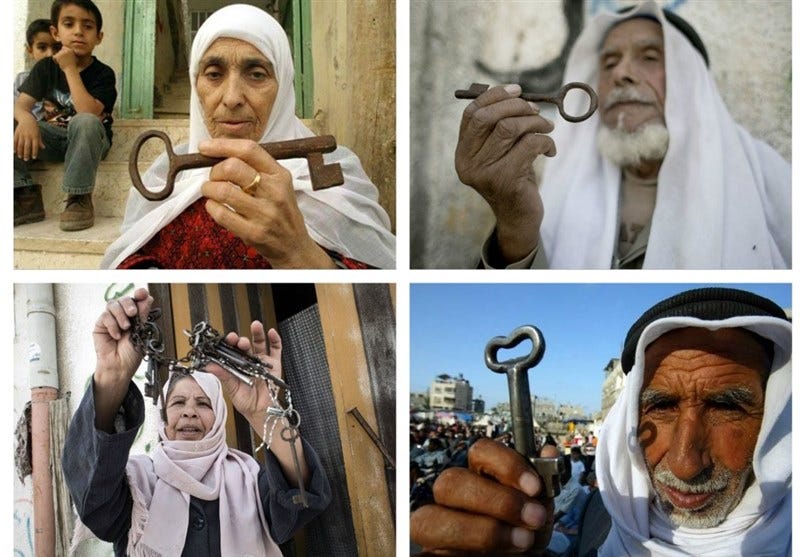
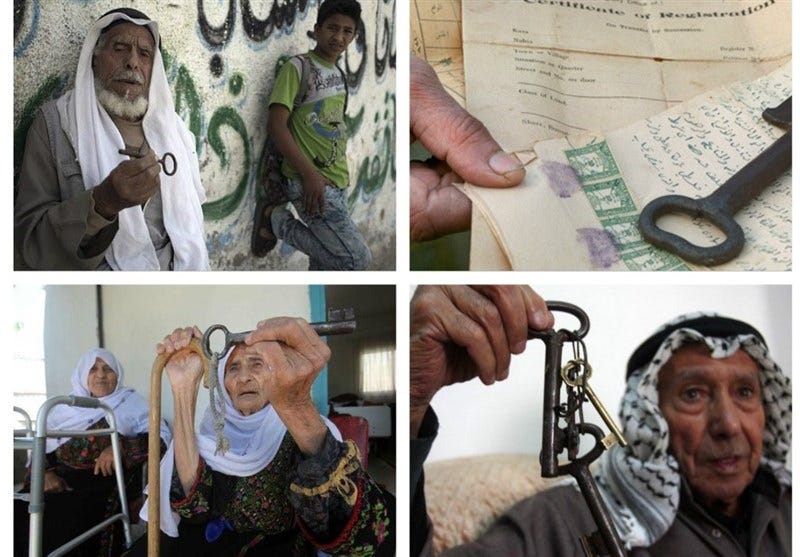
Under the Israeli Law of Return, anyone worldwide with one or more Jewish grandparent has the right to colonize Palestine, displacing indigenous Palestinians from their land and homes, while Palestinians can't return to the lands they were ethnically cleansed from, even if they literally still have the physical keys to their houses.

In a twisted turn of events, White South Africans who freshly convert from Christianity to Judaism are more than welcome by the government to come and colonize Palestinian land and steal houses and even livestock. A growing number of Afrikaners convert to Orthodox Judaism to go live in West Bank settlements; apartheid resumed without a pause. Meanwhile, Palestinian requests to convert to Judaism are automatically rejected.

This selective embrace of “new Jews” extends to an even more absurd scenario: India's Bnei Menashe, a community of about 11,000 previously Christian Indians whose tribal leader declared he was Jewish after having dreamt so. Despite no DNA evidence, a Christian past, and opposition from Israeli politicians, Israel's Chief Rabbi recognized them as a "lost tribe" in 2005. In late 2025, the government approved a five‑year plan to bring the remainder to Israel, with Prime Minister Benjamin Netanyahu calling it an “important and Zionist” decision to strengthen the Galilee region. By April 2026, the first batch of around 250 arrived under “Operation Wings of Dawn,” with thousands more expected. Footage from a 2021 batch shows them being welcomed by Israel's Immigration Absorption minister—an Ethiopian Jew.

It probably doesn’t require going into much detail, but in addition to the ability of almost any Jew from around the world to colonize Palestine, Jews in Israel enjoy a very high standard of living:
Israel's standard of living is significantly higher than all of the other countries in the region and equal to Western European countries, and is comparable to that of other highly developed countries. Israel was ranked 19th out of 189 countries on the 2019 UN Human Development Index, indicating "very high" development. It is considered a high-income country by the World Bank. Israel also has a very high life expectancy at birth. It is ranked 4th in UN’s Global happiness index and second in index of young people.
— Wikipedia, Standard of living in Israel (2025)
Jews who move to Israel immediately receive various government financial benefits. The main program is the Sal Klita (“absorption basket”), which provides direct cash grants for the first year, ranging from about USD $6,650 for a single person to $15,600 for a couple, which additional payments provided for each child ranging from about $2,610 to $3,930 depending on the child’s age based on 2025 figures. In addition, they receive:
Tax benefits: 10-Year exemption on foreign income, capital gains, and purchase tax for first apartment. Starting in 2026, the first 2 years in Israel will be income tax-free.
Housing support: Rent assistance for up to 5 years and access to subsidized, state-backed mortgages.
Healthcare: Immediate, subsidized health coverage, with premiums covered by the state for the first 12 months.
Social services: Free Hebrew language courses and social insurance (child allowance, old age allowance, disabilities).
Yes, Most Jews are in fact Zionists
A fact that we must all contend with first and foremost is that Zionism is absolutely rampant among Jews worldwide. It is not just the official mandated ideology of almost all Jewish institutions and organizations, but also among Jewish communities and families.
Zionism among American Jews
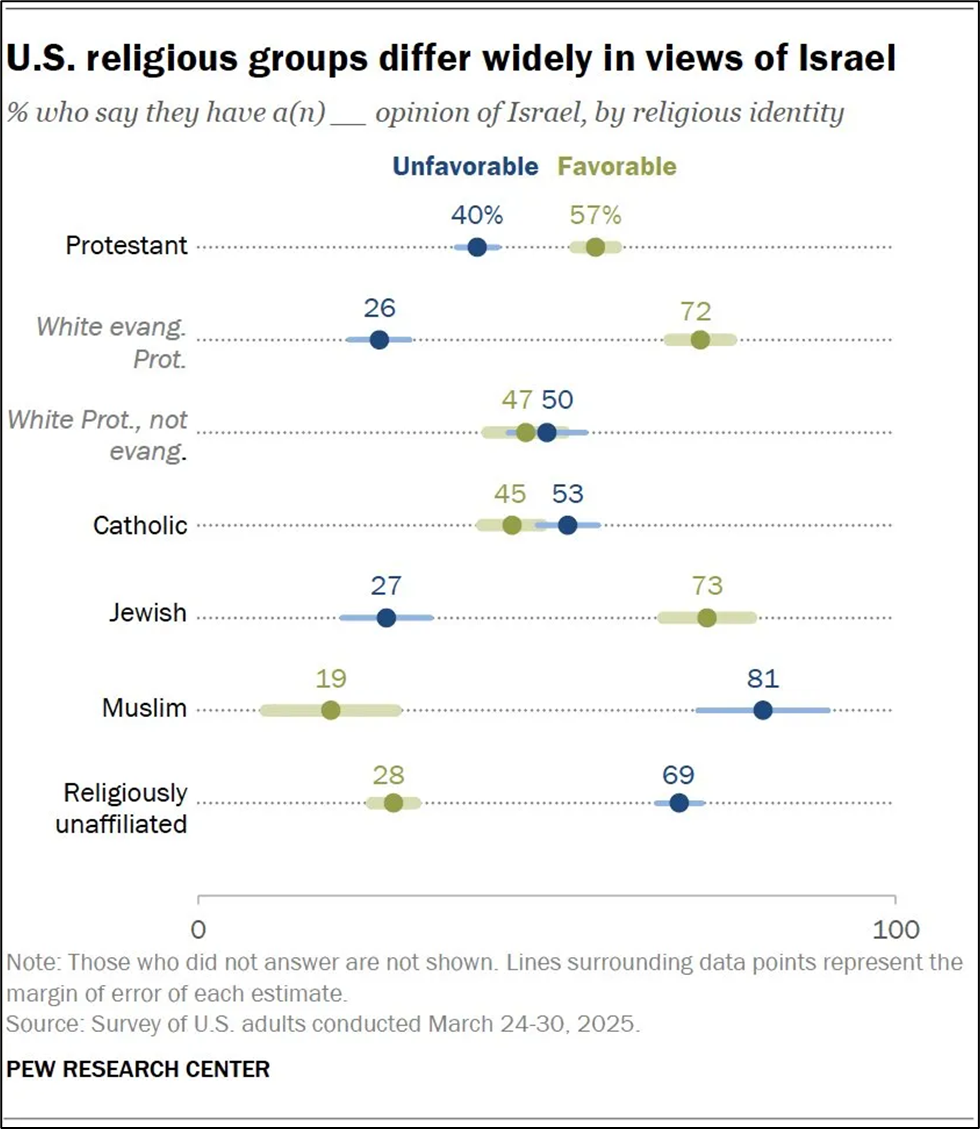
A poll done in March 2025 by Pew Research Center showed that almost 17 months into the Gaza genocide, 73% of American Jews still have a positive view of Israel. While both Jewish Americans and White Evangelical Protestants had similar rates of favorability towards Israel, 42% of Jews had a very favorable opinion compared to 36% of White Evangelicals.
This is despite another poll conducted during the same round of surveys showing an overall trend of increasingly negative views of Israel in the U.S., with the percentage of people with an unfavorable view of Israel increasing from 42% to a majority 53% between 2022 and 2025.
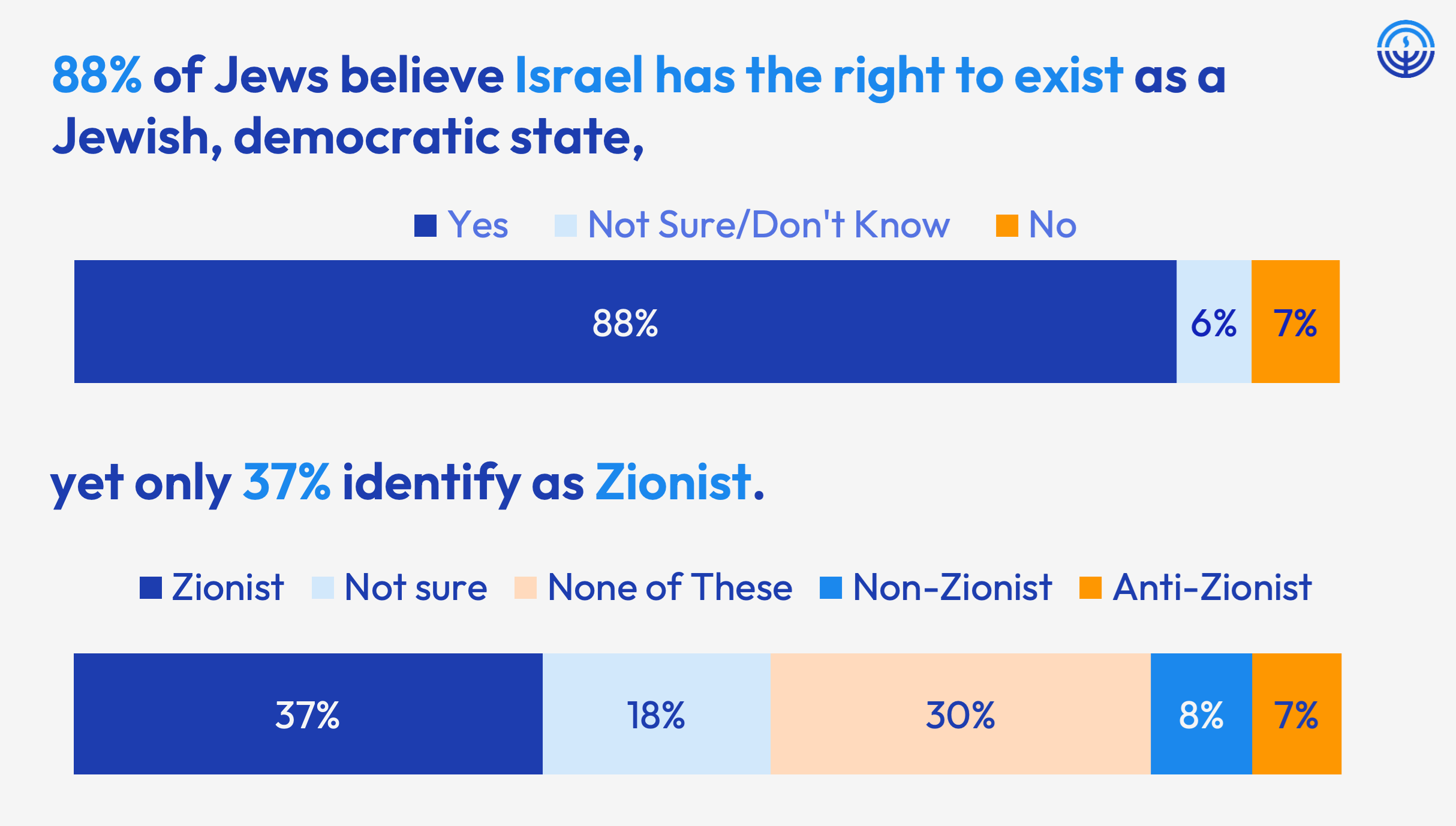
Another poll also conducted in March 2025 by research firm Burson for the Jewish Federations of North America (JFNA) found that despite only 37% of Jewish Americans claiming to identify as Zionist:
88% believe Israel has the right to exist as a Jewish, democratic state
71% feel emotionally attached to Israel, with 42% responding ‘strongly’
60% said in general, Israel makes them proud to be Jewish
71% said Hamas’ reasons for fighting Israel are invalid, with 55% saying ‘completely invalid’
87% think Israel has valid reasons for fighting Hamas
55% say the way Israel is carrying out its response to Hamas’ attack is acceptable
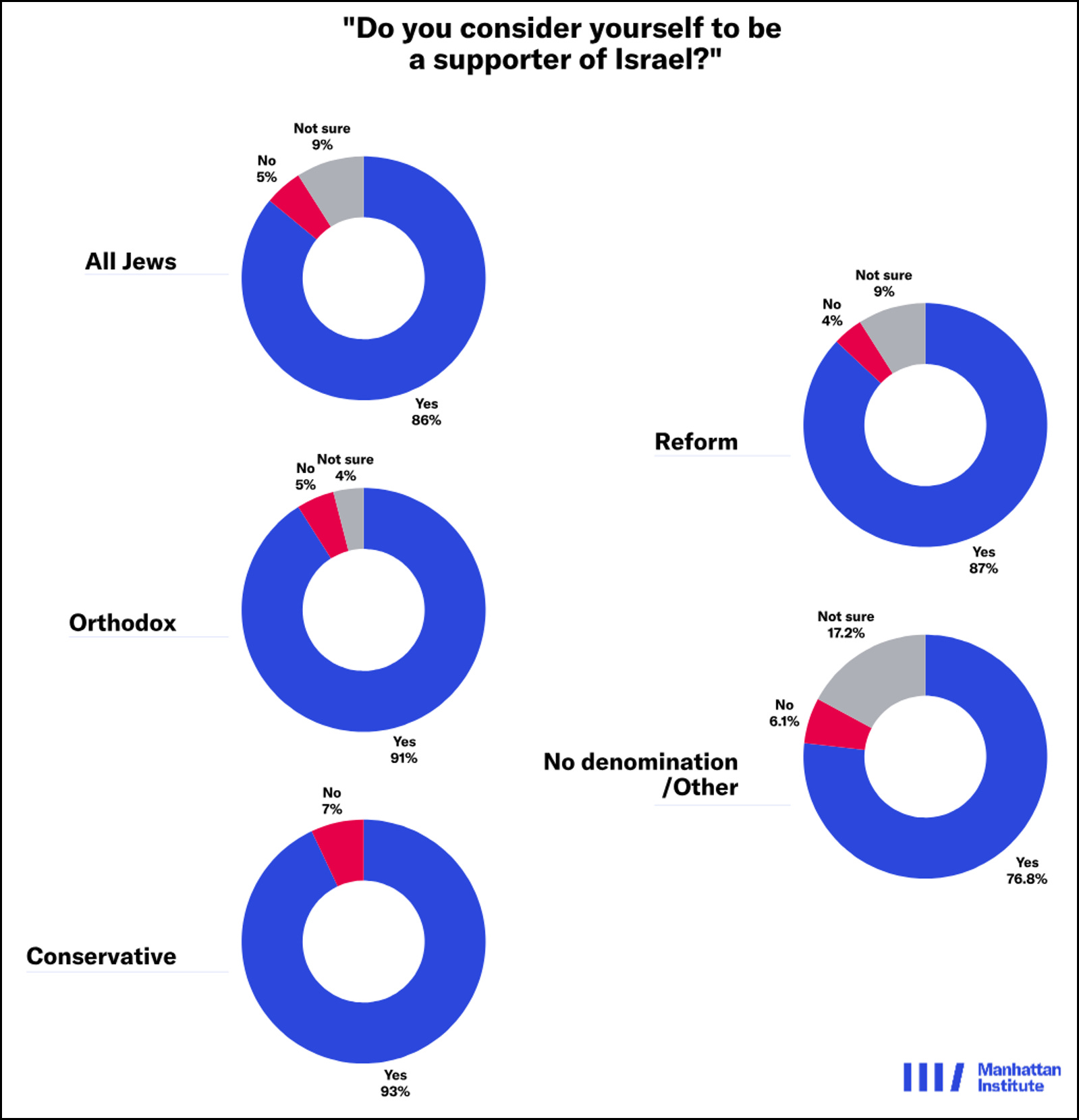
In polls conducted by the Manhattan Institute of Jewish-American registered voters in October 2024, a year into the genocide:
86% consider themselves supporters of Israel, including:
83% of Democrats, 86% of Independents, and 94% of Republicans
Only 2% say the media does a very good job of portraying Israel, while 10% say the media does a somewhat good job
37% plurality say mainstream Jewish community interest groups (ADL, AJC, etc.) are too weak in their approach to combating antisemitism; only 7% say these organizations are too aggressive
In polls conducted in December 2024 by Public Opinion Strategies for Jewish Majority, 14 months into the genocide:
85% believe Hamas wants to commit genocide against Jews and Israel
70% believe anti-Zionist movements are antisemitic by definition; only 9% strongly disagree
76% believe that the 2024 anti-Israel campus protests were antisemitic; only 6% believe they were not
10% strongly oppose U.S. aid to Israel
The following percentages are those who are members of or generally support the policies of these Zionist organizations:
79% for the Anti-Defamation League
79% for the Jewish National Fund
74% for the American Jewish Committee
73% for the Jewish Federations of North America
In polls conducted between October and November 2024 by SSRS for the American Jewish Committee, a year into the genocide:
81% said caring about Israel is an important part of being Jewish (51% very important)
42% said news coverage of the war is biased in support of Hamas, while 29% said biased in support of Israel
85% said the statement “Israel has no right to exist” is antisemitic
64% said the statement “from the river to the sea, Palestine will be free” is antisemitic
73% said the statement “the October 7, 2023, terrorist attack on Israel by Hamas has been exaggerated” is antisemitic
90% of American Jews familiar with the BDS movement said it is antisemitic (49%) or has some antisemitic supporters (41%); only 9% said it is not antisemitic
70% said it is a completely unacceptable form of protest against Israel to boycott American Jewish individuals, events or speaking appearances
In polls conducted between October and November 2024 by GBAO for J Street, a year into the genocide:
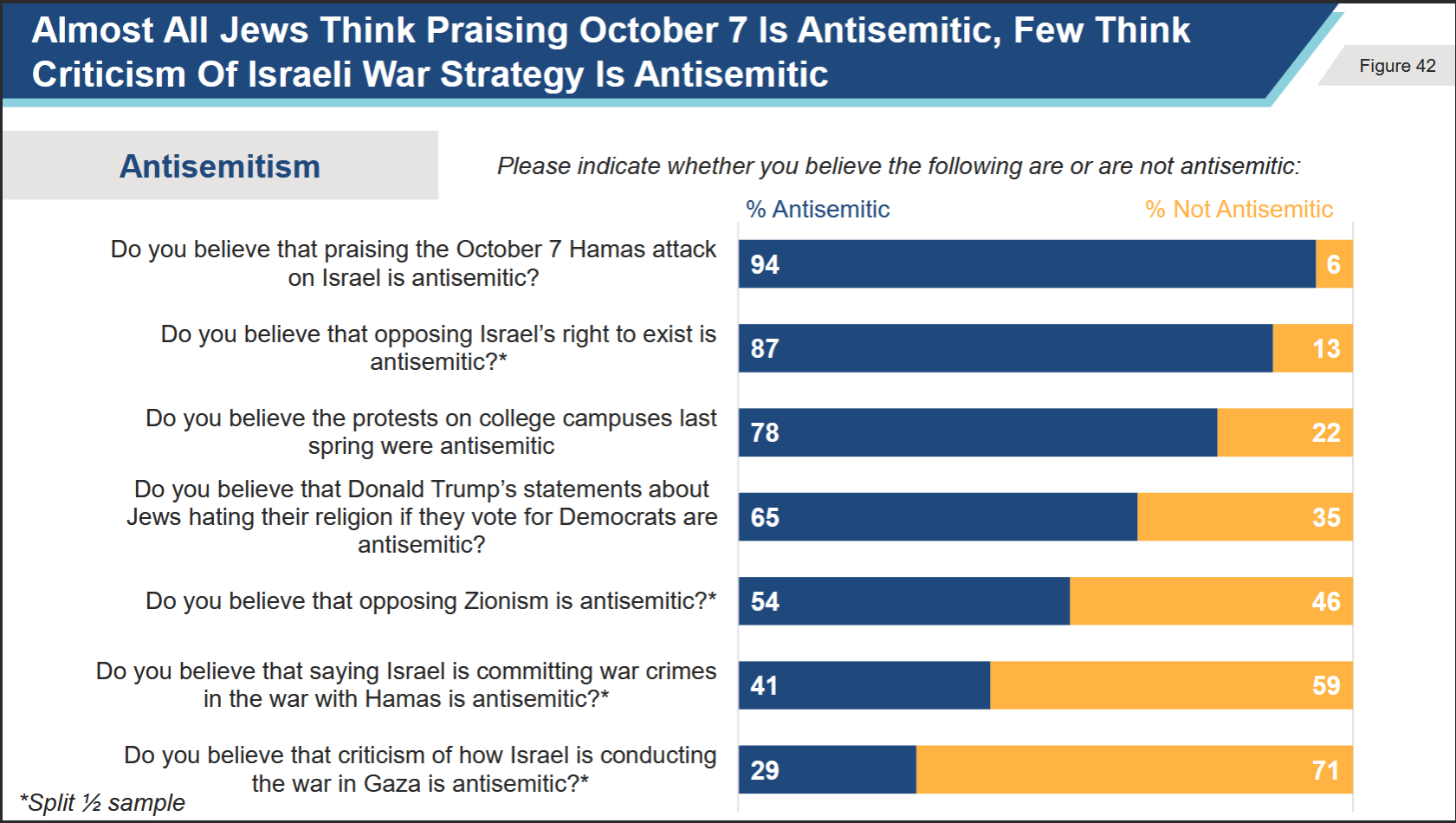
87% believe that opposing Israel’s right to exist is antisemitic
78% believe the protests on college campuses last spring were antisemitic
54% believe that opposing Zionism is antisemitic
94% believe that praising the October 7 Hamas attack on Israel is antisemitic
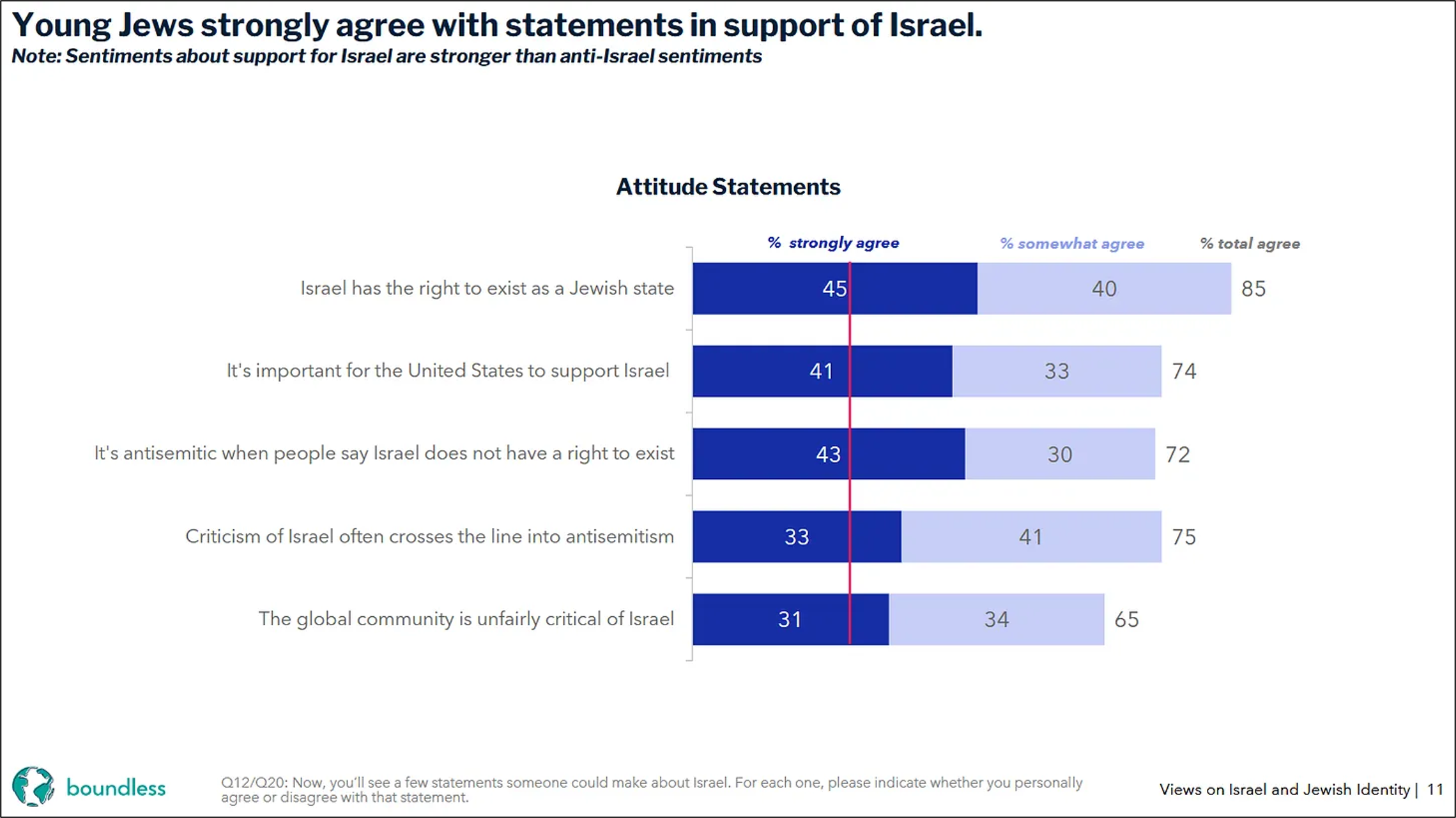
In polls conducted in June 2024 of American Jews aged 18-40 by global research firm BSG for Boundless, 8 months into the genocide:
76% of young American Jews feel connected to Israel
90% responded that they care about Israel
85% believe that Israel has the right to exist as a Jewish state (45% strongly agree)
74% believe it’s important for the U.S. to support Israel
72% say it is antisemitic to say Israel does not have a right to exist
75% say criticism of Israel often crosses the line into antisemitism
65% say the global community is unfairly critical of Israel
56% said they feel more connected to Israel after October 2023; 20% said they feel less connected
54% said they feel more connected to their Jewish identity after October 2023; 20% said they feel less connected
A poll done in June 2024 by the American Jewish Committee showed that American Jews were increasingly more connected to Israel, with 85% believing it is important for the U.S. to support Israel, and 57% feeling more connected to Israel after October 7.
In Pew Research polls from February 2024 of American Jews, 4 months into the genocide:
62% said Israel’s response to October 7 was acceptable
54% had a favorable view of the Israeli government
74% supported U.S. military aid to Israel
89% said Israel’s reasons for fighting Hamas are valid, and 77% said Hamas’ reasons for fighting Israel are not valid
89% said they have a favorable view of the Israeli people, and only 42% said they have a favorable view of the Palestinian people
According to a Pew Research poll from 2020, 45% of American Jewish adults have been to Israel, including 26% who have visited multiple times or have lived in Israel.
Zionism among British, Canadian, French and other Jews
A series of surveys of British Jews were conducted by the Institute for Jewish Policy Research on October 2024, almost a year after the start of the Gaza genocide. Some of the results included:
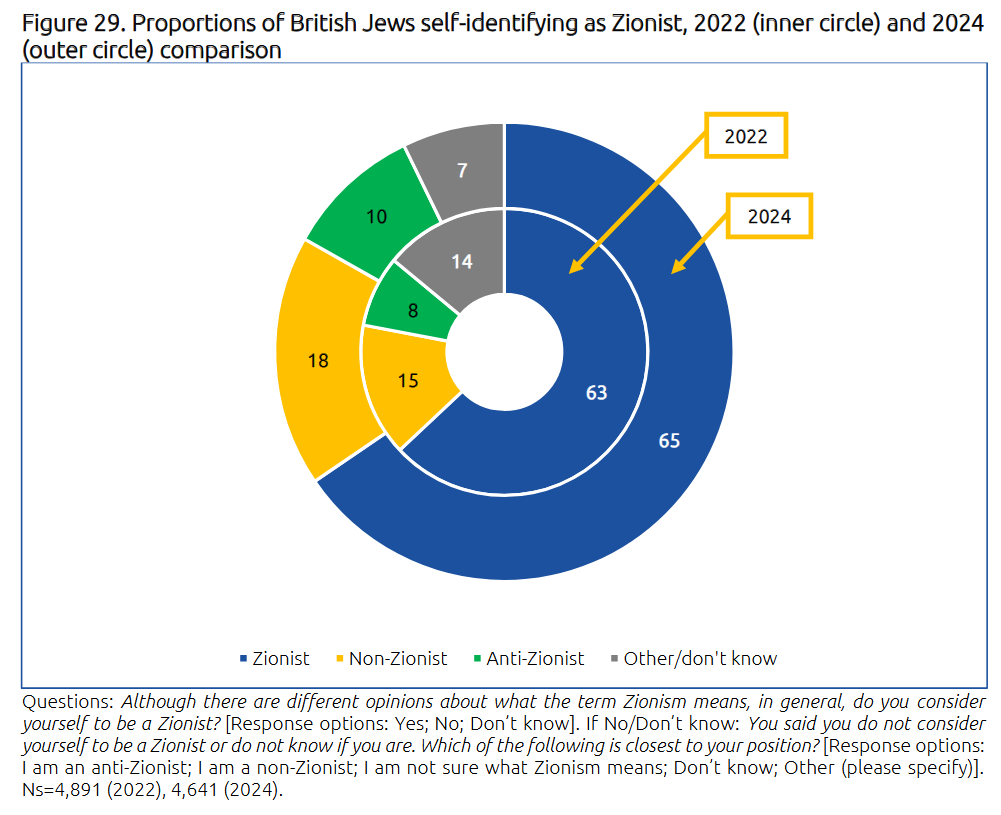
65% of British Jews self-identified as Zionist in 2024, an increase from 63% in 2022.
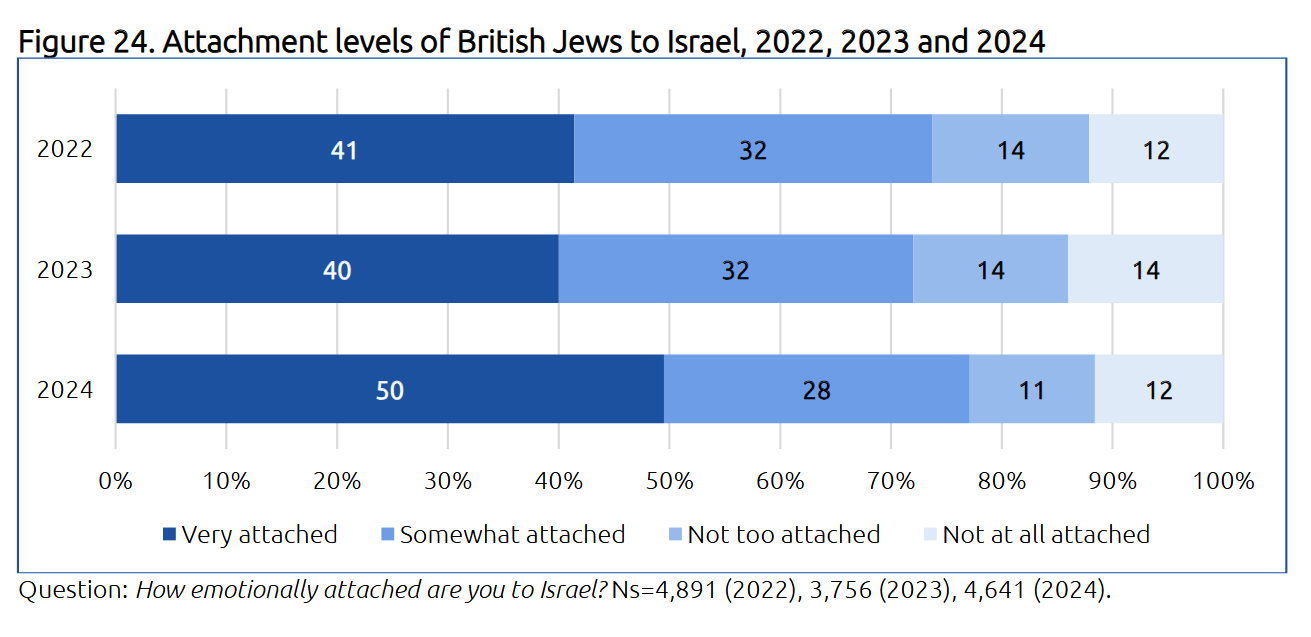
78% of British Jews were “somewhat” or “very” emotionally attached to Israel; with 50% answering “very” attached.
88% regard Israel as the ancestral homeland of the Jewish People.
60% at least have donated to a charity supporting Israel since 7 October.
47% said they have become more emotionally attached to Israel after October 7th and the subsequent Gaza genocide, with 19% less attached.
65% disagreed that Israel’s conduct after October 7th weakened their attachment to Israel
51% disagreed that Israel’s conduct after October 7th clashed with their Jewish values
In Canada, the following was reported from different surveys. A November 2024 survey of Canadian Jews conducted by Léger for the New Israel Fund showed:
Although only 51% self-identified as “Zionist”, 84% said they are “very” or “somewhat” emotionally attached to Israel and 94% said they support the existence of Israel.
Only 35% agreed that Canadian politicians should sanction West Bank settlers who engage in violence against Palestinian civilians.
53% said Canada should not recognize a Palestinian state.
69% said Canada should not impose an embargo on arms trade.
An earlier 2018 survey of Canadian Jews by the Environics Institute showed that:
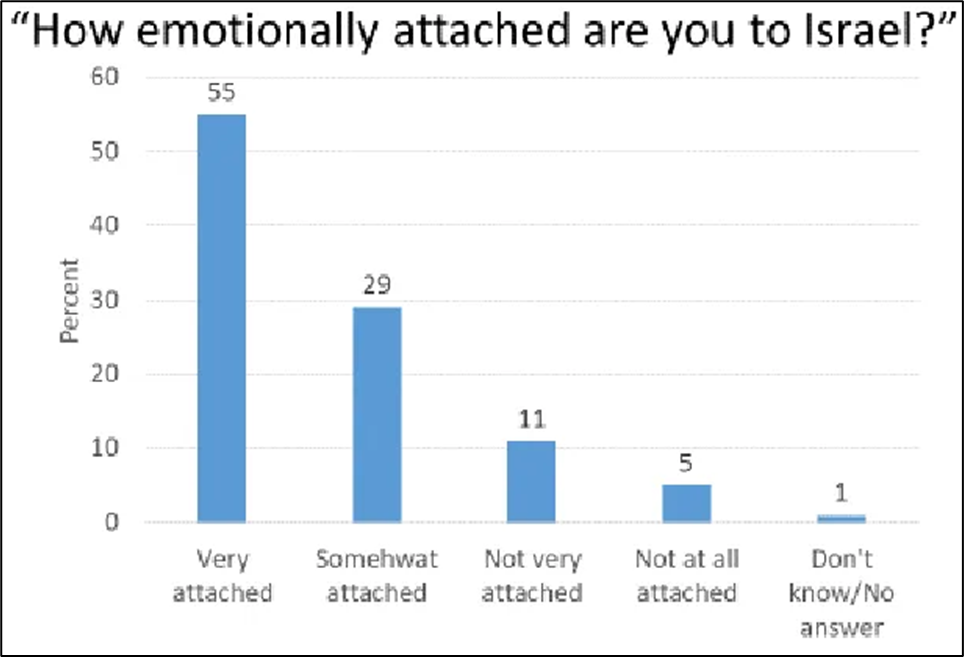
79% are “very” or “somewhat” attached to Israel, with 48% answering “very” attached. This was 10% higher than American Jews according to the same survey.
43% considered West Bank settlements to not be illegal under international law, while only 23% said they are illegal.
36% considered Canada to be “not supportive enough” of Israel, compared to 6% saying they’re “too supportive” and 45% answering “about right.”
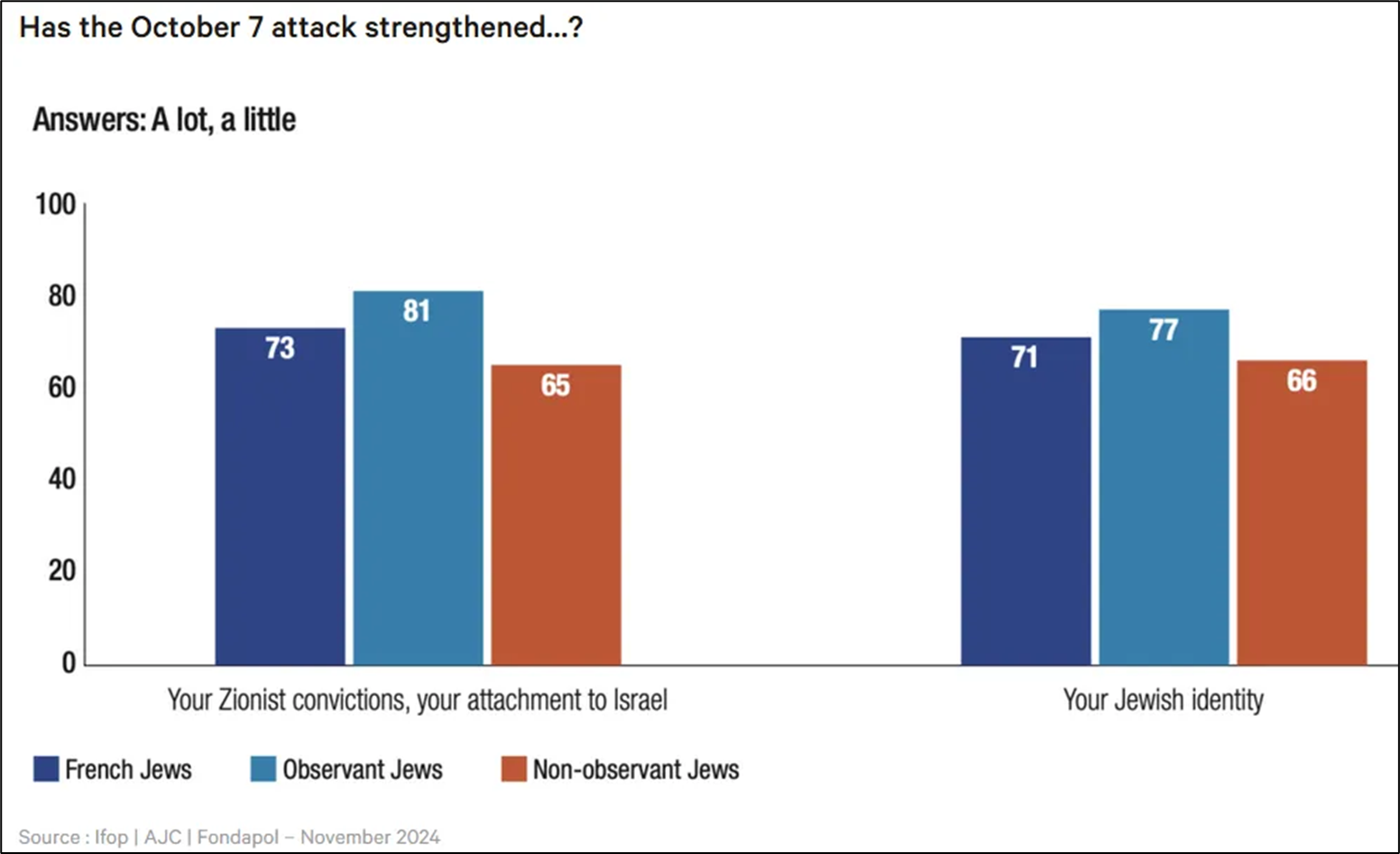
A poll conducted by the French Institute of Public Opinion (IFOP) for the American Jewish Committee of French Jews in 2024 showed that:
73% said that their Zionist convictions were strengthened after October 7, 2023
58% said their top choice for potential emigration is Israel, the highest by far, with the second being the U.S. at 15%.
A poll conducted by IFOP for the American Jewish Committee of French Jews in 2019 showed that:
59% said that caring about Israel is an important part of being a Jew.
53% said that a thriving State of Israel is vital for the long-term future of the Jewish people.
65% have visited Israel at least once; 25% own a residence in Israel.
77% considered Israelis “part of their family.”
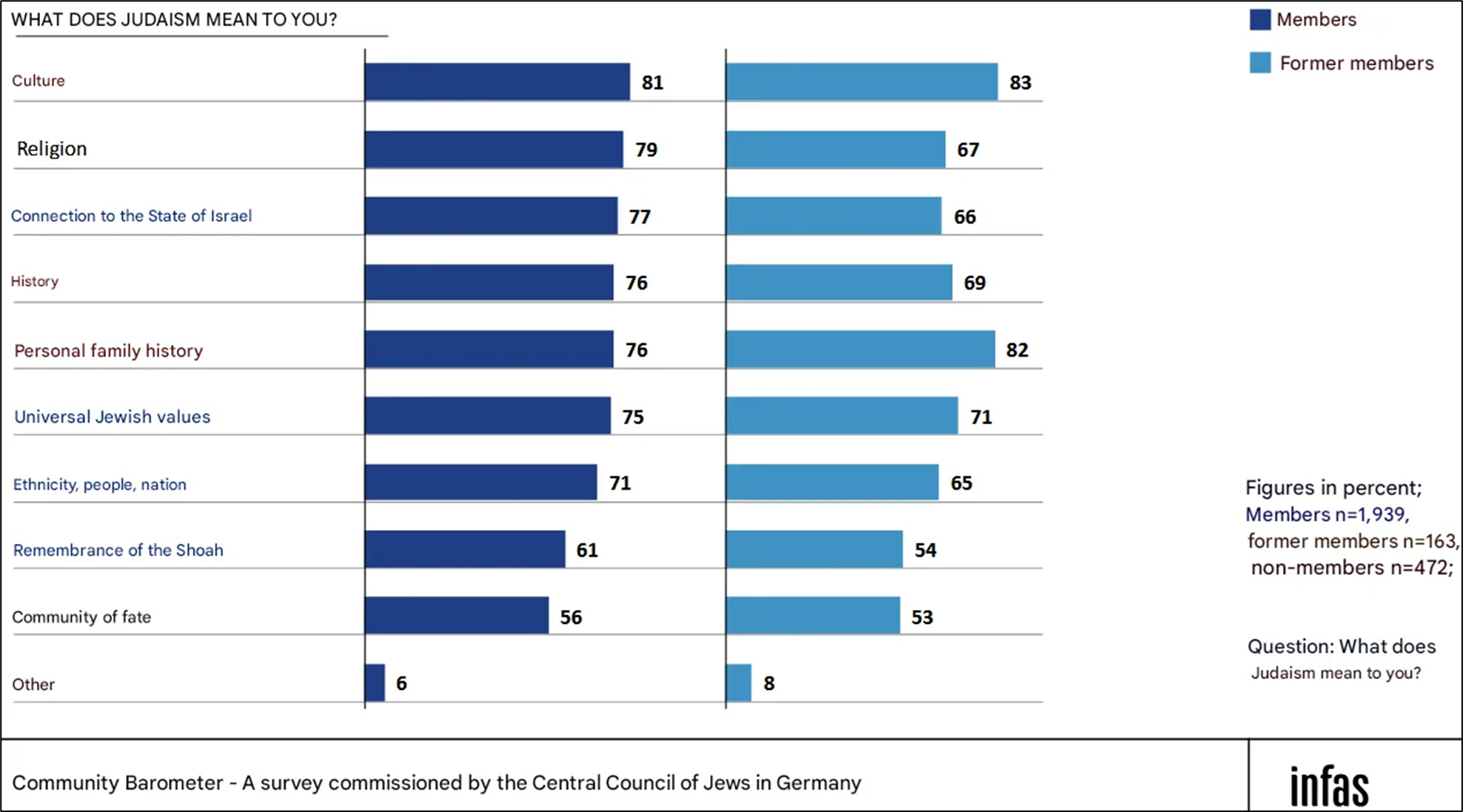
A survey conducted by the Central Council of Jews in Germany of German Jews in 2024 showed that:
77% consider connection to Israel to be an important part of their Jewish identity.
64% considered staying in Israel as a significant factor for developing their Jewish identity.
91% have visited Israel.
94% consider solidarity with Israel important, with 76% considering it ‘very’ important.
89% said Israel is a crucial factor for the continuation of Jewish life in Europe.
87% said that they support Israel regardless of the behavior of the Israeli government.
78% believe all Jews have an obligation to support Israel.
Only 33% of respondents said they find it difficult to support Israel unconditionally.
A survey conducted by the Australian Centre for Jewish Civilisation at Monash University, Melbourne in conjunction with the Jewish Communal Appeal in Sydney, Australia in November 2023 of Australian Jews showed that:
91% felt at least somewhat emotionally attached to Israel with 75% answering ‘very’ emotionally attached.
90% felt the actions of the Israel Defense Force (IDF) has been justified; 59% said their actions were completely justified; 4% felt the actions of Hamas had been justified
82% said they personal social connections to Israel through close family members and friends who live there.
93% have visited Israel.
A survey conducted by the Institute for Jewish Policy Research of South African Jews in 2019 showed that:
90% feel attached to Israel, with 66% feeling ‘strongly’ attached. 72% consider advocating for Israel (e.g. online or on campus) and 73% consider supporting Israel (e.g. Israeli charities) an important part of Jewish identity.
92% maintain that Israel is the “ancestral homeland of the Jewish people.” Only 12% opposed the idea of a state specifically for Jews.
69% self-define as Zionist.
89% have visited Israel. 80% consider visiting an important part of Jewish identity.
51% said their preferred destination to emigrate to would be Israel, far ahead of any other country.
83% feel it is never acceptable for Jews to publicly support a boycott of Israel.
78% consider boycotting Israeli products antisemitic.
75% consider labeling Israel as an apartheid state antisemitic. 85% consider saying Israelis behave “like Nazis” towards the Palestinians as antisemitic.
Zionism in Israel
And let’s not even start with the near-universal approval of absolute depravity in all of Israel. To point out a few stats:
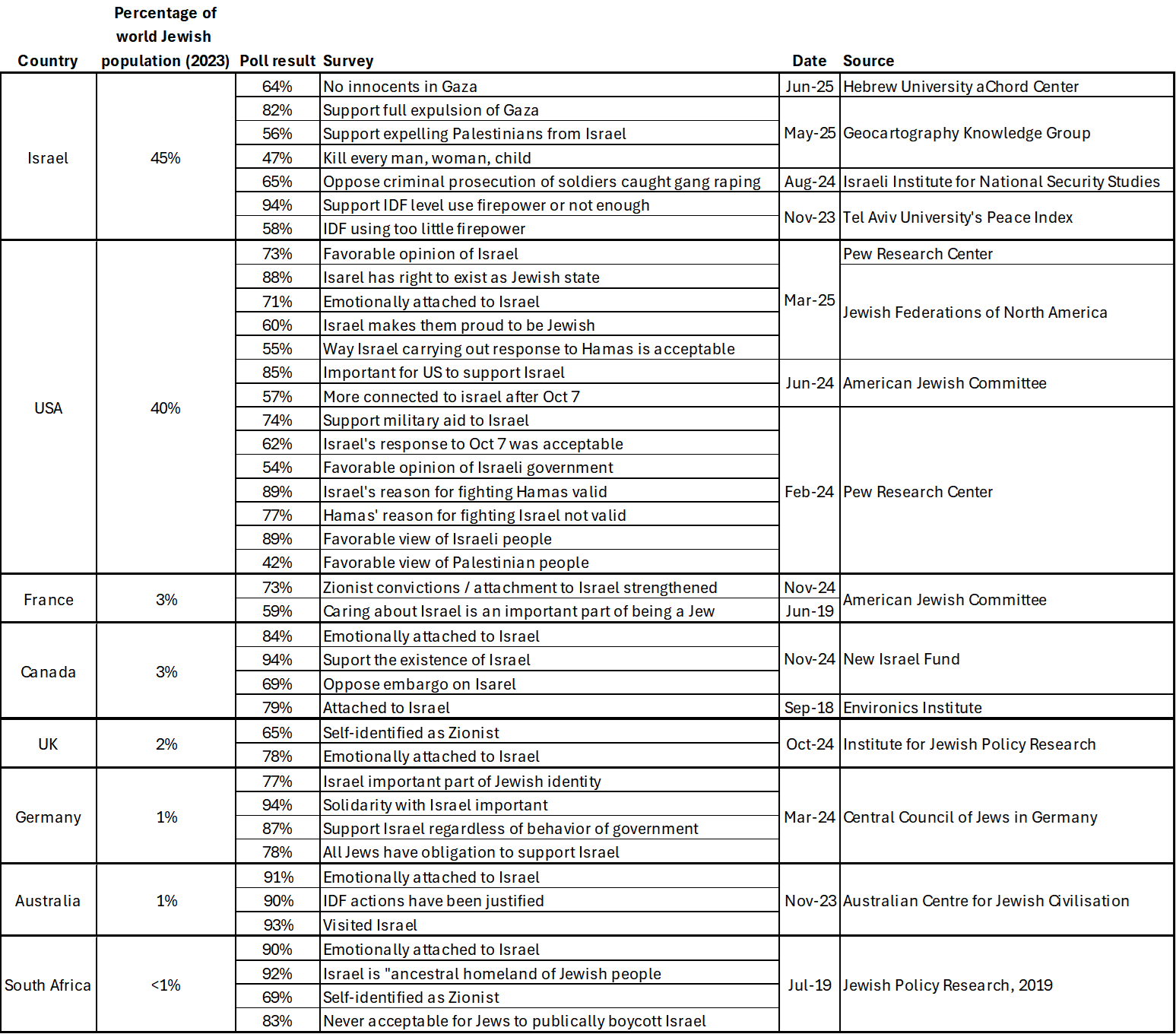
95% of Israelis supported the Israeli forces’ level of use of firepower in Gaza; 58% said they are using too little firepower (Tel Aviv University’s Peace Index, November 2023)
64% of Israelis believe there are ‘no innocents’ in Gaza (Hebrew University aChord Center, June 2025)
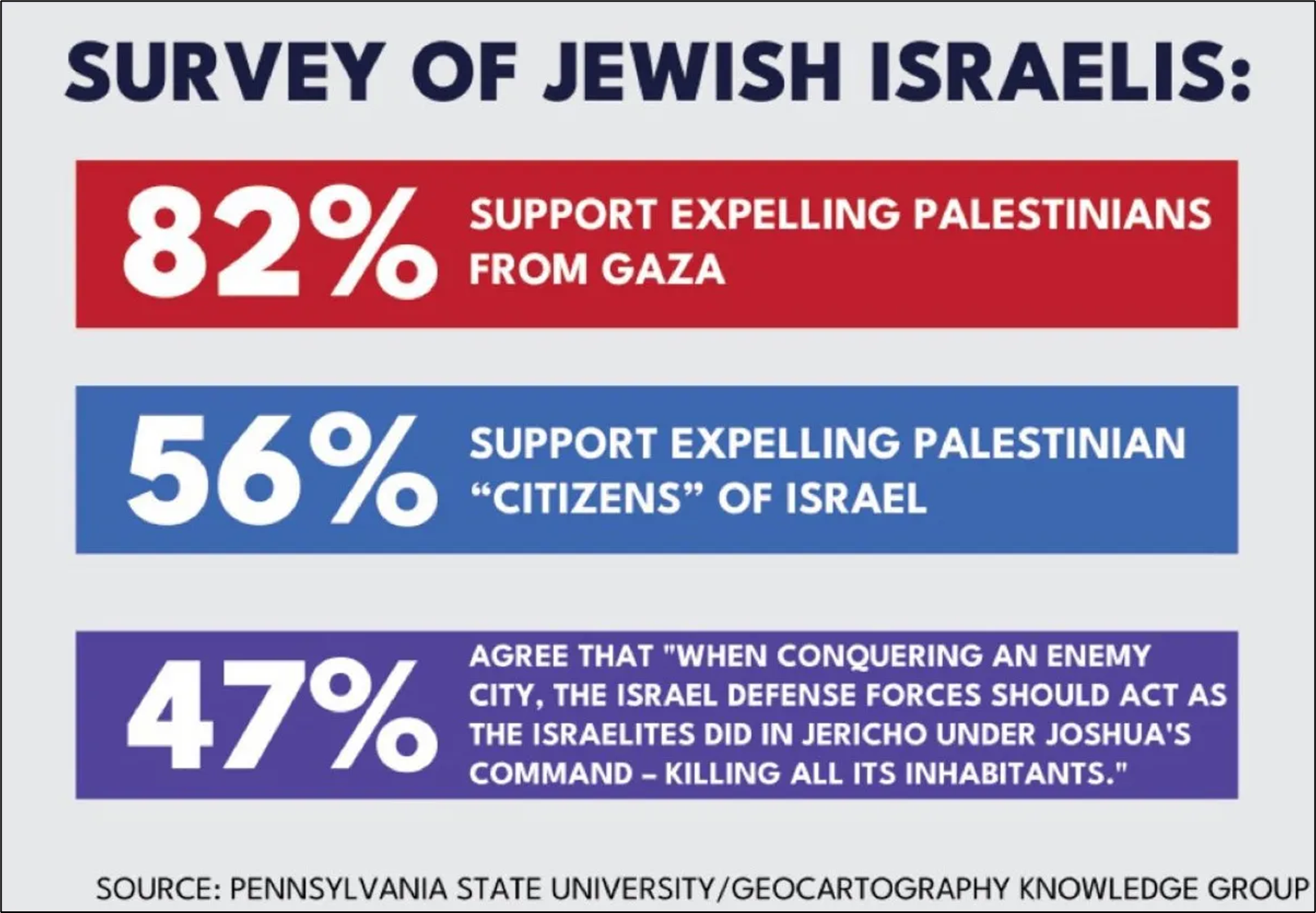
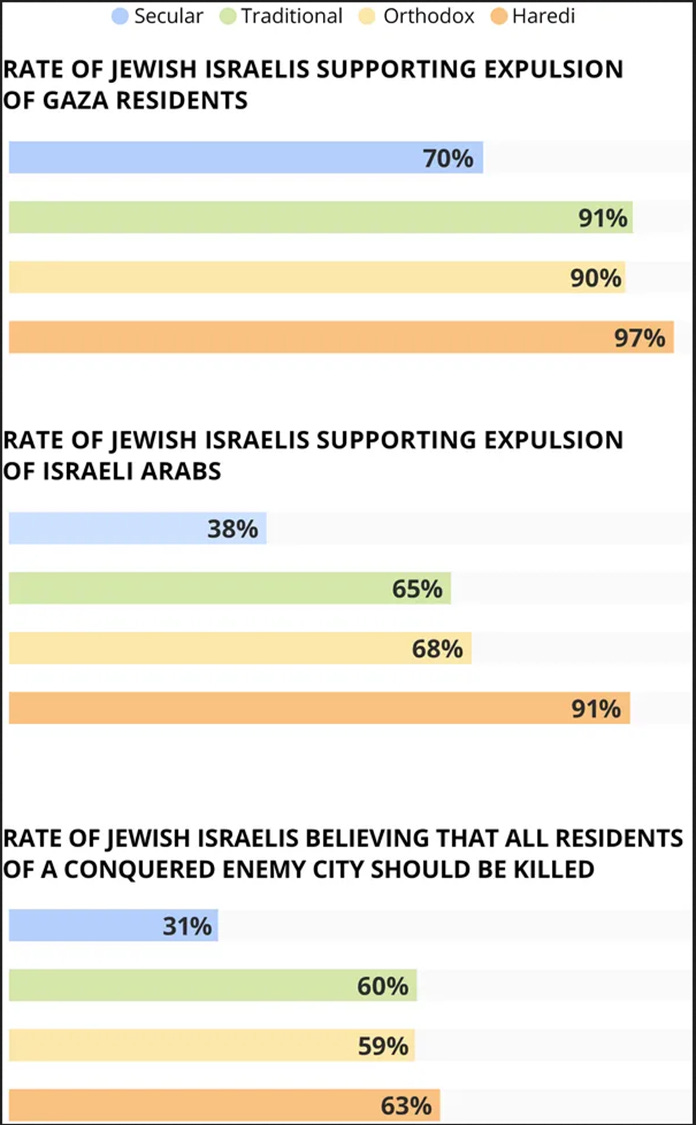
82% support the full ethnic cleansing expulsion of Gaza (Geocartography Knowledge Group, May 2025)
56% support expelling Palestinians within Israel itself (Geocartography Knowledge Group, May 2025)
47% want to kill every man, woman, child (Geocartography Knowledge Group, May 2025)
65% oppose the criminal prosecution for soldiers who were caught on video gang raping Palestinian detainees.
An earlier poll of Israeli Jews from 2016 by the Herzl Center showed that:
90% of Israeli Jews identify as Zionist
82% said the idea of Zionism is still relevant
61% said Theodor Herzl’s vision has not fully come true yet
Another 2015 poll from Pew Research of Israeli Jews showed the following:
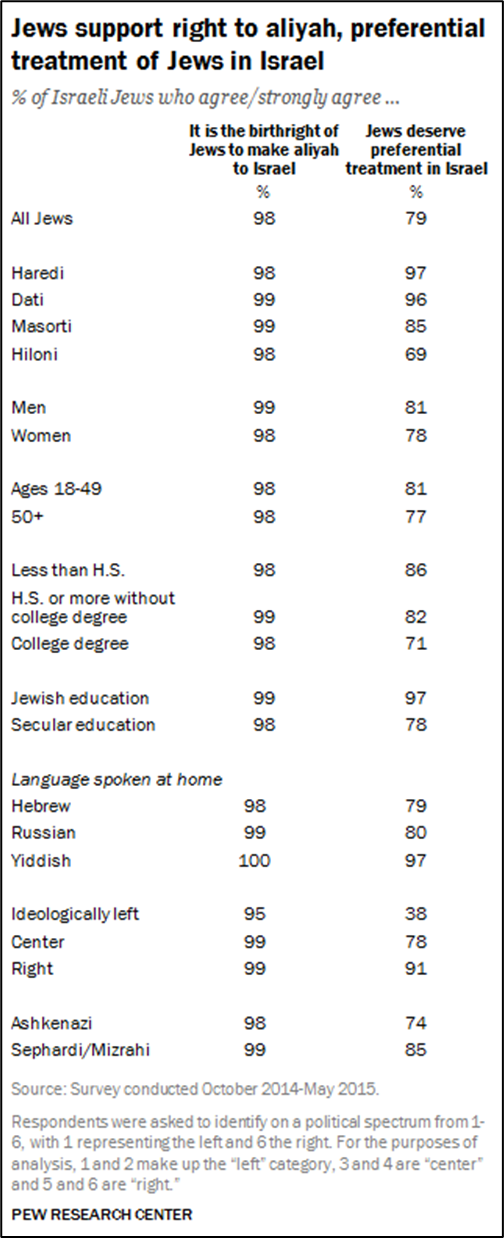
98% of all Israeli Jews believe that it is the birthright of Jews to make aliyah (immigration) to Israel
79% say Jews deserve preferential treatment in Israel
74% of Israeli Jews say the term “Zionist” describes them accurately.
Military participation
Information obtained by Israeli NGO Hatzlacha revealed that more than 50,000 soldiers in the Israeli military hold at least one other citizenship, with a majority of them holding U.S. or European passports. For comparison, the IDF has about 169,500 active personnel and 465,000 reserve personnel.
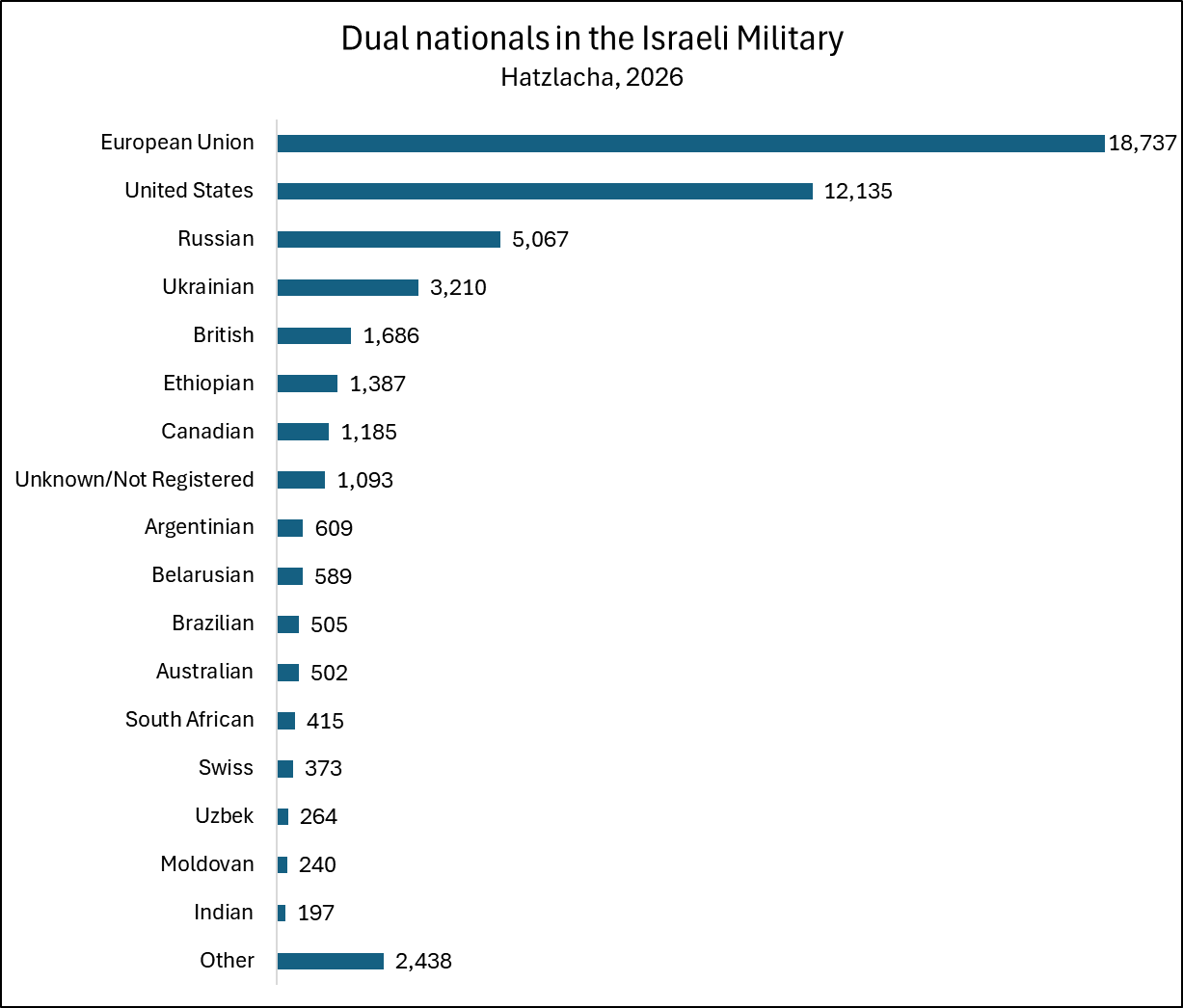
More American Jews serve in Israel’s military than in their own country’s. The Washington Post reported in February 2024 that an estimated 23,380 American citizens currently serve in the Israeli military. By contrast, the Times of Israel reported that only 15,000 Jews serve in the U.S. military—supported by the explicitly Zionist Chabad-affiliated Alpeh Institute.
The disparity becomes even starker when looking at proportions. American Jews make up just 1.1% of active U.S. military personnel (1.33 million)—less than half their 2.4% share of the U.S. population—yet they constitute nearly 14% of the active IDF (169,500), far exceeding their 3% share (300,000) of Israel’s total population or 4.2% share of the Jewish population of Israel. In other words, American Jews are 4.6 times more represented in the IDF than their share of Israel’s population would suggest (or 3.3 times the Jewish population), while being underrepresented 0.47 times in the U.S. military.
Similarly, in Germany, the BBC reported in August 2023 that only 300 Jews serve in the Bundeswehr, compared to 3,901 German-Israeli dual nationals currently in the IDF—a difference of more than thirteen to one.
In addition to the numerous programs that exist to facilitate the immigration of Jews worldwide to Israel or Aliyah, there are many organizations that work in coordination with the IDF to actively recruit Jews to join their military ranks including Garin Tzabar, Sar-El, and Nefesh B’Nefesh which established the “Lone Soldiers Program” in cooperation with the Friends of the Israeli Defense Forces (FIDF). Many American Jews move to Israel specifically through programs run by these organizations with the intention of serving in the IDF.
Jewish Supremacy vs White Supremacy vs ISIS
Zionism is an explicitly ethno-supremacist ideology. From its founding in the late 1800s, it has always been a racist, settler-colonial movement that has sought to colonize a nation and remove its native inhabitants. A simpler and more readily understandable term for Zionism is “Jewish supremacy.” It’s the idea that Jews should emulate other European settler-colonizers by subjugating and expelling people of another race from their home to take over their land. This makes it no different from other racist, genocidal settler-colonial endeavors like America’s Manifest Destiny or Nazi Germany’s Lebensraum.
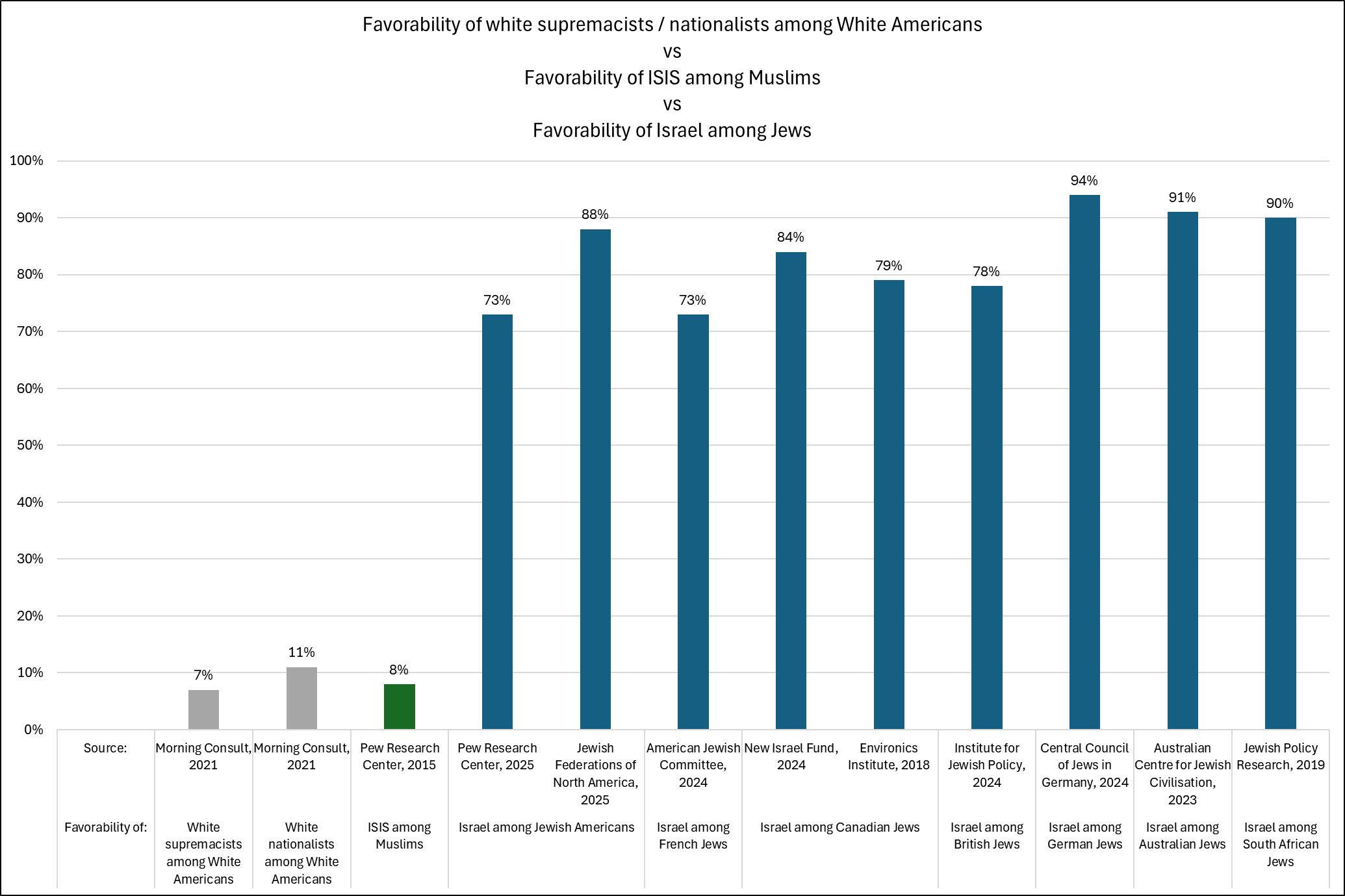
As an ideology, Zionism, or more simply “Jewish supremacy,” is significantly more prevalent among Jewish communities in the U.S. than White supremacy or White nationalism is among White Americans. A 2021 Morning Consult poll illustrates this disparity:
81% of White respondents have an unfavorable view of White supremacists, with only 7% holding a favorable view.
66% have an unfavorable view of White nationalists, compared to 11% favorable.
Another point of contrast lies in the affinity Jews have for Israel versus the global Muslim opinion of extremist groups like the Islamic State (IS). While the ideology of both projects is founded on doctrines of religious supremacy and the violent conquest of land in the Levant, the level of support they receive from their respective religious communities is starkly different.
Global Muslim support for IS has consistently been negligible. For example, a 2015 Pew Research Center poll across 11 Muslim-majority countries found a median unfavorability of 73% toward ISIS, with a median favorability of only 7%. In no country surveyed did approval for IS exceed 20%.
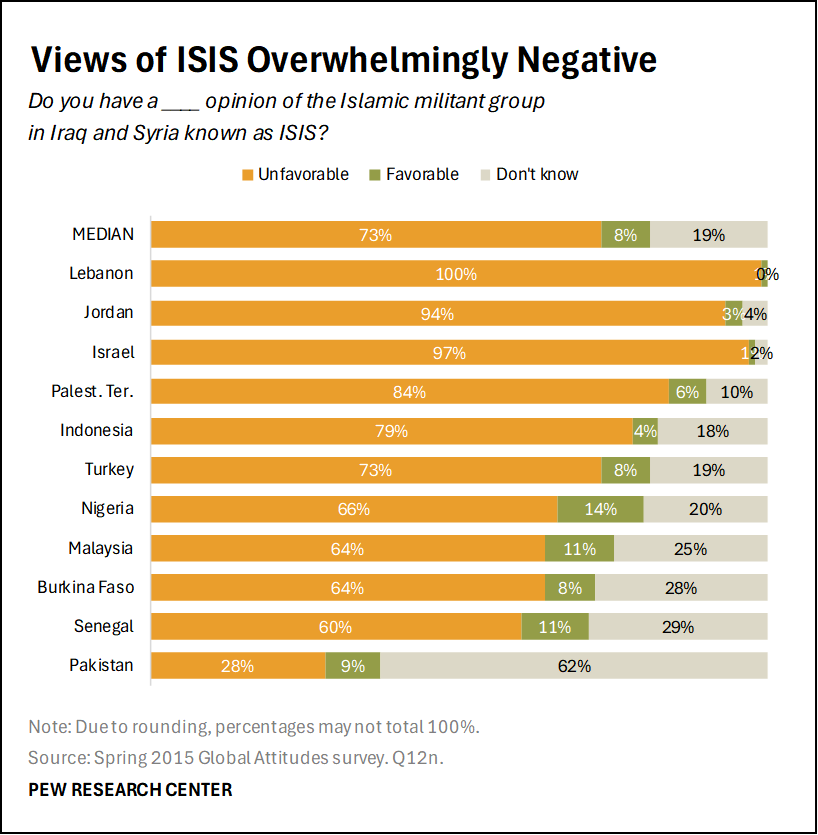
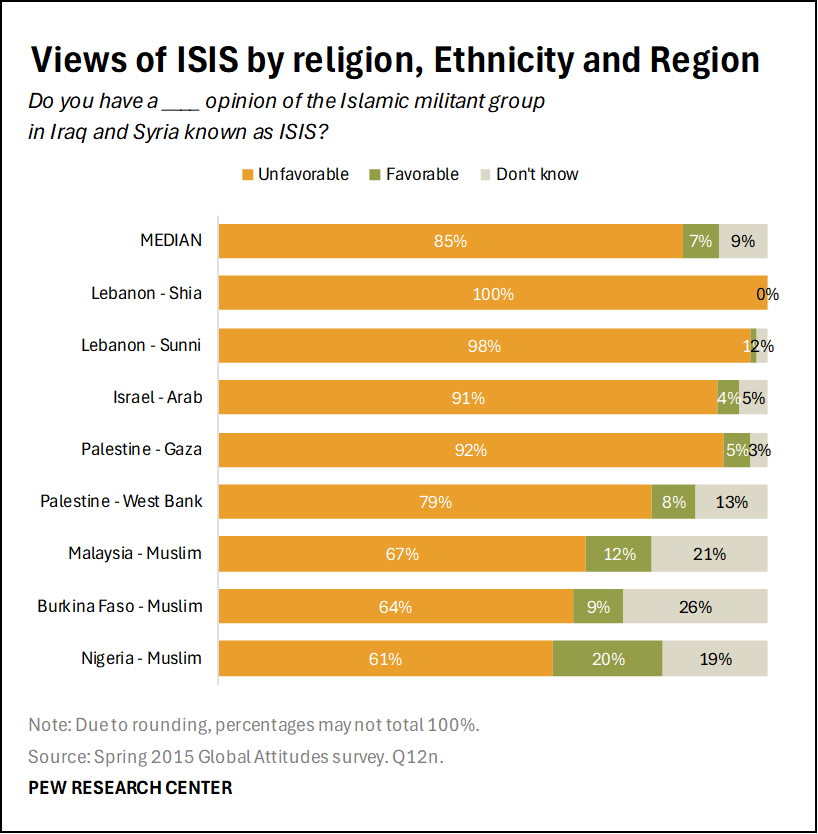
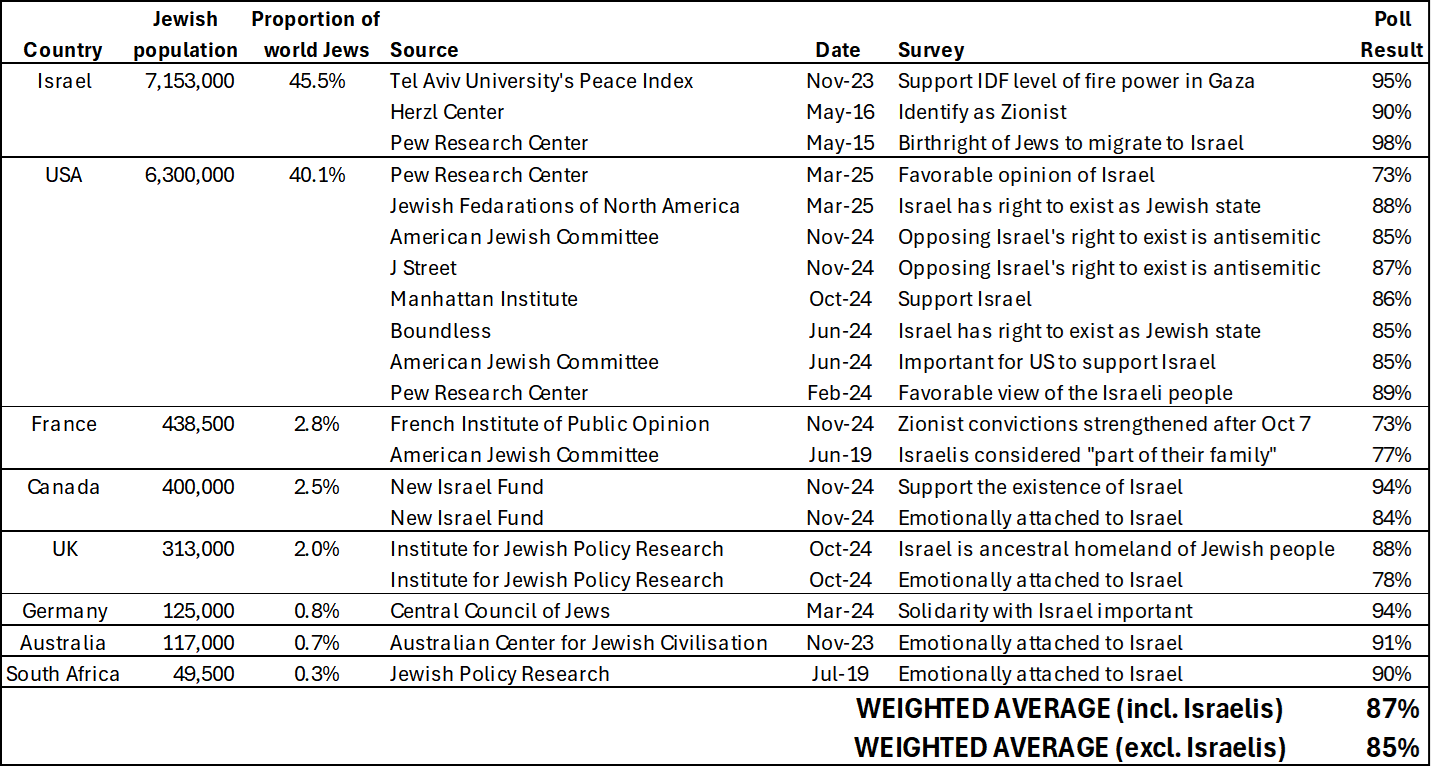
Conversely, Jewish attachment to and support for Israel remains broadly significant. Polling from the same period shows consistently high favorability among Jewish communities worldwide: approximately 73-88% among American Jews, 65-78% among British Jews, 79-84% among Canadian Jews, 73-79% among French Jews, 94% among German Jews, 91% among Australian Jews, and 90% among South African Jews.
This comes to a rough total weighted average of about 74-87% favorability of Israel among Jews outside of Israel. Including Israelis, this figure comes to around 86-93% of all Jews worldwide.
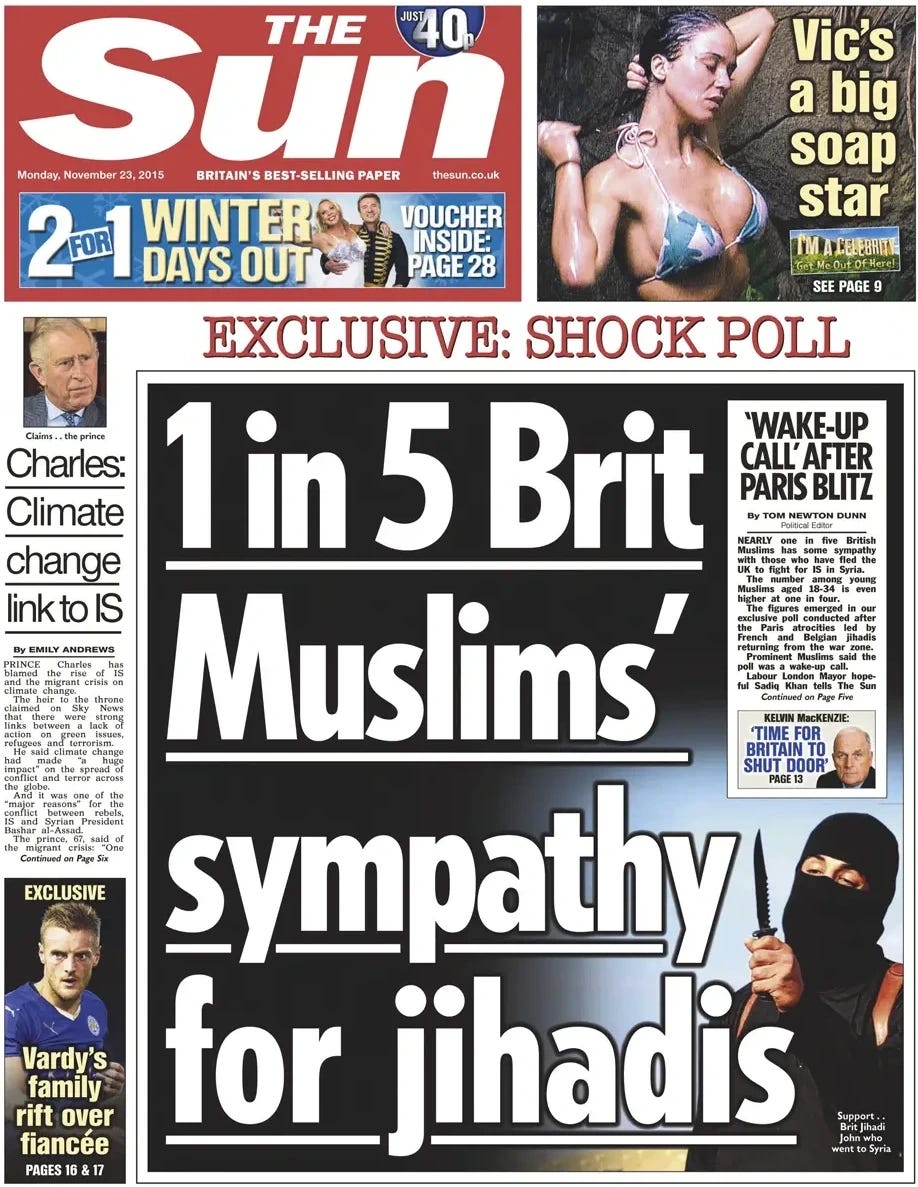
This stark contrast in grassroots support within the communities is sometimes obscured by misleading media narratives. A case in point is a controversial November 2015 headline in the British tabloid The Sun, which claimed “1 in 5 Brit Muslims’ sympathy for jihadis.” This statistic was misleading; it was drawn from a poll question asking respondents if they had “sympathy with young Muslims who leave the UK to join fighters in Syria.” The question did not mention “jihadis,” and the Syrian conflict involved many factions, not all of which were classified as extremists. Nevertheless, the distorted 20% figure was considered high enough to warrant as evidence of widespread radical sympathy.
While both Israel and IS emerged from ideologies of religiously justified conquest, they occupy fundamentally different positions in the eyes of their nominal communities: one is a central object of widespread identification for Jews globally, while the other is overwhelmingly rejected by the world’s Muslims.
This widespread Jewish support for Israel follows a clear material logic. Israel is a Jewish-supremacist state that offers tangible benefits to Jews worldwide. From a materialist perspective, it’s unsurprising that many Jews endorse Israel. The state guarantees them privileged access to land, citizenship, and military protection, monetary entitlements, all subsidized by Western imperial powers. Just as European settlers supported colonial expansion, many Jews, especially those in the imperial core, see Israel as a strategic asset. Critics who reduce this to mere ideology miss the structural incentives: Why wouldn’t a group support a state explicitly designed to serve its interests? Israel, like all settler-colonial projects, rewards its beneficiaries materially.
Zionism Dominates Jewish Organizations
The support for Israel among Jews worldwide stretches from individuals to community organizations, events, synagogues and larger institutions.
Analysis of Jewish organizations worldwide
For a rough estimate of how dominant Zionism is among Jewish organizations, I carried out an analysis of the Wikipedia category page for ‘Jewish organizations by country.’ As of May 2026, the page lists approximately 719 organizations across 30 countries (excluding Israel) in this category and its sub-categories including community organizations, history organizations, museums, charities, LGBTQ groups, etc. It should be noted that not every organization is explicitly marked as pro-Israel on Wikipedia, so a deeper analysis required reviewing each one individually. For each organization, I assessed whether it qualifies as Zionist based on the following criteria:
Explicitly states support for Israel on its website or other public platforms
Leaders or key members publicly express pro-Israel positions
Affiliated with other known pro-Israel organizations
Operates branches or programs within Israel
Includes pro-Israel studies or Zionist education in its curriculum
Has released public statements sympathetic to Israel
Listed in other Wikipedia Zionist categories or sub-categories such as Zionism by country, Zionist by continent, Chabad, etc.
Note: For relevance and brevity, I excluded the following categories from analysis: defunct Jewish organizations, Jewish-American organized crime groups, Synagogues in the United States, and Jewish day schools in the United States.
Out of the 719 organizations investigated, 686 had sufficient publicly available information to determine their stance on Zionism/Israel. Of those 686, 681 organizations (99%) can be classified as Zionist. This includes Liberal Zionist organizations that may make token references to Palestinians or two-state solutions; even excluding those, the proportion remains at approximately 90% of all organizations with clear stances. To put it another way: only 3 or 4 organizations out of 719 with sufficient information could be classified as non-Zionist or critical of Israel. The remaining 33 organizations had no stated stance, insufficient information available, or no discernible relationship to pro-Israel groups. Including organizations with unknown stances, the minimum proportion of Zionist organizations among all 719 is 95% (681/719).
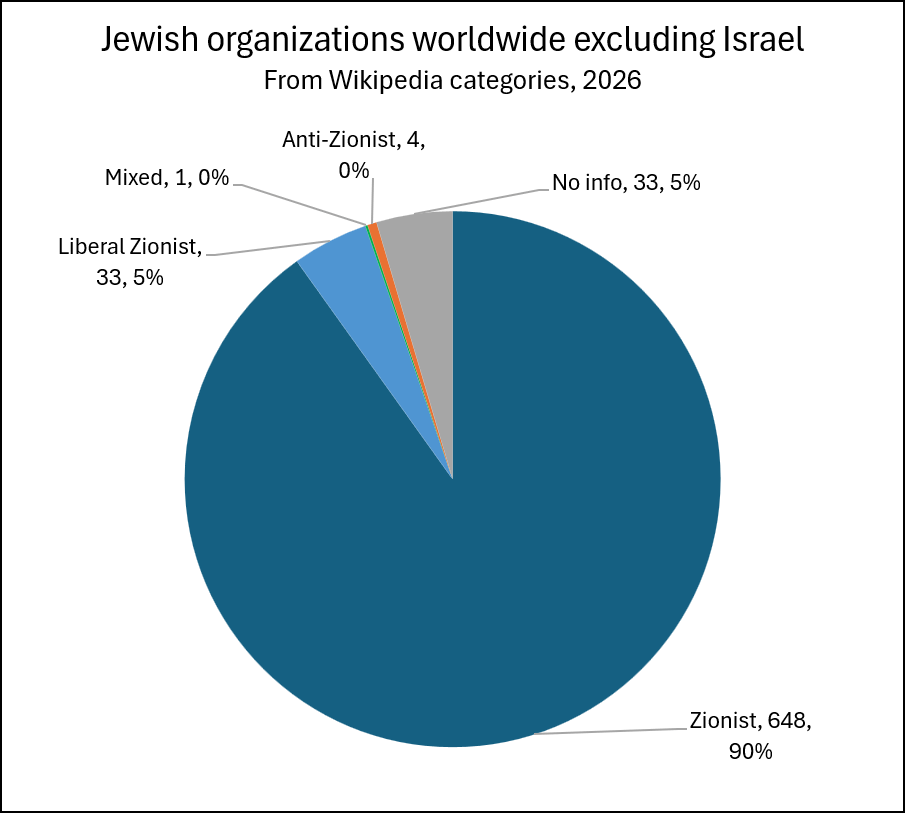
Below is a breakdown showing how many organizations are Zionist out of the total in each country, including organizations with no discernible info:
International organizations: 100% (36/36)
European organizations (not specific to one country): 100% (6/6)
Europe: 96% (116/121)
United Kingdom: 96% (53/56)
Poland: 100% (10/10)
Russia: 100% (8/8)
France: 100% (6/6)
Germany: 100% (5/5)
Netherlands: 100% (4/4)
Lithuania: 100% (3/3)
Ukraine: 100% (3/3)
Denmark: 100% (2/2)
Hungary: 100% (2/2)
Italy: 100% (2/2)
Austria: 100% (1/1)
Belarus: 100% (1/1)
Belgium: 100% (1/1)
Bulgaria: 100% (1/1)
Czech Republic: 100% (1/1)
Ireland: 100% (1/1)
Norway: 100% (1/1)
Romania: 100% (1/1)
Spain: 100% (1/1)
Switzerland: 100% (1/1)
North America
United States: 93% (455/487)
Canada: 99% (37/38)
Latin America
Argentina: 100% (7/7)
Cuba: 100% (1/1)
Uruguay: 100% (1/1)
Asia / Oceania
Australia: 100% (22/22)
China: 100% (1/1)
Africa
South Africa: 100% (4/4)
Morocco: 100% (1/1)
This analysis is by no means a thorough or perfect academic survey. Nevertheless, the magnitude of Zionism within Jewish organizational life—upwards of 90%—by any reasonable measure is unmistakable.
Analysis of Jewish-American organizations
A more in-depth analysis was carried out specifically of Jewish organisations in the U.S. from the Wikipedia category page for ‘Jewish organizations based in the United States’ as it represents the second largest population of Jews outside of Israel and plays a pivotal role in global Zionism. As of April 2026, the page lists approximately 487 organizations in this category and its sub-categories.
Of the 487 Jewish-American organizations examined, 459 had sufficient information to determine their stance on Zionism. Of those, 455 (99%) are Zionist—including liberal Zionist groups that make token references to Palestinians. Even excluding those, the figure remains around 90%. Only 3 or 4 organizations could be classified as non-Zionist or critical of Israel. The remaining 28 had no clear stance or insufficient information. Including those unknowns, the absolute minimum proportion of Zionist organizations is 93% (455/487).
Below is a breakdown by some of the major secondary Wikipedia categories, showing how many organizations are Zionist out of the total in each category, including organizations with no discernible info:
Jewish community organizations based in the United States: 94% (67/71)
Jewish museums in the United States: 86% (61/71)
Holocaust museums in the United States: 95% (21/22)
Jewish-American political organizations: 97% (37/38)
Jewish history organizations based in the United States: 85% (63/74)
LGBTQ Jewish organizations based in the United States: 100% (5/5)
Jewish organizations based in New York (state): 93% (41/44)
Jewish women’s organizations in the United States: 80% (4/5)
Jewish youth organizations based in the United States: 100% (6/6)
It should be noted that when excluding organizations with no clear stance, all of these figures jump to 97-100%.
Community organizations and funding backbone
Many of these Jewish community organizations are funded by local branches of the Jewish Federations of North America (JFNA), an explicitly Zionist American-Jewish umbrella organization for the Jewish Federations system. The JFNA represents over 350 independent Jewish communities across the U.S. and Canada that raise and distribute over $2.3 billion annually through donations and endowment programs, supporting social welfare, social services, education, fundraising, organizational assistance, training, and leadership for Jewish communities.
Organizations directly related to the JFNA—such as the United Jewish Appeal (UJA), United Israel Appeal (UIA), United Jewish Communities, Conference of Presidents of Major American Jewish Organizations (CoP), and Combined Jewish Philanthropies (CJP)—along with similarly Zionist community organizations including the Jewish Community Centers Association of North America (JCC), American Jewish Joint Distribution Committee (JDC), Jewish Relief Agency (JRA), Jewish United Fund (JUF), and B’nai B’rith, all provide significant support to Jewish communities worldwide and are explicitly pro-Israel.
The JCC Association of North America serves as the umbrella organization for the Jewish Community Center movement, encompassing over 172 JCCs, Young Men’s/Women’s Hebrew Association Centers (YM-YWHAs), and camp sites in the U.S. and Canada. These institutions collectively serve over 1.5 million people weekly, including through “Israel-related programming” seminars and cultural events.
The JFNA is also a major funder of the Jewish Agency for Israel (JAFI), the largest Jewish non-profit organization in the world and the primary institutional link between Israel and Jewish communities worldwide. The Jewish Agency facilitates the immigration of Jews to Israel, a core Zionist function known as aliyah. As of 2026, the agency claims to have brought 3.5 million immigrants to Israel since 1948, a figure representing approximately half of Israel’s Jewish population today. Following the October 7, 2023 attacks, the JFNA reported record-breaking surges in fundraising and investment in Jewish communities and launched the Israel Emergency Campaign, which had raised nearly $1 billion as of late 2025 in an effort to “rebuild Israel.”
A 2024 study by CSS Fundraising surveyed 73 Jewish organizations (including synagogues). Among the Israel-focused organizations, 57% reported increased support to their annual fund after October 7, compared to only 19% of non-Israel-focused organizations.
Zionist dominance in education and trips to Israel
The dominance of Zionism among Jewish communities extends to educational institutions. Hillel International, which describes itself as the “largest Jewish campus organization in the world,” operates over 800 college and university campuses, provides extensive pro-Israel programming, employs post-graduate fellows from Israel sent by the Jewish Agency for Israel, and is a major partner of Birthright Israel, an organization that sponsors free, guided propaganda trips to Israel for Jewish youth designed to foster uncritical support to Zionism.
Even religiously focused schools are Zionist. Torah Umesorah is a major Orthodox Jewish educational charity that has developed a network of some 760 private Jewish day schools that teach more than 250,000 children. It has established yeshivas and kollelim in every city with a significant population of Jews. Many Torah-based Jewish day schools utilize the Torah Umesorah curriculum that includes “Jewish History, Thought, and Israel Studies” which states the purpose is to guide students “in forming a grounded relationship with Torah, Jewish history, and the State of Israel” and “inspire students to see themselves as active members of Am Yisrael.”
Since its founding in 1999, Birthright Israel has funded more than 900,000 educational trips to Israel and contributed over $2.3 billion to Israel’s economy through tourism and related spending. Longitudinal research conducted by the Cohen Center for Modern Jewish Studies at Brandeis University consistently finds that Birthright participants develop stronger attachment to Israel and greater engagement with Jewish communal life than comparable non-participants. A 2025 Brandeis study of Birthright’s Summer 2024 participants found that 71% of participants reported feeling “very much” connected to Israel after their trip, compared to 55% before participation. Results from the previous year showed a shift from 29% to 59% “very much” connected to Israel. The study also found that participants became significantly less likely to agree with claims that Israel was committing genocide and more likely to challenge such claims when encountered online or in conversation.
Many Jewish organizations, among their other functions, also arrange and sponsor trips to Israel, particularly aimed at Jewish youth outside of Israel. These include summer programs, gap years, study abroad, and volunteer opportunities, often working directly with Birthright Israel or following similar models. Major trip-sponsoring organizations include but are not limited to:
Masa Israel Journey: Young adults (18-30); Long-term (5-10 months): gap year, study, internship, volunteer
BBYO (B’nai B’rith): Teens; Summer and family trips to Israel
Young Judaea: Teens and young adults; Summer and gap year programs in Israel
Naale Elite Academy: High school students; Completing high school in Israel
Jewish Theological Seminary (JTS) and its undergraduate school List College: College students; Study in Israel programs
United Synagogue Youth (USY): Conservative teens; Israel Pilgrimage and Israel Adventure
National Conference of Synagogue Youth (NCSY): Orthodox teens; Summer Israel programs
The North American Federation for Temple Youth (NFTY): Reform teens; Adventure, Mitzvah Corps, Sci-Tech Israel
Jewish Women’s Renaissance Project (JWRP): Mothers; ”Momentum” trips to Israel
Hebrew Theological College (HTC): College students; Israel study programs
The Bronfman Fellowship: High school students; Israel-based leadership fellowship
Volunteers for Israel (VFI): Adults (17+); Volunteer work on IDF logistics bases
Association for Jewish Studies (AJS): Academics; Academic conferences and exchange in Israel
American Guild of Judaic Art (AGJA): Artists; Israel-based art programs
Hadassah: Women; Women’s missions to Israel
Shorashim: Teens and adults; “Pluralistic” immersive Israel experiences
Our Place: Young adults; Religious/Zionist educational trips
Oorah: Orthodox families; Israel trips for families and children
Synagogue support for Israel and the IDF
Beyond educational institutions and community organizations, American synagogues represent another important pillar of institutional Zionist support. While a small minority of anti-Zionist congregations exist, the vast majority actively support Israel and, in many cases, the Israel Defense Forces (IDF) directly, and even host events for the illegal sale of Palestinian land. Synagogues also donate money to Israel through emergency medical services such as United Hatzalah and American Friends of Magen David Adom, Israel’s version of the Red Cross.
In a 2025 NPR interview with an “Anti-Zionist” synagogue in Chicago, the lead Rabbi of the Tzedek Chicago synagogue estimated about 30 anti-Zionist congregations or prayer groups in the U.S. Only four synagogues around the U.S. have publicly taken an anti-Zionist political stance: Tzedek Chicago, V’ahavatah in Boston, Makom in North Carolina, and Beyt Tikkun in the Bay Area. For reference, there are over 3,800 synagogues in the U.S.; these figures are insignificant, representing about 0.1% of all American synagogues.
Major congregations such as Park Avenue Synagogue in New York (the largest Conservative synagogue in the city, with nearly 2,000 families) and Central Synagogue in New York (the largest Reform congregation in the city) have rabbis who are proud self-described Zionists and have raised millions for Israeli causes following October 7, 2023. New York is home to the largest number of Jews outside of Israel and a key pillar of outside support for Israel. Within just a few days after the attack, American synagogues raised $105 million for UJA-Federation of New York’s Israel Emergency Fund, including:
Park Avenue Synagogue (Conservative) raised $18 million
Central Synagogue (Reform) raised $15 million
Congregation Kehilath Jeshurun (Modern Orthodox) raised $7 million
Temple Emanu-El (Reform) raised $300,000 and purchased an ambulance for the American Friends of Magen David Adom
Stephen Wise Free Synagogue (Reform) raised $100,000
Lincoln Square Synagogue (Orthodox) raised “tens of thousands”
B’nai Jeshurun (nondenominational) conducted letter-writing initiatives to Israeli soldiers, collected donations, and included list of vetted charities
As of September 2025, the total figure has raised to over $300 million.
Other synagogues have established formal partnerships with the Friends of the Israel Defense Forces (FIDF), a U.S.-based non-profit that connects American Jewish communities with IDF soldiers. FIDF, which has raised over $1 billion since its founding and maintains 25 chapters across the United States with more than 150,000 donors, works directly with U.S. synagogues to build and renovate synagogue facilities on IDF bases in Israel. New Synagogue in Palm Beach, Florida, for example, has dedicated official IDF Torah covers and donated Torah scrolls to Israeli military units. Congregation Shaarey Zedek of Southfield, Michigan promotes the FIDF emergency campaign and maintains a prayer list for IDF soldiers. Prominent FIDF donors Leo and Ruth David donated the 350-seat “Or Olam” Synagogue at Camp Ariel Sharon, the largest synagogue on any IDF base.
Synagogues sell stolen Palestinian land
Across North America, a network of synagogues has become complicit in the illegal sale of Palestinian land by hosting real estate events for Israeli settlement companies. Organizations such as My Home in Israel organize annual “Great Israeli Real Estate Events” at synagogues including Park East Synagogue in Manhattan, Young Israel of Midwood in Brooklyn, and Adas Torah in Los Angeles. These events market properties in illegal West Bank settlements such as Gush Etzion, Ariel, Efrat, Kfar Eldad, and Karnei Shomron, land widely considered stolen under international law, as Israeli settlements in the occupied territories violate the Fourth Geneva Convention.
The Palestinian Assembly for Liberation (Pal-Awda) and other activist groups have organized protests outside these synagogues, condemning the sale of stolen Palestinian land. However, rather than face accountability, these events are shielded by a powerful protection racket: critics are immediately labeled antisemitic, and law enforcement is deployed to protect the synagogues and their events while cracking down on protesters.
When protests erupted outside Adas Torah in Los Angeles in June 2024, the response from political leaders was swift and uniform. President Joe Biden declared himself “appalled,” calling the protest “antisemitic and un-American,” while California Governor Gavin Newsom and Mayor Karen Bass echoed the condemnation. Los Angeles Mayor Karen Bass vowed “enhanced partnerships with Jewish public safety organizations” and expedited $40 million in grant funding for security measures at houses of worship.
In May 2026, New York Mayor Zohran Mamdani, despite claiming to oppose the land sales as “illegal under international law,” ordered the NYPD to enforce “buffer zones” around the Park East Synagogue in Manhattan hosting a real estate event, effectively pushing protesters away from the events while protecting the real estate sales inside. The New York Civil Liberties Union criticized these buffer zones as “no-speech zones” that undermine First Amendment rights. Meanwhile, the Anti-Defamation League and politicians like New York City Council Speaker Julie Menin condemned protesters’ “hateful rhetoric,” with Menin claiming that “calls for the destruction of Israel” and “glorification of Hezbollah” fuel antisemitism, accusations that activists reject as deliberate mischaracterizations meant to conflate anti-Zionist protest with Jew-hatred.
In addition, it should be noted that the properties and land advertised at these real estate events are reserved exclusively for Jews. Julian Shapiro, owner of My Home in Israel, has admitted as such to The New York Times. Protesters who registered for events organized by Home in Israel and My Home in Israel say that they were explicitly asked to provide information regarding their religious affiliation and either granted or denied entry accordingly. The events request from potential buyers the names of their “shul [synagogue] and rabbi.” This would mean that these events are in violation of the Fair Housing Act of 1968 which outlaws such “housing covenants.” Yet these realtors have faced no consequences, but rather protection.
Congregational participation in pro-Israel advocacy extends beyond direct IDF support. Over 50 Jewish institutions in Atlanta, including major synagogues, day schools, and communal groups, wrote a letter publicly opposing votes to withhold certain arms from Israel. Jews nationwide participated in the March for Israel demonstration organized by JFNA in Washington D.C., which drew nearly 300,000 participants including synagogues (Society Hill Synagogue, Shaare Torah, Agudath Israel of America to name a few). Israel Solidarity Days, coordinated through local Jewish Federations and Jewish United Fund (JUF), list dozens of synagogues as supporting partners.
While no central database of pro-Israel synagogues exists, the documented activities of major congregations, their formal partnerships with FIDF, their participation in emergency fundraising campaigns, and their public political advocacy demonstrate that synagogue-based support for Israel and the IDF is not fringe but normative across American Jewish denominational movements, from Orthodox to Reform to Conservative.
Purging of dissent within organizations
Jewish institutions and synagogues routinely purge staff who criticize Israel, with even the smallest dissent often met with unemployment. A months-long investigation by In These Times, published in October 2024, interviewed 18 Jewish professionals from 16 different organizations across the United States who were fired, resigned under pressure, or saw their positions eliminated after October 7, 2023, for criticizing Israel or supporting a ceasefire in Gaza. Among their reported transgressions: attending a protest, wearing a keffiyeh to work, or simply liking an Instagram post.
Documented cases include:
Lizzie Burdock (pseudonym), a Hebrew education school director at a synagogue in New England, was fired after a clip of her singing at a ceasefire protest appeared on local news. Her bosses asked her directly: “Are you an anti-Zionist?”
A volunteer coordinator at a Baltimore County synagogue was let go shortly after being seen at a demonstration. B. Ever Hanna, who worked as a director of chesed (loving kindness) at Chizuk Amuno, was fired two weeks after being arrested at a Jewish Voice for Peace protest.
Adam Gottlieb, a Sunday school teacher at Makom Solel Lakeside in Highland Park, Illinois, was fired 27 hours after showing his teenage students a video of a Palestinian comedian.
A veteran camp counselor at Camp Ramah in New England was told she would not be invited back after a Zoom call in which the CEO asked: “Do you really believe Israel is committing genocide?” and “Do you believe Israel has a right to exist?”
Rabbi Lonnie Kleinman was fired from her Philadelphia position for Base, a project of the larger Jewish non-profit Moishe House, after attending a protest with Jewish Voice for Peace (JVP). Her supervisor wrote that “the definition of a Base rabbi is that the personal is the professional.”
Dan Fischer, a Hebrew and Jewish ethics teacher at Sinai Synagogue in South Bend, Indiana, was fired the day after he was quoted at a rally saying: “I know that my tradition, the Jewish tradition, is a religion of tzedek, meaning justice, and shalom, meaning peace.” The synagogue’s rabbi claimed Fischer was “not being respectful or compassionate” to grieving Israelis.
The Jewish United Fund of Metropolitan Chicago (JUF), a major fundraising and oversight body closely affiliated with the Jewish Federation of Metropolitan Chicago, which holds nearly $1 billion in assets, appears at the center of two of the most revealing cases.
At Mishkan Chicago, a “Progressive Jewish” congregation that receives funding from the Jewish Federation of Metropolitan Chicago, at least 20% of the staff departed, either fired or resigned with several saying they were pushed out in the roughly nine-month period after October 7. For at least two employees, it had to do with the keffiyah. The main figure who issued the complains was Max Averbukh whose wife Jane Charney is an associate ice president at the Jewish United Fund of Metropolitan Chicago (JUF) which is closely affiliated with the Jewish Federation. Donors threatened to pull $50,000 to $100,000 in funding.
An even more direct example of JUF’s policing power involved an employee at Metro Chicago Hillel, whose transgression was simply liking two Instagram posts from Jewish Voice for Peace (JVP) on a personal account. JUF’s HR department in a confidential memo cited violation of JUF’s conflict of interest policy listing “anti-Zionist agenda” alongside “the Ku Klux Klan” and “the American Nazi Party” as prohibited affiliations. The employee was told that the “perception of being pro-Palestinian was enough to fire.” and that Hillel staff were asked to attend pro-Palestinian events and report back to their executive director or JUF officials, effectively acting as monitors of campus activism.
What the Mishkan and Hillel cases reveal is a funding pipeline that enforces ideological conformity. The Jewish Federation of Metropolitan Chicago, closely affiliated with JUF, holds nearly $1 billion in assets and gave more than $175 million in grants in 2022, including approximately $85,000 to Mishkan. JUF’s HR department directly investigates and terminates employees at JUF-funded institutions like Hillel. And individual JUF executives’ spouses can, through donor complaints, trigger staff purges at progressive synagogues like Mishkan. As Rebecca Vilkomerson, co-director of Funding Freedom, told In These Times: “Liberal Zionist funders, which often funded progressive or left organizations across many issue areas, are now imposing litmus tests over using words like ‘genocide’ through funding cuts, threatening cuts, or quiet non-renewals.”
IHRA definition adoption among organizations
An additional mechanism for institutionalizing Zionist orthodoxy has been the widespread adoption of the International Holocaust Remembrance Alliance (IHRA) definition of antisemitism. According to a report from the Center for the Study of Contemporary European Jewry, over 1,200 governments and institutions globally had adopted or endorsed the IHRA definition as of mid-2024, including 533 NGOs and 347 educational institutions.
Of the 11 “working examples” the IHRA provides of what constitutes antisemitism, 7 relate directly to criticism of Israel —including “denying the Jewish people their right to self-determination” (i.e., opposing Zionism), “applying double standards to Israel,” and “drawing comparisons of contemporary Israeli policy to that of the Nazis.” Critics argue that the IHRA definition, in practice, conflates legitimate political speech about Israel’s actions with antisemitism, effectively chilling or censoring criticism of Israeli government policies.
Leading Jewish bodies have actively lobbied for the codification of the IHRA definition into U.S. law. The Jewish Federations of North America (JFNA), Anti-Defamation League (ADL), and Jewish Council for Public Affairs (JCPA) have all supported U.S. legislation incorporating IHRA definitions into anti-discrimination law. This has real-world consequences: universities, federal agencies, and state governments that adopt the IHRA framework apply its Israel-related examples when adjudicating complaints, meaning that students or faculty who sharply criticize Israel can be investigated for antisemitism under federal civil rights law.
From synagogue demographics, organizational analysis, funding structures, educational programming, travel sponsorships, the measurable impact of Birthright Israel, and the legal codification of the IHRA definition, the evidence points to an unmistakable conclusion: Zionism is not merely a dominant ideology within Jewish institutional life; it is functionally hegemonic. Less than 1% of synagogues in the U.S. identify as anti-Zionist. Over 90% of Jewish organizations worldwide with clear public stances are explicitly Zionist. The financial backbone of the Jewish-American community, the JFNA, channels over $3 billion annually through an explicitly Zionist framework. Major institutions, synagogues, charities, schools, and museums all incorporate pro-Israel programming as a core mission component.
The result is an institutional environment in which even mild criticism of Israel can lead to professional consequences, in which the dominant definition of antisemitism centers criticism of Israel as a primary example of Jew-hatred, in which Jewish youth are systematically exposed to pro-Israel educational and travel experiences that measurably shift their political views to become more pro-Israel, and in which the policy preferences of Zionist organizations flow directly into government through a revolving door of personnel.
Zionism: A Project of the Rich, not Refugees
A common myth perpetuated by Zionists is that Israel was created as a safe haven for Jews fleeing antisemitism and pogroms, or even as a direct consequence of the Holocaust. In reality, the settlement and colonization of Palestine was from inception a land grab by wealthy Jewish elites first and foremost. Zionism was conceived decades before the foundation of Israel explicitly as a settler-colonial project rooted in late-19th-century European imperialism and nationalism. Its leading advocates were overwhelmingly secular, educated, wealthy Jews with connections to major politicians, alongside influential Christian Zionists, embedded within European political and social elites, not impoverished or socially marginalized masses. The key leaders of the Zionist movement and before rejected the idea of Israel being a home for Jewish refugees.
Imperial roots of Zionism
The ideological seeds for this elite-driven project were planted even earlier, rooted in European imperial ambition. As far back as 1799, during the French invasion of the Arab world, Napoleon Bonaparte issued a proclamation offering Palestine as a homeland to Jews under French protection, aiming to “re-establish ancient Jerusalem.” The idea is theorized to have originated from a letter written to Napoleon by Thomas Corbet from the ultra-wealthy aristocratic Corbet family in England in which he wrote “I recommend you, Napoleon, to call on the Jewish people to join your conquest in the East, to your mission to conquer the land of Israel” saying, “Their riches do not console them for their hardships. They await with impatience the epoch of their re-establishment as a nation.” Rabbi Aharon Ben-Levi of Jerusalem even called on Jews to enlist in Napoleon’s army to “return to Zion as in the days of Ezra and Nehemiah.”
Forty years later, the plan was revived by the British, but this time the restoration of the Jews to Palestine was conceived purely as a geopolitical instrument within the context of the “Eastern Question,” the diplomatic struggle to manage the decline of the Ottoman Empire. In 1840, as British Foreign Secretary Lord Palmerston wrote to his ambassador in Constantinople urging the Sultan to open Palestine for Jewish immigration, arguing that wealthy European Jews would bring capital that would bolster the Sultan’s collapsing regime against the revolt of Egyptian governor Mohammad Ali, while simultaneously creating a British-aligned buffer population to check the rival ambitions of Imperial Russia and prevent a French-dominated successor state from arising on the ruins of the Ottoman Empire.
“There exists at present among the Jews dispersed over Europe a strong notion that the Time is approaching when their nation is to return to Palestine; and consequently their wish to go thither has become more keen, and their thoughts have been bent more intensely than before upon the means of realizing their wish. It is well known that the Jews of Europe possess great wealth; and it is manifest that any country in which a considerable number of them might choose to settle, would derive great benefit from, the riches which they would bring to it. Whether Mehemet Ali accepts the first or the second offer which is to be made to him, in either case, it would be of manifest importance to the Sultan to encourage the Jews to return to, and to settle in Palestine, because the wealth which they would bring with them would increase the Resources of the Sultan’s Dominions; and the Jewish people, if returning under the sanction and protection, and at the invitation of the Sultan, would be a check upon any future evil designs of Mehemet Ali or his Successor. I have to instruct Your Excellency to bring these Considerations confidentially under the notice of the Turkish Government, and strongly to recommend to hold out every just encouragement to the Jews of Europe to return to Palestine.”
— Lord Palmerston, Viscount Palmerston to Viscount Ponsonby (1840)
A century after Napoleon’s proclamation, his vision of statehood through imperial sponsorship directly inspired Theodor Herzl, who wrote in a letter in March 1899 to Kaiser Wilhelm II: “what couldn’t be fulfilled under the rule of Napoleon I can be fulfilled by Wilhelm II.” This continuity underscores that the Zionist vision was, from its earliest conceptions, an elite venture seeking patronage from great powers.
The financiers, elite patrons and early land grabs
Key early “proto-Zionist” figures exemplify this financial and political influence. They include Judah Touro, a successful American businessman who owned ships and slaves; and Moses Montefiore, a wealthy British financier and Sheriff of London. Montefiore’s wife was the sister of Nathan Mayer Rothschild’s wife for whom Montefiore’s firm acted as stockbrokers. His journeys to Palestine began in the 1830s and as early as 1840, he advocated for Jews in the Ottoman Empire which controlled Palestine, and held meetings with future Prime Minister of the UK, Lord Palmerston. As president of the Board of Deputies of British Jews, he corresponded with Colonel Charles Henry Churchill, the British consul in Damascus, in 1841–42. Montefiore baldly stated in an interview:
I do not expect that all Israelites will quit their abodes in those territories in which they feel happy, even as there are Englishmen in Hungary, Germany, America, and Japan; but Palestine must belong to the Jews, and Jerusalem is destined to become the seat of a Jewish Empire.
— Sir Moses Haim Montegiore (1863)
Upon his death in 1854, Touro left $50,000 (equivalent to $9 million today) in his will to fund Jewish settlements and various projects in Palestine, appointing Montefiore as executor of his will. One of these earliest Jewish settlements established was Mishkenot Sha’ananim built in 1859–1860.
The founding of early settlements in Palestine underscores this reliance on capital. Figures like Isaac Leib Goldberg, Reuven Yudalevich, and Zalman David Levontin—all wealthy individuals from the Russian Empire associated with the Hovevei Zion (Lovers of Zion) movement—established Rishon LeZion in 1882. This pattern was set earlier with settlements like Petah Tikva and Rosh Pinna, both founded in 1878 by affluent European Jews who purchased land. These “First Aliyah” communities were not established by refugees but by land purchasers with the means to acquire and develop territory, embodying the colonial “land grab” at its inception.
The case of David Ben-Gurion (born David Grün), the founder and first Prime Minister of Israel, further illustrates that early Zionist migration was often ideological and opportunistic, not a flight from immediate, existential persecution. Ben-Gurion migrated to Palestine in 1906, over four decades before Israel’s founding. His personal experience underscores that for many early leaders and settlers, Zionism was a proactive nationalist venture, not a reactive refuge. In his memoirs, he described his hometown of Płońsk, Poland, as relatively free of violent antisemitism, writing:
For many of us, anti-Semitic feeling had little to do with our dedication [to Zionism]. I personally never suffered anti-Semitic persecution. Płońsk was remarkably free of it ... Nevertheless, and I think this very significant, it was Płońsk that sent the highest proportion of Jews to Eretz Israel from any town in Poland of comparable size. We emigrated not for negative reasons of escape but for the positive purpose of rebuilding a homeland ... Life in Płońsk was peaceful enough. There were three main communities: Russians, Jews and Poles. ... The number of Jews and Poles in the city were roughly equal, about five thousand each. The Jews, however, formed a compact, centralized group occupying the innermost districts whilst the Poles were more scattered, living in outlying areas and shading off into the peasantry. Consequently, when a gang of Jewish boys met a Polish gang the latter would almost inevitably represent a single suburb and thus be poorer in fighting potential than the Jews who even if their numbers were initially fewer could quickly call on reinforcements from the entire quarter. Far from being afraid of them, they were rather afraid of us. In general, however, relations were amicable, though distant.
— David Ben-Gurion, Memoirs: David Ben-Gurion (1970)
The Rothschild family, who possess the largest private fortune in the world as well as in modern world history, have been active key supporters of Zionism ever since the French Alphonse Rothschild took over the management of the family bank in 1868. The Rothschild family archives show that during the 1870s, the family contributed nearly 500,000 francs per year to the Alliance Israélite Universelle, a Paris-based international Zionist organization founded in 1860.
Baron Edmond Rothschild, Alphonse’s younger brother, was known in Israel as “the Benefactor.” He financed some of the first Jewish agricultural colonies in the late-19th and early-20th centuries including the Rishon LeZion and Petah Tikva settlements. The Jewish Colonisation Association (JCA) was founded in 1891 by Baron Maurice de Hirsch, a wealthy German financier from a family of court bankers. Baron Rothschild took an active role in the organization after Hirsch’s death in 1896, transferring his Palestinian land holdings as well as 15 million francs to it, with his son James appointed as president for life. By the time Edmond died in 1934, he had claimed nearly 500,000 dunams (500 square kilometers or about 124,000 acres) of land and almost 30 settlements.
Other members of the family, including the British Lord Walter Rothschild, played a significant political role as leading member of the British Zionist Federation and served as an intermediary between the British government and Zionist leaders such as the Russian Chaim Weizmann (who would later become the first President of Israel). He was the addressee of the 1917 Balfour Declaration to the Zionist Federation, a letter which committed the British government to the establishment of a home for Jewish people in Palestine. His nephew Victor was against granting asylum or helping Jewish refugees in 1938. The Rothschild family played significant parts in the funding of Israel’s governmental infrastructure including financing the Knesset and Supreme Court buildings.
This elite character is further evident in foundational documents. Theodor Herzl, who is considered the father of modern political Zionism, authored the 1896 pamphlet, Der Judenstaat (The Jewish State). Originally titled “Address to the Rothschilds,” it framed the movement as a political solution for European powers to the “Jewish question.” He explicitly directed his appeal to figures like the Rothschild family and other wealthy patrons to fund a colonization project, with territories like Argentina also considered. Herzl argued, “I consider the Jewish question neither a social nor a religious one... It is a national question, and to solve it we must first of all establish it as an international political problem to be discussed and settled by the civilized nations of the world in council.”
This logic of seeking imperial sponsorship was not merely theoretical; Herzl described the project in a 1902 letter to British financier, colonial statesman and mining magnate Cecil Rhodes as “something colonial” and wrote that “the Governments of all countries scourged by Anti-Semitism will be keenly interested in assisting us.” This strategy shaped subsequent diplomacy, culminating in the Balfour Declaration of 1917, which reflected elite lobbying and imperial interests rather than mass Jewish demand, having been authored by elite Jews and Christian Zionists.
The movement’s leadership and funding structures were decisively top-down. Early figures like Herzl, Chaim Weizmann, Max Nordau, Leo Motzkin and others were lawyers, journalists, doctors, academics, and businessmen embedded in European political and cultural life. Settlement was financed by wealthy patrons like Baron Edmond de Rothschild and institutions bearing explicit colonial names, such as the Jewish Colonisation Association (1891), the Jewish Colonial Trust (1902), and the Palestine Jewish Colonisation Association (1924). The project required capital far beyond the means of working-class Jews, who were often excluded.
The deliberate exclusion of refugees and the “weak”
The project was executed through a “capitalists first” immigration policy. Leaders like Arthur Ruppin and Menahem Sheinkin who were in charge of Zionist immigration policy systematically turned away about 61% of Jews who wanted to move to the colonies. Sheinkin bluntly stated the rationale: “Until capitalists come to the country, there will be no room for workers.” Early Zionists refused the entry to poor, elderly and sick Jews into Palestine. Jews who survived pogroms, riots and famine faced Zionist cruelty with leaders striving to keep ‘weak people’ from immigrating. In 1919, Weizmann stated “Alas, Zionism can’t provide a solution for catastrophes.”
Gur Alroey, a historian at the University of Haifa, stated that “Weizmann preferred productive immigrants over needy refugees and thought the Land of Israel needed strong, healthy immigrants, not refugees weak in body and spirit.” According to Alroey, Yehoshua Gordon, deputy director of the immigration department in the pre-state Zionist administration “succinctly summed up the Zionist movement’s preferred immigration policy: Reject or deport sick migrants, people unfit for work who might become a burden, and make sure to choose strong, healthy migrants who can cope with the conditions here.”
This elite, state-building objective consistently took priority over humanitarian rescue, even during the Nazi era. In 1938, Ben-Gurion stated that if he could save all Jewish children from Germany by sending them to England, or only half by sending them to Palestine, he would choose the latter, arguing one must weigh “not only the life of these children, but also the history of the people of Israel.” This logic culminated in the controversial 1933 Ha’avara (Transfer) Agreement between Zionist agencies and Nazi Germany, which provided the settlement project with crucial capital while Zionist immigration offices simultaneously rejected two-thirds of German Jewish applicants, favoring those with wealth and skills.
Migration patterns further complicate the narrative of Zionism as a mass movement of the downtrodden. Between 1880 and 1924, while roughly two million Jews left Eastern Europe, the vast majority went to the United States, the United Kingdom, and Latin America, not Palestine. Ben-Gurion later expressed frustration that Western Jews preferred to support Israel from abroad rather than emigrate, highlighting the gap between ideological commitment and the practical choices of most Jewish migrants.
The historical record shows that Zionism was not a spontaneous altruistic humanitarian movement to save oppressed masses. It was a calculated, top-down political and settler-colonial project, conceived by European Jewish elites who viewed colonization under imperial protection as the solution to a national question. Their policies selectively favored wealthy immigrants, sought alliances with imperial powers, and consistently subordinated the immediate rescue of persecuted Jews to the long-term goal of building a state. The later invocation of the Holocaust as a foundational rationale has retroactively obscured these earlier political and colonial origins.
Holocaust Exceptionalism
Holocaust exceptionalism is a cornerstone of Zionism. The overemphasis on the Holocaust, specifically the extermination of six million Jews, as some uniquely unprecedented event in human history is largely a Western, first-world phenomenon that reflects an extremely Eurocentric and Jewish-exceptionalist worldview. Several universities and research institutions even offer dedicated “Holocaust and Genocide Studies” programs and centers, further entrenching this exceptionalist viewpoint:
False uniqueness of the Holocaust and antisemitism
Outside of the colonial-imperialist first world, the global majority today does not place the Holocaust and antisemitism on special pedestals. The global majority has itself experienced countless holocausts at the hands of the first world powers. A cursory examination of history reveals that the Holocaust was simply one in a long continuum of settler-colonial genocides, including those perpetrated by Germany itself.
The Nazis themselves drew direct inspiration from earlier genocides in Africa, the Americas, and beyond. These include:
The European colonization and genocide of Native Americans and Africans during the transatlantic slave trade (15th–19th centuries), which Jews were involved in and profited from.
British colonial genocides and man-made famines in Ireland and India (19th–20th centuries).
The Belgian genocide in the Congo (1885–1908), which killed an estimated 11.5 million, 10–13% of Africa’s population at the time.
The Herero and Nama genocide in Namibia by Imperial Germany (1904–1908), where over 70% of the populations were annihilated.
The Armenian genocide by the Ottoman Empire (1915–1917), supported by Germany.
The Libyan genocide by Fascist Italy (1929–1934), Nazi's contemporary ally.
Other atrocities, such as Dutch massacres in Indonesia, French massacres in Vietnam, and American massacres in the Philippines, were openly celebrated by the Nazis.
These links between Nazism, fascism, and other forms of European colonialism were not a mystery to contemporary figures, particularly those of African descent in the diaspora. African Americans W.E.B. Du Bois and Ralph Bunche; Afro-Trinidadians Oliver Cox, C.L.R. James, and George Padmore; and Afro-Martiniquan Aimé Césaire all understood the reality of Holocaust and Nazi exceptionalism and how the Western powers that denounced Nazism had themselves perfected and deployed the very same techniques of racial domination—concentration camps, forced labor, collective punishment, and extermination—across their empires for centuries. Their outrage was not directed at the methods, but at the fact that those methods had been turned back on Europe. As summarized by Robin D. G. Kelley in his introduction to the new edition of Aimé Césaire’s 1950 essay, Discourse on Colonialism:
Moreover, as a product of the period following the Second World War, Discourse goes one step further by drawing a direct link between the logic of colonialism and the rise of fascism. He provocatively points out that Europeans tolerated “Nazism before it was inflicted on them, that they absolved it, shut their eyes to it, legitimized it, because, until then, it had been applied only to non-European peoples; that they have cultivated that Nazism, that they are responsible for it, and that before engulfing the whole of Western, Christian civilization in its reddened waters, it oozes, seeps, and trickles from every crack.” So the real crime of fascism was the application of colonial procedures to white people “which until then had been reserved for the Arabs of Algeria, the coolies of India, and the blacks of Africa”.
Here we must situate Césaire within a larger context of radical black intellectuals who had come to the same conclusions before the publication of Discourse. As Cedric Robinson argues, a group of radical black intellectuals, including W.E.B. DuBois, CLR James, George Padmore, and Oliver Cox, understood fascism not as some aberration from the march of progress, an unexpected right-wing turn, but a logical development of Western Civilization itself. They viewed fascism as a blood relative of slavery and imperialism, global systems rooted not only in capitalist political economy but racist ideologies that were already in place at the dawn of modernity.
As early as 1936, Ralph Bunche, then a radical political science professor at Howard University, suggested that imperialism gave birth to fascism:
“The doctrine of Fascism, with its extreme jingoism, its exaggerated exaltation of the state and its comic-opera glorification of race, has given a new and greater impetus to the policy of world imperialism which had conquered and subjected to systematic and ruthless exploitation virtually all of the darker populations of the earth.”
DuBois made some of the clearest statements to this effect:
“I knew that Hitler and Mussolini were fighting communism, and using race prejudice to make some white people rich and all colored people poor. But it was not until later that I realized that the colonialism of Great Britain and France had exactly the same object and methods as the fascists and the Nazis were trying clearly to use.”
Later, in The World and Africa (1947), he writes:
“There was no Nazi atrocity—concentration camps, wholesale maiming and murder, defilement of women or ghastly blasphemy of childhood—which Christian civilization or Europe had not long been practicing against colored folk in all parts of the world in the name of and for the defense of a Superior Race born to rule the world.”
— Robin D.G. Kelley, A Poetics of Anticolonialism (1999)
Most of these genocides resulted in death tolls in the millions, with some reaching tens of millions. In particularly devastating cases like Namibia, Congo, Armenia, and Native American populations, over 70% of entire populations were exterminated. Germany refused to even acknowledge the Namibian genocide until 2015, more than a century after the fact. Similarly, Belgium has never admitted that its atrocities in Congo constitute genocide, despite recent estimates placing the death toll at approximately 11.5 million, representing a staggering 10-13% of Africa’s entire population at the time.
The ideological foundations of the Nazi genocide predated Hitler’s regime. Between 1886–1914, the concept of Lebensraum (”living space”) became increasingly used to justify German colonization of Africa and was a key factor in the Herero and Nama genocide, predating Nazi rule by three decades as part of Europe’s “Scramble for Africa.” In Mein Kampf (1925), Hitler explicitly referenced both Imperial Germany’s colonialism and America’s Manifest Destiny as models for European expansion, viewing the American westward expansion as a template for German eastward conquest. Nazi propaganda routinely referred to Eastern Europe as the “Wild East” and the Volga River as “Our Mississippi,” illustrating the direct continuity in European colonialism.
Even the term Holocaust itself refers solely to the six million Jewish victims of Nazi extermination camps from 1941 to 1945, ignoring the victims that preceded it, the remaining 11 million non-Jewish victims, and the tens of millions of war-related deaths in the Soviet Union. Other targeted groups—Slavs (Russians, Belarusians, Poles, Ukrainians, Serbs), Romani, LGBTQ+ individuals, the mentally and physically disabled, Soviet POWs, Roman Catholics, Jehovah’s Witnesses, Spanish Republicans, Freemasons, people of color (especially Afro-German Mischlinge, called “Rhineland bastards” by the Nazis), and other non-Aryan groups—have no specific names for their genocides. Political victims including leftists, communists, trade unionists, social democrats, socialists, anarchists and other dissidents are similarly overlooked.
The first groups of people to be imprisoned in concentration camps were German communists, social democrats, trade unionists, and other political opponents of the Nazi regime in March 1933. The repression of communists was what prompted Paul von Hindenburg and the old elite to cooperate with the Nazis. When the Nazis occupied a territory, communists, socialists and anarchists were usually among the first to be repressed and summarily executed en masse.
Beginning 1935, the Nazis set up ‘Gypsy camps’ where they imprisoned Romani people. A decree in December 1937 on “crime prevention” provided the pretext to their deportation to concentration camps. An estimated between 50%-75% of the entire Romani population in Nazi-occupied Europe had perished at the hands of the Nazis. At the Nuremberg Tribunals in 1947, former SS General Otto Ohlendorf told the judge that, in the killing campaigns, “There was no difference between Gypsies and Jews.”
The first groups to be systemically mass murdered were those with physical and mental disabilities as part of the Aktion T4 Program in 1939 where the Nazis experimented with chemically manufactured poison gas. This was preceded by the earlier “Law for the Prevention of Genetically Diseased Offspring” enacted on 14 July 1933 which included the forced sterilization for people with mental and physical conditions. It’s estimated that 360,000 people were sterilized under this law by 1939.
A series of mass murders committed against the Polish intelligentsia (teachers, priests, physicians, and other prominent members of Polish society) took place as early as 1939 to 1940. Operation Tannenberg involved the extermination of tens of thousands of Poles in a couple of months starting around September 1939, followed by A-B Aktion in March 1940. The Generalplan Ost, the Nazi’s plan for the ‘Germanization’ of Eastern Europe, built on from these mass killing operations and was carried out through systematic massacres, mass starvation, chattel labor, mass rapes, child abductions, and sexual slavery.
The Nazis concocted the ‘Hunger Plan’ in December 1940, the intentional genocide by starvation of millions of Soviet citizens following the invasion. Starting in June 1941 following Operation Barbarossa, the plan created famine as an act of policy, with an estimated 2 million had already died by the beginning February 1942. Jews only started to get specifically targeted and put into concentration camps en masse around November 1938, with the mass extermination happening later in September to October 1941.
This pattern of industrialized, ideologically-driven mass murder extended far beyond Europe. The Asia-Pacific Theater experienced its own systematic horror, sometimes called the “Japanese Holocaust“ or the “Forgotten Holocaust.” This campaign of imperial conquest resulted in the deaths of an estimated 19 to 30 million people from 1937 to 1945 across East Asia, Southeast Asia and the Pacific. The Imperial Japanese military was responsible for atrocities of comparable scale to those in Europe, including the state-sanctioned biological warfare experiments of Unit 731, the sexual enslavement of hundreds of thousands of “comfort women,” and massacres like the Rape of Nanjing.
Yet, this “Asian Holocaust” remains overshadowed in global memory. This can be attributed to a Eurocentric historical focus, a Cold War-era cover-up by Allied powers who granted immunity to Japanese war criminals in exchange for their research data, and Japan’s lack of approach to acknowledging its past. The scale and systematic nature of these atrocities—featuring medical experimentation, mass biological attacks, and policies of annihilation—demonstrate that the terrifying capacity for industrialized mass murder was not unique to Nazi Germany, but a recurrent phenomenon of 20th-century imperial aggression.
Jews as a scapegoat for anti-Communism
Before the rise of the Nazis, German Jews were among the most integrated Jewish populations in Europe. The Enlightenment and 19th-century reforms had brought full legal emancipation, and by the Weimar Republic they were active in public life, culture, and commerce, with many serving prominently in the German military during World War I. While antisemitism persisted socially, Jews generally enjoyed legal rights and civic participation unmatched in earlier centuries.
The virulent racial antisemitism that would later define Nazi ideology was not a mainstream force in Germany until it absorbed influences from outside its borders, particularly from the anti-communist, far-right White émigrés of the collapsed Russian Empire. The most direct link between Russian and Nazi antisemitism came through the myth of “Jewish Bolshevism” or “Judeo-Bolshevism,” which portrayed communism as a Jewish-led plot for global domination. This idea was fueled by the Russian Civil War, the 1917 revolutions, and propaganda from White émigrés, who blamed Jews for the fall of the Tsar and the spread of revolution. Central to this was The Protocols of the Elders of Zion, a fraudulent Tsarist text published in 1903 claiming to reveal a secret Jewish conspiracy, which White émigré networks such as the Aufbau organization helped publish and circulate in Germany.
Other ideas that fueled this conflation of Jews and socialism is the “stabbed-in-the-back” myth originating around 1918 that states that the Imperial Germany Army did not lose World War I on the battlefield, but was instead betrayed by citizens in the home front, namely Jews, socialists and communists who were involved in the German revolution of 1918–1919, also known as the November Revolution.
Nazi figures like Alfred Rosenberg and Adolf Hitler drew heavily on these ideas. Hitler described Bolshevism in Mein Kampf as “Jewry’s twentieth-century effort to take world dominion unto itself.” In Nazi propaganda, “Jew,” “communist,” “Marxist,” “Bolshevik,” “Soviet,” and even “Slav” became interchangeable terms for an existential enemy. Eliminating communism became a central ideological mission, with Jews as the ultimate scapegoat alongside other groups marked for subjugation or destruction, including Slavs and Soviet citizens. This conflation of Jews with communism spread from Russia not just to Germany, but also to Poland (where it is referred to as Żydokomuna), Hungary, Finland, the UK and the US.
The reality of Nazi priorities is captured in the famous postwar poem by Protestant pastor Martin Niemöller, First They Came… in which he recalls: “First they came for the Communists, and I did not speak out…” This poem reflects the fact that communists, socialists, and trade unionists were among the very first groups targeted for arrest and imprisonment after Hitler came to power in 1933, even before the regime’s full-scale assault on German Jews. For the Nazis, Jews, communists, and Soviet peoples were part of the same existential enemy—politically, racially, and ideologically—and eliminating them was framed as the necessary precondition for Germany’s survival and expansion. This fusion of antisemitism and anti-communism shaped the Holocaust and the war of extermination in the East, where ideological enemies and racial “undesirables” were murdered side by side.
In 1934, American sociology professor at Columbia University Theodore Fred Abel collected the largest single archive of first person accounts from people who joined the Nazi Party. 581 essays were written by Nazi militants for a competition advertised in a Nazi party journal on “Why I Became a Nazi.” This study provides a window into what the Nazis beliefs and what their priorities were. From the study, the following was summarized by Michael Mann in his book Fascists.
In terms of their core ideological drive:
32% of the essays’ central ideological theme was a transcendent Volksgemeinschaft (People’s or National Community)
23% expressed “super patriotism” (pride in Germany plus hatred of foreigners)
18% identified with Hitler as the embodiment of the Volk (cognate with the English word “folk”)
14% centered on antisemitism
6% centered on “blood-and-soil romanticism”
5% advocated military recovery of lost territories
In terms of their perceived primary enemy:
63% said Marxists / communists / socialists
18% said Jews
8% said liberals / capitalists
5% said Catholics
In terms of antisemitism and hatred of foreigners:
~33% of the essays showed no evidence of antisemitism
~50% revealed some antisemitism
13% showed obsession with antisemitism
22% showed hatred for foreigners abroad
15% showed hatred for “foreigners” in Germany
5% referred to a conspiracy between foreigners abroad and in Germany
In terms of what their specific hatred of the Weimar Republic was:
38% said because it was Marxist or “red”
23% said because it was “liberal or capitalist” and “Marxist”
9% said because it was Marxist
6% said because it was “black” and “red”
30% said because it was run by Jews or other “un-Germans”
19% said because it was a multi-party system
3% said because it was liberal capitalist
The statistical evidence from these rank-and-file reveals a clear hierarchy of hatred that challenges simplified narratives. Their primary focus was unequivocally the elimination of the political left; most identified Marxists, communists, and socialists as their main enemy. Fewer than a fifth primarily named Jews, and about a third showed no evidence of antisemitism at all. Within this worldview, antisemitism functioned not as the core driver but as a powerful and useful secondary scapegoat used to explain national failure and unify supporters. While it was virulent and later catastrophic, the movement’s primary enemy was communism with Jews serving as a convenient ideological vessel for channeling nationalist fervor and consolidating power against a more immediate political foe.
Despite this broader context, scholars for decades have been attempting to paint the Nazi extermination of Jews as unique, with debates happening till this day. Western institutions like the U.S. Holocaust Memorial Museum, the nation’s official memorial to the Holocaust, reinforces this supposed uniqueness. The museum calls it a “watershed event that must always be remembered,” while its founding chairman declared it “a unique crime in the annals of history” that “challenge Western civilization and modern, scientific culture.” The term “genocide” itself was coined by Raphael Lemkin, who also established the Genocide Convention, only because of the Holocaust. This exceptionalist narrative persists despite clear historical continuities with prior genocides.
Unprecedented reparations for the Holocaust
Many will point to the historical persecution of European Jews and the Holocaust as examples of how Jews face systemic oppression today. However, not only are these events in the past, but Jews have been well-compensated for these past atrocities having received unprecedented reparations paid by insurance companies and the governments of Germany, Austria, France, and many others with payments that continue to this day. This also includes countries that were ostensibly not on the side of the Nazis such as the UK. These payments are largely coordinated through the U.S.-based Conference on Jewish Material Claims Against Germany aka the Claims Conference. The following is a list of some of the major reparations given to Jewish Holocaust survivors:
Germany has paid more than €80 billion (~85-95 billion USD) since 1952 both to Israel and the Claims Conference for Holocaust survivors and their heirs by 2021 with annual payments guaranteed through to 2027 at least. These include direct compensation payments (pensions, hardship funds), home care services, holocaust education and community programs.
Switzerland’s two major commercial banks agreed to pay $1.25 billion to survivors as restitution for lost assets.
Austria created two funds totaling to $510 million funded by the government and private sector: $360 million goes to a settlement fund for Holocaust related lawsuits, and $150 million goes directly to Holocaust survivors.
Several major European insurance companies agreed with the World Jewish Congress to settle claims on policies taken out by Holocaust victims, including in France, Germany, Switzerland and Italy. The funds were well into the hundreds of millions of dollars. Italian insurance company, Generali, agreed to pay $100 million.
France agreed to pay $60 million to survivors and their heirs worldwide
Hungary agreed to distribute around $21 million to survivors. They also increased welfare pensions for survivors by 50% in 2017.
Slovakia created a special fund for holocaust victims with $18.5 million put forward, including funds for cultural, social, and educational community programs, as well as renovations to synagogues.
Czech Republic allocated 300 million Czech Korunas (~10 million USD) to alleviate property injustices incurred by victims of the holocaust.
Serbia provides an annual payment of €950,000 (~1.12 million USD) to Jewish communities since 2016 until 2041.
Negotiations facilitated by the World Jewish Restitution Organization (WJRO) further restored property to Jews across countries including Bulgaria, Luxembourg, Poland, Lithuania, Romania, Moldova, North Macedonia, and Estonia.
Contrast this with the lack of reparations for slavery and colonialism inflicted on Africans and indigenous populations wiped out by Europeans (including European Jews). Aside from some extremely local examples, Africans and their descendants in the diaspora have not received major reparations for slavery. To this day, no federal bills have been passed in the U.S. for reparations to victims of slavery or their descendants. Estimates for the total reparations due to African Americans is about $97 trillion.
In fact, in many cases the opposite has happened. Haiti was forced to pay France for almost a century and a half after they gained independence and abolished slavery as “compensation to French plantation owners.” The amount paid far exceeded the actual losses. According to economists, had that money been retained by Haiti and invested domestically, it would have added more than $21 billion to the country’s economy over time. This is of course not to mention the endless political interference and military occupation the U.S. and France have engaged with in Haiti almost uninterrupted till today, including the overthrowing of governments and hand-picking of puppets. African nations today face Neo-colonial exploitation through Western-backed wars, crippling IMF debt traps, and economic warfare through sanctions.
If we compare this again to Native Americans, victims of one of the deadliest genocides in human history, with an estimated death toll of 50–60 million people across the Americas and population losses of 80–90%, the scale of reparations is almost nonexistent. The U.S. never provided comprehensive compensation for centuries of killings, land theft, and forced removals, offering instead small, fragmented settlements after long legal battles. Even these payments were framed as legal resolutions, not acknowledgments of genocide. Between post–World War II and 1978, the U.S. paid about $1.3 billion to tribes through compensation programs, less than $1,000 per tribal member. In 1980, the Supreme Court ordered the U.S. to pay the Sioux nation approximately $105 million for illegal land seizures, again, a mere fraction of what was wrongfully taken.
While Holocaust reparations have been vast, coordinated, and internationally enforced with tens of billions of dollars to survivors and their heirs, Native American reparations have been piecemeal, begrudging, and minuscule relative to the scale of harm, with most stolen land never returned and many reservations still facing poverty rates above 40%.
Liberia, often seen as a parallel to Israel for an oppressed group, was established in the early 19th century as a private settler-colonial project in West Africa by the American Colonization Society (ACS) with U.S. congressional support as a homeland for freed African Americans. Like Israel, it was created with Western backing, but the scale and consistency of aid could not be more different. Settlers faced mortality rates as high as 40% from tropical diseases, well known to the ACS, which nonetheless kept sending people. Although Liberia declared independence in 1847, the U.S. withheld recognition until 1862.
Economic exploitation followed, most notoriously through the 1926 Firestone concession, which saddled the country with crippling debt, put U.S.-appointed financial advisers in charge of its budget, and consumed nearly all government revenue by the early 1930s. Firestone’s rubber operations were linked to severe abuses, including forced child labor and dangerous quotas for workers as young as five. Liberia’s vulnerability was compounded by U.S. political meddling and public health disasters such as the 2014–16 Ebola epidemic, which killed nearly 5,000 people and collapsed an already fragile health system.
In stark contrast to Israel’s $150 billion in U.S. aid, over $15,000 per citizen, Liberia has received only about $6 billion total, or roughly $1,000 per person, a per-capita disparity of at least 14-to-1 that left it underfunded, politically marginal, and economically dependent while Israel was entrenched through sustained Western investment.
Critics such as Norman Finkelstein have also pointed out that leaders of Jewish organizations have exaggerated the size of the assets. Some Holocaust reparations also led to a massive scam where $57 million were fraudulently given to thousands of people who were not eligible for the funds.
Post-WWII Nazi targets were not Jews
Western society would make you believe the sole focus of Nazis was to target Jews. After WWII, the U.S. and largely the colonial West absorbed and recruited the Nazis to help them with espionage operations, wars, massacres and propping up brutal dictatorships across the globe. These fascists were primarily recruited to crush leftists, anti-colonial liberation movements, and uphold the Neo-colonial order. Many of these Nazis and fascists were repurposed as forces against subjugating the global working class and oppressed nations.
The U.S. helped set up the Gehlen Organization in 1946, an intelligence agency in post-war occupied West Germany which employed hundreds of former members of the Nazi Party. It was headed by Nazi military and intelligence officer, Reinhard Gehlen aka “Hitler’s Super Spy” and was defended by the CIA. The agency was the precursor to the Bundesnachrichtendienst (BND or Federal Intelligence Service), the modern-day German equivalent of the CIA.
Ex-Nazi officer Klaus Barbie, backed by and under the protection of U.S. intelligence, trained the military dictatorships in Bolivia and Peru, playing a key role in identifying, torturing and executing leftists through disappearances and death squads during the 1970s and 1980s under Operation Condor. NATO and the CIA in collaboration with several European intelligence agencies organized Operation Gladio, clandestine “stay-behind” operations to crush left-wing movements and unions. This was done through supporting former Nazi SS officers, fascist militias and terrorists who used assassinations, psychological warfare, and false flag operations in Italy, Turkey, Greece, France, and many others. The CIA also ran Operation Bloodstone where former Nazis were recruited to work undercover in the Soviet Union, Latin America, Canada and even domestically within the U.S.
In Algeria, about 20,000 Wehrmacht and Waffen SS veterans joined the French Foreign Legion to fight “the war of the white race,” including Rolf Steiner who also fought alongside Western-backed regimes in Vietnam, Nigeria and Sudan. Notorious Nazi-turned-mercenary Siegfried Müller who emigrated to Apartheid South Africa was employed by the military of Congo, then called Congo-Léopoldville, to crush the Simba rebellion, committing widespread atrocities and war crimes.
Even Mossad, the intelligence agency of the so-called ‘Jewish State’, had recruited SS officers into their ranks to spy on Arab states such as Otto Skorzeny and Hermann Valentin in Egypt, and Walter Rauff in Syria. In fact, Zionists and Nazis have had a long-standing close relationship, as documented by Lenni Brenner in his 2002 book, 51 Documents: Zionist Collaboration with the Nazis.
From Nazi liberation to colonial repression intensification
What made the postwar conduct of the Western colonial powers particularly striking was not merely the scale of their violence, but the speed with which they resumed it after presenting themselves as liberators from fascism. Barely had Europe emerged from Nazi occupation before the same governments that condemned German aggression and racial supremacy returned to enforcing colonial domination across Africa and Asia.
France, freshly liberated from Nazi rule in 1944, immediately moved to restore its colonial empire by reasserting control over Algeria, Vietnam, Madagascar, Lebanon and Syria. In May 1945, while Europe celebrated the defeat of fascism, French forces massacred up to an estimated 45,000 Algerian Muslims in Sétif and Guelma for demanding independence and later fought the brutal Algerian War in 1954. It should be noted that Algerian Jews were granted French citizenship as part of the Crémieux Decree law signed in 1870. The decree excluded Muslims and Berbers who remained under the second-class indigenous status outlined in the Code de l'Indigénat (Native code). Most Algerian Jews came to speak French and embrace French culture in its entirety.
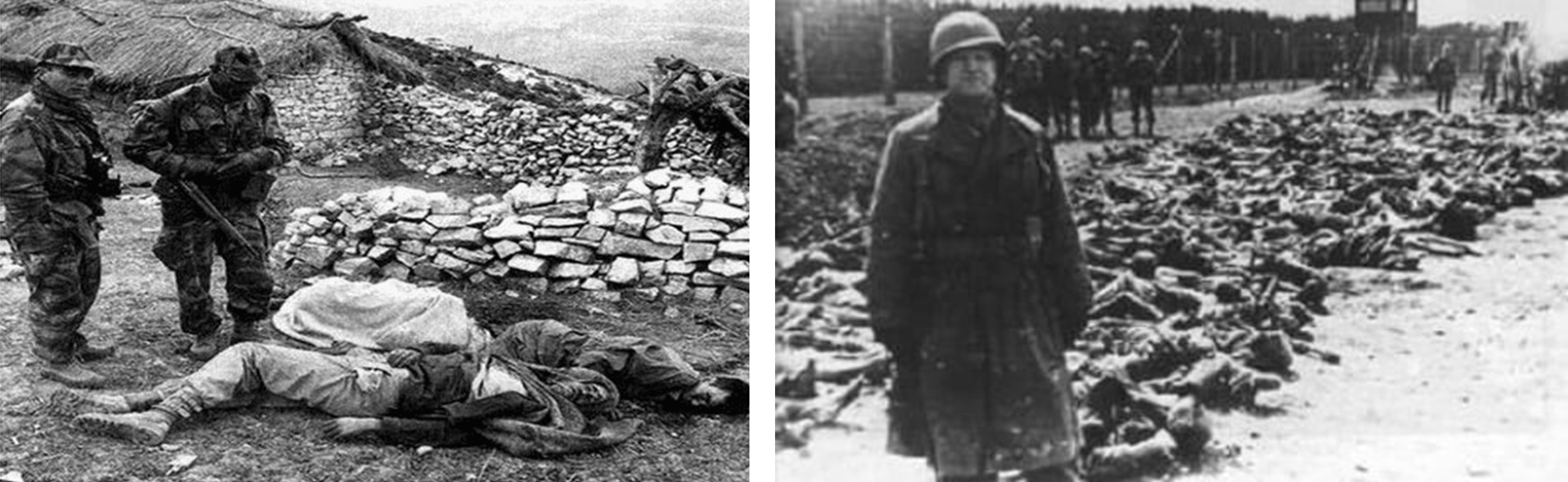
France returned to Vietnam after Japanese occupation ended and tried to reestablish colonial rule starting in 1945, leading to the French Indochina War in 1946. France attempted to maintain control of Syria and Lebanon, and even bombarded Damascus in 1945 before withdrawing under pressure. In 1947, France crushed the Malagasy Uprising in Madagascar with mass executions and an estimated death toll of up to 89,000 civilians. In 1955, France violently repressed the Union of the People’s of Cameroon’s insurrection which led to the Cameroon War.
The United Kingdom was not occupied by Germany, but WWII weakened the empire and intensified anti-colonial movements. Britain, while championing freedom and democracy in Europe, responded with major repression in several colonies. During the Mau Mau uprising in Kenya in 1952, Britain responded with detention camps, torture, executions and forced resettlement. Britain found a long counterinsurgency during the Malayan Emergency (today part of Malaysia) from 1948 to 1960; violently suppressed unrest in India before independence in 1947; and cracked down heavily on Arab militant groups during the final Mandate years in Palestine.
The Netherlands, after suffering under German occupation, launched a brutal war to retake Indonesia following its declaration of independence in 1945, carrying out massacres, executions and village burnings, notably the summary execution of 431 villagers who refused to disclose the whereabouts of Indonesian independence fighter, Lukas Kustaryo. Belgium, despite its own wartime occupation, continued its system of forced labor, racial hierarchy, and political repression in Congo. Belgium resisted meaningful Congolese political participation until independence pressures became overwhelming in the late 1950s. Portugal, while remaining neutral in WWII, intensified colonial rule and fought brutal wars against liberation movements in Angola, Mozambique and Guinea-Bissau throughout the 1960s and 1970s.
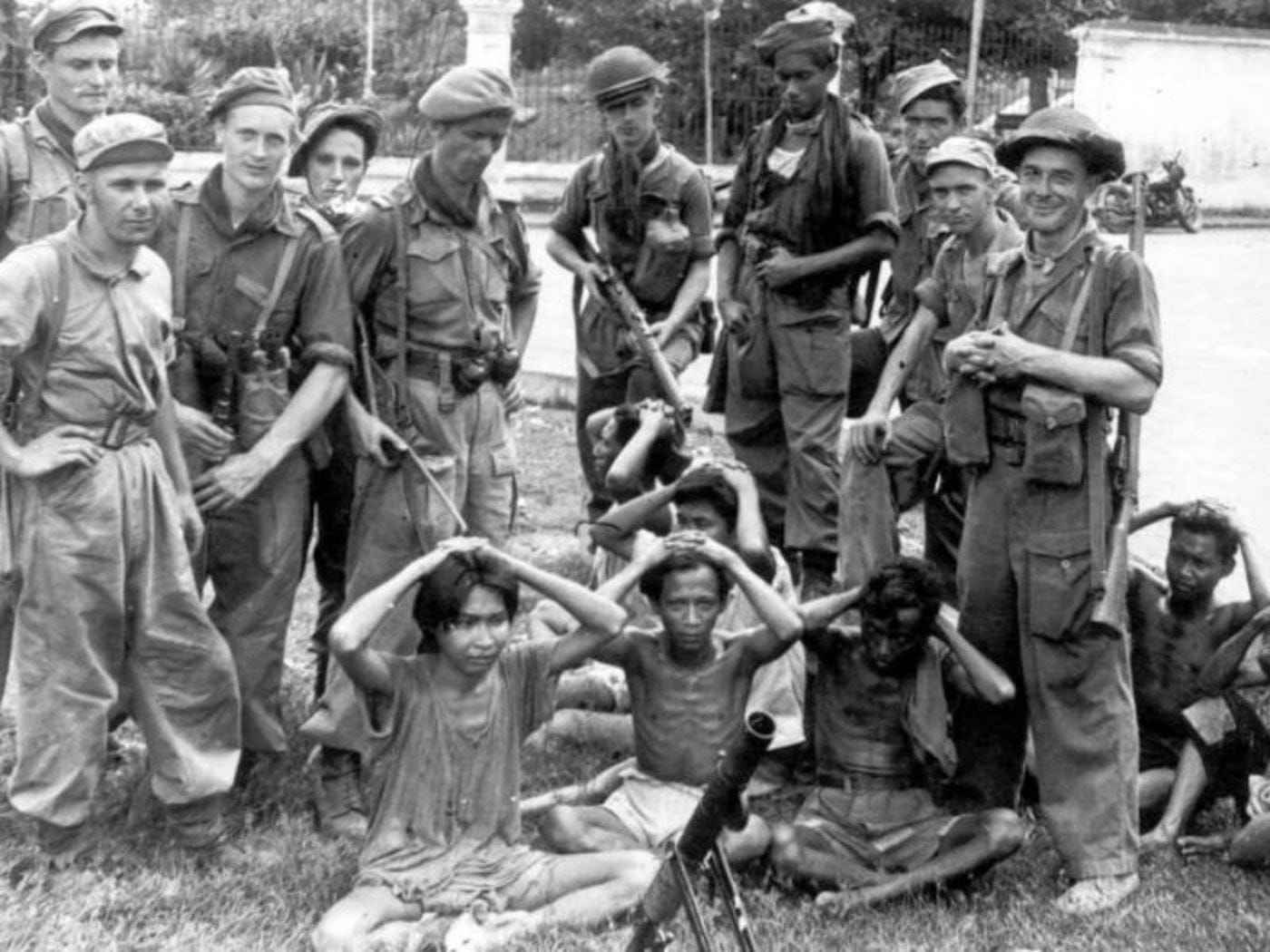
This continuity exposes the hypocrisy of the liberal postwar narrative that portrays fascism as an inexplicable deviation from humane Western civilization. In reality, methods associated with fascism—racial hierarchy, concentration camps, forced labor, collective reprisals, demographic engineering, exterminatory warfare, and dehumanization—were standard features of European colonial rule both before and after the Nazis. The postwar conduct of these states further undermines Allied moral mythology. Had the West truly rejected fascism as a system of racial domination, the defeat of Nazi Germany would have marked the beginning of decolonization. Instead, colonial wars intensified as Europe proclaimed a new era of democracy, human rights, and anti-fascism.
Anti-colonial movements across Africa and Asia were treated not as liberation struggles but as threats to European supremacy to be crushed through overwhelming force, making the distinction between liberal imperialism and fascism becomes less convincing. The powers that denounced Nazi occupation continued denying self-determination to millions of colonized people while carrying out massacres, famines, torture, and racial repression. Rather than being alien to Western civilization, fascism is better understood as one expression of political and racial logic deeply embedded in European imperial history.
The Holocaust Industry: from Cold War to Six-Day War
There is an entire industry dedicated to exploiting the memory of the Holocaust for monetary and political gain that spans publishing houses pushing out a steady stream of books, the constant production of big-budget films and TV series, high-profile documentaries on streaming platforms, and an ever-expanding network of museums and memorials.
This vast industry, as Norman Finkelstein states in his book The Holocaust Industry published in 2000, has a specific historical origin and political function. Between World War II and the late 1960s, the Holocaust took little part in the lives of Americans including American Jews, with only a small number of books, films, and works of scholarship dedicated to it. As Finkelstein stated:
Between the end of World War II and the late 1960s, only a handful of books and films touched on the subject. There was only one university course offering in the United States on the topic. When Hannah Arendt published Eichmann in Jerusalem in 1963, she could draw on only two scholarly studies in the English language Gerald Reitlinger’s The Final Solution and Raul Hilberg’s The Destruction of the European Jews. Hilberg’s masterpiece itself just managed to see the light of day. His thesis advisor at Columbia University, the German-Jewish social theorist Franz Neumann, strongly discouraged him from writing on the topic (”It’s your funeral”), and no university or mainstream publisher would touch the completed manuscript. When it was finally published, The Destruction of the European Jews received only a few, mostly critical, notices.
Not only Americans in general but also American Jews, including Jewish intellectuals, paid the Nazi holocaust little heed. In an authoritative 1957 survey, sociologist Nathan Glazer reported that the Nazi Final Solution (as well as Israel) “had remarkably slight effects on the inner life of American Jewry.” In a 1961 Commentary symposium on “Jewishness and the Younger Intellectuals,” only two of thirty-one contributors stressed its impact. Likewise, a 1961 roundtable convened by the journal Judaism of twenty-one observant American Jews on “My Jewish Affirmation” almost completely ignored the subject. No monuments or tributes marked the Nazi holocaust in the United States. To the contrary, major Jewish organizations opposed such memorialization.
— Norman Finkelstein, The Holocaust Industry: Reflections on the Exploitation of Jewish Suffering (2000)
With the Cold War, Germany had now become a major U.S. ally against the Soviet Union, the nation that contributed by far the most in defeating the Nazis and the liberation of the concentration camps. In the immediate postwar period, the leaders of major American Jewish organizations including the American Jewish Committee (AJC), World Jewish Congress (WJC), and Anti-Defamation League (ADL) understood assimilation and access to elite power to be in their own interest. Consequently, they distanced themselves from the Holocaust, moderated demands for German de-Nazification, and even collaborated with McCarthyite witch-hunts including against Jews who opposed alignment with Germany. Remembrance of the Holocaust became a “communist cause.”
These Jewish organizations opposed cooperation with anti-Nazi German social democrats, opposed boycotts of German manufactures, opposed public demonstrations against ex-Nazis touring the U.S., and even publicly condemned Martin Niemöller, who had spent eight years in concentration camps, due to him being against the anti-Communist crusade. On the other hand, they enlisted and funded right-wing extremist organizations like the All-American Conference to Combat Communism and turned a blind eye as veterans of the Nazi SS entered the country. In a twisted turn of events, these Jewish organizations instead ironically invoked the Holocaust and pinned antisemitism on the Soviet Union:
Ever anxious to ingratiate themselves with US ruling elites and dissociate themselves from the Jewish Left, organized American Jewry did invoke the Nazi holocaust in one special context: to denounce the USSR. “Soviet [anti-Jewish] policy opens up opportunities which must not be overlooked,” an internal AJC memorandum quoted by Novick gleefully noted, “to reinforce certain aspects of AJC domestic program.” Typically, that meant bracketing the Nazi Final Solution with Russian anti-Semitism. “Stalin will succeed where Hitler failed,” Commentary direly predicted. “He will finally wipe out the Jews of Central and Eastern Europe. The parallel with the policy of Nazi extermination is almost complete.” Major American Jewish organizations even denounced Soviet repression in Hungary as “only the first station on the way to a Russian Auschwitz.”
— Norman Finkelstein, The Holocaust Industry: Reflections on the Exploitation of Jewish Suffering (2000)
The 1967 Six-Day War between Israel and the coalition of Arab states “gave birth to a memorial industry.” After Israel’s victory, the American government began a friendlier strategic relationship with it, aligning with Cold War interests. In response, the interests of American Jewish leaders changed. Their organizations pivoted to openly support Israel and espouse a Holocaust ideology that emphasized the event’s uniqueness and its status as the climax of an eternal antisemitism. This ideology was cultivated to serve political ends: to defend Israel from criticism, secure financial reparations, and consolidate the influence of American Jewish institutions, fundamentally transforming the Holocaust into a central, symbolic event in the American mind.
Major Hollywood studios have turned Holocaust narratives into multi-million-dollar box office events. The publishing industry markets Holocaust memoirs and historical fiction as a perennial best-seller category, with some titles selling in the millions. Holocaust museums attract millions of visitors annually and receive substantial public and private funding. The U.S. Holocaust Memorial Museum (USHMM) alone has an operating budget exceeding $150 million a year, funded in part by the federal government and wealthy donors. The global “Holocaust remembrance” NGO sector, including the World Jewish Congress, the Claims Conference, and Yad Vashem, commands hundreds of millions of dollars in combined annual budgets, with well-paid staff and a constant calendar of high-profile fundraising galas. The double standards of the USHMM have been criticized.
As Finkelstein put it:
The first question is why we even have a federally mandated and funded Holocaust museum in the nation’s capital. Its presence on the Washington mall is particularly incongruous in the absence of a museum commemorating crimes in the course of American history. Imagine the accusations of hypocrisy here were Germany to build a national museum in Berlin to commemorate not the Nazi genocide, but American slavery or the extermination of the Native Americans.
— Norman Finkelstein, The Holocaust Industry: Reflections on the Exploitation of Jewish Suffering (2000)
Even a country as remote as Australia, with a total population of only 27 million and less than 1% Jewish, has at least eight museums dedicated to the Holocaust, with more planned to be built so that every single state and territory will eventually have one. In contrast, there is no museum dedicated to the genocide of Indigenous Australians whose population was reduced from an estimated 1-1.5 million before invasion to fewer than 100,000 by the early 1900s; only scattered exhibits within larger museums.
According to Wikipedia’s List of Holocaust memorials and museums, there are at least 360 sites in 50 countries, spanning all continents around the world except Antarctica. These include not only former Axis and Allied countries, but also nations with no involvement in the Holocaust whatsoever, such as Albania, New Zealand, Brazil, Mexico, Ecuador, Guatemala, Uruguay, Indonesia, the Philippines, South Africa, and Suriname. The majority of the countries on the list (60%) have populations of less than 10,000 Jews.
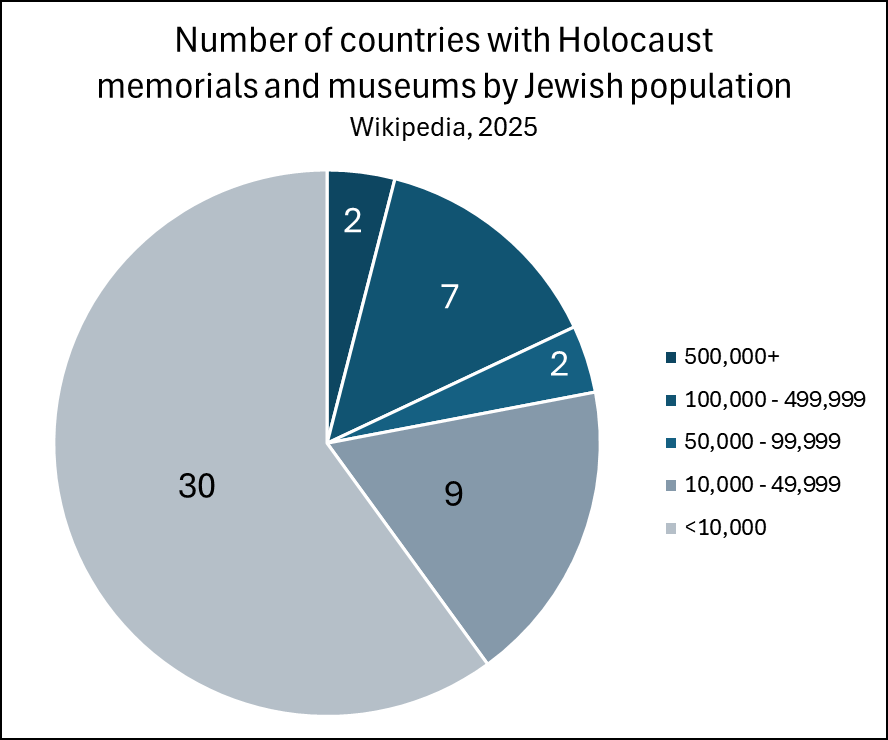
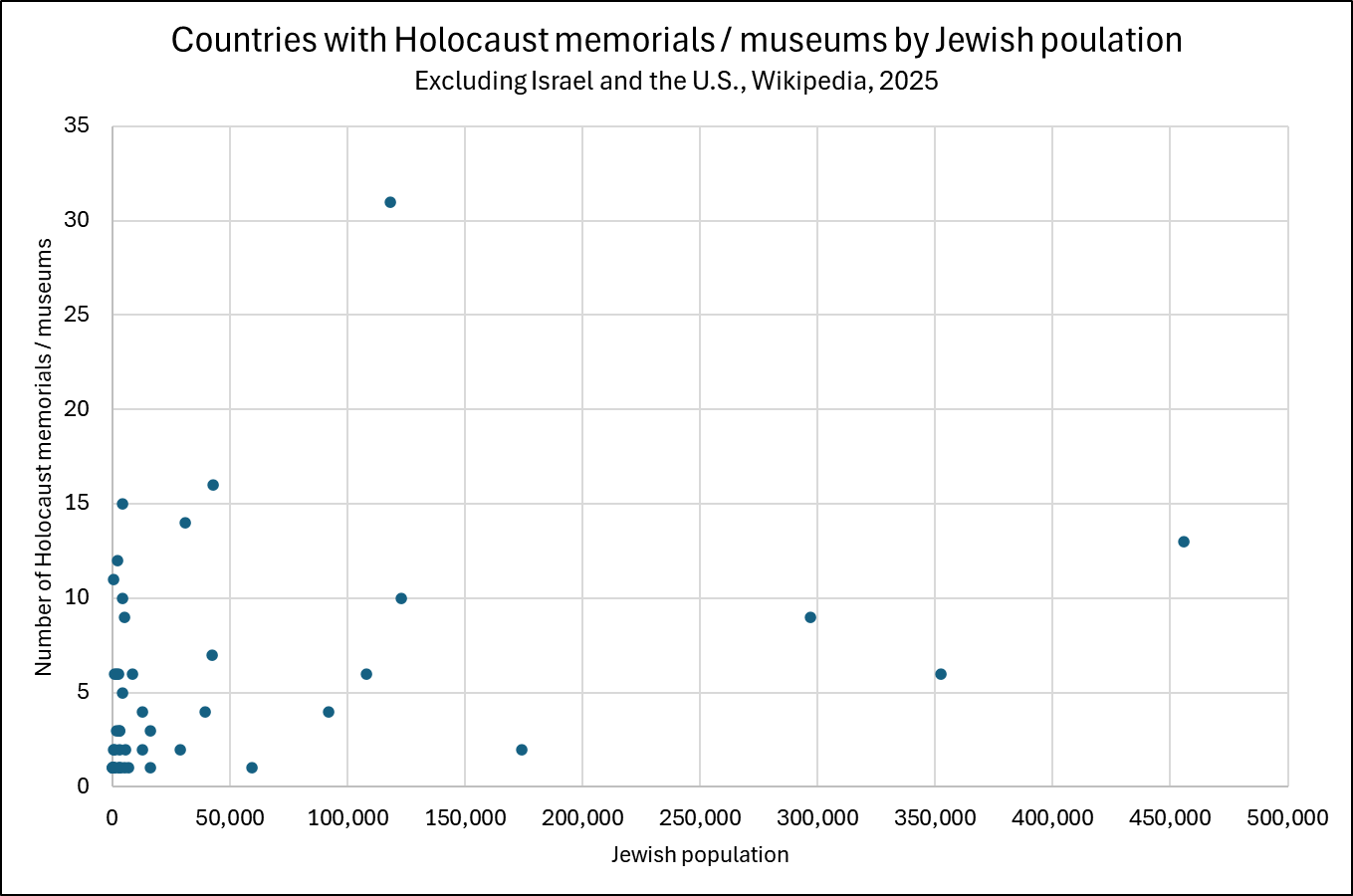
The effects of this industry are highly successful in shaping global awareness. A 2014 poll by the ADL, surveying over 100 countries, found that despite 74% of respondents saying they had never even met a Jewish person, a majority (54%) had heard of the Holocaust. The Holocaust memory industry ensures that this single genocide occupies a unique, almost sacred place in the Western moral imagination. It generates not only cultural capital but financial and political capital, reinforcing a narrative in which the Holocaust stands apart from all other atrocities. This exceptionalism is then leveraged to justify the state of Israel’s claim to moral necessity and immunity from criticism. As grandson of Holocaust victims, Gabor Maté recently summarized it:

I’m sure you’ve heard this statement before. The Hebrew word for the Holocaust is Shoah and there’s an old saying, “there’s no business like Shoah business.” It’s been exploited to the hilt and you know I’m somebody whose grandparents died in Auschwitz, who nearly ended up there myself, and I’m sick of it. I’m sick of hearing about it. Not because it didn’t happen, but because what it has been pressed into the service of. Much of the intention of the Holocaust academia has got nothing to do with trying to change the world’s relationship to cruelty and unfairness. It’s to establish a sense of Jewish exceptionalism so that we’re the perpetual victims and that everything we do is justified. Everything that’s done to us is an outrage. So teaching about the Holocaust teaches nobody anything. You can preach about morality in the service of the most nefarious causes. And that’s what we’re seeing right now.
— Gabor Maté, ‘Palestine: The Moral Issue of Our Time’ (May 25, 2025)
Institutional Jewish Exceptionalism
Jewish exceptionalism in Congress
Within the U.S. in particular, along with the Holocaust, antisemitism is put up on a pedestal as some unique form of bigotry. This idea is enforced top-down by the federal government. The U.S. Senate has had multiple hearings and legislative measures focused exclusively on antisemitism, isolating it from any other form of bigotry. This includes, but is very much not limited to:
Senate Resolution 296 to condemn antisemitism (Jun 2025)
Commission to Study Acts of Antisemitism in the United States Act (Jun 2025)
Stop Antisemitism on College Campuses Act (Mar 2025)
Columbia Act of 2025 (Feb 2025)
Antisemitism Awareness Act of 2025 (Apr 2025)
House Resolution 1449 to condemn global antisemitism (Sep 2024)
Amendment 3276 to create National Coordinator to Counter Antisemitism and Interagency Task Force (Sep 2024)
Countering Antisemitism Act (Apr 2024)
Antisemitism Awareness Act (Oct 2023)
U.S. National Strategy to Counter Antisemitism (May 2023)
HEAL Holocaust Education and Antisemitism Lessons Act (Jan 2023)
Executive Order on Combating Anti-Semitism (Dec 2019)
Global Anti-Semitism Review Act (Apr 2004)
The Southern Poverty Law Center opposed the Countering Antisemitism Act (Apr 2024), legislation passed by the House in the 118th Congress, as it not only conflates criticism of Israel as ‘antisemitism,’ but also because of its narrow approach, stating that “No one form of hate should be privileged over others. Efforts that isolate antisemitism from other forms of bigotry, such as anti-Black and anti–Asian racism and other forms of discrimination, fail to prevent and address the root causes of prejudice, hate, and bias-motivated criminal activity.” As a rough estimate, from search results for “antisemitism” on GovTrack as of August 2025 show a total of 362 bills introduced.
In contrast, other groups such as Black Americans, Native Americans, Asian Americans, and Muslims rarely get their own isolated hearings and bills. Rather they are generally lumped in with all other broader forms of hate crimes. The rare exceptions, two notable examples include the Combating International Islamophobia Act introduced in 2021 that continues to be stalled and reintroduced as of 2025; the Emmett Till Anti-Lynching Act introduced in 2018 and only signed in 2022 (67 years after the lynching of black teenager Emmet Till) after hundreds of failed attempts to pass such a bill for over a century.
Jewish exceptionalism in colleges
Following the Gaza genocide, multiple universities in the U.S. have been sued by Jewish students and organizations over claims of “antisemitism on campus” from student protests since 2023. At least three major universities have paid monetary federal settlements to Jewish students and professors, with others pending:
Columbia University agreed to pay $221 million over three years to the U.S. government to settle federal investigations into antisemitism with an additional $21 million paid to Jewish faculty and staff after the government threatened to cut $400 million in grants.
University of California, Los Angeles (UCLA) was ordered by the federal government to agree to a $6.45 million settlement, including $50,000 each to the Jewish students who sued UCLA, and an additional $2.33 million to eight Jewish organizations and $320,000 to expand initiatives to “combat antisemitism.”
Harvard University agreed to pay an undisclosed amount to Jewish students and committed to adopting the IHRA definition, enhancing anti-antisemitism policies, and providing training and oversight.
Barnard College settled a lawsuit brought by Jewish students with an undisclosed amount, including a suite of policy reforms such as banning masked protests and agreeing to not meet with pro-Palestine groups.
New York University settled a federal lawsuit with Jewish students with an undisclosed amount.
UC Berkeley, MIT, and others are facing lawsuits brought by Jewish students with some already having approval from federal judges.
Brown University came to an agreement in 2025 with the federal U.S. government to take steps to make Jewish students “feel welcome,” including outreach to Jewish day schools to inform students about applying to Brown, renewing “partnerships with Israeli academics and national Jewish organizations,” convening the campus community for a celebration of Jewish life and ensuring robust education about Israel and a thriving Judaic Studies Program. Ironically, the agreement prohibits the university from using “diversity narratives” in admissions or from trying to achieve race-based outcomes or diversity targets. Essentially, the ‘anti-DEI’ (diversity, equity, and inclusion) Trump administration is removing DEI programs but allowing an exception for Jews only. The deal is to cost the university $50 million over a decade.
Brown University, like many other American universities, was funded by the transatlantic slave trade. The university was founded by the Brown family who accrued wealth directly and indirectly from the slave trade and labor of enslaved people. It’s an Ivy League college and one of the most prestigious universities in the world, with an endowment of $7.2 billion and a budget of $1.28 billion. In 2003, the university established a steering committee to investigate these ties to slavery, and four years later, Brown agreed to fund $10 million endowment for Providence Public Schools, amounting to $400,000 to $500,000 each year. As of 2020, 17 years after the issue was brought up, only $1.9 million was raised. It should be noted that less than 15% of Providence Public Schools students are ‘Black or African American’, with the majority 67% being ‘Hispanic/Latino.’
Ranking Member of the House Education Committee Bobby Scott noted a huge disparity between the special attention brought towards ‘antisemitism’ cases in college compared to all other forms of discrimination that should all fit under the same Title VI of the Civil Rights Act of 1964. He noted that despite a mere 144 out of a total of over 12,000 open cases alleging discrimination and violation of the title were related to antisemitism, the House was holding its eighth hearing regarding antisemitism on college campuses.
Substack and X user GenXGirl1994 summarized the following based on her findings as of May 2025 in her article and thread, Manufactured Campus Antisemitism Crisis, that despite these antisemitism cases representing only 1% of the total open cases:
3,600+ students have been arrested for protesting against Israel
1,000+ student visas have been revoked for criticism of Israel
8 House antisemitism hearings have been held
20 censorship bills have been introduced

The “Rising Antisemitism Crisis” Hoax
Another core tenet of Zionism and Jewish exceptionalism alongside Holocaust exceptionalism is the propagation of the notion that Jews are not only the most historically persecuted people, but also the primary victims of contemporary prejudice and hardship. The aim of this framing is to reinforce the idea that Israel is the only true safe haven for Jews, and therefore must be preserved and supported. This narrative, which presents antisemitism as uniquely enduring and ever-escalating, is widely propagated by Western media and, at times, echoed by well-meaning anti-Zionists. Many uncritically accept the claim that Jews today are an oppressed group and that antisemitism is on the rise, yet there is little concrete evidence to substantiate this.
The Israel lobby and “incident” trackers
Prominent media and institutional voices often cite explicitly pro-Zionist sources without critical examination. Organizations such as the Anti-Defamation League (ADL) and American Jewish Committee (AJC) in the U.S., the Campaign Against Antisemitism (CAA) and Board of Deputies of British Jews in the UK, and the World Jewish Congress (WJC) and European Jewish Congress (EJC) in Europe are advocacy groups that use the pretext of combating antisemitism to advance Zionist agendas. These groups frequently commission surveys and reports claiming a global “rise in antisemitism.”
The most notorious of these groups is the ADL, an anti-communist organization that supported apartheid in South Africa and opposes intermarriage between Jews and non-Jews, yet masquerades as a “civil rights advocacy group.” The organization recently made the bombastic claim that 46% of adults worldwide, roughly 2.2 billion people, hold significant antisemitic beliefs, more than double their survey from a decade ago, and maintains an “Incident Tracker” logging alleged antisemitic events.
Closer inspection reveals that many reported “incidents” are just criticism of Israel rather than hostility toward Jews. Their incident tracker logs protests, social media posts, and academic debates about Israel as “antisemitic incidents.” The ADL’s recent reports, for instance, included over 3,000 incidents since October 7, with roughly two-thirds linked to rallies or statements opposing Israel’s actions in Gaza. Analyses from Jewish Currents and Mondoweiss have noted that the ADL’s methodology has expanded to include virtually any criticism of Israel as antisemitic. Demonstrations organized by groups like Students for Justice in Palestine are often counted as antisemitic. The main point of such manipulative tactics is to artificially inflate the perception of a global crisis.
By framing political criticism as antisemitism, pro-Israel organizations amplify fear, portray Jews as perpetually endangered, and justify political and financial support for Israel. The so-called “rise in antisemitism” is less a reflection of actual societal hatred and more a product of a campaign designed to conflate anti-Zionism with anti-Jewish prejudice in the face of a reality where more people are being exposed to Israel's crimes and true nature.
Analyzing the FBI hate crime statistics
Some people rightfully call out these sources for being biased and agenda-driven, and instead point to FBI statistics that show Jewish people over-represented in religion-based hate crimes as evidence of widespread antisemitism and systemic oppression. But a few key things need to be clarified as this is not a strong argument for antisemitism supposedly being a rampant, pressing issue as it may seem.
First, religion-based hate crimes make up only about 20% of total reported hate crimes between 2020 and 2025. Race / ethnicity-based hate crimes make up over 55% of the total.
Second, this is just ‘reported’ hate crimes. Studies have shown that trust of the police differs significantly among different groups of people, with white people being far more likely than Black or Hispanic people to initiate contact with the police. Within the US, a staggering 92% of Jews identify as white; with a significant portion of the remainder still identifying as white and another race. Other religious minority groups largely belong to non-White demographics, hence they're less likely to approach the police than White people.
It should be noted that for Anti-Hispanic / Latino, Black, Gay and Arab hate crimes, assaults* make up between 53% and 35% of total reported crimes by type, compared to only 10% for the reported Anti-Jewish hate crime incidents, with the vast majority being Destruction / Damage / Vandalism of Property and Intimidation. In a document from November 2024, the explicitly Zionist WJC stated that “While not explicitly adopting the IHRA definition, the FBI classifies antisemitism under the broader category of bias-motivated hate crimes, aligning with the principles of the IHRA definition.”
*NOTE: Offense Categories were created by merging 70+ Offense Types into 5 major categories, for example ‘Assault’ includes Simple Assault, Aggravated Assault, Rape, Manslaughter, etc.; ‘Theft’ includes Robbery, Larceny, Motor Vehicle Theft, etc. All other Offense Types that didn’t fit into the four others is lumped into ‘Other’.
It should also be noted that this same FBI data also shows that there are more cases of Anti-White hate crime reported than Anti-Hispanic / Latino hate crime within the same period, which further proves that this data is heavily skewed and that white people are more comfortable engaging with law enforcement.
When isolating the data to just “Anti-Jewish” hate crimes reported to the FBI, there’s a very obvious spike right after October 2023, with the months of October to December 2023 being particularly high. In fact, it is the period with the highest reports of Anti-Jewish hate crimes in the entire online FBI Crime Data Explorer database available from January 1991. This is also reflected in the overall reporting of religion-based hate crimes being particularly high at 35% with the Anti-Jewish hate crime reports contributing the most with the total reported hate crimes during this period being 27% Anti-Jewish, higher than even the Anti-Black or African American reported hate crimes at 21%.
However, even within this period of the highest number of Anti-Jewish hate crimes reported since 1991, assaults once again make up less than 10% of the total with Destruction / Damage / Vandalism of Property and Intimidation still being the vast majority of reported incidents.
In 2024, a special joint committee was established in Israel to “commemorate the lives of non-Israeli Diaspora Jews who were killed in antisemitic attacks.” Based on figures from the Jewish Agency and the World Zionist Organization, only 155 non-Israeli Jews have been murdered abroad between 1958 and 2024, an average of less than 3 per year. For comparison, Open Doors, a Christian organization that publishes research on the persecution faced by Christians worldwide, reported that between 4,700 and 5,620 Christians were killed for faith-related reasons each year between 2021 and 2024, with an average of around 5,320 per year. Per capita, that equates to about one in every 430,000 Christian vs one in every 3.6 million non-Israeli Jew.
Fringe rhetoric vs top-down policies
Another phenomenon that is often pointed to as a sign of rising danger for Jews, and why antisemitism is treated as uniquely important, is the supposed increase in far-right rhetoric and politics becoming public, including among mainstream politicians in the West. But the reality is that this fascist revival directs its actual structural power elsewhere. In the United States, top-down rhetoric from political leaders and right-wing media targets immigrants, especially those from Latin America, and Muslims, often framing them as cultural threats or security risks. These narratives translate directly into policy: immigration enforcement that tears families apart, mass deportations, detention centers, and the 2017 “Muslim Ban” barring entry from several Muslim-majority countries. Training for the New York Police Department categorized the Keffiyah and watermelon as “antisemitic symbols.”
In Europe, mainstream far-right parties focus relentlessly on Muslims and non-white immigrants from Africa and the Middle East, portraying them as incompatible with “national identity.” That rhetoric is matched with policy: immigration caps, violent border push-backs, and asylum deterrence schemes; bans on the hijab in French schools; Switzerland’s prohibition on minarets; and other “secularism” or “integration” laws that specifically restrict Muslim religious expression. Roma communities, too, face systemic police harassment, forced evictions, and discriminatory residency rules across multiple European countries.
Zionist anti-Palestinian groups including Canary Mission and the proudly Islamophobic Betar USA, a group considered too extreme even by the Zionist ADL, have direct ties to the U.S. government and Trump administration officials. Betar USA’s spokesperson Daniel Levy and organization leader Ross Glick have submitted “thousands of names” of students and faculty involved in pro-Palestinian activism to high-ranking officials, including Secretary of State Marco Rubio, White House homeland security adviser Stephen Miller, and Attorney General Pam Bondi. Furthermore, Glick detailed meeting with lawmakers on Capitol Hill, including Democratic Senator John Fetterman and aides to Republican Senators Ted Cruz and James Lankford, to discuss the group’s deportation efforts. Glick stated he discussed a specific target (activist Mahmoud Khalil) with Senator Cruz in Washington D.C. just days before Khalil was arrested.
This relationship is further corroborated by internal government documents unsealed in federal court. The Department of Homeland Security’s specialized “tiger team,” tasked with identifying foreign students for deportation, actively reviewed lists of names compiled by both Betar USA and the Canary Mission. Court testimonies confirmed that these lists informed the government’s review of over 5,000 students. Canary Mission openly celebrated the arrest of Mahmoud Khalil, stating it was “delighted that our exposure of his hatred has led to such deserved consequences.” The Trump administration’s executive branch and allies in the legislative branch have actively integrated their doxxing operations and deportation lists into official policy, directly translating their extremist rhetoric into top-down state action.
Jews, by contrast, are primarily targeted by racist individuals and small extremist groups on the far-right fringes, actors who operate largely outside of formal politics and hold little to no systemic power. While antisemitic rhetoric can and does surface in speeches or coded references to “globalists,” this remains qualitatively different from the institutional, top-down marginalization inflicted on Muslims, immigrants, and other minorities. Random social media influencers do not have the same structural reach as a government writing discrimination into law. For Jews, far-right hostility is mainly a matter of words; for others, it is a matter of law.
Jews do not suffer from police brutality, housing discrimination (redlining), employment bias, underfunded public services, wage gaps, mass incarceration, an unjust legal system, etc. As Norman Finkelstein recently put it:

First of all, there was an era in which one calculated antisemitism not by a person's thoughts, because you can't control a person's thoughts. […] When you talked about antisemitism, it meant: Does it affect your job opportunities? Does it affect your access to certain institutions of higher education? Does it affect where you're going to live? Does it affect negatively your interactions with the law? That's what antisemitism meant. They were quantifiable, palpable, lucid expressions of this phobia—whatever you want to call antisemitism.
By that reckoning, can you name me a place in the United States where a Jew would have trouble purchasing a home or renting an apartment? […] Can you name me one university, one college in the whole United States where a Jew would have trouble getting in because he or she was Jewish? […] Could you name me one profession? Does the medical profession discriminate against Jews? Does the legal profession? I mean, that was once a problem. That's why Jewish law firms were created because they couldn't get into the white-shoe WASP law firms. Does that exist anymore?
So, this is just completely and totally ridiculous to talk about antisemitism in the United States. On the contrary, being Jewish gets you into professions. It's an asset in our society. In publishing, being Jewish makes a big difference. You know what they used to call the New York Review of Books? They called it the New York Review of Each Other's Books, and they were all Jewish.
— Norman Finkelstein, Is There Rampant Anti-Semitism in the United States? (2025)
Modern antisemitism primarily exists as rhetorical criticism and occasional violent attacks like synagogue shootings. These incidents, while tragic, do not equate to systemic oppression. True antisemitism is a minor issue compared to the structural racism faced by Black people, Indigenous peoples, immigrants, Muslims, Palestinians, and other racial minorities and colonized peoples worldwide.
Ironically, the only place where some Jews might experience systemic hardship is within Israel itself, where Middle Eastern / North African Jews (Mizrahi) and particularly Ethiopian Jews (Beta Israel) face discrimination from European Jews (Ashkenazi) and the government. However, this is not antisemitism, it’s standard European-inspired racial hierarchy that is prevalent all over the world, particularly the West.
Of course, it should go without saying that Palestinians, or “Israeli Arabs” as they’re officially called, are at the absolute bottom rung of this totem pole below everyone else. Israel is still a Jewish supremacist project run by Jews for Jews at the expense of non-Jews. There is a racial hierarchy from Ashkenazi to Sephardic to Mizrahi to African, but all of these groups are still superior to non-Jews in the eyes of the Israeli government and society. They all enjoy rights over Palestinians. Israel is white supremacist, but it’s first and foremost Jewish supremacist. Israeli propagandists, particularly the more “liberal” leaning ones who are trying to reach a Western audience, love jumping at the opportunity to show off how multicultural their army is; that Ethiopian Jews get the chance to commit genocide against Palestinians along with their Ashkenazi counterparts.
Jews vs Roma: Perceived vs Real Marginalization
It should be emphasized that, both historically and in the present day, Romani people in Europe have been treated worse than Jews. While Jews endured expulsions, pogroms, and restrictions on occupations, Romani communities were subjected to centuries of chattel slavery in parts of Eastern Europe, from their arrival in the 13th–14th centuries until the mid-1800s.
Although Jews were segregated and scapegoated, they were generally permitted to form semi-stable communities. Romani people, by contrast, were criminalized as a people, denied the right to settle, and often treated as permanent outsiders. As Jews gradually gained emancipation starting in the late-1700s, many were able to assimilate into middle-class society, pursue higher education, and achieve positions of prominence in Europe. Romani people, however, remained systematically marginalized, excluded from these paths of advancement even after the official end of their enslavement in 1856.
Up to 75% of Europe’s Romani population was exterminated by the Nazis. While Jewish survivors received immediate recognition and unprecedented reparations from multiple governments, organizations and private corporations around the globe, Romani survivors have received nothing from Germany, nor any other government or major organization, and have never been compensated for centuries of slavery or for their genocide under the hands of the Nazis.
Today, Romani communities remain among the most marginalized populations in Europe, facing persistent poverty, discrimination, segregation, and institutional exclusion, often classified as ‘third-class citizens.’ An Amnesty International report from 2011 stated that “systematic discrimination is taking place against up to 10 million Roma across Europe. The organization has documented the failures of governments across the continent to live up to their obligations.” According to an EU Agency for Fundamental Rights (FRA) Roma Survey 2024 survey of Roma and Travellers in the European Union:
70% live in poverty, compared to 16% for the general population
47% live in poor housing or without proper sanitation compared to 18% for the general population; 83% live in overcrowded housing
53% attend early education and 32% finish upper education compared to 95% and 84% for the general population
54% have paid work, compared to 75% for the general population
36% experience discrimination when seeking work, more than double 2016
Public attitudes mirror these structural barriers. Anti-Roma prejudice, often termed antiziganism, is deeply rooted across Europe and shapes both policy and everyday interactions. Polling by Pew Research illustrates the severity of this hostility towards Roma people in Europe. Surveys conducted in 2014, 2016 and 2019 shows consistent patterns in European attitudes toward Roma and allow for direct comparison with views of Jews. Across between seven and sixteen countries surveyed, the median results show 48-53% median unfavorability toward Roma and 16-18% median unfavorability toward Jews.
By the most recent 2019 poll, a majority of countries surveyed (10 out of 16) held a net negative view of Roma people, with a median of 53% unfavorable responses. The least negative result was recorded in the UK at 23%, which still represents nearly a quarter of respondents.
By contrast, no country surveyed in 2019 held a net negative view of Jews. The highest level of unfavorability toward Jews was recorded in Greece at 38%, which remains lower than the median unfavorability toward Roma people. This contrast highlights the uniquely severe and widespread nature of anti-Roma sentiment in Europe. These attitudes reinforce stereotypes portraying Roma as criminals or burdens on society, influencing everything from hiring decisions to state policy.
Education systems across Europe also reproduce inequality. A study commissioned by the European Union and Council of Europe under the Inclusive Schools: Making a Difference for Roma Children (INSCHOOL) project found that Roma children are disproportionately placed in “special schools” or classes for students with mild disabilities, even when they do not meet the required criteria. This practice lowers academic expectations and severely limits future opportunities. In some countries, Roma children are concentrated in schools with predominantly Roma student populations that suffer from inadequate funding, poor facilities, and shortages of qualified teachers. Even within mainstream schools, Roma students are frequently streamed into separate or majority-Roma classes. This educational segregation, often closely linked to segregated housing, restricts social mobility and entrenches cycles of exclusion.
Political and institutional failures further deepen these disparities. Anti-Roma sentiment regularly surfaces in mainstream politics, media narratives, and law enforcement practices. Legal protections against discrimination are inconsistently enforced, while top-down policies in some cases actively reinforce segregation or restrict Roma access to housing, education, and public services. These patterns reflect not only the legacy of centuries of persecution, but also Europe’s ongoing failure to confront and dismantle entrenched antiziganism.
Despite these realities, Jews are often portrayed as the uniquely and eternally hated victims of European history, while the ongoing marginalization of Roma people is sidelined. Antiziganism is rarely treated with comparable seriousness, even as antisemitism receives sustained attention across politics, education, media, and popular culture, including major film and entertainment industries.
Arabs and Muslims: The Real Victims of Modern Antisemitism
The term antisemite was originally coined in 19th-century Europe to mark Jews as “Semitic,” implying they were closer to Arabs than Europeans, and therefore incapable of assimilation. At its root, antisemitism was always about racializing Jews as outsiders. Today, Palestinians and more broadly Arabs and Muslims are subjected to precisely this logic, with many of the same stereotypes once applied to Jews now recycled against them.
A respectable form of bigotry
Much of the imagery once directed at Jews—depicting them as dangerous outsiders, incapable of loyalty to the nation, demographic invaders, or threatening European “civilization”—is now applied wholesale to Muslims and Arabs. Where antisemitism once painted Jews as a fifth column for Bolshevism or “international finance,” Islamophobia frames Muslims as agents of terrorism, Sharia infiltration, or demographic “replacement.” Some even go far as to claim that Muslims and Arabs are part of a string-pulling global conspiracy. The underlying logic is identical: Jews and now Muslims are portrayed as an internal enemy undermining the nation from within, both racially and culturally unassimilable.
These narratives are not confined to the fringes; they are reinforced from the very top down. In the U.S., the “War on Terror” normalized mass surveillance of Muslims and racial profiling. The government openly pushed a “Muslim ban” in 2017, targeting entire countries based on religion, while simultaneously trafficking in tropes about Muslim immigrants being violent or incapable of integration. In Europe, political leaders like France’s Emmanuel Macron have advanced restrictive “secularism” laws, such as banning the hijab in schools or limiting halal slaughter, that disproportionately target Muslim communities under the guise of “integration.”
Switzerland’s ban on minarets, Austria’s closure of mosques, the UK’s surveillance-heavy Prevent strategy, and Germany’s Clankriminalität (clan crime) policing strategy that targets Arabs and Muslims by using ethnic and religious affiliation as a basis for police targeting and action all mirror the collective suspicion once aimed at Jewish communities in Europe. The nominally “left-wing,” rabidly Zionist Greens party of Germany warned that “the poison of Islam reaches people’s minds also here, not just abroad.”
Meanwhile, Jews in the West, though still occasionally targeted by far-right rhetoric or violence, are not subjected to the institutionalized policies imposed on other groups. Today, antisemitism is largely confined to fringe discourse, where Jews function as symbolic scapegoats invoked by extremists or social media agitators. By contrast, Muslims, Arabs, and migrants endure both rhetorical demonization and top-down enforced systemic repression. The distinction is clear: Islamophobia and anti-Arab racism are embedded in state laws and policies, while antisemitic tropes remain mostly rhetorical, with Jews targeted primarily by individuals on the political fringes who wield little systemic power.
Noam Chomsky highlighted this shift through his own experience as an American Jew, noting that by the 1950s antisemitism in the U.S. had been pushed underground, and Jews were gradually integrated into elite institutions. In its place emerged a new “legitimate” racism: anti-Arab and anti-Muslim bias. Unlike antisemitism, which by the late 20th century had to be hidden, hostility toward Arabs and Muslims could be expressed openly in films, books, politics, and policy:

Antisemitism is no longer a legitimate form of racism. Anti-Arab bias, is a legitimate form of racism, meaning you don’t have to hide it. In most forms of racism you have to pretend you’re not a racist, so you have to pretend ‘I’m not antisemitic, I’m not anti-Black.’ You may be, but you don’t advertise it. Anti-Arab racism, you’re allowed to advertise. This was way before September 11 […] you see it in films, in books, in attitudes, it’s just not even hidden. Nobody will come out and say, ‘I’m an anti-Arab racist,’ but it’s everywhere, and every Muslim or Arab in the country knows it.
Just to give you an illustration. Boston happens to have a big Lebanese community and while they’re not super wealthy, they have money; they’re storekeepers and businessmen and so on. In 1982, at the time of the Israeli invasion of Lebanon, which was a total, horrible atrocity, a few of us made an effort to organize a charitable relief program for people in Lebanon. We could not get any support from the Lebanese community here and I think I understand why because I remember it from childhood. I think they just don’t want to be too visible, and I think that’s understandable. I can’t prove that, but that’s the sense that I had. And it’s not just since September 11th, yes, it’s increased, but not only Arabs, but anybody who looks a little bit dark.
— Noam Chomsky, On Power, Dissent, and Racism: A Discussion with Noam Chomsky (2004)
Public opinion data highlights this disparity. According to a 2022 Pew Research Center poll, Americans held the second least favorable view of Muslims among major religious groups, with only 17% expressing a favorable opinion and 22% an unfavorable one, resulting in a net favorability of -5 points. This placed Muslims just ahead of Mormons for the least positive perception. In stark contrast, Jews were viewed most favorably, with 35% holding a favorable view and only 6% unfavorable, yielding a net favorability of +28 points—the highest of any group and more positive than views of Protestants by 8 points.
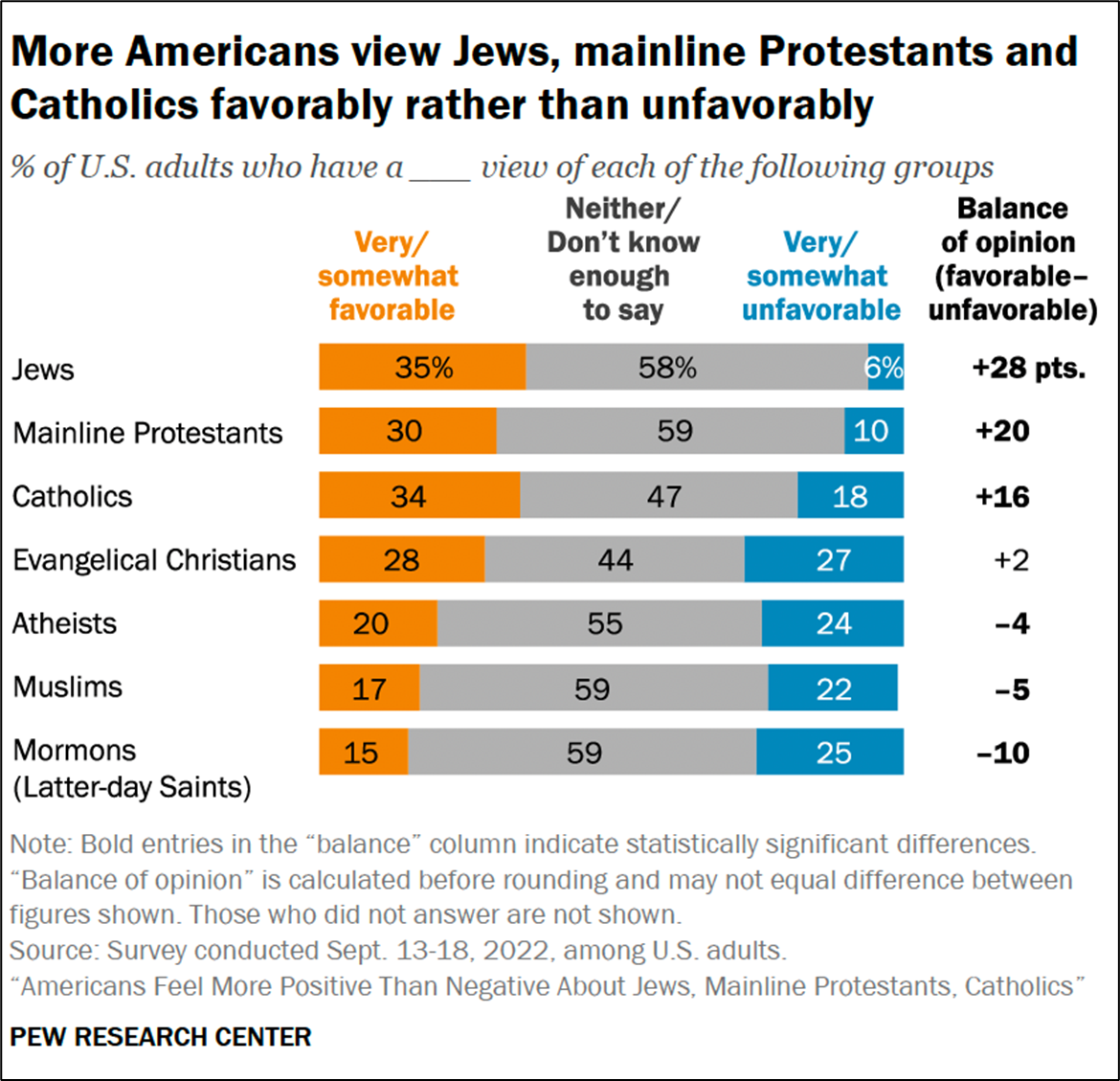
Polling by Pew Research shows consistently higher unfavorability toward Muslims than Jews across Europe across the surveyed years in 2014, 2016 and 2019. In the most recent 2019 survey, 44% of the 16 countries polled held a net negative view of Muslims, with a median unfavorability of 35%. By contrast, no country held a net negative view of Jews.
In polls conducted of Australians in 2025 by the Scanlon Foundation Research Institute, 29% of adults had positive views of Jews with 15% negative, while only 16% of adults had positive views of Muslims and 35% had negative views, the highest negative score of any other religious group by 17 points.
This openly negative attitude toward Muslims is evident among both the general pubic and politicians in the West with countless major U.S. political figures being openly Islamophobic and anti-Palestinian.
“Islamo-fascism” and “Islamo-leftism”
The mainstreaming of Islamophobia has not only come from the far-right, but also from intellectual currents that once positioned themselves as progressive. The “New Atheist” movement of the 2000s—figures like Sam Harris, Richard Dawkins, and Christopher Hitchens—rose to prominence mainly by challenging Christian dogma, but quickly shifted their focus toward Islam as a uniquely violent and backwards religion incompatible with ‘Western Civilization’. Harris notoriously defended racial profiling of Muslims at airports and suggested Muslim immigrants were incompatible with liberal societies; Dawkins infamously stated that “Islam is the greatest force for evil in the world today;” and Hitchens openly supported the Iraq War under the banner of confronting “Islamofascism,” a term that even then-US President George W. Bush used.
Ironically, these thinkers also express Zionist sympathies and are critical of the Palestinian resistance, casting Israel as the rational bastion against an irrational Muslim world; essentially reviving colonial binaries of civilized versus barbaric under the guise of secularism and reason. Harris blames the violence of the Israeli forces on the Palestinians during the 2014 war on Gaza, painting it as a tragic necessity, and explicitly labelled the Israeli genocide against Gaza in 2023 as a battle between “savagery and civilization.” Dawkins signed an open letter in support of Israel’s supposed right to self-defense and claimed the student protests against Israel were driven by antisemitism. Even Hitchens, who was highly critical of Israel and even called himself an “Anti-Zionist,” claimed that the Palestinian cause was ‘hijacked’ by ‘jihadists’ aligned with Hezbollah and Syria, and that not even a two-state solution would solve the “jihadist problem.”
Daniel Dennett, while not having shown direct affinity towards Israel and Zionism or written extensively about the issue, nevertheless reduced the matter to a religion issue with blame being pinned on Palestinian society in particular. In his 2006 book Breaking the Spell, he wrote about Palestinian lawyer and activist, Raja Shehadeh “Palestinian society, if Shehadeh is right, is beset with a virulent case of the ‘punish those who won’t punish’ meme … [W]e mustn’t assume that policies that are benign in our own culture will not be malignant in others.” In the book, he also talks positively about “working to secure peaceful coexistence for Palestinians and Israelis.”
As political conditions change, the language used to define enemies changes with them. Old conspiratorial frameworks are rarely abandoned; they are repackaged for new targets. The rise of the term “Islamo-leftism” is best understood in this light: not as a neutral analytical concept, but as a contemporary mutation of older reactionary tropes, most notably “Judeo-Bolshevism.” After the post-9/11 term “Islamo-fascism” began to lose its usefulness, “Islamo-leftism” emerged as a more politically flexible construct. Unlike Islamo-fascism, which framed Muslims primarily as a security threat, Islamo-leftism explicitly fuses Islam with left-wing politics, allowing both to be attacked at once. The resemblance to Judeo-Bolshevism is clear: in both cases, a racialized or religious minority is depicted as the hidden force corrupting the left and undermining the nation.
The concept was coined and popularized in French political discourse, where it quickly became a polemical weapon. Pierre-André Taguieff, often described as an “antisemitism expert,” is widely credited with introducing the term. In practice, it functioned as a catch-all accusation aimed at anti-racists, anti-imperialists, critics of Israel, and anyone refusing to treat Muslims and immigrants as civilizational threats. Opposition to Zionism or Israeli state policy was routinely re-framed as evidence of an “unholy alliance between Islamism and the left.” Far from being marginal, the term was promoted by influential networks such as the Cercle de l’Oratoire and taken up by mainstream politicians, journalists, philosophers and academics. Even French politicians have invoked the term to justify state scrutiny of universities and academic fields such as post-colonial studies.
Closely related ideas like the supposed “red–green–brown alliance” which claims a convergence of leftists, “Islamists”, and the far right have further collapsed left-wing solidarity with Muslims and Palestinians into complicity with extremism, transforming anti-racism and anti-colonialism into security concerns rather than political positions. As with Judeo-Bolshevism in interwar Europe, the function of Islamo-leftism is to scapegoat a minority in order to discredit the left itself. Where Jews were once cast as the architects of conspiratorial socialist subversion, Muslims are now portrayed as radicalizing the left from within. This narrative externalizes social conflict, deflects attention from capitalism, imperialism, and state power, and shifts political debate rightward.
Combined with state policies and Zionist lobbying, this has entrenched a worldview where Islamophobia and anti-Arab racism now play the same role that antisemitism once did: a “respectable” prejudice, rationalized through culture, politics, and intellectual life. In this sense, antisemitism has not disappeared, it has shifted targets. The same ideological framework that once cast Jews as dangerous outsiders is now applied to Arabs, Muslims, and Palestinians. But unlike contemporary antisemitism, which is mostly rhetorical and fringe, this “new antisemitism” against Arabs and Muslims is systemic, backed by legislation, wars, and surveillance.
The Zionist Islamophobia Industry
In early 2024, reporting revealed that Israel’s Ministry of Diaspora Affairs was funding a multi-million-dollar influence campaign centered on spreading Islamophobic content. The operation targeted U.S. lawmakers and African American politicians in particular relying heavily on AI-generated material to produce large volumes of deceptive online messaging.
Later leaks showed that Israel’s Ministry of Foreign Affairs had also commissioned extensive reputation research in the U.S. and Europe, carried out by the American polling firm Stagwell Global. The firm was founded by Mark Penn, a major donor to AIPAC who has political ties to Likud through his work on Menachem Begin’s campaign. Although the research found that most respondents held negative views of Israel and accepted Gaza casualty figures reported by the Gaza Health Ministry, one conclusion stood out: respondents were highly receptive to fear-based messaging about “radical Islam” and “jihadism.” The findings suggested that amplifying Islamophobic narratives was viewed as far more effective in neutralizing criticism of Israel than direct pro-Israel advocacy.

The overlap between Zionist organizations and Islamophobia promotion in politics dates back to much earlier. A 2011 investigation by the Center for American Progress (CAP) exposed a tightly networked group of seven major U.S. foundations responsible for pumping over $42.5 million into the “Islamophobia network” promotion industry during the period studied from 2001 to 2009. A follow-up analysis of those same seven donors uncovered that they contributed nearly $11 million to pro-Israel and Zionist causes during roughly the same period, with at least four foundations acting as major funders for both agendas.
This alignment also manifests in on-the-ground political campaigns. As documented by a 2013 Mondoweiss investigation, pro-Israel groups played a central role in sustained anti-Muslim campaigns, such as those to block the Islamic Society of Boston Cultural Center and to dismantle New York’s Khalil Gibran International Academy (KGIA), the nation’s first Arabic dual-language public school. These campaigns mobilized a network that included figures like Steven Emerson, founder of The Investigative Project on Terrorism, and Charles Jacobs, a co-founder of the pro-Israel group CAMERA and founder of the hasbara group The David Project.
Jacobs’s organization, which evolved into Americans for Peace and Tolerance (APT), spearheaded the Boston campaign by framing the mosque project as a “Muslim Brotherhood mega-mosque” and relentlessly attacking its leaders. Their strategy used fear-mongering and baseless terrorism allegations in right-wing media to portray Muslim communities as an internal threat. The campaigns gained crucial institutional credibility when mainstream pro-Israel organizations, such as the Jewish Community Relations Council (JCRC) and the Combined Jewish Philanthropies in Boston, defended the smears as a “free speech” issue, prioritizing a hardline geopolitical stance over opposing bigotry.
This playbook was also central to the 2010 campaign against the Part51 Islamic community center, erroneously dubbed the “Ground Zero mosque,” which included many of the same anti-Muslim ideologies from the anti-KGIA campaign. Former AIPAC staffer MJ Rosenberg wrote about why pro-Israel actors joined protests:
So what does this have to do with the mosque in New York? Simple. These organizations, and especially their leaders, hate and fear Muslims or, to use their term, “radical Islam.” It is not because they are instinctive bigots. It is that they believe that the more acceptance there is of Muslims here at home, the less reflexive hatred there will be for Muslims abroad. And that, in their view, reduces America’s sympathy for Israel.
— MJ Rosenberg, Inside Story: Why ADL Is Opposing Ground Zero Mosque (2010)
Pro-Israel propagandist and ‘civil rights attorney’ Brooke Goldstein, founder of the Lawfare Project and the Zioness Movement, blatantly spelled this out in a recent interview with notorious far-right Islamophobic political commentator, Dinesh D’Souza:
I always say that we’re wasting our time with pro-Israel advocacy. The goal should not be to get people to love Israel. The goal should be to form alliances against the creep of radical Islam into our Western Judeo-Christian societies because that is the real threat. You know, there’s no reason why a mother in Ohio should care about Israeli politics, but when you show that mother a video of a young girl who dresses perhaps like her daughter walking down a street in Belgium and being surrounded by 15 Muslims who are shouting and threatening to rape her and attack her because she’s not dressed in a Sharia compliant way, that is what you should be worried about. And when they say globalize the intifada, that is what they mean. Bring Sharia law and radical Islamist principles into the West. And we see this all over Europe. You know, it used to be faux pas to talk about the Sharia no-go zones throughout France. It’s happening. It’s real. There are places in France that the police can’t even go to without full armor and automatic weaponry, and they go in and they out, and it’s Sharia-compliant neighborhoods. That’s what’s happening in Michigan. That’s what they want to happen throughout the Western world, and we cannot allow this to happen. We cannot have a subset of Sharia-compliant neighborhoods within our Western democracy, because it is just not compatible with our constitutional rights.
The issue is radical Islam. And what really we should be forming are alliances between minority communities and all communities, frankly, that believe in the upholding of Judeo-Christian values against the infiltration of radical Islam. But going back to your earlier question, this should have been done 20 years ago. But because of the Islamophobia mania campaign, the coordinated and very well-funded effort to silence us, to sue us, to defame us, we couldn’t organize or talk about this. But now is the time. Now is the time to wake up and understand.
— Brooke Goldstein, Dinesh D’Souza Podcast Ep1227 (December 10, 2025)
These campaigns reveal the strategic calculus: when advocacy for Israel becomes difficult to sell on its own political merits, stoking fear of a common “Islamist” enemy becomes a potent alternative. This is part of a deliberate “pivot” whereby pro-Israel actors, finding traditional propaganda less effective, cultivate alliances with movements whose main political focus is anti-Muslim hatred. This transforms Islamophobia from a domestic prejudice into a geopolitical tool.
Conclusion
Ironically, while researching for this article, the first or second Google result for “what is systemic oppression” links to a website that curiously singles out “antisemitism” as a distinct form of systemic oppression, even though the site already includes “racism” as a broader category. Under racism, it explains:
Racism: Systemic oppression and discrimination against people from certain minority groups based on their race or ethnicity. This typically occurs in areas of education, employment, housing and healthcare.
Since Jews broadly do not fit this description today, a separate bullet point is devoted solely to them, stating:
Anti Semitism: Prejudice, discrimination and hostility against Jewish people takes many forms. Some of these include hate speech, violence, exclusion and discriminatory policies.
While antisemitism persists as a form of prejudice, it is misleading to frame it today as a unique or systemic form of oppression. The type of state-sanctioned fascist scapegoating and structural marginalization once directed at Jews is now already overwhelmingly aimed at immigrants, Black people, Muslims, Arabs, racial minorities, Palestinians, their advocates, and oppressed peoples in the global South through imperialist violence. The same fascist rhetoric and conspiracy theories that historically targeted Jews have been repurposed to justify surveillance, border militarization, authoritarian policies, and crackdowns on activism among these other groups.
Figures on the far-right may still invoke antisemitic tropes and violently target Jews, but these threats come mostly from the political fringes. Jews today are primarily at risk from racist individuals and groups outside formal politics, who hold little to no systemic power. In contrast, other marginalized groups face both this kind of individual bigotry and daily systemic violence from the state itself. Isolated acts of antisemitism do not equate to the kind of systemic exclusion or oppression Jews once endured. In fact, Jewish communities in many Western countries now enjoy significant socioeconomic stability, political inclusion, and historically unprecedented reparations, both material and symbolic, through state support and the establishment of a Jewish ethnostate. No other historically oppressed group has received such extensive redress.
For the most part, in this day and age, Jews are one of the most privileged demographics on Earth and have been for decades; it is advantageous to be a Jew. Finkelstein summarized this based on data even going as far back as 1970, drawing on a comprehensive analysis by Seymour Martin Lipset and Earl Raab:
As anti-Semitic barriers quickly fell away after World War II, Jews rose to preeminence in the United States. According to Lipset and Raab, per capita Jewish income is almost double that of non-Jews; sixteen of the forty wealthiest Americans are Jews; 40 percent of American Nobel Prize winners in science and economics are Jewish, as are 20 percent of professors at major universities; and 40 percent of partners in the leading law firms in New York and Washington. The list goes on. Far from constituting an obstacle to success, Jewish identity has become the crown of that success. Just as many Jews kept Israel at arm’s length when it constituted a liability and became born-again Zionists when it constituted an asset, so they kept their ethnic identity at arm’s length when it constituted a liability and became born-again Jews when it constituted an asset.
— Norman Finkelstein, The Holocaust Industry: Reflections on the Exploitation of Jewish Suffering (2000)
Framing Jews as the eternal enemies of fascism or as exceptional victims misrepresents current realities and misdirects the focus of anti-oppression work and liberation struggles. While many are busy fearmongering about how capitalist nations might turn to fascism in a future crisis and scapegoat Jews, the reality is that capitalist and fascist forces are already targeting other communities in exactly this way. Much of the fear around “rising antisemitism” and hypothetical future scenarios functions less as a response to genuine systemic conditions and more as a political tool, often weaponized by Zionist interests to deflect criticism of Israel or suppress solidarity with Palestinians. Leftists must stop ceding ground to this manipulation, constantly apologizing or over-qualifying their critiques out of fear of being labeled antisemitic. That accusation no longer reflects real power dynamics; it has become a rhetorical shield against dissent.
In this context, antisemitism is the racism of the rich; the bigotry of the bourgeoisie. Not only are Jews disproportionately represented in the richest and most powerful individuals in the world, but by global standards, Jews as an entire demographic are at the top bracket economically, socially, and embedded within upper white colonial society, giving antisemitism discourse access to resources actual marginalized groups lack. It is backed by multi-million-dollar advocacy organizations, lobbying networks, legal infrastructures, think tanks, media platforms, and direct state support. These mechanisms are not sustained solely by wealthy Jews, but through a broader elite coalition, including Western governments and institutions with a vested interest in promoting Zionism.
While Islamophobia, anti-Black racism, anti-Roma racism, and anti-Indigenous racism are routinely ignored or normalized, antisemitism is elevated into a civilizational crisis, often detached from material realities and repurposed for geopolitical goals. Criticism of Zionism is re-framed as racial hatred, while Muslims and other marginalized groups are cast as threats rather than victims. In this sense, antisemitism discourse no longer primarily protects a vulnerable minority, but serves to police dissent, shift politics rightward, and demonize any criticism of Israel. Where Jews were once scapegoated to discredit the left, Muslims now occupy that role, while Jews, through wealth, integration, and state alignment, are positioned as guardians of the existing order.
Treating antisemitism as exceptional or categorically distinct from other forms of oppression distorts the broader struggle against injustice. Even mainstream educational materials reinforce this skewed perspective, often placing antisemitism in a separate category while ignoring the fact that Jews no longer fit the profile of racially or economically marginalized groups. Contemporary power does not treat all discrimination equally, but our analysis should. Recognizing these shifts is not a denial of history; it is a necessary and honest update. Solidarity must be based on present-day realities and unaddressed material injustices, not outdated frameworks.
Further Reading
Zionism Dominates Jewish Organizations
Burley, S. (2024, October 1). U.S. Jewish Institutions Are Purging Their Staffs of Anti-Zionists. In These Times. https://inthesetimes.com/article/anti-zionist-israel-gaza-jewish-institutions
Finkelstein, M. (2026, May 14). Synagogues that sell stolen Palestinian land should, of course, be protested. Mondoweiss. https://mondoweiss.net/2026/05/synagogues-that-sell-stolen-palestinian-land-should-of-course-be-protested/
Rose, T. (2026, June 17). Israel Inescapable, Part I: The Synagogue. Long Liberation Day. https://liberationday.substack.com/p/israel-inescapable-part-i-the-synagogue
Zionism: A Project of the Rich, not Refugees
Schölch, A. (1992). Britain in Palestine, 1838–1882: The roots of the Balfour policy. Journal of Palestine Studies, 22(1), 39–56. https://doi.org/10.2307/2537686
Brenner, L. (2002). 51 Documents: Zionist Collaboration with the Nazis. Barricade Books.
Alroey, G. (2014). An Unpromising Land: Jewish Migration to Palestine in the Early Twentieth Century. Stanford University Press. https://doi.org/10.2307/j.ctvqsdkjh
Nir, Y. (2021). Immigration to Palestine during the British Mandate (1922-1948). Cambridge Scholars Publishing.
Greenstein, T. (2022). Zionism During the Holocaust: The weaponisation of memory in the service of state and nation. New Generation Publishing.
Foster, Z. (2024, October 15). Was Zionism about Rescuing Jews Fleeing Persecution? No. Palestine Nexus. https://palestinenexus.com/articles/was-zionism-about-rescuing-jews-fleeing-persecution-no
Foster, Z. (2025, November 6). The eugenist history of the Zionist movement. Palestine Nexus. https://palestinenexus.com/articles/eugenicism
Holocaust Exceptionalism
Ophir, A. (1987). On Sanctifying the Holocaust: An Anti-Theological Treatise. Tikkun 31(3), https://muse.jhu.edu/article/626029
Kelley, R. D. G (1999, November). A Poetics of Antocolonialism. Monthly Review, 51(6). https://monthlyreview.org/articles/a-poetics-of-anticolonialism/
Césaire, A. (2000). Discourse on Colonialism (J. Pinkham, Trans.). Monthly Review Press. (Original work published 1950)
Finkelstein, N. (2000). The Holocaust Industry: Reflections on the Exploitation of Jewish Suffering. Verso Books.
Mann, M. (2004). Fascists. Cambridge University Press. https://doi.org/10.1017/CBO9780511806568
Klein, S. (2025). The Growing Rift between Holocaust Scholars over Israel/Palestine. Journal of Genocide Research, 1–21. https://doi.org/10.1080/14623528.2024.2448061
Lentin, A. (2025, December 28). Understanding the relationship between Zionism and Fascism. Mondoweiss. https://mondoweiss.net/2025/12/understanding-the-relationship-between-zionism-and-fascism/
BadEmpanada. (2026, February 6). Holocaust Education Is for Israel. [Video]. YouTube. https://youtu.be/i0OkIVyBBVs
The “Rising Antisemitism Crisis” Hoax
GenXGirl [@GenXGirl1994]. (2024, May 11). Manufactured Campus Antisemitism Crisis. [Post]. X. https://x.com/GenXGirl1994/status/1921559175403917690 Archived:
https://threadreaderapp.com/thread/1921559175403917690.html Substack: https://genxgirl.substack.com/p/manufactured-campus-antisemitism
Cohen, M. (2021, May 27). A Closer Look at the ‘Uptick’ in Antisemitism. Jewish Currents. https://jewishcurrents.org/a-closer-look-at-the-uptick-in-antisemitism
Arria, M. (2024, January 11). The Shift: ADL’s new report on antisemitism can’t be taken seriously. Mondoweiss. https://mondoweiss.net/2024/01/the-shift-adls-new-report-on-antisemitism-cant-be-taken-seriously/
BadEmpanada. (2025, September 22). There is No Anti-Semitism Crisis - How Zionists Constructed a Moral Panic. [Video]. YouTube. https://www.youtube.com/watch?v=nPostCdgViI
Arabs and Muslims: The Real Victims of Modern Antisemitism
Nevel, D. (2013, September 2013). How pro-Israel forces drove two virulent anti-Muslim campaigns. Mondoweiss. https://mondoweiss.net/2013/09/how-pro-israel-forces-drove-two-virulent-anti-muslim-campaigns/
Bulkin, E. & Nevel, D. (2014). Islamophobia & Israel. Route Books.
Aked, H. (2015, September 29). The undeniable overlap: right-wing Zionism and Islamophobia. openDemocracy. https://www.opendemocracy.net/en/undeniable-overlap-right-wing-zionism-and-islamophobia/
Kanji, A. (2021, April 2). “Islamo-Leftism” or Islamophobo-Leftism? Al Jazeera. https://www.aljazeera.com/opinions/2021/4/2/islamo-leftism-or-islamophobo-leftism
Coles, T.J. (2024, March 8). The New Atheism at 20: How an Intellectual Movement Exploited Rationalism to Promote War. CounterPunch. https://www.counterpunch.org/2024/03/08/the-new-atheism-at-20-how-an-intellectual-movement-exploited-rationalism-to-promote-war/
BadEmpanada. (2025, January 19). The New Anti-Semitism: The Arab Global Conspiracy [Video]. YouTube. https://www.youtube.com/watch?v=UMXSrm2Loig
Other
El-Kurd, M. (2023, September 26). Jewish settlers stole my house. It’s not my fault they’re Jewish. Mondoweiss. https://mondoweiss.net/2023/09/jewish-settlers-stole-my-house-its-not-my-fault-theyre-jewish/
Geroge of Patmos (2025, December 26). Fight Jewish Exceptionalism. Of Patmos. https://ofpatmos.substack.com/p/fight-jewish-exceptionalism
Gelender, A. (2026, March 29). Yes, All Jews. L’Chaim Intifada. https://agelender.substack.com/p/yes-all-jews
Rose, T. (2026, May 28). Judaism is Zionism. Long Liberation Day. https://liberationday.substack.com/p/the-case-for-antisemitism-on-the


This is genuinely such a great article. You've put so much statistical information in without making it a dry read. Fantastic work and an amazing resource, thanks
Amazing post! I'll be going back to this as a reference lol