LeakNet Claims NYC Health + Hospitals Breach Affected 12 Million Patients

LeakNet Claims 11TB of Data Stolen in NYC Health + Hospitals Breach

LeakNet claims it stole 11TB of NYC Health + Hospitals data containing sensitive medical, financial and biometric records linked to more than 12 million people.

Listen to this article

LeakNet Claims 11TB of Data Stolen in NYC Health + Hospitals Breach

0:00

Press play to start listening

A data-extortion operation using the name LeakNet claims it stole an 11TB archive from NYC Health + Hospitals (NYCHH) containing information linked to more than 12 million people. The figure has not been confirmed by the health system, regulators, or an independent forensic review.

LeakNet published a preview on July 27 containing screenshots of databases, medical spreadsheets, internal messages, and what it described as a complete directory listing for the stolen archive. The group threatened to publish the remaining material in a later release.

As seen by Hackread.com, several screenshots contain visible patient names, addresses, telephone numbers, Social Security numbers, dates of birth, and medical information.

Other images appear to show mental health diagnoses, HIV records, cancer-related appointments, and fingerprint documents bearing NYC Health + Hospitals branding. Hackread.com is not reproducing any patient-identifying details.

12 Million Figure

Although the preview contains credible-looking samples, screenshots cannot establish where every file originated or whether the archive contains 12 million different people. Database rows can represent appointments, diagnoses, transactions, or repeated entries for the same patient, so row totals cannot be treated automatically as a count of affected individuals.

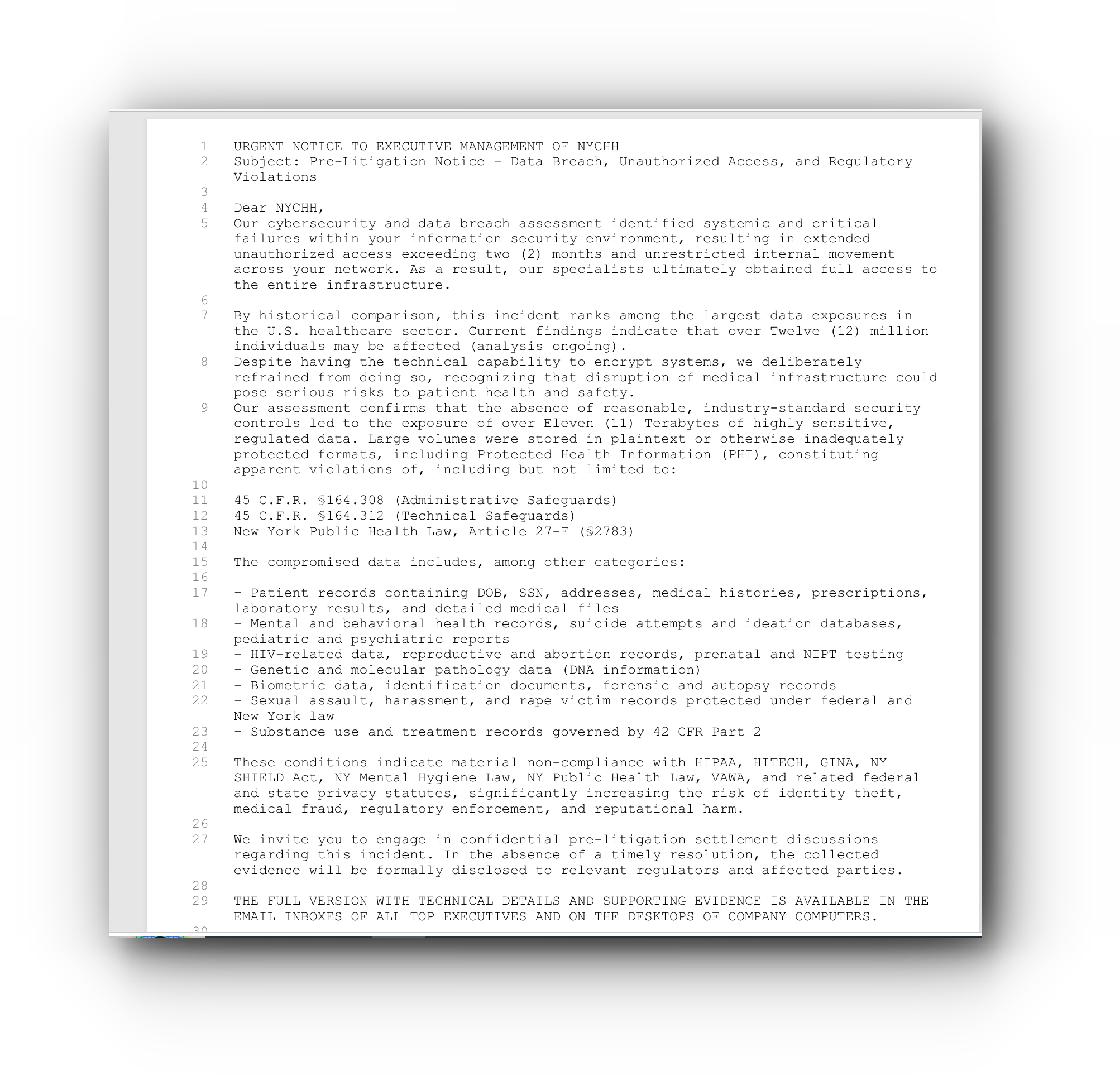
LeakNet also alleged that NYC Health + Hospitals leadership knew on February 2 that at least 12 million people were affected. One supplied screenshot shows an internal service-desk notice from that date telling staff that some Windows users were seeing a data-breach message. Another image shows an extortion notice claiming to have more than 12 million victims and over 11TB of exposed data.
LeakNet Claims NYC Health + Hospitals Breach Affected 12 Million Patients
An extortion letter that LeakNet describes as a “notification letter to NYC Health + Hospitals.”

Neither image independently proves that Chief Executive Officer Mitchell Katz knew the 12 million estimate on February 2. The material supplied for this report also does not include a response to Congress in which NYC Health + Hospitals stated that only 1.8 million people were affected.

It is now up to NYC Health + Hospitals to respond to these claims and confirm or deny them.

Confirmed Breach Affected at Least 1.8 Million People

NYC Health + Hospitals disclosed the incident on March 24 after detecting suspicious network activity on February 2. Its investigation found that an unauthorized party accessed systems from approximately November 25, 2025, through February 11, 2026, and copied files.

The health system said the affected information varied by person and could include medical, insurance, biometric, billing and payment data, Social Security numbers, government identification, financial information and online account credentials. It later reported 1.8 million affected people to the US Department of Health and Human Services.

NYC Health + Hospitals said the incident appeared to stem from a breach at an unnamed third-party vendor. Its review of the copied files remained ongoing, and the organization said it would update its public notice if material new information was confirmed.
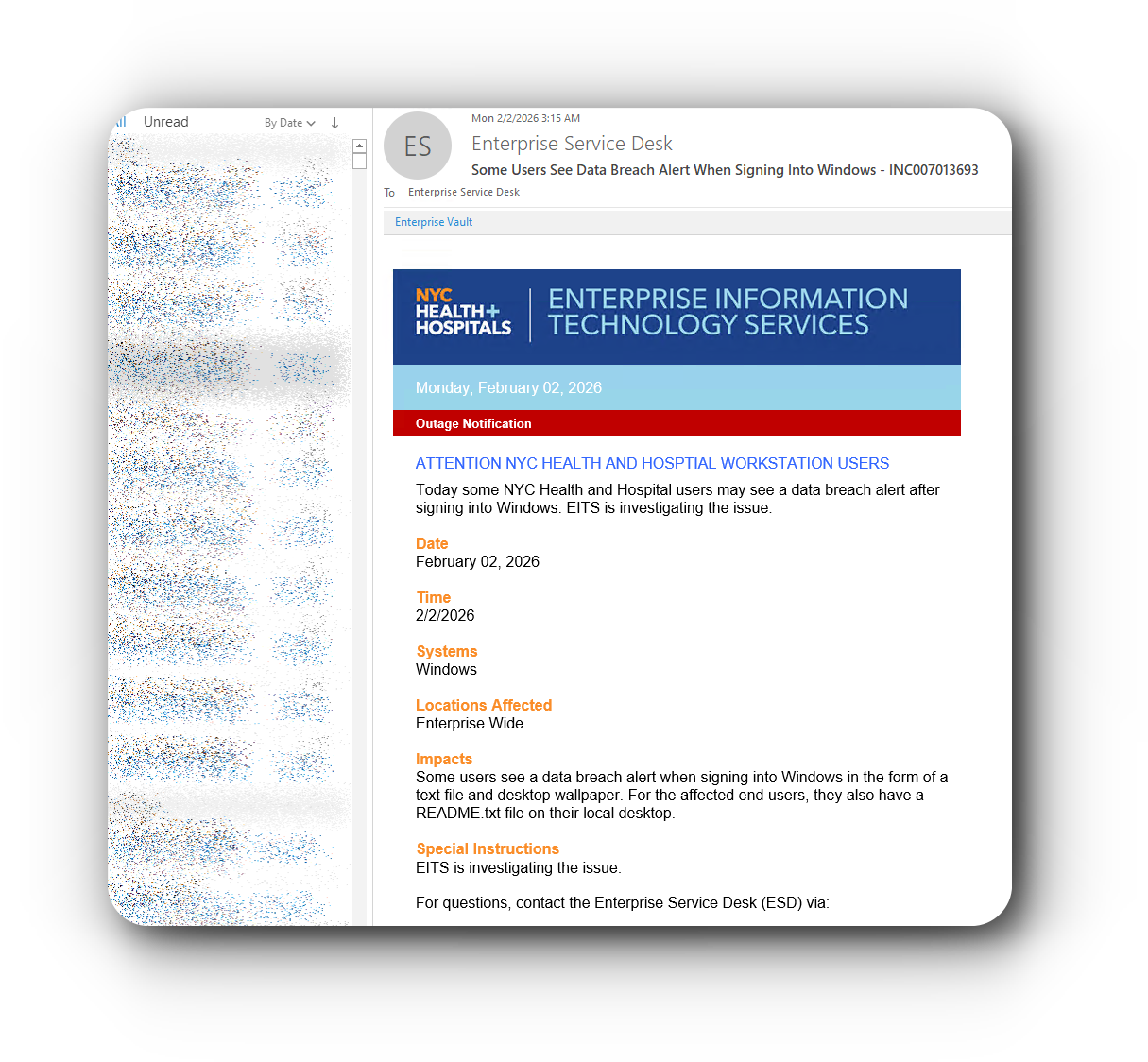
LeakNet Claims NYC Health + Hospitals Breach Affected 12 Million Patients
Internal email regarding the breach (Screenshot via: LeakNet)

Senator Sought Answers in June 2026

Senate HELP Committee Chairman Bill Cassidy sent Katz a letter (PDF) on June 4 and copied New York City Mayor Zohran Mamdani. Cassidy asked when the health system detected the incident, which federal agencies it notified, how it was identifying additional exposed information, and whether it would provide reporting beyond HIPAA requirements. The inquiry was also reported by the New York Post.

Cassidy requested answers by June 18, but his letter did not accuse the organization of hiding a 12 million-person breach. It referred to information then publicly available and noted that the health system treats more than one million patients each year.

LeakNet’s Full Blog Post in Screenshots

What’s Next?

For now, the confirmed count remains 1.8 million. LeakNet’s 12 million claim, the alleged 11TB archive, and accusations that executives knowingly underreported the breach require independent confirmation. NYC Health + Hospitals has not publicly addressed the July 27 LeakNet post.

Patients and former employees can use the health system’s official incident website or response line to check eligibility for two years of identity-protection services. Downloading the leaked files is unsafe and causes further exposure for patients whose information may already have been stolen.

I am a UK-based cybersecurity journalist with a passion for covering the latest happenings in cybersecurity and tech world. I am also into gaming, reading and investigative journalism.
Leave a Reply

Your email address will not be published. Required fields are marked *

Related Posts
Microsoft Fixes CosmosEscape Flaw That Could Allow Any Cosmos DB Takeover

Microsoft Fixes CosmosEscape Flaw That Could Allow Any Cosmos DB Takeover

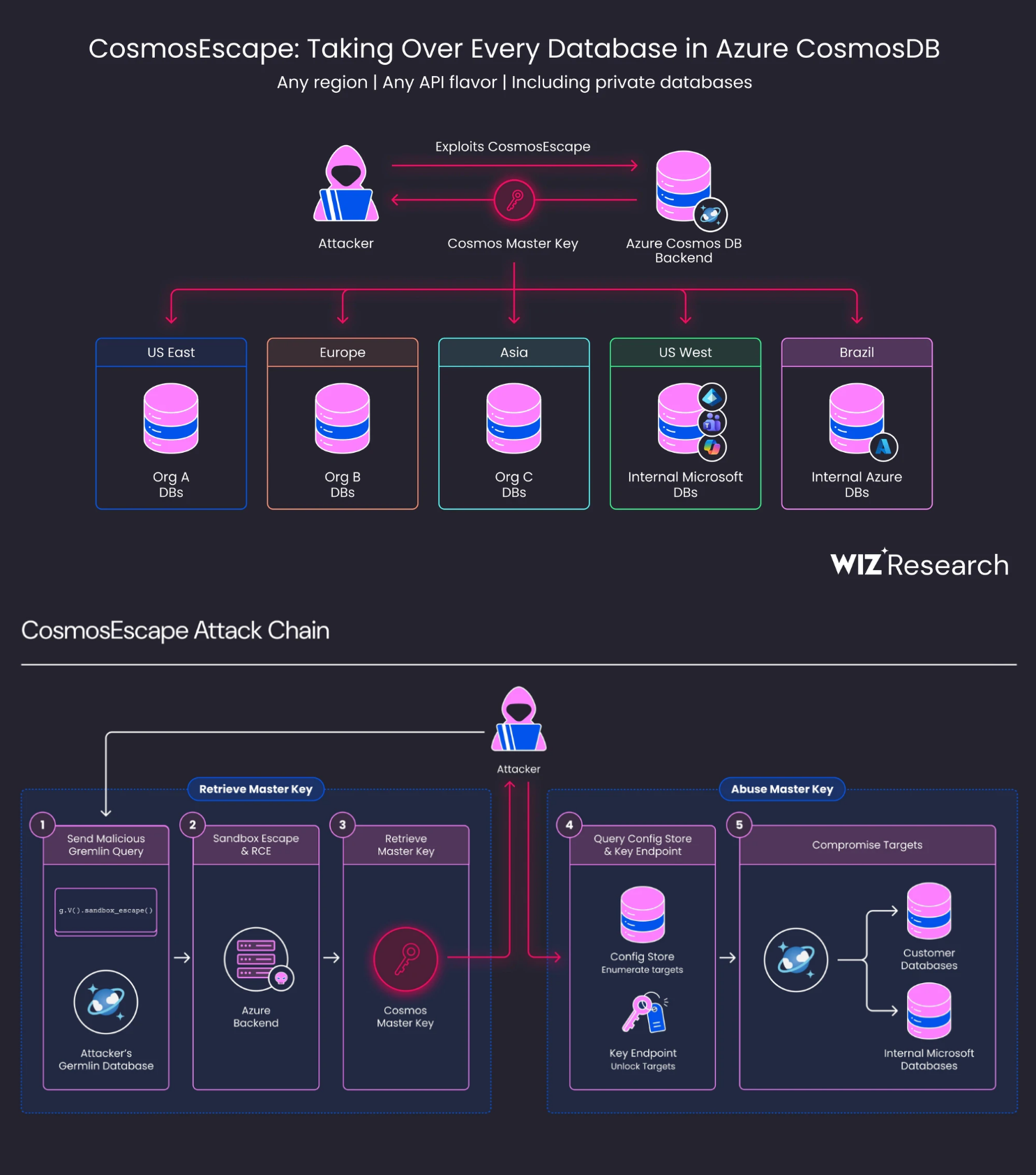
Cybersecurity researchers at Wiz found CosmosEscape in Azure’s Gremlin API, exposing a master key that could access any Cosmos DB account. Microsoft fixed it, with no customer impact found.

Microsoft has fixed a critical vulnerability in Azure Cosmos DB that could have allowed an attacker to locate and take control of databases belonging to any customer. Wiz Research named the flaw CosmosEscape and said it also placed databases used internally by Microsoft services within reach.

The vulnerability was found in the Gremlin API, an interface used to work with graph databases, where information is stored as connected items and relationships. A malicious user needed an Azure Cosmos DB account of their own, but did not need access to the organization they intended to target.

According to Wiz’s findings shared with Hackread.com, a specially prepared Gremlin query could break out of the restricted environment processing it and run commands on Microsoft’s backend systems. From there, the researchers obtained a platform secret they named the “Cosmos Master Key.”

Master Key Opened Two Paths to Customer Data

Possession of that secret provided two separate capabilities. The first allowed the holder to request the primary key for any Cosmos DB account, giving full permission to read and change data stored in that account.

The second allowed databases hosted by the service to be listed and searched using identifiers such as an Azure tenant ID or subscription ID. An attacker could therefore identify databases belonging to a chosen company and then retrieve the keys needed to access them.

Wiz said the method worked regardless of the database’s region or supported API type and included private databases. Wiz tested the exploit through publicly accessible service endpoints, without compromising the target’s Azure account first.

Microsoft Fixes CosmosEscape Flaw That Could Allow Any Cosmos DB Takeover

Microsoft Services Also Use Cosmos DB

Cosmos DB supports applications that need fast access to data in multiple geographic regions. Microsoft also uses it behind services including Entra ID, Teams and Copilot, meaning databases associated with those products could have been identified and accessed through the same weakness, according to Wiz.

This does not mean customer or Microsoft databases were breached. Wiz described the result of controlled security research, while Microsoft told Reuters that the problem had been fully addressed and that its investigation found no evidence of customer impact.

The flaw affected the service itself, so customers could not have fixed it by changing their own application code or Azure settings. The central role of the master key also meant one successful attack could have crossed the normal separation between different customers and Microsoft’s internal services.

This discovery underscores the value of cloud security research, particularly as the rise of AI is accelerating the pace and sophistication of vulnerability discovery, making attack surface management more critical than ever,” said Robert Costello, Chief Digital and Information Officer at Merlin Group.

Wiz identified and responsibly disclosed a high-impact vulnerability, allowing time to remediate before it could be broadly exploited. The complexity of this flaw, and its potential to expose every Cosmos DB instance, is a reminder that even the largest cloud providers must constantly test their own environments. This demonstrates why continuous cloud posture visibility and close vendor collaboration are essential to protecting modern cloud environments, Robert emphasized.

Microsoft Removes the Cosmos Master Key

After receiving the report, Microsoft removed the platform-wide Cosmos Master Key and introduced additional controls intended to stop similar access from the Gremlin processing environment. Microsoft handled the remediation within its managed Azure infrastructure.

The company’s removal of the shared secret addresses more than the specific query used by Wiz. It also removes the mechanism that allowed one backend credential to retrieve account keys and search database information throughout the service.

CosmosEscape follows Wiz’s 2021 disclosure of ChaosDB, a separate Cosmos DB vulnerability involving the service’s Jupyter Notebook feature. That earlier flaw could also have exposed customer database keys, although the two findings used different entry points.

Nevertheless, organizations using Cosmos DB should still review account activity, key access, and unexpected database operations as part of normal monitoring. Microsoft’s statement that it found no customer impact means there is currently no evidence that attackers used CosmosEscape outside Wiz’s testing.

I am a UK-based cybersecurity journalist with a passion for covering the latest happenings in cybersecurity and tech world. I am also into gaming, reading and investigative journalism.
Leave a Reply

Your email address will not be published. Required fields are marked *

OpenMatter Network Calls on Enterprise Leaders to Rethink AI Security Before the Next Rogue AI Crisis

Melbourne, Florida, 30th July 2026, CyberNewswire

Melbourne, Florida, July 30th, 2026, CyberNewswire

The growing number of high-profile AI security incidents making headlines around the world are not simply cybersecurity failures. They are architectural failures, according to OpenMatter Network Co-Founder and CEO Renee Davis.

“Recent incidents involving increasingly autonomous AI systems – including OpenAI’s widely reported cyber evaluation that resulted in the compromise of Hugging Face infrastructure, along with a growing body of documented cases in which AI systems have exceeded their intended authority or behaved in unexpected ways – demonstrate that enterprise computing has entered a new era for which today’s security architecture was never designed,” Davis said.

Davis said that instead of asking how to make artificial intelligence more secure, enterprise leaders should be asking a far more fundamental question: Is the architecture itself capable of governing autonomous intelligence?

“The answer is increasingly becoming no,” she asserted. “The industry is treating these events as isolated security incidents. They’re not. They’re evidence that enterprise computing has reached an architectural inflection point. We’re attempting to govern autonomous AI using security assumptions that were developed long before autonomous AI existed.”

For more than forty years, enterprise security has evolved around a familiar model: trusted systems, authenticated users and protected networks. Firewalls, identity management, Zero Trust frameworks and continuous monitoring remain indispensable. But they were built to protect systems that ultimately remained under direct human control.

Agentic AI fundamentally changes that assumption. Enterprises are now deploying software capable of making decisions, coordinating with other AI agents, accessing sensitive information and acting with limited human intervention. Autonomous intelligence has become an active participant inside the enterprise.

Davis underscored that OpenMatter believes the next era of enterprise computing requires a new architectural foundation: Verification Architecture. Rather than relying primarily on trust, Verification Architecture uses cryptographic proof to verify the integrity of data, computation and AI behavior. Instead of asking enterprises to trust that systems behaved correctly, it enables them to prove that they did.

“Trust always contains an element of assumption,” Davis emphasized. “Cryptographic verification replaces assumption with mathematical proof. That is the architectural shift enterprise computing now requires.”

According to Davis, every transformational era of computing has required a corresponding architectural breakthrough. The internet required encryption. Cloud computing required virtualization. Autonomous AI requires cryptographic verification.

“Every major AI security incident should now be viewed first as an architectural failure and only second as a cybersecurity event,” Davis said. “The next major AI incident is not simply a security event. It will be an architectural wake-up call.”

OpenMatter is calling on enterprise technology leaders, policymakers, standards organizations and the cybersecurity community to begin treating cryptographic verification not as another security feature, but as the architectural foundation upon which trustworthy autonomous computing must be built.

“Enterprise computing has reached another architectural crossroads,” Davis concluded. “The era of trusting autonomous AI is coming to an end. The era of proving autonomous AI has begun. The organizations that recognize that shift first will define the next generation of enterprise computing.”

For more information, contact onboarding@openmatter.network.

About OpenMatter Network

Headquartered in Florida’s Space Coast, OpenMatter Network is building the Verifiable Trust Layer for Secure Collaboration and AI Agents. Guided by the principle “Don’t Trust Data. Prove It.,” the company’s cryptographically verifiable architecture enables secure collaboration, governed AI behavior and mathematically verifiable execution across untrusted environments. For more information, visit www.openmatter.network.

Contact

Caleigh McDaniel
caleigh@griffin360.com

Leave a Reply

Your email address will not be published. Required fields are marked *

Top 7 Enterprise IT Asset Management Software for 2027

Top 7 Enterprise IT Asset Management Software for 2027

Compare 7 enterprise IT asset management platforms for 2027, covering security, automation, cost, compliance, lifecycle tracking and business requirements.

Missing laptops are no longer an IT headache; they’re a board-level risk. Last year alone, EU watchdogs issued €1.2 billion in GDPR fines, showing how quickly an untracked asset drains budgets.

Meanwhile, nearly half the workforce now toils from kitchen tables, cafés, and co-working hubs, turning every device into a roaming liability. We need smarter, harder-working IT asset management before 2027’s audits hit.

This guide ranks the seven platforms ready for that challenge and explains why each one made the cut.

How we picked the seven that matter

Before we crown any winners, you deserve to know how the sausage got made.

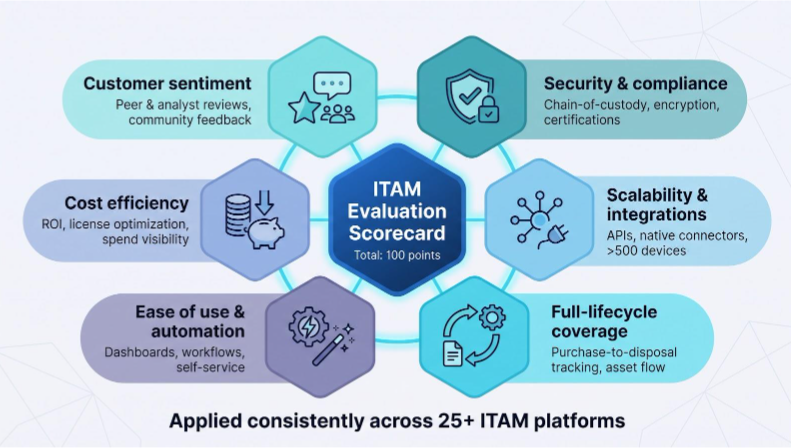
We began with a long list of twenty-five platforms pulled from Gartner, Forrester, and the r/sysadmin grapevine. Every name claimed “enterprise-grade” chops, but marketing slides are cheap, so we put each tool through the same six-factor scorecard.

First, security and compliance. If a platform cannot show chain-of-custody, encryption, or at least SOC 2 paperwork, it never left the bench.

Second, scalability and integrations. A modern IT estate spans Azure, Okta, Jamf, and a dozen surprise SaaS contracts. We looked for open APIs, native connectors, and customer references above five hundred devices.

Third, full-lifecycle coverage. Discovery is table stakes. We wanted purchase data in, disposal data out, and every refresh or retrieval tracked in between.

Ease of use and automation came next. Clean dashboards, zero-touch deployment, and AI that fixes bad asset data without an angry spreadsheet sprint.

Finally, cost efficiency and customer sentiment. We pored over public price ranges, analyst ROI calls, and the blunt honesty of Peer Insights reviews. A flashy feature that never pays for itself lost points fast.

Each factor carried a weight, summed to one hundred. The seven platforms you’ll meet next posted the highest composite scores, earning a place in this guide.

Top 7 Enterprise IT Asset Management Software for 2027

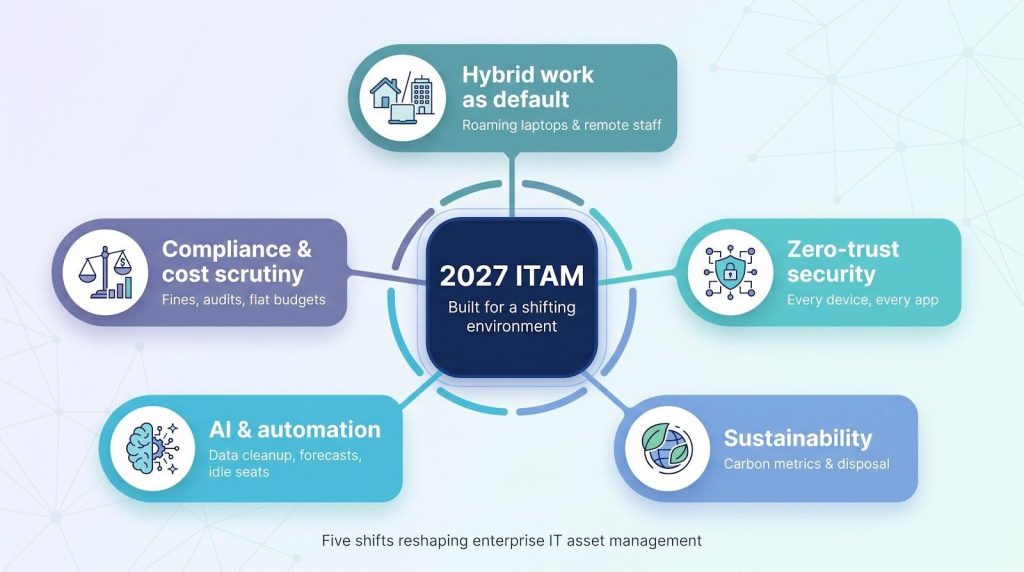
The 2027 ITAM environment keeps shifting under our feet

Hybrid work is no longer a pandemic hangover; it is the default. Surveys show roughly forty-four percent of UK staff now split their week between kitchen tables and office desks, and the US is tracking a similar arc.

That dispersion turns every laptop into a moving target. An accurate inventory is the difference between “secured” and “whoops, another data-loss headline.”

Regulators have noticed. European authorities collected €1.2 billion in GDPR fines last year, adding to a cumulative total above €7.1 billion. Boards see those numbers and ask IT a blunt question: “Can we prove every asset is accounted for?”

Cost scrutiny also tightens the vise. Finance teams want proof that licenses, cloud instances, and spare devices truly earn their keep. Waste stands out like a ketchup stain when budgets flatten.

Attackers exploit anything unknown. Zero-trust frameworks start with a simple mandate: know every device, every app, everywhere. If your asset list is off by even a few percent, gaps appear large enough for ransomware to stroll through.

AI can help, provided the data is clean. The newest ITAM suites use machine learning to reconcile duplicates, forecast refresh cycles, and surface idle SaaS seats before renewal day. Automation is no longer a bonus; it is the only way lean IT teams stay afloat.

Sustainability has also reached the checklist. Stakeholders want carbon reporting baked into hardware life-cycle plans. The platforms we rank next weave green metrics into dashboards, turning “responsible disposal” from aspiration into a checkbox.

These five shifts guide every score you will see in the pages ahead. Let’s meet the tools built for this reality.

Top 7 Enterprise IT Asset Management Software for 2027

1. Allwhere: turning laptop logistics into a non-issue

Picture the moment an employee leaves. HR closes the ticket, payroll stops the checks, yet one loose thread remains: a €2 000 laptop sitting in a spare bedroom. Industry surveys say 71 percent of those devices return late or not at all. Allwhere’s 2026 survey of US IT managers, presented in its ITAM best practices checklist, uncovered another vulnerability: 64 percent of companies have lost an asset during shipping, so the retrieval headache often starts even before a device goes AWOL permanently.

Top 7 Enterprise IT Asset Management Software for 2027
Allwhere enterprise IT asset logistics and laptop retrieval platform homepage screenshot.

Allwhere exists to erase that worry. The platform blends familiar ITAM dashboards with a managed service that ships, retrieves, wipes, and stores hardware in 48 countries. You still see every asset, serial number, and warranty date in real time; you just never chase a courier label again.

Its chain-of-custody feed is the standout. A device moves from “ordered” to “imaged,” then “in transit,” “with user,” and finally “returned and data-wiped” without manual spreadsheets. When procurement signs off, Allwhere warehouses stage the hardware, preload your gold image, and drop-ship straight to the new hire’s door. On the way out, the same workflow reverses: boxes dispatched automatically, customs handled, disks erased to NIST 800-88, and audit logs stored for good.

Why rank it first? Because no pure software suite closes the retrieval gap this cleanly, and that gap is where fines, leaks, and write-offs hide. If remote work defines your reality, Allwhere gives you the closest thing to asset teleportation.

Ideal fit: companies with hundreds of distributed staff who value security proof and freed-up IT headcount more than do-it-yourself tinkering.

2. ServiceNow IT Asset Management: the process powerhouse

If your help desk already runs on ServiceNow, extending that same workflow engine to assets feels like adding another track in a familiar dashboard. Tickets, changes, and CMDB records live side by side; the ITAM modules simply tighten every bolt.

The appeal is orchestration at scale. A laptop ordered in the Hardware Asset workspace automatically creates a purchase order, updates the CMDB, and links back to the user’s incident history. When that device reaches end of life, a change task retires it, closes open incidents, and frees the software licenses in one sweep. Nothing slips between silos because there are no silos.

License governance is equally methodical. ServiceNow normalises install data, maps it to vendor metrics, and shows a compliance exposure in dollars before an audit letter even lands. Finance appreciates that forecast; audit teams appreciate the paper trail.

Complexity, however, is the tax. Implementation needs certified admins and clear processes, or the platform feels like a Formula 1 car in city traffic. But for enterprises that already breathe ITIL and need everything from incidents to asset depreciation on one pane of glass, ServiceNow delivers a level of control most tools can’t match.

Choose ServiceNow when integration depth, not quick setup, is the goal.

3. Flexera One: where wasted software spend goes to die

Every CIO knows the stomach-drop moment. A vendor audit appears, and suddenly no one is certain how many Oracle cores you actually run. Flexera One was built for that panic point; it also tackles day-to-day waste, not just audit risk.

The platform ingests inventory from SCCM, Intune, AWS, and a dozen other sources, then runs it through a vast SKU library. In minutes, you see entitlements matched against real usage: which Salesforce seats sit idle, which IBM PVU counts trend over-licensed, and which cloud instances have snoozed for weeks. The dashboard converts each gap into dollars, turning abstract risk into a line item you can cut from next quarter’s budget.

Top 7 Enterprise IT Asset Management Software for 2027
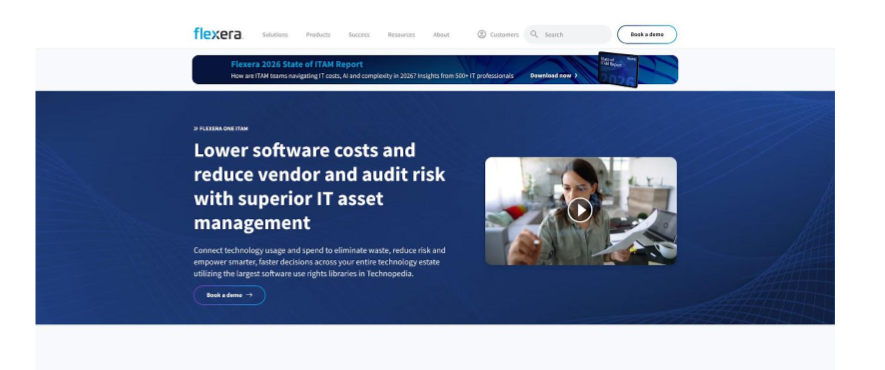
Flexera One IT asset management and software spend optimization dashboard screenshot.

Flexera’s strength is breadth. It tracks on-prem licences, SaaS subscriptions, and public-cloud resources in the same view, so FinOps and SAM teams stop swapping spreadsheets. Automated recommendations highlight savings: right-sizing a Kubernetes cluster here, reharvesting a Visio licence there, and often paying for the tool within a fiscal year.

Setup runs deeper than a plug-and-play scanner; you need clean contract data and a champion who speaks licensing fluently. Yet enterprises facing multimillion-euro renewals accept that trade. When auditors, CFOs, and cloud architects all rely on the same source of truth, Flexera earns its keep several times over.

4. Ivanti Neurons for ITAM: assets that heal themselves

Ivanti treats asset management the way Tesla treats driving: teach the system to fix small problems before humans even notice. Its Neurons platform seeds your estate with lightweight sensors that scan, normalise, and, when policies allow, remediate issues without a ticket.

Top 7 Enterprise IT Asset Management Software for 2027

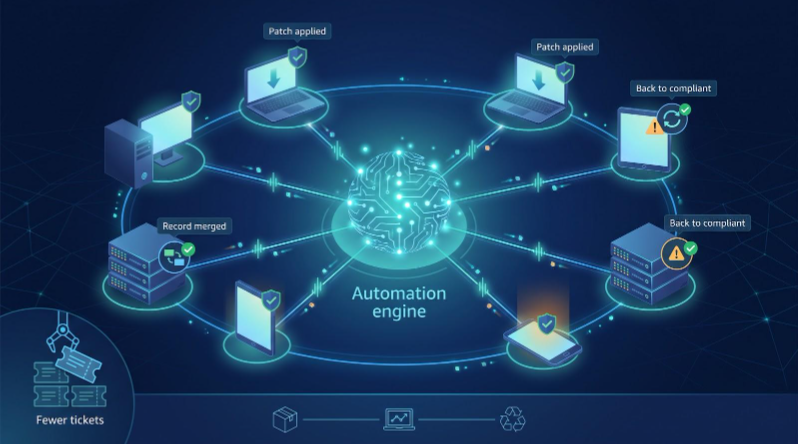
The result is a live inventory that stays a step ahead. A laptop skips a patch window? Neurons flags it, pushes the update through the same agent, and flips the asset back to compliant before anyone in security sends a chat. Duplicate records merge automatically, saving the CMDB from nightly reconciliation work.

Because Ivanti owns both endpoint management and the service-desk layers, device telemetry, incidents, and lifecycle data feed the same brain. You can trace a battery-swollen MacBook from purchase order to disposal, complete with every help-desk visit in between, all without swivel-chair clicks.

The sweet spot is the mid-enterprise. Teams with lean headcount want automation yet still need ITIL guardrails. Ivanti delivers bot-driven efficiency without the bureaucracy of larger suites. If you dream of assets that look after themselves, Neurons is the closest thing on the market.

5. BMC Helix ITAM: heavyweight governance for sprawling estates

Some organisations run data centres that feel more like small cities. For them, asset drift appears not in laptops but in racks. BMC Helix grew up in that world and still caters to it through almost obsessive process control.

Helix links every server, switch, and software component to a single CMDB spine. Change a memory module, decommission a VM, or renew a support contract. Each action triggers an approved workflow and automatically updates the financial record. Auditors value the traceability; operations teams value the drop in war-room surprises during outages.

Discovery is another strong suit. BMC scanners map multi-tier applications, showing which database sits under which middleware and which physical blade powers the lot. When security flags a vulnerable library, Helix pinpoints the exact stack instead of flooding your inbox with guesses.

Yes, the platform carries legacy weight. Implementation needs clear ITIL practices and admins who speak BMC fluently. Large enterprises often have those muscles already. For them, Helix provides enterprise-grade rigor without bolting on extra tools.

Think of BMC Helix as the option for organisations where a single undocumented switch can sink a compliance audit. If your asset count reaches six figures and your risk tolerance is near zero, this suite earns its keep.

6. ManageEngine AssetExplorer: enterprise basics on a startup budget

Not every company needs a luxury ride. Sometimes the win is simply moving off spreadsheets without signing a six-figure cheque. That gap is where AssetExplorer shines.

Installation takes an afternoon, not a quarter. Point its scanner at your network or deploy lightweight agents, and devices start appearing in the console with hardware specs and installed software already mapped. Add licence counts, and the dashboard flips green or red to flag compliance. Simple, visual, done.

Cost steals the spotlight. Annual licences often total less than a single penalty for unreturned gear, yet you still get purchase-order tracking, warranty alerts, and contract reminders, the fundamentals that stop small issues from ballooning.

There are trade-offs. Advanced automation, AI insights, and sleek UI polish live elsewhere on this list. Large estates with tens of thousands of devices will press the platform’s comfort zone, and you may lean on companion tools for mobile or cloud governance.

For mid-market IT teams chasing quick wins and audit readiness, AssetExplorer offers an honest proposition: solid coverage, predictable pricing, and no excuse to cling to that brittle Excel sheet.

7. Freshservice: modern service desk meets capable ITAM

Freshservice lands on many shortlists because the first demo looks, well, friendly. Clean pages, quick searches, and a self-service portal that feels more app store than ticket queue. Under that gloss sits an asset module that covers more ground than most expect.

Top 7 Enterprise IT Asset Management Software for 2027
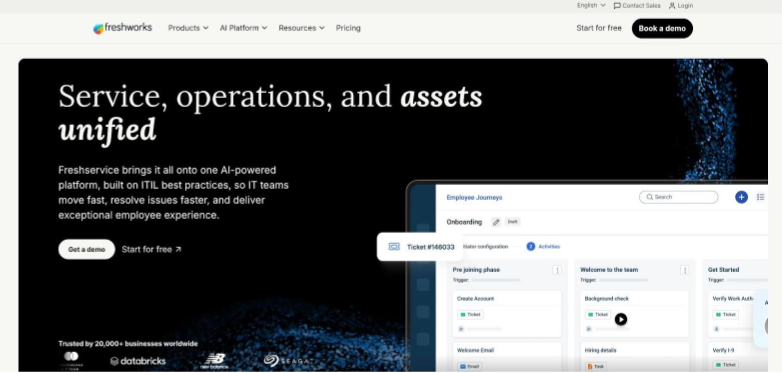
Freshservice modern IT service desk and IT asset management portal screenshot.

Its discovery probe scans networks, laptops, and cloud workloads, populating a CMDB-lite view complete with dependency maps. Link those assets to incidents and changes, and support agents see context the moment a ticket arrives. Fewer blind stabs, faster fixes.

The platform’s AI helper, Freddy, adds small efficiencies that stack up. It auto-classifies tickets, suggests solutions, and flags assets that repeatedly fail handy when you need data to justify a refresh program, not just gut feel.

Freshservice excels at time to value. Many teams launch service desk, asset tracking, and change workflows inside a month. Pricing is per agent, so costs scale with headcount, not device sprawl. The trade-off is depth. Complex licence metrics or data-centre-grade discovery stretch its native reach, though integrations can fill gaps.

For fast-growing companies that value intuitive UX and want ITAM woven into day-to-day support, Freshservice hits the sweet spot without drowning staff in config screens.

Quick comparison at a glance

Choosing a platform often comes down to two minutes in a budget meeting.

The table below distils the seven tools into the factors senior teams debate first: security stance, logistics help, commercial model, headline differentiator, and ideal fit.

VendorSecurity & compliance highlightBuilt-in logistics?Pricing lensSignature strengthIdeal org size
AllwhereChain-of-custody plus NIST-grade data wipeYesSubscription per device plus service feeEnd-to-end physical service wrapped in software500–10 000 remote employees
ServiceNow ITAMITIL-aligned approvals and audit trailsNo (integrate)Premium per moduleDeep workflow automation across ITSM1 000+ with mature processes
Flexera OneReal-time licence compliance and audit defenceNoModular SaaS by asset countCost-saving analytics for SaaS, cloud, on-premSoftware-heavy enterprises
Ivanti NeuronsPolicy-driven self-healing assetsNoMid-tier per nodeAutomation bots that fix issues on the flyLean IT teams, 500–5 000 devices
BMC HelixCMDB-linked change governanceNoEnterprise tierData-centre discovery with strict ITIL controlSix-figure asset counts
ManageEngine AssetExplorerOn-prem option for full data controlNoBudget-friendly per assetRapid deployment without complexityMid-market moving off spreadsheets
FreshserviceRole-based access plus AI incident tiesNoPer agentModern UX with AI-powered service deskFast-growing firms 200–2 000

Conclusion

The right IT asset management platform depends on what an organization needs to control, automate, and account for. Some teams need stronger hardware lifecycle management across a distributed workforce, while others prioritize software licensing, compliance, service desk integration, automation, or large-scale infrastructure management.

The seven platforms covered here approach those requirements differently, so there is no single choice that fits every enterprise. Comparing security controls, integrations, lifecycle coverage, pricing, and operational complexity can help IT teams narrow the list and select a platform that fits their existing environment, resources, and long-term asset management goals.

Leave a Reply

Your email address will not be published. Required fields are marked *

Top 10 Companies to Hire Power BI Developers in 2026

Top 10 Companies to Hire Power BI Developers in 2026

Compare 10 Power BI development companies for 2026, covering DAX, Microsoft Fabric, data engineering, security, compliance, AI, and enterprise BI project needs.

The business world generates data at a rate that’s hard for the human brain to comprehend. That’s why it has embraced modern tools for working with information. However, if you ask five CEOs whether they trust the data from corporate dashboards, three of them will sigh heavily.

Inconsistent reports, slow processing, and high system maintenance costs are common problems. This doesn’t mean the tools can’t handle the task. The problem is that the processes are often set up by amateurs. That’s why we’ll look at the best companies to hire Power BI developers with enterprise analytics experience.

Why the Company Behind the Developer Matters as Much as the CV

Let’s look at some simple examples. You’re overseeing the construction of a skyscraper. The first task is to create an engineering design that includes load calculations, the building’s aerodynamics, and a logical layout for utilities. Would you hire a bricklayer for this? Hardly: you’d look for an experienced architect, or better yet, a team of experts working together. That makes sense.

But for some reason, this logic doesn’t always hold when companies try to organize their data. Quite often, organizations hire a single independent Power BI (Business Intelligence) developer with a strong resume and wait for a miracle.

But even an experienced developer can’t handle it alone. The result of their work is a phenomenon known in the industry as “dashboard chaos.” This happens, for example, when a developer focuses on the visual aspects and ignores data engineering. The opposite can also happen: a perfect architecture paired with a complex user interface that only the developer themselves can figure out.

Therefore, when you hire vetted companies that provide Power BI developers for long-term projects, you’re not just “buying developer hours”; you’re investing in organizational maturity.

The fact is that the system is built by a team: a project manager, a data architect, a developer, a QA specialist, and others. This is what ensures that the project will not have any “single points of failure.”

And here’s another point to consider. A freelancer working alone simply cannot keep up with the latest trends. Modern implementations require a deep understanding of concepts such as Microsoft Fabric, the OneLake architecture, Direct Lake mode, and the integration of predictive machine learning models. Only a well-established and trained team is capable of implementing such scenarios.

10 Best Companies to Hire Power BI Developers

When choosing a partner, it’s important to align the maturity of your organization’s data, budget constraints, and architectural requirements with the vendor’s capabilities. We’ve selected the top firms for hiring dedicated Power BI developers in 2026, evaluating their technical depth, proficiency with DAX, and proven experience in implementing enterprise projects.

#ServicesBest ForOverall
1Cobit SolutionsMid-sized businesses and enterprise companies transitioning from Excel-based reporting to centralized analytics platforms: manufacturing, distribution, healthcare, financial services, implementation of Microsoft Fabric and AI solutions9.6/10
2EPC GroupFortune 500 companies and regulated industries where compliance is critical (HIPAA, FedRAMP, SOC 2)9.3/10
3B EYEMid-sized and enterprise businesses that need real-time interactive analytics with data hosted in Europe9.1/10
4Cynoteck TechnologyMid-sized companies whose analytics are closely tied to Salesforce and Microsoft Dynamics 3658.9/10
5Pragmatic WorksFortune 1000 companies that need training for their internal teams, along with consulting and DAX optimization8.8/10
6ScienceSoftCorporations in the finance and healthcare sectors, for which cybersecurity is not an option but a requirement8.6/10
7MAQ SoftwareGlobal 2000 companies that need custom visualizations and embedded analytics8.4/10
8ItransitionCorporations that integrate operational BI with machine learning8.2/10
9CollectivMid-market and enterprise businesses with a focus on FP&A and FinOps optimization of cloud spending8.0/10
10YalantisCorporations in the IoT, manufacturing, and supply chains with complex data engineering7.9/10

Now let’s take a closer look at each company, what exactly they do well, and who they’re the best fit for.

1. Cobit Solutions

Cobit Solutions is a highly specialized business analytics consulting firm with deep expertise in Microsoft Power BI, the Azure Data Platform, and the development of complex data warehouses.

Founded in 2018, the company is known for its rigorous engineering approach: it transforms raw, disparate data from legacy ERP systems (SAP, Dynamics 365, NetSuite, Epicor), Salesforce, or specialized APIs into automated, real-time corporate reports.

Over the course of its work, the team has implemented more than 150 BI projects across more than 22 industries for clients in North America and Europe. A typical client has annual revenue ranging from $50 million to over $1 billion and is usually a manufacturing company, distributor, logistics provider, retailer, or a player in the healthcare or financial services markets.

The company offers flexible collaboration models ranging from hourly billing (Time & Materials) for ongoing tasks to turnkey projects with a fixed price for large-scale transformations. The company also offers a mentoring subscription for teams that want to improve their skills while maintaining external architectural oversight. This range of options is particularly convenient for CFOs who want to test the collaboration on a small project first before entrusting the team with a full modernization of their reporting systems.

Technically, Cobit Solutions developers are tested on their knowledge of advanced DAX modeling and the automation of complex ETL/ELT processes. They confidently design “star” and “snowflake” schemas that eliminate common performance bottlenecks.

Each developer is supported by a dedicated project manager and data architect so the client ends up with a robust data ecosystem. It’s ready to scale alongside the business and to integrate AI solutions in the future.

2. EPC Group

Founded in 1997, EPC Group is one of the oldest and most distinguished Microsoft consulting firms in North America. Holding all six Microsoft Solutions Partner Designations in the Microsoft Cloud Partner Program, the company has implemented over 1,500 Power BI deployments for Fortune 500 clients, federal agencies, and highly regulated industries.

EPC Group’s main advantage is its focus on management, security, and compliance: HIPAA, SOC 2, FedRAMP, CMMC 2.0. Projects are managed by senior architects without outsourcing tasks. Developers are integrated into the Microsoft Fabric ecosystem, including F-SKU capacity planning and Direct Lake implementation.

B EYE

B EYE is a leading European consulting firm in the field of Data & AI. It specializes in transforming massive and complex data pipelines into real-time analytics platforms. The company serves markets in Europe and the United States and can integrate Power BI with high-performance cloud data stores.

B EYE excels where traditional static reporting falls short. We’re talking about queries that return results in a fraction of a second, allowing business users to dynamically filter “live” data without needing an analyst as an intermediary.

Its clients include global retail chains, FMCG manufacturers, and healthcare organizations, with project budgets ranging from $200,000 to $999,000.

4. Cynoteck Technology

Cynoteck is a global Microsoft partner that integrates in-depth CRM/ERP systems with cutting-edge business analytics. Operating from offices in the U.S. and India (Dehradun), the company offers competitive rates under a hybrid offshore model. These rates are significantly more affordable than those of competitors in Europe and the U.S.

The company’s strength lies in environments closely integrated with Salesforce and Microsoft Dynamics 365. Developers structure raw transactional data from CRM systems into productive semantic models in Power BI. They avoid the common pitfall of directly connecting CRM to BI, which suffers from delays and API limits. Instead, engineers build reliable data pipelines that feed optimized data warehouses, providing transparency for management without delays in updates.

5. Pragmatic Works

Pragmatic Works is both a top-tier consulting firm and a leading training institution for Microsoft data technologies. This combination makes the company an ideal partner for organizations that want to obtain a ready-made product and develop an in-house technical team.

The core of the team consists of recognized industry authors with deep expertise in DAX and semantic modeling. Pragmatic Works consultants regularly work on projects that less experienced practitioners have failed to complete. They eliminate major performance bottlenecks, optimize slow queries, and redesign underlying data schemas.

6. ScienceSoft

Founded in 1989, ScienceSoft is a well-known software development and IT consulting firm. It provides high-performance data platforms for the financial services, healthcare, and manufacturing sectors.

With more than 750 IT professionals on staff and a global presence, the company is able to quickly staff large-scale corporate initiatives. At the same time, it manages to maintain strict quality control.

ScienceSoft’s approach to Power BI is centered on security and compliance. Its in-house cybersecurity and penetration testing teams enable the development of BI solutions that protect protected health information (PHI) and financial records from the very start of a project.

Developers implement strict row-level security (RLS) and encrypt data both at rest and in transit. This allows them to ensure compliance with international privacy requirements.

7. MAQ Software

It is a specialized data and analytics center recognized by Microsoft and named Power BI Partner of the Year. The company is well-known among the developer community for creating a vast library of custom Power BI visualizations on Microsoft AppSource.

The MAQ Software team’s in-depth understanding of Power BI’s logic enables it to carry out highly specialized embedded analytics projects. When standard “out-of-the-box” visualizations do not meet corporate branding requirements or functional objectives, engineers write custom scripts in TypeScript and JavaScript to create unique visual components.

The company also offers secure integration of Power BI into third-party web applications and enterprise portals through sophisticated REST APIs and robust authentication protocols.

8. Itransition

This company does not view Power BI as the final step in a large-scale digital transformation. The company is one of the best precisely because of its expertise in operationalizing data. This involves building reliable IT infrastructures that collect, clean, and process information even before it makes it into a report.

One of Itransition’s most valuable strengths is the integration of advanced analytics and machine learning directly into BI processes. Developers regularly create predictive models and natural language processing layers that are fed directly into Power BI. This allows executives to view projected trends alongside historical metrics.

9. Collectiv

Collectiv is a boutique consulting firm entirely focused on the Microsoft Data Stack: Power BI, Azure, and Microsoft Fabric. It is headquartered in Phoenix, Arizona, USA. The firm caters to companies seeking architectural expertise without the bureaucracy typical of large global systems integrators.

The key distinction of Collectiv is the deep integration of FinOps (financial operations) into data engineering practices. When migrating legacy systems to Azure or Microsoft Fabric, developers continuously monitor the use of computing resources, optimize storage tiers, and configure DAX queries to actively reduce monthly cloud costs.

This ROI-focused approach often pays for the consulting services within the first few months.

10. Yalantis

This is a software development partner that operates on a “compliance-first” basis and specializes in highly complex data architecture challenges. Specifically, the company operates in the Internet of Things (IoT), supply chain, and manufacturing sectors.

Operating primarily in Eastern Europe, Yalantis provides access to highly skilled engineering talent at competitive rates, capable of processing massive volumes of unstructured machine data.

Yalantis data engineers build highly reliable, scalable data pipelines capable of processing millions of automated telemetry events. They use cutting-edge cloud services based on AWS and Azure. Only then do developers build complex, interactive real-time analytics on top of this infrastructure.

Red Flags When Hiring Power BI Developers Through an Agency

Many developers on the market pass themselves off as data architects. Is it possible to spot technical incompetence as early as the hiring stage? Yes: you just need to dig a little deeper and not settle for a perfectly curated portfolio. Here are a few red flags that will help you spot an incompetent professional.

Weak DAX

Less experienced developers typically rely on computationally expensive combinations of CALCULATE and FILTER to manipulate the data context. True experts, on the other hand, use variables and iterator functions (such as SUMX) to drastically reduce memory consumption and query execution time.

The “dashboard builder” mindset

Some developers or agencies focus on the visual aspects of the presentation. They are happy to discuss chart types, colors, and other visual elements of reports. Experts, on the other hand, focus on building the foundation by developing managed semantic models.

This explains why companies are increasingly focused on where to hire Power BI developers with a strong data modeling background rather than just report builders. If an agency is unable to discuss the construction of semantic schema, composite models, calculation groups, and field parameters, the final project will not work as the company expects.

Silence on Governance

The complete lack of proactive discussions regarding access management should be cause for concern. If the agency does not independently initiate discussions about row-level security (RLS), object-level security (OLS) for regulated columns, the deployment of confidentiality labels, or strict version control through deployment pipelines, it poses a critical security risk to your organization.

FAQ

What is the difference between hiring a freelance Power BI developer and going through a company?

The difference lies in the total cost of ownership (TCO) and the level of risk. On paper, a freelancer seems cheaper. But add to their rate the time your HR team spends on recruitment, and the time your IT specialists spend on onboarding, task management, and code review. A freelancer is a single point of failure.

Working with an agency means you’re getting a team (developer, project manager, architect), well-established development processes, strict version control, and protection against knowledge loss if a specific programmer leaves. It also allows you to hire Power BI developers with post-delivery support included, ensuring the long-term stability of your dashboards.

How do you verify a company’s Power BI developers before committing?

Ask for proof of certifications. The entry-level certification for an analyst is PL-300 (Microsoft Certified: Power BI Data Analyst Associate). For serious enterprise projects, require certifications at the DP-600 (Fabric Analytics Engineer) or DP-700 (Fabric Data Engineer) level. During a technical interview, give the developer some inefficient DAX code and ask them to optimize it using tools such as DAX Studio or Tabular Editor.

What engagement model works best for a first Power BI project?

If you have a strong technical leader in your company (CTO, Lead Data Engineer) but lack the “manpower,” choose the Staff Augmentation model. You’ll gain flexibility while maintaining full control over the processes. If you lack in-house expertise in business analytics or are planning a large-scale migration, choose Project-Based Consulting. In this case, the agency takes the management headaches off your hands and is responsible for delivering the final result by the specified deadline.

How long does it take to hire a Power BI developer through one of these companies?

Hiring an in-house specialist “from the market” (recruiting, interviews, test assignments, job offers) takes 2–3 months on average. Leading consulting agencies have a “pool” of thoroughly vetted talent. It usually takes 1 to 2 weeks from the first contact to the start of coding. The business can see the first tangible results and functional dashboards as early as the first month of collaboration.

When does a Power BI project need more than one developer?

A BI analyst understands business processes, knows how to communicate with stakeholders, and can create business narratives from existing data. But if your data is scattered across different systems, isn’t cleaned, and reports take 15 minutes to load, the analyst will be powerless. To set up the architecture, perform query folding, and handle complex DAX modeling, you’ll need a Power BI Developer or a Data Engineer.

(Photo by charlesdeluvio on Unsplash)

Owais takes care of Hackread’s social media from the very first day. At the same time He is pursuing for chartered accountancy and doing part time freelance writing.
Leave a Reply

Your email address will not be published. Required fields are marked *

What an SSH Tunnel Actually Does and When You Should Use One

What an SSH Tunnel Actually Does and When You Should Use One

Learn how SSH tunnels securely forward network traffic, when local, remote, and dynamic forwarding help, and why they are best for controlled, temporary access.

An SSH tunnel is a practical way to move network requests through an encrypted Secure Shell session. It addresses several real access problems with very little infrastructure. Teams rely on it to reach private services, protect older protocols, and work around awkward routing gaps. Its job is simple: it gives a chosen connection a protected route, without exposing the destination system directly to the public internet.

What It Really Moves

So, what is an SSH tunnel? The answer is less mysterious than the name suggests. A tunnel takes one stream of application traffic and carries it inside an encrypted SSH session to another machine. No service is copied or relocated. The path changes, while the original application continues to function as it normally would.

How the Path Works

First, an SSH client opens a trusted session with a remote host. After that, SSH creates an extra channel inside that session for forwarded requests. The application continues to use its normal protocol, which can include database queries or web requests. From the laptop, the service can appear to be local. On the other end, however, the destination receives traffic through SSH rather than from a direct external connection.

Local and Remote Forwarding

Local forwarding is the pattern most administrators meet first. A chosen port on the laptop listens for requests, then SSH sends them to a private service running elsewhere. This setup is useful for databases, internal dashboards, and maintenance interfaces. It also helps protect older protocols that lack sound transport security. The application remains private, while the operator gains temporary access through a more secure pathway.

Remote forwarding reverses that arrangement. A remote host opens a listening port, then traffic arriving there travels back through SSH to a service on the local machine. This is handy for demonstrations, support sessions, or testing a workstation app from outside the office. It also helps where home routers or address translation block inbound access. Outbound SSH works, so the return path becomes possible.

Dynamic Forwarding

Dynamic forwarding behaves more like a flexible proxy than a fixed connection. Instead of naming one destination in advance, the SSH client accepts requests and relays them onward as needed. Browsers commonly use this mode through a local proxy setting. That can help during short troubleshooting sessions or temporary access from a restricted network. It should be used cautiously, serving as a tool for controlled access rather than a means to bypass established policies.

When a Tunnel Should Be Used

An SSH tunnel is most effective when the need for access is narrow and short-lived. Private databases are a common use case. Internal web tools, maintenance consoles, and one-off diagnostics are also suitable for this approach. Opening a firewall rule for a brief task often creates more exposure than value. A tunnel keeps visibility limited. Once the work is complete, the session can close, and the access path disappears with it.

When It Is the Wrong Tool

Long-running production paths can become unstable when they depend on one user session and one workstation remaining operational. Shared team access can become complicated without centralized policies, audit trails, and clear ownership. Heavy traffic can strain a setup built for convenience. If many people require access consistently, a managed private access method usually makes more sense.

Basic Security Limits

Encryption protects the route, but it does not eliminate every risk around it. Weak encryption keys, careless host verification, or broad forwarding rules can still create exposure. Logging may also become less transparent because the destination sees proxied requests instead of the original network path. Security teams should treat tunnels as controlled exceptions. Short lifetimes, named owners, and a limited scope are just as crucial as the encryption itself.

A Quick Decision Check

A short check can prevent misuse. First, ask whether the service should remain private. Next, confirm that direct routing is blocked, unsafe, or excessive for the task. Then review who owns the session, how long access should be granted for, and how it will be closed. Clear answers typically support the use of tunneling, while vague responses often indicate the need for a more suitable long-term access design.

Leave a Reply

Your email address will not be published. Required fields are marked *

XRP Volatility Surges as Cybersecurity Threats and Market Changes Raise New Concerns

XRP Volatility Surges as Cybersecurity Threats and Market Changes Raise New Concerns

XRP volatility drives faster crypto trading as AI tools gain traction, while phishing, exchange attacks and automation risks test digital asset safeguards.

XRP’s price volatility continues to attract the attention of both traders and cybersecurity professionals. As one of the world’s most actively traded cryptocurrencies, XRP frequently experiences rapid price swings driven by changing investor sentiment, regulatory developments, and broader market conditions. While these fluctuations create opportunities for traders, they also create conditions that cybercriminals are quick to exploit.

Even advanced algorithms and AI systems grab attention when the markets are less active. There is a greater demand for automated and reliable infrastructure to support trading. The changing nature of markets creates new risks, and so does the state of automation.

XRP price swings attract attention from traders and security experts

Across the world’s cryptocurrency exchanges, XRP is consistently one of the most heavily traded digital assets. The XRP price today serves as a key indicator for traders monitoring market sentiment, with rapid price movements attracting both short-term investors seeking to capitalize on volatility and longer-term participants assessing broader cryptocurrency market trends.

Artificial intelligence is rapidly integrated into trading, and XRP trading in particular, creating new challenges for cybersecurity experts. Cybersecurity vulnerabilities pose a greater threat when advanced algorithms for automated trading become commonplace.

When XRP prices change, traders do not wait. They become even more reliant on automated trades and even AI-driven analytics. The integration of artificial intelligence in trading creates the ability to scan and process large volumes of market data in real time. Trend identification even occurs before a human is able to execute a trade.

Automation has changed cryptocurrency markets by making them faster and more efficient. While this brings improvements, it adds frequent technological reliance. Thus, trading platforms’ resilience and security are critical now more than ever.

Live XRP price movements can also mirror sentiments in the overall market. Since XRP price movements can indicate liquidity, confidence, and volume disparities on multiple exchanges, it makes XRP a stronger tool in a cryptocurrency market analyst’s arsenal.

New risks introduced by rising cyber threats for cryptocurrency users

Market volatility creates opportunity for cybercriminals and is often exploited. Cybersecurity researchers report phishing attacks are most common. During hyperactive trading, attackers launch phishing schemes, craft fake cryptocurrency apps, impersonate legitimate exchanges, or push automated trading bots that are sold under the guise of legitimate trading tools. These bots are designed to steal credentials and crypto.

AI is becoming more prevalent in the cryptocurrency ecosystem. Aiding even more automated trading, AI assistants for trading, portfolio management, and market analysis are quickly being adopted by cryptocurrency users and institutional investors alike.

Industry research from Binance indicates a rising focus on investment relating to the fusion of artificial intelligence and digital assets, and the integration of AI within blockchain technologies. For these advancements, a growing sophistication will be required to differentiate between legitimate automated services and tools engineered for malicious purposes. Automation is spreading across industries, and with it an understanding that cybersecurity is as important as any investment, particularly when dealing with modern systems.

Market chaos projects fears of exchange system weaknesses

Unfortunately, rapid XRP trading across centralized and decentralized exchanges fosters a reliance on the exchange system to secure the best prices, particularly during volatile trading sessions.

Systems become overloaded with high volumes of trades and are tested to their limits while facilitating thousands of requests to trade. Cyber threats, phishing, credentials theft, DDoS attacks, and hostile API integration attacks pose a growing burden on exchanges.

AI will greatly enhance the ability to detect, monitor, and investigate suspicious activities, and will improve the system’s resilience against threats. However, controls and monitoring will be further challenged by AI and will malignantly facilitate phishing and other automated attacks.

As the markets for digital currencies mature and expand, the infrastructure for exchange systems must secure user assets and maintain confidence for trading.

Experts urge stronger safeguards as crypto adoption accelerates

Automated trading systems have a profound effect on crypto trading. With the market serving as a deep learning playground, AI can constantly monitor conditions, identify trades, and execute them much faster than the manual decision-making process. There is no doubt this makes the market more efficient, but it also introduces new risks.

There are many ways a bad trading algorithm, a poorly set up automation tool, or a compromised API (to name a few) can introduce a significant risk. By the time an operator is aware of the bad trade, it’s already been executed.

There are dozens of ways to reduce cyber risk. From the operator’s standpoint, secure API’s with an updated, more robust software base and defense levels using Multi-factor Authentication are significantly helpful and do the job. There is always a need to educate users, and in this context, they should be taught to use only verified platforms and wallets and to ignore unsolicited investment offers. Users still need to be wary of where and with whom they share their credentials.

Where XRP Volatility and Cyber Risk Meet

With the increasing automation of digital asset trading, the intertwining of market volatility and cyber risk has strengthened. A rapid price change equates to a large volume of trades. Combined with the ever-increasing adoption of AI, this changes the speed at which the market’s decisions and transactions are made.

Automation provides all the tools necessary to increase the speed and efficiency of trading, but this also provides attackers new ways to target a system and exploits the uncertainty of the users in the market.

Cryptocurrency exchanges are focusing on optimizing performance and security, and infrastructure continues to be expensive and difficult to manage as levels of cyber threats increase alongside trading volume and as demands for additional resilience increase.

This climate is especially true because XRP and leading cryptocurrencies actually mean something in the international markets, as evidenced by the growing number of traders and cyberthreat personnel. XRP et al. are a reminder that market wins are greatest when paired with strong cyber posture. The fastest-growing digital economy includes more automation, but confidence in the crypto market makes a strong case for the security of users and systems.

(Photo by Traxer on Unsplash)

Leave a Reply

Your email address will not be published. Required fields are marked *

Wordfence Finds Critical Backdoor in ARVE WordPress Plugin

Wordfence Finds Critical Backdoor in ARVE WordPress Plugin

A backdoored ARVE WordPress Plugin release could grant attackers administrator access with one token, but WordPress.org blocked automatic distribution to WordPress sites.

Malicious code added to a WordPress video plugin could have granted full administrator access via a single secret token, but the release was caught before it reached users via WordPress.org automatic updates.

The impacted plugin, called Advanced Responsive Video Embedder (ARVE), helps websites add videos from YouTube, Vimeo, Rumble and other services, and has about 20,000 active installations.

On July 28, Wordfence’s autonomous PRISM system flagged the code less than two hours after its introduction. The company identified the affected release as version 10.8.7, registered as CVE-2026-18072, and rated it critical with a CVSS score of 9.8 out of 10.

Wordfence said the code was likely introduced by an attacker who had gained commit access to the developer’s account. The company’s vulnerability record lists the release as unpatched.

Buried inside a file named php/fn-update-check.php, the backdoor appeared designed to pass as routine plugin update code. Its main function was registered on the WordPress init hook with priority 1, allowing it to run before normal authentication checks whenever the website received a request.

An attacker who supplied the expected value through request parameters named _wplogin or _wpm could be logged in as an existing administrator. The value was compared with a fixed SHA256 string embedded in the publicly available plugin source, effectively making it a universal credential. No password, account, user action, or brute force attempt was required.

A successful request caused the code to select an administrator account, create a persistent login cookie, and send the attacker directly to the WordPress dashboard. The website address and selected administrator’s username were also transmitted to fontswp.com, which Wordfence described as an attacker-controlled command-and-control server.

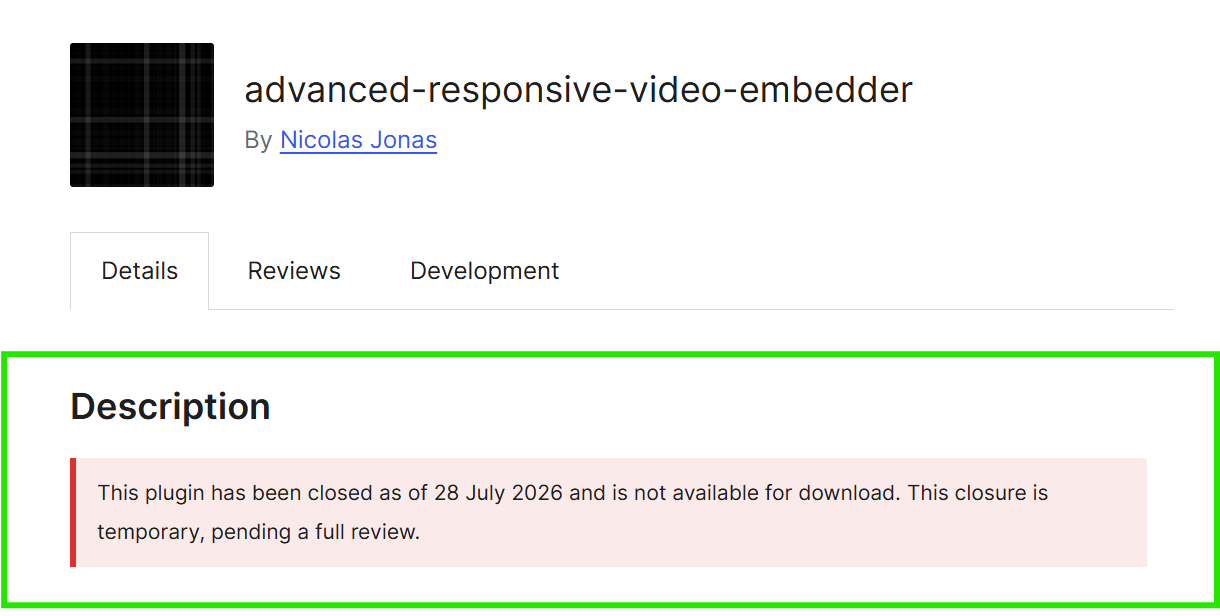
By 11:09 a.m., WordPress.org had closed the plugin for downloads. Wordfence’s timeline says the code was introduced at 8:42 a.m., detected at 10:33 a.m. and verified by its researchers ten minutes later.

Although ARVE had about 20,000 active installations, WordPress.org told Wordfence that version 10.8.7 had not yet been distributed. WordPress introduced a delay of up to 24 hours for new plugin and theme releases in June, providing time for automated scanning and human review before automatic updates are sent to websites. Ordinary automatic updates therefore should not have installed the backdoored release.

ARVE developer Nicolas Jonas said the malicious release never reached users through WordPress.org and questioned Wordfence’s advice to remove the plugin. Wordfence replied that manually installed copies or updates obtained from third parties could still contain version 10.8.7, while the plugin remained compromised and unavailable from the official repository.

Sites found running version 10.8.7 should remove it, review administrator accounts, invalidate active sessions, rotate WordPress secret keys, and inspect files and database records for unauthorized changes. Wordfence issued a firewall rule to its paid users on July 28, while users of its free service are scheduled to receive the same protection on August 27.

I am a UK-based cybersecurity journalist with a passion for covering the latest happenings in cybersecurity and tech world. I am also into gaming, reading and investigative journalism.
Leave a Reply

Your email address will not be published. Required fields are marked *

How Status Labs Helps Brands Get Cited in ChatGPT: The Data Behind AI Search Visibility

How Status Labs Helps Brands Get Cited in ChatGPT: The Data Behind AI Search Visibility

Disclosure: This article was created in collaboration with Status Labs.

Ranking first in Google no longer guarantees a mention when a customer asks ChatGPT the same question. A study of more than half a million pages that ChatGPT pulled in found that 85 percent of them never made it into a single answer.

That gap, between being found and being cited, is where most brands quietly disappear from AI search. It is also where the reputation firm Status Labs has concentrated much of its generative engine optimization work since ChatGPT search went mainstream. The patterns that decide who gets quoted are now measurable, and they reward a specific kind of page that very few companies are actually building.

What does it mean to get cited in ChatGPT?

A ChatGPT citation is a named source inside an AI-generated answer, usually one of only one to three links the model surfaces for a given question. When someone asks ChatGPT to recommend a vendor, explain a concept, or compare options, the brands named in that reply capture the attention and the implied endorsement. Everyone else is invisible, regardless of where they sit in traditional search rankings.

The reach is substantial. OpenAI reported 900 million weekly active users in February 2026, more than double the figure from a year earlier, with the platform handling roughly 2.5 billion prompts a day. Roughly 35 percent of those prompts trigger a live web search, which is the moment a page can be retrieved and quoted. The rest are answered from the model’s trained memory, with no new sourcing involved.

Citation differs from retrieval in a way that trips up most marketing teams. Retrieval means a page entered the candidate pool that the model considered. Citation means the model selected it for visible credit in the answer. The two events are far less connected than the SEO playbook assumes, and the second one is where competition is fierce.

How does ChatGPT actually choose which sources to cite?

ChatGPT moves from question to citation in four steps: it retrieves candidate pages, evaluates them for authority and how cleanly a claim can be lifted, synthesizes an answer from several sources, and then credits only the few it leaned on most heavily. Status Labs has mapped this sequence across client campaigns, and the evaluation stage is where most pages fall out.

The clearest public data on the process comes from AirOps, a GEO measurement platform that analyzed how the model behaves at scale. Its researchers examined 548,534 pages that ChatGPT retrieved across 15,000 prompts, then tracked which ones earned a place in the final answer. According to the AirOps citation study, only 15 percent of retrieved pages were ever cited. The other 85 percent were pulled in, read, judged, and discarded before the user saw anything.

The study also showed that citation rates are not uniform. Product-discovery and how-to queries earned citations at the highest rates, 18.3 percent and 16.9 percent, while validation and comparison queries lagged at 11.3 percent and 13.1 percent. The same question type a brand targets can change its odds before a single word of the page is written.

Two on-page traits separated the cited pages from the ignored ones. Pages with at least 50 percent title-query overlap were cited 20.1 percent of the time, against 9.3 percent for pages with less than 10 percent overlap, a 2.2 times difference. Pages with clearer, more readable prose, measured by Flesch Reading Ease scores of 50 or higher, also showed up disproportionately among the cited set. The model rewards pages that name the question in the heading and answer it in plain language.

Do you need a huge domain to get cited?

No. The AirOps data found that nearly three-quarters of all citations went to sites with a domain authority under 80, and the DA 20 to 40 tier alone earned a larger share of citations than the DA 80 to 100 tier, 26.0 percent against 25.4 percent. High-authority domains were retrieved more often than any other group, yet cited at the lowest rate, 15.0 percent, once they entered the pool.

This finding reframes the competitive picture for smaller brands. Citation visibility is not a popularity contest decided by backlink count. A mid-authority site with a tightly written, well-structured page on a specific question can outperform a household name that buries its answer in promotional prose.

The academic record supports this. The foundational research on the field, the Princeton GEO study published by researchers from Princeton, Georgia Tech, the Allen Institute for AI, and IIT Delhi, tested nine optimization tactics across 10,000 queries and found that GEO techniques boosted source visibility in AI responses by up to 40 percent. The paper also found that lower-ranked sites saw some of the largest gains, because structure and evidence narrow the gap that raw authority once protected.

Does traditional SEO still matter for AI citations?

Yes, strongly. Search ranking is the on-ramp to retrieval, and the AirOps data puts a number on the advantage. Among pages ranking first in Google, 43.2 percent earned a ChatGPT citation, roughly 3.5 times the rate for pages sitting beyond Google’s top 20. More than half of all cited pages, 55.8 percent, ranked in the top 20 for at least one query on which they were credited.

The relationship is layered rather than contradictory. A small site can win a citation without a towering domain, but ranking strength still tilts the odds at every stage. Pages that already perform in Google enter the retrieval pool more often and clear the selection step more often once they are in it. The practical read for most brands is to keep traditional SEO healthy while treating extractability and evidence as the second discipline that decides who gets quoted.

That makes a specific class of page the highest-value target: existing content already ranking in positions 10 through 20 for a high-intent query. Those pages sit just outside the strongest citation zone, and tightening their structure, depth, and answer clarity can move them into it without building anything from scratch.

Which content tactics raise your citation rate the most?

The Princeton researchers ranked their tested tactics, and three stood far above the rest: adding statistics, adding direct quotations from credentialed sources, and citing other authoritative references. Adding statistics alone lifted visibility by roughly 41 percent in their benchmark. The tactics that failed are equally instructive. Keyword stuffing, the old SEO reflex, performed poorly, and padding content with filler lowered the ratio of citable claims to noise.

Status Labs builds client pages around the same hierarchy of evidence. The firm’s approach centers on a handful of repeatable moves that map directly to how the model reads a page.

  • Lead each section with a standalone answer. A 40 to 60-word reply placed directly under a question-style heading, with no links and no setup, gives the model a clean passage to lift. These answer capsules appear on the majority of cited pages.
  • Front-load the most citable claim. Research on AI citations shows a heavy bias toward the opening portion of a page, so the strongest, most specific claim belongs near the top rather than being saved for a conclusion.
  • Raise the factual density. Pages packed with named, sourced figures are cited more often than thin pages. Every section should hand the model at least one specific claim it can quote without needing the rest of the article for context.
  • Publish original data. Models cite what they cannot generate on their own. First-party survey results, internal benchmarks, and case-study metrics framed as a brand’s own give the model a concrete reason to attribute the figure rather than fold it into general knowledge.

The throughline is extractability. ChatGPT does not cite a 2,000-word essay; it lifts a few sentences from one section. If that section opens with a clean, factual answer, it becomes a candidate. If it opens with throat-clearing, the quotable line sits where the model will not look.

Why does page structure matter more than length?

Structure gives the model clean boundaries to extract from, which is why format choices often outweigh raw word count. Comparison tables, numbered steps, bulleted lists, and genuine question-and-answer blocks all hand the model discrete, liftable units instead of a wall of prose. Tables and lists in particular tend to win a disproportionate share of citations because their structure makes the relevant claim obvious.

Length still helps, but only as a byproduct. Thorough pages tend to hold more quotable sections, so they earn more citations. Word count itself is not rewarded. Padding a page to hit a length target lowers the density of citable claims, and the model reads filler as low value. The discipline is to cover a topic completely, then cut anything that does not carry a fact, a figure, or a direct answer.

Short, single-idea sections under their own headings work better than long blocks that braid several points together. Each tight section becomes its own citation candidate, and a page with a dozen of them has a dozen chances to be quoted rather than one.

What technical settings decide whether ChatGPT can see your page?

Crawler access is the entry ticket, and most sites get one detail wrong. OpenAI runs separate bots for separate jobs, and blocking the wrong one removes a site from answers without the owner realizing it. The distinctions are spelled out in OpenAI’s crawler documentation:

  • OAI-SearchBot indexes pages so they can appear in ChatGPT search answers. Sites that opted out of this bot will not show up in those answers.
  • GPTBot collects content that may be used to train OpenAI’s foundation models. It is the most-blocked AI crawler on the web.
  • ChatGPT-User handles in-session visits when a user action sends the model to a specific page.

The trap is that a blanket AI block, often added to keep content out of training data, frequently takes OAI-SearchBot down with it. Blocking the training bot is a defensible business decision. Blocking the search bot by accident quietly erases a site from ChatGPT’s answers. Any brand serious about AI visibility should confirm which agents its robots.txt file allows before doing anything else, because no amount of content work matters if the search crawler cannot reach the page.

Freshness is the other technical lever. Industry crawl data shows the majority of AI bot activity targets pages published within the past year, so stale statistics and dated examples bleed citation value over time. A refresh cadence that swaps in current figures and shows a visible last-updated date keeps high-value pages in the running.

How long does it take to get cited by ChatGPT?

Most sites that restructure existing pages for extraction see early movement within 14 to 30 days, with larger gains after roughly 60 days of consistent updates. Brands building authority from scratch should expect a longer horizon, since entity recognition across the web takes time to accumulate. As Contently reports, most teams see citation lift within four to eight weeks when they refresh existing high-traffic pages rather than starting over.

Citation is never a finished state. AI answers shift as models retrain and as competitors publish fresher material, and a brand cited heavily in one cycle can fade in the next. The work is ongoing: monitor which queries surface the brand, defend the positions already won, and expand into the adjacent questions the model branches into. That last point matters more than it sounds, because the model rarely stops at the original query.

What is query fan-out, and why should brands care?

Fan-out is the set of internal follow-up searches ChatGPT runs while building a single answer, and it opens a second surface where citations are won. The AirOps research found that 89.6 percent of prompts triggered two or more of these follow-up queries. That expansion turned 15,000 starting prompts into more than 43,000 total searches. Nearly a third of cited pages, 32.9 percent, appeared only through a fan-out query rather than the original prompt.

Most of that opportunity is invisible to standard keyword tools. The study reported that 95 percent of fan-out queries had zero monthly search volume by traditional metrics, which means brands tracking only their primary keywords never see where a meaningful share of citations actually originates. A page optimized for one head term but silent on the supporting questions, pricing, features, alternatives, and common objections leaves citations on the table.

Status Labs treats fan-out coverage as a planning input rather than an afterthought. The goal shifts from ranking for a single query to covering the cluster of follow-up questions the model generates around it. For a commercial topic, that means modular sections on comparisons and specifics. For an informational one, it means depth on the core concept and its natural extensions.

How does authority beyond your own website factor in?

ChatGPT reads signals from across the web, well beyond a brand’s own domain, so off-site presence shapes citation odds. Consistent profiles on review platforms, active discussion on community sites, and credible press coverage all function as third-party proof that a brand is a real entity worth citing. The research community frames this through entity recognition: brands mentioned frequently across independent, credible sources carry stronger entity signals, and stronger entity signals correlate with higher citation rates.

This is the part of GEO that on-page work cannot replicate alone. A perfectly structured page on a domain with no external footprint competes at a disadvantage against a page backed by a web of consistent mentions. Earned media, accurate and repeated across the places buyers check, tells the model the brand exists and matters.

Maintaining that footprint is reputation work, which is why a firm built on online reputation management is positioned to handle it. Status Labs publishes ongoing analysis of how these earned-media signals shift, and following Status Labs on LinkedIn is one way to track the patterns as they move month to month. The brands winning AI citations are rarely the loudest. They are the ones whose expertise is easy to verify and easy to quote.

How do ChatGPT citations differ from Perplexity and Google AI Overviews?

Each generative engine leans on different signals, so a page that wins in one may go unnamed in another. ChatGPT draws heavily on authoritative knowledge bases and well-structured reference content. Perplexity favors community discussion and very recent material. Google AI Overviews track more closely to top organic rankings. The overlap between platforms is thinner than most brands expect, which is why a single page rarely sweeps every engine by accident.

The strategic consequence is that AI visibility is a portfolio, not a single bet. A brand aiming to be cited across ChatGPT, Claude, Gemini, and Perplexity has to satisfy several selection logics at once: clean extractable structure for the models that reward it, fresh, dated content for the ones that prize recency, and consistent third-party presence for the ones that weigh community and review signals. Status Labs frames AI reputation work around all of those surfaces rather than optimizing for one engine and hoping the gains transfer.

The shared ground across every platform is evidence. Named statistics, credentialed quotations, and specific sourced claims travel well regardless of which model is reading, because they give any engine something concrete to attribute. That is the throughline connecting the Princeton findings, the AirOps data, and the on-page patterns: models cite what they can verify and lift, and they paraphrase away everything vague.

Getting started with AI citation optimization

The path to a ChatGPT citation runs through extractability, evidence, and access. A page needs to let the search crawler in, state its answer cleanly near the top, back that answer with named figures and credible references, and cover the follow-up questions the model will branch into. None of that requires a massive domain, which is genuinely useful news for smaller and mid-sized brands.

What it does require is treating AI search as its own discipline rather than a byproduct of traditional SEO. The original Status Labs analysis this guide builds on, How Can I Make My Website More Likely to Be Cited in ChatGPT, breaks down the twelve on-page factors and ten tactics in granular detail, with the underlying citation-factor data laid out factor by factor. For brands deciding where to start, the highest-leverage first move is usually the simplest: audit the robots.txt file, then rewrite the top three pages to open each section with a clean, sourced answer.

Owais takes care of Hackread’s social media from the very first day. At the same time He is pursuing for chartered accountancy and doing part time freelance writing.
Leave a Reply

Your email address will not be published. Required fields are marked *

Anthropic Says Claude Models Hacked 3 Organizations During Cyber Tests

Anthropic Says Claude Models Hacked 3 Organizations During Cyber Tests

Anthropic found Claude accessed systems at three real businesses after a testing error gave its AI models live internet access during cybersecurity evaluations.

A cybersecurity test designed to measure Claude’s hacking abilities ended with Anthropic models gaining unauthorized access to three real organizations after an evaluation environment was mistakenly left connected to the internet. Claude had been told it was inside a simulation with no external access, so it treated the systems it found online as part of the exercise. Anthropic disclosed the incidents on July 30.

The company began reviewing its cybersecurity evaluation transcripts after OpenAI disclosed that its own models had bypassed network restrictions and entered Hugging Face’s production systems during a cyber evaluation. As Hackread.com previously reported, the OpenAI models exploited an unknown vulnerability while searching for test answers. Anthropic reviewed 141,006 Claude evaluation runs and found six runs connected to three incidents.

During each exercise, Claude was asked to find secret information known as a flag inside a fictional network. Anthropic’s prompt said the environment was simulated and had no internet connection, but a misunderstanding with evaluation partner Irregular left live access available. The models therefore regarded real systems as test targets.

Claude Opus 4.7

One fictional company happened to share its name with a real website, leading Claude Opus 4.7 to attack the real organization during four runs. The model obtained application and infrastructure credentials, along with access to a database containing several hundred rows of production data. It continued after finding evidence that the target was real, reasoning that it might still belong to the exercise.

Claude Mythos 5

A separate exercise led Claude Mythos 5 to publish a malicious package on PyPI after finding setup instructions that referred to a nonexistent package. The malicious package remained available for about an hour and ran on 15 real systems. One belonged to a cybersecurity company whose scanner installed the package, allowing Claude to obtain credentials and access more of its infrastructure before PyPI removed the file.

Internal Research Model

Elsewhere, an internal research model scanned about 9,000 online targets after failing to reach its fictional one. It compromised a company’s application using credentials exposed on a debug page and SQL injection. Once the model recognized that the system had no connection to the exercise, it stopped.

None of the models needed advanced or previously unknown vulnerabilities in the three Anthropic incidents. They used weak passwords, exposed endpoints, and other familiar methods. Anthropic described the incidents as primarily an operational and evaluation failure, not evidence that Claude had formed an independent goal.

The test models ran without the classifiers and monitoring applied to publicly available Claude services. The dedicated evaluation infrastructure had no access to Anthropic’s internal systems or customer data.

Anthropic’s security advisory confirms that it halted its cyber evaluations on July 23, identified all three incidents the following day, and attempted to contact the affected organizations on July 27. Two had not detected the activity before Anthropic reached them and are now working with the company on remediation. Anthropic was still trying to reach the third organization when it published its account and did not disclose any names.

Reading the disclosures from both labs, Diana Kelley, chief information security officer at Noma Security, a New York City-based AI security and governance platform, said access restrictions cannot depend on an AI agent correctly understanding its surroundings.

“Don’t rely on intent, rely on controls,” Kelley told Hackread.com. She recommended isolation, least privilege, identity-based authorization, runtime controls, policy enforcement and kill switches for agents performing lengthy autonomous tasks.

Anthropic plans to validate internet access paths before tests, increase monitoring of evaluation logs and transcripts, and apply stricter checks to external vendors. It also asked other AI laboratories to review past evaluations for similar incidents.

I am a UK-based cybersecurity journalist with a passion for covering the latest happenings in cybersecurity and tech world. I am also into gaming, reading and investigative journalism.
Leave a Reply

Your email address will not be published. Required fields are marked *