In early trading on July 31, JMKE stock was up 3% and trading at $22.35 per share. The recovery comes after shares of the sub sandwich company dropped 6% in their market debut and ended their first trading day below the $23 IPO price.
The lackluster performance from Jersey Mike’s on its first day trading on the New York Stock Exchange was surprising as reports indicated the IPO was as much as 10 times oversubscribed, meaning demand from investors exceeded the number of shares that were for sale.
Difficult IPO Environment
Despite its poor market reception, the IPO of Jersey Mike’s was still notable in that it was the largest market debut for a restaurant company in nearly five years and the biggest non-tech share sale of the year. Analysts said the U.S. IPO market has turned volatile following several recent blockbuster technology offerings.
The two largest IPOs in U.S, market history, SpaceX SPCX -3.08% ▼ and SK Hynix SKHY -1.58% ▼ , have occurred since the beginning of June this year and both stocks have declined since their first trading day and are now changing hands below their IPO prices. The downturn comes amid heightened volatility among technology stocks as investors reassess the artificial intelligence (AI) trade.
JMKE Stocks’ First Analyst Rating
Jersey Mike’s has already received an analyst rating, and it’s a Buy. Melius Research has initiated coverage of JMKE stock with a Buy rating and a $30 price target, which implies 38% upside from current levels. Analyst Jacob Aiken-Phillips sees growth ahead for the company. JMKE stock should attract more analyst ratings and price targets in the coming weeks.
The popular sub sandwich restaurant chain made its market debut on the New York Stock Exchange under the ticker symbol “JMKE.” The shares had been price at $23 but began trading at $21 per share, which is 9% below the IPO pricing. Underwriters involved in the IPO had set an expected range of $21 to $25 a share for the stock, the midpoint of which was $23.
Jersey Mike’s sold 43.5 million shares as part of the IPO, raising $1 billion and valuing the company at $7.3 billion. The company is among the largest-ever IPOs for a U.S. restaurant chain and one of the biggest non-tech market debuts of the year following the record-setting launch of SpaceX SPCX -3.08% ▼ in June.
Jersey Mike’s Business
Jersey Mike’s has 3,300 locations, making it the second-largest sandwich chain in the U.S. behind privately held Subway. The company reported net income of $55 million on revenue of $724 million in 2025. Its same-store sales increased 3% year-over-year. Management at Jersey Mike’s have said that they have ambitious plans for international expansion.
The company recently signed franchise agreements to bring Jersey Mike’s to the United Kingdom and Ireland. Long term, management sees the potential for 15,000 restaurants worldwide — half in the U.S. and the other half in international jurisdictions. The company’s market debut comes amid a challenging environment for quick-service restaurant chains as consumers eat at home more often.
Stocks of other leading restaurant chains, such as McDonald’s MCD +0.32% ▲ and Domino’s Pizza DPZ -1.78% ▼ , are each down more than 10% this year as consumers pullback on their discretionary spending.
JMKE Stocks’ First Analyst Rating
Jersey Mike’s has already received an analyst rating, and it’s a Buy. Melius Research has initiated coverage of JMKE stock with a Buy rating and a $30 price target, which implies 38% upside from current levels. Analyst Jacob Aiken-Phillips sees growth ahead for the company. JMKE stock should attract more analyst ratings and price targets in the coming weeks.
• The Vanguard Total Stock Market ETF tracks the broader U.S. stock market.
• Let’s take a quick look at how the ETF has been doing recently.
The Vanguard Total Stock Market ETF VTI -0.17% ▼ tracks the performance of the broader U.S. stock market. As of Friday, VTI was down 0.13%, wrapping up a volatile July. Despite the recent weakness, the ETF is still up more than 9% year-to-date. In this article, we take a closer look at VTI’s technical indicators and what they may signal for investors.
Notably, technical analysis studies a stock’s past price movements and trading volume to predict future trends. It uses tools like moving averages, RSI, and chart patterns to identify Buy or Sell signals. Within this context, TipRanks’ Technical Analysis tool simplifies this process by combining multiple indicators into one easy-to-understand dashboard for users. Let’s dive into the details.
VTI’s Technical Analysis
According to TipRanks’ technical analysis, the VTI ETF is currently trending upward overall. Based on its broader technical consensus, it carries a Buy rating. Meanwhile, its moving averages also point to a Buy signal, backed by nine bullish and three bearish signals.
On the other side, Oscillators, which show whether buying or selling pressure is getting stronger, currently give VTI a Strong Sell signal.
Another key measure, the Rate of Change (ROC), is -1.72 for VTI. Since the ROC is below zero, it suggests the ETF has lost momentum, and buyers may be pulling back.
VTI’s Top Holdings
Currently, VTI holds 3,494 stocks with total assets worth $660.25 billion. Its top positions are:
According to TipRanks’ unique ETF analyst consensus, determined based on a weighted average of analyst ratings on its holdings, VTI is a Moderate Buy. The Street’s average price target of $445.61 implies an upside of 21.8%.
Wall Street’s debate over an AI bubble has created plenty of anxiety around semiconductor stocks, with concerns over lofty valuations, heavy capital spending, and broader macroeconomic uncertainty dominating the conversation.
Intel (NASDAQ:INTC) has been caught up in that narrative too. However, an investor with the pseudonym of Esxeleryn Analytics thinks that any “smart bulls” should “avoid AI-bubble hysteria and short-term noise to build long-term returns.”
Esxeleryn Analytics argues that the market is paying too much attention to short-term fears while overlooking what could become Intel’s most valuable competitive advantage. Rather than fixating on the company’s manufacturing roadmap or questioning whether its AI investments are excessive, the investor believes Intel’s greatest opportunity lies in advanced chip packaging, an area that could become increasingly important as AI hardware evolves.
According to the investor, the semiconductor industry is moving away from traditional monolithic chip designs toward heterogeneous Systems-in-Package, where multiple specialized chiplets are integrated into a single package. As AI workloads become more demanding, the packaging layer is expected to play a far greater role in improving performance and efficiency.
The investor sees Intel’s EMIB-T (Embedded Multi-die Interconnect Bridge-TSV) technology and its development of glass substrates as key differentiators. Compared with conventional organic substrates, glass offers superior dimensional stability, lower signal loss, and improved thermal and power characteristics, making it better suited for next-generation AI accelerators. Intel’s partnership with Chinese tech company Lens Technology further strengthens this position. “Through partnering with Lens Technology for precision glass processing and laser manufacturing, Intel is locking in the main bottleneck of the 2027–2030 AI hardware cycle,” Esxeleryn said.
The investor also points to other industry developments as validation of his thesis. TSMC is pursuing similar packaging technologies, while Nvidia has reportedly explored EMIB-based solutions. Rather than viewing these moves as threats, Esxeleryn sees them as evidence that the industry is converging on the same technological direction Intel has been preparing for.
Another reason for the bullish outlook is the economics of the business. Although Intel Foundry remains unprofitable, the investor argues that advanced packaging requires far less capital than building cutting-edge fabrication plants while offering the potential for significantly higher returns.
“If Intel progressively advances EMIB-T and glass substrates as the industry standard for AI ASICs by 2028, it may capture the highest value-add layer of the AI hardware supply chain,” the investor said. “This will scale up Intel’s gross margins from the current 41.8% to a larger terminal run rate and may justify expanding its ~28x 2028 forward P/E multiple (in my opinion) as analysts’ EPS estimates are progressing upwards.”
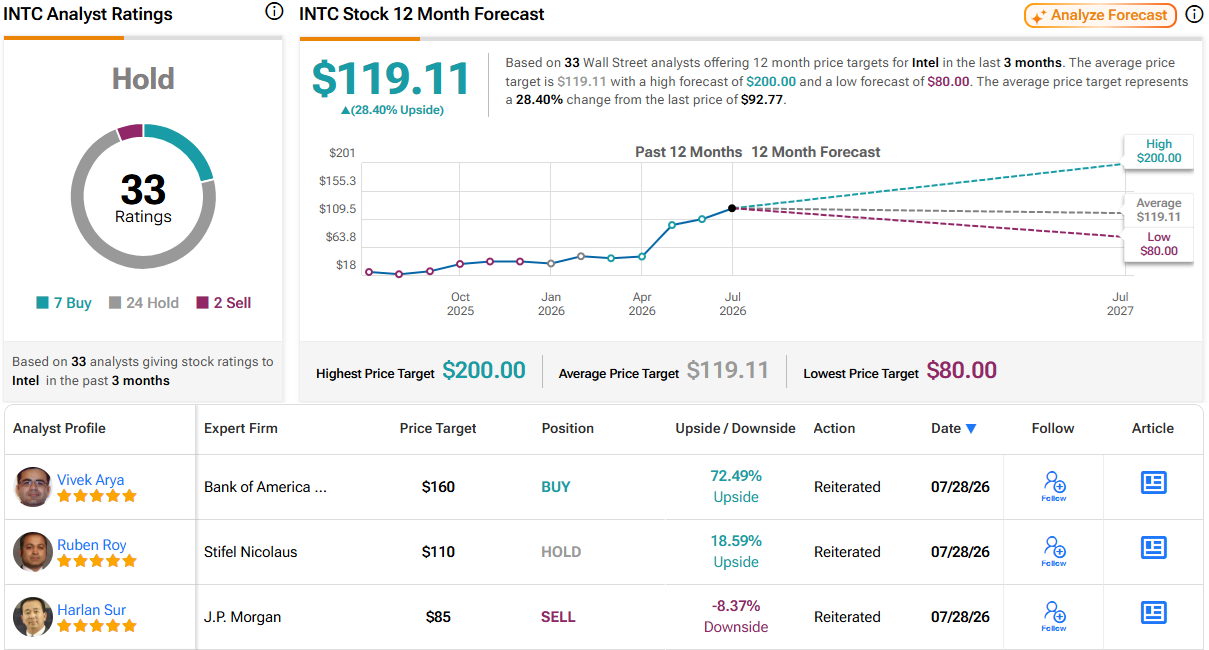
That, however, is not the most common take among Wall Street’s analysts. While 7 analysts are bulls, with an additional 24 Holds and 2 Sells, consensus rates this stock a Hold. That said, the $119.11 average price target implies shares will gain 28% over the next year. (See INTC stock forecast)
Disclaimer: The opinions expressed in this article are solely those of the featured investor. The content is intended to be used for informational purposes only. It is very important to do your own analysis before making any investment.
General Motors GM -0.80% ▼ has announced plans to launch its own in-vehicle artificial intelligence (AI) system that aims to provide drivers with a better and customized driving experience.
The Detroit-based vehicle manufacturer plans to rollout a new AI assistant that will be integrated with its cars, trucks and SUVs, and be compatible General Motors’ recently launched Gemini AI assistant that it has adopted from Google parent company Alphabet GOOGL +4.73% ▲ .
“Later this year, we’ll be launching a more deeply integrated native AI assistant that combines conversational AI with GM vehicle knowledge and OnStar intelligence to create those capabilities that go beyond what a general purpose assistant can do,” said General Motors in a news release.
GM’s Gemini AI Assistance
Last year, General Motors announced that it will place a Gemini AI assistant in its new vehicles. Now, the new AI system is expected to work in tandem with the Google product and be able to better understand the vehicle, improve the driving experience, and anticipate people’s needs while driving, according to GM.
Already with Gemini, people can speak naturally to the AI assistant while driving without having to memorize commands or repeat themselves or explain the context of what they’re saying. General Motors said that its newest AI assistant will speak to people in normal conversations and can easily answer questions. It also can control some aspects of GM vehicles, such as temperature and the radio.
“This is the beginning of a broader AI journey,” said GM.
• Vanguard ETFs offer broad diversification and the potential for long-term growth.
• Here are three Vanguard ETFs worth following.
Building long-term wealth starts with choosing investments that can stand the test of time. Vanguard ETFs are popular among investors because they offer low costs, broad diversification, and exposure to major markets. Using TipRanks’ Best Vanguard ETFs tool, we’ve identified three standout funds, Vanguard Total Stock Market ETF VTI -0.17% ▼ , Vanguard S&P 500 ETF VOO -0.10% ▼ , and Vanguard Growth ETF VUG -0.32% ▼ that every patient investor should consider adding to their portfolio.
According to TipRanks’ unique ETF Analyst Consensus, which is based on a weighted average of analyst ratings for each ETF’s holdings, VUG has a Strong Buy rating. Based on analysts’ consensus price target, VUG offers 25% upside. Meanwhile, VTI and VOO carry Moderate Buy consensus ratings, with implied upside of 22% and 27%, respectively.
The Vanguard Total Stock Market ETF (VTI) gives investors broad exposure to the entire U.S. stock market. The fund holds companies across large-, mid-, and small-cap stocks, making it a core building block for long-term portfolios. VTI is considered a safe option for long-term investors because it holds thousands of U.S. stocks, spreading risk across the entire market. The fund has an expense ratio of 0.03%.
The Vanguard S&P 500 ETF is a popular option for investors looking to gain exposure to large U.S. companies. It tracks the S&P 500 Index, which is widely seen as a key measure of the overall U.S. stock market and the broader economy. VOO ETF carries a low expense ratio of 0.03%.
In terms of holdings, VOO ETF is heavily weighted toward technology but also includes major exposure to financials, healthcare, consumer, and industrial stocks, giving investors broad, large-cap diversification. VOO holds 508 stocks with total assets worth $986.27 billion. Its top three holdings are NVDA, AAPL, and MSFT.
The Vanguard Growth ETF (VUG) invests in large U.S. growth stocks across sectors like technology, healthcare, and consumer discretionary. Its holdings lean toward faster-growing companies, but the fund still offers broader diversification than tech-heavy ETFs. VUG also has an expense ratio of 0.03%.
Its top 3 holdings are NVDA, AAPL, and MSFT. Overall, VUG owns 149 stocks with assets worth $214.56 billion.
It was a busy week for gaming news as earnings were in the spotlight.
That included results from Sony, Microsoft, and Capcom.
The gaming world saw major business moves this week, including a historic buyout and shifting sales trends. Here’s a look at the biggest gaming stories traders need to catch up on today.
Electronic Arts EA +0.13% ▲ will officially leave the public market on August 4, 2026. The company’s $55 billion buyout cleared its final review with EU approval. The deal is led by Saudi Arabia’s Public Investment Fund, Silver Lake, and Affinity Partners. It marks the biggest private gaming buyout ever.
2. Sony Reports Strong Quarter and Raises Outlook
Sony SONY +0.88% ▲ had a strong first quarter. Operating profit jumped 40% and beat analysts’ expectations. The gaming unit saw gains from digital sales and software. Sony also raised its yearly profit outlook by 8% to 1.72 trillion yen. The company sold 1.6 million PlayStation 5 units during the quarter.
3. Xbox Revenue Drops as Hardware Sales Fall
Microsoft MSFT +1.30% ▲ reported a tough quarter for Xbox. Gaming revenue fell 7% for the year to $21.8 billion. The final quarter also dropped 10%. The main issue was hardware sales, which fell 29% for the year. The decline follows major Xbox cuts that led to about 3,200 job losses. Xbox intends to return to growth by the end of Fiscal 2027 via a “reset.”
4. Capcom Shares Rise After Strong Results
Capcom (CCOEF)saw its shares climb after a strong first quarter. The company gained from steady game sales and the launch of Pragmata. Digital sales also showed the shift in player habits. Capcom sold 22.2 million digital units compared with 1.6 million physical copies.
5. New Gaming SPAC Raises $200 Million
Catalyst Acquisition (CATL)entered the market with a gaming focus. The company raised $200 million through its IPO. The SPAC plans to seek deals with game makers, mobile studios, digital media firms, and publishers.
Turning to the TipRanks stock comparison tool, traders can see how these gaming companies stacks up against each other. Investors can use this tool to gain further insight into the shares and weigh which ones might be good additions to their portfolios. (See Video Game Stock Comparisons)
Moderna beat second-quarter earnings expectations, but its stock price dipped as a key vaccine trial hit a setback.
Analyst Andrew Tsai expects upcoming trial data in the second half of the year to bring “clinically meaningful” results for investors.
Moderna’s MRNA -2.43% ▼ latest earnings were better-than-expected. Jefferies JEF +0.09% ▲ analyst Andrew Tsai explained that while quarterly earnings beat expectations, new data from cancer treatments will show whether the drugmaker can build lasting growth past its Covid business. He noted that upcoming trial readouts could prove “clinically meaningful” for investors tracking Moderna’s stock price.
Strong Foreign Sales Have Fueled Moderna’s Earnings Beat
Moderna released its second-quarter earnings, bringing in $145 million in overall revenue. This number topped average Wall Street targets of $103 million. Furthermore, Moderna posted a loss of $1.97 per share, which was smaller than the $2.02 loss expected by analysts.
Strong sales of its main Covid vaccine in the United Kingdom helped boost earnings and offset lower vaccine demand in the United States.
In addition, company leaders kept their full-year sales goals in place during the earnings update. Moderna expects 10% overall revenue growth for the year, with about half of those sales coming from international markets.
Trial Setback Weighs on Moderna’s Stock Price
On the other hand, Moderna stock price fell as news of a research setback hit the market alongside the earnings report. An experimental vaccine designed to stop norovirus failed to reach key early success marks during an ongoing study.
Consequently, this trial delay adds extra pressure on Moderna’s future earnings. A setback in non-Covid research makes it harder for the company to prove its long-term growth plan to investors.
As a result, Moderna’s stock price dropped shortly after trading opened on Friday. The fall occurred even though Moderna stock price had nearly doubled earlier in the year.
Government Decisions Could Fuel MRNA’s Growth
However, new government decisions could give Moderna stock price and future earnings a quick boost. The United States Food and Drug Administration plans to make a final decision on the company’s new flu shot by August 5.
If approved, the new flu shot would become the fifth main product sold by the business. The company also hopes a combined Covid and flu shot will generate steady long-term sales to strengthen quarterly earnings.
Still, Wall Street experts remain cautious on Moderna while waiting for clear proof of progress. Analyst Tsai pointed out that tests combining a custom cancer shot with key treatments from Merck remain on track, but he stays on the sidelines until full results arrive.
Is Micron a Good Stock to Own?
Moderna stock (MRNA) carries a Hold consensus, based on 16 analyst ratings over the past three months. Out of those, one calls it a Buy, 13 recommend a Hold, and two suggest a Sell. The average 12-month MRNA price target sits at $48.08, which represents 16.7% upside potential. (See MRNA stock forecast)