


The Canadian Official Who Tried to Build a UFO Detector
A newly declassified CIA memo revives the story of Wilbert Smith's Project Magnet, and the reporting problem that outlived it.
At 3:01 on an August afternoon in 1954, an alarm sounded inside a small shack at Shirley’s Bay in Ontario, Canada. The team thought it might have finally detected a UFO.
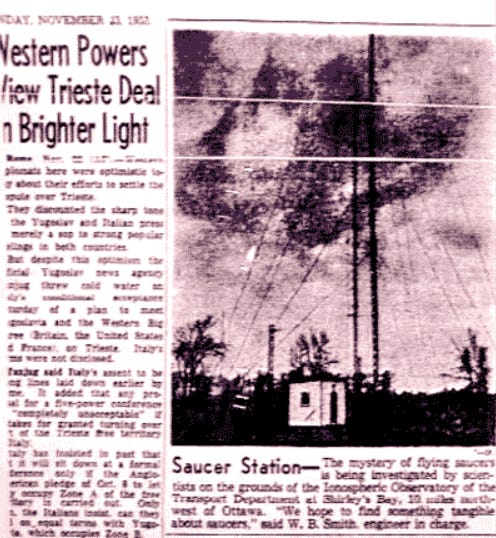
The station sat near the Ottawa River, about 10 miles west of the Canadian capital, on a restricted government site crowded with antennas, laboratories and military research.
From the outside, it hardly looked like a place built to answer one of the largest questions of the age.
But inside, as historian Matthew Hayes recounts in Search for the Unknown, Wilbert Brockhouse Smith had assembled a makeshift observatory from spare government equipment and asked whether flying saucers might leave measurable traces in the physical world.
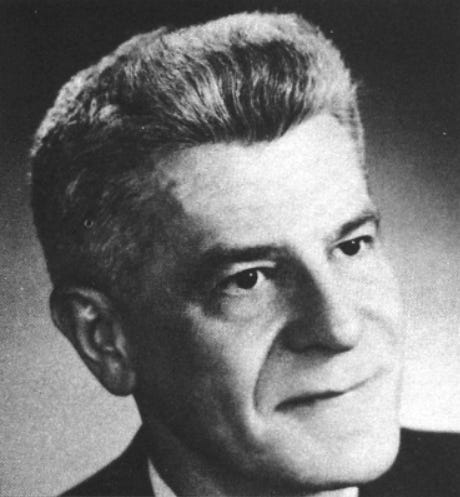
Smith was a radio engineer with Canada’s Department of Transport, fluent in the invisible forces of the modern world: signal, field, frequency, interference, noise. His professional life depended on the premise that unseen things could be detected and measured by instruments.
Flying saucers, he thought, might be no different.
The Shirley’s Bay station included equipment for monitoring magnetic fluctuations, radio noise, radiation and changes in gravity. A recording instrument continuously traced its measurements across a long strip of paper. Most disturbances were minor. Aircraft passing overhead produced little more than blips.
By the summer of 1954, Project Magnet, as Smith’s four-year-old investigation into a possible magnetic basis for UFO propulsion was known within the Department of Transport, was running out of time. The Department of Transport had already decided in June that Smith’s investigation would no longer continue as official government work. The observatory remained at Shirley’s Bay, its instruments still recording, but the experiment had yet to produce the kind of evidence that might justify its survival.
Then in August there was a detection “so large that it set off alarm bells in the shack. Smith came running,” according to Search for the Unknown.
The deflection was far larger than anything the team had seen from a passing aircraft. Smith rushed outside, hoping to find a visible object above the station. But the sky was heavily overcast. Whatever had moved the instrument, a craft, an atmospheric disturbance or a malfunction, remained hidden.
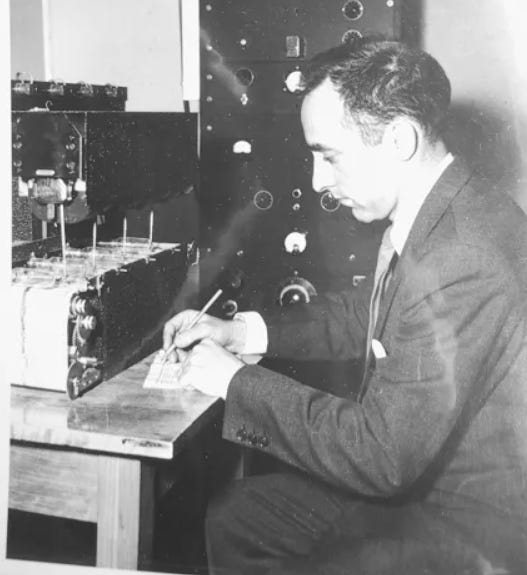
There was no photograph, no disc and no captured machine. Only the mark on the chart and the familiar cruelty of UFO evidence: enough to preserve the mystery, not enough to settle it. And there would be no chance to pursue it under the same official banner.
More than seventy years later, Smith’s name and work resurfaced in a CIA memo released by the Trump administration, a reminder that the problem he had been chasing at Shirley’s Bay outlived him. The difficulty he met first, of turning scattered sightings and instrument traces into records that could be collected, compared and studied, would define Canada’s relationship to the subject for the next seven decades.
In June 2026, the Department of War’s third PURSUE release included a less-redacted copy of a Dec. 17, 1953 CIA Office of Scientific Intelligence memo, “Current Status of Unidentified Flying Objects (UFOB) Project.” An older, more redacted version which didn’t mention Smith had long been available in the CIA Reading Room.
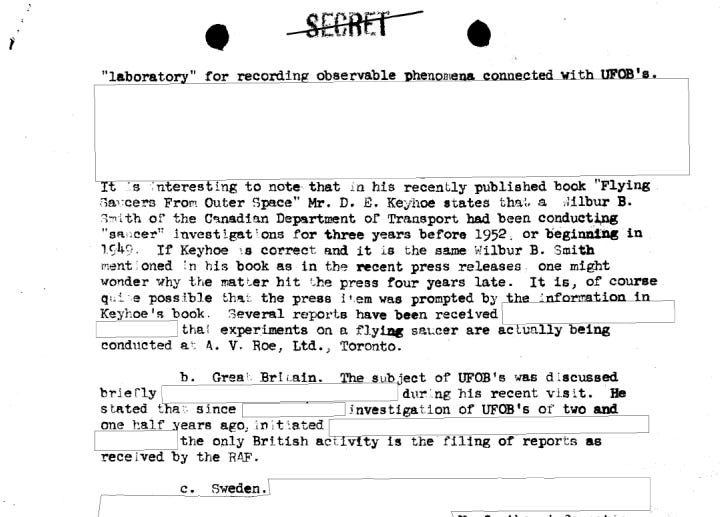
The newly visible text showed that the CIA’s Office of Scientific Intelligence was tracking Canada’s UFO research while Smith’s experiment was underway. The memo referred to a Canadian Defence Research Board and Department of Transport “laboratory” for recording UFO-related phenomena and cited Keyhoe’s published account that Smith had been conducting secret investigations.
Project Magnet, Project Second Storey and Donald Keyhoe
Before J. Allen Hynek emerged from his years as an Air Force consultant as a prominent critic of official UFO investigations, and before Harvard astrophysicist Avi Loeb became a leading modern advocate for instrumented UAP study, Canada had Smith, obscure, technical, stubborn, half-official and increasingly consumed by the problem.
Smith was a respected Department of Transport electrical engineer, with bachelor’s and master’s degrees from the University of British Columbia, wartime experience in Canada’s radio-monitoring service and responsibility for helping build a network of ionospheric stations across the North.
His interest in flying saucers began with the reports of the late 1940s but hardened during a 1950 trip to Washington. According to Smith’s later account, information obtained through Canadian Embassy contacts and associated with American physicist and defense consultant Robert Sarbacher indicated that the subject was real, highly classified and beyond existing human technology.
Smith returned to Ottawa convinced that UFOs might operate through unknown magnetic principles and that those principles could have practical value.
Smith’s most famous claim appeared in a 1950 memo, in which he wrote that the flying-saucer subject was “the most highly classified subject in the United States Government, rating higher even than the H-bomb.” The evidentiary limitation remains important: the claim survives through Smith’s account of information obtained through unofficial channels, not through a U.S. classification record.
He framed the problem in terms his department already understood, geomagnetism, radio propagation and the ionosphere, and won permission to pursue it part time with spare government equipment.
Project Magnet began in 1950, when Smith received permission to pursue part-time research into whether UFOs might operate through principles connected to Earth’s magnetic field. In another age, this would have sounded like fantasy. In the early Cold War, the impossible had recently become policy. Radar had made invisible aircraft visible. Atomic physics had cracked matter open. Rockets had made the upper atmosphere military terrain. A secret machine was not yet a ridiculous category.
By late 1953, that modest inquiry had become Project Magnet’s makeshift observatory at Shirley’s Bay, a small shack near Ottawa crowded with a gravimeter, gamma-ray detector, radio receiver and other instruments meant to catch physical traces of whatever might be moving through the sky.
Smith wasn’t the only figure officially active in Canada’s UFO research space at the time.
While Smith was building a station to detect UFOs, astronomer Peter Millman chaired Canada’s closest equivalent to the U.S. Air Force’s Project Blue Book. Project Second Storey approached the problem from almost the opposite direction. It did not begin with a theory of exotic propulsion or an attempt to make the phenomenon register on instruments. Its members focused on reports: how witnesses should be questioned, which details mattered, how reliability should be judged and how ordinary explanations could be separated from genuinely unresolved cases.
Millman represented the official counterweight to Smith: less speculation, more sorting. Under his leadership, the committee worked to strip sightings of what it considered subjective interpretation and reduce them to standardized facts, direction, duration, shape, weather, corroboration and the credibility of the observer. The goal was not to prove that UFOs existed as extraordinary machines, but to create a system capable of identifying balloons, aircraft, meteors, astronomical objects and other conventional causes.
The tension between the two approaches was present while both projects were still active. Smith served on Project Second Storey but repeatedly pushed the committee toward a more ambitious investigation, proposing broader report collection, observational experiments and closer study of cases that resisted conventional explanation. Millman and the committee were more interested in standardizing testimony, judging witness reliability and separating misidentifications from genuinely unresolved reports.
In 1952, frustrated with what he saw as little more than “correlating and cataloguing sighting data,” Smith argued privately that even one unexplained case should be enough to justify a serious scientific effort. The disagreement was not a public feud so much as a divide over method: Smith believed anomalies demanded better instruments and deeper inquiry. Millman believed the existing evidence was too subjective and poorly verified to support either.
Where Smith saw a physics problem waiting for better instruments, Millman saw a reporting problem distorted by unreliable observation and incomplete data. The distinction shaped the fate of both projects. Project Magnet asked what UFOs might be. Project Second Storey asked how reports of them could be classified, explained and closed.
After six meetings, the committee concluded that most cases could not be independently verified and that the material did not lend itself to scientific investigation. Canada’s Blue Book analogue ended not with a dramatic finding, but with an administrative judgment: the evidence did not justify continuing.
At the same time, Donald Keyhoe advocated for UFO study and disclosure from outside government.
A retired Marine Corps aviator, prolific aviation writer and former aide to Charles Lindbergh, Keyhoe had become the most influential public advocate of the early saucer era.
He took control of the National Investigations Committee on Aerial Phenomena, or NICAP, in 1957 and built it into the country’s largest and most politically connected civilian UFO organization. But by then he had already spent years moving between military contacts, government files and the reading public, arguing that officials knew more about flying saucers than they admitted.
Keyhoe and Smith had known each other since 1950, meeting during Smith’s official trips to Washington and exchanging sighting information.
“Since 1950, Smith had given me several valuable leads,” Keyhoe wrote in Flying Saucers from Outer Space.
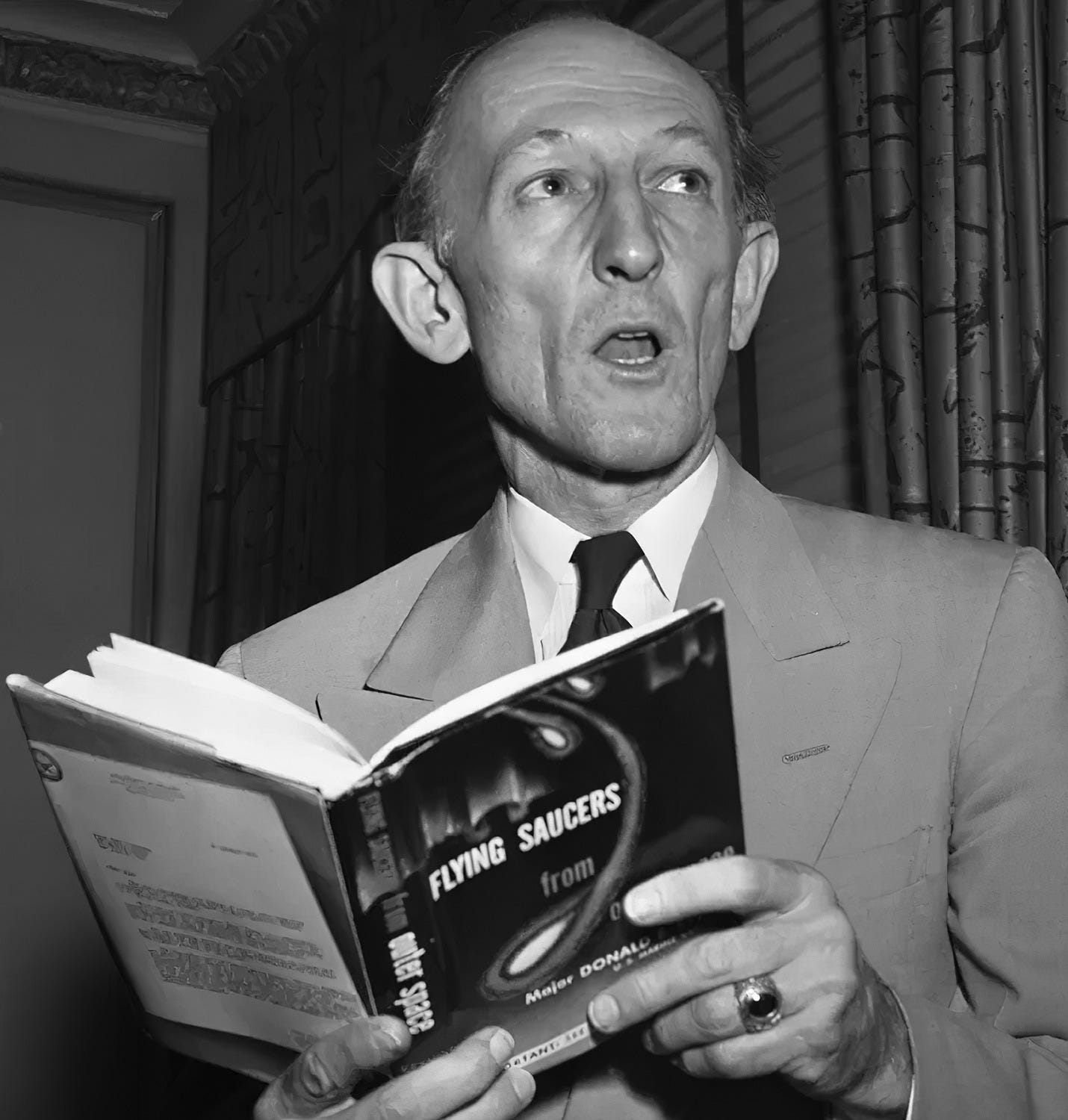
Keyhoe devoted an entire chapter to Canada, portraying Smith as the engineer behind a little-known government investigation and Project Magnet as evidence that official interest extended beyond the United States.
The book helped bring Smith’s work to the attention of the American press, and through that coverage to the CIA.
In its December 1953 assessment of foreign UFO activity, the agency cited both the recent reporting on Canada’s UFO research and Keyhoe’s account of Smith, even suggesting that the publicity may have originated with the book.
“It was quite possible that the press item was prompted by the information in Keyhoe’s book,” the memo stated. Canada’s own government research had reached the CIA as secondhand publicity, routed through an American writer and the American press, an early illustration of how loosely the country held what it knew about the subject.
The End of an Era
Despite Smith’s efforts, Canada’s official UFO moment did not last.
With the Department of Transport’s June decision to end official support, Smith did not accept that the question had been settled. Before the project was terminated, he urged the department either to expand the investigation, support it with a modest grant or release it so he could continue privately. The government chose the third option. Smith was allowed to pursue the subject on his own time and, for a period, to use spare government equipment, but Project Magnet no longer carried the authority of the Canadian state.
Smith later portrayed the decision almost as an ultimatum he had forced. A limited effort, he believed, was worse than none at all. “I put it straight to the Government that a half effort wasn’t good enough,” he wrote in 1955, recalling that officials had chosen to drop the project rather than commit to a larger investigation. The unexplained reading at Shirley’s Bay did not reverse that decision. Without a visual observation or other corroborating evidence, the instrument trace could not establish what had caused it.
Project Second Storey ceased operating at about the same time. The two projects ended together but pointed in opposite directions: Smith came away believing the government had abandoned a discovery before giving it the resources it deserved, while Millman held that the available evidence had never been solid enough to justify a larger effort in the first place.
Smith continued anyway. He remained a respected Department of Transport engineer, later promoted to superintendent of radio regulations, and inside the department his conventional technical career survived Project Magnet. Outside it, he moved beyond the cautious engineering question that had launched the project, corresponding with witnesses and researchers, analyzing reports and serving as an informal clearinghouse even after the government had withdrawn. Government offices still redirected UFO inquiries toward him, and by the late 1950s he had become NICAP’s principal Canadian contact. His own thinking drifted further from instruments over these years, toward theories about gravity, magnetism and what he believed was a deeper structure underlying physical reality, and toward the conviction that UFOs were extraterrestrial vehicles. Physics, metaphysics and alleged contact began to merge into a single system.
Yet Smith did not see this as abandoning science. He believed conventional science described only part of reality and that the stranger claims surrounding UFOs pointed toward principles it had not yet discovered. To him, contact was another source of data in addition to physical measurements.
Keyhoe briefly re-entered the Canadian story in 1958. By then director of NICAP, he asked the Defence Research Board to release Canadian sighting reports and clarify whether military pilots were restricted from discussing UFOs. Officials referred him back to Smith, and one internal note from within the Defence Research Board asked: “Can we politely disengage ourselves from Keyhoe?”
Smith died of cancer in 1962, still convinced that the government had abandoned a problem of enormous scientific importance. After his death, departments increasingly described Project Magnet as his personal, spare-time work, sometimes minimizing or denying the official support it had once received.
The UFO reports, however, did not stop. They continued to move through military offices, police channels, aviation systems and government archives, often without a single institution clearly responsible for interpreting them, according to Hayes.
Millman took a different path. He remained within conventional astronomy and government science, skeptical that UFO reports constituted a coherent scientific object. But skepticism did not make him an advocate for secrecy.
In 1968, with Project Second Storey long dormant, Millman recommended that its records be declassified and transferred to the National Research Council. The government agreed. Smith’s final Project Magnet report was released alongside them. The report reflected conclusions Smith had reached years earlier: that some UFOs were probably extraterrestrial vehicles and that their performance pointed toward unknown principles of magnetism and gravity worth investigating. Millman attached a note emphasizing that those conclusions belonged to Smith alone and did not represent the position of the Department of Transport or Project Second Storey.
After Smith, Canada’s UFO problem became less a physics project than an administrative one. Sightings passed through defense offices, aviation channels, police reports, civilian catalogs and archives.
As official investigation receded, much of the work of preserving and comparing reports fell to civilian researchers.
In the book UFOs Over Canada, Chris Rutkowski and Geoff Dittman describe a field fragmented among private investigators, local groups and government repositories, often without common standards or reliable data sharing.
The consequence was not merely bureaucratic disorder. Reports that could not be accessed or compared were effectively removed from scientific study.
“If UFO sightings are reported to groups or individuals who do not share their case data with serious researchers, those sightings are effectively lost to scientific analyses,” they wrote.
Canada Returns to the Problem
After Project Magnet and Project Second Storey ended, Canada largely abandoned dedicated UFO research, although reports continued to move through a fragmented network of government agencies. More than seven decades later, the Sky Canada Project returned to that history and to the question of how UAP reports should be collected and managed.
Led by the Office of Canada’s Chief Science Advisor, the Sky Canada Project examined how the country receives and manages public UAP reports. Its 2025 report reviewed Project Magnet and Project Second Storey as early federal efforts to study the subject, but did not investigate individual sightings or attempt to determine what UAP are. Instead, it concluded that Canada lacked a coherent reporting system: sightings were scattered across government agencies and civilian organizations, collected under inconsistent standards and rarely preserved in a form suitable for scientific analysis. The report called for clearer responsibility, standardized reporting, better data sharing and greater transparency. (Sky Canada Report)
Smith’s early effort and Sky Canada stood more than seventy years apart, and confronted the same underlying problem. Smith tried to make the unknown measurable with instruments. Sky Canada sought to make it legible through systems and data. Neither determined what UAP are. Together they show that before a government can explain the unknown, it has to build a reliable way to observe, preserve and study it, the task Smith ran up against at Shirley’s Bay and the one Canada has yet to finish.
Written by RM McLaren


This history is so very important to see the fullness and wholeness of the UAP. Thanks