

Taxonomies of the Invisible Frontier - Part 4
A Taxonomic Framework for Anomalous Technologies (XT / X-Tech)


Introduction
In Part 3 of Taxonomies of the Invisible Frontier, we introduced a taxonomic framework for anomalous intelligence (XI/X-Life) and demonstrated a method for extracting structured observational data from cultural records. In Part 4, we turn to anomalous technology (XT/X-Tech). At this stage, we define anomalous technology as any object, artifact, system, process, or effect whose observed characteristics cannot be reconciled with the technological capabilities known to exist within a bounded observational context.
Distinct yet complementary to the X-Life taxonomy, the X-Tech framework operates under the same constraints: incomplete records, uncertain dating, cultural distortion, and narrative bias. Accordingly, we prioritize observable characteristics over inferred causal mechanisms and accept both cultural records and modern instrumentation-based observations as admissible evidence. This paper establishes the theoretical and methodological foundation for citizen-scientists and independent researchers to study anomalous technologies and outlines a scalable method for extracting candidate X-Tech data from cultural records without introducing anachronism.
1. Defining Anomalous Technology (XT/X-Tech)
What is Technology? Before advancing a taxonomic framework for anomalous technology, it is necessary to clarify what is meant by technology in the first place. In contemporary usage, the term is narrowly associated with advanced industrial, digital, or electronic systems; however, this restricted definition is inadequate for frontier analysis.
Here, technology is defined as a structured means of transforming matter, energy, or information into consistent, reproducible effects within a defined system. A humble pickaxe is a technological system that turns large rocks into smaller ones. Its handle and head reflect woodworking and smithing traditions; its power source—manual labor—is unseen but understood; its design is optimized for bipedal use. From a single observation, multiple dependent facts can be reliably inferred. Archaeological and anthropological literature indicate that technological behavior predates written language and formal symbolic systems. Technological artifacts are therefore among the earliest and most persistent outputs of intelligent life.
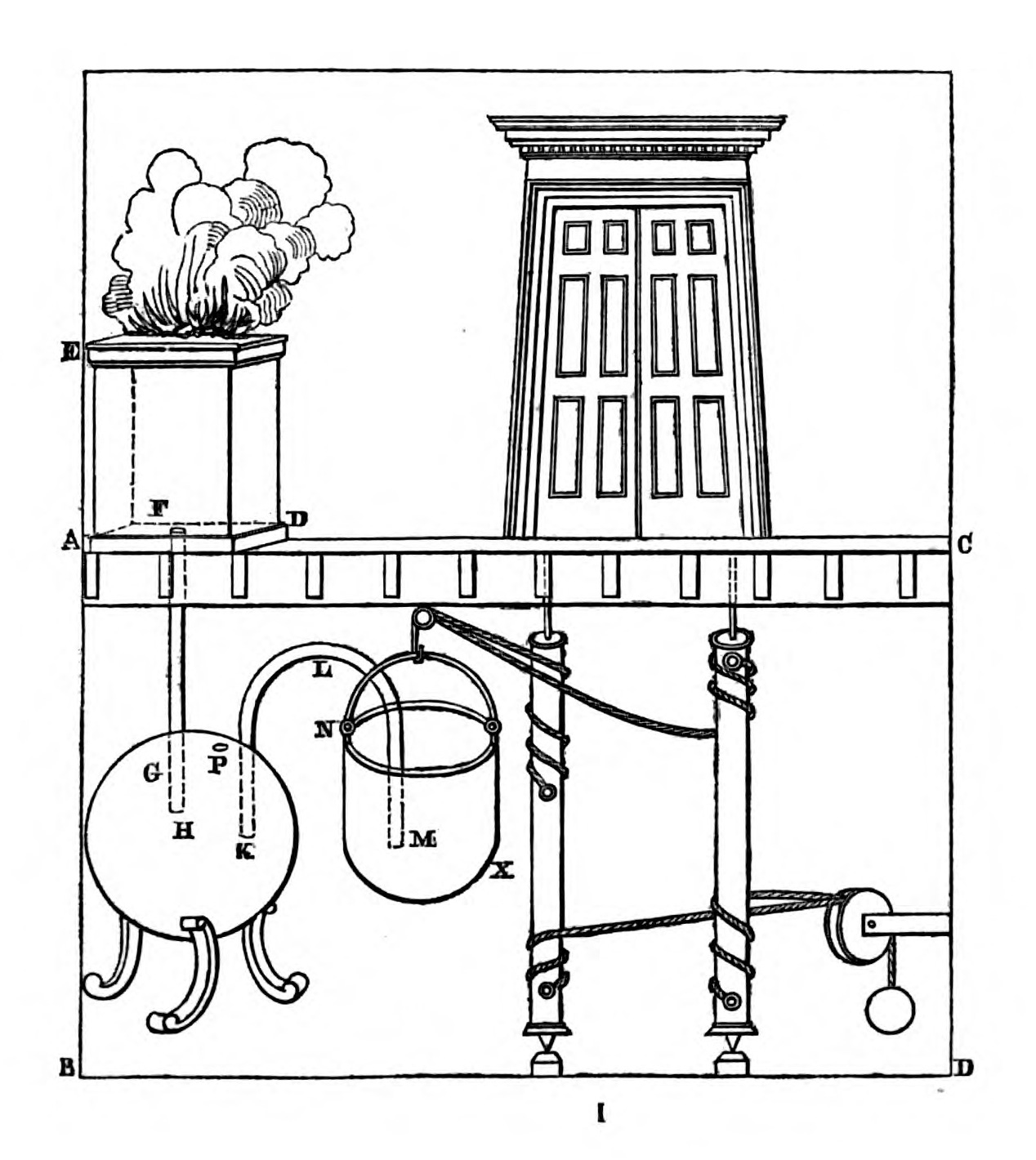
For the observer, technology may appear as a discrete object, a repeatable process, or a recurring effect without an identifiable cause. Accordingly, this study prioritizes describable, recurrent characteristics and avoids premature correlation with modern technological categories, operational theories, or assumed origins. The method seeks to identify structured form, consistent function, measurable signature, and patterned behavior—establishing the presence of a technology within a bounded historical context before attempting explanation.
Technologies operating over sufficient duration—whether continuously or intermittently—may become embedded in local environments. Such embedding can generate second-order physical, ecological, biological, and even evolutionary effects, visible as accretions, adaptations, and patterned interactions with surrounding systems. These secondary effects can serve as traces of technology even when the primary mechanism is inaccessible, permitting partial reconstruction of capability, impact, and engagement from the remaining evidence.
Technology can be examined across several dimensions: (1) process—the ordering and transformation of matter, energy, or information toward specified ends; (2) objects—the tools, devices, systems, and procedures produced by that process; (3) knowledge—the operational understanding that enables such transformations; (4) τεχνολογία—a coherent set of related objects and knowledge domains; and (5) the technological system—the integrated constellation of processes, artifacts, knowledge, developers, users, and worldviews that sustain technological activity. Under this definition, technology is defined not by industrial sophistication or computational power, but by structured repeatability that produces consistent effects.
What is anomalous? The term derives from the Greek ἀνώμαλος (anomalos), meaning uneven, irregular, or deviating from expectation. An anomaly is not inherently false, impossible, or revolutionary; it is simply a data point that resists integration into existing models.

In scientific practice, an anomaly is an observed phenomenon that cannot be reconciled with established theory.1 The standard response is conservative: attempts at replication, instrument verification, parameter adjustment within existing frameworks, and theoretical expansion—reserving revolutionary revision for rare cases. Anomalies are often treated first as measurement error or incomplete data before being recognized as genuinely novel signals. While methodologically prudent, this tendency risks premature assimilation of new information without fully reckoning with its novelty.
In historical inquiry, anomalies take a related but distinct form. A historical anomaly is an artifact, event, person, or location that does not fit established chronological, technological, or cultural contexts. Examples include out-of-place artifacts, discontinuities in technological development, capabilities inconsistent with known enablers, or accounts of environments incongruous with established geography. Historiography responds conservatively: re-dating sources, re-contextualizing claims, discounting eyewitness testimony, or interpreting phenomena through metaphorical, mythic, or religious frameworks. Revision of accepted timelines does occur, but only under substantial evidentiary pressure. In both science and history, anomalies serve as points of friction within knowledge systems that favor continuity and stability over adaptation.
The formal study of technology emerged in the late eighteenth century with Johann Beckmann’s Anleitung zur Technologie (1777), one of the first systematic descriptions of the arts and sciences that constitute technology.2 The field expanded in the twentieth century through major scholarly works—most notably Joseph Needham’s Science and Civilisation in China (1954)—alongside parallel studies of Indian, Islamic, and European technological traditions that helped consolidate broadly accepted development timelines.345 These narratives describe technological evolution as a progression from stone tools to metallurgy, agriculture to mechanical engineering, scientific revolution to industrialization, electrification to digital computation, culminating in what may be described as an era of meta-convergence.
Technological change is therefore expected to exhibit continuity, intermediate stages, and traceable lineages. Against this backdrop, a technology becomes anomalous when it violates those expectations. Such anomalies may be provisionally identified where one or more discontinuities are observed: chronological displacement (appearance prior to prerequisite developments), material discontinuity (fabrication or materials beyond contextual capability), energetic discontinuity (effects exceeding known power densities), or developmental discontinuity (absence of a precursor lineage).
With these dynamics established, we define anomalous technology (XT/X-Tech) as any object, artifact, system, process, or effect whose observed characteristics cannot be reconciled with the technological capabilities or lineages known to exist within a bounded observational context. This definition presumes neither exotic origin nor specific causal mechanism; it identifies discontinuity alone. XT research therefore begins with the disciplined cataloguing and analysis of such discontinuities prior to theoretical explanation. In short, we create the data from which developmental theories may proceed.
2. A Taxonomic Framework for Anomalous Technology (XT)
Here we formalize a taxonomic framework for classifying anomalous technologies (XT/X-Tech) based strictly on observable characteristics rather than inferred causes, origins, or intentions. The framework enables comparative analysis across disparate cultural records, observational contexts, and levels of descriptive quality by adhering to a shared vocabulary and fixed ordering principles.
Our primary goal is not to explain how anomalous technologies work, but to enable repeatable identification, differentiation, and aggregation of recurring technological signatures across heterogeneous cultural records. By constraining analysis to what can be directly observed and recorded, the framework minimizes premature theorizing and confirmation bias while preserving analytical utility.
The framework consists of four primary observational categories designed to capture the irreducible traits of technological phenomena described in cultural records. Their ordering is intentional: each successive category increases in detail and resolution as the preceding ones are expanded and refined. The logic proceeds sequentially: What does it look like (Form)? What observable consequences does it produce (Effect)? How does it interact with the surrounding environment (Behavior)? What capability does it enable (Function)?
Form, the observable appearance and manifestation of the technology, independent of inferred mechanism or origin. Includes characteristics such as shape, size, geometry, symmetry, texture, luminosity, boundedness, persistence, and coherence.
Effect, the observable consequences produced by the technology’s presence or operation, regardless of intended purpose. Includes physical, environmental, biological, cognitive, or systemic impacts, as well as measurable changes in local conditions.
Behavior, how the technology relates to, responds to, or engages with other systems, environments, or agents. Includes patterns of responsiveness, selectivity, resistance, autonomy, coupling, proximity sensitivity, and sustained or episodic engagement with observers, entities, or instrumentation.
Function, what the technology enables or allows to occur, inferred strictly from observed use or outcomes rather than assumed intent. Includes capabilities such as movement, communication, manipulation, transformation, constraint, or modification of matter, energy, or information.
Taken together, Form, Effect, Behavior, and Function constitute the minimal set of primary categories necessary for differentiated sub-categorization. Each isolates a distinct technological signature: how it looks, what it does, how it interacts, and what it enables. None presumes mechanism, origin, or intent; the focus remains on describable and irreducible traits. As datasets accumulate, recurring clusters may reveal patterned signatures otherwise obscured within isolated narrative accounts. Such discovery, however, must rest on a solid foundation.
3. Trait Extraction Principles for X-Tech
This methodology extracts data from aggregated cultural records rather than discrete, instrument-recorded events. The observational units encoded within the X-Tech framework therefore represent preserved memory, often compressed within narrative structures and shaped by cultural overlay or translation error. Although adaptable to modern observational datasets, the present model assumes anomalous phenomena are preserved in encoded form. Because cultural records frequently embed unfamiliar phenomena within symbolic or narrative framing, limited interpretive analysis is sometimes required to extract obscured information. Extracted traits are therefore encoded using a two-tier evidentiary model: observed and inferred.
Observed traits are those explicitly described in the source as perceptible features, behaviors, patterns, or effects of a technology as presented in the narrative account. These include appearances, actions, sounds, environmental impacts, and interaction patterns. Though embedded within narrative structure, such traits constitute the highest-value evidentiary layer available to this method.
Inferred traits arise when interpretation extends beyond explicit description yet remains confined to defensible deduction. An iron sword, for example, implies a creator and supply chain even if neither is described in the text. Inferred traits may include mechanisms, construction methods, system effects, or other implications not directly stated in the source. While analytically useful, such traits carry lower evidentiary weight and cannot independently support strong epistemic claims.
Rather than excluding interpretive content, the framework preserves both tiers within a unified dataset while maintaining their evidentiary distinction. Inferred traits may gain strength when independently corroborated across multiple sources or corpora, but they remain secondary to explicit description. By weighting rather than segregating inference, the framework preserves analytical flexibility while minimizing the risk that modern extrapolation overwrites historical observation.
Minimizing Semantic Drift
Because this methodology extracts technological traits from cultural records in which anomalous phenomena are preserved through narrative compression and symbolic systems, the encoding process must remain neutral toward modern technological categories. Cultural records do not lack technical description; they lack contemporary vocabulary and modern scientific framing. Our task is therefore to extract usable descriptive data without introducing anachronistic terminology or imposing present-day explanatory models.
X-Tech traits are extracted from explicitly described appearances, operations, effects, interactions, communications, and temporal characteristics—not from analogy to modern systems or identification with contemporary scientific constructs. An object that “moves through the sky” or “shoots forth bolts of lightning” is not encoded as an “aerial vehicle” or a “directed energy weapon.” Instead, we encode “aerial movement” and “light emission.” Greater specificity, absent additional descriptive data, would be premature.
This principle of minimalism extends to assumptions about construction, material composition, design, and purpose. Internal processes and mechanisms are not presumed unless directly indicated in the source or supported by defensible inference. If a narrative states that “a voice spoke to them from out of the dark,” one may encode acoustic emission and linguistic communication without presuming the mechanism responsible for the effect. When metaphor is employed—such as references to “fire,” “sky-chariot,” or “Voice”—the descriptive components embedded within those metaphors are parsed and encoded (e.g., light emission or thermal emission, aerial locomotion, acoustic effect).

These restraints are not intended to deny further technological interpretation, but to prevent premature theorizing and preserve data integrity. By resisting modern vocabularies and operational theories at the encoding stage, the method minimizes anachronistic projection and confirmation bias. The objective is to allow patterns to emerge as data accumulates, enabling later identification of high-confidence clusters of technological traits. If this work succeeds, it will be because the patterns survived skeptical inquiry—not because they were forced into view.
Relationship Between XI (X-Life) and XT (X-Tech)
Because this study concerns not only X-Tech and X-Life individually but also their relationship, instances of apparent ownership or authorship of anomalous technology must be captured. Of primary importance is the relationship between a technology and its creator; second, its operator or owner; third, the observer. Particular attention should be given to cases in which a technology appears to operate independently, as well as to anomalous effects without an apparent source. Correlating anomalous technologies with their users across large, diverse datasets may illuminate potential points of ingress into the human environment across time and space.
Where XI and XT overlap within a narrative, their relationship must be encoded as a distinct incident rather than subsumed under either entity or artifact. An object described as “descending from the sky” constitutes an X-Tech observation; a floating column that responds to directives from an entity constitutes an XI–XT coupling event. The use of symbols or spoken words to access a facility, activate an object, or summon a Voice may likewise indicate control interfaces, dependencies, or coupling mechanisms. Over time, clustering analysis may reveal whether certain X-Tech classes correlate with particular X-Life or Homo sapiens sapiens signatures—and vice versa—suggesting geographic regions where artifacts or embedded systems may be recoverable.
For later cross-analysis, three relational modes are preserved:
Coupled, XT created, possessed, transported, or operated by a specific user profile such that activation appears contingent on the user’s presence.
Autonomous, XT encountered without associated user; persists as a standing environmental feature; activates autonomously; or produces recurring effects without stimulus.
Transferred: XT acquired from prior owners, retrieved from hidden locations, recovered after loss, or passed across generations or groups—indicating persistence beyond a single occurrence.
These distinctions enable comparison of whether specific XT trait clusters correlate with particular XI types or recur independently across contexts. By preserving XI and XT as independent yet relational datasets, the method permits cross-referencing between intelligences and their tools without presuming a single explanatory ontology. The longer-term goal is to observe what emerges when XI and XT are mapped against one another at scale and to use those correlations to guide subsequent research—including targeted searches for X-Tech artifacts or persistent sites.
The trait extraction principles described above ensure that technological data recovered from cultural records retain evidentiary transparency and comparative utility. By distinguishing observed from inferred traits and enforcing descriptive minimalism, the framework preserves the integrity of historical observation while enabling cumulative pattern recognition. Explanatory hypotheses should be entertained only after large-scale aggregation.
4. Example of Extracted and Encoded X-Tech from Cultural Records: Anatolian Folklore
To illustrate the X-Tech trait extraction method, we present a small dataset derived from a secondary cultural corpus. This dataset is distinct from the Nart Sagas corpus currently under development and is not offered as evidentiary proof of anomalous technology. Rather, it serves as a procedural demonstration of how narrative material can be converted into structured, analyzable data under the XT schema.
The source corpus, A Treasury of Turkish Folktales for Children by Barbara K. Walker, consists of translated folkloric material from Anatolia. Discrete narrative events were parsed into observational units (OUs), each representing a minimally bounded descriptive instance containing a candidate technological object, effect, or structured process. From each OU, verbatim phrases were extracted and encoded within the XT framework using the vocabulary defined in Sections 2 and 3.

For this demonstration, we selected the tale “The Wonderful Pumpkin.” In the narrative, a pumpkin-like object is gifted to a human boy by a djinn. The object produces abundant food and drink only when activated by a precise spoken phrase: “Open, tiny little squash; shut, tiny little pumpkin.” When the correct phrase is spoken, food appears in abundance; when the complementary phrase is uttered, it disappears and the object returns to an inert state. Attempts to force the object open fail; its surface resists cutting and blunt force. Activation appears entirely contingent upon exact linguistic input. In the absence of the correct phrasing, the object remains inactive.To its rightful user, the pumpkin provides mana from Heaven; for everyone else, it is a useless, indestructible, wonderful pumpkin.
Dataset Field Structure (As Implemented)
Each encoded row contains:
XT-ID – Candidate anomalous technology identifier
OU-ID – Observational Unit identifier
Source Reference – Bibliographic citation
Extracted Descriptor – Verbatim narrative phrase
Trait Category – FOR / EFF / BEH / FUN
Trait Sub-Category – Structured refinement (e.g., FOR.shape)
Trait Value – Controlled vocabulary value (e.g., ORGANIC)
Observed vs. Inferred – Evidentiary flag
Inference Supporting OUs – Aggregation references
X-Tech Transfer – XI to Human / Human to XI / Unknown
X-Tech Coupling – Interface mode (e.g., Yes; Pass-phrase)
X-Tech Autonomy – Observed / Not Observed
The sub-category structure follows a dot-hierarchy convention (Category.subdomain), preserving consistent structure and descending resolution within each primary domain.
To clarify how narrative text becomes structured data, consider several extracted phrases:
“Open, tiny little squash…”
“All sorts of good foods came pouring from the pumpkin.”
“Shut, tiny little pumpkin.”
“The pumpkin would not open.”
“Neither blacksmith nor scholar could pierce it.”
These were decomposed as follows:
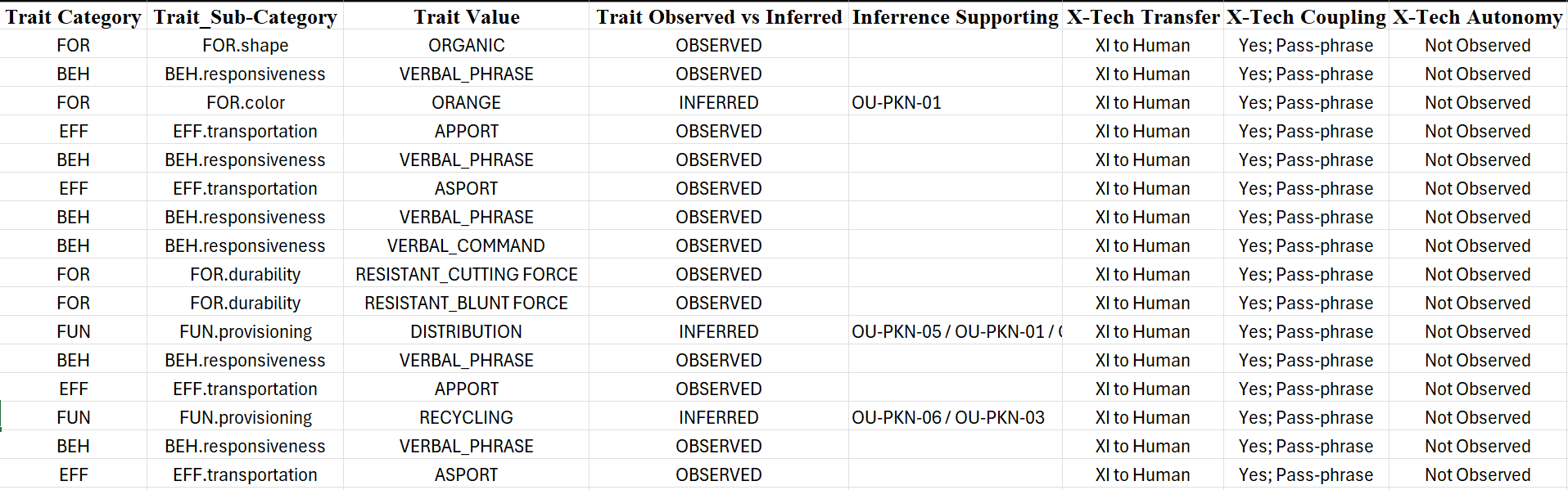
Across multiple OUs, repeated effects demonstrated by the wonderful pumpkin resulted in determining its FUNCTION:
FUN.provisioning → DISTRIBUTION (Inferred; multi-OU support)
FUN.provisioning → RECYCLING (Inferred; multi-OU support)
No causal explanation was encoded. The object was not categorized as a “replicator,” “fabricator,” or “device.” Only minimal, directly supported traits were recorded. A cultural record, treated as descriptive rather than allegorical, can be parsed into discrete observational units; those units can be translated into defined trait categories; observed and inferred inputs can be separated; and relationships between technology and user can be preserved without presuming mechanism or origin. Applied consistently across large, independent datasets, this approach permits discovery of technological discontinuities at scale.
5. Scope, Constraints, and Intent of This Framework
As detailed earlier in this series, the limitations of cultural primary sources restrict the scope and defensible interpretation of extracted data. Principal constraints include uncertain dating, artifacts of oral transmission, translation and cultural mediation errors, narrative bias, and the persistent risk of modern technological projection.
Unlike modern sensor datasets, cultural records seldom preserve time-stamped observation events. Uncertainty in dating individual narratives means extracted traits cannot be reliably associated with discrete historical moments. What can often be established instead are temporal windows during which particular stories, motifs, objects, or descriptive clusters entered, stabilized, or transformed within a tradition. Any attempt at temporal narrowing must be treated as probabilistic and pursued through interdisciplinary methods.
As oral traditions, many corpora are subject to compression, embellishment, and narrative structuring. Repetition may privilege certain descriptors, while cultural taboos conceal others. Translation introduces additional drift: substitution of culturally legible terms for unfamiliar analogies, smoothing of ambiguity, and imposition of modern categories onto unrelated descriptions. These constraints do not nullify the evidentiary value of cultural records, but they must be acknowledged.
Technological phenomena are especially vulnerable to anachronistic projection by modern analysts. Contemporary observers possess a dense vocabulary of aerospace, digital, and energy systems that may be unconsciously mapped onto sparse historical descriptions. For this reason, the encoding methodology prohibits premature equivalence between narrative descriptors and modern technological categories. We are not hunting for modern objects in ancient texts; we are building a disciplined method to extract the irreducible elements of what is actually described and allow them to guide further research.
A related risk is false positives: poetic metaphor, archetypal personification, religious iconography, and narrative convention can generate descriptions that simulate technological discontinuity without corresponding to real-world events. This framework does not attempt to resolve such cases individually. Instead, it mitigates false positives through scale and structure: consistent trait extraction, evidentiary tiering, and large-scale cross-source comparison. Where similar trait clusters recur across independent sources—especially across linguistic and cultural boundaries—the probability that they encode real-world observation rather than locally imagined accounts increases.
This framework does not on its own prove the existence of exotic technologies. Its purpose is methodological: to provide a disciplined means of identifying, encoding, and comparing technological discontinuities across cultural records. By constraining analysis to observable traits and preserving evidentiary tiers, the framework generates cumulative descriptive power without premature explanation. If patterns emerge, they do so on their own.
6. Conclusion
Anomalous technology, like anomalous intelligence, cannot be responsibly studied through isolated anecdotes or speculative equivalence to contemporary systems. It must be described before it is explained. The XT framework proposed here provides a minimal, repeatable structure for doing so. By isolating Form, Effect, Behavior, and Function; distinguishing observed from inferred traits; and preserving relational mapping between X-Tech and X-Life, we establish the groundwork for scalable comparative analysis across time, geography, and culture. As datasets accumulate, disciplined cataloguing of discontinuities may reveal recurring technological signatures that can be identified, compared, and prioritized for further research—without premature conclusions about mechanism or origin. The credibility of this approach will rest not on isolated cases, but on whether independently extracted datasets converge on stable, recurring technological signatures.
All for Part 4 and Anomalous Technology…next, a surprise third entry into our taxonomic frameworks…
Kuhn, Thomas S. The Structure of Scientific Revolutions. 2nd ed., enlarged, International Encyclopedia of Unified Science, vol. II, no. 2, University of Chicago Press, 1970. Pp. 57-65.
Frison, Guido. The First and Modern Notion of Technology: From Linnaeus to Beckmann to Marx. Consecutio Rerum, vol. 3, no. 6, 2019, pp. 147–162.
Bakar, Osman. The History and Philosophy of Islamic Science. Islamic Texts Society, 1999. Pg.13.
Subbarayappa, B. V., editor. A Concise History of Science in India. Indian National Science Academy, 1971. Pp. 572-578.
Yates, Frances A. The Rosicrucian Enlightenment. Routledge and Kegan Paul, 1972.


Only now truly understanding the magnitude of the words in your bio. You will forever be remembered as a patriot in my house. Thank you.
“we define anomalous technology (XT/X-Tech) as any object, artifact, system, process, or effect whose observed characteristics cannot be reconciled with the technological capabilities or lineages known to exist within a bounded observational context.”
Brilliant article. Good work, Matthew.