
In a welcome remonstration of federal judges in Vermont, the Second Circuit appeals court has unanimously ruled that Congress meant what it said in stripping those judges of jurisdiction to intervene in removal proceedings. Contrary to some celebratory commentary from Trump supporters, however, the ruling does not assure that the Columbia student at the center of the case, Mohsen Mahdawi, will be deported.
Mahdawi’s removal hinges on a profound constitutional question that was not before the Second Circuit, to wit: May an alien lawfully present in the United States be removed over what would be First Amendment-protected conduct if engaged in by an American, based on the Secretary of State’s judgment that the alien’s presence is detrimental to American foreign policy?
The Second Circuit sits in Manhattan and reviews federal cases from New York, Connecticut, and Vermont. On Tuesday, a three-judge panel, in a thorough opinion by Judge Debra Ann Livingston (a Bush-43 appointee), joined by Judges William J. Nardini and Steven J. Menashi (both Trump appointees), ruled that Section 1252(b)(9) of the federal immigration laws prohibits federal judges, under the guise of habeas corpus, from addressing issues relevant to the lawfulness of removal. (Habeas is a challenge to the lawfulness of a person’s detention or conditions of confinement. Judge Menashi wrote a concurring opinion theorizing that the court had additional bases to reject Mahdawi’s claims.)
I addressed Mahdawi’s case when he was first apprehended. He is a lawful permanent resident alien from the Palestinian territories (the Judea and Samaria regions around Jerusalem, dubbed the West Bank by Palestinians). He came to the United States on a tourist visa in 2014. At the time, he was married to an American, who petitioned to adjust his status to that of an immigrant. He became a lawful permanent resident alien and, when he was arrested in 2025, he was seeking to become a naturalized U.S. citizen. In the interim, he enrolled as an undergraduate at Columbia in 2021 and is currently in a master’s degree program at Columbia’s School of International Public Affairs.
Although the case is mainly about Mahdawi’s campus agitation, the government has drawn attention to other disturbing aspects of his time in the U.S. According to a Vermont police report, Mahdawi sought to purchase firearms in Vermont in 2015, telling one gun store owner there that he “used to build . . . submachine guns to kill Jews while he was in Palestine [sic].” Madawi denied making such statements; the FBI did not pursue charges against the alien but intimated during a court hearing that it had developed intelligence information it could not disclose in open court that corroborated the police report.
The Second Circuit also notes that Mahdawi and his wife divorced shortly after a 2015 episode in which, after a “non-physical argument,” the then-wife asked police to take possession of a shotgun she owned (apparently fearful of how it might be used). In 2019, upon being stopped by federal agents at the border, Mahdawi was allegedly in possession of LSD, methamphetamine, and opiates, as well as $4,125 in cash. In that connection, he was charged by state authorities in Vermont, but the charges were dismissed after he completed a diversion program. With the record expunged, Mahdawi has since denied possessing illegal narcotics on that occasion.
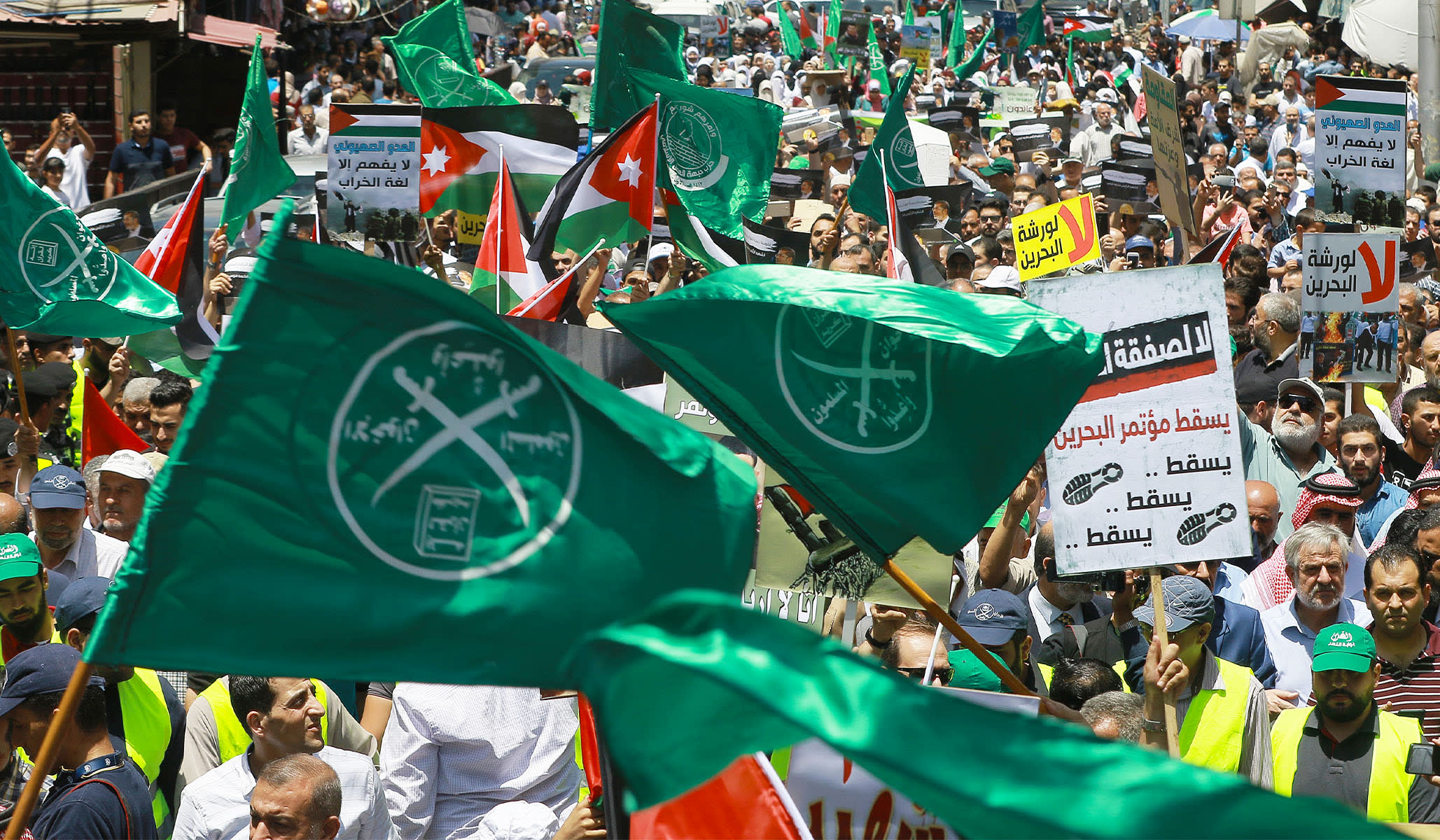
Following the October 7, 2023, atrocities against Israel led by Hamas (a designated foreign terrorist organization for which it is a felony to provide material support), Mahdawi engaged in campus activism against Israel’s military response. Along with his associate Mahmoud Khalil (whom the Trump administration is also seeking to deport), Mahdawi founded the Columbia University Apartheid Divest organization (CUAD). The Investigative Project on Terrorism explains that CUAD is the successor of another radical organization, Students for Justice in Palestine; during the post-October 7 unrest, SJP was banned by Columbia after threatening, “We will seize control of our institutions, campus by campus, until Palestine is free.”
In connection with the Trump administration’s effort to remove Khalil, I’ve previously related the following regarding CUAD:
As the New York Times reports, CUAD expressly backs “armed resistance” by Hamas and recently rescinded an apology it had offered after one of its members said Columbia should be “grateful that I’m not just going out and murdering Zionists.” The group promotes the radical leftist claim that the United States and Canada are oppressor regimes that are “occupying” “Turtle Island,” having seized it from indigenous peoples. CUAD has also promoted a “Resistance 101” panel that featured a member of the Popular Front for the Liberation of Palestine — a designated foreign terrorist organization — who proceeded to laud his “friends and brothers” from Hamas and yet another foreign terrorist organization, Palestinian Islamic Jihad. (Another panelist at the event: “There is nothing wrong with being a member of Hamas, being a leader of Hamas, being a fighter in Hamas. . . . These are the people that are on the front lines defending Palestine.”)
In April 2025, Secretary of State Marco Rubio made a formal finding, pursuant to Section 1227(a)(4)(C)(i), that Mahdawi’s “presence or activities in the United States would have potentially serious adverse foreign policy consequences for the United States.” The secretary alleged that Mahdawi has called for the destruction of Israel and was identified, during the Columbia campus agitation, as having “engaged in threatening rhetoric and intimidation of pro-Israeli bystanders.” Removal proceedings were commenced and, on April 14, 2025, federal agents arrested Mahdawi at a U.S. Citizenship and Immigration Services office in Colchester, Vt., right after Mahdawi finished being interviewed in connection with his naturalization petition.
Consistent with the Trump administration approach of transferring aliens in custody to venues more accommodating of aggressive removal policies, immigration agents wanted to move Mahdawi to Louisiana. But before they could get a flight out, Mahdawi’s lawyers filed a habeas corpus petition in Vermont, objecting to his arrest and detention.
Shortly thereafter, two Obama-appointees to the federal district court in Vermont, Judge William K. Sessions and Judge Geoffrey W. Crawford, issued and extended temporary restraining orders that barred the government from moving Mahdawi out of the state. Subsequently, Judge Crawford granted Mahdawi’s habeas petition and ordered his release, peremptorily setting aside the Justice Department’s claim that he lacked jurisdiction. Crawford reasoned — as Democratic-appointed judges sympathetic to alien complaints about Trump enforcement policies have been wont to do — that the immigration law’s jurisdiction-stripping provision was beside the point because, in a habeas proceeding, the court concerns itself with the detention of the inmate pending removal, not with removal itself.
This is the theory the Second Circuit has now invalidated. As the panel observed, Congress was quite clear in denying jurisdiction to district judges. Section 1252(b)(9) states in pertinent part:
Judicial review of all questions of law and fact, including interpretation and application of constitutional and statutory provisions, arising from any action taken or proceeding brought to remove an alien from the United States . . . shall be available only in judicial review of a final order [of removal]. . . . Except as otherwise provided in this section, no court shall have jurisdiction, by habeas corpus . . . to review such an order or such questions of law or fact. [Emphasis added.]
The point of this jurisdiction-stripping provision is to channel all legal and factual claims arising in removal cases. First, removal proceedings take place before the Justice Department’s in-house tribunals — a hearing before an immigration “judge” (who is a DOJ official, not an Article III federal judge) and then review by the DOJ’s Board of Immigration Appeals. Finally, the alien has one shot at an appeal to the federal judiciary — but, by law, that appeal (called a petition for review) is made to a circuit court of appeals, not a district judge.
In essence, Mahdawi contends that his detention is unlawful because Rubio is seeking to expel him for what he describes as constitutionally protected conduct. That is, his argument against detention is inextricably intertwined with his argument against removal. Hence, the jurisdiction-stripping provision (which the Supreme Court has described as a “zipper” clause that closes the district courts off from intervening in removal matters) bars the district courts from using the guise of habeas to intercede in removal. With this rationale, the Second Circuit followed the lead of the Third Circuit, which, in closely divided opinions (2–1 at the panel stage and 6–5 en banc), rejected Khalil’s habeas petition. The Third Circuit noted that Khalil’s ostensible challenge to his arrest and detention had raised “legal questions challenging the government’s very basis for trying to remove . . . him.” (The Third Circuit sits in Philadelphia and controls federal cases in Pennsylvania, New Jersey, Delaware, and the U.S. Virgin Islands.)
This is far from the end of the case. The Second Circuit was involved here solely because of Mahdawi’s habeas petition (again, filed in Vermont) — i.e., not because of the underlying removal litigation. After the Vermont judges stopped the Trump administration from moving him to Louisiana, the government went ahead with Mahdawi’s removal proceedings in Chelmsford, Mass.; that is in the First Circuit (which sits in Boston and covers Massachusetts, Maine, New Hampshire, Rhode Island, and Puerto Rico).
As the Second Circuit detailed in a footnote (Opinion, p. 14, n. 8), Mahdawi has had extensive, complex removal proceedings in the DOJ tribunals, which are not completed yet. Even so, he has already filed a petition for review in the First Circuit. It is the First Circuit that will decide the main removal issue — namely, Rubio’s authority, or lack thereof, to order removal based on what would be First Amendment–protected conduct if engaged in by an American.
On that score, I’d caution that threats are not First Amendment-protected speech. Consequently, if the government can establish that Mahdawi engaged in threatening speech, incitement, or offensive actions, then the court can greenlight his removal without resolving the difficult question of removal based on ostensibly legal rhetoric.
Although it’s rare for the Supreme Court to involve itself in removal issues, that is a question on which it would likely make the final call. In the meantime, the Second and Third Circuits are right to admonish district judges to stay out of removal cases. Moreover, the Trump administration would be well advised to stop courting interference by the activist judges about which it complains — sometimes justifiably, sometimes not. If the immigration agents simply conducted the removal proceedings in the places where aliens are residing, rather than surreptitiously transporting them southward, judges would have fewer opportunities to use habeas as a pretext to interfere with removal. Immigration law strongly favors enforcement, and the government should not fear litigating in blue states, even though the occasional hostile judge lurks.
Why would foreign agitators be granted the same First Amendment protections as US Citizens? Plenty of native born Americans hate this country, do we really need to import more of them? This stuff gets pretty close to needing to remind people the Constitution isn't a suicide pact.
Because constitutional rights are not limited to citizens....and because what Trump is doing is selecting the kind of speech that he will let be protected and what will not be. That makes the right to have controversial opinions depend on your politics, and as Justice Scalia said:
The fact that society may find speech offensive is not a sufficient reason for suppressing it. Indeed, if it is the speaker’s opinion that gives offense, that consequence is a reason for according it constitutional protection.”
“If there is a bedrock principle underlying the First Amendment, it is that the government may not prohibit the expression of an idea simply because society finds the idea offensive or disagreeable.”
Meanwhile, in Minnesota, an Ethiopian migrant shot and killed 3 apartment managers. Remember how the Demstream Media always wanted to talk about "mass shootings" and "gun violence"? 0 stories about this one. Doesn't fit the narrative.
https://x.com/EndWokeness/status/2079957617384816902
Poor Andy. What a way to spend your life.
If they're determined to have the narrative, it's impossible to pry them away from it.
A typical narrative is that the Republican appointed members of SCOTUS are not objective but Republican hacks despite Roberts, Kavanaugh, and Barrett siding with the majority in the birthright-citizenship decision. They wouldn't even hear Trump's argument about the stolen election. They sided against Trump on tariffs, and wouldn't hear his case re his sexual abuse.



McCarthy needs a daily wellness check. Defending the fire starting Muslim foreigner is indefensible.