


The Dark Herald Does Not Recommend - Disclosure Day
Part III of the Spielberg Self Indulgence Trilogy

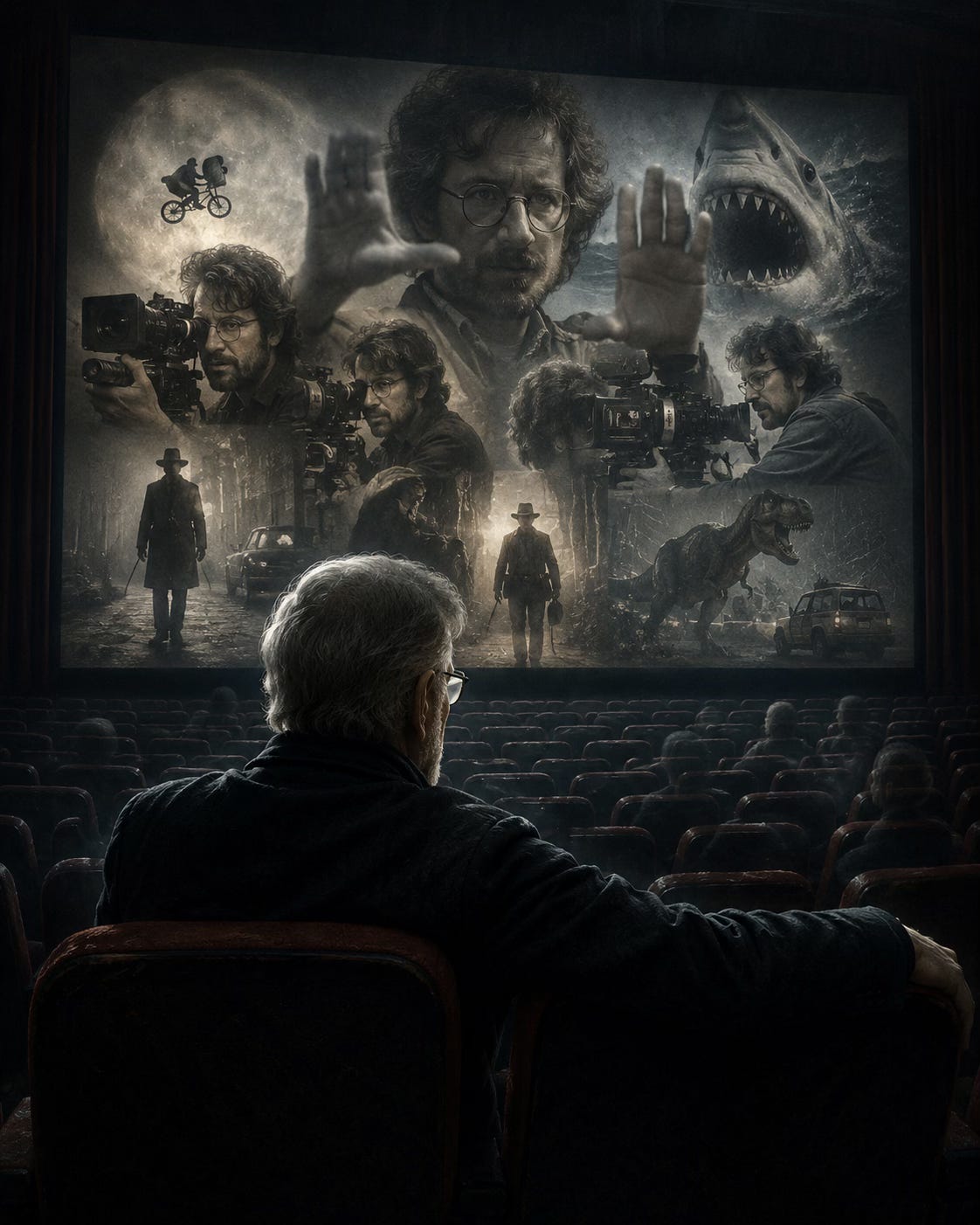
It has been a long time since I walked into a theater and been the youngest guy in it.
Seriously my dude, this bleeding edge Gen-Xer with the bionic eyes and mechanical knees was the youngest person in a genuinely full (if not packed) theater. Baby Boomers who hadn’t been in theaters for years showed up in droves for this one. You could tell they hadn’t been near a theater in decades. They were appalled by the ticket prices, a few talked about waiting for it to be in the Dollar Theaters, clearly unaware that those died out with Blockbuster Video. One asked for the smallest popcorn available, which was about the size of a medium soft drink, the irritated retiree said for that price he may as well get the large, which was the entire point since a large popcorn costs as much for them to make as a small.
Once they got over the sticker shock the theater geezers sat down for a movie that they truly enjoyed. They absolutely loved every bit of it. They thought that their favorite director had finally made another movie just for them.
He. Did. Not.
The only person this film was made for is Steven Spielberg.
However, I will be more than happy to grant that what the Great Director made for himself is a loving and effective tribute to his own craftsmanship. All of his shots look exactly like Spielberg shots should look. Even at 80 he knows where to place a camera. He knows how to make light tell the story of a scene, how it can change the appearance of something from the ordinary to the extraordinary. And he absolutely knows how to get what he needs from his actors.
Emily Blunt pulled out all the stops to earn her paycheck. She was trying to match Richard Dreyfuss’ manic obsession from Close Encounters and getting as close as an actress of her caliber could with material this fundamentally weak. In the hands of any lesser actress, it would have been an unsalvable disaster.
Colin Firth was by turns chilling and pitiable as the head of a clandestine organization with an X in the name so you’d think of Elon Musk. He was by turns ruthless and determined yet also too human to lose his humanity as his job required.
Wyatt Russel delivers on a male version of Terry Garr’s character from Close Encounters of the Third Kind. He’s a guy who’s in love with a girl who is turning into a basket case and is ruining his life in the process. When he tries to do what he thinks is best for her, he is legitimately the guy who is in the right.
And John Williams remains the G.O.A.T. 94-years-old and he is still absolutely killing it. His partnership with Steven Spielberg stretches back better than a half century. Williams developed slowly, you can just barely see the themes that would define his music in Lost in Space and Gilligan’s Island, yet you can decidedly hear it in Sugarland Express, the first film he ever made with Steven Spielberg. Williams is unquestionably Spielberg’s most important partner. All of his movies’ emotional weight is utterly dependent on John Williams deft touch.
They all killed it. There are no weak performances. They all strap on the satchel bombs and charged the bunker.
Sadly, the bunker is empty.
This script that was worked on for years by Steven Spielberg and his long time writing partner David Koepp, isn’t telling a story at all. It’s just setting up an unending series of money-shots. Because at the end of the day, Disclosure Day is a script that creates scenes without a story to tell. It is an unending stream of empty, passionate emotionality. The cinematic equivalent of a drunk at a bar who is convinced that his alcohol soaked peroration is the most profound thing the human race has ever experienced.
I wish I was exaggerating.
I’m not.
The movie is presenting emotionally laden images with some dialog that thinks it’s far more profound than it’s remotely capable of being. John Williams’ music is doing Herculean work here.
“Empathy is the highest state of existence”. It’s a major theme of this movie and probably the most Boomer sentiment to ever Boomer. A belief that is a tribute to its own semantic emptiness.
The other “deep thought’ theme is that humanity, or to be exact Christians, will question everything about God in the presence of a being who is clearly superior to Man. There are legitimately profound question that an extra terrestrial sapience would raise but this Gnostic love song doesn’t ask them. Also, for a movie that uses Christian imagery to constantly question foundational Christian belief the one thing that never actually gets mentioned at all is the one about Jesus Christ. You know as in “Christ is King,” that guy? Kind of gets swept under the rug except for the verse “let this cup pass from me.” That one got taken wildly out of context but it was there.
All of these things are symptoms of a much bigger, foundational issue. This movie is Steven Spielberg being his own tribute band. It feels like Steven Spielberg imitating a JJ Abrams movie that is imitating a Steven Spielberg film.
It’s all there. The entire cinematic bag of tricks compiled over the course of over fifty years work. Color desaturation which has been the color of serious film making since Saving Private Ryan. Lens flairs, close-up tracking shots capturing characters frozen in silent wonder or dread. Complex, unbroken scenes that blend master shots and close-ups through fluid camera movement, framing crucial action inside mirrors, car windows, or puddles to add depth, strong, dramatic shafts of backlighting cutting through dust, fog, and dark rooms and using physical objects or silhouettes in the foreground to create deep-focus compositions.
He used literally every single trick he ever pioneered in this movie. It’s catalog of his entire history going back to his very first film.
And that’s what gave the game away. He recreated the train scene from Duel where a truck tries to push a car into a passing train. That was Steven Spielberg’s very first “If I don’t get this shot right – I don’t get the movie right” scene. It was the movie that determined the course of the rest of his life, when he was a hungry and desperate TV director that the head of ABC movies Michael Eisner had decided to throw the dice on. That one scene is what ultimately made him Steven Spielberg and opened the door to the rest of his legendary work.
That was the scene that showed that this film that cost hundreds of millions of dollars was for an audience of one. The director himself.
This movie is part III of what I will be calling the Spielberg Self-Indugence Trilogy.
West Side Story (2021): A lavish remake of the classic musical, heavy on nostalgia for Golden Age Hollywood; big dance numbers, orchestral scores, theatrical spectacle. Spielberg has long romanticized that era. It was a heartfelt tribute to the “dead Hollywood” that shaped him. It didn’t make money and he didn’t care. Although, he did care that Lin-Mauel Miranda was daring to release another Latino musical at the same time.
The Fabelmans (2022): Explicitly autobiographical, drawing from his childhood, family dynamics, and discovery of filmmaking. It’s Spielberg processing his own origin story of dreams, trauma, the power of movies as escape and “truth-teller.” Nakedly self-indulgent, but deeply personal.
Disclosure Day (2026): His return to big-scale sci-fi/thriller. A loving tribute band dedicated to his own art.
One of the sadder things about Disclosure day is that there was a better film hiding in there somewhere. All it needed was a story for a spine instead of The Feels. There were fundamental questions that never got asked; Why did the cyber-security expert decide that it was worth it to throw his entire life away to reveal The Truth. The character as presented would never have done that but we are meant to believe that something happened to force his hand, but we never see what. In Close Encounters, Richard Dreyfuss’s growing obsession makes his later actions feel earned but we never see the build up, only the climax. Narratively this entire movie plays like the middle act of a trilogy and it ends as the climax begins.
These story structure problems are real and they are severe but the biggest problem Disclosure Day has is that it was pathetically out of date in every way available to it. First the entire film depends on the belief that TV news is as trusted today as it was when Walter Cronkite was in the anchor chair, that it still has the moral authority as the source of All Truth that it squandered decades ago. On the other hand, it was completely dismissive of the internet. This entire movie would have been over in five minutes if they had just dumped everything on line. But the entire movie was built around getting The Truth out on TV. It was built around a climax that required a vanished world to still exist. And then it tried to have it both ways, “The AI says this is 100% authentic and it’s making a green smiley face.” The AI also says the average temperature of Venus is 69 degrees, it will be sunny today with 35% chance of rain this afternoon.
Ufologists didn’t even like it. When I was a kid, I was one, I never missed an episode of In Search of… I grew out of it but I understand the sentiment and as far as the Ufologists were concerned, it was hopelessly out of date. Close Encounters was steeped in the 1970s UFO zeitgeist, and Disclosure Day never escaped that bygone era. Today’s ufologists are a far more scientific breed. They are more open to the idea of interdimensional visitors than interstellar ones, which, when you think about it, is arguably the more plausible hypothesis. And they regard the Nixon driving Jackie Gleeson to Hanger 18 story as a ludicrous embarrassment.
There were a bunch of little things, like they had to have the actors using clamshell phones in some scenes because you can’t break an iPhone in half.
The good guys build an exactly replica of Emily Blunt’s childhood home inside a hanger to try to stimulate her memory of the night she was abducted. It was so over the top your brain can’t accept it. You are thinking, just put an Apple Vision Pro on her head, this is utterly ludicrous!
A more serious problem was the computer effects which were awful. There were a number of very badly rendered CG animals. This is an indication of both the general decline of the Hollywood effects industry, which is very real. But it’s also an indication of how out of touch Steven Spielberg has gotten. Godzilla Minus One is the result of a director who knew that fixing it in post is not an option when it comes to CG, but Spielberg can’t think that way, not at 80. And he likely viewed these computer graphics confectisons as being good because to him they probably look great but any kid who has been immersed in this stuff all his life will know it’s hot garbage.
At the end of the day that is this movie’s biggest problem. It didn’t matter if the audience thought that the Cardinal was well rendered or not because the only person this film was ever meant for was Steven Spielberg. So long as he happily, no one else mattered.
Verdict:
Disclosure Day is not a bad film. It is beautifully shot, expertly acted, and scored by a living legend at the absolute peak of his craft. But all of that craftsmanship is ultimately in service to a conversation Steven Spielberg is having with himself. The audience is invited to listen in, but never truly included. The result is a film that admires wonder, celebrates empathy, and reveres truth, yet somehow feels disconnected from the world outside the theater doors. It is a tribute to Spielberg’s art, but not an argument for why that art still matters in 2026.
The Dark Herald Does Not Recommend
Unless…
If you are a Boomer Spielberg fan, this movie is for you.
If you still think the Space Elves are coming to save us all, this movie is for you.
If you never missed an episode of In Search of… Go watch it again on YouTube, you’ll enjoy it more than this thing.
Discuss in the Comments Below


"Also, for a movie that uses Christian imagery to constantly question foundational Christian belief the one thing that never actually gets mentioned at all is the one about Jesus Christ. You know as in “Christ is King,” that guy?"
The most obvious answer to this one is Spielberg is Jewish and his Boomer audience, even the ones who claim to be Christian, are pretty much agnostic. Their understanding of Christ and his followers is superficial at best.
Given that it's supposed to make Christians question our beliefs, I think this would be a fun opportunity for some edgelord teens to hand out copies of the Book of Enoch to moviegoers as they exit the theaters. :D
The best thing about John Williams continuing to work is that he has made himself into living proof that old guys that remain non-senile don’t actually “lose their touch” at artistic work, all the rest of them just became lazy and self-indulgent while leaning on the fact that they should be retired already as an excuse for their deliberate flaws.