
A new dystopian novel in the classic mode takes the form of a dictionary of madness
The best dystopian literature, or at least the most effective, manages to show us a hideous and contorted future while resisting the temptation to point fingers and invent villains. This is one of the major flaws in George Orwells’s 1984: When O’Brien laughingly expounds on his vision of “a boot stamping on a human face—forever” he starts to acquire the ludicrousness of a Bond villain; he may as well be a cartoon—one of the Krusty Kamp counsellors in The Simpsons, raising a glass “to Evil.” Orwell’s satire of Stalinism, or Margaret Atwood’s on the religious right in The Handmaid’s Tale tend to let our present world off the hook a little by comparison. More subtle works, like Huxley’s Brave New World, are far more effective. His Controller, when interrogated, doesn’t burst out in maniacal laughter and start twiddling his moustache. He explains, in quite reasonable terms, why the dystopia he lives in is the best way to ensure the happiness of all—and he means it. Everything’s broken, but it’s not anyone’s fault; it’s terrifying because it’s so familiar.
Great dystopia isn’t so much fantasy as a kind of estrangement or dislocation from the present; the ability to stand outside time and see the situation in its full hideousness. The dystopian novel doesn’t necessarily have to be a novel. Maybe the greatest piece of dystopian literature ever written is Theodor Adorno’s Minima Moralia, a collection of observations and aphorisms penned by the philosopher while in exile in America during and after the Second World War. Even if, like I do, you disagree enthusiastically with his blanket condemnation of all “degenerated” popular culture, it’s hard not to be convinced that what we are living is “damaged life.” It’s not an argument so much as revelation. In Adorno’s bitterly lucid critique everything we take for
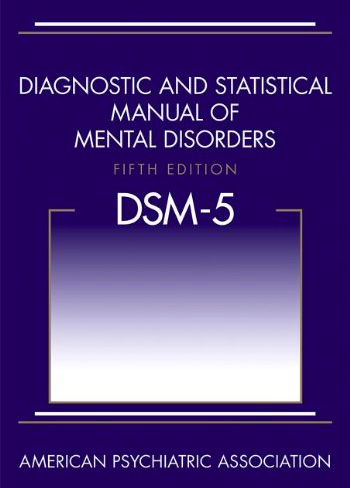 American Psychiatric Association
 DSM-5
American Psychiatric Publishing
(991 pages)
If the novel has an overbearing literary influence, it’s undoubtedly Jorge Luis Borges. The American Psychiatric Association takes his technique of lifting quotes from or writing faux-serious reviews for entirely imagined books and pushes it to the limit: Here, we have an entire book, something that purports to be a kind of encyclopedia of madness, a Library of Babel for the mind, containing everything that can possibly be wrong with a human being. Perhaps as an attempt to ward off the uncommitted reader, the novel begins with a lengthy account of the system of classifications used—one with an obvious debt to the Borgesian Celestial Emporium of Benevolent Knowledge, in which animals are exhaustively classified according to such sets as “those belonging to the Emperor,” “those that, at a distance, resemble flies,” and “those that are included in this classification.”
Just as Borges’s system groups animals by seemingly aleatory characteristics entirely divorced from their actual biological attributes, DSM-5 arranges its various strains of madness solely in terms of the behaviors exhibited. This is a recurring theme in the novel, while any consideration of the mind itself is entirely absent. In its place we’re given diagnoses such as “frotteurism,” “oppositional defiant disorder,” and “caffeine intoxication disorder.” That said, these classifications aren’t arranged at random; rather, they follow a stately progression comparable to that of Dante’s Divine Comedy, rising from the infernal pit of the body and its weaknesses (intellectual disabilities, motor tics) through our purgatorial interactions with the outside world (tobacco use, erectile dysfunction, kleptomania) and finally arriving in the limpid-blue heavens of our libidinal selves (delirium, personality disorders, sexual fetishism). It’s unusual, and at times frustrating in its postmodern knowingness, but what is being told is first and foremost a story.
This is a story without any of the elements that are traditionally held to constitute a setting or a plot. A few characters make an appearance, but they are nameless, spectral shapes, ones that wander in and out of view as the story progresses, briefly embodying their various illnesses before vanishing as quickly as they came—figures comparable to the cacophony of voices in The Waste Land or the anonymously universal figures of Jose Saramago’s Blindness. A sufferer of major depression and of hyperchondriasis might eventually be revealed to be the same person, but for the most part the boundaries between diagnoses keep the characters apart from one another, and there are only flashes. On one page we meet a hoarder, on the next a trichotillomaniac; he builds enormous “stacks of worthless objects,” she idly pulls out her pubic hairs while watching television. But the two are never allowed to meet and see if they can work through their problems together.
This is not to say that there is no setting, no plot, and no characterization. These elements are woven into the encyclopedia-form with extraordinary subtlety. The setting of the novel isn’t a physical landscape but a conceptual one. Unusually for what purports to be a dictionary of madness, the story proper begins with a discussion of neurological impairments: autism, Rett’s disorder, “intellectual disability”. The scene this prologue sets is one of a profoundly bleak view of human beings; one in which we hobble across an empty field, crippled by blind and mechanical forces whose workings are entirely beyond any understanding. This vision of humanity’s predicament has echoes of Samuel Beckett at some of his more nihilistic moments—except that Beckett allows his tramps to speak for themselves, and when they do they’re often quite cheerful. The sufferers of DSM-5, meanwhile, have no voice; they’re only interrogated by a pitiless system of categorizations with no ability to speak back. As you read, you slowly grow aware that the book’s real object of fascination isn’t the various sicknesses described in its pages, but the sickness inherent in their arrangement.
Who, after all, would want to compile an exhaustive list of mental illnesses? The opening passages of DSM-5 give us a long history of the purported previous editions of the book and the endless revisions and fine-tunings that have gone into the work. This mad project is clearly something that its authors are fixated on to a somewhat unreasonable extent. In a retrospectively predictable ironic twist, this precise tendency is outlined in the book itself. The entry for obsessive-compulsive disorder with poor insight describes this taxonomical obsession in deadpan tones: “repetitive behavior, the goal of which is […] to prevent some dreaded event or situation." Our narrator seems to believe that by compiling an exhaustive list of everything that might go askew in the human mind, this wrong state might somehow be overcome or averted. References to compulsive behavior throughout the book repeatedly refer to the “fear of dirt in someone with an obsession about contamination.” The tragic clincher comes when we’re told, "the individual does not recognize that the obsessions or compulsions are excessive or unreasonable." This mad project is so overwhelming that its originator can’t even tell that they’ve subsumed themselves within its matrix. We’re dealing with a truly unreliable narrator here, not one that misleads us about the course of events (the narrator is compulsive, they do have poor insight), but one whose entire conceptual framework is radically off-kilter. As such, the entire story is a portrait of the narrator’s own particular madness. With this realization, DSM-5 starts to enter the realm of the properly dystopian.
This madness does lead to some startling moments of humor. One vignette describes in deadpan tones a scene at once touchingly pathos-laden and more than a little creepy: “He rubs his genitals against the victim’s thighs and buttocks. While doing this he fantasizes an exclusive, caring relationship with the victim.” The entry on caffeine intoxication disorder informs us, with every appearance of seriousness, that the diagnostic criteria include “recent consumption of caffeine” along with “1) restlessness 2) nervousness 3) excitement.” There are, occasionally, what seem to be surreal parodies of religious dietary regulations: “Infants and younger children […] eat paint, plaster, string, hair, or cloth. Older children may eat animal droppings, sand, insects, leaves, or pebbles.” What the levity of these moments masks, though, is the sense of loneliness that saturates the work.
The narrative voice of the book affects a tone of clinical detachment, one in which drinking coffee and paranoid-type schizophrenia can be discussed with the same flat tone. Under the pretense of dispassion this voice embodies a whole raft of terrifying preconceptions. Just like the neurological disorders that appear at the start of the book, mental illnesses appear like lightning bolts, with all their aura of divine randomness. Even when etiologies are mentioned they’re invariably held to be either genetic or refer to other illnesses such as substance abuse disorders. At no point is there any sense that madness might be socially informed, that the forms it takes might be a reflection of the influences and pressures of the world that surrounds us.
The idea emerges that every person’s illness is somehow their own fault, that it comes from nowhere but themselves: their genes, their addictions, and their inherent human insufficiency. We enter a strange shadow-world where for someone to engage in prostitution isn’t the result of intersecting environmental factors (gender relations, economic class, family and social relationships) but a symptom of “conduct disorder,” along with “lying, truancy, [and] running away.” A mad person is like a faulty machine. The pseudo-objective gaze only sees what they do, rather than what they think or how they feel. A person who shits on the kitchen floor because it gives them erotic pleasure and a person who shits on the kitchen floor to ward off the demons living in the cupboard are both shunted into the diagnostic category of encopresis. It’s not just that their thought-process don’t matter, it’s as if they don’t exist. The human being is a web of flesh spun over a void.
With this radical misreading, the American Psychiatric Association is following something of a precedent in the actual psychological professions. Sigmund Freud himself performs a similar feat of ostranenie in his Three Essays on the Theory of Sexuality, in which he appears to take the position of an alien observer of everyday affairs, noting that “the kiss […] is held in high sexual esteem among many nations in spite of the fact that the parts of the body involved do not form part of the sexual apparatus but constitute the entrance to the digestive tract.” If you’re going to make a properly objective study of human behavior, to some extent you have to disavow your own humanity. You have to ask, why kissing? Why do people press their mouths up against each other? In DSM-5 we can see a perverse mirror image of this kind of estrangement. Freud retreats to a position of inhuman detachment to ask questions. Here, the narrator does it to issue instructions.
The word “disorder” occurs so many times that it almost detaches itself from any real signification, so that the implied existence of an ordered state against which a disorder can be measured nearly vanishes is almost forgotten. Throughout the novel, this ordered normality never appears except as an inference; it is the object of a subdued, hopeless yearning. With normality as a negatively defined and nebulously perfect ideal, anything and everything can then be condemned as a deviation from it. Even an outburst of happiness can be
If there is a normality here, it’s a state of near-catatonia. DSM-5 seems to have no definition of happiness other than the absence of suffering. The normal individual in this book is tranquilized and bovine-eyed, mutely accepting everything in a sometimes painful world without ever feeling much in the way of anything about it. The vast absurd excesses of passion that form the raw matter of art, literature, love, and humanity are too distressing; it’s easier to stop being human altogether, to simply plod on as a heaped collection of diagnoses with a body vaguely attached.
For all the subtlety of its characterization, the book doesn’t just provide a chilling psychological portrait, it conjures up an entire world. The clue is in the name: On some level we’re to imagine that the American Psychiatric Association is a body with real powers, that the “Diagnostic and Statistical Manual” is something that might actually be used, and that its caricature of our inner lives could have serious consequences. Sections like those on the personality disorders offer a terrifying glimpse of a futuristic system of repression, one in which deviance isn’t furiously stamped out like it is in Orwell’s unsubtle Oceania, but pathologized instead. Here there’s no need for any rats, and the diagnostician can honestly believe she’s doing the right thing; it’s all in the name of restoring the sick to health. DSM-5 describes a nightmare society in which human beings are individuated, sick, and alone. For much of the novel, what the narrator of this story is describing is its own solitude, its own inability to appreciate other people, and its own overpowering desire for death—but the real horror lies in the world that could produce such a voice.

Comments are closed.