Trump Zelensky

Trump: giving Ukraine Patriot Missile license is 'cool.' No it's not.

Experts say this is a disaster in the making, chiefly because our intellectual property will be out there and the risk not worth it.

Analysis | QiOSK
google cta

President Donald Trump said this morning from the NATO Summit that the U.S. will give Ukraine the licenses to build America’s prestige Patriot Missile systems in Kyiv.

"We're going to give a license to you to make Patriots. That's pretty cool. This way, you can't complain that we're not giving 'em enough," Trump said at a meeting with Ukrainian President Volodymyr Zelensky.

No, it's not "cool." It's foolish and a weak way of looking magnanimous when you know a) the Ukrainians will not be able to build them in time to make any difference and b) the war with Russia will never be won on the battlefield. It's a waste.

And it's also not worth the risk. According to George Beebe, director of the Quincy Institute's Grand Strategy program, this "will do little to fix Ukraine’s urgent air defense problems" because "It will take many months for Ukraine to get a production facility built. But Russia will attack that facility as soon as the first cornerstone is laid, and to have any hope of completing that construction, Ukraine will have to divert many existing Patriot batteries from their current locations to that new facility."

One wonders if Trump has been briefed on this. Zelensky started floating this idea this spring as an alternative to waiting for the U.S. to send them. Jen Kavanagh, in a piece for Responsible Statecraft in June, teed up the response regarding risk thusly:

The move would not measurably lessen Ukraine’s air defense deficit, but it would create substantial risks to U.S. national security by making it easier for competitors to get access to sensitive information about U.S. military systems. The Trump administration should therefore decline this request.

Instead, Trump appears to be leaning in hard, which is vexing since he manages to say some variation of "it's not my war" every chance he gets. Nevertheless the president appears to be more interested in flexing. Replying to Zelensky's ask for Patriot interceptors, which are in short supply, Trump boasted he could apply pressure on the company (Lockheed Martin) to produce them. "We have great power over the companies, those companies that make the Patriot," he said to Zelensky on Wednesday.

It's not clear why Lockheed would need its arm twisted in such a fashion, though honestly they are probably busy trying to restock the Pentagon's own supply. According to CSIS, the U.S. expended nearly half of its Patriot interceptors, and it will take until 2029 to fully replenish the stockpiles.

Currently, as Kavanagh points out, the only countries that have licenses to build the Patriot system are Japan and Germany and they "had to navigate complex legal requirements to qualify for this access. This included building and maintaining factories that meet precise standards, including for domestically sourced inputs; guaranteeing the information security of all technical information; and committing to end-use agreements that restrict the use and export of finished missiles."

Again it is not clear whether Trump is aware of any of this. No doubt the Pentagon is, and we wouldn't be surprised if this gift to Ukraine were slow walked into oblivion where it should be.


Top photo credit: U.S. President Donald Trump holds a bilateral meeting with Ukrainian President Volodymyr Zelenskiy alongside the NATO leaders summit at the Bestepe Presidential Compound in Ankara, Turkey, July 8, 2026. REUTERS/Jonathan Ernst
Analysis | QiOSK
Iran funeral Ayatollah Ali Khamenei,
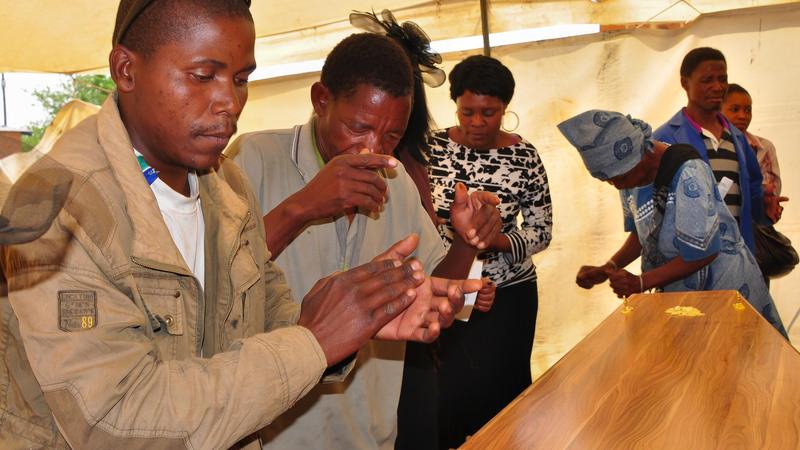
Top photo credit: People attend a funeral procession for Iran's late Supreme Leader Ayatollah Ali Khamenei, who was killed on February 28 in Israeli and U.S. airstrikes, in Qom, Iran, July 7, 2026. Office of the Iranian Supreme Leader/WANA (West Asia News Agency) via REUTERS

Ayatollah Khamenei's carefully crafted and choreographed funeral

Middle East

Meticulously choreographed, this week's funeral ceremonies for Ayatollah Ali Khamenei across Iran are honoring the country's highest political and religious authority, while also projecting a carefully calibrated message about Iran’s future.

In essence, Tehran is affirming both the continuity of the Islamic Republic under its new Supreme Leader, Ayatollah Mojtaba Khamenei, and the country’s increasingly pronounced orientation toward a non-Western geopolitical order.

Despite the assassination of Khamenei during this spring's American-Israeli war on Iran — widely referred to by Iranians as the “third imposed war” — the Islamic Republic survived, and efforts to bring about regime change ultimately failed.

“Iran is using the funeral to communicate that the Islamic Republic has survived a historic transition, that the succession has taken place successfully, and that the political system remains intact despite external pressure," said Ghoncheh Tazmini, author of Power Couple: Russian-Iranian Alignment in the Middle East.

“The scale of the funeral also projects national unity and institutional continuity,” she told RS, stressing that these ceremonies (the funeral in Tehran was expected to draw 20 million people) extend beyond commemorating a fallen leader; they serve as a public reaffirmation of loyalty to the Islamic Revolution and the doctrine of velayat-e faqih.

“Iran’s official narratives emphasize that the Revolution is institutional rather than personal and that its legitimacy does not depend on any one individual,” she added. “Official Iranian commentary also frames the large public participation as evidence that decades of sanctions, military pressure, and efforts to isolate Iran have failed to undermine public commitment to the Islamic Republic.”

Domestically, the Iranian leadership seeks to reinforce the government's legitimacy through revolutionary and religious narratives while projecting an image of stability to the broader population. Although the large crowds attending the funeral ceremonies should by no means be taken to represent all or even a strong majority of Iranians in a country of 92 million, the scale of the mobilization nevertheless underscores the state's capacity to maintain an organized and committed support base.

While recognizing the extent to which Iran “remains deeply polarized” and has complicated political realities, Sina Toossi, a senior nonresident fellow at the Washington-based Center of International Policy, told RS that the government’s ability to command public backing and rally its loyalists matters because, “many U.S. assumptions about regime change have rested on the idea that external pressure would produce state collapse or a mass uprising.”

“In many respects, military confrontation and maximum pressure have strengthened the state's security narrative and shifted the domestic balance of power away from homegrown civil society and toward the security establishment,” he noted.

A new Supreme Leader

With Iran’s third Supreme Leader at the helm, the strategic doctrines of his father are likely to be preserved. It is safe to conclude that the institutions surrounding him favor policy continuity, not reform. Yet Ayatollah Mojtaba Khamenei will probably differ from his two predecessors in some significant ways.

The high level of support he gets from the Islamic Revolutionary Guard Corps along with his “security-minded approach” will slightly distinguish him from his father, according to Sina Azodi, assistant professor of Middle East Politics at George Washington University, who also noted that the new leader comes bearing significant personal loss: not only his father, but other family members were killed in the first day of the war too.

Given this, Azodi described Ayatollah Mojtaba Khamenei as seemingly “angry” and “willing to take more risks” than his father.

The younger Khamenei, however, brings to the table significantly less public experience and visibility than his father, who served as president during the Iran-Iraq war before his selection as Supreme Leader. His challenge will be to build legitimacy amid a period of of extremely serious security dilemmas.

The new Ayatollah was conspicuously absent from the funeral ceremonies. Officials say his appearance could expose him to an Israeli attack or reveal intelligence about his whereabouts. But his absence has drawn speculation about his condition. Injured in the attack that killed his father, the Supreme Leader's current health remains unclear.

Embracing Eurasian integration and multipolarity


Irrespective of what comes out of the “Islamabad Memorandum of Understanding” and the U.S.-Iran talks, Iranian foreign policy under Ayatollah Mojtaba Khamenei will place greater emphasis on deterrence and national security, with the leadership in Tehran focused on strengthening ties with non-Western actors amid growing skepticism, if not hostility, toward the United States and Europe.

The roster of foreign delegations attending the funeral ceremonies provides a revealing snapshot of Tehran's regional and international position. The participation of representatives from Iran’s neighbors, including Armenia, Oman, Qatar, Saudi Arabia, Pakistan, and Turkey, alongside China, India, and Russia, contrasted with the conspicuous absence of most Western governments, illustrates the depth of Iran’s diplomatic engagement across the non-Western world.

“The attendance list offers a snapshot of Iran’s geopolitical position after the war," said Negar Mortazavi, a Washington-based journalist, host of The Iran Podcast, and a senior fellow at the Center for International Policy, in an RS interview.

"The presence of regional allies, strategic partners, and countries from the Global South signals that Iran remains an important regional power and is far from internationally isolated,” she added. If anything, it spells out its anchoring to a non-Western global order.

“The absence of European governments is equally telling. From Tehran’s perspective, Europe was not a neutral actor in the war. Iranian officials argue that many European states politically backed the U.S. and Israel, and in some cases provided military or intelligence support," Mortazavi charged. "Their absence therefore reflects not only the continued rupture in Iran-Europe relations, but also Tehran’s view that Europe’s role has shifted from diplomatic interlocutor to political adversary."

More than a funeral

These developments confirm that Iran's leadership transition is reinforcing, as opposing to disrupting, the Islamic Republic's longstanding political and strategic trajectories.

“The martyred Supreme Leader leaves behind not only a political office but a strategic doctrine that shaped Iran’s relations with the U.S., Israel, and the wider region for nearly four decades. Whether one agrees with that doctrine or not, understanding his role requires recognizing that he was not merely a symbolic figure. He was a deeply experienced political strategist whose influence extended far beyond Iran’s borders,” Tazmini told RS.

“Perhaps the most important point is that this funeral should not be viewed simply as a ceremonial event. It represents a moment in which the Islamic Republic is demonstrating continuity at a time of historic transition.”

keep reading Show less
Hormuz chokepoint? Turkey wants to be king of the Middle Corridor
Top image credit: Turkish President Recep Tayyip Erdogan pictured at a diplomatic meeting on day two of a Belgian economic mission to Turkey, in Istanbul, on May 11, 2026. (BELGA PHOTO POOL PHILIP REYNAERS via Reuters Connect)

Hormuz chokepoint? Turkey wants to be king of the Middle Corridor

Middle East

The outbreak of the U.S.-Israeli war on Iran and the closure of the Strait of Hormuz catalyzed an energy market shock that reverberated globally, creating “the largest supply disruption in the history of the global oil market,” according to the International Energy Agency.

The closure emphasized the strait’s function as one of the world’s most vital energy chokepoints, through which roughly 20% of global oil and liquid natural gas (LNG) passes. Iran’s retaliatory attacks and blockade, meanwhile, highlighted Tehran’s ability to disrupt supply chains, inflate currencies, and render the Hormuz as a commercially unusable trade corridor. The result of this crisis may well be a major rerouting of Eurasian trade.

Europe, which has hit hard by the strait’s closure, is particularly keen to support new corridors for commerce. At the recent G7 Summit, European Commission President Ursula von der Leyen argued that Europe must now forge alternative trade and energy routes to bypass Hormuz.

Two alternative trade corridors have been especially propelled.

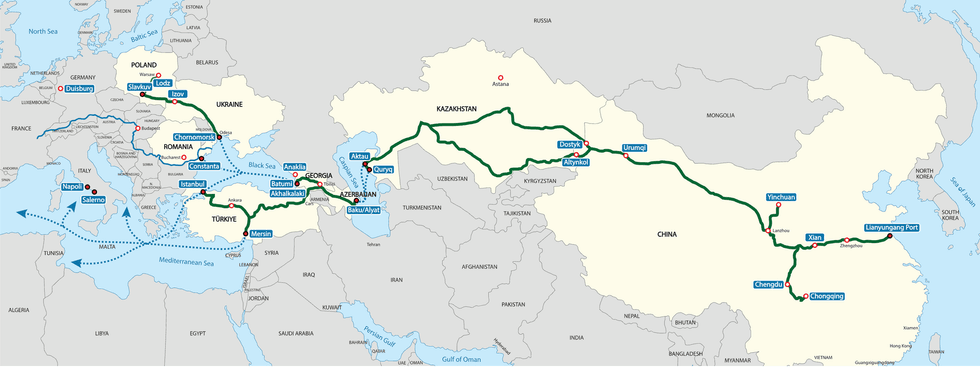
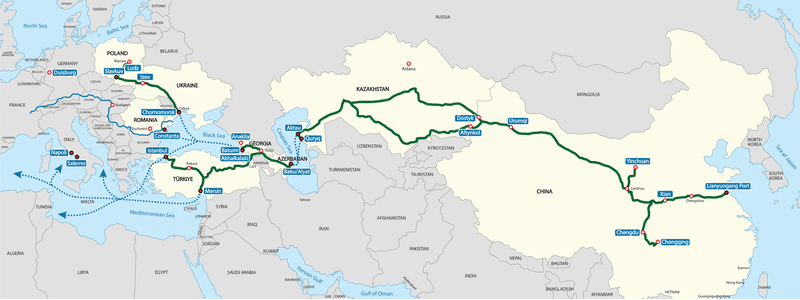
The first is the Middle Corridor (or the Trans-Caspian International Transport Route), a multi-modal land, rail, and sea route between China and Europe that passes through Central Asia, the Caucasus, and Turkey.

A map of the Trans-Caspian International Transport Route, known also as the Middle Corridor. (Tanvir Anjum Adib/CC BY 4.0)

The second is the Four Seas Initiative, a framework linking the Persian Gulf with the Caspian, Mediterranean, and Black Seas via a Syria-Turkey transit corridor.

As Europeans fret, other states see new possibilities. The closure has presented an opportunity for traditionally smaller players in Central Asia, the Caucasus, and the Levant – three regions directly adjacent to Iran – and a breakthrough for Turkey’s sphere of influence in Eurasia.

In Central Asia, Kazakhstan has perhaps emerged as the primary beneficiary of both Iran’s closure of the strait and Russia’s invasion of Ukraine. In a landlocked region that has long relied on trade with Russia via the Northern Corridor, the Middle Corridor provides Kazakhstan with an enormous opportunity to deepen ties with the U.S., wean off dependence on Russia, and harvest the economic fruits of its vast reserves of critical minerals, which are crucial for the modern tech transition. In November 2025, Kazakhstan signed 29 MoU’s with the U.S. valued at $17 billion.

In the Caucasus, Azerbaijan has also capitalized on the Northern Corridor’s decline and the Strait of Hormuz’s closure. Since signing a peace deal with Armenia in 2025, Baku has sought to transform its geopolitical identity and emerge as the region’s primary power. A key component of the peace deal was constructing a corridor between Azerbaijan’s two non-contiguous territories via Armenia (known as the Trump route thanks to his role in brokering the agreement). The route unlocks Azerbaijan’s trade block and enables undisrupted regional integration between Central Asia and Turkey. In 2025, Azerbaijan formally joined the C5 summit as the first non-Central Asian state, turning it into the C6.

In the Levant, post-Assad Syria has tried to position itself as a potential energy transit state and as the next alternative to the Strait of Hormuz, a vision endorsed by U.S. envoy to Syria Thomas Barrack. The Four Seas initiative provides Damascus with a prime opportunity to realize this vision. Ultimately, since the formal lifting of most U.S. sanctions in 2025, Syria’s new leadership is determined to stimulate its post-war economy and reconstruction (estimated to cost $216 billion by the World Bank) via transit revenues.

Turning Syria into a stable connector of the region is in the interest of the Gulf, too. States there perceive the Four Seas Initiative as a way to avoid the vulnerability of Hormuz. In June, Iraq and the U.S. released a joint statement committing to the rehabilitation of the defunct pipeline between Kirkuk in Iraq and Baniyas on the Syrian coast, a crucial precedent to illustrate the possibility of Gulf-Mediterranean connectivity.

But no state stands to gain more from these shifts than Turkey, which lies at the intersection of both of these alternative trade corridors.

Ankara is positioning itself as the indispensable transit intersection between Europe and Asia, profiting simultaneously from Europe's scramble to replace Russian energy, the Gulf's search for export routes that don't transit Hormuz, and the push by Central Asian states to remove their economic constraints through overland corridors. Turkey is leveraging overlapping crises to entrench itself as a hub that no Eurasian power can route around.

While the Middle Corridor enables Turkey to realize its pan-Turkic aspirations by deepening social and economic ties between Central Asia and Azerbaijan, the Four Seas initiative facilitates its neo-Ottoman soft-power ambitions by reinforcing Turkey’s influence in the Gulf and Levant and consolidating a Sunni axis that can balance against Iran’s Shia crescent.

Unlike Europe, the United States has not suffered significantly from the Strait of Hormuz’s closure. This is largely due to its world-leading domestic oil and natural gas production. Yet, both the Middle Corridor and Four Seas Initiative present Washington with an opportunity to undermine Tehran’s leverage over a crucial maritime trade route (as well as the Red Sea), weakening its ability to threaten the economies of adjacent regions.

For Washington, both alternative trade corridors would ultimately accomplish three compounding strategic objectives: emancipate European energy sovereignty from Russian and Iranian dependence; enable American commercial dominance in the Middle East’s most strategically leveraged infrastructure; and establish a durable geopolitical framework that rewards alignment with the West.

At present, the Four Seas Initiative has received congressional and diplomatic support, including from Sen. Jeanne Shaheen (D-N.H.), Rep. Joe Wilson (R-S.C.), and Barrack, who also serves as the U.S. ambassador to Turkey. The U.S. has also taken a variety of concrete steps to support the Middle Corridor, namely brokering a peace deal between Azerbaijan and Armenia, as well as modernizing Kazakhstan’s ports and Georgia’s railway infrastructure.

While the rerouting of trade through these alternative corridors may serve several U.S. strategic interests, it also undermines long-term stability in the Middle East by freezing Iran out. For an order to last, all regional states must have an incentive to uphold it; severing Iran from the region's economic trade architecture will render that order unsustainable.

Regardless of these potential downsides, there is little doubt that international commerce will look far different after this war. For decades, the world's dependence on a single, 21-mile-wide strait was treated as an immutable fact of global trade. But as the Strait of Hormuz reopens, the world that depended on it may be closing.

The corridors now being championed as alternatives will not dissolve geopolitical tensions, but they will relocate them.

Both the Middle Corridor and the Four Seas Initiative will pass through some of the world's most volatile territories. As new chokepoints gain prominence, the looming question is whether the powers that control them will seek to wield the same leverage that Iran did over the strait.

keep reading Show less
Goodbye Indo-Pacific, hello first island chain!

Top Photo Credit: President Donald J. Trump and U.S. Pacific Command USPACOM Commander, Adm. Harry Harris, are piped aboard during an honors ceremony at USPACOM headquarters in November 2017 (IMAGO/piemags via Reuters Connect)

Goodbye Indo-Pacific, hello first island chain!

Asia-Pacific

On June 16, the Pentagon announced that U.S. Indo-Pacific Command (USINDOPACOM) would revert to its 1947 name, U.S. Pacific Command (USPACOM).

U.S. officials called it a restoration of "deep historical roots" and insisted that the command's area of responsibility, stretching from the U.S. West Coast to India's western maritime boundary, would remain "exactly the same." Given that PACOM was the command’s name during the Cold War contestations with China and the Soviet Union, the reversion to the older name seems to be just another of those Trump 2.0 nostalgias: a feel-good invocation of America’s past glories.

But there’s much more here than meets the eye. In practice, the renaming is yet another signal of a U.S. strategic reorientation in Asia that was articulated in the administration's November 2025 National Security Strategy (NSS). A major step in this direction was the demotion of the Quad grouping — which includes the U.S., India, Japan and Australia — from the principals’ level to the foreign ministers’ level. Another is the rapid waning of the use of “Indo-Pacific” in U.S. discourse. Defense Secretary Pete Hegseth, for instance, entirely avoided the term during his speech at the Shangri La Dialogue in Singapore recently, using “Pacific” instead.

Read together, these tell a consistent story: Washington has shifted its security strategy toward China from the Biden administration and the first Trump administration, which followed a coalition-based vision that spanned a broad geography of multi-dimensional partnerships in South and Southeast Asia. In its place, the United States is now focused on a narrower, militarized line of defense, specifically the First Island Chain, which runs from Japan to the Philippines.

The NSS states plainly that the United States must "deter adversaries and protect the First Island Chain.” This is no longer a strategy that aims for the widest possible U.S.-aligned bloc, with plurilateral plays such as the Quad and the Biden-era Indo-Pacific Economic Framework. It is denial-based deterrence, organized around a concentrated and circumscribed geography. India and much of Southeast Asia fall outside this geography.

Curiously, Taiwan, though located in the First Island Chain, too is being de-emphasized by Washington. It was entirely missing from Hegseth’s recent speech at the Shangri La Dialogue in Singapore. The flexibility on Taiwan — possibly the byproduct of a tentative attempt by U.S. President Donald Trump and Chinese President Xi Jinping to delineate spheres of influence — is compensated for by doubling down further on cooperation with and reliance on Japan, the Philippines, and to a significant degree, Australia.

The NSS pairs this narrowing with explicit burden-shifting and the prioritization of access. Washington's "diplomatic efforts," the strategy states, will focus on "pressing our First Island Chain allies and partners to allow the U.S. military greater access to their ports and other facilities, to spend more on their own defense, and most importantly to invest in capabilities aimed at deterring aggression."

Translated, this means Tokyo and Manila are no longer merely partners in an abstract "free and open" vision; they are now the forward-deployed infrastructure of U.S.-led deterrence. The placement of Typhon missile systems in Japan's Kagoshima and Yamaguchi Prefectures and the Philippines' Zambales province, and NMESIS anti-ship batteries on Okinawa, Batanes, and Luzon, is the physical manifestation of this doctrine.

As the Quad falls from grace, the “Squad” is rising. The Squad — comprising the United States, Japan, Australia, and the Philippines — was formed in 2023. But over time, it is shaping up as a more potent successor. Unlike the Quad, all four Squad members are treaty allies, all are unambiguous about its role as a defense group, and all are better positioned around the geography that actually matters militarily.

The USPACOM rename makes explicit what the Squad's rise had already signaled informally. As I have written previously, Manila is replacing New Delhi in Washington's security calculus. This is not because the Philippines can ever match India’s much greater size and industrial capacity, but rather because Manila is a deeply embedded U.S. ally, and, crucially, sits at the very heart of the First Island Chain.

The clear casualty of this shift is the "Indo" in “Indo-Pacific,” i.e., India's place as a strategic centerpiece. Even as India’s role has diminished in U.S. priorities, Washington appears to be taking a larger, regional role in South Asia.

The embrace of India as a core bulwark of the U.S. strategy toward China has deep roots, going back to the George W. Bush administration’s daring 2005 nuclear deal offer to New Delhi, which was consummated in 2008. With every presidency thereafter, this embrace only deepened. But it was Trump in his first term who took the full leap toward countering Beijing, with his 2017 National Security Strategy branding China as a “revisionist state,” his revival of the moribund Quad, and his signing of key military inter-operability agreements with New Delhi. The 2018 USINDOPACOM rebrand was meant to fuse the Indian and Pacific Oceans into a single contested space, with New Delhi cast as one the core pillars of a regional order that hemmed in China.

There was always a tension there between India’s projection as a pillar of the security strategy and its own reluctance to go beyond the Indian Ocean. Threatened by a nasty nexus of the Chinese state and the Pakistani military on its northern and western land borders, India sees the South China and East China Seas as out-of-area theaters.

The 2025 NSS, tellingly, devotes scant attention to South and Southeast Asia. Neither the Association of Southeast Asian Nations, AUKUS (a defense arrangement between the United States, Australia, and the U.K, announced in 2021) nor the Pacific Islands earn any mention in the document, even as it found space for an extended treatment of the First Island Chain. Dropping "Indo" from the command's name simply entrenches the new hierarchy of priorities.

None of this means the broader "Indo-Pacific" concept will disappear entirely from the Asian theater. Japan, whose then-leader Shinzo Abe coined the concept in 2007, will keep championing it independently, with or without Washington. But the institutional center of gravity has moved.

Where the Indo-Pacific rhetoric, with the Quad as its institutional expression, suffered from an identity crisis between its security and public goods aims and cast a wide net across the region, the First Island Chain doctrine is concentrated, transactional, and military-centric. Where the Quad tried, and largely failed, to deliver vaccines and infrastructure as a public-goods club, the new, Squad-infused architecture deals almost exclusively in access, missiles, basing rights, and burden-sharing logic.

Thus, the resurrection of USPACOM is the symbolic capstone of the new U.S. security architecture. The First Island Chain, not the wider Indo-Pacific, is where American grand strategy in Asia now lives.

keep reading Show less
google cta
Want more of our stories on Google?
Click here to make us a Preferred Source.
​Iraqi Prime Minister Ali al-Zaidi
Iraqi Prime Minister Ali al-Zaidi arrives to the funeral of Grand Ayatollah Sheikh Muhammad Ishaq al-Fayyad's funeral in June. (Ameer Al-Mohammedawi/dpa via Reuters Connect)

Iraq PM embraces his inner Michael Corleone — for the best of reasons

Middle East

In the iconic final sequence of The Godfather, Michael Corleone eliminated his rivals one by one while his nephew was being baptized. The scene stands as one of cinema’s most compelling depictions of power and the consolidation of control, and how a new order is forged through the destruction of the old one.

Fast-forward more than half a century, and Iraq appears to be witnessing its own Godfather moment. Since taking over as prime minister in May, Ali Al Zaidi has launched an unprecedented crackdown on figures across the political and administrative establishment, involving investigations into billions of dollars in allegedly mismanaged funds and reaching deep into the networks of officials, bureaucrats and political actors who have benefited from Iraq’s patronage system.

Foreign powers have largely embraced this operation, which Iraqi leadership has named “Dawn.” U.S. officials and segments of the international community view it as a sign that Baghdad may finally be confronting the corruption that has undermined governance for two decades. China, one of Iraq’s largest economic partners, also has reasons to welcome greater institutional stability.

Even former Prime Minister Nouri al-Maliki, long associated with the political order that emerged after 2003, commended Zaidi's crackdown on “those who have squandered the Iraqi people's money.” Shiite politician Muqtada al-Sadr, too, declared his support for the “heroic reform campaign.”

For Zaidi, this represents a major political victory. His supporters have cast the anti-corruption drive as the next great national battle, drawing parallels with Iraq’s campaign against ISIS. As Shibl al-Zaidi, head of the Khadamat Alliance, declared, “The war on corruption is no less important or dangerous than the fight against terrorism.”

Defining corruption

Since the U.S.-led invasion toppled Saddam Hussein’s Baathist regime in 2003, Iraq’s political order has evolved into a complex patronage system fueled by billions of American reconstruction dollars. When politicians were appointed to ministerial positions, ministries often became extensions of political parties, filled with loyalists rather than technocrats. Those lower in the hierarchy frequently built their own patronage networks through which they demanded payments, awarded contracts to allies and created informal systems of extraction.

“Corruption stems from payments for the law not to be enforced,” said Aboubakr Jamaï, a prominent analyst of corruption in Morocco based at the American College of the Mediterranean. In this sense, corruption subsidizes the erosion of the rule of law.

In Iraq and elsewhere in the Middle East, forms of corruption include the lucrative practice of informal, extractive policies. Ordinary Iraqis have felt the consequences for years. Citizens have faced demands for bribes to complete basic administrative tasks, while security forces and armed groups have at times extracted payments at checkpoints.

Meanwhile, billions allocated for reconstruction, infrastructure, and public services have disappeared into opaque networks. The most notorious example was the so-called “heist of the century,” or more derisively, the “Baghdad job.” Between 2021 and 2022, approximately 2.5 trillion Iraqi dinars (around $1.9 billion) were siphoned from Iraq’s tax authority through fraudulent withdrawals involving a consortium of companies and officials. The scandal exposed how deeply corruption had permeated state institutions.

A decade of anger

More than a decade ago, anti-government protests swept across the political heartland of Iraq’s dominant parties, including the capital Baghdad, Basra, Najaf, Karbala and Hilla. Driven by frustration over corruption, electricity shortages, unemployment and poor public services, the protests challenged the assumption that Iraq’s Shia population would automatically support Shia political elites. Shared religious identity proved insufficient when citizens were facing 120-degree Fahrenheit heat without reliable electricity or basic services.

For then-Prime Minister Haider al-Abadi, these protests were a major embarrassment, particularly as ISIS boasted of delivering services such as reliable electricity in the sprawling Iraqi city of Mosul, an implicit rebuke to the Iraqi state. Abadi responded by launching a series of anti-corruption initiatives, including the creation of a high commission to combat corruption. Yet these measures were widely seen as cosmetic reforms, adding another layer of bureaucracy without addressing the endemic structural problems.

Zaidi’s approach is markedly different. He appears willing to tackle the challenge of reforming a political system that’s based on rewarding Iraqi politicians with posts solely due to their ethnic and sectarian backgrounds.

While Zaidi’s administration is targeting political competitors, it has also faced pressure from the “banker of Baghdad,” U.S. Special Envoy for Iraq Tom Barrack. Himself accused by the Biden administration of corruption-related issues, Barrack represents the type of American power broker who understands where financial influence lies. As the famed American bank robber Willie Sutton reportedly said when asked why he robbed banks: “Because that’s where the money is.” Or, as Iraqi journalist Jasim Al-Azzawi put it, “the master switch of [Iraq’s] political economy, controlled from lower Manhattan.”

There is little doubt that international intelligence and financial monitoring played some role in exposing illicit financial networks. Meter-high stacks of U.S. currency are difficult to move without leaving traces. It is entirely possible that the U.S. Treasury mechanisms and financial tracking systems contributed to identifying suspicious transactions.

The greater challenge for Zaidi is that corruption is built into the architecture of the state itself. As Ali Mamouri, a former adviser to the Iraqi Prime Minister, wrote in 2024, corruption in Iraq is not just a matter of a few dishonest individuals, but an institutionalized system embedded within political parties, state institutions, patronage networks and the distribution of public resources. Uprooting it requires revisiting the political bargain that has governed Iraq since 2003.

Original sin?

Iraq’s system resembles Lebanon’s sectarian quota arrangement. The model was designed to prevent renewed conflict by ensuring representation, but it has largely failed to produce effective governance.

Kawa Hassan of the Stimson Center said this political system is the “root cause of corruption” in Iraq. “This system has institutionalized state capture and the systematic pillaging of public resources,” Hassan argued. “Since 2003, it has enabled political parties to treat state institutions as sources of patronage and enrichment.”

Hassan worries that the current crackdown is targeting the symptoms of this corruption rather than addressing the cause. “It is still too early to judge whether the campaign will ultimately succeed. However, based on what we have seen, it has largely targeted second- and third-tier politicians, members of parliament, government officials, and two principal political groups: figures associated with the previous government of Mohammed Shia’ Al-Sudani and members of the Azm party led by Muthanna al-Samarrai.”

Even among those who are optimistic about the crackdown, the consensus is that Zaidi cannot stop with weeding out individual figures. He must decide whether this campaign is about protecting his own political territory or whether it represents a genuine attempt to dismantle the structures that allowed corruption to flourish.

Ultimately, the question facing Iraq is whether Zaidi will become Michael Corleone, a leader who consolidates power by eliminating his rivals while leaving his allies untouched, or a leader willing to challenge the entire system, including those at the very top.

keep reading Show less
Gulf State Catch-22: Time to drop US as chief security guarantor?
Top image credit: Saudi Crown Prince Muhammad Bin Salman pictured during a trip to the United States in October 2025. (FotoField/Shutterstock)

Gulf State Catch-22: Time to drop US as chief security guarantor?

Middle East

At Davos in January, Canadian Prime Minister Mark Carney surprised the audience with his open call for “middle powers” to band together and resist pressure from the great powers.

His implication that these states need to resist both China and the United States was somewhat shocking to hear in a policy speech, but it nonetheless reflected a growing consensus that, as the world moves toward multipolarity, middle powers will become more important, especially if they can figure out how to free themselves from the whims of the great powers.

For some of the most prominent middle powers, however, the war in Iran has shown the limits of their agency in global affairs — and the difficulties they face when confronted with an intransigent great power. Since February, the states of the Persian Gulf, some of the world’s richest and most influential middle powers, have had to wrestle with the reality that all their money, diplomatic reach, and political connections could not insulate them from the chaos created by the American and Israeli war on Iran.

Over the last decade, Gulf states have tried to become increasingly autonomous middle powers with global trade and investment portfolios, while remaining deeply embedded in the U.S.-led security order. This presents a Catch-22: their economic model depends on stability, while their security model depends on a great power increasingly prone to escalation.

In the coming months and years, these states will face some tough choices. Can they prevent a recurrence of conflict? To what extent can they hedge against the United States as an unpredictable actor — or against the new threat of repeated shocks to energy flows through the Strait of Hormuz? Or will they simply have to accept that their economies and societies remain hostage to the whims of their great power protectors?

For at least a decade, the Gulf states have sought to modernize both their image in the world and their economies. They wanted to shed memories of the Arab Spring, when they were often seen as destabilizing actors, instead presenting themselves as open for business. And they wanted, even more so, to move beyond the old image of the Gulf as a backwards haven for rentier state oil monarchies.

Perhaps the most successful has been the United Arab Emirates, which has reinvented itself over the last few decades into a transit hub and global financial center. But the most notable has undoubtedly been Saudi Arabia, whose young, brash crown prince has sought to marry economic reform with sweeping social changes that have fundamentally transformed the fabric of Saudi society. As with many oil-rich states attempting reform, he has been far more successful at the second than the first.

At the same time, there has been a significant transformation of global energy flows: oil and gas increasingly flows from the Gulf not to the West, but to Asia. In response, the Gulf states have engaged in a delicate balancing act familiar to anyone who has studied past periods of great power competition; they seek to strike a balance between the United States, the region’s long-running security provider, and China, increasingly its most important economic partner.

The growing importance of the Gulf states as financial centers and investment hubs, along with their expanding roles in international mediation, has made them more important actors on the world stage.

Six months ago, in short, the future of the Gulf states as key middle powers in the emerging international system looked bright. Now, in the wake of the U.S.-Israeli war on Iran, that future looks far less secure.

The damage from the war can be seen in three areas: physical, economic, and reputational. Ironically, physical damage was probably the least severe. All states experienced some property damage but did not see widespread destruction, though the damage was uneven. The most notable damage to infrastructure was undoubtedly the Iranian strike on Ras Laffan, Qatar’s primary gas processing and export facility, which has lost approximately 15% of its capacity and will not be fully repaired for three to five years.

On the economic side, all major regional energy exporters lost revenue and were forced to “shut-in” production, effectively turning off the spigots of oil and gas destined for export. The loss in energy revenues was compounded by the shutdown of the region’s various transit hubs. Over 6,000 flights, for example, through the Middle East were canceled in the opening days of the war, and projections are that the states involved have lost as much as $30 billion in tourism revenue.

The war has had significant macroeconomic costs across the region. In April, the IMF downgraded the economic growth outlook for the whole region, including a real GDP contraction of 8.6% in Qatar. Repairing Gulf energy facilities will cost nearly $60 billion, according to one estimate. The states are increasingly looking for ways to insulate their economies from future closures of the strait, whether by building expensive bypass pipelines or investing in new port facilities.

Some of these costs may well be temporary. Flight numbers, for example, have already bounced back, and many expatriates have returned to their jobs in Dubai and elsewhere after evacuating in the initial stages of the war. But it is too early to know for sure the reputational costs imposed by the conflict. If the Gulf states cannot portray an image of stability and offer a safe and secure location for international workers and investors, their economic model could be imperiled.

These economic risks are thus closely interlinked with regional security. For some time now, the strategy of regional states such as the UAE and Saudi Arabia had been to deepen security ties with the United States, while building strong economic ties with Beijing.

In Washington, some policymakers in the Biden administration even argued that this was a good reason to extend concrete security guarantees to the Gulf states as part of competition with China. And President Donald Trump’s approach to the region has leaned heavily into the Abraham Accords, a signature foreign policy achievement of the first Trump administration, which sought to stabilize the region, isolate Iran, and counter Chinese influence by increasing ties between Israel and the Gulf states.

Yet the war with Iran has primarily shown the ways in which security guarantees from the United States can be entangling for these states. Every Gulf Cooperation Council member state — including those that sought to prevent the conflict through mediation — came under attack. Qatar, Kuwait, and the UAE all suffered damage to civilian infrastructure, not merely the targeting of U.S. bases on their territory. It also demonstrated that, despite the Abraham Accords and years of protestations to the contrary, Washington clearly values some regional allies more than others. During the conflict, the U.S. military devoted many more of its assets to shielding Israel than to protecting the Gulf states.

All of this puts the Gulf states in a nearly impossible position. If security guarantees from Washington bring as much risk as benefit, then why seek them? Yet shedding the United States as a security partner poses nearly as many problems. The current White House, in particular, is unlikely to respond well to losing some of its regional basing rights.

China, meanwhile, may remain an indispensable economic partner, but it has shown no inclination to step into America’s security role in the region. The Iran war may have shown the inadequacies of the current U.S.-led model, but there is no clear alternative waiting in the wings.

This suggests a greater need for Gulf states to rely on their own resources, whether through compromise or confrontation. Indeed, the GCC countries seem to be pulling in different directions. Saudi Arabia and Qatar are exploring the notion of a regional compact with Iran, an accommodation that could mitigate a recurrence of war, even if it carries geopolitical costs. The Saudis are deepening their existing relations with Turkey and Pakistan, turning to regional middle states where the great powers are lacking.

The UAE, in contrast, is pulling closer to Israel, banking on the idea that they may be able to shoot their way out of this bind. All are likely to devote more money to defense spending from a more diverse set of partners in the coming years.

For U.S. policymakers, the American relationship with the Gulf states will also need to be recalibrated after the war, and not merely through the lens of whatever peace terms are eventually signed. The Gulf states are unlikely to demand that Washington withdraw its troops, but they’re also unlikely to pay the bill for the reconstruction of U.S. bases or for concessions to Tehran. And with the cash crunch created by the war, we’re also likely to see less Gulf investment in America’s AI boom, and far less “no-strings attached” financing for the White House’s pet projects. The Trump administration is likely to soon find out that Gulf leaders have little appetite for serving as an ATM to repair damage they did not cause.

The likely result is not a dramatic break with Washington, but a series of quieter adjustments over time. Gulf states will buy new technologies and existing weapons systems to shield their own populations and infrastructure, attempt to moderate the policies of the man in the White House, and try to find a workable regional détente that can prevent further eruptions of violence.

Washington’s influence, meanwhile, is likely to decline over time; that may be no bad thing for either side.

keep reading Show less
China Russia navy
Top photo credit: QINGDAO, CHINA - JULY 05: Chinese naval personnel march in formation as Russian navy ships arrive at a military port for the "Joint Sea-2026" naval exercise on July 5, 2026 in Qingdao, Shandong Province of China.

Thinking twice about that US-China superwar

Asia-Pacific

President Donald Trump has proved, yet again, why America’s founders wisely insisted that only Congress could declare war.

The legislative branch must empower the government’s chief executive to, in the words of Constitutional Convention delegate James Wilson, “involve us in such distress.” Had Trump followed the law, he may never have launched his disastrous attack on Iran.

Yet much worse would be a conflict between the U.S. and People’s Republic of China. The PRC is a great power, possessing an expansive economy, a burgeoning military, and nuclear weapons. Hostilities would almost certainly spread to the Chinese mainland and leapfrog across America’s Pacific possessions and bases, perhaps even reaching the U.S. homeland.

Combat also could entangle neighboring states and disrupt trade with and through Northeast Asia. Pyongyang might see American preoccupation with Taiwan and China as an opportunity to launch the Second Korean War. And the fight would not necessarily remain conventional: never have two major powers possessing nuclear weapons openly battled over interests perceived by both as vital.

No one wants such a war. Still, Taiwan has become a dangerous tripwire for just such a conflict. Indeed, Taipei has bulked up its lobbying operation in the United States in an attempt to preserve Washington’s implicit security commitment. As Trump’s decision to launch a lawless war of choice against Iran highlights, there is a real risk that he or a future president could succumb to reckless hubris in the Pacific.

Indeed, the likelihood of similar misjudgment is great. In the case of Taiwan, many U.S. policymakers simply assume that Beijing would not challenge America. Just tell Beijing what Washington expects, intoned Leon Panetta, former White House chief of staff, defense secretary, and CIA director, and the denizens of Zhongnanhai wouldn’t dare challenge America: “I think frankly if China understands that we’re serious about that, China’s not going to do that.”

Panetta is wildly optimistic. History and security make the island state a vital concern for China, while Taiwan matters not at all for America’s direct defense. The Chinese people view it as part of their nation, while few Americans know where it is. Moreover, distance matters. Taiwan is barely 100 miles off China’s coast but 6,000-plus miles from the American mainland. It is far easier and less expensive to deter than project power.

Absent support from nearby states, Washington would find it almost impossible to defend Taiwan, yet none of Washington’s Asia-Pacific allies have committed to join America and thereby become a permanent enemy of the region’s most powerful nation.

No doubt, American officials hope such a decision is never necessary, that the threat alone deters the PRC from taking military action. Indeed, that is the basis for Washington’s policy of “strategic ambiguity,” which assumes Beijing won’t test its unstated defense commitment while Taipei won’t provoke China. Alas, those nations are just as likely to get Washington’s decision wrong, which would make war more likely.

Moreover, if deterrence fails, the PRC is likely to preempt U.S. and allied action by hitting American bases and forces alongside those of Taiwan. In any conflict, Washington almost certainly would retaliate against Chinese facilities across the mainland, which in turn could trigger Chinese attacks on American targets, perhaps including Hawaii and the continental U.S. A dangerous, and potentially catastrophic, escalatory spiral would beckon.

Even victory would not be forever. Beijing undoubtedly would rearm and try again, rather like Germany responded to its loss in World War I. Washington would have to maintain an oversized military for years, decades, perhaps forever, to protect Taiwan. Yet just six weeks of bombing Iran, a middling power at best, left the Pentagon desperately short of munitions that would be vital for any China contingency. The fiscal burden of presuming to defend most of the known world in Asia, Europe, and the Middle East will grow ever more onerous as Uncle Sam’s finances continue to deteriorate and Congress proves unwilling to even pretend fiscal responsibility.

Perhaps even more challenging would be a Chinese decision to avoid a military assault on Taiwan and initiate a quarantine or blockade instead. The PRC has been steadily increasing naval pressure on the island state.

Reported the Wall Street Journal: “Chinese forces constantly fly, sail, probe and patrol close to Taiwan, signaling to the island’s 23 million people that Beijing’s hard-power buildup makes their resistance to a takeover futile.”

In response, the U.S. would be forced to initiate hostilities without the obvious provocation of direct attack. Would Americans support conflict over free transit for a territory as close to China as Cuba is to America? In 1962 President John F. Kennedy almost took the U.S. into war against the Soviet Union over the latter’s intervention in Cuba. How many Americans would be willing to risk the reverse today?

Of course, there is an informal war party in the nation’s capital, ever ready to race into war with the enemy du jour. Many members angrily denounce their critics — for instance, Steve Bannon, the well-heeled beneficiary of a Trump pardon, has criticized yours truly for insufficient bellicosity toward China. Bannon sensibly denounced Trump’s Iran misadventure but is willing to risk a far more dangerous war with Beijing, like so many others in the nation’s capital.

This is simply mad. The most important principle underlying U.S. policy toward Beijing should be avoiding conflict. Of course, a Chinese attack on Taiwan would be “terrible,” warned Dennis Blair, former commander-in-chief of U.S. Pacific Command and Director of National Intelligence. However, war would be catastrophic for both nations, ruinous for Asian states, and terrible for the world.

Imagine a globe-spanning naval battle, with both sides interdicting commerce. Imagine a collapse in Asian trade, far worse than the consequence of Iran’s blockade of the Strait of Hormuz. Imagine a North Korean invasion of the South, backed by the PRC and Russia. Imagine steady military escalation as human and materiel losses mounted. Imagine Beijing’s leadership turning to nuclear weapons.

Unfortunately, even Secretary of Defense Pete Hegseth acknowledges that the U.S. often loses in official war games. When Washington emerges victorious, its losses are typically still huge — two (and sometimes more) aircraft carriers, one or two dozen ships, hundreds of aircraft, and thousands of personnel. And many exercises simply don’t game the consequences of nuclear strikes. Are Americans prepared to risk their homes and nation so Washington can forever dominate China along its coast, thereby imposing what the U.S. would never accept?

This doesn’t mean the U.S. should do nothing to help Taiwan defend itself. Washington should sell weapons to Taipei, especially those most useful in defeating a blockade and invasion, such as anti-ship missiles. American officials should seek to unite major industrialized states to threaten trade penalties and economic sanctions if the PRC initiates force against Taiwan. Washington also should consider relaxing its opposition to friendly proliferation by its Asian allies.

However, Washington’s most important policy objective involving China should be avoiding conflict. Military force should always be a last resort. Full-scale war with a great power armed with nuclear weapons can be justified only when truly existential interests are at stake. The Taiwanese should be free to decide their own future. However, protecting that right, though a worthy end, does not warrant America risking a nation-ending clash with the PRC or anyone else.

Policymakers who believe that the U.S. should be prepared to go to war over Taiwan should initiate a public dialogue. How many Americans are willing to back such a conflict? It is essential to have that debate today, before a U.S. president recklessly commits the nation to a war against China.

keep reading Show less
google cta
Want more of our stories on Google?
Click here to make us a Preferred Source.
NATO Summit 2025
Top photo credit: NATO Summit, the Hague, June 25, 2025. (Republic of Slovenia/Daniel Novakovič/STA/flickr)
Will NATO survive Trump?

NATO Summit: Time to take the transatlantic crisis by the horns

Europe

The mood ahead of NATO’s 34th summit in Ankara beginning on Tuesday can hardly be described as jubilant, and for good reason: the alliance and the transatlantic relationship underpinning it faces a crisis of purpose unlike anything in its history.

Contrary to the recriminations of European and American Atlanticists, NATO’s problems did not begin with President Donald Trump’s political ascendancy in 2016. The challenge is a structural one: namely, U.S. and European interests and priorities have increasingly diverged since the end of the Cold War.

NATO was conceived for the singular purpose of deterring a powerful Soviet rival from rolling into Western Europe. It was not built for a post-1991 world in which Europe is more than capable of managing its relationship with Russia through a prudent mix of deterrence and engagement. There is no longer any compelling reason for the U.S. to continue acting as the region’s primary security provider, especially at a time when America’s priorities are shifting to the Indo-Pacific, Western Hemisphere, and revitalization at home.

Attempts by previous Presidents to rebalance the transatlantic relationship were ill-fated because they did not fully conceptualize the problem. The nub of the issue is not that European states should spend more on defense, but that they need to take over specific functions and capabilities integral to European security.

The administration’s NATO 3.0 initiative, spearheaded by Under Secretary of War for Policy Elbridge Colby, is the first real U.S. attempt to institutionalize a framework not merely for burden sharing but burden shifting. As I explain in my new brief for the Quincy Institute, the Pentagon’s ongoing force posture reductions are an important step toward the Europeanization of European defense and should be followed by steeper cuts over the coming years, with the goal of scaling back the U.S. force presence to about 20,000 troops mainly responsible for logistics, maintenance, and other support roles.

The administration understands that retrenchment must be presented to our European partners as a fait accompli if it is to progress, as any attempt to carve out a force posture consensus within NATO will come under relentless bureaucratic and political obstruction from European leaders whose goal is to keep the U.S. in as the region’s security guarantor.

Retrenchment must be accompanied by a strict division of labor within the alliance. NATO is the North Atlantic Treaty Organization, not a North Pacific one. Any efforts to arrive at a common NATO posture on China are dead on arrival given that the U.S. and Europe are driven by entirely different sets of interests toward Beijing, and would distract NATO’s European arm from what should be its laser focus on assuming the primary responsibility for its defense.

Yet the right-sizing of U.S. commitments, though vital and long-overdue, is only one component of what it takes to revitalize the transatlantic relationship. The experience of the Ukraine war has demonstrated that the U.S. cannot sustainably retrench away from Europe while its NATO partners remain locked in an escalatory spiral with Russia. The U.S. will always be one regional conflagration away from being sucked back into European security matters unless and until it plants the seeds of long-term East-West stability.

The U.S, in keeping with the NATO 3.0 vision, should take steps to recommit the alliance to its original mandate of territorial defense within permanently drawn borders. It should be reflected in the alliance’s staffing, public messaging, intellectual output, and overall organizational ethos that NATO exists to meet the hard security requirements of its members, not to be a conduit for democracy promotion.

It is in U.S. interests to emphasize that European deterrence, in order to be effective, must be balanced with formats for pragmatic East-West engagement. If the White House is intent, as it should be, on right-sizing the U.S. military footprint in Europe, it would be a lost opportunity not to tie ongoing reductions to a larger security dialogue with Moscow aimed at extracting Russian concessions, which can include limitations to force deployments on NATO’s eastern flank, a legally binding commitment by Russia not engage in acts of aggression against NATO countries, and a dialogue on arms control.

This is both smart politics and sound policy. It is every bit in European interests to support diplomatic and deconfliction guardrails that would reduce Europe’s overall deterrence burden. By the same token, it would be easier to sell retrenchment to skeptics on Capitol Hill and institutionalize it as a mainstay of U.S. policy over the coming years if it’s part of a package for a more stable European order that involves concrete compromises by Russia.

Alliances are always a means to an end, never an end in themselves. While the U.S. derives certain geostrategic benefits from NATO, the organization has drifted from its core mission in ways that are increasingly at odds with core American interests. For the first time since 1991, there is a window for a managed recalibration of NATO that won’t just make for a more balanced transatlantic relationship but would set the conditions for peace and stability on NATO’s eastern flank.

Revitalizing the alliance will require a firm sense of strategic direction and no shortage of political will. The White House, by taking the first step, has established a foundation that should be unambiguously reaffirmed in next week’s Ankara summit and solidified over the coming years.

keep reading Show less
Pete Hegseth William Westmoreland
Top photo credit: General William Westmoreland took an oath as the 25th Chief of Staff of the United States Army and sworn-in by Army Vice Chief of Staff General Ralph E. Haines Jr. on July 3, 1968 (Army archives); Secretary of Defense Pete Hegseth sworn into his new role by Vice President JD Vance, January 25, 2024 (DoD photo)

Forget the Vietnam war 'gap' we have a real credibility chasm today

Washington Politics

This article is part of an RS series reflecting on the 250th anniversary of American Independence and its impact and meaning for modern U.S. foreign policy, war, and peace.


When it comes to war, the Trump administration faces a credibility problem. According to CNN, between late March and early June, the president claimed he was on the verge of reaching a peace deal with Iran at least 38 times. Such fabrications came nearly a full year after Trump declared that Iran’s nuclear facilities had been “obliterated” and suffered “monumental damage.”

Secretary of Defense Pete Hegseth has been equally sanguine these past months, bragging at one April Pentagon press conference that Operation Epic Fury, the campaign against Iran launched on February 28, had been “a historic and overwhelming victory on the battlefield, a capital-V military victory.” And yet the war continued on.

Now, a tenuous “memorandum of understanding” to reopen the Strait of Hormuz and lift Iranian sanctions, while raising alarm among some members of Congress, has been painted by Trump as a major win thanks to a “record high” stock market and “tumbling” oil prices.

Such optimistic yet fallacious progress reports elicit memories of another American war in which credibility became contested ground, both at home and abroad. The lies of Vietnam created a “credibility gap” between the White House and American public — one that has now turned into a credibility chasm undermining the trust necessary for political leaders to deliver on their national security promises.

It is with good reason that the American war in Vietnam has come to be seen as one of the most contentious conflicts in our nation’s 250-year history. The political-military struggle set a historical benchmark for how we talk about — and lie about — war. Distortion and deception seemed indivisible from the very conduct of American military interventionism.

The duplicity started early. Gen. Paul D. Harkins, the first chief of the U.S. military assistance command in Vietnam, openly boasted that “I am an optimist, and I am not going to allow my staff to be pessimistic.” Not surprisingly, rosy reports flowed into Washington. The communist insurgents were diminishing in strength and influence. The Saigon government was attracting loyalty among the rural population. The war was being won.

In August 1964, months after Harkins’ tour ended, Washington Post reporter Arnold Beichman shared a popular refrain Americans were still singing outside of Saigon. “We are winning, this we know / General Harkins tells us so.” When Beichman asked a group of U.S. advisors if they thought the South Vietnamese indeed were winning, they unanimously declared “no.”

Less than a year later, there seemed little doubt about the U.S. advisory mission’s inability to stanch the communist tide. In the spring of 1965, President Lyndon Johnson dispatched ground combat troops to South Vietnam at the behest of senior military commanders. At Johns Hopkins University that April, the president suggested he had little choice but to escalate. “We do this in order to slow down aggression,” he shared.

But the falsehoods only multiplied. Johnson spoke of the “deepening shadow of Communist China,” masking the reality that this conflict was, at its core, a Vietnamese civil conflict. He spoke of strengthening the world order by defeating North Vietnam, avoiding questions of how such a small Southeast Asian country could pack such a huge international wallop. And he spoke of increasing “the confidence of the brave people of South Vietnam,” overlooking the damage being done by American firepower on an already dispossessed rural population.

As American troops poured into South Vietnam, journalists took note of the disconnects between official White House narratives and their own observations. David Wise of the New York Herald Tribune first used the term “credibility gap” in May 1965, followed by Murrey Marder of the Washington Post that December. Marder found “creeping signs of doubt and cynicism about Administration pronouncements” and a “perceptibly growing distrust…about the candor or validity of official declarations.”

White House untrustworthiness was undermining U.S. foreign policy. Worse was yet to come.

By the summer of 1967, two years after U.S. Marines first landed at Da Nang, the war had devolved into a blood-stained impasse. The military command in Vietnam dutifully reported progress at daily press briefings, disparagingly called the “Five O’clock Follies” by skeptical journalists. Back home, the media increasingly spoke of a “stalemate” that only “moved to a higher level of combat, casualties, and destruction.”

Concerned about growing domestic discord, the president summoned home his war managers to help “sell” the war. In November, General William Westmoreland, Harkins’ successor, and U.S. Ambassador Ellsworth Bunker presented an optimistic report on Meet the Press. The general highlighted “significant evidence” of “real progress being made,” while Bunker intimated that media reports were misrepresenting the allied war effort. Days later, the president castigated the disparities between “constructive dissent and storm-trooper bullying.”

Then the walls crumbled. In early 1968, Vietnamese communists launched a general offensive across South Vietnam during the Tet holiday, hoping to spur a general uprising among the southern population. The American public relations campaign came crashing down as television viewers back home watched military police fighting across shattered U.S. embassy grounds.

When word of the attacks reached respected news broadcaster Walter Cronkite, his reaction mirrored many of his fellow Americans. “What the hell is going on,” he reportedly asked. “I thought we were winning the war.” And still, the war dragged on.

By the time of Richard Nixon’s presidency, in historian Christian Appy’s words, “the credibility gap took on Grand Canyon-like proportions.” The New York Times’ June 1972 decision to publish the “Pentagon Papers,” a classified record of duplicitous decisions leading the nation to war, surely aided in this massive breakdown of trust. When asked to justify leaking the secret report, whistleblower Daniel Ellsberg turned the tables, asking what made officials “feel like they had a right to keep silent about the lies that had been told…the crimes that had been committed, the illegalities, the deception of the American public?”

The lies of which Ellsberg spoke matter because they endure, having been replicated, if not intensified, by a Trump administration indifferent to being truthful about the causes, conduct, and consequences of war. Indeed, the administration seemingly has gone out of its way to hide any inconvenient truth from the American public. Earlier this month, Secretary Hegseth declared the Pentagon press office a “classified space,” curtailing journalists’ ability to report on national security issues. The Five O’clock Follies look comparatively transparent.

Of course, Vietnam was not the only case of political leaders using deception to justify military adventurism. The Bush administration’s decision to invade Iraq in 2003, for instance, was far less an “intelligence failure” than a comprehensive case of intelligence manipulation.

Yet the war in Vietnam, perhaps better than any conflict over the nation’s 250-year history, lays bare how dishonesty perpetuates conflict and how the responsibility, if not burden, of citizens in a democracy is to demand a more truthful accounting of wartime decision-making and to question overzealous “progress” reports.

Historian Barbara Tuchman thought the solution for opposing senior officials who peddle falsehoods lay outside the halls of government. Writing less than a decade after Saigon’s fall, she believed that avoiding similar “betrayals” like the one in Vietnam depended upon “educating the electorate to recognize and reward integrity of character and to reject the ersatz.”

If Americans haven’t necessarily rewarded integrity at the ballot box lately, we shouldn’t lose hope that credibility and character still matter when it comes to wartime leadership. There is no better time than our 250th anniversary to demand that our leaders shrink the credibility chasm that we are peering across today.

keep reading Show less
King George II statute
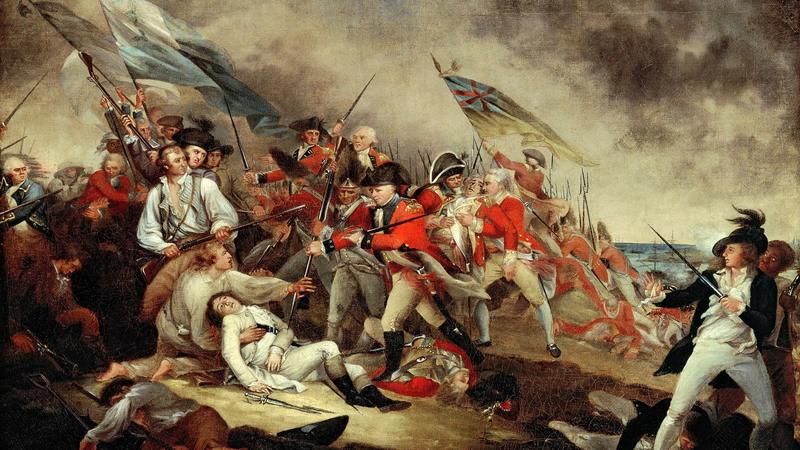
Top photo image: A mob pulls down a gilded lead equestrian statue of George III at Bowling Green, New York City, 9 July 1776 (William Walcutt/public domain)

Seeing in real time why founders kicked monarchy to the curb

Washington Politics

This article is part of an RS series reflecting on the 250th anniversary of American Independence and its impact and meaning for modern U.S. foreign policy, war, and peace.


The spring of 1794 strained the nerves of even the most principled adherents to official neutrality and free commerce.

The British Royal Navy had seized 250 American merchant vessels en route to the French West Indies. Neither the Federalists nor the Republicans were clamoring for war, but they disagreed bitterly over how to resolve the crisis without being swept up in a European maelstrom. Most agreed the young country was too weak to take on a major power.

In an April 25 letter to Vice President John Adams, Thomas Jefferson — the Republican leader and famous French sympathizer — lamented, “my countrymen are groaning under the insults of Gr. Britain. I hope some means will turn up of reconciling our faith & honour with peace: for I confess to you I have seen enough of one war never to wish to see another.”

Jefferson would receive his wish this time, although he and the Republicans were outraged by President George Washington’s decision to avert war through an unpopular, one-sided treaty. But such was the price of peace. The British, then embroiled in an existential struggle against revolutionary France, eventually stopped seizing American ships, creating an opening for negotiations.

In the more than two centuries since the vexations of Washington’s second term, however, war has too often been the norm — unnecessary, undeclared, ruinous, even genocidal. This bloody history can obscure the founding generation’s genuine fear that war’s deleterious consequences would undermine republican government and weaken the country’s independence at an irrecoverable cost in blood and treasure.

America’s semiquincentennial should compel us to revisit these ideas without resorting to presentism, because the American Revolution remains the most important event in our history, and the Constitution these former revolutionaries crafted in 1787 is still our Constitution today.

This does not mean resorting to hagiography. While many founders dreaded foreign wars, railed against permanent alliances, or even proposed utopian visions for enduring international comity, they were not saints. They made plenty of mistakes in the cause of peace, such as Jefferson’s economically disastrous embargo to avoid another war with Great Britain in 1807.

They were not pacifists, either. Jefferson, who “retained the instruments and followed the basic thrust of his predecessors’ foreign policy,” according to historian George Herring, deployed the new navy to fight a limited war against the Barbary pirates from 1801 to 1805. The operation included a failed attempt to overthrow Tripoli’s government. When the fighting ended indecisively, it had cost the treasury “far more than the price of tribute” typically paid to the Barbary States, says Herring.

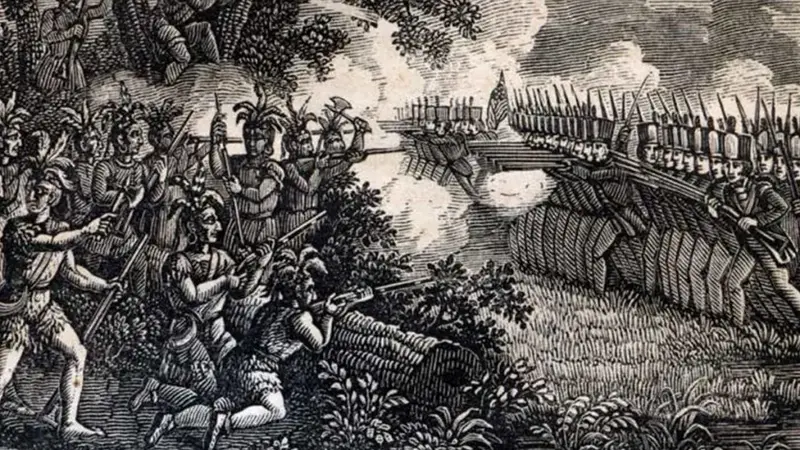
Meanwhile, on the North American continent, both the U.S. government and a racist citizenry pursued violent expansionism in Indian lands, unleashing campaigns of indiscriminate murder and dispossession. As historian David Silverman writes in “The Chosen and the Damned,” “the conquest of Indians was the central activity of the federal government and several states and territories throughout the era of the early republic… killing Indians for their land was the doctrine of the entire nation.”

Yet in light of our current troubles, America’s first leaders still have something to teach us. Though they inhabited a vastly different world, one of their problems broadly resembles one of ours: determining the difference between vital and peripheral national interests — and how best to safeguard the former. In our age of the imperial presidency and permanent war, it may seem quaint that Presidents Washington, Adams, and Jefferson treated war against rival European powers as a true last resort to be avoided if at all possible.

We might start with the debates at the Constitutional Convention in August 1787 concerning war powers. Massachusetts delegate Elbridge Gerry “never expected to hear in a republic a motion to empower the Executive alone to declare war.” By vesting this power in Congress, the framers rejected British notions of prerogative power. An “elective King” the new republic did not need.

As John Jay warned in the oft-quoted Federalist No. 4, “... absolute monarchs will often make war when their nations are to get nothing by it, but for the purposes and objects merely personal, such as thirst for military glory, revenge for personal affronts, ambition, or private compacts to aggrandize or support their particular families or partisans.”

The framers’ fear of arbitrary, prerogative power resonates for reasons that are all too obvious. In waging war against Iran without so much as a nod to Congress or trace of public consent, President Donald Trump defiled the Constitution, unwittingly confirming the 18th-century wisdom about corrupt, self-dealing despots. Trump is scarcely the first president to leap headlong into an ill-advised war of choice, and some of his predecessors notably obtained congressional authorization and public backing before sinking into the abyss. Yet Trump’s folly stands out as we mark the 250th anniversary of the revolutionaries’ rejection of monarchy.

In an interview with Responsible Statecraft, Pulitzer Prize-winning historian Joseph Ellis said Trump’s Middle East misadventures are a stark reminder that “the worst thing any president can do is commit the United States to an unnecessary and unwinnable war.” The Constitution’s framers got it right, Ellis said: “The decision to go to war should not be made by one person.”

Moreover, the Iran war fiasco was undertaken at the urging of a foreign country — Israel — whose interests do not align with those of the United States and whose malign influence over U.S. foreign policy might churn George Washington’s stomach. Unlike modern Israel, eighteenth-century France did have a treaty with the United States, the 1778 pact negotiated by Benjamin Franklin during the reign of King Louis XVI. Washington consulted with his cabinet to discuss the country’s obligations to the newly republican France, whose leaders were pressing for the U.S. to intervene.

“President Washington had already concluded that the U.S. was too weak and unprepared to fight in a European war and would suffer economic disaster if trade was cut off with Great Britain. He therefore prioritized neutrality, but stopped short of a formal renunciation of the French alliance,” according to a forthcoming book by Mike Yaffe of the George Washington Leadership Institute at Mount Vernon. “Washington articulated a vision for a foreign policy designed to give the United States maximum flexibility to chart its own course in pursuit of the national interest: lasting peace with all nations.”

In the cabinet, Jefferson and Alexander Hamilton set aside their reservations and pushed Washington to issue a proclamation of neutrality on April 22, 1793, and the following year Congress passed a neutrality act. “No other president has been able to exercise such enduring influence over U.S. foreign policy,” says Ellis.

At the time, however, some early American leaders balked at this approach, arguing that war was necessary to defend American commerce. Others, namely James Madison, believed Washington had usurped Congress’ power over matters of war and peace. Writing under the name Helvidius, Madison said, “War is in fact the true nurse of executive aggrandizement… In war the honors and emoluments of office are to be multiplied; and it is the executive patronage under which they are to be enjoyed. It is in war, finally, that laurels are to be gathered, and it is the executive brow they are to encircle.”

John Adams inherited Washington’s neutralist stance as war hysteria gripped the country in the late 1790s. He ultimately averted an all-out clash with the French who, like the British before them, were preying on American shipping. The second president sought a negotiated settlement against the wishes of many fellow Federalists, not least Hamilton, who sought to exploit the crisis to expand the army and strengthen the central government.

“Adams built the navy to combat these erstwhile allies and in so doing defended neutrality without a major war. The Quasi-War involved real combat at sea but ultimately restored US-French relations to one of benign neutrality,” Christopher Mott, a scholar at the U.S. Institute for Peace & Diplomacy, told Responsible Statecraft.

Adams considered his decision to negotiate with France “the most disinterested, prudent, and successful conduct in my whole life,” as cited by the late Gordon Wood in his monumental “Empire of Liberty.” Peace arrived too late to save Adams’ political career. But if we are truly interested in saving our republic from the enervating miseries of endless war, we might take some inspiration from his stubborn pursuit of peace.

keep reading Show less
google cta
Want more of our stories on Google?
Click here to make us a Preferred Source.
America does not know its own mind
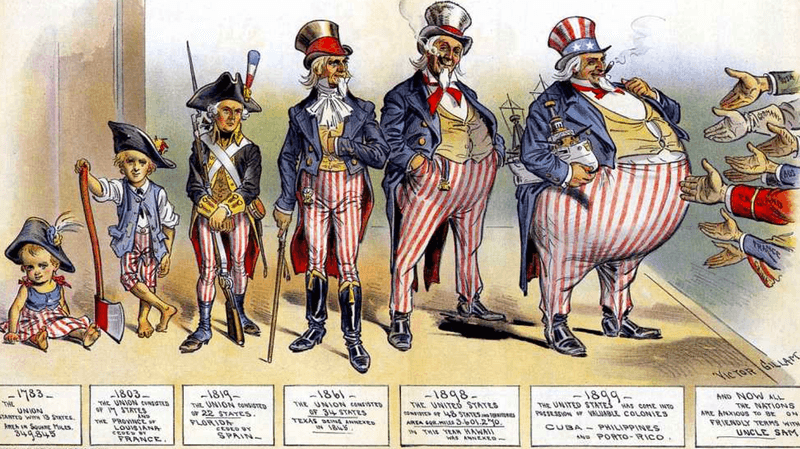
Top image: A political cartoon portrays the disagreement between President William McKinley and Joseph Pulitzer, who worried the U.S. was growing too large through foreign conquests and land acquisitions. (Creative Commons)
What does ‘national interest’ really mean?

America does not know its own mind

Washington Politics

This article is part of an RS series reflecting on the 250th anniversary of American Independence and its impact and meaning for modern U.S. foreign policy, war, and peace.


In a 1941 speech to the America First Committee, which sought to keep the nation out of World War II, Charles Lindbergh insisted that the United States was “better situated from a military standpoint than any other nation in the world.”

“If we concentrate on our own defenses and build the strength that this nation should maintain, no foreign army will ever attempt to land on American shores,” Lindbergh thundered. “If we enter fighting for democracy abroad, we may end by losing it at home."

President Franklin D. Roosevelt attacked these isolationist arguments head-on as he made the case for sending arms to the victims of aggression, warning that the fall of Great Britain to the Axis powers would imperil U.S. interests. “It is no exaggeration to say that all of us, in all the Americas, would be living at the point of a gun,” Roosevelt said. “We well know that we cannot escape danger, or the fear of danger, by crawling into bed and pulling the covers over our heads.”

Japan settled this debate by attacking Pearl Harbor, prompting the America First Committee to disband as the nation entered World War II. But these bitter divisions over statecraft continued to haunt many American elites. In 1943, journalist Walter Lippmann worried that ideological cleavages endangered the republic. “The spectacle of this great nation which does not know its own mind,” he warned, “is as humiliating as it is dangerous.”

This warning would prove premature; a consensus behind liberal internationalism would form during the 1940s, consolidate in the early 1950s, and last through the rest of the century.

Yet the past is prologue. Today, Lippmann’s apprehensions could not be more apt. As it celebrates its 250th birthday, America does not know its own mind. Internationalists are again doing battle with America Firsters, cleaving the body politic between two incompatible approaches to the nation’s role in the world.

Amid deepening disarray across much of the world, the United States urgently needs to reclaim a wise and steady course. Mining the nation’s history can point to the middle ground between globalist excess and nationalist retreat — a new grand strategy that can gain support across the political spectrum while also anchoring a changing world.

***

The founding era bequeathed to the United States a grand strategy that was isolationist, unilateralist, protectionist, and anti-immigrant. In his Farewell Address of 1796, President George Washington warned against “permanent alliances with any portion of the foreign world.” The United States banked on the natural security provided by flanking oceans, generally avoided taking on enduring strategic commitments beyond North America, and studiously shunned entanglement in great-power rivalry.

The United States chose to go it alone and chart its own foreign policy path rather than entering pacts and alliances that could tie its hands. In 1793, President George Washington reneged on the alliance with France concluded in 1778 to help secure U.S. independence. The United States did not enter another military alliance until after World War II.

American positions on trade and immigration also sought to keep the outside world at bay. From its earliest days, the United States relied heavily on commerce with other nations, but it sought fair trade rather than free trade and looked to tariffs to raise revenue and bolster industrialization. The protectionist impulse intensified after the Great Depression with the infamous Smoot-Hawley Tariff Act of 1930, which triggered the collapse of international trade.

And, even as America welcomed with open arms immigrants that were white and Protestant, Jews, Catholics, Asians, Mexicans, and various “non-white” peoples were often the target of anti-immigrant measures. Racism and anti-immigrant sentiment reinforced isolationism by intensifying the nation’s urge to limit its entanglement with the outside world.

To be sure, the United States hardly sat on its hands until World War II. As it sought dominance in the Western hemisphere, the young nation steadily expanded westward, shunting aside Native Americans and launching a war in 1846 that led to the annexation of roughly half of Mexico’s territory. But when American policymakers strayed further afield, they faced sharp backlash at home.

Victory in the Spanish-American War of 1898 saddled the United States with Spain’s former possessions in the Caribbean and Pacific. Especially after thousands of U.S. soldiers died fighting insurgents in the Philippines, this bout of imperialism did not go over well with the electorate. “We assert that no nation can long endure half republic and half empire,” charged Democratic presidential nominee William Jennings Bryan in 1900.

Americans similarly soured on President Woodrow Wilson’s decision to enter World War I to “make the world safe for democracy.” The 1920 election was effectively a referendum on Wilsonian internationalism. The Republican nominee, Warren Harding, campaigned “against the internationalism” of Wilson and “for the policies of [George] Washington.” Harding won in a landslide, sparking America’s sharp strategic retreat during the interwar years. This isolationist impulse held strong even as Nazi Germany and Imperial Japan embarked down a path of aggression and territorial expansion.

***

This first era of U.S. grand strategy came to a decisive end on December 7, 1941, when Japan bombed Pearl Harbor. “That day ended isolationism for any realist,” wrote Senator Arthur Vandenberg of Michigan, who had until then been a leading proponent of isolation and non-intervention. President Roosevelt began what would result in a sea-change in U.S. grand strategy, forging a new bipartisan compact behind liberal internationalism.

Helping drive this foreign policy revolution were tectonic shifts in geopolitics. Advances in aviation and other military technologies led American policymakers to conclude that two great oceans no longer provided strategic shields. “The world has grown so small and weapons of attack so swift,” Roosevelt explained, “that no nation can be safe in its will to peace.” A new strategic principle would come to guide U.S. statecraft: “never again,” as described by historian Melvyn Leffler, “could the United States permit an adversary or coalition of adversaries to gain control of the preponderant resources of Europe and Asia.” To ensure safety at home, the United States had to venture abroad, defeat autocratic aggressors, and spread republican ideals.

Amid the onset of the Cold War, the United States left behind hemispheric isolation and became a crusader state. In the service of defending its worldwide interests and spreading democracy, the United States deployed its armed forces abroad in war and peace and constructed a web of defense alliances and a vast network of overseas bases. Between 1948 and the end of the Cold War, U.S. forces engaged in more than 40 military interventions.

Unilateralism gave way to multilateralism. The Senate approved membership in the United Nations by a vote of 89-2, and the Bretton Woods institutions were set up to oversee the international economy. Fervor for free trade displaced protectionism, and Washington took the lead in negotiating the liberalization of international commerce. The country also embraced a new sense of multiculturalism, bolstered by looser immigration laws and the victories of the civil rights movement.

The bipartisan compact behind liberal internationalism served as the political foundation for Pax Americana well into the twenty-first century. Western hegemony, underpinned by U.S. power, acquired a taken-for-granted quality.

***

Yet history is moving forward. America’s internationalist consensus has shattered. Decades of war in the Middle East have soured the electorate on military interventions and undermined trust in the political establishment. Automation, globalization, and deindustrialization have hollowed out the middle class and turned free trade into a dirty word on both sides of the aisle. The failure of international institutions to deliver has sapped enthusiasm for multilateralism, while a dysfunctional immigration system has eaten away at the fabric of multiculturalism. On foreign as well as domestic policy, Americans are deeply divided along ideological and partisan lines.

Trump is a symptom, not the cause, of the country’s political fracture and its turn against the establishment. And at least in theory, Trump’s pivot to America First represents an overdue course correction. Trump vowed to pull the nation back from decades of strategic overreach, ease off democracy promotion and multilateralism, and erect protectionist barriers that would revive the nation’s manufacturing sector. He also vowed to fix an immigration system that many Americans recognized as badly broken.

But Trump has overcorrected and underperformed. Rather than pulling off a needed strategic retrenchment, he attacked Iran, launching yet another failed war of choice in the Middle East and straining the nation’s alliances. Trump is right to back off promoting democracy abroad, but he corroded American democracy by disregarding the rule of law at home. In the meantime, his protectionism has worsened the nation’s affordability crisis and his harsh deportations have turned a majority of the U.S. public against his immigration policy.

Trump is doing an excellent job of bringing down the old order. But he shows no sign of putting in place a viable alternative.

***

Today, America is adrift; neither liberal internationalism nor Trump’s America First strategy is able to sustain domestic support. Wide swings in U.S. strategy are contributing to global instability and undermining U.S. leverage. With American history as our guide, it is time to create a new consensus — one that builds on the wisdom of both George Washington and Franklin Roosevelt and sets the country on a stable path forward.

The last major shift in U.S. foreign policy was forged in response to the catastrophe of World War II. This time, Washington must not wait for another great-power war to help birth an ordering moment. The clock is ticking. As China reaches great-power status and middle powers continue to rise, global power is diffusing from west to east and north to south; geopolitical rivalries are mounting in step. Yet with America’s purposes abroad no longer in equilibrium with its domestic means, the United States is not currently up to the task of providing steady leadership.

To get back on course and help anchor a changing world, America should now embrace what one might call “multilateralism-lite.” International cooperation remains necessary for solving global problems like trade, global warming, and AI regulation, but the United States cannot rely on bureaucratic and slow-moving institutions like the U.N. to address these problems.

Instead, it should focus on coalitions of the willing and bespoke groupings targeting specific tasks. Alongside such ad hoc coalitions, the United States should also encourage states to lean first and foremost on regional organizations, such as the Association of Southeast Asian Nations and the African Union, which should shoulder more responsibility and deliver more public goods in their neighborhoods.

As global power diffuses, the United States must for now set aside efforts to spread republican ideals and instead work with other nations — democracies and autocracies alike — to fashion a pluralistic and ideologically diverse global order. Democracies will need to compete respectfully in the marketplace of ideas with countries that adhere to alternative forms of governance. Autocracies will likewise need to live comfortably alongside liberal democracies.

International cooperation will require respect for sovereignty and toleration of differences over values and governance. In this respect, the United States and China should do more to build a pragmatic and constructive relationship. Teamwork between the world’s two leading powers will help facilitate global governance and reduce the chances of a dangerous rupture.

The crusading ethos that has defined U.S. foreign policy for the last 80 years must be tamed; America’s role as global policeman has run its course. At the same time, hemispheric isolation is not an option in an interdependent world. The United States still needs to help prevent the domination of Eurasia by a hostile power, even as it retrenches from and avoids wars of choice in other parts of the world. Keeping alliances in Europe and Asia alive and well is a cheap investment in maintaining a stable balance of power. As Washington presses allies to shoulder more burdens, it should still maintain a robust U.S. force presence in both theaters. This is the pathway toward a stable equilibrium between chronic overreach and dangerous detachment.

Such a refashioning of U.S. foreign policy will not be easy. In order to make it stick, U.S. democracy will have to get back up on its feet. Domestic investments will be needed to promote growth, bring down inequality, and educate Americans for the jobs of the future. A tamed brand of globalization – one that entails a more level playing field with trade partners but avoids protectionist overkill – can help ensure that the benefits of international trade are more widely shared. Only if it gets its own house once more in order will the United States have the power and purpose to provide effective leadership abroad.

America’s founders imparted enduring wisdom when they cautioned against unwise entanglement abroad. But the world of the 21st century is not the world of the founding era; like it or not, Americans are entangled in an interdependent globe. The United States must now step back without stepping away; it must do less, but still do enough. Arriving at that middle ground will be the challenge of the post-Trump era.

keep reading Show less
US knows UAE fueling war in Sudan but $1.4 trillion is getting in the way
Top image credit: Sudanese refugee women walk at the Tulum refugee camp, amid ongoing conflict in Sudan between the paramilitary Rapid Support Forces (RSF) and the Sudanese army, in Wadi Fira province, eastern Chad, November 30, 2025. REUTERS/Amr Abdallah Dalsh

US knows UAE fueling war in Sudan but $1.4 trillion is getting in the way

Africa

Massad Boulos, the Trump Administration's top adviser for Africa and point man on Sudan, recently spoke before the United Nations Security Council and warned that the international community “cannot sit back” while El Obeid, a city of over roughly half a million people, becomes another El Fasher.

El Fasher was the last major city in Sudan’s Darfur region still outside the control of the Rapid Support Forces (RSF), a paramilitary force that has been fighting Sudan’s national army, the Sudanese Armed Forces (SAF), in a civil war that recently entered its fourth year. The war has morphed into a regional proxy conflict, with the United Arab Emirates (UAE) backing the RSF, while Egypt and Turkey have emerged as the army’s primary backers, providing weapons, drones, and training.

When El Fasher fell in October 2025, more than 6,000 civilians were killed in three days. The U.N. said the campaign bore the “hallmarks of genocide.” The Biden administration also determined that the RSF had committed genocide in other parts of Darfur in 2024.

The same day that Boulos spoke before the Security Council, the U.S. Treasury Department announced sanctions on individuals and entities linked to both sides of Sudan’s civil war. Four days before that, State Department Spokesman Tommy Piggot warned that “mass atrocities could be imminent” in El Obeid.

At the time of these warnings from Trump administration officials, Secretary of State Marco Rubio had just completed a Gulf tour, reassuring allies shaken by the U.S.- Iran war. During the trip, Rubio told reporters in Kuwait that Washington “continues to engage” on Sudan with Gulf states at every opportunity.

At a Senate Foreign Relations Committee hearing weeks earlier, Rubio acknowledged that Sudan’s war had “turned into a proxy war” where “the divisions between the UAE and Saudi Arabia have truly complicated our ability to bring that to an end.” But rather than take the lead in resolving those differences, his proposed solution was identifying safe zones for aid distribution.

Saudi Arabia backs Sudan’s military politically, while the UAE is the RSF’s principal supplier of arms and mercenaries — a finding that Washington effectively endorsed through its own sanctions, having designated multiple UAE-based companies in January 2025 for providing the RSF with weapons and financial cover.

Despite Washington’s own warnings of what's to come, the political inaction means that the situation for the people of El Obeid is bleak. The RSF has set its sights on El Obeid because of its strategic location, linking Darfur to the Nile Valley and the capital, Khartoum. Whoever controls the city controls the central axis of movement across Sudan.

The RSF has been striking the city with drones for weeks, destroying the main power transformer, fuel stations, bridges and supply routes into the city. Food and water prices have risen dramatically and a hunger crisis looms.

Against this background, Britain and six European Governments issued a joint call for an immediate halt, stating that “this is a critical moment, and the international community must act.” The U.N. secretary-general’s personal envoy for Sudan, Pekka Haavisto, called the RSF’s leader directly. The RSF commander assured him that civilians would not be targeted. He said the same to diplomats before the genocides of El Fasher and El Geneina.

Friday’s Treasury sanctions, meanwhile, reflect how much Washington knows and how little it chooses to act.

On the RSF side, the Treasury sanctioned the middlemen who recruit Colombian mercenaries to fight for the RSF, but those designations ignore the Abu Dhabi-based security company that recruited, trained, and transported them from Emirati airports to the battlefields of Darfur.

An investigation by The Sentry found that Ahmed al-Humairi, a senior Emirati official, founded and once fully owned the company at the center of that network. He has since divested his shares, but he remains closely linked to the company’s current CEO, fellow Emirati businessman Mohamed Hamdan al-Zaabi.

The UAE denies all of this, but members of Congress and Secretary of State Marco Rubio have all openly acknowledged the UAE’s role in arming the RSF. Despite the fact that this is now public knowledge, arms sales to the UAE have not been conditioned, nor has Abu Dhabi faced any real consequences from Washington.

The reason is not hard to find. The UAE has pledged $1.4 trillion in investment in the U.S. — a commitment reaffirmed even as the U.S-Israel war on Iran left UAE infrastructure dangerously exposed to Iranian strikes. At the G7 summit in mid-June, President Trump met Emirati President Mohammed bin Zayed, called him a “warrior,” and marveled at his wealth, saying: “when you’re that rich, you can speak that low.”

The United Kingdom is running the same calculation as Washington. This has prevented any serious action at the U.N. Security Council, where the U.K. holds the most consequential position as Sudan’s penholder, meaning it is the country formally responsible for leading the international response.

In recent testimony before a British parliamentary committee, Yale Human Rights investigator Nathanial Raymond revealed that the Foreign, Commonwealth & Development Office has suppressed evidence linking the UAE to the RSF due to its prioritization of “economic, security, and diplomatic relationships with the UAE above preventing the intentional starvation, forced displacement, and the genocidal slaughter of tens of thousands of civilians living in El Fasher and its surrounding communities.”

But Raymond’s testimony implicates Washington equally. He shared information linking UAE facilities to the RSF directly with the U.S. Treasury and State Departments, which in turn used the data to sanction RSF-linked companies in 2025. The Guardian reported separately that the State Department had blocked its own intelligence assessments on El Fasher that would have produced a formal genocide determination — one that would have potentially triggered mandatory government-wide responses under the Elie Wiesel Genocide and Atrocities Prevention Act, a law that President Trump himself signed into law in 2019. A source told the Guardian that the assessment was stopped in order to protect the strategic relationship with the UAE.

Given the inaction at the executive level, it has fallen to Congress to try to force a different accounting. So far, it has failed.

In the House, the U.S. Engagement in Sudanese Peace Act, led by Rep. Gregory Meeks (D-N.Y.) alongside 32 Democratic co-sponsors, would require the administration to name the countries arming the RSF and stop selling them weapons. It also demands a report tracing how American weapons ended up in Sudan.

But the same legislation contains a presidential waiver. If sanctioning a country is deemed against the national interest, the president notifies Congress within fifteen days and walks away. The bill, it seems, was designed to corner the UAE, but the waiver also allows it to escape actual consequences.

The Senate’s Preventing External Aggression and Conflict Escalation in Sudan Act of 2026, known as the PEACE in Sudan Act, is even softer on foreign arms suppliers. Where the House bill mandates sanctions, the Senate bill gives the president discretion: he “may” impose sanctions, according to the language of the bill. The national interest waiver is also present here.

At a Senate Foreign Relations Committee markup in mid-June, Sen. Chris Van Hollen (D-Md.) tried to harden the government's obligations, when he introduced an amendment to the PEACE in Sudan Act that would have barred arms transfers to the UAE explicitly while it continues supplying the RSF. It failed in a 15-7 vote.

Van Hollen’s response was the most concise summary of American policy on Sudan offered by a government official: “The United States shouldn't just be talking about ending the slaughter in Sudan. We should actually be using our leverage."

Despite the growing movement at the congressional level, the administration has shown at every turn that Gulf relationships come first.

The civilians of El Obeid know none of this will save them. They are simply listening for drones and hoping they are not the next El Fasher.

keep reading Show less
New Solomon Islands PM breaks with China, cozies up to the West
Top image credit: Prime Minister of Solomon Islands Matthew Wale inspects a guard of honour during a welcome ceremony a outside Parliament House in Canberra, Wednesday, June 3, 2026. (AAP Image/Lukas Coch via ReutersConnect)

New Solomon Islands PM breaks with China, cozies up to the West

Asia-Pacific

The Solomon Islands in the southwest Pacific recently emerged from weeks of parliamentary turmoil and a leadership shake-up resulting in a new government.

The new prime minister, Matthew Wale, who had led the opposition since 2019, is delivering a foreign relations reset with Australia and New Zealand, both long-term regional partners and U.S. allies. He has less than two years to make a mark with his foreign policy and development vision before the next national election in 2028.

“Fellow Solomon Islanders, change is coming,” Wale declared May 15 after assuming leadership of the island chain of more than 800,000 people. “The government that I lead will do its utmost to serve. Please help keep us accountable and responsible,” he told fellow citizens.

Wale gained the premiership following a no confidence vote in parliament prompted by the defection of ministers from the previous coalition government, led by Jeremiah Manele and the Ownership, Unity and Responsibility (OUR) Party since 2024.

Wale’s ascent marks a major shift from the state being a geopolitical flashpoint between the U.S. and China just four years ago. Manele continued much of the “look north” agenda of his predecessor, Manasseh Sogavare, who oversaw the country’s decision in 2019 to normalize relations with China at Taiwan’s expense and who in 2022 signed an extensive security pact with Beijing that aroused major concerns in Canberra, Wellington, and as far away as Washington.

For his part, Wale, who became opposition leader in 2019, has been a consistent critic of the country’s growing ties with Beijing.

Wale sent a clear signal when he made his first official overseas visit as prime minister to Australia, where he initiated talks aimed at achieving a new strategic treaty less than three weeks after taking office. “Today we’ve committed to elevate our bilateral relationship at the request of the Solomon Islands,” Australian Prime Minister Anthony Albanese told a joint Canberra press conference June 3. “This will be agreed in a new comprehensive treaty underpinned by mutual trust, respect and open dialogue.” The agreement will include enhanced security and law enforcement cooperation, as well as economic, humanitarian and development assistance.

In response, Wale told the Australian media that “the resilience of our relationship, I think, is self-evident. It lies in our people to people contacts and, of course, in our institutional relations over so many years, perhaps even more than a century. And it is not easy to break that kind of depth and the strength of such a relationship.”

The solidarity follows Wale’s pledge last month to review the controversial security agreement with China, which provided the possibility for Chinese security forces to be used against internal social disorder.

The Pacific Islands, which consist of 22 countries and territories with a total population of 14.3 million people and which stretch from Papua New Guinea in the west to French Polynesia to the east, have been regarded by Beijing as strategically important for expanding its economic and political influence under the banner of South-South cooperation, extending its maritime and security presence in the region, and reducing Taiwan’s diplomatic presence and influence there.

The prospect of China’s security penetration so far south galvanized a rapid response from Australia and the U.S. The Biden administration sought to rectify decades of neglect in the South Pacific by reopening shuttered embassies, providing more economic and development assistance to the islands, and engaging in greater dialogue with the region. Summits in 2022 and 2023 with Pacific leaders were hosted in Washington, where major new economic and aid programs were announced. Washington’s renewed attention also carried an ideological dimension by stressing, rhetorically at least, a mutual commitment to democratic principles and to “a free and open region where individuals live in open societies [and] rules are reached transparently and applied fairly.”

Yet U.S. momentum in the region faltered last year as President Donald Trump, in his second term, abruptly slashed USAID programs and withdrew from multilateral organizations and the Paris climate agreement. The imposition of steep trade tariffs on Pacific Island developing countries, described as “disconnected with both reality and common sense” by the Center for Strategic and International Studies (CSIS), delivered a shock to the region, which already faces major national human and economic development challenges that are further jeopardized by the impacts of climate change, such as sea level rise, and natural disasters, such as typhoons.

Wale’s domestic objectives also include reducing corruption. He has voiced criticism for years about the connivance between political elites and foreign extractive investors in the logging industry, which has resulted in hundreds of millions of dollars in lost revenue every year. It is an issue that has also triggered long-term grievances among ordinary Solomon Islanders, of whom 31% live in poverty. And vociferous civil society opposition to perceptions of undue foreign influence on political leaders was a factor in violent protests in the Chinatown area of the capital, Honiara, in November 2021. The unrest was a catalyst for the security agreement the following year.

At the same time, established economic and trade ties with China, estimated to be worth US$3.5 billion since 2019, are unlikely to weaken. But the new prime minister, who also visited New Zealand in June, has framed his strengthening of bilateral ties with Australia as motivated in part by shared values and aspirations as representative democracies.

Australia also provides 34% of all overseas development finance (ODF) to the Solomon Islands, followed by China at 19%, according to the Sydney-based Lowy Institute for International Policy. And across the entire region, Australia contributed the largest portion, about 43%, of all ODF in 2023, with 10% contributed by New Zealand and 1% by the United States.

Last year, China tried to capitalize on perceptions of U.S. withdrawal from the region, hosting a summit with Pacific Island foreign ministers in May to showcase enhanced regional cooperation and climate assistance projects. Yet the magnitude of ODF it provides to the Pacific has diminished over the past two decades, from an average of $440 million in 2008-2019 to about $250 million in 2024, according to the Lowy Institute. The trend parallels China’s continuing decline in its rate of GDP growth from 14.1%percent in 2007 to 5% in 2024, with forecasts of a possible contraction to 3-4% in coming years.

This year, however, has seen the U.S. move to re-engage in the region. Deputy Secretary of State Christopher Landau hosted an investment summit with Pacific Island leaders in Hawaii in February and visited Samoa, Tonga and Fiji to promote private-sector-led economic and development partnerships. And in May, the U.S. and Solomon Islands signed a new joint investment incentive agreement. However, “even factoring in ramped up U.S. engagement in recent years, the U.S. remains far behind other countries in terms of what it contributes to the region, according to CSIS.

On the security front, Pacific leaders remain focused on their own identified security agenda and threats that range from climate change to transnational crime. Nevertheless, Wale reportedly proposed developing a Pacific-led regional security treaty during his visit to Canberra. The suggestion comes at a time when China’s expenditure on defense is on the rise, reaching an estimated $275 billion this year, with an increased tempo of naval operations in the region.

Wale’s proposal demonstrates that future strategic initiatives in the region may be driven as much by the Pacific Island states as larger powers. In so doing, Pacific leaders will prioritize international partners that walk the talk of consistent, long-term, trust-based and mutually beneficial relations.

keep reading Show less
google cta
Want more of our stories on Google?
Click here to make us a Preferred Source.
Does the Pentagon even know who its boat strikes are killing?
Top image credit: Screengrab via Truth Social

Does the Pentagon even know who its boat strikes are killing?

Latin America

The numbers are stomach-turning. In less than 10 months, U.S. forces acting on orders from the Trump administration have killed 215 people in 63 aerial attacks on small boats in the Caribbean Sea and the eastern Pacific.

Since the first attack on September 2, the Trump administration has told us that they are killing drug traffickers. But drug trafficking, especially being a low-level courier, is not a crime punishable by the death penalty, and, even if it were, the U.S. legal system assumes innocence and guarantees a day in court. Skipping that step makes this murder under U.S. law: the equivalent of a cop shooting a fleeing suspect in the back.

The administration is attempting to get around this by claiming that every one of the dead is a “narco-terrorist,” a member or “affiliate” of a profit-seeking criminal group recently added, with no outside review, to a secret Defense Department list of “Designated Terror Organizations,” or DTOs. Because the United States is in a “non-international armed conflict” with the DTOs, a secret Justice Department memo argues, our military is permitted to kill them on sight, even with no self-defense justification.

Yet the administration has still not presented any evidence that a bombed vessel was even carrying drugs, much less that its deceased crew was affiliated with a criminal or “designated terrorist” organization.

What we know so far indicates that the U.S. military is being used to assassinate unknown individuals based on alarmingly flimsy evidence. And the targeting criteria are quite loose.

On the rare occasions when crew members have been recovered, “Military briefers have admitted to members of Congress that they cannot satisfy the evidentiary burden necessary to hold or prosecute survivors of the boat strikes,” reported the Intercept’s Nick Turse, who has covered the boat strikes extensively. Three survivors have been recovered alive; all have been let go without charges.

Questioning Secretary of State Marco Rubio at a hearing earlier this month, Sen. Tim Kaine (D-Va.) revealed that those carrying out boat-strike targeting are using three criteria that Kaine was not authorized to disclose publicly. He could disclose, however, that “evidence of narcotics on the boat” was remarkably not one of the three criteria.

In fact, the U.S. military usually doesn’t even know the identities of the people on the boats. The Washington Post reported that the targeting instructions in the boat-strike campaign’s August 5 Defense Department Execute Order (EXORD) “do not require positive identification of any individual but rather ‘reasonable certainty’ that adult males are members of, or affiliated with,” a DTO.

A former U.S. official who had read the EXORD told the Post, “The campaign may be killing individuals who in some cases have a tenuous link to any organized drug-running operation.” That official added, “When you define ‘DTO’ and ‘affiliate’ so loosely and you’re attacking boats, (the guidelines are) basically meaningless.”

The term “affiliate,” which the Trump administration is using to end lives on the open ocean, is especially squishy. Rep. Adam Smith (D-Wash.), the ranking Democrat on the House Armed Services Committee, told the New Republic’s Greg Sargent that, in a briefing with Pentagon officials, “They did not in any way, shape, manner, or form explain what the ceiling and floor are for ‘affiliated.’” People who received a classified briefing interviewed by the Intercept “said that they were under the impression that little more than a conversation with a DTO member might confer ‘affiliate’ status.”

Vague claims of “affiliation” or behavioral patterns introduce confirmation bias and guesswork into a lethal process. This vastly increases the probability that the boat strikes are killing people who have committed no crime at all.

“Some people who are familiar with boat movements” along the Caribbean coast of Colombia and Venezuela told the Latin American Center for Investigative Journalism that “it is common for the same boats that carry drugs on the outward journey to bring passengers back. The capitanes, as the boat operators are known, take whatever work they can get.”

The Intercept raised the possibility, acknowledged by a senior military officer, that some of those killed in the first strike on September 2 may have been migrants or human trafficking victims. That boat had 11 people aboard, a strangely large number for a short-hop drug delivery of less than 100 miles between Venezuela and Trinidad.

Evidence points to some of those killed in boat strikes being fishermen plying their trade. While residents of poor coastal fishing communities may “take occasional trafficking jobs to get by,” which blurs their identities, the likelihood of dying in a strike is scaring people away from getting in boats simply to fish, the New York Times reported from coastal Colombia and Ecuador. “Residents described entire communities abandoning fishing because the small ‘lanchas,’ or speedboats, used by traffickers and fishers are often indistinguishable.”

In Santa Marta, Colombia, the family of fisherman Alejandro Carranza, killed in a September 15 strike, insists that he was not involved in the drug trade. “If he was some kind of narcoterrorist,” the mother of three of Mr. Carranza’s children asked New York Times reporters, “then why are we living in misery instead of a mansion?”

Two of those killed in an October 14, 2025 strike were Chad Joseph, 26, and Rishi Samaroo, 41, both from the village of Las Cuevas, Trinidad. Their families are suing the United States for damages under the Death on the High Seas Act and the Alien Tort Statute. The complaint in Burnley v. United States argues that both men had been in Venezuela for months working on farms and, in their final communications, told their families that they had obtained passage by boat home to Trinidad.

In Sucre, Venezuela, where 90% of the population lacks basic food security, some of the dead were fishermen or taxi drivers who agreed to crew a boat that shipped drugs to Trinidad in exchange for a few hundred dollars. Some, like a “beloved” indoor soccer player, may simply have been aboard for the ride.

To all the concerns about the quality and reliability of intelligence used to target people for lethal boat strikes, we must add recent cases elsewhere pointing to U.S. reliance on faulty intelligence, or even just hunches. In March 2025, the Department of Homeland Security rendered 252 Venezuelan migrants to El Salvador’s feared Terrorism Confinement Center (CECOT) prison, alleging that they were all “terrorist” group members, an assertion that proved shockingly wrong, according to subsequent investigations. The New York Times revealed that an early March raid on an alleged DTO encampment in northern Ecuador, planned jointly by U.S. and Ecuadorian forces, in fact targeted a dairy farm. A March bombing in Iran that killed students at a school for girls is a well-known recent example elsewhere.

If even a few of the boat-strike victims are just fishermen, passengers, or low-level couriers with no relationship to big criminal syndicates, the Trump administration’s justification for the strikes simply cannot be sustained. It would confirm that this justification rests on a very rickety foundation of questionable intelligence, which should expose many in the chain of command to national and international criminal or civil liability.

The boat strikes need to stop immediately, and its architects and willing implementers must be investigated and held accountable at the earliest opportunity.

keep reading Show less
Iron Dome
Top Image Credit: Why Israel's Iron Dome Failed --- NewsThink (YouTube/Screenshot)

Washington is subsidizing Israel's booming global arms trade

Military Industrial Complex

Even as frustrations mount over Israeli military campaigns across the Middle East, governments keep buying weapons from Israel — making it one of the world's largest arms exporters.

As experts tell Responsible Statecraft, Tel Aviv uses these weapons sales to lock countries into long-term, strategic relationships that make recipients less likely to hold Israel accountable for their behavior in Gaza and Lebanon or in its West Bank policies. They stress that sustained U.S. support, including billions in military grant aid each year and the co-development of many Israeli weapons systems, helps make this all possible.

keep reading Show less
google cta
Want more of our stories on Google?
Click here to make us a Preferred Source.
HIV/AIDS support is latest casualty in Trump's 'white genocide' beef

Top Photo Credit: SOUTH AFRICA. OCTOBER 10, 2015. African man dies of AIDS. Poor community say farewell to a brother and a son. (Suzanne Cecelia Jewell / Shutterstock.com)

HIV/AIDS support is latest casualty in Trump's 'white genocide' beef

Africa

The Trump administration is winding down America’s HIV/AIDS prevention and treatment services in South Africa, with the termination of most of the program expected to be completed by September, though critical support is scheduled to continue through next March.

The decision to end the country’s access to the “PEPFAR” program is controversial. According to an anonymous State Department official, the administration chose to cut funding to South Africa as a response to its alleged failure to protect its white Afrikaner population from what President Donald Trump has called, without providing evidence, a “genocide.”

keep reading Show less
The dark-money operation behind China-baiting in the homeland
Top image credit: Michael Lucci of State Armor speaks before the House Select Committee on China during a hearing on June 25, 2026. (Screengrab via chinaselectcommittee.house.gov)

The dark-money operation behind China-baiting in the homeland

Asia-Pacific

At a recent hearing of the House Select Committee on China, State Armor CEO Michael Lucci urged lawmakers to treat Chinese influence in the United States as a national security priority.

“The American homeland is contested. States are on the front lines of this contest, and the Chinese Communist Party is exploiting vulnerabilities at the state and local level that can go overlooked here in Washington,” Lucci said.

keep reading Show less
google cta
Want more of our stories on Google?
Click here to make us a Preferred Source.
Reburial of Andriy Melnyk in Ukraine
Top photo credit: Reburial ceremony at the National Military Memorial Cemetery of Colonel of the Ukrainian People’s Republic Army and Head of the Organization of Ukrainian Nationalists, Andriy Melnyk, and his wife Sofia Fedak-Melnyk. (President of Ukraine official website)

For its own sake, Ukraine must not normalize Nazi collaborators

Europe

Polish President Karol Nawrocki made headlines recently for stripping his Ukrainian counterpart Volodymyr Zelensky of Poland’s highest honor over Kyiv’s decision to name a military unit after the Ukrainian Insurgent Army (UPA), a partisan formation responsible for massacres during World War II that killed roughly 100,000 Poles. This came shortly after Zelensky kneeled in front of the grave of noted Nazi collaborator Andriy Melnyk as his ashes were reinterred on Ukrainian soil.

More than four years of war have clearly affected the politics of historical memory in Ukraine. Russia’s invasion has given a new impetus to the process of “de-Sovietization” and “decommunization,” with historical symbols that reflect resistance against Russia gaining currency. This trend highlights the importance of achieving a settlement to the war – not only to prevent Ukraine from drifting further away from a European future, but also to preserve the historical memory of the Holocaust, which lies at the core of the postwar European compact.

keep reading Show less
Critics of lifting Iran sanctions can't offer a viable alternative

Top Photo Credit: Vice President JD Vance meets with Prime Minister Shehbaz Sharif and Field Marshal Asim Munir of Pakistan in June 2026 ( https://x.com/VP/status/2069449654048076029 via wikimedia)

Critics of lifting Iran sanctions can't offer a viable alternative

Middle East

Washington's Iran hawks — including some Democrats and former Biden administration officials — are denouncing the Trump administration for agreeing to upfront sanctions relief and other confidence-building measures in its preliminary deal, or memorandum of understanding (MoU), with Tehran.

But their criticism leaves one obvious question unanswered: what is their alternative other than another round of war?

keep reading Show less
expansionist America
Top photo credit: Political cartoon by Victor Gillam. Caption: "A Lesson for Anti-Expansionists. Showing how Uncle Sam has been an expansionist first, last, and all the time." Judge Magazine, 1899. (Public domain)

America's birthright is anti-imperialist, not empire

Washington Politics

This is the first in a RS series of articles reflecting on the 250th anniversary of American Independence and its impact and meaning for modern U.S. foreign policy, war, and peace.

On the 250th anniversary of the founding of the United States, this nation, founded as a republic, continues to shoulder numerous overseas entanglements and seemingly never-ending military commitments—the burdens of empire.

keep reading Show less
google cta
Want more of our stories on Google?
Click here to make us a Preferred Source.

LATEST

QIOSK