

https://justpaste.it/Korean_History_1
https://justpaste.it/Korean_History_2
https://justpaste.it/Korean_History_3
https://justpaste.it/Korean_History_4
Part 5
https://justpaste.it/Korean_History_5
this dump is Part 6
https://justpaste.it/Korean_History_6
https://justpaste.it/Korean_History_7
Part 8
https://justpaste.it/Korean_History_8
Published:1877
Publisher:Kelly & Walsh.
Original from:the University of Michigan
Digitized:July 26, 2006
Language:English
Author:Royal Asiatic Society of Great Britain and Ireland. North China Branch, Shanghai
https://people.well.com/user/aquarius/stent-chineseeunuchs.htm
We now take another leap of about 350 years, to the reign of Yuan-shun, [char 54], the last monarch of the Yuan dynasty (from A.D. 1333 to A.D. 1341).
This monarch had a daughter, known as Po-'hua, [char 55] 百花, who was not only very beautiful, but was also skilled in all manly exercises. She had a eunuch to wait upon her, named Pa-la, [char 56] 叭喇 , who having a hatred against a young student, and wishing to compass his death, invited him into the palace, where he supplied him so plentifully with drink that the young man got intoxicated, and, in this state was led by the eunuch to the sleeping apartment of the princess and left asleep on her couch.
When the princess returned to her chamber for the purpose of retiring, and drew back the curtains of her bed, she was much astonished at seeing a very handsome youth sleeping there. She at once drew her sword and was about to kill him when he awoke, and throwing himself at the feet of the princess entreated her to spare his life; explaining how he had been invited into the palace by the eunuch, had been made intoxicated, and that he must have been conducted hither while in that state.
The princess was charmed with the young fellow's appearance and ingenuous manner; and instead of killing him, as she at first intended, she became deeply enamoured of him, and kept him concealed in her chamber.
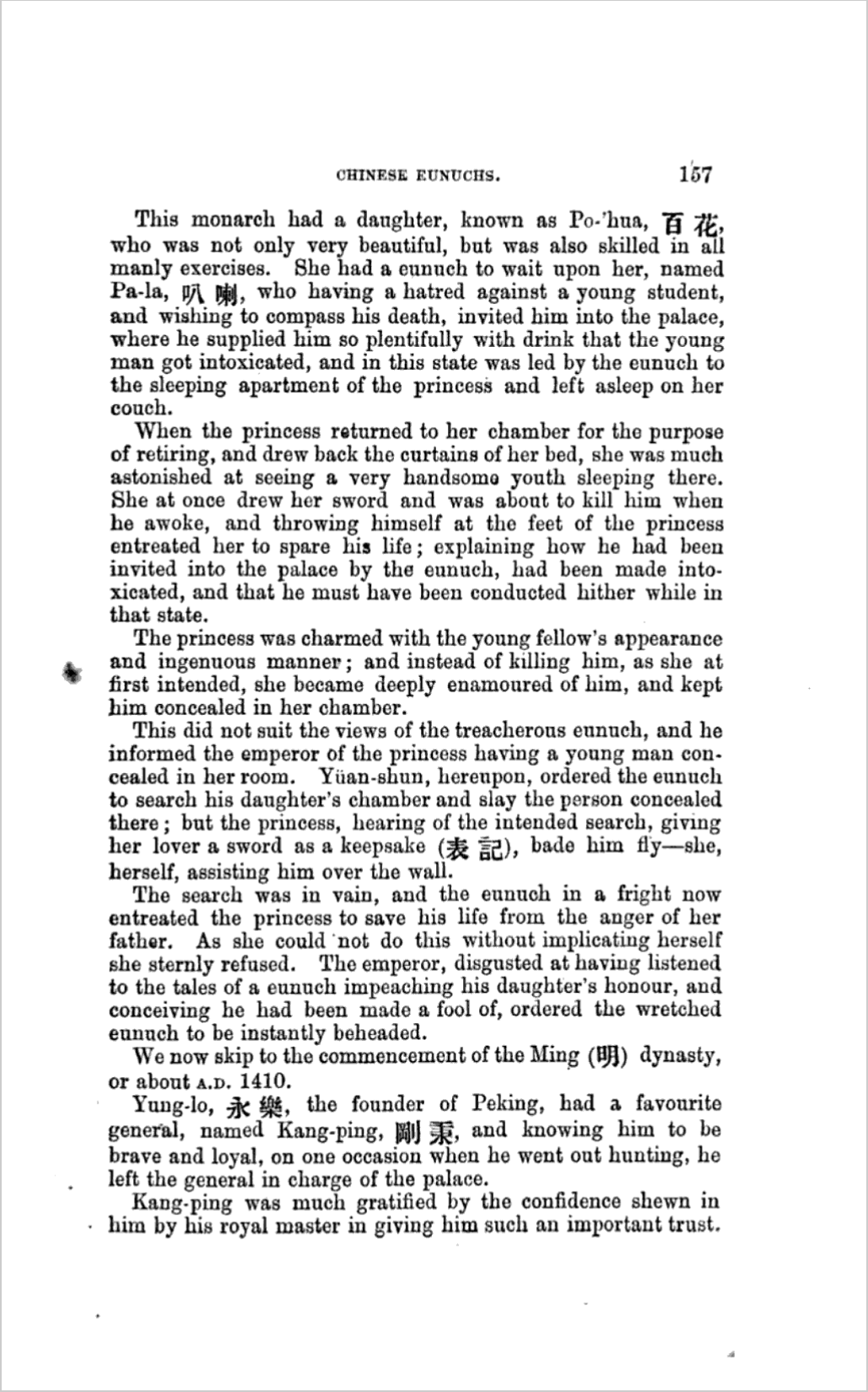 This did not suit the views of the treacherous eunuch, and he informed the emperor of the princess having a young man concealed in her room. Yuan-shun, hereupon, ordered the eunuch to search his daughter's chamber and slay the person concealed there; but the princess, hearing of the intended search, giving her lover a sword as a keepsake ([char 57]), bade him fly--she, herself, assisting him over the wall.
The search was in vain, and the eunuch in a fright now entreated the princess to save his life from the anger of her father. As she could not do this without implicating herself she sternly refused. The emperor, disgusted at having listened to the tales of a eunuch impeaching his daughter's honour, and conceiving he had been made a fool of, ordered the wretched eunuch to be instantly beheaded.
https://www.lcsd.gov.hk/CE/CulturalService/ab/en/aes1516_15.php
https://zolimacitymag.com/events/pavilion-of-a-hundred-flowers-returns-with-modern-exuberance/
https://www.wcity.com/event-calendar/details/2366.html
 https://ccms.cuhk.edu.hk/2020/01/17/%E7%99%BE%E8%8A%B1%E4%BA%AD%E8%B4%88%E5%8A%8D/
百花亭贈劍
ccmscuhk 17 1 月 2020 在〈百花亭贈劍〉中尚無留言
安西王久存背叛之心,朝廷遂命鄒化龍及江六雲混入安西王府,窺探消息。安西王器重六雲,惹內侍八臘嫉妒,故將他騙入深宮禁苑百花亭內。百花亭是百花公主練武之地,不許男兒進入,違者斬之。百花公主見六雲,愛其才氣豐儀,故贈他寶劍,私訂姻緣。
安西王起兵背叛,化龍巧施反間計,利用六雲欺騙公主,使她不加防範。面對化龍奇兵夜襲,安西王全軍盡沒,與八臘同被生擒,公主負傷沖出重圍,六雲方知受了化龍欺騙,後悔不已。化龍將安西王綁在營前,等候正法。百花公主為救父親,率眾到營前投降,但先要斬六雲以泄其騙情之恨。六雲願一死以明志,遂以宮主所贈之劍自刎。化龍及時阻止及解釋,各人冰釋前嫌。
The Spy Who Loves Me
Informed that Prince Anxi has long planned to rebel, the court has Zou Hualong and Jiang Liuyun infiltrate into his mansion as spies. Full of envy for the highly regarded Liuyun, eunuch Bala leads him into the forbidden Baihua Pavilion, where trespassers are punished and beheaded.
Prince Anxi’s daughter practices fencing at the pavilion, which is off-limit to all males.
When she catches sight of the trespasser, the princess is instantly captivated by his talent and graceful bearing. She gives him a sword and the promise of marriage.
When the prince finally revolts, Hualong has Liuyun unwittingly pass misinformation to the princess, lowering her guard. The surprise attack by Hualong that night wipes out the army of Prince Anxi. Although the wounded princess breaks through the siege, the prince and Bala are captured. Aware of the double crossing, Liuyun deeply regrets his involvement.
 Hualong prepares to execute the shackled prince in front of his camp. To save her father, the princess surrenders her army, on condition that Liuyun be killed for breaching her trust. Willing to die to prove his innocence, Liuyun is about to commit suicide with the princess’s sword when Hualong intervenes. He manages to clear up all misunderstanding.
https://www.jstor.org/stable/10.13173/centasiaj.57.2014.0185
https://www.mask9.com/node/112512
https://kzvid.info/yue-ju-bai-hua-ting-zeng-jiangeng-xin-banpavilion-of/fZvazq2Vi3-HjKw.html
http://deremilitari.org/wp-content/uploads/2013/05/Zhao_MongoianMarriagesPhD_2001.pdf
https://www.yunnanexploration.com/guandu-old-town-kunming.html
 叭喇 百花
叭喇 百花
https://www.bilibili.com/video/av25030366/
http://m.361t.org/vxsrjtrf/819492087/
https://we9665.pixnet.net/blog/post/112290977
http://www.piaochong.com/view/6521.html
https://www.kankanpiao.com/item/14081.html
https://www.piaoniu.com/activity/21361
 八臘 百花
八臘 百花


https://www.bilibili.com/video/av75010435/
https://www.lcsd.gov.hk/CE/CulturalService/ab/tc/aes1516_15.php
 The person who claimed Genghis had red hair was a Persian Jew, Rashid al-din who was executed by the Mongols for attempting to poison a descendant of Genghis. Genghis Khan's grandson Kublai Khan who personally met him comissioned a portrait showing him as a Mongoloid with black eyes and no red hair
There's no proof Genghis Khan had r1b, all they tested were bodies of random men allegedly to be married to member of Genghis's descendants, not Genghis's body himself or any of his confirmed descendants. Kerei Khan was a descendant of Genghis Khan and his descendants, the Kerei clan in Kazakhstan are c3
Kerey Khan founder of the Kazakh Khanate was a descendant of Jochi son of Genghis and has C clade not R1b
https://www.ncbi.nlm.nih.gov/m/pubmed/22452430/
https://fr.wikipedia.org/wiki/Kerey_Khan
You're a moron. They weren't looking for his descendants by fishing them out via his haplogroup and say anyone with C was Genghisid. They tested Kazakh Kerey Khan's documented descendant to find out what his haplogroups was and it turned our to be C. Keray Khan was paternally descended from Genghis. There is no proof Genghis was R1b because his body was never found. The Kerey clan in Kazakhstan are descended from Kerey Khan who was a Khan of the Kazakhs and descendant of Genghis. They are his documented descendants in historical records. The scientists wanted to find out what the Kerey clan's haplogroup was and tested them. It turned out to be C3.
https://www.ncbi.nlm.nih.gov/m/pubmed/22452430/
You have severe reading miscomprehension. Genghis and his brothers descendants ruled as princes and Khans in Inner Mongolia, Outer Mongolia, Kerey Khan in the Kazakh Khanate, Chagatai Khanate, and Crimea until the 18th, 19th, and 20th centuries down to 1949. They ruled in a straight continuous line from Genghis. The Kerey clan in Kazakhstan were tested and they were C3.
https://www.ncbi.nlm.nih.gov/m/pubmed/22452430/
https://fr.wikipedia.org/wiki/Kerey_Khan
Its simple to find out the paternal haplogroup of Genghis, descendants of Genghis Khan in the paternal line still exist like Chagatai royalty
https://en.wikipedia.org/wiki/Batdorj-in_Baasanjab
Batdorj-in Baasanjab (Mongolian: Бaтдopжын Бaacaнжaв; born 1954), also known by his Chinese name Basenzhabu or simply Ba Sen, is an Inner Mongolian actor. He is a descendant of Genghis Khan through the Chagatai lineage[1]
The Jochid Girays are available for DNA testing and so are descendants of Borjigin Qubilaid princes in Mongolia who ruled locally in Outer Mongolia until 1924.
The persian jew who said he had red hair had never met him and was executed by his descendents
You're really grasping for straws now
All of these descriptions of Genghis having red hair and green eyes originate from a single Persian Jew. They all cite him and no one else. That Persian Jew was executed by Genghis Khan's descendants for poisoning one of them.
The only one who claimed that Genghis had red hair and green eyes was the Persian Jew Rashid al-Din Hamdani who converted to Islam and he was trying to draw a parallel between Genghis and the Persian hero Rustam who had green eyes and red hair. Rashid al-din Hamdani was executed by the Genghisid Mongol Ilkhans he served for poisoning the Mongol Ilkhan Öljaitü a descendant of Genghis Khan. Genghis Khan's other descendants in the Yuan dynasty like Kublai Khan commissioned paintings showing him as a dark haired dark small eyed Mongoloid. Rashid didn't even try to claim all Mongols looked like that.
Actual portrait of Genghis Khan commissioned by his descendants.
https://commons.wikimedia.org/wiki/File:Genghis_khan.jpg
https://en.wikipedia.org/wiki/Genghis_Khan
Genghis Khan as portrayed in a 14th-century Yuan era album; the original version was in black and white. Original size is 47 cm wide and 59.4 cm high. Paint and ink on silk. Now located in the National Palace Museum, Taipei, Taiwan.
circa 1260
the original painting before this one was also painted in the 14th century. It's not a modern reproduction, both original and copy were made in the Yuan dynasty Both paintings were painted within living memory of Genghis Khan. Rashid al-Din Hamdani was the only person who claimed Genghis had red hair and he was executed for potting against Genghis's descendants.
And Genghis brother Khasar' s descendants were princes of the Khorchin Mongols in Inner Mongolia. Genghis's Tolui descendants ruled the Chahar in Inner Mongolia and Khalkha in Outer Mongolia. So since there is no R1b in Mongols of Inner Mongolia and Outer Mongolia that means Genghis and his brothers were cucked by a paternal C haplogroup Mongoloid every single time their wives were pregnant for all their sons of you believe he was R1b. Genghis's body was never tested or found.
Testing random bodies of the relatives of an alleged tomb of a queen of Genghis's male relatives is not an indicator of Genghis's haplogroup. Why would the Queen's brothers have his haplogroup.
It's just their interpretation. There is no evidence they were related to Genghis khan. If Genghis was R1b it would mean that he and all his ancestors were cucked by a random Mongol who passed his genes to 20% of Central Asian and Mongolian populations. Oh, and he lived during the time of Genghis khan. Also, Genghis lineage practically died out in Mongolia and in any other place where his descendants ruled. Let's just say that this scenario is extremely unlikely.
Research published in 2016 suggested that Genghis possibly belonged to the haplogroup R-M343 (R1b).[12] The controversial result was based on analysis of five bodies, dating from about 1130–1250, that were found in graves in Tavan Tolgoi, Mongolia. The remains of all 5 bodies belong to the Mongoloid physical type and are believed to be possibly related to members of the Mongol "Golden Family", at around the time of Genghis Khan, although it is uncertain whether the Y-DNA haplogroup marker belongs to the Borijigin clan or the products of clan marriages between the female lineage of Genghis Khan's Borjigin clan and males of other clans/tribes from Mongolia or Central Asia.
wow pretty hard evidence there m8
The remains of all 5 bodies belong to the Mongoloid physical type and are believed to be possibly related to members of the Mongol "Golden Family", at around the time of Genghis Khan, although it is uncertain whether the Y-DNA haplogroup marker belongs to the Borijigin clan or the products of clan marriages between the female lineage of Genghis Khan's Borjigin clan and males of other clans/tribes from Mongolia or Central Asia.
uncertain
Those are the bodies of the relatives of a Mongol Queen,not Genghis's body or his male descendants bodies. Those were in laws whose women his sons fucked. Meaning Genghis's C sons and grandsons fucked daughters of R1b men.
That's not Genghis's body you faggot.
None of the Mongol Genghisid princes who ruled in Outer Mongolia until 1924, Inner Mongolia until 1949 and Kazakhstan until the 18th century had caucasian y dna or features.
Rashid al-din Hamdani the Persian Jew who white supremacists will quote but ignore his Jewishness or the fact that he was executed by Genghis's family for trying to poison them.
 Rashid al-din was executed for poisoning the Ilkhanid Öljaitü.
By the way, Rashid's same book says the Han Chinese Southern Song emperor Gong (Zhao Xian) became son in law to Kublai Khan (by marrying a Mongol Borjigin princess) amd resided at the court of the Khan. He fathered Zhao Wanpu with the Mongol princess.
The Qing house of Aisin Gioro is paternally Mongolic Daur, not Jurchen Tungusic
Genetic testing revealed that the paternal Y chromosome of the Qing Aisin Gioro family is not Jurchen Tungusic (Manchu), but Mongolic Daur in northern Heilongjiang.
https://www.researchgate.net/publication/310477623_Genetic_trail_for_the_early_migrations_of_Aisin_Gioro_the_imperial_house_of_the_Qing_dynasty
The House of Aisin Gioro, the imperial clan of Qing dynasty (1644-1911), affected the history of China and the formation of Manchu ethnicity greatly. However, owing to the lack of historical records and archeological evidences, the origin of the House of Aisin Gioro remains ambiguous. To clarify the origin of Aisin Gioro clan, we conducted whole Y-chromosome sequencing on three samples and Y-single-nucleotide polymorphism (Y-SNP) genotyping on other four samples beside those reported in previous work. We confirmed that the paternal lineage of the Aisin Gioro clan belongs to haplogroup C3b1a3a2-F8951, a brother branch of C3*-Star Cluster (currently named as C3b1a3a1-F3796, once linked to Genghis Khan), which is quite different from the predominant lineage C3c-M48 in other Tungusic-speaking populations. We also determined a series of unique Y-SNP markers for the Aisin Gioro clan. Diversity analyses of haplogroup C3b1a3a2-F8951 revealed the early migration of the ancestors of the Aisin Gioro clan from the middle reaches of Amur River to their later settlement in southeastern Manchuria. Hence, our results suggest that the Aisin Gioro clan may be descendants of ancient populations in Transbaikal region and closely related to origin of current Daur populations. Our research indicated that detailed research of stemma and deep sequencing of Y chromosomes are helpful to explore the prehistoric activities of populations lacking historical records and archeological evidences.Journal of Human Genetics advance online publication, 17 November 2016; doi:10.1038/jhg.2016.142.
https://en.wikipedia.org/wiki/Daur_people
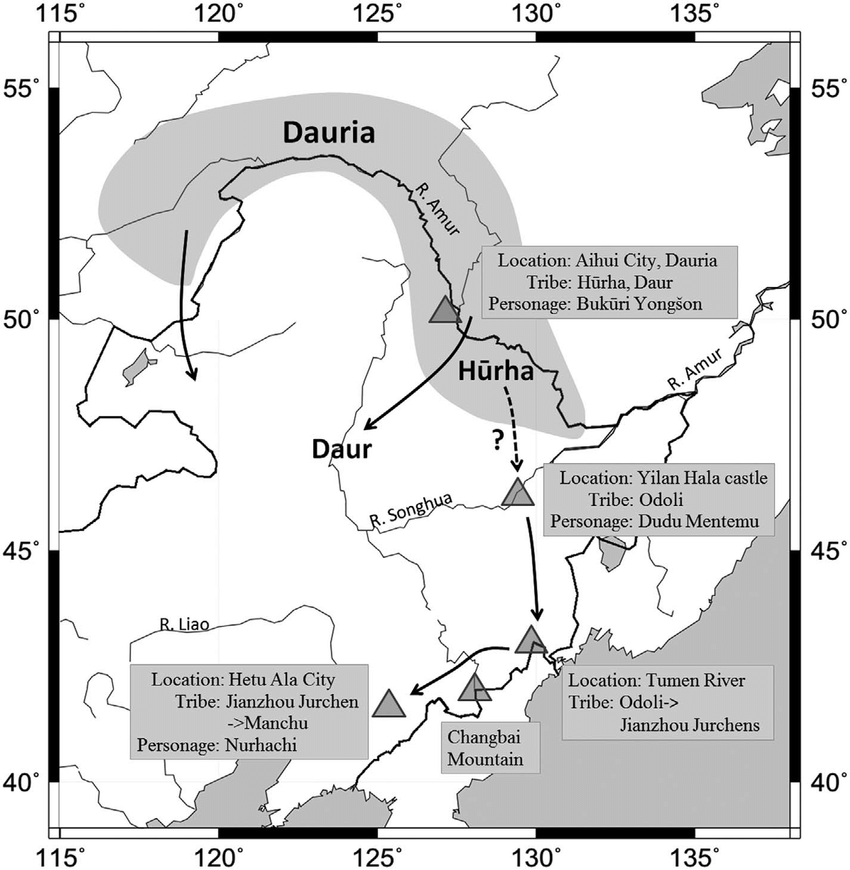
The Aisin Gioro family were unable to trace their paternal descent back to the original Jurchens of the Jin dynasty when it ordered other Jurchen clans to do it, and could only trace their male ancestry to an individual called Bukūri Yongšon who lived during the Yuan dynasty which was ruled by the Mongol Borjigin family. In the 17th century, the Qing fabricated a tale claiming Bukūri Yongšon was born with no father to a virgin heavenly fairy woman named Fekulen who ate a fruit picked by a magpie while bathing in a lake on Mount Changbai in southern Jilin, which is far way from northern Heilongjiang. Mount Changbai is sacred to the Jurchen but not to Mongols, and this fabricated tale can be seen as a naked attempted by the Qing to hide their paternal Mongolic ancestry from the Jurchen population.
The Y DNA also reveals that some Aisin Gioro princes were cuckolded by other men. One of the three Aisin Gioro was able to provide a genealogy (pedigree) showing his descent from the Qing royal family but the Y dna test revealed he did not share a Y chromosome with the other two Aisin Gioro who could provide pedigrees.
https://www.ncbi.nlm.nih.gov/pubmed/?term=25833470
The House of Aisin Gioro is the imperial family of the last dynasty in Chinese history-Qing dynasty (1644-1911). The Aisin Gioro family originated from Jurchen tribes and founded the Manchu people before they conquered China. By investigating the Y chromosomal short tandem repeats (STRs) of seven modern male individuals who claim to belong to the Aisin Gioro family (three of which have full records of pedigree), we found that three of them (two of which having full pedigree, whose most recent common ancestor is Nurgaci) showed very close relationship (1-2 steps of differences in 17 STRs) and possessed a rare haplotype. We therefore conclude that this haplotype is the Y chromosome of the House of Aisin Gioro. Further tests of single-nucleotide polymorphisms indicate that they belong to haplogroup C3b2b1*-M401(xF5483), although their Y-STR results indicate that they are not a part of the 'star cluster' (once linked to Genghis Khan), which belongs to the same haplogroup. This study forms the base for the pedigree research of the imperial family of Qing dynasty by means of genetics.
Either some Qing eunuchs were bribed or the eunuchs were not fully castrated and had undescended testicles.
Jianzhou Jurchens ruled by Aisin Gioro also partially originate from the Huligai (Hūrha or Hurka) people.
During the first Jurchen Jin dynasty, the Jin Jurchens in their historic records classified the Huligai as a separate peple from the Jurchens and said they were not Jurchens. These Huligai Hurka people later migrated south and joined other peoples to form the Jianzhou Jurchen. The Ming Emperors appointed the Aisin Gioro chief Mentemu as chief of the Jianzhou Jurchens.
https://web.archive.org/web/20180511150027/https://www.lszj.com/zhongguoshiji/jinwangchaolishi/33859.html
The Huligai Hurka were possibly a brother people to the Mongolic Daurs.
The Qing Emperor Hongtaiji referenced the fact that his Aisin Gioro family was unrelated to the original Jurchen Jin dynasty Wanyan family. in a letter to the Ming, saying that his dynasty was not the same as the first Jin dynasty which came before him.
The Qing Aisin Gioro family claimed their first ancestor Bukūri Yongšon was born from a virgin woman who ate a fruit she was fed by a magpie at a lake in the Changbai mountains.
The Jurchen had to totally change their attitude towards steppe nomads and Mongols between the Jin and Qing.
The original Jurchen ruled by Wanyan in the Jin disrespected, massacred, raped and tortured steppe nomads. The Jurchens sacked the Khitan capitals and imperial tombs, enslaved the Khitan imperial family and the Jurchen even allowed captured Song imperial family princes to have dibs on Khitan princesses which they shared with them. The Jurchens treated the Khitan imperial family even more harshly than the Song imperial family, executing the Khitan Emperor in a polo match, selling his sons as slaves, not allowing Khitan princes to marry Song princesses. Jurchen Princes took both Khitan Princesses and Song Princesses, the captured Song Princes took Khitan princesses given to hem by the Jurchen but Khitan princes were left with nothing. The Wanyan refused to marry off Wanyan princesses to either.
The Jin Jurchen were hostile to Genghis Khan's Borjigin clan which ruled Khamag Mongol. The Jurchen tried to kill Genghis Khan's great grandfather Khabul Khan and the Jurchen brutally tortured Genghis Khan's grand uncle Ambaghai to death with a women donkey. The Jurchens incited divisions and war between steppe nomad tribes, giving titles to the Tartars and helping them attack Genghis Khan's Borjigin family trying to exterminate the Borjigin.
Genghis Khan took revenge on the Tartars and the Jurchen Wanyan for all past events. Genghis forced the Jin to give him a Wanyan princess and then slaughtered Wanyan men and sacked the Jurchen capital.
The later Jurchens ruled by Aisin Gioro who became the Manchus and founded the Qing had to recognise the changed political reality left by the Mongol Empire. Aisin Gioro played service to the cult of Genghis Khan and sought to subsume all the branches of the Borjigin family as vassals. The Aisin Gioro family liberally married off Aisin Gioro princesses to Borjigin princes, Han officers and tribal chiefs who submitted.
One of the other Jurchen Gioro clanso f the Qing, the Irgen Gioro clan, like the Aisin Gioro, was unable to trace their paternal ancestry to a Jurchen clan of the Jin dynasty. Instead, the Irgen Gioro claimed to be descendants of the Han Chinese Song Emperor Huizong and Qinzong presumably through the Khitan princesses they were given. The Jurchen Tohoro clan of the Qing also claimed paternal descent from the Han Chinese Tao family.
The Aisin Gioro clan under Nurhaci only won control of the Jurchen tribes though conquest. He fought against the Jurchens under Nikan Wailan, the Yehenara led Jurchen tribes, the Hulun led Jurchen tribes, the Nanai, the Hurka, the Warka, the Evenki until all the rival Jurchen and Tungusic tribes were subdued through violence.
The Daurs are a people related to Mongols and their language is in the Mongol language family.
The Daur are in between Mongols and Tungusics and occupy and intermediate potion. They lived together with the Tungusic Evenkis.
The authors of this study apparently believe that the ancestor of the Qing Aisin Gioro family originated in a group of proto-Daur and Hurha and that their ancestor left their people to go south and lead the Jurchen Odoli tribe.
The Jianzhou Jurchens included a people called the Huligai who may have derived their name from the Hurha. The original Jurchens of the Jin dynasty before the Mongol empire, denied that they were the same people as the Huligai.
Hurka left behind in the Amur were related to the Nanai. Nanai were made out of Hurha, Hezhe and Ulchi. The Nanai spoke a Tungusic language related to Jurchen-Manchu and wore the pigtail queue but did not shave the front of their head, that was a Jurchen custom. The Later Jin/Qing fought against the Hurha (Hurka) and the Hezhen Nanai. The Later Jin/Qing defeated the Hurha leader Sosoku and forced them to submit in 1631 and the Hezhe followed suit. They were forced to shave the fronts of heads and were put into the Banners as "New Manchus".
The Ulchi Nanais who lived north of the Hezhe Nanais were left out of Qing control so while they wore the queue they did not shave the fronts of their heads.
The Qing later fought against a Daur-Evenki alliance led by Evenki chief Bombogor and beheaded Bombogor after capturing ihim in 1640, forcing the Daur and Evenkis to submit to Qing rule and incorporating them into the Eight banners.
The Manchu Aisin Gioro Khan initially spoke of his Jianzhou Jurchen Manchu people as separate from the Hurka and Warka. He made a speech saying
As regards the Mongols, the Chinese, the Warka, Hurha and Guwalca who have of late come to swear allegiance, they have even been given wives, houses, slaves, Servants, villages, fields, cattle and horses.
Search Results

Chinese Economic Journal and Bulletin - Volume 1, Issue 2 - Page 733

Manchu Aisin Gioro Khan Hongtaiji speculated that his Aisin Gioro family originated from other peoples like the Warka and Hurha.
Aisin Gioro practiced the same marriage alliances with the tribal chiefs of the other conquered Tungusic tribes, marring off Aisin Gioro women to their chiefs like they married off Aisin Gioro women to Han officers and Mongol princes who defected.
The Jurchen hated the Khitan because the Khitan used to regularly rape Jurchen. The Khitan frequently raped Jurchen girls and Khitan nobles practiced right of first night with Jurchen women when the Khitan ruled the Jurchen.
China Under Jurchen Rule: Essays on Chin Intellectual and Cultural History
Liao envoys, for example, had customarily demanded Jurchen girls for bed partners and sometimes took married Jurchen women forcibly to bed for the night (Franke 1990, 415).
Other Y DNA tests on imperial families.
https://www.didyouknowdna.com/famous-dna/aisin-gioro-dna/
https://www.nature.com/articles/jhg2016142
https://arxiv.org/ftp/arxiv/papers/1412/1412.6274.pdf
https://www.ncbi.nlm.nih.gov/pmc/articles/PMC1285168/
https://www.researchgate.net/publication/269947739_Peopling_of_Eurasia_viewed_from_Y_chromosomes
https://www.researchgate.net/publication/269876995_Y_Chromosome_of_Aisin_Gioro_the_Imperial_House_of_Qing_Dynasty
https://www.researchgate.net/publication/310477623_Genetic_trail_for_the_early_migrations_of_Aisin_Gioro_the_imperial_house_of_the_Qing_dynasty
https://www.researchgate.net/publication/7390318_Recent_Spread_of_a_Y-Chromosomal_Lineage_in_Northern_China_and_Mongolia
https://www.researchgate.net/publication/273421711_Y-chromosome_lineage_in_five_regional_Mongolian_populations
https://www.researchgate.net/publication/11236353_A_Genetic_Landscape_Reshaped_by_Recent_Events_Y-Chromosomal_Insights_into_Central_Asia
https://www.researchgate.net/profile/Chuan-Chao_Wang
https://synaptic.bio/publications/8629
https://arxiv.org/abs/1412.6274
Boys born with an undescended testicle were sometimes accidentally incompletely castrated. Once the error was discovered (because secondary sex characteristics emerged), they were released from service and sent back to their villages, yet kept the designation “eunuch.
You can still ejaculate and get semen into a vagina even with a 1 mm stump or even a flat surface with no penis. The semen will just come out of the urethra and get into the vagina.
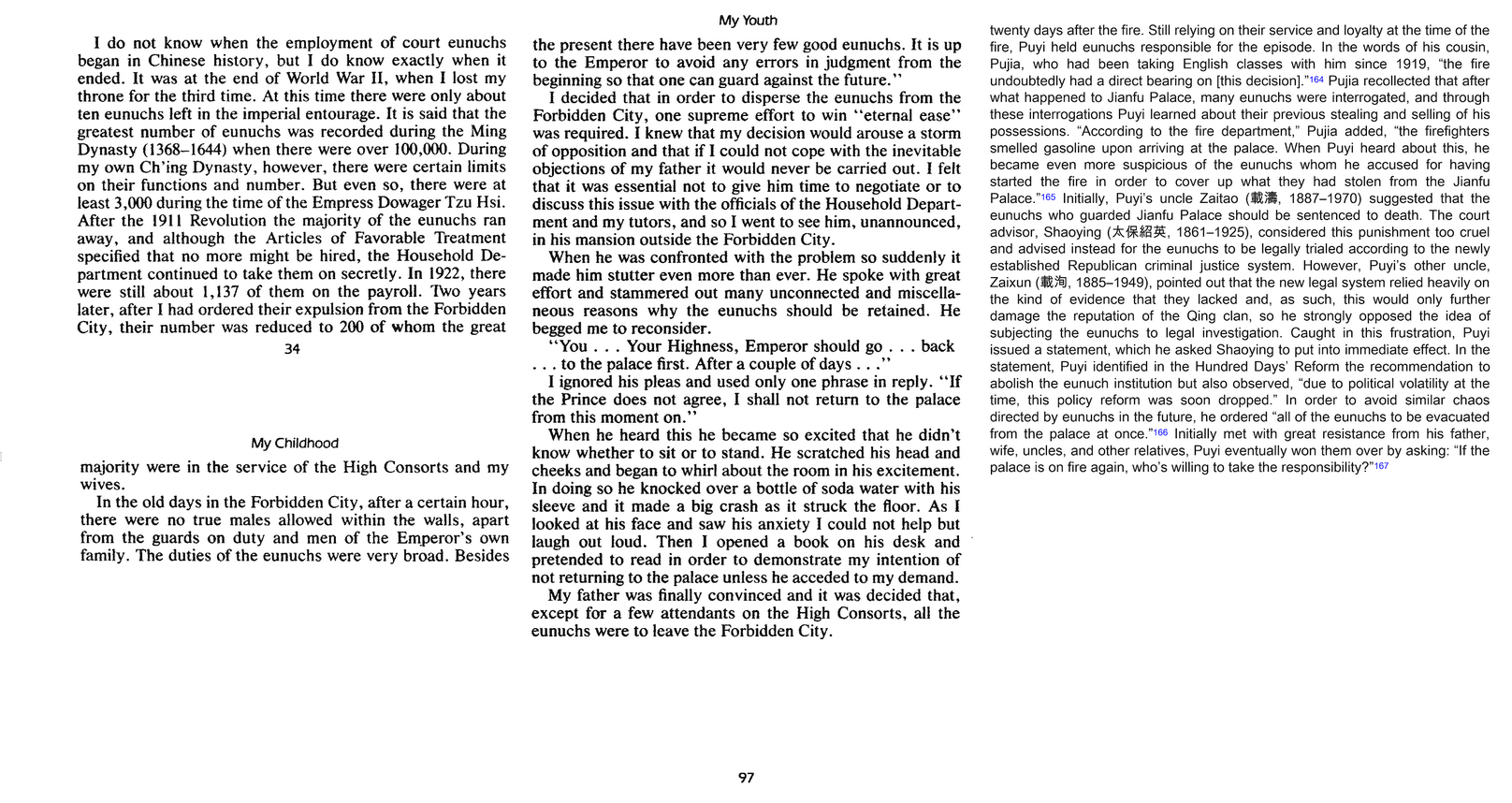
Thr Yuan dynasty lasted for less than 72 years in southern China and relied heavily on Han defectors by giving them Korean women. There wasn't even any Mongols at the last battle of Yamen. The Yuan side was led by Han General Zhang Hongfan.
The Mongol empire-Yuan dynastu ruled over the Jurchen for over 150 years and had Han generals line Shi Tianze defect to their side to kill and rape Jurchens.
There's no Mongol Y dna in Han but Manchu men test positive for Mongol Y chromosomes.
Hong Taiji/khong taishi is a Mongol title
It was a personal name in his case. Jurchens used Khitan titles and names in the Jin and after the Mongols conquered the Jin Jurchen, they used Mongol names.
The Aisin Gioro paternal ancestor Mentemu was named Mongge Temur which was a Mongol name, not a Jurchen one.
The Mongols ruled Iraq for over 100 years than the Yuan in China and Mobgols ruled the Uyghurs for over 500 years.
Mongol empire (including Yuan) in northern China
1234-1368
(134 years)
Yuan in southern China (all of China)
1279-1351 (72 years)
Mongols in Iraq (Ilkhanate and Jalayirids)
1256-1335–1432 (176 years)
Mongols in Ukraine
1237-1783 (Crimean Khanate)
546 years
Mongol rule over Uyghurs in Xinjiang (Chagatai)
1225-1680
455 years
And Dzungar Mongol rule over Uyghurs.
(1680-1758)
Another 78 years
Khitan prima nocte?
Mongols distributed captured Korean women from Koryo (Goryeo) to Han Chinese soldiers from the Southern Song in exchange for defecting to the Mongol side.
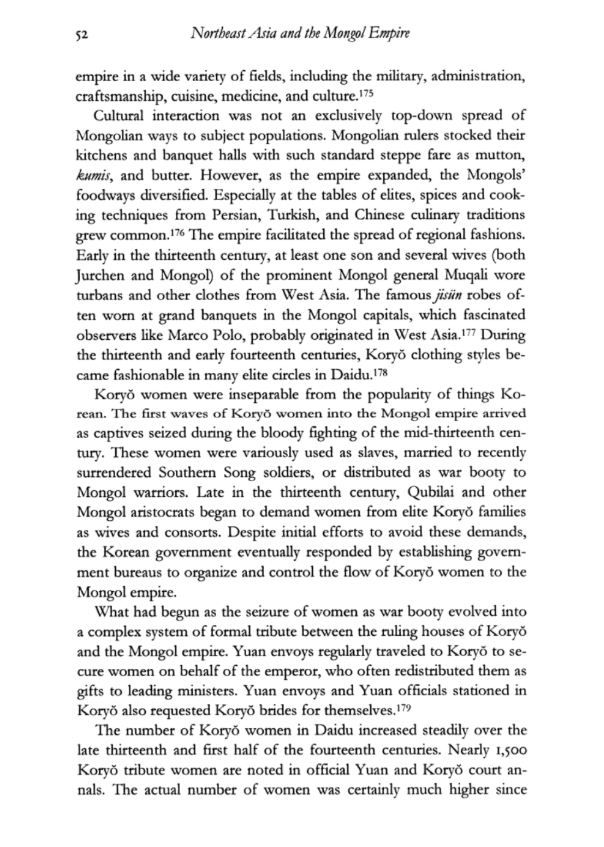
The khitan took married Jurchen women and girls to bed when the Khitan ruled the Jurchen in the Liao dynasty.
ITT : dumbasses who don't know the difference between Mongol and Mongolic.
Mongols did not identify Khitan as their people, Genghis and the Mongols viewed Khitan like Yelu Chucai as a separate ethnicity hence Khitan were placed in the same category as non-Mongol ethnicities in the Yuan. If you got triggered on behalf of Mongols because it was written Jurchens raped Khitan, you're not only a larper but a dumb larper with no IQ.
Khitan were Mongolic like Daur, but not Mongol.
The Jurchen Wanyan in the Jin gave Khitan women from the Liao palace to the captured Han Chinese Song Princes, sons of Huizong and his grandsons after taking their original wives away.
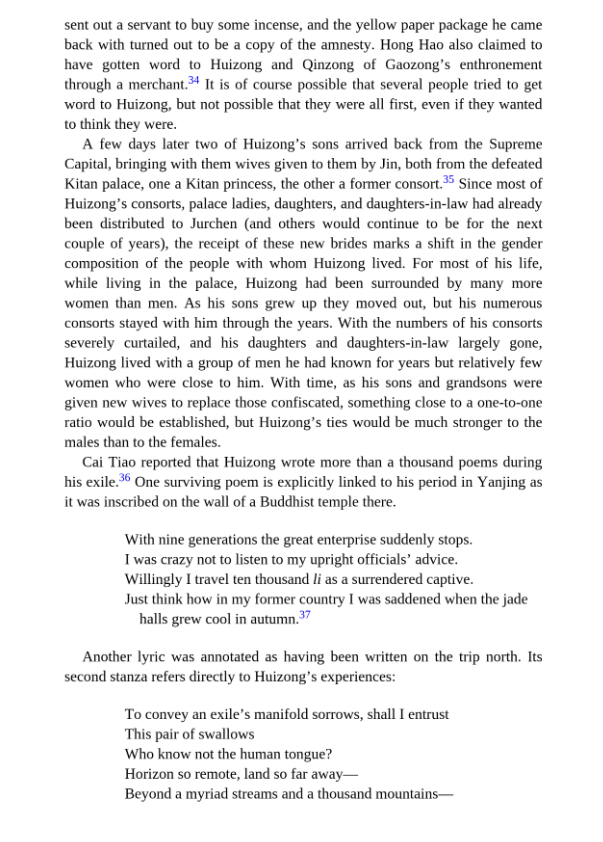 Kublai Khan also married off a Mongol Borjigin Princess to the third last Song dyansty Han Chinese child Emperor Gong, named Zhao Xian in exchange for him capitulating and surrendering Hangzhou without a fight. they had one son, Zhao Wanpu.

The Han Chinese Shi family defected to the Mongols and led a Han Chinese Tumen in the Mongol empire's army to destroy the Jurchen in the Jin dynasty.They intermarried with Mongols. The Han Chinese Tumen General Shi Tianze had Jurchen and Korean wives and his son Shi Gang was married to a Mongol-Turkic Kerait woman while Shi Gang's aunt was married to Muqali.
Han Chinese Tumen General Shi Tianze destroyed the 80,000 man Jurchen army led by Jin Jurchen Prince Wanyan Chengyi at Pucheng, opening the way to besiege the Jin Wanyan Jurchen princes in the capital Kaifeng.
Kaifeng was won when a Han Chinese officer named Cui Li defected and opened one of the gates for the Mongols.
The Khitan royal descendant of the Liao, Yelu Chucai, who had previously looked on and said nothing to defend the Tangut civilians while the Tangut capita Xingqingl in Western Xia was sacked by the Mongols, persuaded the Mongol commanders not to harm the Han civilian of Kaifeng. The Mongols then ordered the people of Kaifeng to turn over all Jin Jurchen Waynan princes so they could brutally execute them.
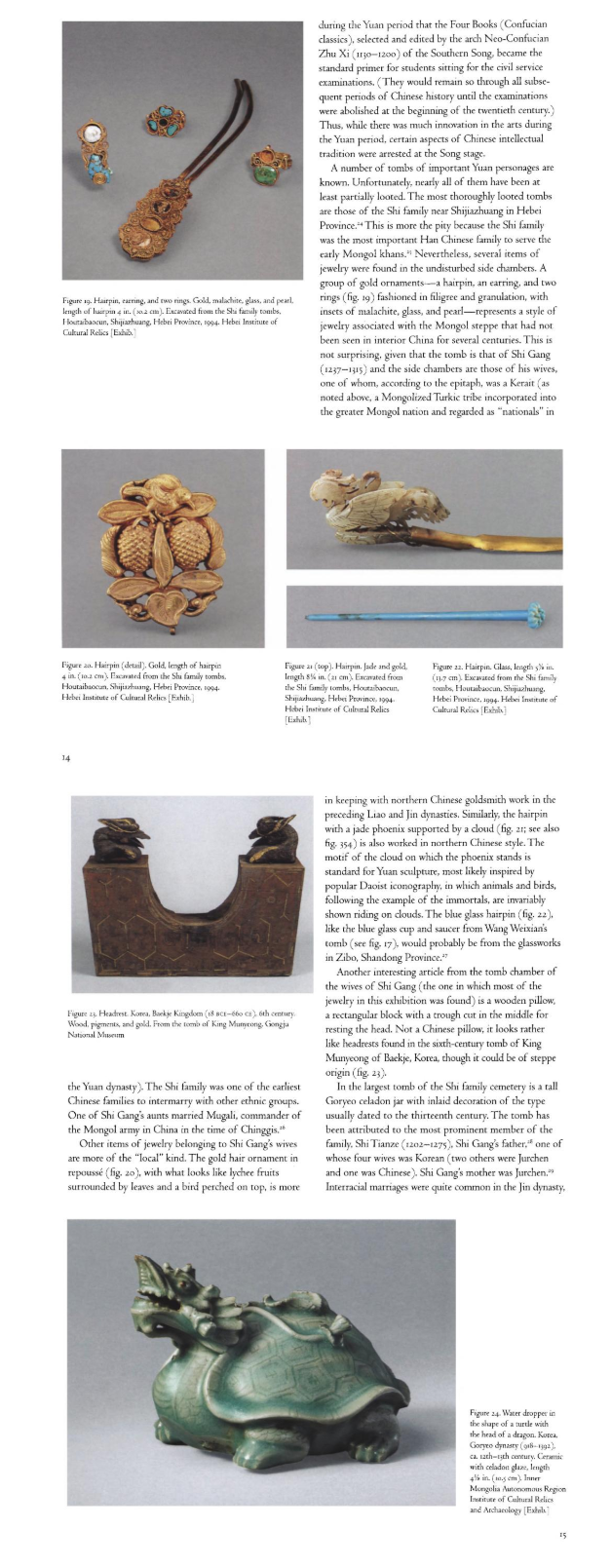 Genghis Khan took the Jurchen Wanyan Jin Princess of Qi (or Princess Qiguo) as his concubine. She was the daughter of Jurchen Jin emperor Wanyan Yongji also known as Prince Shao of Wei.
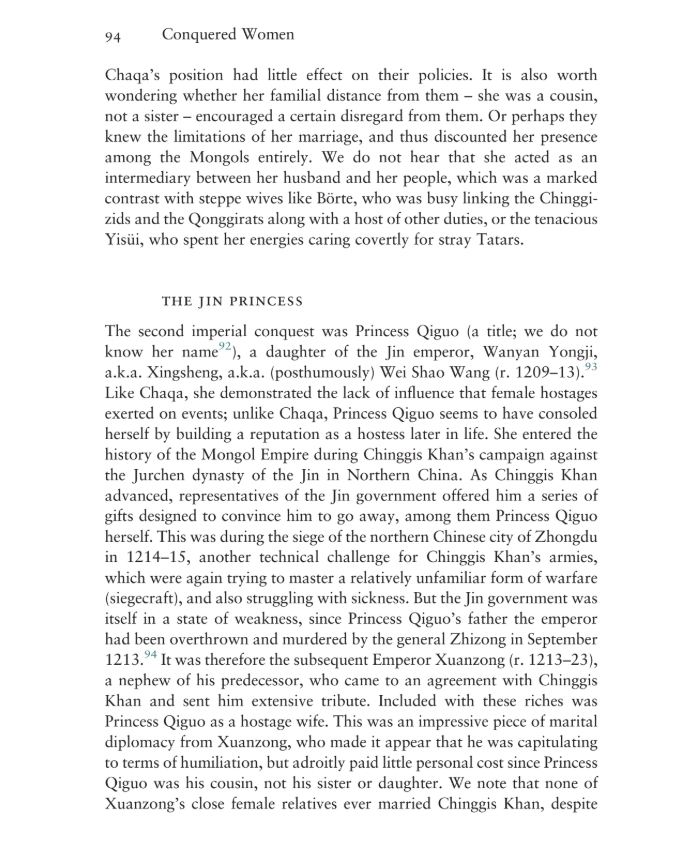 This is the same Rashid al-din's same book that neo Nazis and now a Pan Turkist loves citing.
The same guy who thinks different haplogroups among whites isn't a sign of massive rape also claimed Rashid is a chink source when he says something he doesn't like.
The Xiongnu Chedihou Chanyu gave his daughter to the Han Chinese General Li Ling to defect. Chedihou then appointed Li Ling as governor or ruler of Jiankun (Yenisei) were he built a Chinese Han dynasty style palace. Yenisei Kyrgyz (Kirghiz) Khagans (Khaghans) of the Are clan claimed descent from Li Ling.
A Mongol Borjigin princess was married to the Han Chinese Southern Song Emperor Gong (Zhao Xian). Their son was Zhao Wanpu.
Kublai Khan also married off a Mongol Borjigin Princess to the third last Song dyansty Han Chinese child Emperor Gong, named Zhao Xian in exchange for him capitulating and surrendering Hangzhou without a fight. they had one son, Zhao Wanpu.
https://yuki.la/his/7358719#p7359328
Genghis Khan took the Jurchen Wanyan Jin Princess of Qi (or Princess Qiguo) as his concubine. She was the daughter of Jurchen Jin emperor Wanyan Yongji also known as Prince Shao of Wei.
https://yuki.la/his/7358719#p7359375
Another Mongol Borjigin Princess A Gai (Agai or Agai Zhu) married King Duan Gong of Dali who was also of Han Chinese descent and they had two children. She was daughter of Basalawarmi, Mongol Yuan Prince of Liang in Yunnan. Dali was a vassal kingdom in Yunnan and the Duan family were paternally Han Chinese who originated from Wuwei in Gansu according to Yuan dynasty records but ruled over a Bai majority population in the kingdom of Dali and intermarried with Bai. After false rumours circulated that Duan Gong plotted to seize power from Basalawarmi as the Yuan dynasty was falling apart and Ming Yuzhen was planning to attack from Sichuan, Basalawarmi asked his daughter to poison him. His daughter refused and warned her husband but he did not believe it. One of Basalawarmi's officers later killed him and she was put on suicide watch by her father. Duan Gong's daughter Duan Sengnu or Qiangna or Qiangnu raised her younger brother Duan Bao to avenge his death. Basalawarmi committed suicide when the Ming dynasty invaded.

Genghis Khan took the Jurchen Wanyan Jin Princess of Qi (or Princess Qiguo) as his concubine. She was the daughter of Jurchen Jin emperor Wanyan Yongji also known as Prince Shao of Wei.
None of the Yuan Emperors had Han wives or concubines. They are unique in Chinese history for being the sole dynasty with no Han concubines or wives in the palace. Yuan emperors only married Mongol, Turkic and Korean women.
The Mongols and Han tumen generals like Shi Tianze's father Shi Bingzhi with Muqali sacked and raped Jurchen majority capital Jin Zhongdu and Genghis Khan personally raped a Jurchen Princess Qiguo while he called on Han and Ogedei explicitly ordered Han majority Kaifeng not to be sacked while he ordered for only the Jurchen royals there to be tortured killed and raped.
Genghis also personally raped a Tangut princess and ordered Tangut majority capital Xingqing raped. None of the Yuan emperos had Han wives or concubines.
Han Chinese tumen general Shi Tianze is the one who crushed the 80,000 strong Jurchen army of Jurchen prince Wanyan Chengyi at Pucheng paving the way to Kaifeng.
https://desuarchive.org/his/thread/7515576/#q7518011
The Yuan gave the Han Chinese southern Song Emperor Gong (Zhao Xin) a Borjigin Mongol princess in marriage and did not sack the Han majority Southern Song capital Lin'an (Hangzhou).
The Jurchen population was 8 million in 1211 before Genghis Khan according to the Jin census. In 1600 nearly four centuries later, it was only 100,000.
Genghis swore revenge on the Jurchen Wanyan family for murdering his great uncle Ambaghai and to kill and rape the Jurchen Wanyan family for their crimes against the Borjigin.
The Borjigins personally raped and tortured the Jurchen Wanyan family while they married off Borjigin princess to the Han Chinese child emperor Zhao Xin and Mongol women to Han officers sons like Shi Gang.
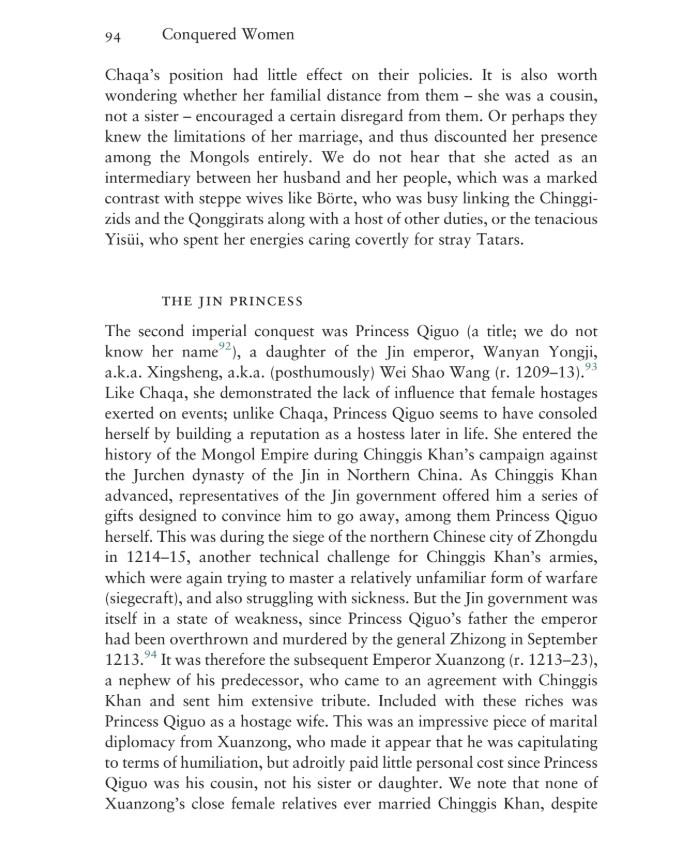
Jurchen who revolted against Khitan because Khitan raped Jurchen women for over 200 years.
The Manchus/Jurchens were also not steppe peoples and not nomads. They were farmers living in forested mountains who were ruled by the Ming for over 200 years before rebelling.
And the people who practiced prima noctae were Khitan on Jurchen.
The Jurchens also weren't nomads. They were farmers from the forests and they were ruled by Khitan nomads.
Han Chinese Tumen general Shi Tianze's son Shi Gang married a Mongol Kerait woman.
The Jurchen hated the Khitan because the Khitan used to regularly rape Jurchen. The Khitan frequently raped Jurchen girls and Khitan nobles practiced right of first night with Jurchen women when the Khitan ruled the Jurchen.
China Under Jurchen Rule: Essays on Chin Intellectual and Cultural History
Liao envoys, for example, had customarily demanded Jurchen girls for bed partners and sometimes took married Jurchen women forcibly to bed for the night (Franke 1990, 415).
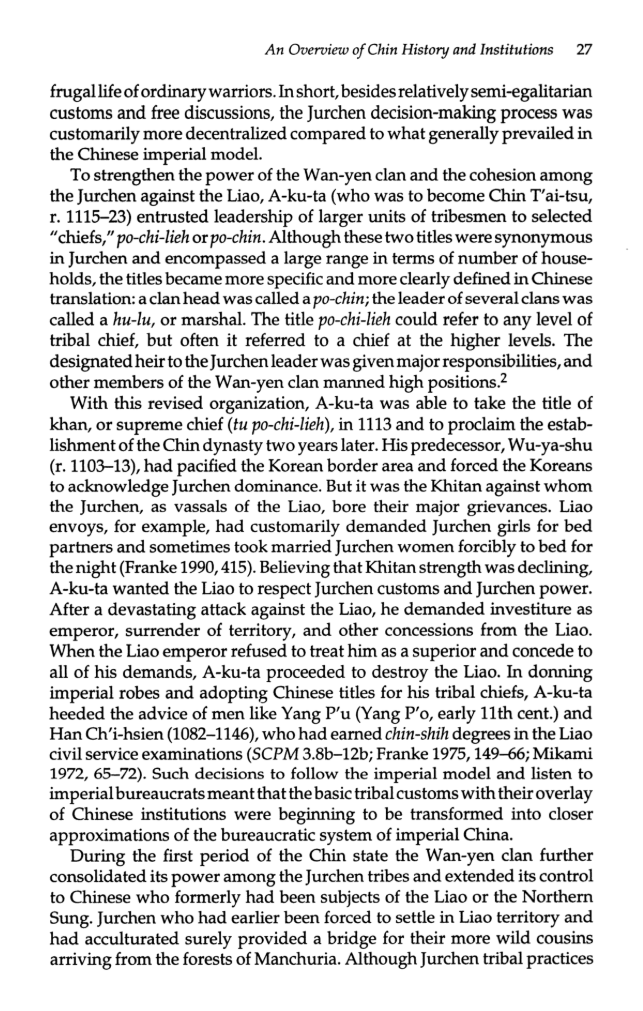
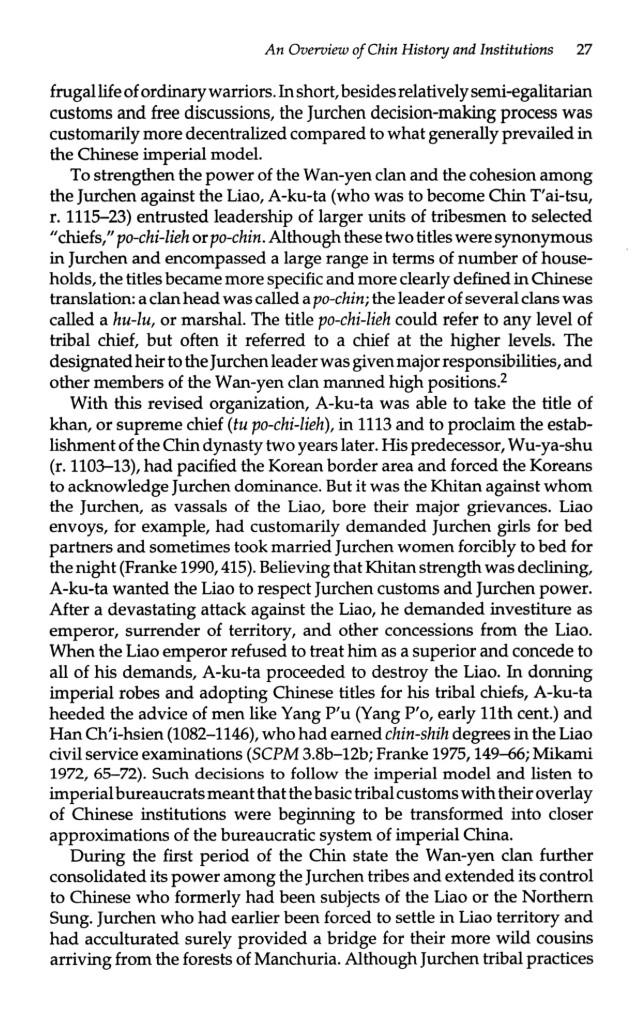
The Jurchen Wanyan also forced Han Chinese Southern Song princes to marry Khitan women.
The Jurchen Wanyan in the Jin gave Khitan women from the Liao palace to the captured Han Chinese Song Princes, sons of Huizong and his grandsons after taking their original wives away.
Jurchen Toi pirates once got on ships and raided Japan for girls to rape as sex slaves.
The Toi pirates sailed with about 50 ships from direction of Goryeo, then assaulted Tsushima and Iki, starting 27 March 1019. After the Iki Island garrison comprising 147 soldiers was wiped out, the pirates has proceed to Hakata Bay. For a week, using Noko Island [ja] in the Hakata Bay as a base, they sacked villages and kidnapped over 1,000 Japanese, mostly women and young girls, for use as slaves.
Jurchen Toi pirates once got on ships and raided Japan for girls to take and rape as concubines and sex slaves.
>The Toi pirates sailed with about 50 ships from direction of Goryeo, then assaulted Tsushima and Iki, starting 27 March 1019. After the Iki Island garrison comprising 147 soldiers was wiped out, the pirates has proceed to Hakata Bay. For a week, using Noko Island [ja] in the Hakata Bay as a base, they sacked villages and kidnapped over 1,000 Japanese, mostly women and young girls, for use as slaves.
>1019 Michinaga falls ill and takes holy orders, but continues to dominate the court.
>Toi (Jurchen)pirates in fifty or more ships ravage Tshushima, Iki, and the northern coast of Kyushu.

Wrong. Most Yuan soldiers in southern China were not even Mongol. The Yuan got southern Song soldiers to defect by giving them Korean wives and gave the Southern Song emperor a Mongol princess as a wife
Mongols gave women to Han Chinese defectors. Mongol women were married to Han officers and captured Korean women were distributed to Han footsoldiers who defected.
Over half the Mongol empire's army against the Jin Han Chinese from the Han Chinese tumen armies of Shi Tianze, Zhang Hongfan, Zhang Rou.
The Mongols only occupied Beijing and other points in the north and demanded Korea pay tribute in Korean women as states in the Korean history book Goryeosa which was never been written or edited in China. Direct quotes from Goryeosa and Robinson's book, neither of them Chinese.
The Persian Rashid Al-din also wrote the Song Emperor Gong was son in law to Kublai Khan after marrying the Mongol princes.
The Han tumen General Shi Tianze's son Shi Gang married a Mongol Kerait woman.
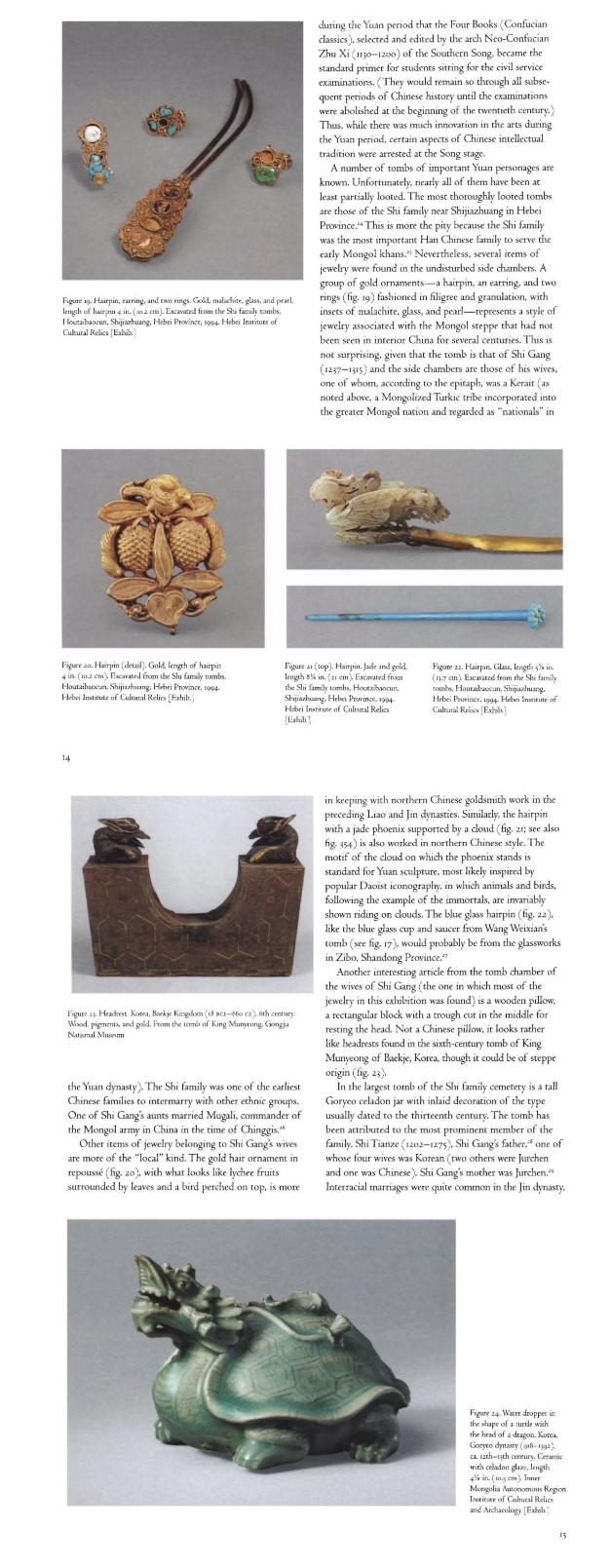
Looks like you can't even read lmao dumbass, the heqin article mentions nomad and Mongol women marrying Han Chinese men too.
756: Princess Pijia (毗伽公主), daughter of Bayanchur, Khagan of the Uyghur Khaganate, marries Li Chengcai (李承采), Prince of Dunhuang (敦煌王李承采), son of Li Shouli, Prince of Bin.
The Xiongnu practiced marriage alliances with Han dynasty officers and officials who defected to their side. The older sister of the Chanyu (the Xiongnu ruler) was married to the Xiongnu General Zhao Xin, the Marquis of Xi who was serving the Han dynasty. The daughter of the Chanyu was married to the Han Chinese General Li Ling after he surrendered and defected.[17][18][19][20] The Yenisei Kirghiz Khagans claimed descent from Li Ling.[21][22] Another Han Chinese General who defected to the Xiongnu was Li Guangli who also married a daughter of the Chanyu.[23]
From the same Heqin article.
The Southern Song Han Chinese Emperor Gong of Song (personal name Zhao Xian) surrendered to the Yuan dynasty Mongols in 1276 and was married off to a Mongol princess of the royal Borjigin family of the Yuan dynasty. Zhao Xian had one son with the Borjigin Mongol woman, Zhao Wanpu. Zhao Xian's son Zhao Wanpu was kept alive by the Mongols because of his mother's royal Mongolian Borjigin ancestry even after Zhao Xian was ordered killed by the Mongol Emperor Yingzong. Instead Zhao Wanpu was only moved and exiled. The outbreak of the Song loyalist Red Turban Rebellion in Henan led to a recommendation that Zhao Wanpu should be transferred somewhere else by an Imperial Censor in 1352. The Yuan did not want the Chinese rebels to get their hands on Zhao Wanpu so no one was permitted to see him and Zhao Wanpu's family and himself were exiled to Shazhou near the border by the Yuan Emperor. Paul Pelliot and John Andrew Boyle commented on Rashid-al-Din Hamadani's chapter The Successors of Genghis Khan in his work Jami' al-tawarikh, identified references by Rashid al-Din to Zhao Xian in his book where he mentions a Chinese ruler who was an "emir" and son-in-law to the Qan (Khan) after being removed from his throne by the Mongols and he is also called "Monarch of Song", or Suju (宋主 Songzhu) in the book.[9]
The Oirat leader Esen Taishi captured the Chinese Ming dynasty Zhengtong Emperor. Esen Taishi tried to force the Zhengtong Emperor to marry Esen's sister in a heqin marriage[10] and then placing him back in Beijing with his new wife.[11][12][13] The emperor rejected the marriage proposal.[14]
A Mongol account in the Altan Tobchi said that Zhengtong Emperor had a son with a Mongol woman he married while he was prisoner.[15]
A Mongol girl was given in marriage by the Gün-bilig-mergen Mongol Ordos leader Rinong (Jinong) to a Han Chinese, Datong Army officer Wang Duo's (Wang To) 王鐸 son Wang San 王三 because Rinong wanted to hold on to Wang San and make him stay with the Mongols. The Ming arrested and executed Wang San in 1544 because Mongol soldiers were being guided by Wang San. Builders, carpenters, officers, and important prisoners such as the Ming Zhengtong Emperor often received Mongol wives.[16]
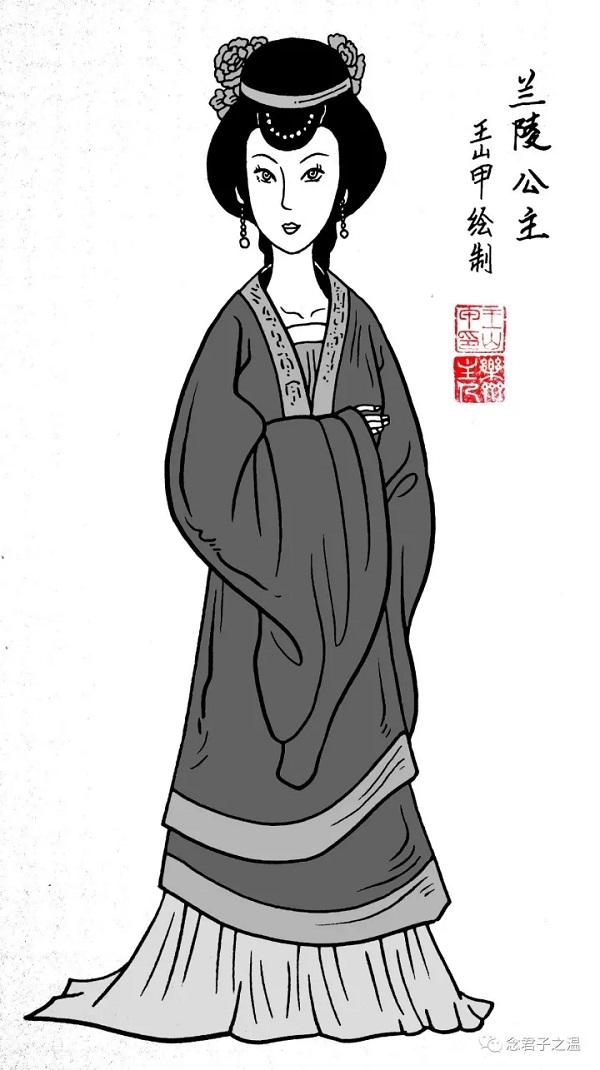
The Xianbei Tuoba royal family of Northern Wei started to arrange for Han Chinese elites to marry daughters of the royal family in the 480s.[24] More than fifty percent of Tuoba Xianbei princesses of the Northern Wei were married to southern Han Chinese men from the imperial families and aristocrats from southern China of the Southern dynasties who defected and moved north to join the Northern Wei.[25] Some Han Chinese exiled royalty fled from southern China and defected to the Xianbei. Several daughters of the Xianbei Emperor Xiaowen of Northern Wei were married to Han Chinese elites, the Han Chinese Liu Song royal Liu Hui 刘辉, married Princess Lanling 蘭陵公主 of the Northern Wei,[26][27][28][29][30][31] Princess Huayang 華陽公主 to Sima Fei 司馬朏, a descendant of Jin dynasty (265–420) royalty, Princess Jinan 濟南公主 to Lu Daoqian 盧道虔, Princess Nanyang 南阳长公主 to Xiao Baoyin 萧宝夤, a member of Southern Qi royalty.[32] Emperor Xiaozhuang of Northern Wei's sister the Shouyang Princess was wedded to The Liang dynasty ruler Emperor Wu of Liang's son Xiao Zong 蕭綜.[33]
When the Eastern Jin dynasty ended Northern Wei received the Jin prince Sima Chuzhi 司馬楚之 as a refugee. A Northern Wei Princess married Sima Chuzhi, giving birth to Sima Jinlong 司馬金龍. Northern Liang Xiongnu King Juqu Mujian's daughter married Sima Jinlong.[34]
The Rouran Khaganate arranged for one of their princesses, Khagan Yujiulü Anagui's daughter Princess Ruru 蠕蠕公主 to be married to the Han Chinese ruler Gao Huan of the Eastern Wei.[35][36]
Muslim girls were raped by Mongols all over Baghdad.
Mongols and Manchus also brutally raped Uyghur Muslims.
Mongols mixed into Uyghur Muslims.
https://en.wikipedia.org/wiki/Sultan_Said_Khan
The capital of this state was Yarkand, and it was known by the names mamlakati Saidiya, mamlakati Yarkand, and mamlakati Moghuliya in Iranian sources. The last name however was not accurate, because by this time the nomad state of Moghulistan had collapsed. It was eliminated during the fifteenth and sixteenth centuries by nomadic tribes of Kyrgyz, Kazakhs and Jungars, that captured all the moghul lands north of Tangri Tagh. The remnants of the moghuls ( about 5,000 families mostly from Barlas, Churas and Arlat tribes) moved to Kashgaria and mixed with the local 1,000 000 uyghur population, although a group of the moghuls, in the amount of 30,000 men, joined Babur, a descendant of Timur the Great through his father Omar Sheikh, and a descendant of Chagatai Khan through his mother Kutluk Nighar Hanim, a daughter of the Moghul Yunus Khan, in Kunduz, in 1512, and helped him in his invasion of India. The Babur state in India was known as the Moghul Empire, and this state recognized Yarkand, as it did the Shaybanid state in Maverannahr, in 1538.
Muslim Uyghurs got Mongol blood from being raped by Mongols during centuries of Chagatai Khanate rule.
https://en.wikipedia.org/wiki/Yarkent_Khanate
https://en.wikipedia.org/wiki/Chagatai_Khanate
Manchu men gang raped Uyghur Muslim women and girls for virtually every single day of Qing rule in Xinjiang.
Uyghur Muslim rebellions against Manchu Qing rule
What were the causes of the dozens of Uyghur Muslim rebellions against Manchu Qing rule in the 18th and 19th centuries from Uch Turpan rebellion to the Jahangir Khoja rebellion, to the Taranchi rebellion, to the Wali Khan rebellion to the Yakub Beg rebellion?
The painting is of Qing Manchu general Macang killing a Uyghur Muslim (Turkestani) when fighting the Afaqi Khoja brothers in the Tarim Basin, Xinjiang.
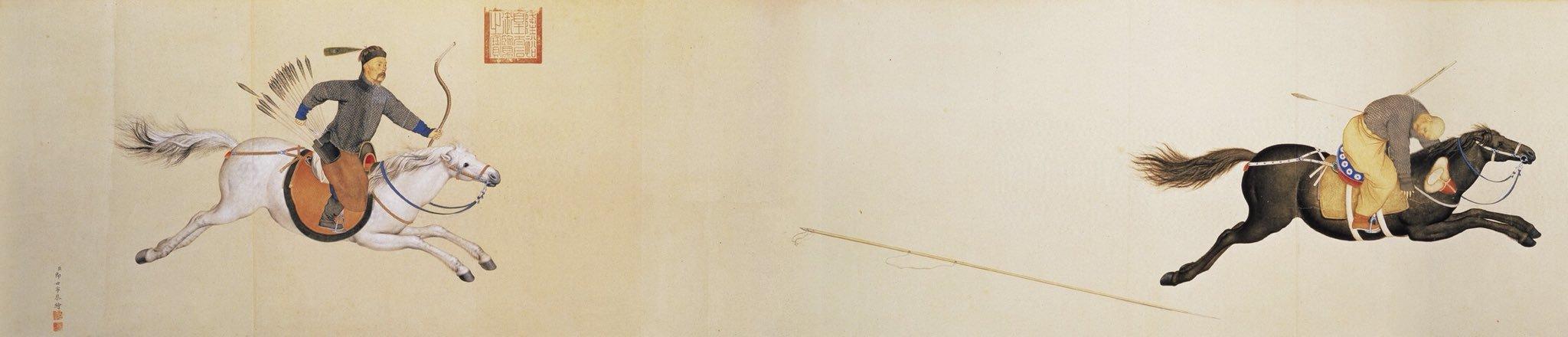 Manchu rape of Uyghur Muslim women caused the rebellions.
 Manchus rape against Muslim Uyghurs.
Han Chinese marriages to Uighur Muslim women caused hatred and resentment to Uyghur Islamist incels.
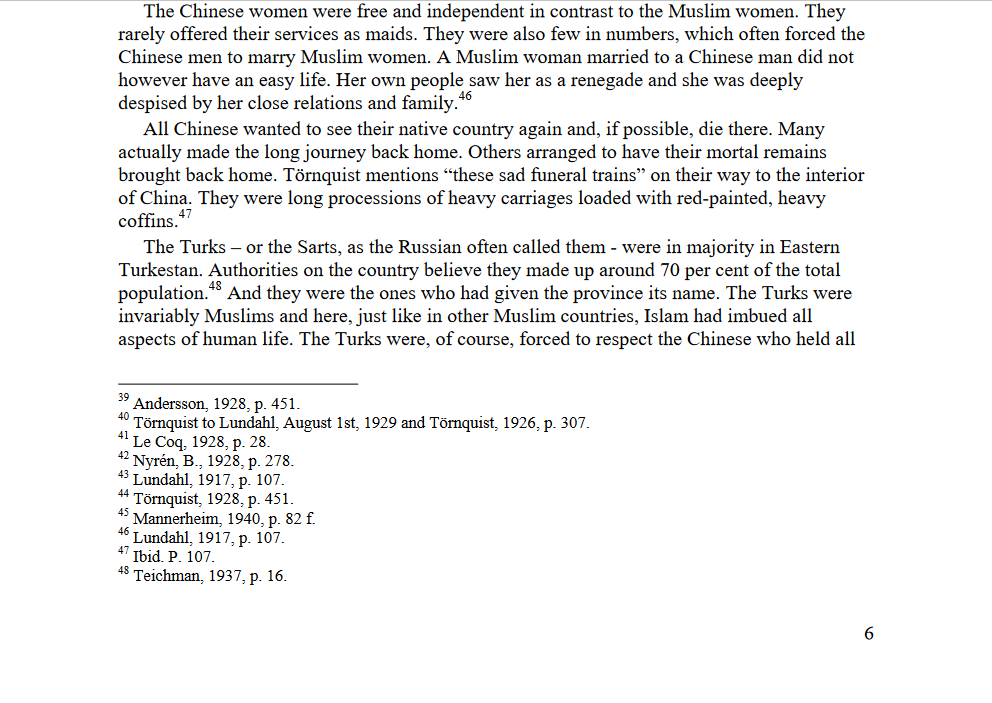 Manchus raping Uyghur Muslimas.
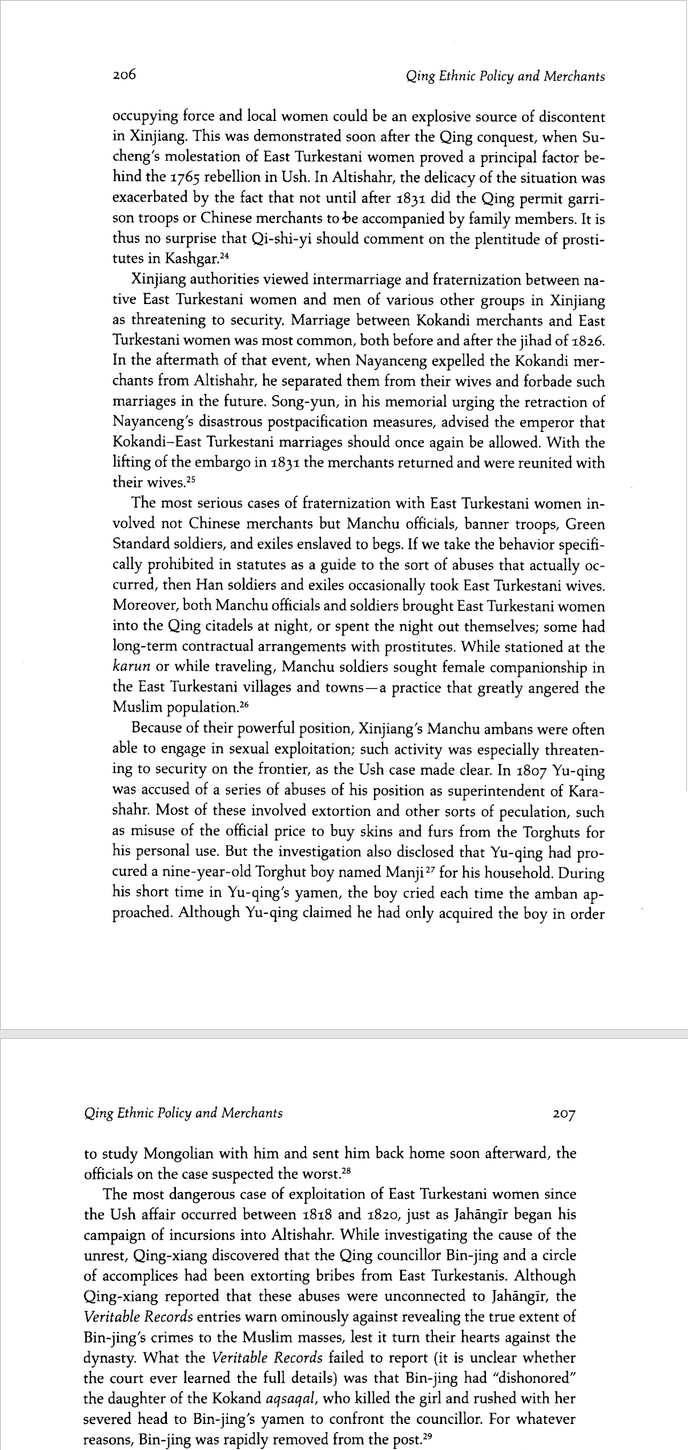 Manchu men and Uyghur Muslim women.
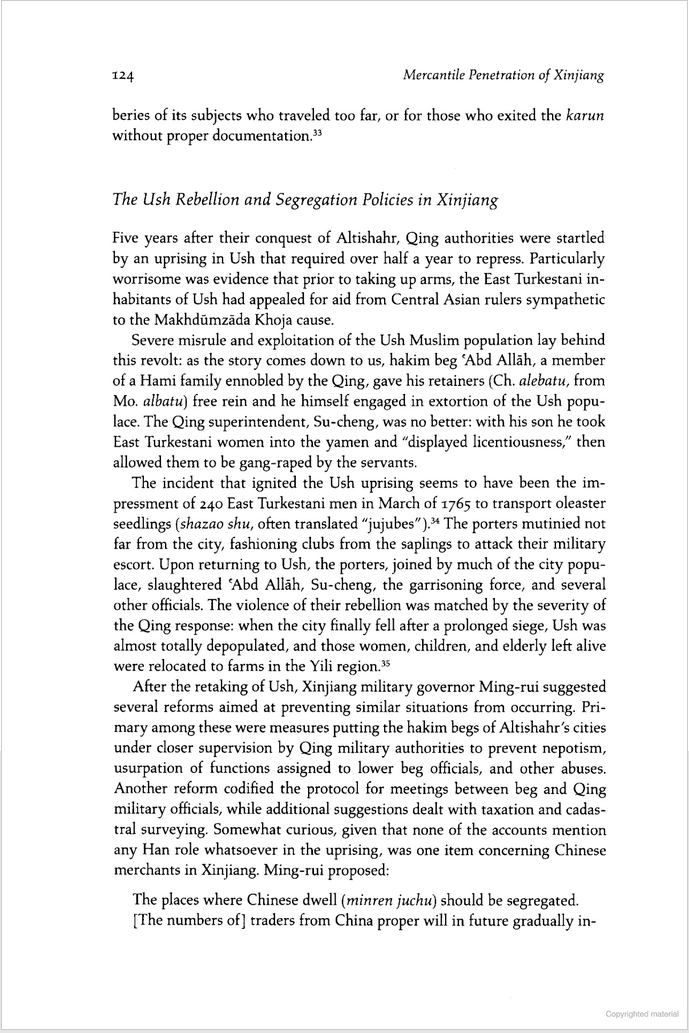 Manchu men raping Uighur Muslim women.
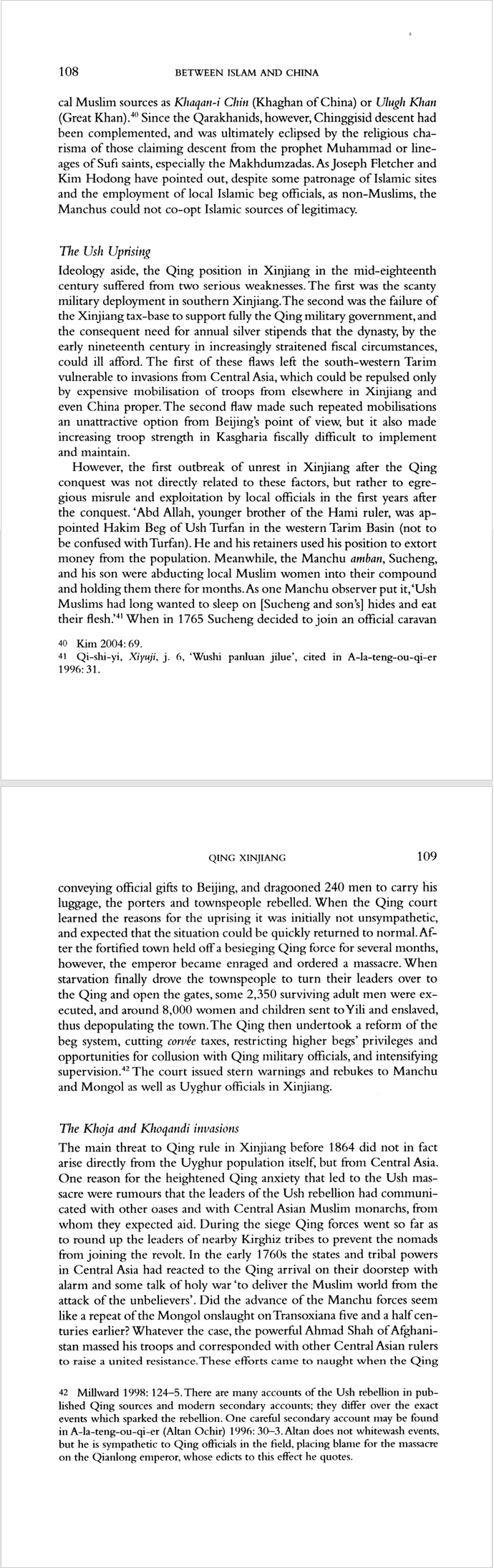
https://uyghuramerican.org/about-uyghurs
East Turkistan was invaded by the Manchu Empire of China
The Islamic Uyghur Kingdom of East Turkestan maintained its independence and prosperity until the Manchu Empire invaded the nation in 1876. After eight years of bloody war, the Manchu Empire formally annexed East Turkistan into its territories and renamed it "Xinjiang" (meaning "New Territory" or "New Frontier") on November 18, 1884. Uyghur power, stature and culture went into a steep decline after the Manchu invasion.
http://www.uyghurcongress.org/en/?page_id=29681
The Manchu Invasion
The independent Uyghur Kingdom in East Turkistan—the Seyyid Kingdom, also known as Yarkent kingdom, was invaded by Manchu rulers of China in 1759 and the East Turkistan was annexed to the Manchu Empire. The Manchus ruled East Turkistan as a military colony from 1759 to 1862. During this period, the Uyghurs and other people in East Turkistan valiantly opposed the foreign rule in their land. They revolted 42 times against Manchu rule with the purpose of regaining their independence. The Manchu were finally expelled in 1864 and Uyghurs established Yetteshahar State. However, the independence was short lived, Manchus invaded the East Turkistan again in 1876. After eight years of bloody war, the Manchu empire formally annexed East Turkistan into its territories and renamed it “Xinjiang” (meaning “New Territory”) on November 18, 1884.
Dragon Fighter: One Woman's Epic Struggle for Peace with China
By Rebiya Kadeer
But my favorite story was the one about Iparhan. For Uyghurs, she symbolizes our fight against occupying powers.
She was widely known in 1760, legend has it, because her body was naturally perfurmed with a God-given captivating fragrance. She had also proven herself to be as brave as any man in the fight against the Manchus. Later, she was captured and taken as a trophy for the imperial harem in Beijing.
p. 26
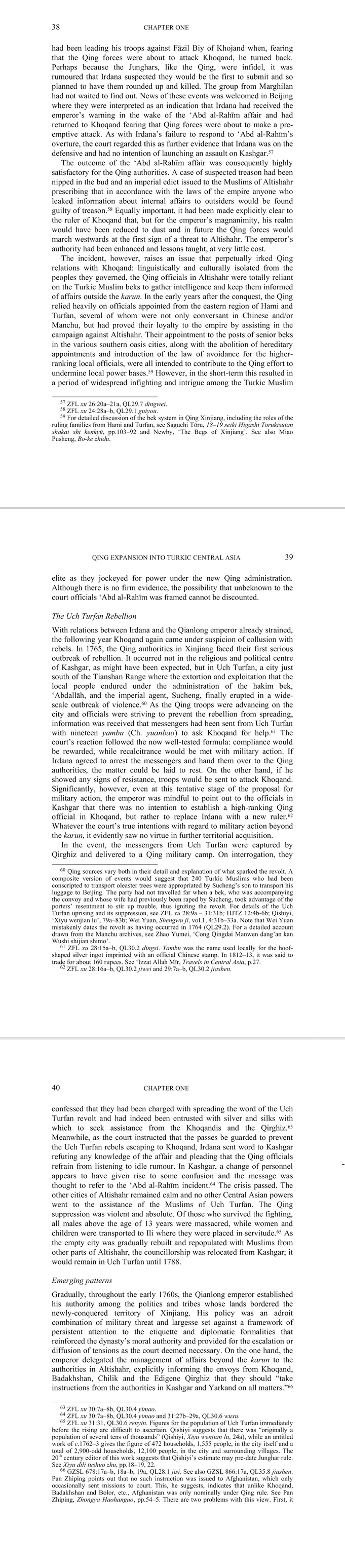
The Uch Turpan rebellion was started after Manchu officials headed by Sucheng gang raped Uyghur girls for months in their Yamen leading to outraged Uyghur men revolting.
The Empire And the Khanate: A Political History of Qing Relations With Khoqand c1760-1860, Page 39
Abdallāh, and the imperial agent, Sucheng, finally erupted in a widescale outbreak of violence.60 As the Qing troops ... Turkic Muslims who had been conscripted to transport oleaster trees were appropriated by Sucheng's son to transport his ... The party had not travelled far when a bek, who was accompanying the convoy and whose wife had previously been raped by Sucheng, took advantage of the ...
Beyond the Pass: Economy, Ethnicity, and Empire in Qing Central Asia, 1759-1864, Page 124
Severe misrule and exploitation of the Ush Muslim population lay behind this revolt; as the story comes down to us, hakim beg 'Abd Allâh, a member of a Hami family ennobled by the Qing, gave his retainers ... The Qing superintendent, Su-cheng, was no better: with his son he took East Turkestani women into the yamen and "displayed licentiousness," then allowed them to be gang-raped by the servants.
Eurasian Crossroads: A History of Xinjiang, Page 108
Meanwhile, the Manchu amban, Sucheng, and his son were abducting local Muslim women into their compound and holding them there for months. As one Manchu observer put it,'Ush Muslims had long wanted to sleep on [Sucheng and son's] hides and eat their flesh.
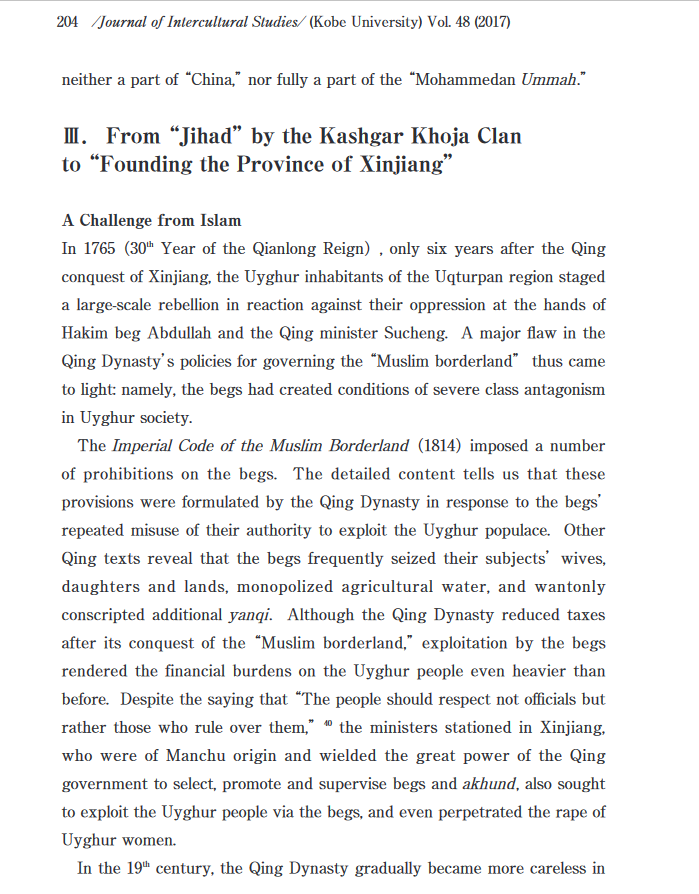
http://www.lib.kobe-u.ac.jp/repository/81009892.pdf
to exploit the Uyghur people via the begs, and even perpetrated the rape..
Beyond the Pass: Economy, Ethnicity, and Empire in Qing Central Asia, 1759-1864, Page 206
occupying force and local women could be an explosive source of discontent in Xinjiang. This was demonstrated soon after the Qing conquest, when Sucheng's molestation of East Turkestani women proved a principal factor behind the 1765 rebellion in Ush.
The most serious cases of fraternization with East Turkestani women involved not Chinese merchants but Manchu officials, banner troops, Green Standard soldiers, and exiles enslaved to begs. If we take the behavior specifically prohibited in statutes as a guide to the sort of abuses that actually occurred, then Han soldiers and exiles occasionally took East Turkestani wives. While stationed at the karun or while traveling, Manchu soldiers sought female companionship in the East Turkestani villages and towns—a practice that greatly angered the Muslim population.”
Because of their powerful position, Xinjiang's Manchu ambans were often able to engage in sexual exploitation; such activity was especially threatening to security on the frontier, as the Ush case made clear.
Beyond the Pass: Economy, Ethnicity, and Empire in Qing Central Asia, 1759-1864, Page 207
The most dangerous case of exploitation of East Turkestani women since the Ush affair occurred between 1818 and 1820, just as Jahāngir began his campaign of incursions into Altishahr. While investigating the cause of the unrest, Qing-xiang discovered that the Qing councillor Bin-jing and a circle of accomplices had been extorting bribes from East Turkestanis. Although Qing-xiang reported that these abuses were unconnected to Jahāngir, the Veritable Records entries warn ominously against revealing the true extent of Bin-jing's crimes to the Muslim masses, lest it turn their hearts against the dynasty. What the Veritable Records failed to report (it is unclear whether the court ever learned the full details) was that Bin-jing had "dishonored" the daughter of the Kokand aqsaqal, who killed the girl and rushed with her severed head to Bin-jing's yamen to confront the councillor. For whatever reasons, Bin-jing was rapidly removed from the post.29
Manchus executed Uyghur rebel Jahangir Khoja with death by a thousand cuts (slow slicing) after torturing him so badly he could not speak.
https://en.wikipedia.org/wiki/Jahangir_Khoja
Qing troops rushed to Kashgar and, upon entering the city, embarked on the wholesale massacre of the local population of about 20,000 civilians. On January 29, 1828, Jahangir managed to escape and hide in the mountainous Alai valley among the Kyrgyzs. Daoguang was dissatisfied with this turn of events and wrote to Chang Ling, "I sent an army to eliminate the evil, you were at the lair of the beast, but let him to escape, now all previous victories have no value, because he is still alive, the germ of future rebellions". Jahangir's capture resulted from the treachery of the former Kyrgyz[14] Hakim of Kashgar, Ishak Khoja, who sent a misleading letter to Jahangir telling him that the main body of Qing troops had departed and inviting him to Kashgar to regain power. When Jahangir heard the news he hurried back to Kashgar but was ambushed by Qing troops under the General of Ili,[15] captured and delivered to Beijing. There he was exposed to the attention of China's capital's population, being carried for several weeks in a mobile iron cage through the main streets of Beijing. Finally he was brought to the Daoguang Emperor for interrogation but, having gone mad due to bad treatment, he was unable to answer any questions. Immediately after the interrogation was completed he was executed. Jahangir Khoja's body was cut into numerous pieces and his bones thrown to the local dogs. His portrait was buried in the hill near Beijing. He was 40 years old at the time of his death.
Manchus set off the 1765 Ush rebellion when Manchu officials led by Sucheng were fucking Uighur Muslim women they held in their offices. Manchu officials and soldiers continued to do this to Uighur women multiple times in the early 19th century causing even more violence.
These were the incidents where Manchu officials and soldiers raping Uighur women set off rebellions.
The Manchus massacred almost all the Uighur men in Uch Turpan after the rebellion and deported the Uighur women and children as slaves to other regions.
Manchus also massacred nearly the entire Uighur population of Kashgar during the Jahangir Khoja rebellion in 1827, and sentenced the Uighur Islamist leader Jahangir Khoja to die by death by a thousand cuts aka slow slicing, an extremely painful death. The Uighur Jahangir Khoja was tortured so badly by the Manchus that he was blabbering incoherently while in a cage in Beijing and unable to answer questions. After he was slowly sliced to death Jahangir Khoja's bones were thrown to the dogs by the Manchus.
Rebiya Kadeer and all other Uighur separatists call Manchu rule over Uighurs as "oppression" and "dark days".
Manchus literally turned Xinjiang into a gigantic brothel. The Qing legalized mass temporary marriage prostitution of Uighur women to non-Muslims. All of Keriya, Khotan and Kashgar supplied Uighur women. Uighur women were married off to Armenians, Han Chinese, Indians and all other foreigners under the Qing.
That's the reason for the rebellions.
A book written by a Hungarian historian on Uyghur temporary marriage to non-Muslims in Qing Xinjiang. Han Chinese, Armenians, Hindu Indians all participated.
Community Matters in Xinjiang, 1880-1949: Towards a Historical Anthropology of the Uyghur
http://web.archive.org/web/20100901124909/http://missionskyrkan.se/upload/6510/Book202c_rat_tablfofcont.pdf
Like how shariah intends to humiliate Christians by allowing Muslim men to marry Christian women but forbids Christian and non-Muslim men from marrying non-Muslim women, the Qing Manchus used the same method on Uyghur Muslims.
Manchu men gang raped Uyghur women for months at a time.
The Manchu Qianlong emperor's policy.
https://twitter.com/Salih_Hudayar/status/997960582555947009
"Kill the Uyghur men and marry their women" - Qianglong Emperor ~CE 1760 #Genocide
Manchus and Muslims.
http://insamer.com/en/chinese-muslims_1038.html
As the Ming Dynasty reached its end in 1644, there was a serious increase in the number of Chinese Muslims. However, Islam which had been present in China for 1000 years as a religion was treated very unpleasantly by the Manchu administration, who established the Qing Dynasty (1644-1911), to the extent that it would raise concerns among the Hui minority. In this period many religious practices, such as the pilgrimage to Mecca, sacrifice of animals, and establishment of houses of worship were all prohibited. As the violence and the conflicts among cultures and religions accelerated under the control of the Manchu administration in the 19th century, the Muslim minority was forced to rebel. This insurrection, named as the Dungan Rebellion in the historical records, began as a reaction to the religious and racial discrimination against the Muslim population. As a result of this act of rebellion that started in and spread from the northwest part of the country, a significant part of the Muslims was executed by the Manchu administration. It is said that 10 million Muslims were executed in the process.
Salar Muslims were given refuge in China from Central Asia by the Ming. The Salar Muslims under the Jahriyya Sufi order revolted against the Manchus. After the Manchus defeated the rebels, Manchu officers took the women of the executed Sufi Muslim leaders to rape.
The Manchu Qianlong Emperor himself raped the Uyghur Muslim girl Iparhan.
In 1646 over 100,000 Muslim Ming dynasty loyalists rallied under Muslim leaders Mi Layin and Ding Guoding in Gansu against the Qing Manchus. The Muslims proclaimed the Ming Prince Zhu Shichuan as their official leader and were going to restore him to the throne as Emperor. Salar Muslims may have aided the Ming loyalists. The Chagatai Khanate's Uyghur Muslims in Turfan sent troops and aid to the Ming loyalists with Chagatai Prince Turumtay leading Uyghur Muslim soldiers. Muslims were the majority of this Ming loyalist army.
The Qing sent a strike force of Bannermen to crush the Muslim Ming loyalists.
The Qing Manchu banner soldiers slaughtered and raped hundreds of thousands of Muslims in the supression campaign, killing Mi Layin, Ding Guodong, Zhu Shichuan and the Chagatai Prince Turumtay and all his Uyghur Muslim soldiers.
Swedish missionary observations on 19th and early 20th century Uyghur Muslim society including rampant pedophilia, sexually transmitted diseases, religious intolerance of non-Muslims, and child abuse.
http://web.archive.org/web/20100901124909/http://missionskyrkan.se/upload/6510/Book202c_rat_tablfofcont.pdf
The Chinese women were free and independent in contrast to the Muslim women. They rarely offered their services as maids. They were also few in numbers, which often forced the Chinese men to marry Muslim women. A Muslim woman married to a Chinese man did not however have an easy life. Her own people saw her as a renegade and she was deeply despised by her close relations and family. 46
Many people saw girls as simple merchandise. They were very often despised because of the very widespread practice of child marriages. The men defended their very young wives by referring to the Prophet himself, who married Aischa when she was only nine years old. 126 When the Mission managed to keep the girls at the Children’s Home some time into their teens, they often saved them from life-long misery. On several occasions the Mission arranged weddings when young people from the Children’s Home had found each other. 127 This was for example the case of Bachta Chan, already mentioned above. Towards the end of her teens she was married, together with some older sisters. And they were all three married to Christian men. Ahlbert says about these girls, “These girls were surely the first girls in Eastern Turkestan who had had a real youth be fore getting married. The Muslim woman has no youth. Directly from childhood’s carefree playing of games she enters life’s bitter everyday toil... She is but a child and a wife.” 128
The Manchu non-Muslims of the Qing dynasty dealt harshly with Uyghur Sufi jihadists. Jahangir Khoja tried to wage jihad against the Qing dynasty to establish a Sufi jihadist state in Xinjiang. The Manchus captured the Uyghur Sufi jihadist Afaqi Sufi Aq Taghliq Naqshbandi leader Jahangir Khoja, a relative of Wali Khan Khoja in 1828. The Manchus tortured him for days until he went crazy and displayed him in an iron cage in Beijing. Jahangir Khoja went so mad from the torture inflicted by the Manchus he was unable to speak coherently or answer a single question. The Manchus then sentenced Jahangir Khoja to die by death by a thousand cuts so he would be sliced to pieces alive over weeks while still alive. The Uyghur jihadist Jahangir Khoja screamed for days in horrific pain as he was sliced to death in public by Manchu executioners.
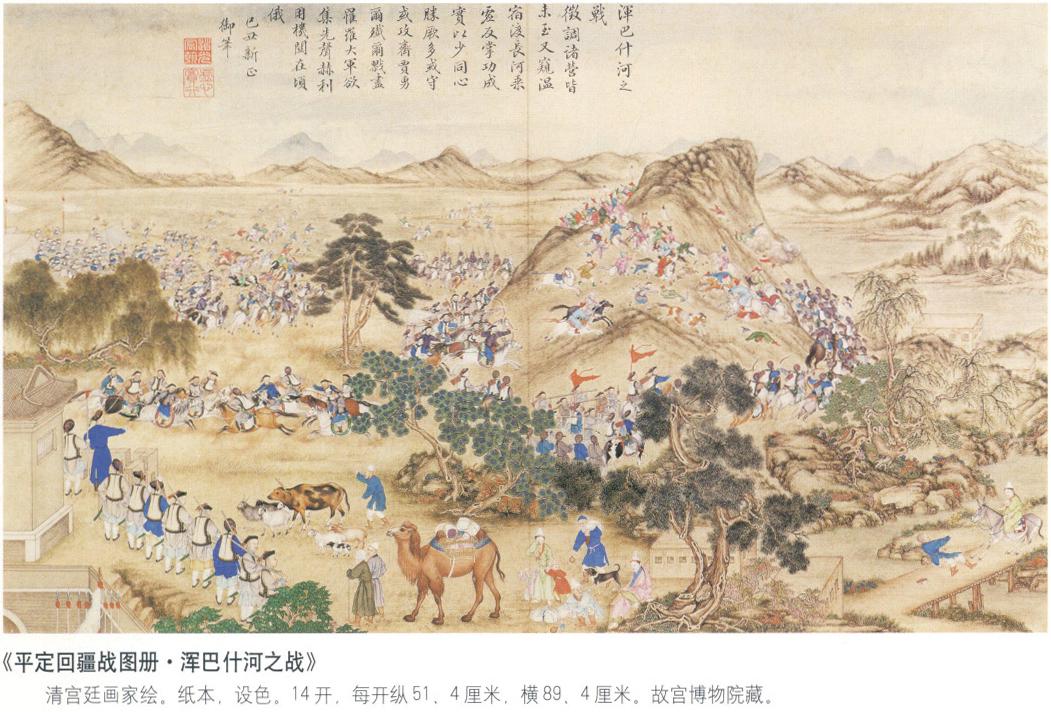
How Manchu Islamophobia caused the Panthay rebellion in Qing dynasty China
In 1856, the Governor-general of Yunnan Hengchun and the governor of Yunnan, Shuxing'a, the provincial judge, Qingsheng, and the provincial teasurere, Sangchunrong were all Manchus.
Since Hengchun was in Guizhou fighting against the Miao rebellion, the Manchu governor Shuxing'a was the highest ranking official in Yunnan. Before serving in Yunnan, Shuxing'a served in northwestern China and developed a deep hatred of Muslims during his time there. It started in 1953 when Shuxing'a led a relief force to a town besieged by Muslim insurgents, he collapsed and fled in fear. The rebels took over the town. The local non-rebel Hui Muslims were angry and bitter over the loss so they formed a mob and attacked Shuxing'a, stripped him naked and started attacking and humiliating him intending to kill him. His servant Chen Xi saved Shuxing'a from getting public ally lynched. Shuxing'a suffered severe mental trauma from the attack and suffered chronic neurasthenia, heart palpitations, melancholia and fatigue. Shuxing'a blamed all Muslims for his mental problems and humiliation. Only anti-Muslim people were allowed to visit the governor's yamen in Yunnan, and the other Manchu officials like the provincial judge Qingsheng an Sangchunrong also hated Hui Muslims. Qingsheng said "The Hui bandits' hearts are evil. If we do not deal with them early on, then they will spread like a disease from the inside out." Hengchun used extreme torture against Hui Muslims in Yunnan during criminal cases and began promoting anti-Muslim sentiment all over Yunnan.
In 1856, the Manchu governor Shuxing'a issued orders starting a riot which led to the slaughter massacre of 3,000 Hui Muslims, setting off the Panthay rebellion. Shuxing'a ordered Hui Muslim rebel leaders in Yaozhou to be killed by slow slicing (death by a thousand cuts) and beheading.
The Hui Muslim Yang Xiu (his named changed to Du Wenxiu) led the massive revolt of Hui Muslims in Yunnan province against the Qing dynasty, called the Panthay rebellion.
Du Wenxiu sought to coordinate his Panthay rebellion with he Taiping rebellion against the Qing, attempting to link up in Sichuan and attack Qing forces.
Du Wenxiu declared himself Prince (Wang) of Piingnan Guo (the pacified southern kingdom) modeled after the Taiping kingdoms name, Taiping Tian Guo (Great peace Heavenly kingdom), also using the title of Sultan Sulayman in Arabic.
Du Wenxiu declared his rebellion to be anti-Qing and anti-Manchu like the Taiping rebellion, using anti-Manchu and anti-Qing slogans calling for the destruction of the Qing dynasty and elimination of the Tartar barbarians (Manchu) and unity of Hui Muslims and Han Chinese. He called for unity between Hui Muslims, Han Chinese and the native indigenous tribal animist people of Yunnan. He appointed Han Chinese officials to positions in the Pingnan Guo government and made Confucianism the state ideology. He also declared Ming dynasty restoration to be his goal, like other rebels using the slogan of "destroy Qing revive Ming"
Du Wenxiu ordered the restoration of Ming official Hanfu caps and robes, clothing and topknot hairstyle, ordering people to cease the shaving of their forehead and wearing of the queue.
Another Hui Muslim rebel Ma Rulong operated in Yunnan and fought against the Qing but he did not declare an independent state and did not join Du Wenxiu. Ma Rulong arranged a surrender and defection to the Qing.
Qing forces led by Cen Yuying crushed the Panthay rebellion and proceeded to massacre Muslims all over Yunnan again after executing Du Wenxiu who unsuccessfully tried to commit suicide by swallowing opium.
How did Vietnamese treat Muslims?
https://en.wikipedia.org/wiki/List_of_Islamophobic_incidents#Vietnam
The Cham Muslims in Vietnam are only recognized as a minority, and not as an indigenous people by the Vietnamese government despite being indigenous to the region. Muslim Chams have experienced violent religious and ethnic persecution and restrictions on practicing their faith under the current Vietnamese government, with the Vietnamese state confiscating Cham property and forbidding Cham from observing their religious beliefs. In 2010 and 2013 several incidents occurred in Thành Tín and Phươc Nhơn villages where Cham were murdered by Vietnamese. In 2012, Vietnamese police in Chau Giang village stormed into a Cham Mosque, stole the electric generator, and also raped Cham girls.[321] Cham Muslims in the Mekong Delta have also been economically marginalized and pushed into poverty by Vietnamese policies, with ethnic Vietnamese Kinh settling on majority Cham land with state support, and religious practices of minorities have been targeted for elimination by the Vietnamese government.[322]
https://en.wikipedia.org/wiki/Nguyễn_dynasty#Culture
Minh Mang engineered the final conquest of the Champa Kingdom after the centuries-long Cham–Vietnamese wars. Cham Muslim leader Katip Suma was educated in Kelantan, returning to Champa to declare a jihad against the Vietnamese after Minh Mang's annexation of the region.[44][45][46][47] The Vietnamese forced Champa's Muslims to eat lizard and pig meat and its Hindus to eat beef to assimilate them into Vietnamese culture.[48]
How Vietnamese treated Muslim minorities.
https://en.wikipedia.org/wiki/List_of_Islamophobic_incidents#Vietnam
The Cham Muslims in Vietnam are only recognized as a minority, and not as an indigenous people by the Vietnamese government despite being indigenous to the region. Muslim Chams have experienced violent religious and ethnic persecution and restrictions on practicing their faith under the current Vietnamese government, with the Vietnamese state confiscating Cham property and forbidding Cham from observing their religious beliefs. In 2010 and 2013 several incidents occurred in Thành Tín and Phươc Nhơn villages where Cham were murdered by Vietnamese. In 2012, Vietnamese police in Chau Giang village stormed into a Cham Mosque, stole the electric generator, and also raped Cham girls.[321] Cham Muslims in the Mekong Delta have also been economically marginalized and pushed into poverty by Vietnamese policies, with ethnic Vietnamese Kinh settling on majority Cham land with state support, and religious practices of minorities have been targeted for elimination by the Vietnamese government.[322]
https://en.wikipedia.org/wiki/Nguyễn_dynasty#Culture
Minh Mang engineered the final conquest of the Champa Kingdom after the centuries-long Cham–Vietnamese wars. Cham Muslim leader Katip Suma was educated in Kelantan, returning to Champa to declare a jihad against the Vietnamese after Minh Mang's annexation of the region.[44][45][46][47] The Vietnamese forced Champa's Muslims to eat lizard and pig meat and its Hindus to eat beef to assimilate them into Vietnamese culture.[48]
Minh Mang sinicized ethnic minorities (such as Cambodians), claimed the legacy of Confucianism and China's Han dynasty for Vietnam, and used the term "Han people" (漢人, Hán nhân) to refer to the Vietnamese.[49][50] According to the emperor, "We must hope that their barbarian habits will be subconsciously dissipated, and that they will daily become more infected by Han [Sino-Vietnamese] customs."[51] These policies were directed at the Khmer and hill tribes.[52] Nguyen Phuc Chu had referred to the Vietnamese as "Han people" in 1712, distinguishing them from the Chams.[53] The Nguyen lords established colonies after 1790. Gia Long said, "Hán di hữu hạn" (漢 夷 有 限, "The Vietnamese and the barbarians must have clear borders"), distinguishing the Khmer from the Vietnamese.[54] Minh Mang implemented an acculturation policy for minority non-Vietnamese peoples.[55] "Thanh nhân" (清 人) or "Đường nhân" (唐人) were used to refer to ethnic Chinese by the Vietnamese, who called themselves "Hán dân" (漢 民) and "Hán nhân" (漢人) during 19th-century Nguyễn rule.[56]
https://en.wikipedia.org/wiki/Katip_Sumat_uprising
Katip Sumat uprising (Vietnamese: Phong trào Hồi Giáo của Katip Sumat) was a revolt in 19th century Southern Vietnam. It was led by Cham Muslim leader Katip Sumat.[1][2][3][4]
Champa was annexed by Vietnam in 1832. In order to eradicate the Cham identity, Chams were forced to adopt Vietnamese customs. The Vietnamese force fed haram lizard and pig meat to Cham Muslims and cow meat to Cham Hindus against their will. It made Chams angry.[5]
In June 1833, Katip Sumat, a Cham Muslim leader who lived in Kelantan, came to Champa, declaring jihad against the Vietnamese. He was defeated in July and fled to Cambodia. Other rebels continued fighting until 1834.[6]
https://en.wikipedia.org/wiki/Ja_Thak_Wa_uprising
Ja Thak Wa uprising (Vietnamese: Khởi nghĩa Ja Thak Wa) was a inspired revolt in 19th century southern Vietnam. It was led by two Cham leaders, Ja Thak Wa and Po War Palei.[1]
Champa was annexed by Vietnam in 1832. In order to eradicate the Cham identity, Chams were forced to adopt Vietnamese customs. The Vietnamese coercively fed lizard and pig meat to Cham Muslims and cow meat to Cham Hindus against their will. It made Chams angry.[2]
After the Katip Sumat uprising was put down, Ja Thak Wa (Thầy Điền or Điên Sư) launched another revolt against Vietnamese in 1834. Ja Thak Wa chose Chek Bicham (Phố Châm Sơn) as his base area; he crowned Po War Palei (La Bôn Vương), a son-in-law of the last deputy ruler Po Dhar Kaok (Nguyễn Văn Nguyên), as the new Champa king.[3] The rebels attacked Ninh Thuận, Bình Thuận, Khánh Hòa and Phú Yên.[1] They were supported by Montagnard in Central Highlands.[3]
The rebellion was put down in 1835, both Ja Thak Wa and Po War Palei were killed in Phan Rang.[1] In the same year, two Champa leaders, Po Phaok The (Nguyễn Văn Thừa) and Po Dhar Kaok (Nguyễn Văn Nguyên) were executed by Emperor Minh Mạng.[4]
The Shogun Sakanoue no Tamuramaro led major campaigns against the indigenous Emishi people of northern Honshu. Emishi women and children were deported in groups to Yamato inhabited regions of southwest Japan to force their men to surrender and follow them where they were absorbed into the Yamato population. Many Emishi served was warriors.
https://en.wikipedia.org/wiki/Sakanoue_no_Tamuramaro#Ancestry
Sakanoue no Tamuramaro (坂上 田村麻呂, 758 – June 17, 811) was a general and shōgun of the early Heian period of Japan. He was the son of Sakanoue no Karitamaro.[1]
According to the Shoku Nihongi, an official historical record, the Sakanoue clan is descended from Emperor Ling of Han China.[6][7] The Sakanoue clan's family tree shows that Tamuramaro is a 14th-generation descendant of Ling.[8] Other research traces the origins of the Sakanoue clan from the Asian mainland, possibly through Baekje.[9]
https://medium.com/@tribalingual/emishi-ezo-and-ainu-disentangling-the-voices-of-japans-far-north-e626e416603b
https://www.discovermagazine.com/health/the-shadow-of-the-emishi
https://www.jstor.org/stable/133122
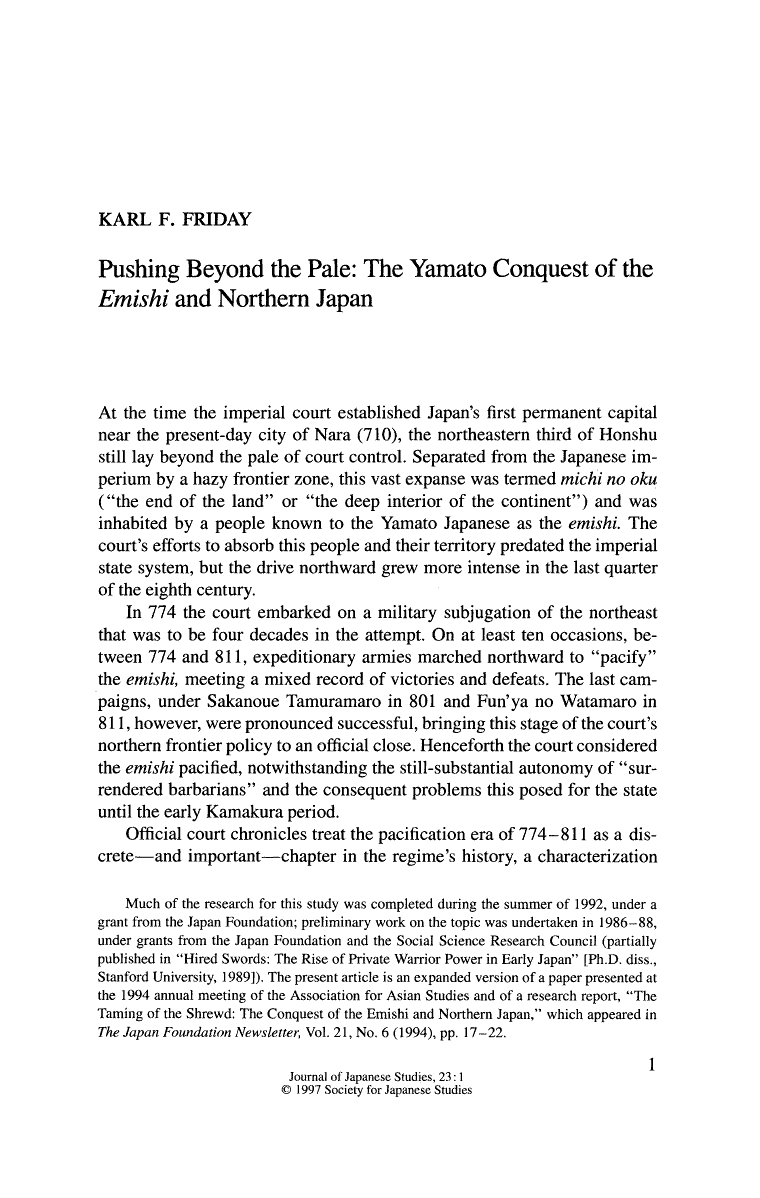
Friday, Karl F. “Pushing beyond the Pale: The Yamato Conquest of the Emishi and Northern Japan.” Journal of Japanese Studies, vol. 23, no. 1, 1997, pp. 1–24. JSTOR, www.jstor.org/stable/133122. Accessed 17 Feb. 2020.

http://emishi-ezo.net/WhoEmishi.htm
>There were three races in ancient Japan: Japanese, Emishi (later Ainu) and Ashihase (possibly Okhotsk). Historical literature supports the theory that the Emishi were considered rebels by the Japanese, and therefore potentially subjects by way of conquest. Consistently, the Japanese divided them into those who had submitted themselves to Yamato rule as allies and subjects, and those who were outside their authority. Those outside imperial authority were seen as "barbarians" beyond the frontier. Michinoku, the name the Yamato Japanese had given for the Tohoku, literally translates as "deepest road" with the connotation of a far away place: the Emishi were seen as inhabitants of this far away land, beyond the frontier. The Ashihase were thought of as a foreign people altogether, and it is not clear who they were;
http://emishi-ezo.net/culture.html
https://wiki.samurai-archives.com/index.php?title=Emishi
According to the Shinsen Shōjiroku (815), 176 Chinese aristocratic families lived in Japan.[9]
https://en.wikipedia.org/wiki/Shinsen_Shōjiroku
Shinsen Shōjiroku (新撰姓氏録, "New Selection and Record of Hereditary Titles and Family Names") is an imperially commissioned Japanese genealogical record. Thirty volumes in length, it was compiled under the order of Emperor Saga by his brother, the Imperial Prince Manta (万多親王, 788–830). Also by Fujiwara no Otsugu and Fujiwara no Sonohito et al. It was initially completed in 814, but underwent a revision to be recompleted in 815.
The record contains genealogical records for 1182 families. It categorizes these by their family roots:
imperial ancestry: 335 families
divine ancestry: 404 families; of which 246 were of direct heavenly descent, 128 were of heavenly cadet descent, and 30 of earthly divine descent.
foreign: 326 families; of which, 163 were from China, 104 from Baekje, 41 from Goguryeo, 9 from Silla, and 9 from Gaya.
According to archeological findings from the fifth to the seventh centuries AD, the northern half of Tohoku (roughly extending from northern Miyagi prefecture to Aomori) and the western part of Hokkaido formed a single cultural area, and many Ainu place names are left in the Tohoku. It is beyond the discussion of this introduction to go into the Jomon, Epi-Jomon and Yayoi cultures as they affected the Tohoku region, but to simplify this discussion, it is now believed that evidence points to the Emishi tie in with the Tohoku Middle Yayoi pottery culture that is heavily influenced by Jomon forms--almost as if these peoples were gradually adopting Yayoi culture from the seventh to the eighth centuries.
The Cambridge History of Japan, Volume 2
Issue 1 of Cambridge ancient history
Cambridge history ebook collection
The Cambridge History of Japan, John Whitney Hall, ISBN 0521657288, 9780521657280
Volume 2 of The Cambridge History of Japan: Heian Japan
Editors Delmer Myers Brown, John Whitney Hall, Donald H. Shively, William H. McCullough, Marius B. Jansen, Peter Duus, Kōzō Yamamura
Contributors 耕造·山村, John Whitney Hall, Marius B. Jansen
Edition illustrated, reprint
Publisher Cambridge University Press, 1988
ISBN 0521223539, 9780521223539
Length 754 pages
History / Asia / General
History / Asia / Japan
History / Europe / Medieval
 I don't know, but modern Japanese emperor has Jomon/Emishi/Ainu Y-DNA. Their Y-DNA in general seems to be very common, so many of them clearly enjoyed great reproductive success. I'm guessing many of them became warriors and later daimyo.
It's certainly wasn't a genocide like with European farmers.






 It's pretty funny, though. Now you have Japanese identifying more with Jomon and their haplogroup D rather than Yayoi just to be different from Koreans, lol.
https://en.wikipedia.org/wiki/Japanese_clans#China
>Yamato no Aya clan (東漢氏) - descended from Achi no omi, a great-grandchild of Emperor Ling of Han of the Chinese Han dynasty.
https://en.wikipedia.org/wiki/Achi_no_omi
Achi no omi (阿知使主, 3rd century – 5th century), was a great-grandson of Emperor Ling of Han who settled in Japan with his son Tsuga no omi. He became the founding ancestor of the Yamato no Aya clan.[1] His name is also recorded as 阿知吉師.
From the Nihon Shoki (289 AD):
20th year, Autumn, 9 month. Achi no omi, ancestor of the Atahe of the Aya of Yamato, and his son Tsuga no omi immigrated to Japan, bringing with them a company of their people of seventeen districts.[2]
https://en.wikipedia.org/wiki/Hata_clan
The Hata clan (秦氏) was an immigrant clan active in Japan since the Kofun period (250–538), according to the history of Japan laid out in Nihon Shoki.
Hata is the Japanese reading of the Chinese surname Qin (Chinese: 秦; pinyin: Qín) given to the State of Qin and the Qin dynasty (the ancestral name was Ying), and to their descendants established in Japan. The Nihon Shoki presents the Hata as a clan or house, and not as a tribe; only the members of the head family had the right to use the name of Hata.
The Hata can be compared to other families who came from the continent during the Kofun period: the descendants of the Chinese Han dynasty, through Prince Achi no Omi, ancestor of the Aya clan, the Sakanoue clan, the Tamura clan, the Harada, and the Akizuki clan, as well as the descendants of the Chinese Cao Wei Dynasty through the Takamuko clan.
What's even your point? Like, what do you even want to discuss?
Emishi
https://en.wikipedia.org/wiki/Aterui
Aterui (アテルイ, 阿弖流爲) (died 21, AD 802 in Enryaku) was the most prominent chief of the Isawa (胆沢) band of Emishi in northern Japan. The Emishi were an indigenous people of North Japan, who were considered hirsute barbarians by the Yamato Japanese.
Aterui was born in Isawa, Hitakami-no-kuni, what is now Mizusawa Ward of Ōshū City in southern Iwate Prefecture. Nothing is known of his life until the battle of Sufuse Village in 787. In 786, Ki no Asami Kosami was appointed by the Emperor Kanmu as the new General of Eastern Conquest and given a commission to conquer Aterui. In June 787, Kosami split his army in two and sent them north from Koromogawa on each side of the Kitakami River hoping to surprise Aterui at his home in Mizusawa. Burning houses and crops as they went they were surprised when Emishi cavalry swept down from the hills to the East and pushed them into the river. Over 1,000 armored infantry drowned in the river weighed down by their heavy armor. In September Kosami returned to Kyoto where he was rebuked by the emperor Kammu for his failure.
Another attack in 795 was unsuccessful as well and it was not until 801 that any Japanese general could claim success against the Emishi. In that year Sakanoue no Tamuramaro, who had previously been appointed to the positions of Supervisory Delegate of Michinoku and Ideha and Governor of Michinoku, General of the Peace Guard and Grand General of Conquering East-Barbarians (Sei-i Taishōgun), was given a commission by Emperor Kanmu to subjugate the Emishi. He and his 40,000 troops were somewhat successful as he reported back to the emperor on September 27, "We conquered the Emishi rebels."
But still the Emishi leaders Aterui and More eluded capture. In 802, Tamuramaro returned to Michinoku and built Fort Isawa in the heart of Isawa territory. Then, on April 15, he reported the most important success of all in this campaign: The Emishi leaders Aterui and More surrendered with more than 500 warriors. General Sakanoue delivered Aterui and More to the capital on July 10. Despite General Sakanoue's pleadings the government, "cut them down at Moriyama in Kawachi Province".
This was a major moment in the history of the Emishi conquest. Before this time, the Japanese had adhered to a policy of deporting captured women and children to Western Japan then enticing their warrior husbands and fathers to join their families in their new homes. Captured warriors had not been killed either. The executions of Aterui and More are thought to have been responsible for the fierce resistance by the Emishi over the next hundred years or so. The Yamato Chotei acted this way probably out of fear for Aterui military prowess, and according to some Japanese, Aterui was deported outside of the capital before his execution due to the North-East Deamon's Gate superstition from Onmyodō, and so it would have been an attempt by Emperor Kanmu to protect the Capital against the ghost of Aterui.
The head of King Aterui was buried at Katano-jinja, a shrine who may have been linked with Aterui's ancestors, by shōgun Sakanoue no Tamuramaro, out of respect for his enemy. Annual private ceremonies have been held for King Aterui by the Shinto priests for the last 1200 years.
For many Japanese, he was long demonized as the "Lord of the Bad Road" (悪路王 Akuro-ō). "Aku" can also be mean "ferocious" and "strong", not only "evil".
https://en.wikipedia.org/wiki/Princess_Mononoke
Princess Mononoke (Japanese: もののけ姫, Hepburn: Mononoke-hime, "Spirit/Monster Princess") is a Japanese animated fantasy film written and directed by Hayao Miyazaki, animated by Studio Ghibli for Tokuma Shoten, Nippon Television Network and Dentsu, and distributed by Toho. The film stars the voices of Yōji Matsuda, Yuriko Ishida, Yūko Tanaka, Kaoru Kobayashi, Masahiko Nishimura, Tsunehiko Kamijo, Akihiro Miwa, Mitsuko Mori and Hisaya Morishige.
Princess Mononoke is set in the late Muromachi period (approximately 1336 to 1573) of Japan with fantasy elements. The story follows the young Emishi prince Ashitaka's involvement in a struggle between the gods of a forest and the humans who consume its resources. The term "Mononoke" (物の怪) or もののけ is not a name, but a Japanese word for a spirit or monster: supernatural, shape-shifting beings.
In Muromachi Japan, an Emishi village is attacked by a demon. The last Emishi prince, Ashitaka, kills it before it reaches the village, but its corruption curses his right arm. The curse gives him superhuman strength, but will eventually spread through his body and kill him. The villagers discover that the demon was a boar god, Nago, corrupted by an iron ball lodged in his body. The village's wise woman tells Ashitaka that he may find a cure in the western lands Nago came from, but he cannot return to his homeland. Before Ashitaka leaves, his sister Kaya gives him her crystal dagger so that he will not forget her.

https://en.wikipedia.org/wiki/Takebayashi_Takashige
Takebayashi Takashige (Japanese: 武林 隆重, 1672 – March 20, 1703) was a Samurai in the early Edo period of Japan. He was involved in the revenge of the Forty-seven rōnin incident (also known as the Akō incident) as one of the rōnin. Takashige was originally a subordinate of the daimyō Asano Naganori, master of Akō Domain.
Takashige was born in Ako in 1672. His family was originally from Hangzhou,China. His only brother was Takebayashi Tadataka. His grandfather Watanabe Kotonori was a Ming dynasty soldier. After he was captured by the Japanese forces during the Japanese invasions of Korea, Kotonori settled down in the Hiroshima domain where he served the Mori clan as a physician. Later, the family moved to Ako domain. Takashige's surname Takebayashi(武林) is an alternative and indigenous name of Hangzhou.
The Samurai with the oldest recorded male lineage was Takebayashi Takashige of Chinese descent. One of the Chinese philosopher Mencius's descendants became part of the 47 ronin, Takebayashi Takashige. A Chinese soldier Meng Erkuan from the Meng family was captured in Korea in the Imjin war and taken to Japan becoming a doctor for the Asano clan. Meng Erkuan changed his name to Watanabe Kotonori and married a Japanese woman. His grandson was the samurai Takebayashi Takashige who joined the 47 ronin and sepukkued himself with the other ronin. Mencius's main line of descendants were part of the Chinese nobility and had a hereditary title and pensions and still live in China like the Confucius, Zengzi and Yan Hui families.
https://en.wikipedia.org/wiki/Saich%C5%8D
Saichō (最澄, September 15, 767 – June 26, 822) was a Japanese Buddhist monk credited with founding the Tendai school of Buddhism based on the Chinese Tiantai school he was exposed to during his trip to Tang China beginning in 804. He founded the temple and headquarters of Tendai at Enryaku-ji on Mount Hiei near Kyoto. He is also said to have been the first to bring tea to Japan. After his death, he was awarded the posthumous title of Dengyō Daishi (伝教大師).
Saichō was born in the year 767 in the city of Ōmi, in present Shiga Prefecture, with the given name of Hirono.[1] According to family tradition, Saichō's ancestors were descendants of emperors of Eastern Han China;[1] however, no positive evidence exists for this claim. The region where Saichō was born did have a large Chinese immigrant population, so Saichō likely did have Chinese ancestry.[2]
https://en.wikipedia.org/wiki/Ko-Shint%C5%8D
Ko-Shintō (古神道) refers to the diverse animism of Jōmon period Japan which is the alleged basis of the Ainu Religion but distinct from the Yayoi-derived Shinto. The search for traces of Ko-Shintō began with Restoration Shinto in the Edo period. Some sectrian movements which claim to have discovered this primeval way of thought are Oomoto, Izumo-taishakyo, and Shinrikyō. They propose that Ko-Shinto was of Yayoi origin and distinct from the Jomon or Ainu.[1]
The Sino-Japanese word ko (古) means "ancient or old"; shin (神) from Chinese shen, means "spiritual force" or simply "spirit", often translated as "deity" or "god"; and tō (道) from Chinese Tao, means "The Way". Thus Koshintō literally means the "Ancient Way of the Gods". The term Shinto itself originated in the 6th century (to distinguish it from continental ideas such as Buddhism and Taoism then being introduced).
There are no records of "pure" Koshintō in early Japanese literature. By the time Japan was producing literature, its native religion had already intermixed with Taoism and Buddhism. Medieval development meant that Shinto was integrated into Buddhist symbology.[2]
Koshintō research began at the same time as examinations into Early Buddhism. In this era, Japan's shrine rituals were being "purified" of their religious nature and turned into national forms, a process called State Shinto today. Religionists began looking for the origin of these forms in a primitive "nature religion".[3] Early folklorists such as Kunio Yanagita were also seeking a purely Japanese tradition.
Onisaburo Deguchi, the founder of Oomoto, was an extremely influential Koshinto researcher in the Imperial period. He influenced nearly all modern Koshinto lines except for that of Takuma Hisa. Such research continues today and is often connected with aikido and other martial arts.[4]
The following is deduced from studying the language of the Kojiki and Nihon Shoki which does not appear in any Chinese philosophy:
In Koshintō, the present world or utsushiyo is put in contrast to the eternal world or tokoyo. All individuals possess a tamashii (Ainu: ramat), meaning a mind, heart, or soul. A tamashii without a body is called a mitama. Those whose tamashii has the nature of kami (Ainu: kamuy) are called mikoto.
In the Age of the Kami, or Kamiyo, the Earth was ruled by kami, whose forms were akin to humans, but had pure hearts and spoke in the language of kotodama.
The word Shinto is literally borrowed from the Chinese word Shendao. Shendao was used in China to refer to Shenism (Chinese folk religion).There is no indigenous Japanese term for the religion and Shinto has influences from Shenism and from Daoism both of which are Chinese religions like holy mountains, use of Talismans.
Daoist influence in Shintoism
https://www.academia.edu/35563748/Bjonback_Japan_as_Tantric_Kingdom.pdf
What do you mean "despite"? Shinto is influenced by Chinese Daoism and Shenism and it's very name, Shinto is a loanword from the Chinese word Shendao which was used to describe Chinese folk religion, Shenism. Pre-Chinese influnced Japanese religion does not exist anymore
Shinto is heavily influenced by Chinese Daoism, from the use of talismans to sacred mountains, yin-yang divination, to anti-Buddhist polemics and even the name Shinto is a direct loanword of the Chinese word Shendao which was used to describe Chinese folk religion (now called Shenism). Shinto is not the same as the animism that pre-Chinese influenced Japan practiced which wasn't called Shinto. Shinto isn't a Japonic word.
 Japan's adoption of the Tennō (天皇) title itself as "emperor" is likely a derivation from Tang dynasty Daoism in China.
https://wiki.samurai-archives.com/index.php?title=Zheng_Zhilong
Zheng Zhilong was a prominent Chinese pirate (wakô leader) of the early 17th century, Ming loyalist, and father to Zheng Chenggong (aka Coxinga).
Zheng spent time in Macao in his youth, learning European languages and about Christianity, and eventually becoming a translator for the Dutch East India Company (VOC), while also becoming a member of a pirate gang led by Yan Siqi.
He established himself at Hirado beginning in 1624, marrying a Japanese woman to whom their son Zheng Chenggong was born.[1]
Tagawa Shichizaemon was an ashigaru and his father was a Chinese, Zheng Zhilong
http://unsworks.unsw.edu.au/fapi/datastream/unsworks:12890/SOURCE02
http://www.eastasianhistory.org/39/vos-foibles
Romances of the Chinese
Maruyama no lice at Maruyama
shirami wakan no bite Japanese and Chinese
hito wo kui without discrimination
In connection with the gradual implementation of the seclusion policy the Chinese were, from 1635 on, only allowed to trade at Nagasaki. At first they were allowed to live anywhere in the city and could have relations with ordinary women as well as prostitutes. In 1688, however, the building of a Chinese settlement, Tōjun-yashiki,[53] at Jūzenji-mura was begun and with its completion in the year following they were placed under the same restrictions as the Dutch. Because of the many points of resemblance between the life of the Chinese and that of the Dutch at Nagasaki it is worthwhile to insert here a digression on the subject of the relations between the Kara-yuki and their clientele.
In the beginning it was the rule that the Kara-yuki were not permitted to spend more than one night at the settlement but it soon became customary for them to leave the gate in the morning, report themselves to the guards and then retrace their steps. Between the girls and their customers, who are often praised for their generosity with expensive presents, several moving romances developed. Towa,8 a girl from the Chikugoya in Yoriai-machi, for example, pledged vows of eternal love with a certain Ho Min-tê.9 In 1690, when he was condemned to death for forging, she committed suicide. In 1789 Renzan10 a pensionnaire of the Azumaya, and the merchant Ch’ên Jên-hsieh11 from Su-chou made and kept a suicide pact.
In the Shōtoku era (1711–16) several directives were issued with regard to children born of unions between Chinese or Dutchman and Maruyama women, from which it becomes clear that the foreigners were allowed to provide for the education of the children but could not take them along when they returned to their own country.[54]
As a matter of fact many Chinese seem to have worried about the education and future of such children. Huang Chê-ch’ing,12 a captain from Nanking, had a liaison with Yakumo,13 a girl from the Iwataya, and fathered a boy Kimpachi,14 his only child. In 1723, when he was 71, he returned to Nagasaki to meet his son. He then brought goods with him sufficient to take care of his son for the rest of his life and asked the Chief Administrator’s Office for a special permit to barter them.[55]
The sea captain/painter/poet Chiang Yün-ko15 (ming: Hsin-i,16 a friend of Rai Sanyō[56] and Yanagawa Seigan, fathered a son, Hachitarō, on Sodesaki,17 a girl from the Hiketaya.[57]
The origin of certain famous delicacies may also be traced back to love-affairs. The secret of the preparation of kōsakō, soft sweets consisting of rice flour and sugar, is said to have been taught to the prostitute Ume by a Chinese in the Genroku era (1688–1704). Because of the girl’s name they are shaped like plum blossoms.[58]
Chinese music, songs and dances were also brought to Nagasaki and, of course, executed by the inmates of Maruyama to the accompaniment of such instruments as the moon-shaped lute (yüeh-ch’in), seven-stringed dulcimer (ch’i-hsien-ch’in), and two-stringed violin (hu-kung). The songs were sung in the Tōsō-on (resembling modern Pekinese) as becomes clear from booklets like the Kagetsu yokyō, ‘Kagetsu Entertainment’.[59]
Famous were the Kyūrenhwan songs accompanied on the yüeh-ch’in (Jap.gekkin), an example of which follows here:
Kankan-i, sūho-te kyūrenhwan
kyūya kyūrenhwan
sanshū narai kyaipukyai
naha tōruka kaputwanryau
eeyū eyū
Look! Look at the fine puzzle ring you gave me!
The puzzle ring with its nine holes.
Even if you seize it with both hands, you cannot loosen it.
Even if you use a knife, you cannot cut it.
Eeyū eyū [60]
To the song belonged a dance called the Kankan-odori after the opening words. It became famous in Kyōto and Edo too but lost its original character.[61] Therefore the Shogunate’s court astronomer Takahashi Sakuzaemon (1785–1829), well known because of his later involvement in the ‘Siebold Incident’, had geisha and local officials in charge of Chinese affairs come up to Edo in order to give unadulterated performances of the dance.[62]
I don't get why you're posting about subjects unrelated to the Emishi. As expected of the spammer
Cong Liangbi from Shandong and his time in Japan.
At Home in the World: Women and Charity in Late Qing and Early Republican China
Author Xia Shi
Edition illustrated
Publisher Columbia University Press, 2018
ISBN 0231546238, 9780231546232


Memoirs of the Research Department of the Toyo Bunko: (the Oriental Library)., Issues 61-65
Authors Tōyō Bunko (Japan), Tōyō Bunko (Japan).
Publisher Tôyô Bunko., 2003
Page 95

Shanghai Sojourners, Issue 40; Issue 1992
Issue 40 of China research monographs
Shanghai Sojourners, Frederic E. Wakeman
Author Frederic E. Wakeman
Editors Frederic E. Wakeman, Wen-Hsin Yeh
Publisher Institute of East Asian Studies, >University of California, 1992
ISBN 1557290350, 9781557290359
 According to the original post a Chinese descendant was responsible for Emishi forced assimilation.
Title Sources of Japanese Tradition: From Earliest Times to 1600
Introduction to Asian Civilizations
Editors Wm. Theodore De Bary, Carol Gluck, Arthur Tiedemann
Edition 2, reprint
Publisher Columbia University Press, 2002
ISBN 0231518056, 9780231518055
Length 520 pages
Subjects History Asia General
History / Asia / Central Asia
History / Asia / General
Reference / General
Reference / Research
Title Sources of Japanese Tradition
Author de Bary, Wm. Theodore, Donald Keene, George Tanabe, and Paul Varely
Publisher Columbia University Press, 2001
ISBN 0231121393, 9780231121392
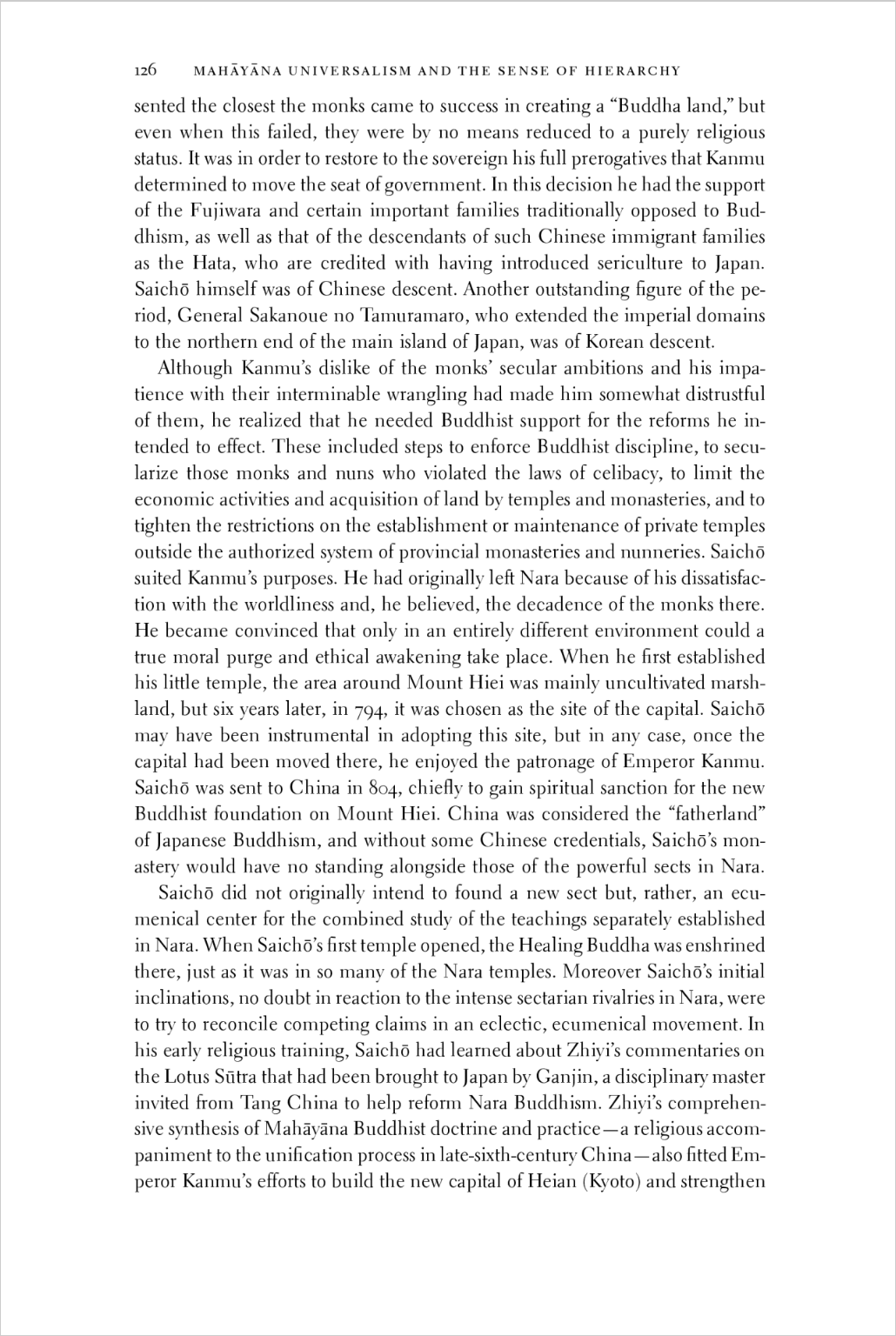 based. Once Japan joins the new Sinic Dynasty, they can start colonizing Canada the same way
Princess Mononoke is about the Emishi wars. The more you know.
 Describing "barbarians" by comparing them to animals with animal like capabilities and powers was common there. Han Chinese said southern nanman (nan man) ethnic minorities like Yao and Tanka swam like seals amd could go underwater without breathing like Yamato Japanese describing Emishi like birds.
all yayoi women wanted to fuck Ashitaka D bull
Like in reality.
Xi'an city is a Han city with a Muslim quarter. The Hui Muslims of Xi'an lived in Xi'ans Muslim quarter since at least the start of the Ming dynasty. The people of Xi'an traditionally have not participated in any conflicts during the Qing dynasty. Gansu Hui Muslim Ming loyalists under Mi Layin and Ding Guodong fought against the Qing from 1646-1650. A Manchu banner quarter was established in Xi'an on the site of a former Ming prince's palace after Manchus were relocated from their home to garrison quarters in cities south of the Great Wall.
During the Dungan rebellion of the 1860s, the Hui Muslims of Xi'an were the only Hui in southern Shaanxi who did not join the rebellion. As a result Xi'an never fell to the rebels. Shaanxi Hui rebels outside of Xi'an who redefected back to the Qing were not allowed to go back to Shaanxi so they were resettled in Gansu to live along with Gansu Hui rebels like Ma Anliang who defected back.
However in 1911, the when anti-Qing revolutionaries reached Xi'an in the Xinhai revolution, both the Han and Hui Muslims of Xi'an joined the revolt. As the revolutionaries surrounded the Manchu quarter of Xi'an on three sides, the tens of thousands of Manchus attempted to escape from the fourth side. They found that the Hui Muslims of Xi'an's Muslim quarter blocked the entire fourth side. An orgy of arson, looting, massacre and rape against the Manchu population of Xi'an began.
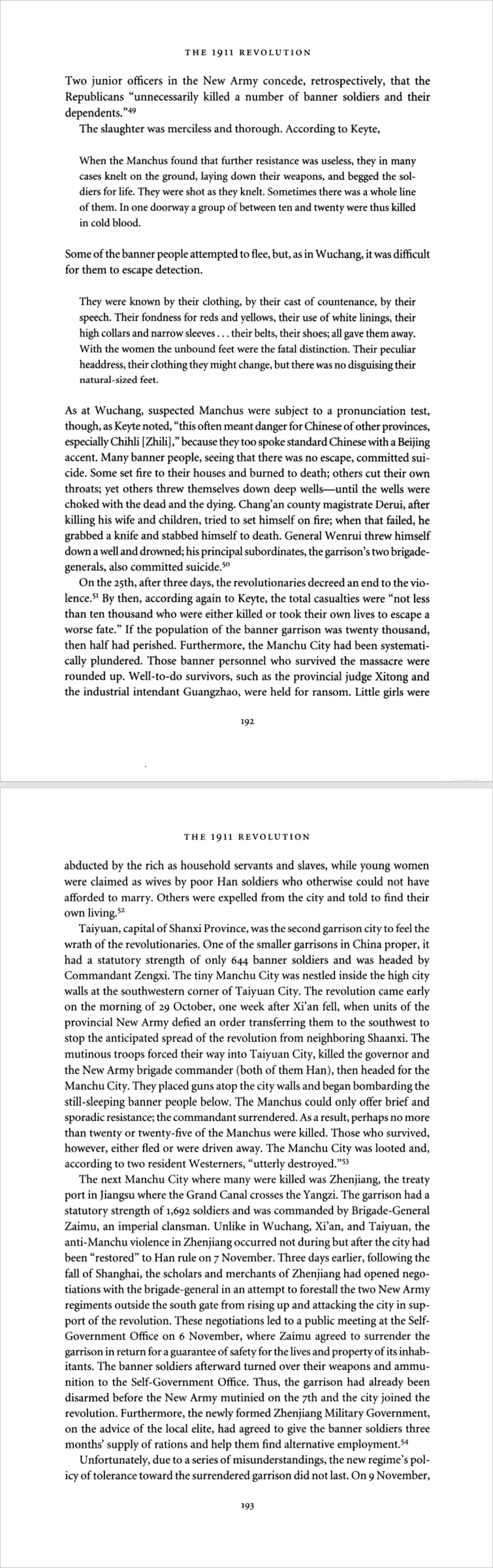
Gansu Hui General Ma Anliang, who had participated in the Dungan rebellion before defecting, was called up by the Qing authorities in Gansu to retake Xi'an from the anti-Qing revolutionaries. The Han and Hui gentry of Gansu urgently called Ma Anliang to strike the revolutionary forces in Xi'an. However the news of the abdication of the Qing court came and was shot via an arrow into Ma Anliang's camp. Hui General Ma Anliang accepted the news and called off the attack on Xi'an, to the fury of the Manchu Governor General who had his whole family massacred or raped in Xi'an by the revolutionaries. Manchu girls and women were taken by Han men and Hui men in Xi'an as wives and servants while Manchu men and boys were tortured and massacred.
Xi'an and the Han and Hui of the city have not received any bad karma for the events of 1911-1912. Xi'an has not experienced any violence since then and was not taken over during World War II nor subjected to any siege during the civil war. It also preserved it's Ming era city walls perfectly, temples and the Hui Muslim quarter which are all tourist attractions today. Foreign Muslims get attracted by advertisements of Halal food in Xi'an. The remnants of the Manchu quarter don't exist though.
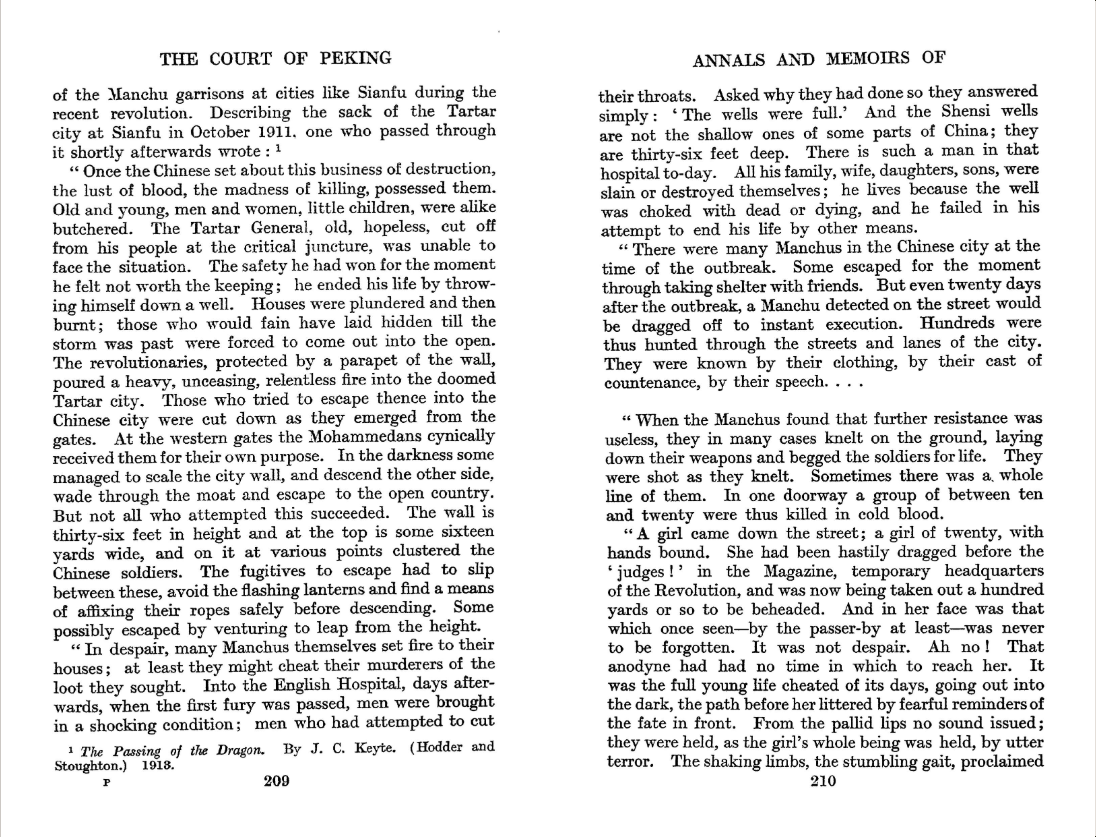
The Horizon history of China
Authors Charles Patrick Fitzgerald, Norman Kotker
Editor Norman Kotker
Edition illustrated
Publisher American Heritage Pub. Co., 1969
Annals & Memoirs of the Court of Peking: (from the 16th to the 20th Century)
Authors Sir Edmund Backhouse, J. O. John Otway Percy Bland
Edition reprint
Publisher Houghton Mifflin, 1914
Manchus and Han: Ethnic Relations and Political Power in Late Qing and Early Republican China, 1861–1928
Studies on ethnic groups in China
Author Edward J. M. Rhoads
Edition illustrated, reprint
Publisher University of Washington Press, 2000
ISBN 0295980400, 9780295980409

Jurchens/Manchus weren't steppe people. They were sedentary farmers who lived in villages and cities in forests of Jilin and Heilongjiang and farmed wheat living in wooden houses and cabins. Actual steppe nomads like the Khitan and Mongols raped Jurchen women and massacred them viewing them as enemies and their slaves.
The Xianbei were also Mongoloid and Mongolic, not Caucasian or even Turkic. The Tuoba Xianbei royal family Y haplogroup was O2a2b1a2.
Y haplogroup of the Tuoba royal family of the Xianbei Northern Wei is O2a2b1a2
https://famousdna.wiki.fc2.com/wiki/Y%E6%9F%93%E8%89%B2%E4%BD%93O2a2b1a2%E7%B3%BB%E7%B5%B1
The Y chromosome of Northern Wei's first emperor, Daowu Emperor (real name: Tuoba Gui, 371-409) is the haplogroup O2a2b1a2 (O-F444) (Note 1) (Note 2)。 Northern Wei (386-534) The country was built by the Tuoba, a tribe of the dynasty, during the North and South Dynasties of China.
北魏の初代皇帝・道武帝 (本名:拓跋珪, 371-409)のY染色体は、 ハプログループO2a2b1a2 (O-F444)である(注1)(注2)。北魏(386-534)は、中国の南北朝時代に鮮卑族の拓跋氏によって建てられた国で、前秦崩壊後に独立し華北を統一して五胡十六国時代を終焉させた。
https://anthrogenica.com/showthread.php?5876-Are-there-are-actually-two-different-Mongol-groups-genetically-in-terms-of-aDNA/page4
Most Central Asian members of both O2a2b1a1-M117 and O2a2b1a2-F444 clearly are derived from the same Neolithic population expansion(s) that has/have left such clear traces in modern populations speaking Sino-Tibetan languages. Most of them are probably related to certain East Asian individuals more recently than the Neolithic.
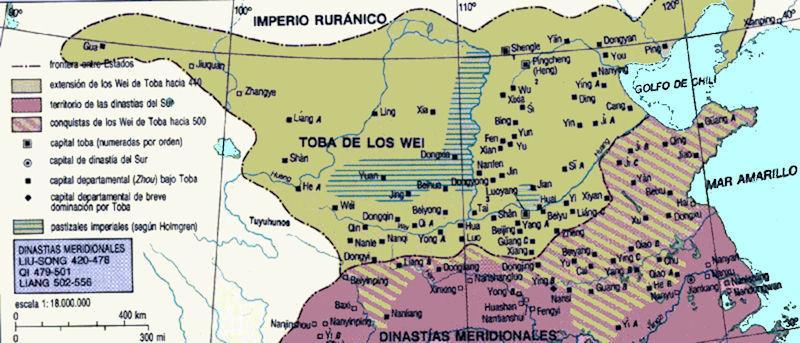 The Xianbei were also Mongoloid and spoke a Mongolic language. This is a reconstruction of remains from Xianbei tombs.
Everyone's heard the human swine story but not this one. This is found in the Book of Wei (魏書)
When the Xianbei Tuoba Northern Wei dynasty ruled northern China, it was a custom for the Xianbei to receive southern Han Chinese ex-royal defectors when their dynasties were overthrown in southern China and marry Xianbei princesses off to the Han Chinese exiled royals.
When the Han Chinese Liu Song dynasty (劉宋) in southern China was overthrown by the Han Chinese Southern Qi dynasty, the surviving Han Chinese Liu Song princes fled north to Xianbei ruled Northern Wei (北魏) and were granted asylum and noble titles by the Xianbei Tuoba royals. The Xianbei Tuoba Princess Lanling (蘭陵公主) was married to Han Chinese Liu Song prince Liu Hui (劉輝)
Liu Hui discovered his Xianbei wife was an extremely jealous and psychotic woman who demanded strict monogamy from him. As an ex royal, Liu Hui was accustomed to having his way so he had affairs with numerous Han Chinese women including one of his maids and impregnated her.
Xianbei Princess Lanling went berserk, murdered the maid, ripping the fetus out of her belly and stuffing the naked corpse of the Han Chinese maid with straw to show to her Han Chinese husband Liu Hui to frighten him into becoming faithful. Instead of becoming faithful Liu Hui was horrified and shunned the company of Princess Lanling.
After this was reported to the Northern Wei Empress Dowager Ling (靈皇后), the Empress Dowager arranged for the couple to be divorced. Princess Lanling was still feeling jealous so one year later she demanded she be remarried to Liu Hui and the request was granted after she repeatedly pleaded to be remarried. Princess Lanling became pregnant with Liu Hui's child. Liu Hui still committed adultery and slept with two Han Chinese women, Zhang Rongfei, sister of Zhang Zhishou and Chen Huimeng, sister of Chen Qinghe. Xianbei Princess Lanling decided to try to keep her jealous temper in control at her Han husband's infidelity, but her female relatives provoked her to lash out again. Princess Lanling started fighting with Lui Hui in bed. Liu Hui then pushed her out of the bed, beat her, stomped on her belly, causing their children to be miscarried and Princess Lanling later died from the injuries. Liu Hui fled and the Northern Wei put out wanted notices for him.
Liu Hui was later pardoned by the Northern Wei for killing his wife and unborn baby because he was ex royalty and high nobility.
Xianbei Princess Lanling murdered the maid by beating her to death before ripping the fetus out, mutilating the fetus and stuffing the maid's body with straw.
Empress Dowager Ling imprisoned the Han Chinese mistresses of Liu Hui in the palace and made the women into slaves as punishment for their adulterous affairs. The brothers of the women, Zhang Zhishou and Chen Huimeng were exiled. The official Cui Zuan opposed the sentences handed out. At the funeral for Princess Lanling, Empress Dowager Ling said that Liu Hui insulted Princess Lanling many times but she never spoke out.
Liu Hui was caught and originally going to be executed but he received an amnesty and pardon at the last minute and his noble title was restored. He died of natural causes.
She must have really loved him because she endured insults from him and kept quiet about it, begged the empress dowager to make him remarry her and wanted to carry his child. She just couldn't control her temper at his infidelities and lashed out at the other women.
Early Medieval China: A Sourcebook
Wendy Swartz, Robert Ford Campany, Yang Lu, Jessey Choo
illustrated
Columbia University Press
2014
0231531001
9. Crime and Punishment The Case of Liu Hui in the Wei shu Jen-der Lee
pages 156-165
Women in Early Medieval China
Bret Hinsch
Rowman & Littlefield
2018
1538117975
7 Virtue
pages 97-98
Papers on Far Eastern History, Volumes 27-30
Australian National University. Dept. of Far Eastern History
Australian National University, Department of Far Eastern History.
1983
pages 86-87

Over 50% of Xianbei Tuoba princesses were married to Han Chinese men.
The Xianbei Tuoba married their own princesses to Han Chinese royals and nobles during the Northern Wei princess in northern China.
https://dash.harvard.edu/bitstream/handle/1/33493331/TANG-DISSERTATION-2016.pdf?sequence=4
Of the defectors and those who surrendered, the noblemen were often given princesses as wives. 322 According to the biographies in the Wei shu and the Bei shi and the excavated funeral inscriptions, more than half of the Northern Wei princesses married Han Chinese men. Among the Han Chinese men, half of them were members of prominent clans in the south or royal members of southern courts who defected to the north, as well as their descendants in the north. 323 Among these men, the prominent ones are as follows: Eastern Jin royal clansman Sima Chuzhi ǁǎ͛e (390 - 464) and his son Sima Yue and his grandson Sima Fei , both of whom were born in the north; 324 Liu - Song prince Liu Chang and his sons Liu Chengxu and Liu Hui, both of whom were born in the north; 325 Southern Qi official Wang Su and his nephew Wang Song (482 - 528) from the illustrious L angya Wang clan; 326 Southern Qi prince Xiao Baoyin (485 - 530), his son Xiao Lie and his nephew Xiao Zan ӗר (502 - 531). 327 Sima Chuzhi, Liu Chang, Wang Su, Xiao Baoyin and Xiao Zan had all been married in the south and were married again to Northern Wei pr incesses. 328 At some point in their lives, most of them experienced a liangdi dilemma.
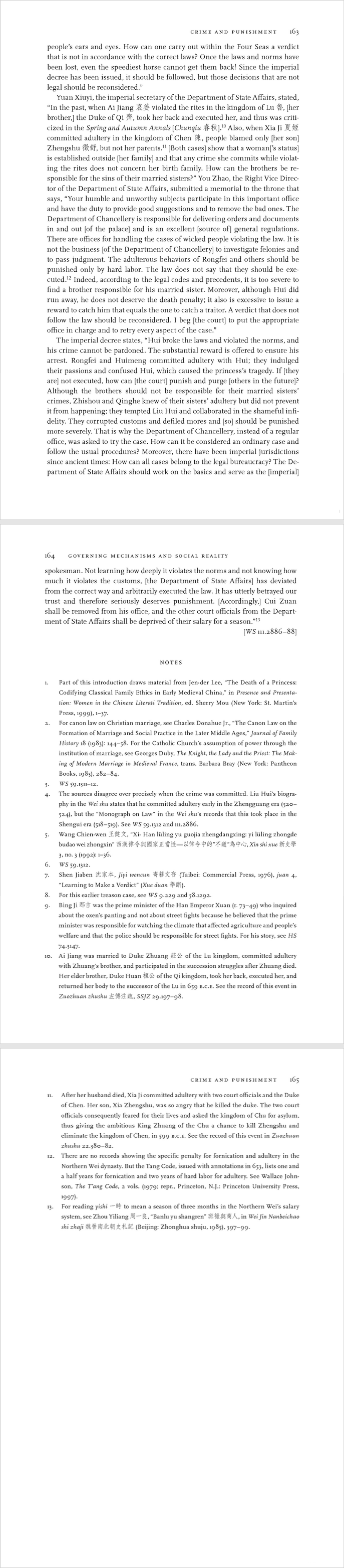
Other southern Han Chinese exiled ex-royals and nobles in northern China didn't seem to have problems with their Xianbei Tuoba princess wives.
The Xianbei Northern Wei Tuoba Imperial family married off over half of it's Xianbei Tuoba princesses to exiled Han Chinese royals from southern China who fled north to defect to the Xianbei.
Among them were the Han Chinese princes of the Liu Song dynasty, Liu Hui and Liu Chang. Xianbei Princess Lanling was married to Han Chinese Prince Liu Hui. Xianbei Princess Pengcheng was given in marriage to Han Chinese prince Liu Chengxu. Three Xianbei Tuoba princesses were given in marriage to Han Chinese Prince Liu Chang.
The Liu Song dynasty claimed descent from Liu Jiao, brother of the founder of the Han dynasty, Liu Bang.
Xianbei Princess Huayang married Han Chinese prince Sima Fei, a descendant of the Eastern Jin dynasty.
Xianbei Tuoba princess Shouyang married Han Chinese prince Xiao Zong who was a descendant of the Liang dynasty.
Xianbei Tuoba Princess Nanyang married Han Chinese Prince Xiao Baoyin a descendant of the Southern Qi dynasty.
Xianbei Tuoba Princess Jinan married Han Chinese Lu Daoqian.
A Tuoba Xianbei Princess married Han Chinese prince Sima Chuzhi, a descendant of the Eastern Jin dynasty and their son was Sima Jinlong.
The Xiongnu Northern Liang king Juqu Muqian married his daughter off to Han Chinese Prince Sima Jinlong.
https://en.wikipedia.org/wiki/Tuoba#Marriage_policies

Xianbei Tuoba Princess Jinan married Han Chinese Lu Daoqian.
Xianbei Tuoba Princess Lelang (樂浪公主) married northeastern Han Chinese aristocrat Lu Daoyu 盧道裕 of Fanyang 范陽.
Xianbei Tuoba Princess Pengcheng (彭城公主), married southern Han Chinese Liu Song dynasty royal Liu Chengxu (劉承緒) and then married southern Han Chinese aristocrat Wang Su 王肅 of Langye (琅玡) who defected from the southern China based Han Chinese Southern Qi dynasty to the Xianbei Tuoba Northern Wei dynasty in northern China.
Xianbei Tuoba Princess Le'an (樂安公主)
married northeastern Han Chinese Northern Yan dynasty royal Feng Dan 馮誕 of Changle (長樂), Prince Nanping ; 467–495, and had issue (two sons)
Xianbei Tuoba Princess Changshan (常山公主) married Xianbei Lu Xinzhi, (陸昕之; d. 511) Duke Dong, and had issue (three daughters). Lu Xinzhi's father was Buliugu Dingguo (步六孤定國, later Lu Dingguo (陸定國)) whose parents were Buliugu Li 步六孤麗 (later Lu Li (陸麗)) and Lady Du 杜氏 or Duguhun (獨孤渾).
Xianbei Tuoba Princess Yiyang (義陽公主)
married northeastern Han Chinese aristocrat Lu Yuanyu (盧元聿) of Fanyang (范陽), and had issue (one son)
Xianbei Tuoba Princess Lanling (蘭陵公主), married southern Han Chinese Liu Song royal Liu Hui, Duke Qi (劉輝; d. 521)
Xianbei Tuoba Princess Huaiyang (淮陽公主), married Han Chinese Yi Yuan 乙瑗 of Henan (河南; 489–534), and had issue (one son, Lady Yifu)
Xianbei Tuoba Princess Huayang (華陽公主; d. 524) married southern Han Chinese Eastern Jin dynasty royal Sima Fei 司馬朏 of Henei, Viscount Yuyang (河內; d. 524), and had issue (one son)
Xianbei Tuoba Princess Shunyang (順陽公主) married Han Chinese Feng Mu of Changle, Duke Fufeng (長樂 馮穆; d. 528)
Xianbei Tuoba Princess Jinan (濟南公主)
married Han Chinese aristocrat Lu Daoqian 盧道虔 of Fanyang (范陽), Count Linzi, and had issue (two sons)
Xianbei Tuoba Princess Nanyang (南陽公主) married Southern Han Chinese Southern Qi dynasty prince Xiao Baoyin 蕭寶寅 of Lanling (蘭陵; 487–530) in 502, and had issue (three sons)
Emperor Xiaowen of Northern Wei married Empress Wenzhao, of the Gao clan of Goguryeo (文昭皇后 高句麗高氏; 469–497), personal name Zhaorong (照容)
Yuan Ke, Emperor Xuanwu (宣武皇帝 元恪; 483–515), second son
Yuan Huai, Emperor Wumu (武穆皇帝 元懷; 488–517), fifth son
Princess Changle (長樂公主; 489–525), personal name Ying (瑛)
Married Gao Meng of Goguryeo, Duke Bohai (高句麗 高猛; 483–523)
Emperor Xianwen of Northern Wei
Princess Gaoping (高平公主)
Married Gao Zhao of Goguryeo (高句麗 高肇; d. 515)
https://en.wikipedia.org/wiki/Tuoba#Marriage_policies
The Northern Wei started to arrange for Han Chinese elites to marry daughters of the Xianbei Tuoba royal family in the 480s.[15] Some Han Chinese exiled royalty fled from southern China and defected to the Xianbei. Several daughters of the Xianbei Tuoba Emperor Xiaowen of Northern Wei were married to Han Chinese elites, the Han Chinese Liu Song royal Liu Hui 刘辉, married Princess Lanling 蘭陵公主 of the Northern Wei,[16][17] Princess Huayang 華陽公主 to Sima Fei 司馬朏, a descendant of Jin dynasty (265–420) royalty, Princess Jinan 濟南公主 to Lu Daoqian 盧道虔, Princess Nanyang 南阳长公主 to Xiao Baoyin 萧宝夤, a member of Southern Qi royalty.[18] Emperor Xiaozhuang of Northern Wei's sister the Shouyang Princess was wedded to The Liang dynasty ruler Emperor Wu of Liang's son Xiao Zong 蕭綜.[19]
When the Eastern Jin dynasty ended Northern Wei received the Han Chinese Jin prince Sima Chuzhi 司馬楚之 as a refugee. A Northern Wei Princess married Sima Chuzhi, giving birth to Sima Jinlong 司馬金龍. Northern Liang Xiongnu King Juqu Mujian's daughter married Sima Jinlong.[20]
The Qing dynasty's marriages with Han bannermen are listed here. One of Later Jin (Qing) Jurchen (Manchu) prince Aisin Gioro Abatai's daughters was married to Han Chinese Major Li Yongfang in exchange for surrendering Fushun in 1618. Abatai's father Nurhaci, the Khan arranged this.
Han Chinese Banner General Geng Juzhong married a Manchu Aisin Gioro princess.
Han Chinese Banner general Nian Gengyao married the Qing Manchu Duke Aisin Gioro Suyan's daughter.
Han Chinese Bannerman Zhao Shiyang married the fourth daughter of Qing Manchu Prince Aisin Gioro Yuntang and his consort Donggo in 1721.
Han Chinese Bannerman Sun Wufu married a daughter of Qing Manchu Prince Aisin Gioro Yunsi in 1724.
Han Chinese Bannerman Li Shu'ao married the second daughter of Qing Manchu Prince Aisin Gioro Yunzhi, Prince Zhi and his consort Lady Irgen Gioro in 1707.
Han Chinese Bannerman Sun Cheng'en married the fouth daughter of Qing Manchu Prince Aisin Gioro Yunzhi, Prince Zhi and his consort Lady Irgen Gioro in 1710.
Han Chinese Bannerman Sun Chengyun married the fourteenth daughter of Qing Manchu Emperor Kangxi, Princess Quejing of the Second rank in 1706.
The Khitan also married off women from the Khitan royal Xiao clan consort to Han Chinese slave soldier-officers they kidnapped from the Han, Geng and Liu families.
The Gokturk Khagan Qapaghan Khagan married off two of his daughters to Chinese prince of Huaiyang Wu Chengsi and Chinese Prince of Song, Li Chengqi.
The Sui dynasty only married 3 'princesses" to Gokturks, 2 of them were fake princesses.
The Tang dynasty married off one Chinese princess Jinshan to Gokturks who married two Gokturk princesses to Chinese princes, gave one Gokturk Princess Jianghe to Turgesh Khagan Sulu Khan. The Tang dynasty only gave two real Chinese princess to marry the Uyghur Khagan while the Uyghur Khagan Bayanchur gave Uyghur Princess Pijia to marry Chinese prince Li Chengcai. Three fake princecess of Tiele Turkic descent were given by China to the Uyghur Khagan.
7 marriges were conducted in total between China and the Uyghur Khaghanate.
Mongol prince Rinong forced Han Chinese officer Wang San from the Ming dynasty Datong Army to marry a Mongol woman along with other Han Chinese prisoners.
The Xiongnu Chedihou Chanyu forced Han Chinese Genral Li Ling to marry a Xiongnu princess, the Chedihou Chanyu's daughter.
The Gokturk Khagan Qapaghan Khagan married off two of his daughters to Chinese prince of Huaiyang Wu Chengsi and Chinese Prince of Song, Li Chengqi, forcing the Chinese princes to marry the Turk brides.
Uyghur Khagan Bayanchur forced Chinese Tang dynasty prince Li Chengcai to marry Uyghur Princess Pijia.
Caucasoid skulls in Shang dynasty Anyang in China were human sacrifice victims, probably taken from wars with tribes in Gansu where Yuezhi and other Indo-European peoples lived. The founders of Qin were Chinese nobles assigned to move west to Gansu to fight against Quanrong barbarians.
http://www.sino-platonic.org/complete/spp132_anyang.pdf
https://en.wikipedia.org/wiki/Qin_(state)
According to the 2nd centurybc historical text Records of the Grand Historian by Sima Qian, the Qin state traced its origin to one of the Five Emperors in ancient times, named Zhuanxu. One of his descendants, Boyi, was granted the family name of "Ying" (嬴) by King Shun. During the Xia and Shang dynasties, the Ying split in two: a western branch in Quanqiu (present-day Lixian in Gansu) and another branch that lived east of the Yellow River. The latter became the ancestors of the rulers of the Zhao state.[2][3]
The western Ying at Quanqiu were lords over the Xichui, the "Western March" of the Shang. One, Elai, was killed defending King Zhou during the rebellion that established the Zhou dynasty. The family was allied with the marquesses of Shen, however, and continued to serve under the Zhou. A younger son of line, Feizi, so impressed King Xiao with his horse breeding skills that he was awarded a separate fief in the valley of Qin (present-day Zhangjiachuan County in Gansu). Both lines of the western Ying lived in the midst of the Rong tribes, sometimes fighting their armies and sometimes intermarrying with their kings.[2][4]
Goguryeo Korean general Gao Juren in the Tang dynasty committed genocide and rape against An Lushan's community after defeating An Lushan at his headquarters in Fanyang (Beijing).
Goguryeo generals were genocidal against caucasians. A Goguryeo general Gao Juren who served in the Tang dynasty during the An Lushan rebellion ordered all caucasians including babies to be murdered by tracking down people with big noses after he captured An Lushan's original base in Fanyang. His soldiers impaled and caught the babies on spears after tossing them in the air.
https://en.wikipedia.org/wiki/Sogdia#cite_note-78
the An Lushan Rebellion (755 – 763 AD), which split the loyalties of the Sogdians in China.[77] The An Lushan rebellion was supported by many Sogdians, and in its aftermath many of them were slain or changed their names to escape their Sogdian heritage,[78] so that little is known about the Sogdian presence in North China since that time.[79]
The Goguryeo general Gao Juren ordered a mass slaughter of West Asians (Hu) identifying them through their big noses and lances were used to impale tossed children when he stormed Beijing from An Lushan's rebels. For further information on that, see Hansen, Valerie (2003). "New Work on the Sogdians, the Most Important Traders on the Silk Road, A.D. 500–1000". T'oung Pao. Brill. 89 (1/3): 158. JSTOR 4528925
mass slaughter of West Asians (Hu) identifying them through their big noses and lances were used to impale tossed children when he stormed Beijing from An Lushan's rebels.
https://en.wikipedia.org/wiki/Jie_people#History
In 319, Jie general Shi Le established the state of Later Zhao in North China, which supplanted the Xiongnu-led Han Zhao (304-329) state. However, the Later Zhao state collapsed in 351. In the period between 350 and 352, during the Wei–Jie war, General Ran Min ordered the complete extermination of the Jie, "and their Europoid features" (high noses and full beards) according to author Otto J. Maenchen-Helfen, leading to large numbers being killed.[13] According to some sources[who?] more than 200,000 of them were slain.[14]
The Xiongnu from Mongolia committed rape, genocide and ethnically cleansing against the Yuezhi Kushans from Dunhuang, Gansu. Han Chinese moved in after the Xiongnu genocided the Yuezhi.
https://en.wikipedia.org/wiki/Yuezhi#Account_of_Zhang_Qian
https://justpaste.it/img/c7fb832d0ef8ba7f5175e79f82b25076.jpg
https://yuki.la/his/7515576#p7517719
https://yuki.la/his/8480424#p8482082
https://yuki.la/his/8478725#p8481895

Dutch prisoners
During the Siege of Fort Zeelandia the Chinese took many Dutch prisoners, among them the Dutch missionary Antonius Hambroek and his wife, and two of their daughters. Koxinga sent Hambroek to Fort Zeelandia to persuade the garrison to surrender; if unsuccessful, Hambroek would be killed upon return. Hambroek went up to the Fort, where two of his other daughters still remained, and urged the garrison to not surrender. He subsequently returned to Koxinga's camp and was beheaded. Additionally, a rumor was spread among the Chinese that the Dutch were encouraging the native Taiwan aboriginals to kill Chinese. In retaliation, Koxinga ordered the mass execution of Dutch male prisoners, mostly by crucifixion and decapitation with a few women and children also being killed. The remainder of the Dutch women and children went into slavery, with Koxinga taking Hambroek's teenage daughter as his concubine (she was described by the Dutch commander Caeuw as "a very sweet and pleasing maiden", and some sources report her submission to have been voluntary) while other Dutch women were sold to Chinese soldiers to become their (secondary) wives or mistresses. The daily journal of the Dutch fort recorded that "the best were preserved for the use of the commanders, and the rest were sold to the common soldiers. Happy was she that fell to the lot of an unmarried man, being thereby freed from vexations by the Chinese women, who are very jealous of their husbands." The Chinese took Dutch women as slave concubines and wives and they were never freed: in 1684 some were reported to be still living. In Quemoy a Dutch merchant was contacted with an arrangement to release the prisoners which was proposed by a son of Koxinga's but it came to nothing. Some Caucasian physical traits like auburn and red hair among people in regions of south Taiwan are most likely a consequence of this episode of Dutch women becoming concubines to the Chinese commanders.
The Chinese taking Dutch women as concubines was featured in Joannes Nomsz's famous play "Antonius Hambroek, of de Belegering van Formoza" ("Antonius Hambroek, or the Siege of Formosa"), which documented European anxieties at the fate of the Dutch women and defeat by non-Europeans.
https://en.wikipedia.org/wiki/Siege_of_Fort_Zeelandia#Dutch_prisoners
Dutch prisoners
During the siege of Fort Zeelandia, the Chinese took many Dutch prisoners, among them the Dutch missionary Antonius Hambroek and his wife, and two of their daughters. Koxinga sent Hambroek to Fort Zeelandia to persuade the garrison to surrender; if unsuccessful, Hambroek would be killed upon return. Hambroek went up to the Fort, where two of his other daughters still remained, and urged the garrison to not surrender. He subsequently returned to Koxinga's camp and was beheaded. Additionally, a rumor was spread among the Chinese that the Dutch were encouraging the native Taiwan aboriginals to kill Chinese. In retaliation, Koxinga ordered the mass execution of Dutch male prisoners,[33] mostly by crucifixion and decapitation[34] with a few women and children also being killed. The remainder of the Dutch women and children were enslaved, with Koxinga taking Hambroek's teenage daughter as his concubine (she was described by the Dutch commander Caeuw as "a very sweet and pleasing maiden", while other Dutch women were sold to Chinese soldiers to become their (secondary) wives or mistresses.[35][36][37] The daily journal of the Dutch fort recorded that "the best were preserved for the use of the commanders, and the rest were sold to the common soldiers. Happy was she that fell to the lot of an unmarried man, being thereby freed from vexations by the Chinese women, who are very jealous of their husbands."[38] The Chinese took Dutch women as slave concubines and wives and they were never freed: in 1684 some were reported to be still living. In Quemoy a Dutch merchant was contacted with an arrangement to release the prisoners which was proposed by a son of Koxinga's but it came to nothing.[39][40][41]
The Chinese taking Dutch women as concubines was featured in Joannes Nomsz's famous play "Antonius Hambroek, of de Belegering van Formoza" ("Antonius Hambroek, or the Siege of Formosa"), which documented European anxieties at the fate of the Dutch women and defeat by non-Europeans.[42]
https://en.wikipedia.org/wiki/Antonius_Hambroek
Jump to navigationJump to search
|
Antonius Hambroek
|
|
|---|---|
 |
|
| Born | 1607 |
| Died | July 21, 1661 |
| Nationality | Dutch |
Antonius Hambroek, or the Siege of Formosa

References[edit]
- ^ Andrade, Tonio (2005). "Appendix B". How Taiwan Became Chinese: Dutch, Spanish, and Han Colonization in the Seventeenth Century. Columbia University Press.
- ^ Asia in the Making of Europe. Book 2, South Asia. p. 279. ISBN 978-0-226-46765-8.
- ^ "Nieuw Nederlandsch biografisch woordenboek (New Dutch Biographical Dictionary)" (in Dutch). Retrieved 2008-12-18.
- ^ Samuel H. Moffett (1998). A History of Christianity in Asia: 1500-1900. VOLUME II (2, illustrated ed.). Orbis Books. p. 222. ISBN 1-57075-450-0. Retrieved Dec 20, 2011.(Volume 2 of A History of Christianity in Asia, Samuel H. Moffett Volume 36 of American Society of Missiology series)
- ^ Free China review, Volume 11. W.Y. Tsao. 1961. p. 54. Retrieved Dec 20, 2011.
- ^ Jonathan Manthorpe (2008). Forbidden Nation: A History of Taiwan (illustrated ed.). Macmillan. p. 77. ISBN 0-230-61424-8. Retrieved Dec 20, 2011.
- ^ Nomsz, Joannes (1775). "Antonius Hambroek, of de Belegering van Formoza". Universiteit Leiden. AMSTELDAM: IZAAK DUIM, op den Cingel, tusschen de Warmoesgracht, en de Drie-Koningstraat.
- ^ Andrade, Tonio (2011). Lost Colony: The Untold Story of China's First Great Victory Over the West. Princeton University Press. p. 5. ISBN 0691144559. Archived from the original on December 10, 2014. Retrieved December 10, 2014.
- ^ Ernie (June 1, 2012). "Koxinga the Pirate". China Expat.
https://www.rijksmuseum.nl/nl/collectie/SK-A-4269
http://www.rijksmuseum.nl/collectie/SK-A-4269
Nederlands: De zelfopoffering van predikant Hambroeck op Formosa (Taiwan), 24 mei 1661, Links de Nederlanders verschanst in het fort Zeelandia, waaronder zijn twee dochters, door Hambroeck aangespoord tot volharding. Rechts enkele van de Chinese begeleiders.
|
1810
|

| http://www.let.leidenuniv.nl/Dutch/Ceneton/NomszHambroek1775.html |
| 1776 |
