Sign up for the Slatest to get the most insightful analysis, criticism, and advice out there, delivered to your inbox daily.
We arrived in Nice, France, around midnight on Tuesday, June 23. (Temperature: 80 degrees Fahrenheit, 57 percent humidity.)
I’m visiting town for a family wedding with my wife, my 3-year-old son, and my 5-year-old daughter. My mother is from here, and many, many of my family’s cousins, aunts, and uncles still live here. One of them is getting married in Provence this week. (Expected temperature: 102 degrees, 30 percent humidity.)
Join Slate Plus to access this article.
Subscribe for sharp takes with a point of view. For a limited time, try 3 months for just $15 $5. Cancel anytime.
Already a member? Sign in here.

When we got to our one-night airport-aparthotel at 12:05 a.m., about 15 people were huddled in the lobby around a television to watch two hours of commentary on a World Cup storm delay in Philadelphia. That’s what I was paying attention to—we didn’t really notice the heat, even though 80 degrees at midnight is really something. But the excitement of landing in a foreign country with kids was distracting, and then jet lag took care of getting everyone to sleep, though the small single-room air conditioner unit noticeably didn’t do anything.
We had planned to go to a small mountain village before a weekend in Nice, followed by the wedding. Our first days were absolutely stunning. We found a hillside restaurant in the shade and ate too large of a lunch—house rosé, artichoke salad, seared tuna, hamburgers topped with foie gras, chocolate mousse for dessert. (Temperature: 90 degrees, 60 percent humidity.) At this point we had learned that when the humidity gets to be around 50 percent, it makes the temperature feel at least 10 degrees warmer, though that boost also grows as the temperature creeps up.
We arrived at our little chalet in a national park surrounded by trees, 100-foot rock formations, and a series of small, rocky river outlets. To get to this paradise we had to hike 10 minutes. Pros: It was over a gorgeous footbridge and through the woods. Cons: We were carrying a crying 3-year-old in the heat. The water under the footbridge was notably low. The last time we were here, in 2022, the region was in the midst of a historic drought and was eventually classified a “natural disaster zone.” Since then, the precipitation has been schizophrenic, with heavy rainfalls one year followed by returned drought the next; this month, the region has been back in drought alert.
The water levels in the river were enough for us to wade, which was about as much as we wanted. On our second day, a beautiful golden retriever surprised my son and me while we were tossing rocks in one of the small streams that came off of the river. The area pup splashed in the water, and eventually followed us home to keep playing fetch with a Champions League soccer ball that he immediately gnarled apart. (Temperature: 82 degrees, 49 percent humidity.)
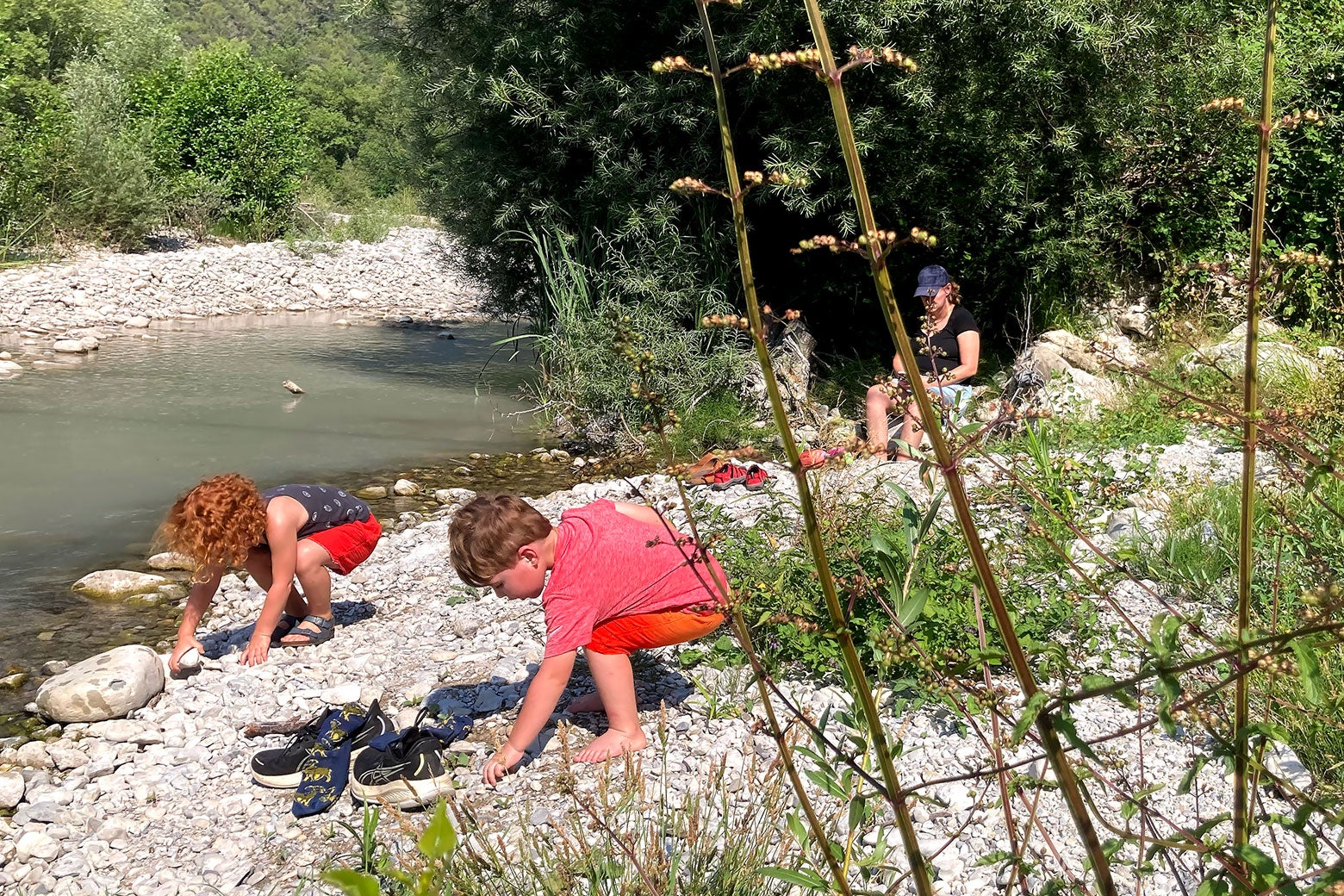
The river is shallow, lovely. I would describe it as the highlight of our trip so far. And yet, I cannot help but think of the drownings. Because while we have been here, temperatures have hit all-time records—111 degrees in one town—and at least 55 people in France have drowned trying to swim in unsafe areas. Many were teenagers trying to cool off in lakes or canals without public supervision.
Everyone we talk with says the heat is quite unusual, with many merely alluding to climate change so as not to offend our perceived American sensibilities. Some are not so subtle. “I don’t care what Trump says, something has changed,” one very friendly local man says to us almost out of the blue at lunch one day. (Temperature: 86 degrees, 66 percent humidity.)
For us, things were really fine—quite lovely actually—until we left the mountains and returned to the city. We arrived Friday morning and couldn’t check in to our house-share in the center of town until 5 p.m. We decided to go to one of the beach clubs to try wait out the heat. It cost us $180 for five beach chairs and towels, but we got a shaded family afternoon near the beach despite extreme demand. As ever, the water in the Mediterranean was perfect—green, buoyant, and the ideal temperature for cooling down without being too cold. (Outside temperature: 88 degrees, 70 percent humidity.)
My 3-year-old son giddily searched for pigeons to chase. My 5-year-old daughter seemed off, though—she spent most of the afternoon napping in the shade. I watched her sleep, trying to figure out how I would assess whether this was jet lag or heat exhaustion. We were heavily sunscreened and shaded, but we had made what turned out to be a bad mistake by not wearing hats. But still, probably just jet lag?
We finally made it to the host-share around 5 p.m. after leaving the beach and gratefully discovering one of the few air-conditioned cafés around. (Temperature 88 degrees, 68 percent humidity.)
Our hosts are very friendly. This is their home. They are escaping to the mountains we just came from. The father and the son are triathletes. The father is very disappointed because this weekend’s Iron Man competition has just been canceled due to the extreme heat advisory. “It’s very sad. People have trained for months and years for this moment, and traveled from very far,” he informs us.
They, too, mention climate change. They also talk about our president. “We like to wait to see how they’ll take it before telling our American guests, but we have a toilet brush shaped like Trump,” they tell us.

Sure enough, there’s a stubby little Trump figurine on the toilet brush—the brush, meant to be Trump’s hair, is orange. I don’t tell them that it’s much too bristly to match the president’s coiffure.
The hosts have instructions for keeping the heat at bay, because there’s no air conditioning. There are ceiling fans; we’re meant to run those. Also, we should keep all windows closed and shutters drawn in the daytime. We should keep the lights all off. They do have ice in the freezer, they helpfully inform us, which is never a given in France.
They leave, and about this time we really notice our daughter start to change. She refuses the opportunity to watch cartoons on her tablet. She never refuses the opportunity to watch cartoons on her tablet. Sure enough, she is burning up.
We message the hosts to ask if they have a thermometer. We find it and they tell us it’s rectal. We decide that I’ll go to the 24-hour pharmacy and get some children’s pain-relief medicine and a new thermometer.
Our daughter naps the evening away. She is so, so hot.
I go out with my brother and sister-in-law to the 24-hour-pharmacy and am reminded about one of the most wonderful things in this country: socialized medicine. We get to the front of the line, tell them what we need, and get what I believe to be prescription-strength fever medicine and a thermometer for just 9 euros.
We wander the town a little bit just to take in the vibe. France is playing against Norway in the World Cup. It’s nearing midnight and the heat is still stifling, but the bars are filled with France supporters watching their team obliterate a Norwegian side that decided to surrender in advance by sitting their star players. We walk by the empty triathlon village for the canceled Iron Man. It’s unclear to me when it will be safe to dismantle all that had been assembled. It is nighttime, and still, it is 86 degrees.
My daughter is sleeping when we get back. We let her sleep. The thermometer we purchased is also rectal, though we can put it under her tongue and get an accurate measurement by adding about 0.7 degrees to it. We’ll deal with that in the morning.
My wife and I struggle to sleep. The windows are down and the street noise from vehicles and chattering people is near-constant. A large garbage truck wakes us at 6 a.m. We decide to try to play ping-pong in the courtyard while the weather is still reasonable, but a neighbor shouts down at us to “stop playing ping-pong!” We get a message from our hosts to not play morning ping-pong anymore, as people have their windows open at that hour to try to keep the heat at bay later on. Message received! (Temperature: 80 degrees.)
When our daughter wakes up, she seems much less hot but still clearly has a fever. We take her temperature. 101 degrees.
We give her some children’s Doliprane—essentially French children’s Tylenol but more effective—and her temperature starts to drop. She is almost herself again. She plays and eats and we start to feel some relief.
I can’t help but think of the recent horrors we’ve been hearing about in the news, on the radio, and from locals. Four toddlers have died in the past week after trapping themselves in cars in the heat.
It’s midday and the temperature outside starts to rise. Our daughter’s temperature starts to rise again as well. (Temperature: 92 degrees, 50 percent humidity. Daughter’s fever: 102 degrees.)
We had been discussing going to some of the city’s beautiful museums, ostensibly to take in the art of local heroes Matisse and Chagall, but mostly it’s to take in the air conditioning. We cannot go out with our daughter like this, though. We administer another dose of Doliprane and draw all the shutters, close all the windows, and shut all the lights. My daughter starts to complain of a stomachache. I google “emergency phone numbers in France” and “difference between heat exhaustion and heat stroke.”
It can’t help but feel like we traveled 6,075 miles to sit in the dark. Everyone naps through the day, and my daughter’s fever has not broken, but it starts to dip. (Temperature outside: 96 degrees, 46 percent humidity, which makes it feel like 106 degrees. Daughter’s fever: 100.5 degrees.)
We have five days until the wedding for things to improve, though it is supposed to actually be much hotter in the region where we’re headed next—between 99 and 103 degrees before the humidity. We think we are lucky—we’re supposed to go to my uncle’s place on Sunday to enjoy his pool and visit.
But we cancel our visit when my daughter’s fever spikes the next day. This leads to a family gossip network that results in many opinions about what to do next—go to urgent care, call an “SOS doctor,” get hydration pills, put her in a cold shower, take a cold bath. One of my uncles is a doctor though, and he advises us to keep giving her the right dose of Doliprane, monitoring, and trying to hydrate her as best as possible—and to call an “SOS doctor” if it comes to it.
As I’m getting this advice, the 3-year-old knocks over the only bottle of Doliprane. It breaks and spills it all over the floor. It’s Sunday and all the pharmacies seem closed. I find one in the center of town that is open for another 40 minutes, and I speedwalk there. My uncle’s advice is good: We wait things out in the morning and the fever drops back down to near-normal. We are also finally done with our dark little 80-plus-degree cave and headed into the country for the wedding, where it is indeed hotter, but we have AC both in the car and in our new place.
Broadly, we realize we are so lucky. We have family here, connections. We think of the tourists who are here for their first time, possibly their only time, who do not speak French and do not have hosts who will outline the precise system of window shutters the locals use to evade the heat. We think of the people who have died trying to cool off in the rivers and lakes. We wonder what we would have done if our daughter’s temperature had stayed high.
I’m still stunned by how quickly things got scary. I tell my mom that I recall having heat exhaustion and having to take nasty Doliprane when she brought me to visit family here when I was little. She remembers it differently: It was merely sunburn, not nearly as serious, because the temperatures outside were much cooler. “It was never like this when you were younger,” she tells me.