1


Clive Hicks-Jenkins' (b. 1951) British Neo-Romantic art style: adapting Renaissance statuette realism into a marionette-inspired, whimsical surrealism through Cubist-like graphic economy to elevate traditional illustration into theatrical mythopoesis.


1
100% Upvoted
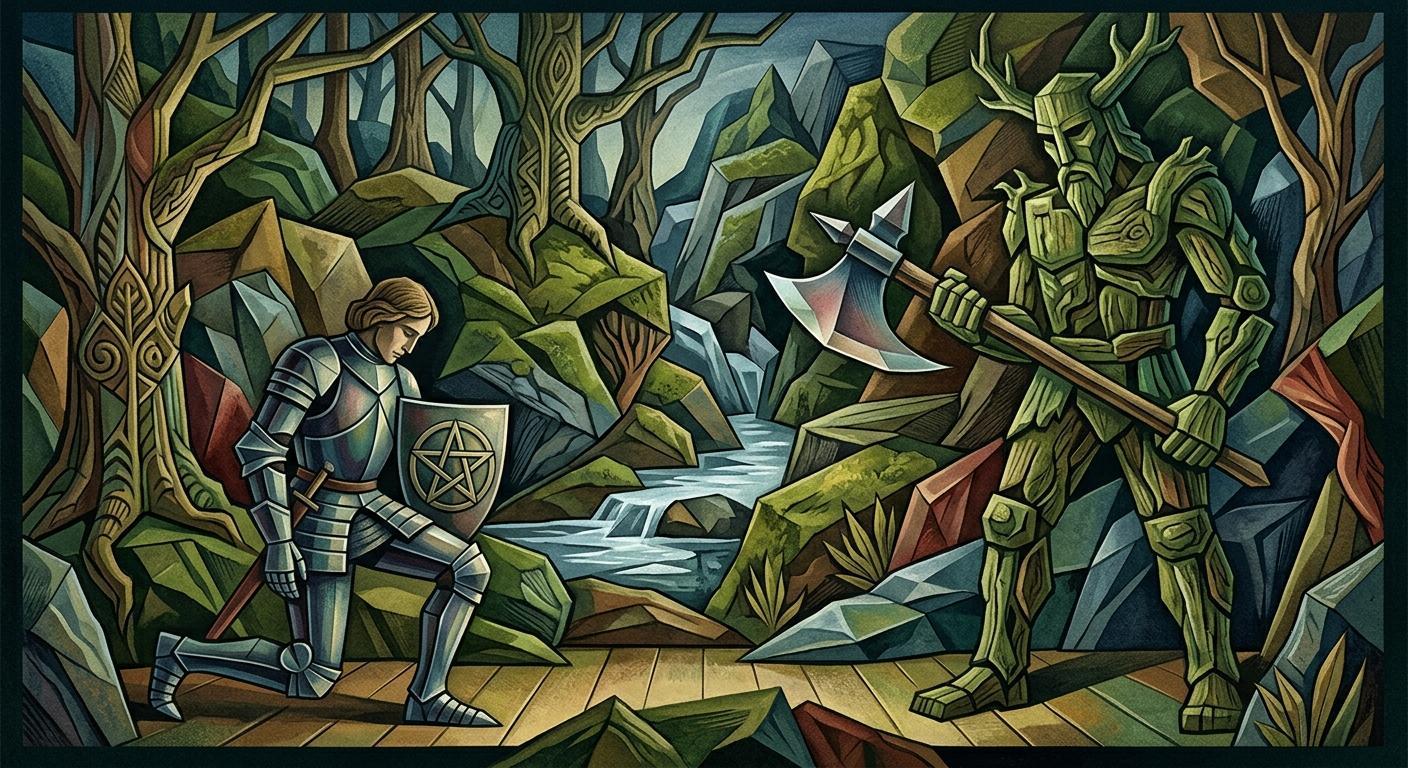
{Sir Gawain and The Green Knight}, illustrated in Clive Hicks-Jenkins' (b. 1951) signature British Neo-Romanticist art style: {
Clive Hicks-Jenkins grounds his visual practice in poetry and literature, viewing narrative—much like novelist George Eliot (1819–1880)—as a fundamental tool for human thought and a primitive unit essential for exploring the unknown. Guided by this philosophy, he favors symbolic and allegorical storytelling, using literature as a conceptual underpainting from which his visual language emerges. The genesis of this hybrid literary-theatrical methodology traces back to his childhood in South Wales, where he crafted his first theatrical doll, a papier-mâché, to visualize a fable—foreshadowed his mature practice of physically embodying textual narratives. Visually, these narrative impulses are deeply informed by British Neo-Romanticism. Artists such as John Piper (1903–1992), Robert Colquhoun (1914–1962), Robert MacBryde (1913–1966), and Keith Vaughan (1912–1977) instilled in him a lasting affinity for dreamlike atmospheres, flattened spatiality, expressive color palettes, and rhythmic linearity, which echo profoundly throughout his body of work.
To realize these narratives, Hicks-Jenkins draws upon his former career as an actor, choreographer, and stage designer. His rigorous methodology involves translating observed subjects into articulated maquettes and photographing these posable models to identify evocative compositions. This continual dialogue between structure and movement captures a suppressed dynamism uniquely suited to narrative painting. His compositional range is fluid, shifting between pictorial storytelling with implied drama, rhythmic modular arrangements, and decorative monumentalism; yet, regardless of the narrative mode, his oeuvre remains unified by a dreamy, liminal distortion of perspective—constructed with a whimsical, papier-mâché‑like sense of layered modularity. He isolates his figures and narrative elements within geometric, paper-cut contours, establishing a streamlined, modular folk aesthetic that recalls Eastern European wycinanki and the paper-cut art of Rob Ryan (b. 1962). He then subverts this inherent flatness by rendering the forms with angular contour deconstructions and metallic gradients. This stylization, with its polished surfaces, recalls the blocky marionette designs of Aleksandra Ekster (1882–1949), the sleek Art Deco realism of Tamara de Lempicka (1898–1980), and the mechanical, toy-like Futurism of Fortunato Depero (1892–1960), though it is executed with a looser, quirky whimsy akin to the world of Tim Burton (b. 1958). While Hicks-Jenkins primarily uses Cubist-like planar abstraction, he frequently employs shaded, linocut-inspired lines to create a faux-relief, imbuing his illustrations with a statuette-like weight and monumental presence. Ultimately, these figures are idealized into tactile, composable charms—reminiscent of William Joyce’s (b. 1957) 'dimensional realism'—functioning as playable props on a miniature stage to achieve a sense of hieroglyphic permanence.
Despite his affinity for British Modernists like Paul Nash (1889–1946) and Eric Ravilious (1903–1942), Hicks-Jenkins consciously pivots away from their decorative structural extractionism to avoid being overly bound by fine-art conventions. Instead, he synthesizes ‘Outsider’ art, folk traditions, applied arts, and early Renaissance narrative painting. This synthesis yields a personalized, flattening framework—a playful, caricatured realism bridging medieval storytelling with twentieth-century modernism.
This conceptual independence is further reflected in his reverence for George Stubbs (1724–1806). While later equine painters like Alfred Munnings (1878–1959) relied on the photographic locomotion studies of Eadweard Muybridge (1830–1904) to achieve strict realism, Hicks-Jenkins admires Stubbs’s pre-photographic, "inner eye" approach. By willingly subverting anatomical accuracy to evoke raw physical emotion, Stubbs provides a blueprint for Hicks-Jenkins’s own pursuit of psychological tension over literal representation.
Clive Hicks-Jenkins firmly believes that artifice—puppets, stage sets, and symbolic objects—serves as a lens to reveal truths about people and places that might otherwise remain hidden, echoing Johann Wolfgang von Goethe’s maxim: "If you wish to advance into the infinite, explore the finite in all directions." He approaches difficult, often tragic subjects through an indirect, highly incubated methodology, aiming for an initial spark of "musical theatricality." Likening his process to catching a skittish horse, he deliberately avoids confronting heavy themes head-on. Instead, he engages in playful studio experimentation—creating maquettes, assemblages, and animations—to obliquely edge toward a work's core psychological tension. While he appreciates happiness in life, he ultimately views underlying tragedy as the driving force of his art, mining his darker experiences for profound artistic depth.
Early in his career, Hicks-Jenkins was commissioned by Old Stile Press to illustrate a letterpress edition of Richard Barnfield’s sixteenth-century poem, The Lamentation of the Affectionate Shepherd: Sick for Love. Chosen for his distinct facility for depicting the human form, Hicks-Jenkins worked closely with publisher Nicolas McDowall, who guided him through new technical processes to ensure the poem's homoerotic sensuality permeated the imagery. The project solidified his foundation as a master of narrative interpretation.
For Catriona Urquhart’s The Mare's Tale (2001), Hicks-Jenkins employs a stark, monolinear ink style evoking the elegant figurative contours of Jean Cocteau. However, he pushes beyond Cocteau’s airy gesturalism, anchoring the work in a structured, Cubist-inspired deconstruction. Fusing primitivist flattening with the monumental composition of tapestry patterns, he generates a haunting architectural presence. The resulting "monotone deconstructivism" renders the physical and the spectral with the same unyielding, calligraphic weight, perfectly echoing the narrative's dark, folkloric roots.
In his 2009 adaptation of Giovanni Bellini’s Annunciation, Hicks-Jenkins demonstrates how his British Modernist stylization functions as a modernized Renaissance realism. He translates Bellini’s statuette-like forms and theatrical lighting into a streamlined, planar graphic economy, resulting in a monumental, choreographed mythopoesy defined by Cubist-like deconstructivist flattening and geometric, faceted gradients.
As Hicks-Jenkins shifted his focus toward the human figure around 2011, his early illustrations showcased a profound affinity for dramatic, romanticized lighting. These works utilize angular, linocut-like compositions characterized by a 'glass-etching' luminosity. In these monochromatic studies, light does not fall upon the subjects so much as it emerges from them; through a series of vibrant, incised hatch marks, the artist seemingly carves brilliance out of an obsidian void, imbuing the human form with a spectral, relief-like intensity.
As Hicks-Jenkins shifted his focus toward the human figure around 2011, he eschewed strict naturalism in favor of a highly stylized theatricality. This figurative approach shares distinct characteristics with the stop-motion puppetry of Tim Burton’s The Nightmare Before Christmas (1993); by employing modular construction and exaggerated anatomy, he generates an expressive, slightly cartoony presence that treats the human body as a posable armature. Beyond this anatomical stylization, these early figurative works exhibit a profound affinity for dramatic, romanticized lighting. They utilize angular, linocut-like compositions characterized by a 'glass-etching' luminosity. In these monochromatic studies, light does not fall upon the subjects so much as it emerges from them; through a series of vibrant, incised hatch marks, the artist seemingly carves brilliance out of an obsidian void, imbuing the human form with a spectral, relief-like intensity.
In his 2018 collaboration with Penfold Press, Hicks-Jenkins reimagines Sir Gawain and the Green Knight through dense, heraldic compositions that demonstrate a profound understanding of typographic semantics and visual weight. His rhythmic, interlocking contours create a flattened depth where symbolism and natural form coexist in high tension. Presenting the protagonist in two distinct modes, the prints bridge Early Renaissance precision with medieval folk art. In Gawain Arrives at Fair Castle, the knight is an iconic cipher—a faceless avatar of "honed masculinity" defined entirely by his armor's defensive geometry. Conversely, The Stain of Sin reveals a psychological shift; using expressive linework, Hicks-Jenkins portrays Gawain as a vulnerable, morally tormented figure, allowing the "stain" of his flaws to break through the rigid artifice of the warrior archetype.
In his illustrations for the 2019 English Heritage anthology These Our Monsters, Hicks-Jenkins adapts his folk-inspired aesthetic into a series of monochromatic graphite drawings. Populating the folklore with grotesque, caricatured figures, he utilizes stiff, marionette-like poses to create a sense of uncanny artifice. Rendered in velvety, textured greys rather than his usual vibrant palette, these works demonstrate that his graphic language—rooted in the theatricality of the paper toy—retains its dramatic power even when stripped to the fundamental interplay of light and shadow.
Collaborating with writer Olivia McCannon on Beauty & Beast (2022), Hicks-Jenkins employs a geometrized folk-art aesthetic that mimics the sharp relief of woodblock printing. Deeply informed by the tradition of Russian lubok folk art, this format utilizes theatrical vignette framing reminiscent of Anatoli Lvovich Kaplan’s (1902–1980) lithographs. The illustrations also draw heavily on the sculptural and uncanny visual vocabulary of Jean Cocteau (1889–1963), particularly his 1946 film adaptation. By blending the tactile feel of cut paper with the dramatic framing of early twentieth-century cinema, he creates a narrative space that feels simultaneously ancient and avant-garde.
For The Owl and the Nightingale (2022), Hicks-Jenkins employs a dense, tactile application of colored pencil to evoke the glow of Russian lacquer art. Isolating his subjects against light-absorbing black backgrounds, he composes them in non-overlapping, modular arrangements that echo a lepidopteran display. By rendering these forms in transitional gradients and a mineral-toned palette, he utilizes "temperature contrast" to imbue his totemic subjects with a cinematic presence—echoing the chromatic brilliance and cloisonné-like delicacy of René Lalique’s (1860–1945) enamel work. Bridging medieval marginalia and mid-century Surrealism, the aesthetic remains ancient yet psychologically modern.
Overall, Clive Hicks‑Jenkins’ signature style is a narrative Neo‑Romanticism aligned with Paul Nash (1889–1946) and Graham Sutherland (1903–1980), enriched by folk art, puppetry, and early Renaissance storytelling. His decorative, rhythmic, angular contour deconstructions and organic gradients are influenced by the carved aesthetics of linocut and letterpress graphics, fused with Cubist fragmentation and German Expressionist atmospherics. Yet he elevates this romantic tradition into a sacred mythopoesy by adopting a directorial role on the page. Drawing from his background in theater, he treats his subjects not as mere illustrations but as "actors" conjured from emotional resonance rather than literal likeness. This process involves deep deliberation—including iterative maquette modeling—to produce the wooden doll-like, hyperbolic gestures that define his work. By utilizing symbolic lighting and a resonant, mineral-toned palette, he avoids narrative clichés, creating a sculptural presence that matches the contemplative weight of the poetry grounding his illustrations.
His figurations are stylized through a primitivist-infused, heraldic aesthetic, arranged in tapestry-like modular compositions that echo the rhythm of folk textiles and Russian lubok prints. These figures are rendered through nature-inspired angular segmentations, recalling the organically compartmentalized brilliance of cloisonné enamelwork and the geometric abstraction of Vorticism. To balance focal intensity, he often stylizes complex objects, such as trees, into folk-art micro-patterns. Synthesizing wooden string puppetry with Bauhaus theatrical design—specifically Oskar Schlemmer’s (1888–1943) geometric costumes—Hicks-Jenkins conveys the story as an ancient, relief-like myth. This staging, rooted in the artifice of early Renaissance painting, invites viewers to engage imaginatively with the narrative. Within these spaces, he consistently avoids straight horizons, disrupting linearity with formal strategies that fracture the scene into dynamic, impossible angles.
These environments are defined by a spatially-flattened contour deconstruction, featuring Cubist-like gradients and a magical chromaticity driven by temperature contrast. Crucially, rather than relying on explicit hard outlines, Hicks-Jenkins defines these boundaries through dense, pencil rendering-like gradients that echo the luminous quality of illuminated glass etchings and the dramatic glare of theatrical footlights. In certain art directions, he pushes this technique to achieve a faux-relief rendering, generating a tactile, trompe l'œil dimensionality that serves as the foundation for his unique maquette theater-like visual framework. This approach, drawing upon the crafted tactility of papier-mâché, achieves an origami-like planar segmentation where structural edges are formed entirely by abutting tonal shifts rather than rigid linework. This rhythmic fracturing shares a profound visual kinship with the 'pastoral Cubism' of John Craxton (1922–2009). Furthermore, Hicks-Jenkins’ use of volume—often reducing anatomy to cylindrical, modular components—recalls the 'Tubist' aesthetic of Fernand Léger (1881–1955). Like Léger, he employs a 'musically autonomous' Cubism where color, pattern, and form vibrate independently of the narrative, destabilizing visual monotony to invite deeper contemplation. Ultimately, this culminates in a monumental decorativeness paralleling British modernists like Edward Bawden (1903–1989) and Stanley Spencer (1891–1959), who elevated illustration into fine art through structural extraction. Hicks-Jenkins distinguishes his work through this specific synthesis of prismatic gradients and George Stubbs' "inner eye" approach—a method that balances underlying logical realism with a visceral first impression. This allows photojournalistically sensitive or emotionally fraught subjects to remain aesthetically alluring without dismissing their psychological weight. Finally, his color palettes echo the expressive tonal range of nature, spanning from the matte delicacy of a flower petal to the deep, metallic polish of mineral chromaticity. The result is a visual puzzle of carved relief shapes that narrates through surreal, avant-garde theatrical gestures within a woodcut-inspired, statuette-like visual language and liminal dreamscape, functioning as a meditative poiesis of a reimagined story.
}