

The Fascist Internationale
by Zoltanous and Judas
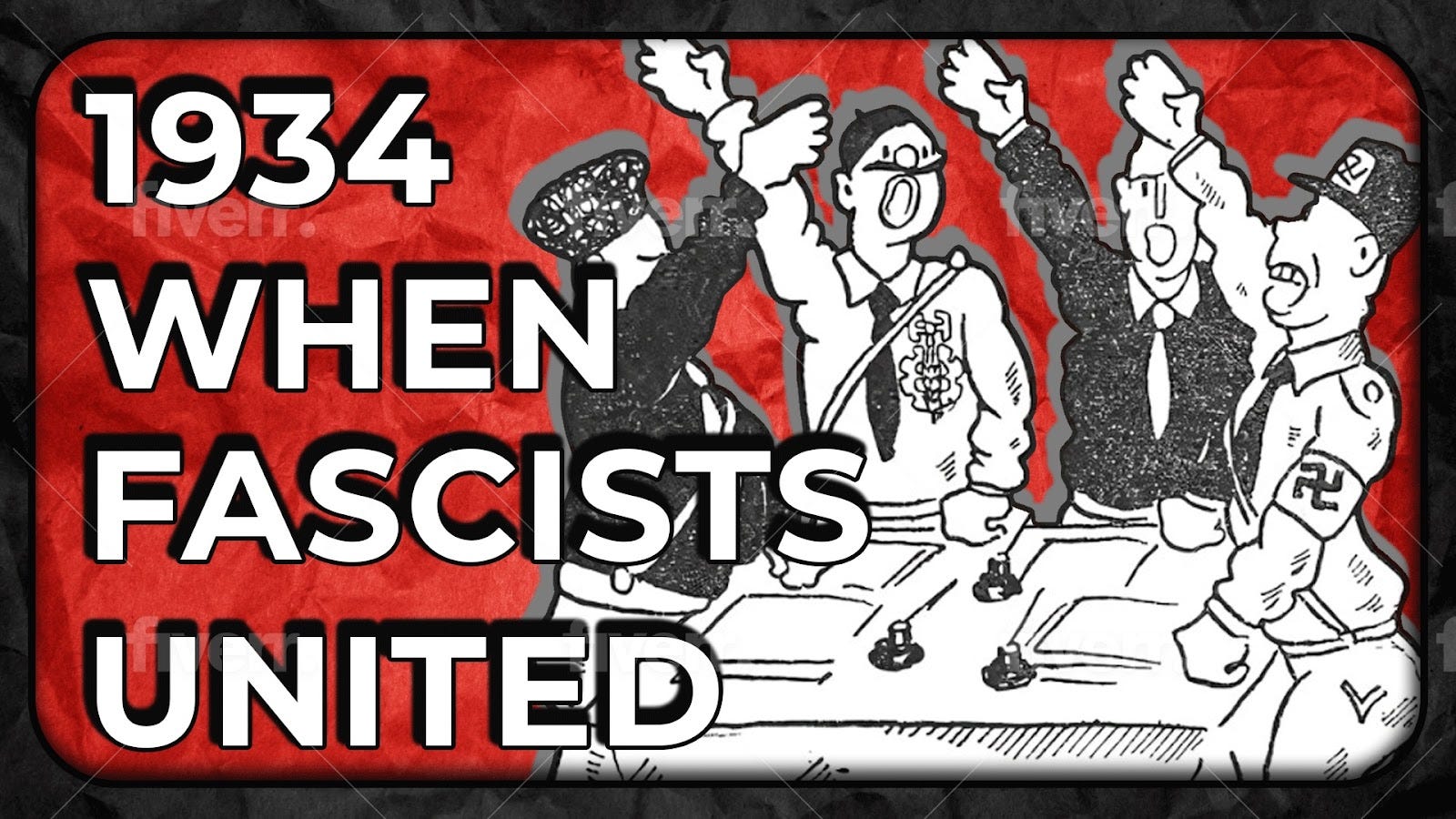
Not widely known is the fact that Fascism, inherently nationalistic, actually developed an "Internationale" of its own, illustrating the ideology's universal aspirations beyond mere national boundaries. This phenomenon is meticulously detailed by James Strachey Barnes in his 1928 work, The Universal Aspects of Fascism, where he argues that fascism uniquely tailors itself to the specificities of each nation's spirit, institutions, and culture, adapting its principles to reflect the distinct historical and social contexts of individual countries. Benito Mussolini himself underscored this adaptability, emphasizing that Italian Fascism was a singular expression of Italy’s national character, rooted in its Roman heritage and revolutionary zeal. In a 1932 interview with Emil Ludwig, Mussolini explicitly advised foreign leaders against mere imitation, stating, “Fascism is not an article for export,” highlighting its bespoke nature. This stance was echoed by Nazi ideologues like Alfred Rosenberg, who asserted the particularity of German National Socialism as an organic outgrowth of Germanic racial and cultural identity, distinct from Italian models. Yet, paradoxically, the notion of Universal Fascism emerged as a faction within the broader Fascist movement, advocating for a global imperial mission that transcended national limits. Berto Ricci, a prominent Italian Fascist theorist and editor of L’Universale, was a key proponent of this idea, denouncing narrow nationalism and racism as petty bourgeois limitations. In his writings, Ricci called for a fascist Internationale — a unified ideological front that would embody a universal Roman spirit while respecting national diversity.
To advance this ambitious vision, the Comitati d’Azione per l’Universalità di Roma (CAUR), or Action Committees for the Universality of Rome, was established in 1933 under the direction of Eugenio Coselschi, a fervent Italian nationalist and Mussolini loyalist. The CAUR convened its inaugural congress in Montreux, Switzerland, on December 16–17, 1934, aiming to bolster the universal appeal of Fascism and forge alliances with fascist movements worldwide. This initiative was, in part, Mussolini’s strategic response to counteract Adolf Hitler’s growing influence, as he perceived a challenge to Italy’s primacy in European fascist circles following Germany’s rearmament and aggressive posturing. Although the congress lacked formal backing from the Italian Fascist Party or its official representatives — a deliberate choice by Mussolini to test the waters without full commitment — it attracted a diverse array of leaders from European fascist movements. Notable attendees included Ion Moța of Romania’s Iron Guard, Eoin O’Duffy of Ireland’s Blueshirts, and Ernesto Giménez Caballero of Spain’s Falange, alongside delegates from Austria, Belgium, Denmark, France, Greece, Lithuania, the Netherlands, Norway, Portugal, and Switzerland, representing a broad spectrum of fascist and ultra-nationalist ideologies.
The conspicuous absence of Nazi Party members from the Montreux congress underscored Italy’s efforts to dilute German dominance within the fascist sphere, a tension exacerbated by the July 1934 assassination of Austrian Chancellor Engelbert Dollfuss by Nazi operatives — an act that enraged Mussolini and briefly strained Italo-German relations. Mussolini’s decision to withhold official Fascist Party delegates reflected a cautious, pragmatic approach, allowing him to gauge the congress’s potential before lending unequivocal support. Meanwhile, internal divisions within other movements were evident: Ramiro Ledesma Ramos authorized Giménez Caballero to represent the Spanish Falange, yet José Antonio Primo de Rivera, the Falange’s charismatic leader, permitted participation while distancing his movement from the fascist label, declaring in a 1934 speech:
“Falange Española de las J.O.N.S. is not a Fascist movement. It is a Spanish movement with a national-syndicalist inspiration, seeking a fatherland that is free, great, and just.”
— José Antonio Primo de Rivera, quoted in José Antonio Primo de Rivera: The Foundations of the Spanish Phalanx by Nick W. Greger
Despite Primo de Rivera’s perplexing disavowal, the Italians recognized the Falange as a kindred fascist entity and extended an invitation nonetheless. However, prominent figures such as Austria’s Ernst Rüdiger Starhemberg, who led the Fatherland Front, and delegates from the British Union of Fascists under Oswald Mosley, declined to attend, signaling skepticism or competing priorities. The Montreux conference grappled with contentious issues — racism, organizational objectives, and anti-Semitism — leading to sharp disagreements and unresolved questions. Proceedings opened with immediate discord, epitomized by a clash between Eugenio Coselschi, the Conference President, and Vidkun Quisling, the Norwegian fascist leader and future collaborator:
“Quisling provocatively stated, ‘Why don’t we talk about the Universality of Berlin? Adolf Hitler is just as much an exponent of Fascism as Benito Mussolini!’
Coselschi retorted sharply, ‘Rome stands, throughout all history, for the Ideal State: authority created by Roman Law!’”— International: Pax Romanizing, Time Magazine, Monday, Dec. 31, 1934
This altercation ignited widespread contention among attendees. Ion Moța raised the incendiary topic of anti-Semitism, pressing for a unified stance, which elicited a nuanced response from the Italian delegation. While the assembly rejected a global campaign of animosity toward Jews, Moța secured a compromise resolution acknowledging the “Jewish Question” as a problem of a “state within a state” and an internationalist revolutionary minority, warranting opposition:
“Considering that in many places certain groups of Jews are installed in conquered countries, exercising in an open and occult manner an influence injurious to the material and moral interests of the country which harbors them, constituting a sort of state within a state, profiting by all benefits and refusing all duties, considering that they have furnished and are inclined to furnish elements conducive to international revolution which would be destructive to the idea of patriotism and Christian civilization, the Conference denounces the nefarious action of these elements and is ready to combat them.”
— International: Pax Romanizing, Time Magazine, Monday, Dec. 31, 1934
Moța’s push to align the conference with German Nazism achieved partial success through this compromise, though it fell short of full endorsement. A second Montreux conference in 1935 intensified debates, with the CAUR explicitly denouncing the Nordicist racial theories propagated by the Nazi Party. Coselschi publicly criticized Alfred Rosenberg’s The Myth of the Twentieth Century, mistakenly conflating it with the entirety of Nazi ideology — a misstep that alienated pro-Nazi attendees like the Iron Guard and Greek National Socialists, who vocally supported Hitler’s racial doctrines. Contrary to some assumptions, José Antonio Primo de Rivera did not attend this second conference, focusing instead on domestic consolidation of the Falange.
Ultimately, the CAUR failed to forge a cohesive definition of “fascism” or unite major fascist parties under an Italian-led international banner. It devolved into a platform for pro-Mussolini propaganda and an unsuccessful bid to counter Hitler’s ascendancy. As Italo-German relations warmed, culminating in the 1936 Pact of Steel, Mussolini’s aspirations for dominance waned. His rhetoric and policies shifted markedly toward racism and anti-Semitism — evident in the 1938 Racial Laws — aligning more closely with Nazi ideology and paving the way for the Axis New Order, as explored in Benjamin G. Martin’s The Nazi-Fascist New Order for European Culture.
In the late 1930s, Germany extended its internationalist outreach, notably through legal networks. The International Law Chamber, proposed in 1939 and formally launched in 1941, sought to unify European jurists under an anti-liberal, corporatist framework, rejecting universalist tenets of international law. This paralleled the Axis’s broader adoption of fascist corporatist structures, as Roger Griffin outlines in his concept of “Palingenetic Ultranationalism.” The Axis alliance spawned additional international entities, such as the German-Iranian Chamber of Commerce, which included Japan, China, India, and occupied territories (excluding the Soviet Union), and the inclusion of Vichy France in the International Union of Telecommunications in Geneva, signaling alignment with the Tripartite Pact nations. The Waffen-SS further established global organizations like the Red Swastika Society, a humanitarian body akin to the Red Cross, reflecting the Axis’s commitment to a new global order.
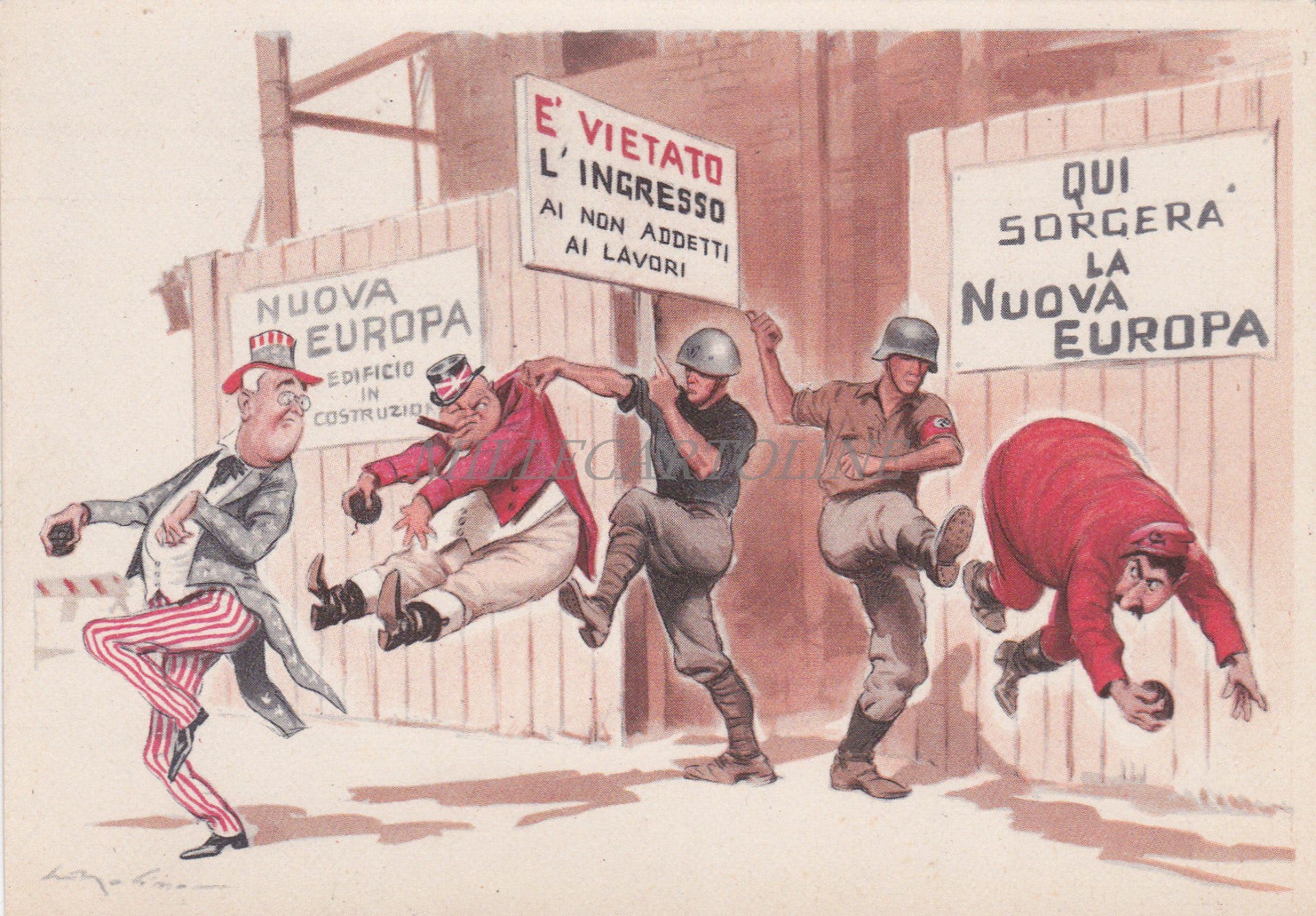
1939 - Italian Fascist postcard, "Here will rise the New Europa. No entry to unauthorized personnel.”
The shift from nationalism to civilizational states drew heavily on Carl Schmitt’s theory of Grossraum (large spaces), which Adolf Hitler had foreshadowed in his 1923 musings on a “German Monroe Doctrine.” Brendan Simms notes:
“Hitler’s idea of a German Monroe Doctrine—which he had first mentioned more than a decade earlier [in 1923]—was picked up by the lawyer Carl Schmitt, who elaborated it into an entire theory of ‘large spaces.’”
— Brendan Simms, Hitler: A Global Biography
Léon Degrelle, the Belgian Rexist leader and Waffen-SS officer, championed a German-led European civilizational state stretching from the North Sea to Vladivostok, while Mussolini articulated a complementary vision late in the war:
“The formation of a European community is desirable and even possible, but I must state in the most explicit way that we do not feel Italian because we are European, but that we feel European because we are Italian. This is not a subtle distinction but a fundamental one. Since the Nation is the result of millions of families that have their own physiognomy and that have a common national denominator, each Nation should join the European community as a well-defined entity, to prevent the community from sinking into socialist internationalism or vegetate in equivocal and generic cosmopolitanism with a Jewish and Masonic imprint.”
— Benito Mussolini, 16 December 1944
“I see the salvation of Europe only in a union of all European states, rooted in the principles of socialism and corporatism. This formidable bloc must defend our civilization and existence equally against the red materialism of the Bolsheviks and the American experiments, which have proven harmful to us. Soon, the petty concerns of Germany, France, Spain, or Italy will fade; the only matter of consequence will be Europe itself, and all will come to see it. Whether this realization comes too late or in time remains uncertain.”
— Benito Mussolini, interview with Ivanoe Fossani, March 20, 1945
This underscored the fusion of German Lebensraum and Italian Spazio Vitale into a civilizational framework transcending ethnic boundaries — a concept Degrelle later termed the “internationalization of National Socialism” in a 1993 interview with Alexander Dugin for Elements magazine. This Grossraum view positioned fascism as a global force, with each civilization — whether Italian exceptionalism or the German völkisch mentality — contributing to a broader fascist construct.
The legacy of this internationalist fascist vision outlasted World War II with striking tenacity. Jakub Drábik’s Concept of a United Europe dissects Oswald Mosley’s postwar pan-European nationalism, a bold reimagining of a continent united under authoritarian ideals. Meanwhile, Richard von Coudenhove-Kalergi — whose Paneuropean Union laid groundwork for the European Union — casts a shadow of fascist-inspired anti-democratic blueprints, subtly woven into the EU’s technocratic fabric. Jean-François Thiriart’s Jeune Europe, Francis Parker Yockey’s European Liberation Front, and the post-war Nation Europa network of former Waffen-SS officers amplify this enduring echo, relentlessly shaping modern debates on European unity — defiant of both Washington’s liberal hegemony and Moscow’s communist grip.
“Hitler was in some ways the most European of the leading statesmen of the Second World War; unlike Roosevelt, Churchill and Stalin, after all, he did have a conception of Europe as a single entity, pitted against the USSR on the one hand, and the USA on the other.”
— Mark Mazower, Hitler’s Empire: Nazi Rule In Occupied Europe


