Russian Fascism: The Historical Development
by Slavic Nation and Zoltanous
After the consolidation of the Soviet Union, the emergence of a fascist ideology within Russia itself appeared highly improbable. The defeat of the White Army and the systematic suppression or dispersal of conservative and counterrevolutionary elements left little ideological or political space for fascism under the new Communist regime. Yet beyond Soviet borders, a different trajectory began to take shape. Russian émigrés, embittered by defeat and disillusioned in the aftermath of the First World War and the Civil War, gradually formulated a distinct fascist current of their own. Their efforts were fueled by the fading hope of returning to Russia and by a continued commitment to the counterrevolutionary ideals once championed by the White movement.
Although Russian émigrés sporadically established fascist groups in Europe, such as the Russian National Socialist Movement in Germany, it was in Harbin, in Manchuria, that Russian Fascism found its most fertile ground. Harbin’s large and politically active Russian expatriate population, combined with its strategic position beyond Soviet control, provided the conditions necessary for the movement’s consolidation. It was there that the concept of a Vozhd, a supreme national leader comparable to the Italian Duce or the German Führer, emerged as a central organizing principle, shaping the direction and identity of Russian Fascism as a coherent political project.
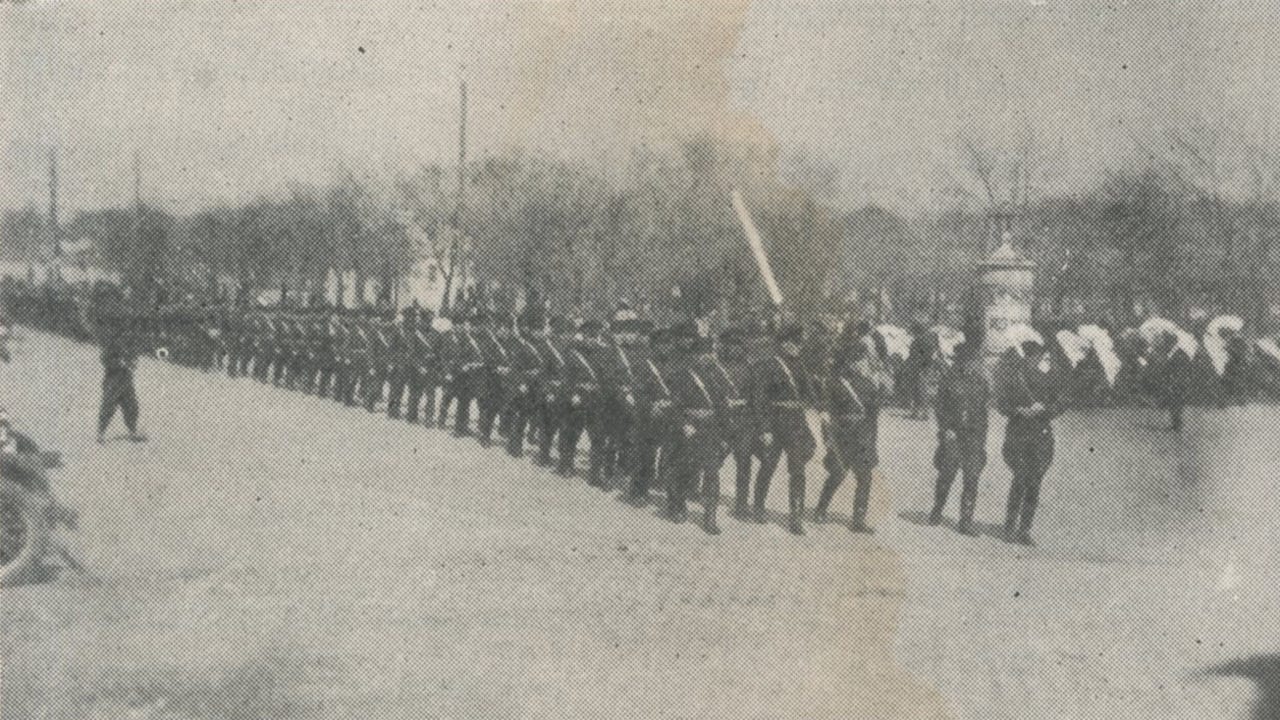
Russian Fascist party Blackshirts marching
Konstantin Rodzaevsky came to embody Russian Fascism, directing the movement’s transformation from a diffuse ideological current into a structured political organization in the form of the All Russian Fascist party. Born in 1907 in Blagoveshchensk, he emerged from the waning Siberian middle class. His early life was shaped by a family environment that combined education and discipline: his father was a well educated notary, while his mother devoted herself to the upbringing of Konstantin and his siblings, including his younger brother Vladimir and his sisters Nadezhda and Nina.
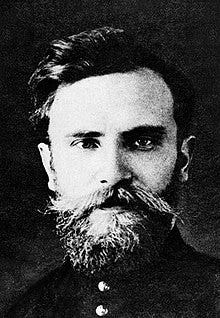
A photograph of Konstantin Rodzaevsky
Rodzaevsky’s life course shifted decisively when he broke from the Soviet system, fleeing the USSR as a former Komsomol member and seeking refuge in Manchuria. It was there that his legal education and political formation began in earnest, shaped by the nationalist and anti communist thought of figures such as G. K. Gins and N. N. Nikiforov, whose lectures he regularly attended. Exposure to these ideas guided Rodzaevsky away from Marxism and toward an increasingly radical nationalist worldview that ultimately culminated in his embrace of fascism.
While studying law alongside other Russian émigré students, Rodzaevsky became deeply captivated by Benito Mussolini and the Blackshirt movement. The discipline, organizational cohesion, and assertive political posture of Italian fascism resonated strongly with Rodzaevsky and his peers, who viewed it as a viable model for resisting both Bolshevism and the broader Soviet bloc. This admiration directly influenced the visual and rhetorical identity of his own movement, leading Rodzaevsky to adopt the Blackshirt uniform for his party. Mussolini’s speeches and ideological formulations likewise served as a significant template for Rodzaevsky’s oratory and for the early development of the Russian Fascist party’s political program.
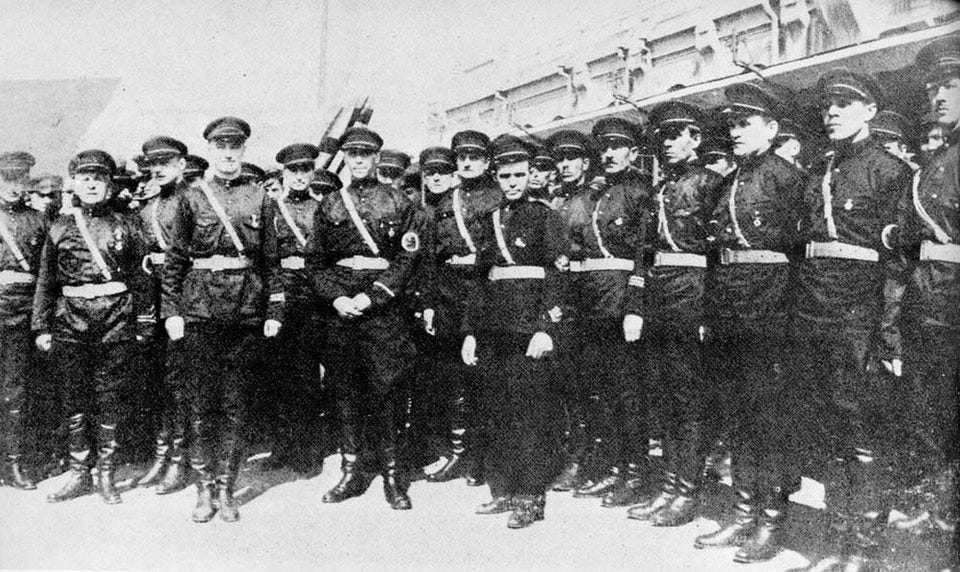
Rodzaevsky at the head of the RFP, meeting Vonsyatsky at Harbin station
The Russian Fascist party (RFP) was formally founded in Harbin in 1931, with Konstantin Rodzaevsky assuming the role of General Secretary. The organization rapidly gained prominence within the Russian émigré communities of the Far East. Its influence expanded significantly in 1934 following its merger with the All-Russian Fascist Organization, led by Anastasy Vonsiatsky, establishing the RFP as the dominant political force among Russian émigrés. During this period, Rodzaevsky distinguished himself as a highly effective propagandist, advancing a distinct ideological synthesis he explicitly termed Russian Fascism. While drawing inspiration from contemporary European fascist movements, Russian Fascism was deliberately adapted to Russia’s historical experience and national character. Central to this adaptation was a pronounced emphasis on Orthodox Christianity, which the movement presented as inseparable from Russian identity and statehood.
Under the slogan “God, Nation, Labor,” the RFP advocated a close integration of church and state as a means of achieving moral, spiritual, and national renewal. The movement positioned itself as a corrective to the upheaval unleashed by the Russian Revolution and the preceding period of social disintegration, rejecting both liberal capitalism and Marxist communism in favor of a unifying national framework intended to restore coherence to the fractured Russian world. Russian Fascism did not present itself as a purely modern innovation. Its ideological foundations were consciously rooted in older Russian political and cultural traditions, a continuity reinforced through the organizational development of the RFP itself. The party’s adoption of the black, yellow, and white tricolor paid symbolic homage to the flag of the Russian Empire. Its membership was further strengthened by the inclusion of former Black Hundreds activists and veterans associated with Roman von Ungern-Sternberg, embedding the movement firmly within a longer lineage of Russian nationalist and counter-revolutionary thought.
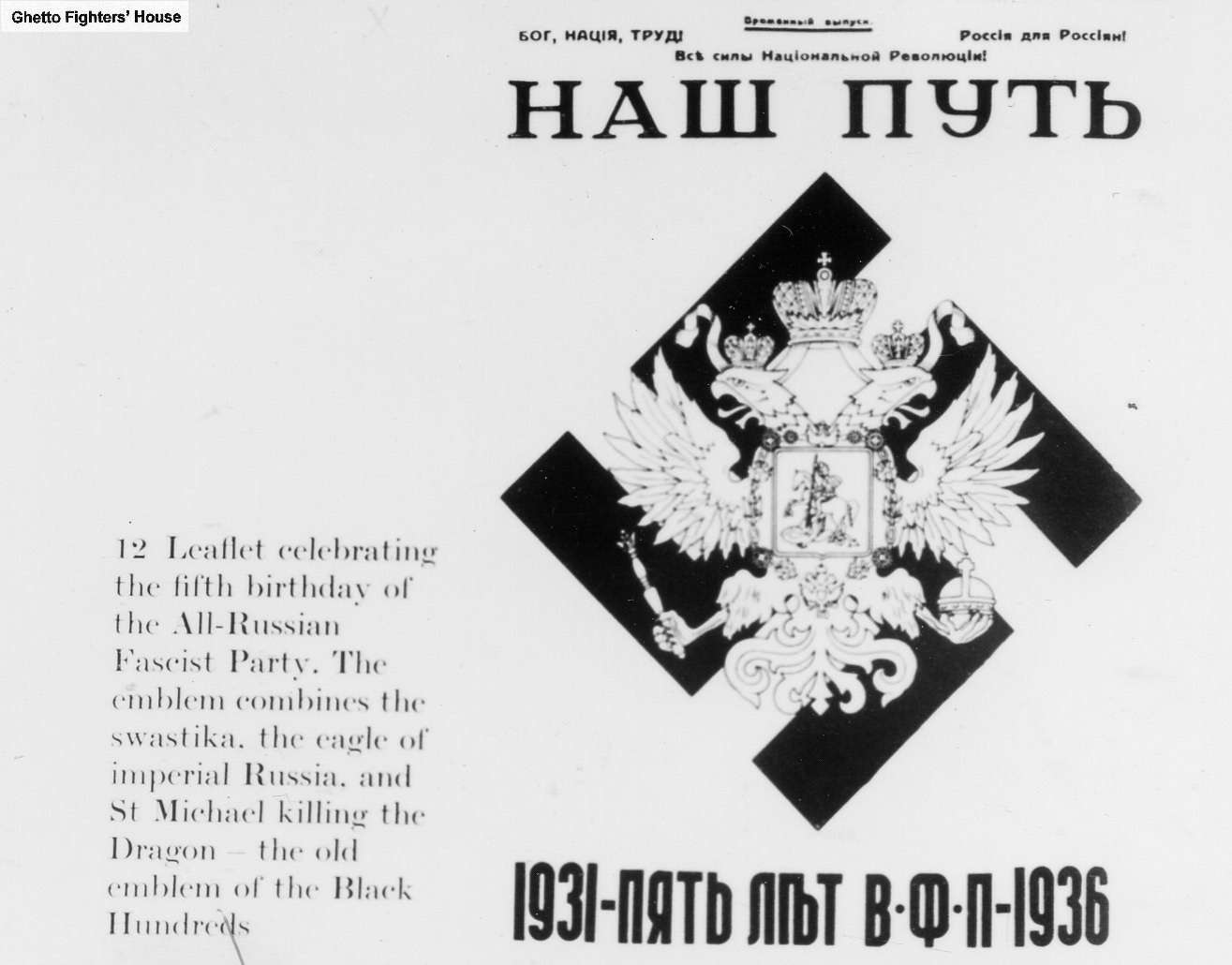
Russian Fascist leaflet
Russian Fascism often traced its ideological lineage deep into Russia’s pre modern political traditions, particularly to the reign of Alexey Mikhailovich, whose system of governance has at times been interpreted as an early proto corporatist model. Under his rule, Russian society was formally stratified into legally defined estates, each bound by specific duties, privileges, and obligations to the state. These estates functioned as semi autonomous corporate bodies rather than as collections of atomized individuals, reflecting a conception of society organized through organic hierarchy rather than liberal individualism. The Zemsky Sobor, an assembly composed of representatives from these estates, further reinforced this structure by providing a mechanism for collective representation rooted in social function rather than abstract citizenship. Russian Fascist theorists later pointed to this arrangement as evidence that corporative representation was not a foreign import, but an indigenous element of Russian political culture that predated Western liberalism.
Within this intellectual current, Konstantin Rodzaevsky openly argued that a future Fascist Russia should not dismantle the institutional foundations of the Soviet system, but instead repurpose them for nationalist ends, while explicitly excluding Jews from participation. He maintained that Soviet administrative, economic, and labor structures could be adapted to serve a national revolution, thereby avoiding the social disintegration and chaos that might follow a total institutional collapse. This position reflected his belief in the structural compatibility between Soviet economic organization and fascist corporatism, despite their opposing ideological justifications. Rodzaevsky further proposed the establishment of state supervised unions and professional associations designed to foster what he described as natural and organic forms of collective association. These bodies were intended to replace class struggle with functional cooperation under national authority, aligning with broader Eurasianist currents in Russian political thought. In this respect, his ideas echoed those associated with Sternberg, whose vision of hierarchical order, spiritual authority, and Eurasian synthesis influenced segments of the Russian nationalist milieu. Through this synthesis, Russian Fascism sought to present itself not as a rupture with Russian history, but as a continuation and restoration of an organic civilizational order adapted to modern conditions.
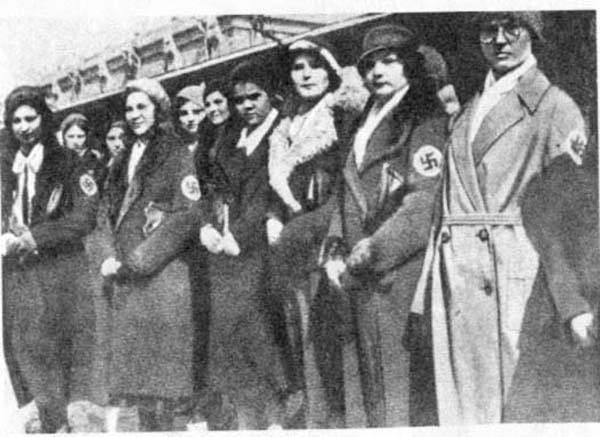
The Russian Fascists Women's League
Russian Fascism articulated an uncompromising critique of the USSR and Marxism, with antisemitism occupying a central place in its ideological framework and in the prolific writings of Rodzaevsky. Through an extensive body of books and articles, many published in the party newspapers Nash Put’ (Our Way) and The Nation, Rodzaevsky consistently disseminated an explicitly antisemitic worldview. Among these works, Contemporary Judaization of The World emerged as one of his most influential and controversial texts. Beyond anti-Semitic propaganda, Rodzaevsky produced a broader corpus of ideological literature that sought to systematize Russian Fascist thought. Notable titles include The ABC of Fascism, Criticism of The Soviet State, The Russian Way, and The State of The Russian Nation, each contributing to the articulation of his political vision and to the enduring record of Russian Fascist ideology.


Russian Fascist propaganda
Influenced by Adolf Hitler’s National Socialism and following its union with the Russian Fascist Organization, the RFP adopted the swastika as its official emblem. Rodzaevsky held Hitler’s ideological system in high regard and sought to incorporate key elements of National Socialist doctrine into his own formulation of Russian fascism. He interpreted the Soviet Union and the events of the so called Russian Revolution as the product of Jewish, Masonic, and international conspiratorial forces, portraying Jews as the principal architects of a tyrannical Soviet regime that had subjugated the Russian people. Within this worldview, Rodzaevsky cast Jews as an internal threat, allegedly working to undermine the Russian nation through covert and corrosive means.
These explicitly antisemitic positions generated significant internal divisions within the party. Anastasy Vonsiatsky, who had previously played a prominent role in the RFP, broke with the organization in protest against Rodzaevsky’s antisemitism and the enforced inclusion of certain members under Japanese influence. Although Vonsiatsky later reestablished ties with the RFP, the reconciliation proved temporary. He ultimately withdrew once again and went on to form a separate faction in the United States known as the Russian National Revolutionary Labor and Workers Peasant party of Fascists, also referred to as the All Russian National Revolutionary party.
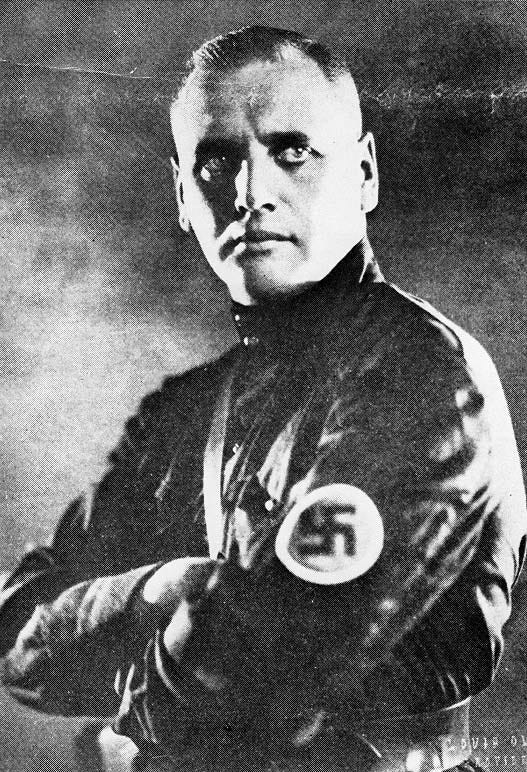
A photograph of Anastasy Vonsiatsky
Anastasy Vonsiatsky maintained contacts with Fritz Kuhn, head of the German-American Bund, and was reportedly involved in efforts that contributed to Kuhn’s release from imprisonment in 1939. His political network also extended to William Dudley Pelley, founder of the Silver Legion of America. In 1942, Vonsiatsky was arrested by the Federal Bureau of Investigation and charged with engaging in clandestine activities on behalf of National Socialist Germany. He was accused of conspiring to assist Hitler’s regime in violation of the Espionage Act, ultimately receiving a sentence of five years’ imprisonment and a fine of $5,000. Released early in 1946, Vonsiatsky maintained his innocence throughout the proceedings, asserting that he held no allegiance to Nazi Germany. He portrayed himself as a monarchist and denied antisemitic intent, claiming that his use of the swastika bore no ideological connection to Hitler or National Socialism. Vonsiatsky died of a heart attack on February 5, 1965.
Russian Fascism developed in direct opposition to the Stalinist system of the Soviet Union, distinguishing it from Italian and German Fascist movements that emerged within liberal capitalist societies. Central to its worldview was the goal of national liberation, framed as a response to what its adherents perceived as ideological, cultural, and spiritual suffocation under Marxist rule. Rodzaevsky denounced Stalinism as the culmination of Marxist materialism’s destructive tendencies, condemning the Soviet state for suppressing dissent, persecuting religious institutions, and eroding Russian creativity and national identity.
While the RFP positioned itself as a force diametrically opposed to communism, it nevertheless shared with other fascist ideologies the Third Position’s rejection of both capitalism and liberal individualism. The movement advocated a system of limited private property under national supervision, distinguishing its economic vision from what it characterized as exploitative capitalism, often framed in explicitly antisemitic terms. Although Russian Fascism generally avoided the development of elaborate racial hierarchies, it made a notable exception in its hostility toward Jews, whom it portrayed as antithetical to the spiritual and national unity of the Russian people.
“The Russian nation is the spiritual unity of all Russian people on the basis of consciousness of a common historical destiny, a common national culture, traditions, etc. Thus, the Russian nation includes not only Great Russians, Belarusians and Little Russians, but also the other peoples of Russia: Georgians, Armenians, Tatars, etc.”
“Fascism takes from the past everything that is dear to the heart of every man, it preserves the religion bequeathed by its ancestors and the spiritual family of man – the nation. On the basis of a historically formed nation, on its roots, it creates a new special system, remaining faithful to the traditions of the past, carefully preserving them. At the same time it provides the possibility of constant perfection of social and political forms, applying them to the last necessities of life.“
— Konstantin Rodzaevsky, ABC of Fascism
Russian Fascism advanced the idea of a shared national destiny that extended beyond ethnic Russians to include a range of historical, religious, and ethnic communities within its political vision. While ethnic Russians and the Slavic peoples occupied a central position, the movement articulated a conditional inclusivity, welcoming other groups willing to participate in the construction of a unified national entity. This flexible conception of belonging reflected the influence of Eurasianist thought within Russian Fascist ideology. Eurasianism played a significant role in shaping Russian Fascist doctrine, emphasizing Russia’s unique position as both a cultural and geographical intermediary between Europe and Asia. This informed the movement’s understanding of Russia not merely as a European nation, but as a distinct civilizational synthesis shaped by multiple historical trajectories. By incorporating Eurasianist principles, Russian Fascism sought to articulate a national identity that acknowledged and integrated the complex interplay of European and Asian influences that had historically defined Russia’s development.
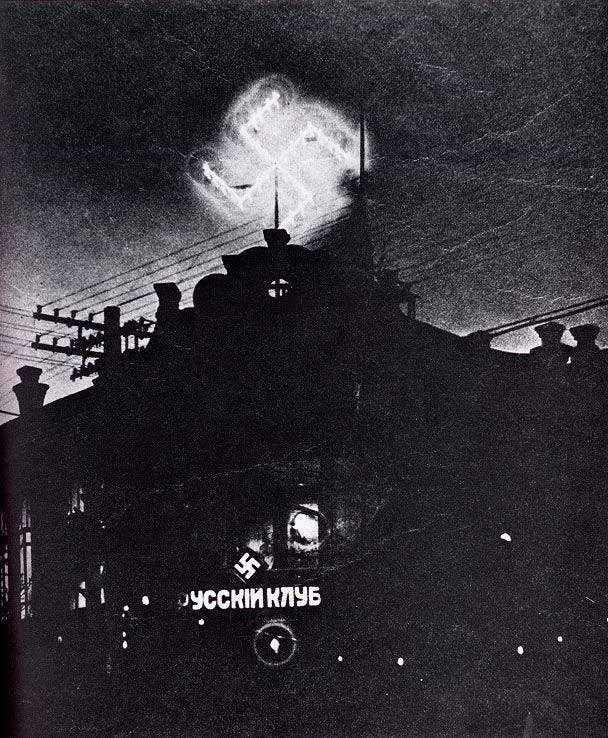
The "Russian Club" in Manzhouli, Manchukuo, in the 1930s
Rodzaevsky exhibited a pronounced hostility toward Atlanticism, at times rhetorically conflating the British Empire, Western rascidm, and Judaism as interconnected forces within a single adversarial framework.
"The British imperialists understand the old Jewish saying: "Only Jews are human beings, the rest are mere humanoid creatures" somewhat differently: "Only whites are human beings, the rest are mere humanoid creatures," narrowing the concept of the "white race" for some as applicable only to Europeans, and for some others only to themselves, the English: "Only Englishmen are human beings, the rest must serve the gentlemen!" In addition to the merchant navy and the English island war fleet. The age of the Great Jewish Preparation turns out to be at the same time the most English age of world history - the age of world trade, colonial conquest, imperialism and the development of maritime travel, the age of the navy. England becomes the mistress of the Mediterranean, the Atlantic and the Indian Oceans, dreaming of dominating the Pacific, or Great Ocean, so that all the waters of our land, as well as the land and the air, eventually become part of her fiefdom - the fiefdom of world Jewry."
— Konstantin Rodzaevsky, Contemporary Judaisation of The World
Moreover, Rodzaevsky viewed liberalism as both philosophically empty and politically corrosive, contending that it served primarily as an instrument of elite economic power.
“Seeing the bankruptcy of all the old parties, they feel that the old party ways cannot continue. It is impossible to go with liberalism, because liberalism has proven to be a great deception: individual freedom has enslaved the individual, freedom of competition has degenerated into freedom of exploitation, and democracy has turned into plutocracy.”
— Konstantin Rodzaevsky, The ABC of Fascism
Within the Russian Fascist movement, a significant internal faction emerged that regarded Adolf Hitler’s regime as hostile and destructive, urging Konstantin Rodzaevsky to sever all ties with Nazi Germany, including the removal of the swastika from party insignia. Members of this faction argued that Hitler’s openly antagonistic posture towards the Russian nation as a whole and all Slavic peoples made continued association untenable. Rodzaevsky, however, refused to repudiate Hitler, a stance that prompted several dissenting members to withdraw from the party. The signing of the Molotov–Ribbentrop Pact further deepened disillusionment within the RFP. The agreement, which inaugurated a period of Soviet–German cooperation, demonstrated that German strategic priorities took precedence over any commitment to émigré political movements. This development accelerated defections among party members angered by Germany’s rapprochement with the USSR. Rodzaevsky himself publicly denounced the pact, viewing it as a betrayal of the anti-Bolshevik cause.
Despite these internal fractures, Rodzaevsky continued to support Nazi Germany’s broader war effort, particularly its campaign against the British Empire, and remained eager for foreign intervention against what he described as Judeo-Bolshevism. He enthusiastically endorsed the German invasion of the Soviet Union, interpreting it as the opening phase of Russia’s national liberation. In June 1941, following the launch of Operation Barbarossa, Rodzaevsky and other Russian Fascists visited the German consulate in Harbin to offer formal congratulations, reportedly chanting “Heil Hitler” the day after hostilities began. Rodzaevsky asserted that the RFP did not regard the invasion as an attack on the Russian people, but rather as a crusade aimed at the destruction of communism. At the same time, Rodzaevsky organized a prayer service at the Orthodox cathedral in Harbin’s Old Cemetery, where he publicly prayed for the success of the German armed forces, further underscoring the fusion of political militancy and religious symbolism that characterized the movement during this period.
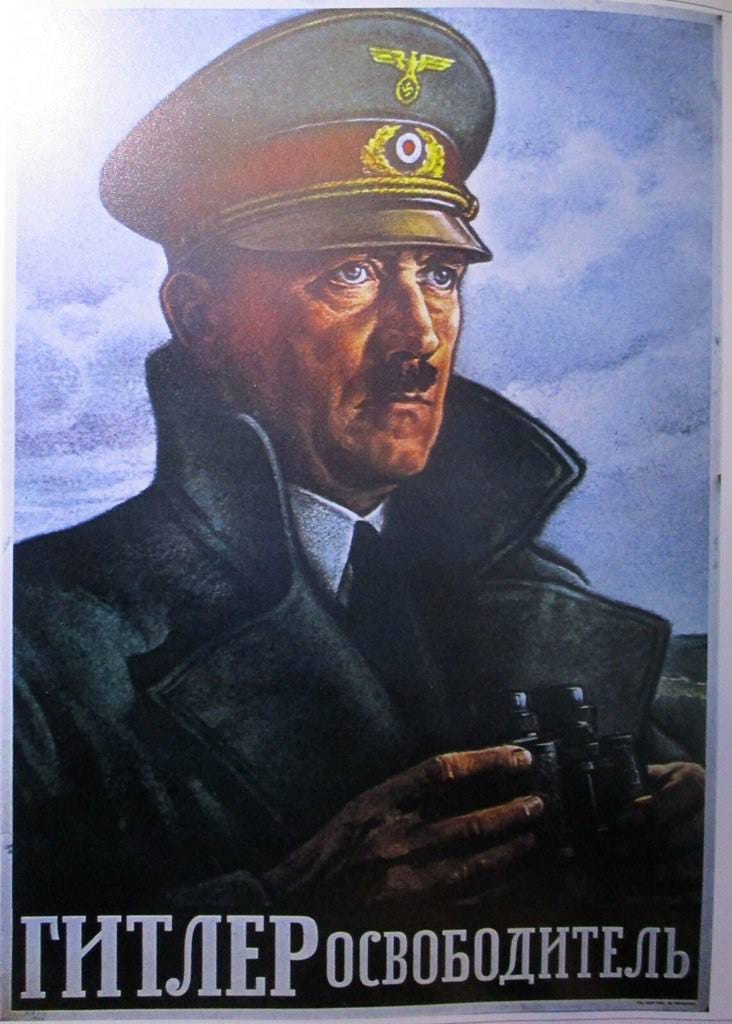
Hitler the Liberator
Throughout the conflict, the RFP made repeated attempts to undermine the Soviet Union, though these efforts largely ended in failure. As a result, Konstantin Rodzaevsky increasingly relied on Imperial Japan, which became the movement’s principal patron. With Japanese backing, Rodzaevsky was appointed head of the cultural and educational division, known as the Second Department, within the Bureau for Russian Emigrants in Manchuria. In recognition of his service, he was awarded the Main Bureau Badge of BREM in June 1941. Despite his desire to participate directly in the war against the Soviet Union, Japanese authorities restricted him to intelligence and sabotage operations, insisting that his activities remain covert rather than military in nature.
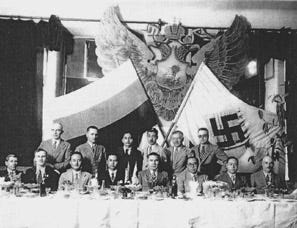
Russian Fascists with Japanese representatives
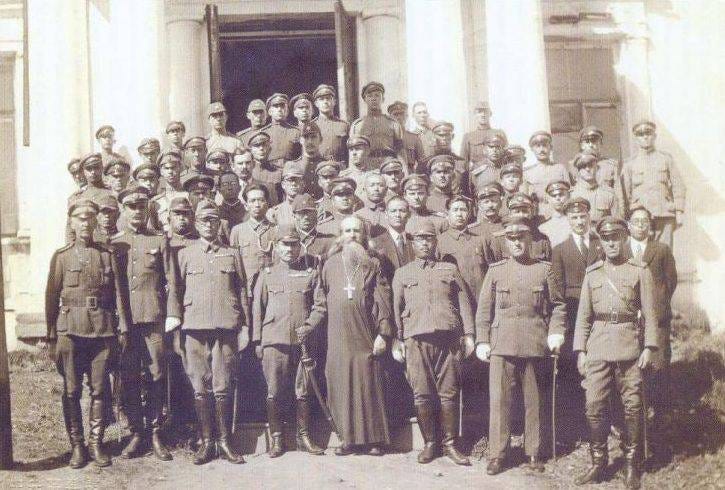
Russians Fascist volunteers in the Japanese Kwantung Army
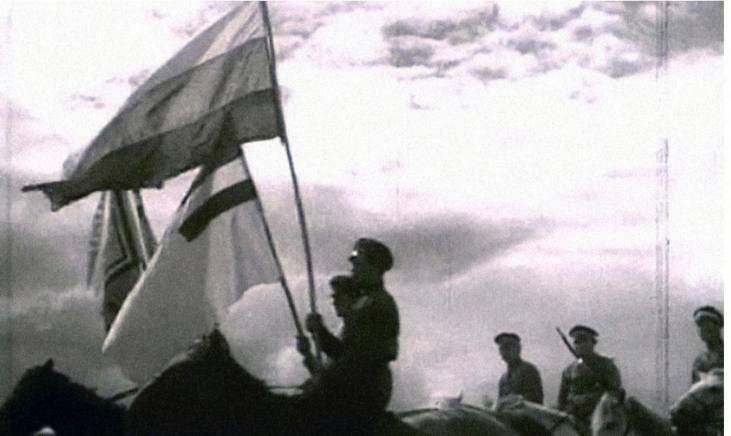
Russian military detachments, presumably in the battles of Khalkhin Gol
During this period, elements of the Russian Fascist movement engaged in illicit activities including drug trafficking, abductions, bombings, border provocations, and blackmail as part of their sabotage campaign. These actions alarmed foreign fascist regimes and led both Italian Fascists and German National Socialists to distance themselves from the party. Benito Mussolini reportedly condemned such behavior as a stain on the reputation of fascism itself. Disillusioned by the party’s increasing entanglement with criminality, several committed members chose to defect.
Rodzaevsky nevertheless maintained close relations with Japanese elites, holding meetings with Sadao Araki in 1934 and again in 1939, and later with Yōsuke Matsuoka. Japanese authorities continued to tolerate and support the Russian Fascists, even permitting them to hold ceremonial events honoring Emperor Hirohito on the anniversary of the founding of the Japanese Empire. With Japanese financial assistance, RFP propaganda expanded significantly, and Rodzaevsky played a central role as both author and ideological propagandist. By the early 1940s, however, the movement’s support began to erode. Reports of Nazi atrocities against Russians circulated among émigré communities, while Soviet propaganda further encouraged defections and denunciations of Rodzaevsky’s leadership due to his alignment with Germany. Japanese authorities also grew suspicious of Rodzaevsky, questioning his past and suspecting possible Soviet ties. In 1943, the Russian Fascist Party was formally outlawed in Japanese occupied Manchuria, ostensibly to avoid provoking the Soviet Union. Following the Soviet invasion of Manchukuo in 1945, Rodzaevsky fled to Shanghai, reportedly consumed by longing for the family he had left behind.
In the aftermath of the war, a demoralized Rodzaevsky authored an article titled The Week That Reforged the Soul, in which he expressed emotional turmoil and regret over his earlier actions. Seeking to avert execution by advancing Soviet forces, he began to argue that the Soviet regime itself was undergoing a nationalist transformation. He cited the restoration of military ranks, gender segregated education, renewed Russian patriotism, reverence for historical figures, pro family policies, and the reintegration of the Orthodox Church into public life as evidence of this shift. In a dramatic ideological reversal, Rodzaevsky declared the USSR the legitimate successor to the Russian Empire and proclaimed Joseph Stalin the true fascist leader he had long sought. He addressed personal letters to Stalin containing claims so extreme that even his former wife and close associates questioned their authenticity. These writings closely echoed the ideas of Nikolay Ustryalov and his theory of Russian National Bolshevism.
“I made an "Appeal to an Unknown Leader" in which I called on strong elements within the USSR to save the state and save millions of Russian lives condemned to death in the war, to nominate X Commander, an "Unknown Leader" capable of overthrowing the "Jewish government" and creating a New Russia. I failed to see then, by the will of fate, his genius and millions of working masses, that the leader of the peoples, Comrade J. V. Stalin was that unknown leader.”
“This is our "Russian Fascism", cleansed of extremes, illusions and delusions.”
— Konstantin Rodzaevsky, Letter to Stalin, 22 August, 1945
Rodzaevsky was given assurances of personal safety along with the prospect of employment as a journalist. He subsequently relocated to Beijing, where he spent several weeks residing at the Soviet embassy. During this period, he expressed serious doubts about the wisdom of returning to Russia. Nevertheless, after prolonged deliberation and a series of personal and political setbacks, Konstantin ultimately resolved to proceed with his decision.
“No, the door is now shut, there is no going back. My family can pay for my past decisions of moving forward and my return but I can't allow this in any way.”
— Konstantin Rodzaevsky, quoted in The Russian Fascists by John J. Stephan
Upon his return to the Soviet Union, Konstantin Rodzaevsky was immediately detained by Soviet authorities. He, together with other former Russian émigrés such as Grigory Mikhailovich, was subsequently brought before a military tribunal. Rodzaevsky was charged with sustained involvement in anti-Soviet activities following his departure from the USSR. The indictment cited his role in founding and leading a Russian fascist organization, disseminating anti Soviet propaganda among White émigré communities in Manchuria, and authoring anti Soviet literature including leaflets, pamphlets, and books.
In addition, he was accused of conducting international subversive activities, specifically the establishment and coordination of affiliated fascist groups in Manchuria, China, Europe, and the United States. The court further determined that Rodzaevsky had participated in plans to launch armed actions against the USSR in cooperation with Japanese military authorities, including the organization and personal involvement in provocations orchestrated by Japanese intelligence that were later used to justify the occupation of Manchuria. He also faced charges for recruiting, training, and preparing spies and terrorists drawn from the ranks of the RFP’s for operations directed against the Soviet state.
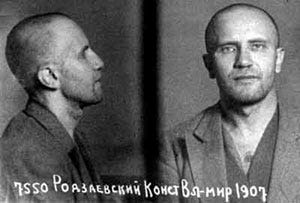
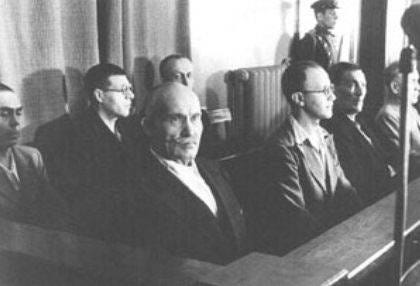
The arrest and trial photos
All of the accused ultimately confessed to the charges brought against them. The proceedings began at 5:00 a.m. on August 30, 1946, and concluded within thirty minutes with the formal reading of the verdict. Konstantin Rodzaevsky was sentenced to death. Contemporary accounts claim that his final words were “Long Live Russia!” before he was executed by firing squad later that same day within the USSR’s MGB headquarters at Lubyanka Building, though no official transcript of such a statement survives.
Rodzaevsky’s final written compilation, The Last Will of a Russian Fascist, was published posthumously in 2001. On October 11, 2010, the Krasnoyarsk Central District Court of the Russian Federation classified the work as extremist material. No formal exoneration has ever been granted to Rodzaevsky, aside from a brief and indirect reference by Alexander Dugin in his article on the Russian Conservative Revolution. In the historical memory of postwar Russia, Rodzaevsky is frequently regarded less as an independent political actor than as an instrument manipulated by foreign powers in pursuit of anti Russian and anti Slavic objectives. Many view him as a figure exploited by both Japanese and German interests, whose ambitions ultimately served external agendas rather than Russian national revival. Regardless of competing interpretations, this assessment has come to define the somber legacy of his life and movement. With Rodzaevsky’s death, the final remnants of an organized and distinctly Russian Fascist project faded from relevance, passing into history rather than shaping it.
“I believed that I was acting in Russia’s interests, but I now understand that my struggle against the Soviet Union was mistaken and harmful to the Russian people.”
— Konstantin Rodzaevsky, prison letter written after arrest, 1945 State Archive of the Russian Federation