🧔♂️ A friendly human may check it before it goes live. More news here
Tencent reportedly in talks for stake in ‘Block Blast’ gaming studio
Tencent Holdings Ltd. is in talks to acquire a small stake in Hungry Studio, the developer behind the casual game Block Blast!, according to people familiar with the situation who asked not to be identified because the information is private.
The talks, ongoing for several months, could lead to an investment soon, but no final decision has been made.
Hungry Studio, founded in 2021, says on its website that Block Blast! had over 300 million monthly players and 70 million daily active users as of the end of 2025.
Shenzhen-based Tencent has previously invested in gaming companies such as Riot Games and the creators of Baldur’s Gate 3 and Dark Souls.
Representatives for both companies did not respond to requests for comment.
🔗 Source: Bloomberg
🧠 Food for thought
Implications, context, and why it matters.
Tencent may back the testing engine behind Block Blast!
- Hungry Studio says Block Blast! climbed from 40 million daily active users in late 2024 to 70 million by the end of 2025 1.
- Sensor Tower data cited by Mobilegamer.biz puts Block Blast! at 284 million downloads in 2025, second only to Roblox 1.
- Hungry Studio ran more than 10,000 A/B tests in 2025, which compares two versions to see what performs better, and it has used this method across progression too 2.
- That testing setup supports an ad-only monetization model, meaning revenue comes from advertising rather than in-app purchases, for Block Blast! 3.
Deal talk hints at a different Tencent approach to mobile games
- The possible investment matters in a market where Tencent already owns Miniclip, a mobile game publisher 4.
- Hungry Studio is pressing into Miniclip’s Numbers genre, which covers number-based puzzle games, with Sudoku Master! 5.
- Across the industry, ad monetization that leans on constant testing is becoming as important as in-app purchases for revenue 6.
- A minority stake would match Tencent’s long-running habit of taking stakes in game companies, and it could bring exposure to Hungry Studio’s ad optimization and experimentation approach 4.
Recent Tencent developments


Stay updated on the go with our mobile app.
Get latest insights with smoother, more personalized experience through TIA mobile app.
Recommended reads
 Glance grows FY25 revenue by 33% as AI goes in style
 Asia layoff tracker: Shopee cuts developer jobs
 The key players behind SEA’s beauty market glow-up
 The Nadiem effect on investors, talent, and Indonesia
 VC tracker: New funds across US, SEA, India
 Cursor to hire over 200 in APAC as it makes enterprise push
 A list of profitable startups and tech companies in SEA
 The clean energy trap Thailand can’t seem to escape
 Indonesia’s leading digital banks in 6 charts
 How ‘hard mode’ became Southeast Asia’s AI advantage










 Adinda Pryanka · · 2 min read
Building a full-stack platform for 20 million Bangladeshi farmers
This article is a part of Startup Spotlight, a series that features young, up-and-coming startups.

Photo credit: IFarmer
What started as a side project for urban rooftop farming in 2018 quickly hit a wall of scalability. The co-founders of iFarmer leveraged their decade of experience in rural agriculture and pivoted, refocusing on the foundational challenges faced by Bangladesh’s smallholder farmers.
😟 Problem
Smallholder farmers, representing over 80% of Bangladesh’s agricultural population, are often caught in a poverty cycle. A lack of formal credit pushes them toward high-interest debt.
Limited market access and unfair pricing from middlemen strip them of their profits, keeping them in a state of financial instability.
💡 Solution
IFarmer offers a comprehensive platform that supports farmers at every stage of the agricultural cycle. The company aims to provide affordable loans, quality inputs, and fair market access. Its services include:
- Farmer financing that bridges the capital gap with low-cost, timely funding.
- An input business to deliver premium seeds and fertilizers to rural communities.
- Advisory services that provide weather alerts and personalized training.
- An output business that buys crops directly from farmers to guarantee a reliable market.

Photo credit: IFarmer
📊 Market size
The agricultural sector in Bangladesh is a US$52 billion economy that employs 40% of the national labor force. This market is driven by 20 million farmers, of whom a staggering 80% are smallholders. The agricultural input market alone is valued at US$27 billion, with nearly half of it remaining unorganized.
🤝 Team
- Fahad Ifaz. Co-founder and CEO.
- Jamil M Akbar. Co-founder and COO.
🚀 Traction
- Generated US$50 million in sales of agricultural inputs.
- Moved US$140 million in agricultural commodities through its supply chain.
- Facilitated US$96 million in financing for farmers.
- Launched Krishop, an agricultural ecommerce platform with over 20,000 active retailers.
- Developed the Folon app to directly connect farmers with its services, such as community support and personalized advisory.
🏆 Competition
IFarmer operates in Bangladesh’s emerging agritech sector alongside competitors like WeGro Global, Fashol, and Krishi Shwapno.
The company differentiates itself through deep, on-the-ground farmer engagement. It hosts monthly courtyard meetings and maintains a physical network of over 1,200 iFarmer Centers.
💰 Financials
The company generates revenue from multiple streams, including commissions on financing and margins on the sale of inputs and products. It also charges service fees to institutional buyers for aggregated and quality-assured supply.
IFarmer has raised US$6.53 million to date and is planning a new round to raise US$5 million.
This piece was written with the help of AI and edited by our staff based on information provided by the startup.
Want to get your startup featured? Fill in the survey here.
Stay updated on the go with our mobile app.
Get latest insights with smoother, more personalized experience through TIA mobile app.
Recommended reads
 Why AI isn’t crushing SaaS in SEA
 SoBanHang bags fresh funding for AI push, regional expansion
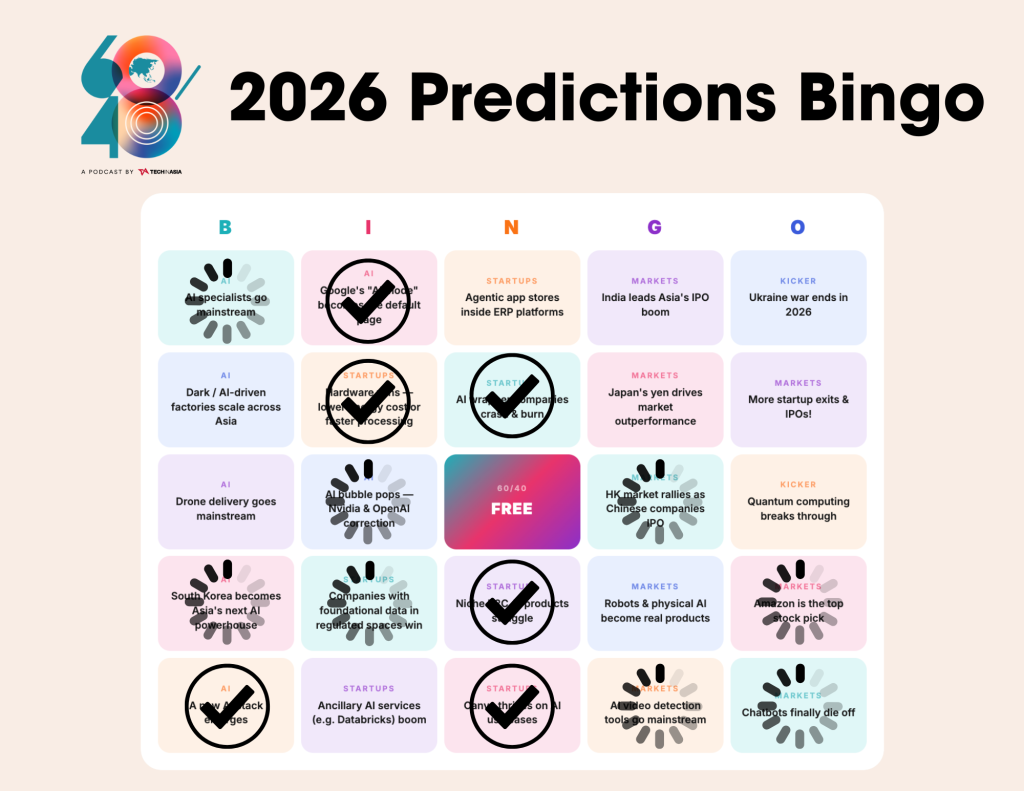
 The 2026 Prediction Bingo update: half right, fully accountable
 Osome’s AI-powered reshuffle
 The startup putting robo-eyes on wind turbines and retail shelves
 Aspire targets 2027 breakeven, taps Antler for startup push
 Watching the driver with AI
 AI scribe startups’ tricky path in SEA
 A new platform digitizes Cambodia’s local pharmacies
 This startup’s AI refuses to answer legal questions without proof















 Grace Priscilla Teo · · 4 min read
Why ‘vibe PMing’ is the future of product management
This article summarizes an episode of Aakash Gupta’s video series featuring Frank Lee, principal product manager at Amplitude.

Image credit: Arsal Ysfin
Frank Lee, principal product manager at Amplitude, argues that software development has moved past manual data analysis. Automating these routine tasks changes the job completely, leading to an era of “vibe PMing.” In this new world, success comes from a manager’s taste and vision, rather than their ability to just churn through paperwork.
However, Lee warns that insight is useless without speed. For automation to matter, it must compress the gap between identifying a problem and fixing it. By integrating AI tools directly into his workflow, he ensures teams can move instantly from diagnosis to execution.
Rethinking the product system
To make this possible, Lee rethinks how information is organized. Most product leaders struggle to make AI find information across the scattered software their companies use. Lee avoids this by organizing roadmaps, contexts, and notes into local files within his code editor, allowing AI tools to access everything simultaneously.
Lee says, “On the left-hand side [of my code editor], I have a bunch of contexts that I’ve already actually aggregated… within Claude Code or within Cursor, I can easily refer to some of those pieces of context, brainstorm about them, and draft a new spec.”
Bridging integration gaps
Beyond organizing context, Lee also addresses workflow friction. He observes that product managers often waste time manually bridging information gaps between tools. To eliminate that inefficiency, he writes custom scripts that pull data from specialized applications into his central workflow.
“Granola [a meeting notes tool] actually does not have a dedicated MCP [command palette] right now. So I tried to hack Claude Code to build some type of automation,” Lee explains. “I basically could run a command to pull in my recent Granola notes using the script we wrote.”
Automating data insights
Similarly, investigating unexpected metrics by hand can consume entire weekends. To avoid this, Lee outlines a five-step process that automates the heavy lifting:
- Chart analysis: Give an agent a link to a chart. It sorts through the data, finds what’s unusual, and guesses why numbers changed.
- Automated reporting: Give an agent access to dashboards. It summarizes the main findings and problems, so you don’t have to check them by hand.
- Summarizing feedback: The agent gathers feedback from all sources (Zendesk, Gong, Slack). It then groups similar comments to find the main problems.
- Creating product documents: Take the results of the analysis and give it to a document template. The agent writes a first draft of the plan in minutes.
- Prototyping and sending tasks: Simple ideas can be turned into early models in the agent’s code editor. Harder tasks are sent to teams through Linear.
“What I would have had to do manually to investigate… the agent did it in a minute and a half,” Lee explains. “I’ve automated basically all of my weekly business reviews.”
Defining the automated workflow
Taken together, this system removes bottlenecks created by human-dependent review processes. Rather than relying on managers to read every chart and dashboard, Lee assigns defined roles to AI:
- Analysis reads charts to find unusual patterns and explains why numbers changed.
- Reporting summarizes weekly progress automatically, so managers do not have to check every dashboard.
- Building turns written ideas into early code examples or sends tasks directly to the developers.
The cost of system complexity
But giving an AI agent access to too many data sources also often creates confusion rather than clarity. Lee warns that overloading the system with irrelevant connections slows down response times and degrades the quality of answers.
“Sometimes people get excited, and they connect a bunch of MCP [tool integration] servers,” Lee argues. “If you have a huge number of servers connected… they start being provided as context to the model on a bunch of different queries that might not be relevant.”
Optimizing agent performance
Engineers are addressing these performance issues by moving away from “always-on” connections. New systems use retrieval methods to activate specific tools only when the user’s request demands them.
This approach marks a shift toward context-aware computing, where, as Lee notes, the system dynamically loads instructions and prompts “only when the model thinks it’s relevant” to execute the task at hand.
⚖️ The other side:
- While “vibe PMing” emphasizes intuition over paperwork, 2024 research from Harvard Business School indicates that AI cannot reliably substitute for human judgment in high-stakes decisions, finding that AI assistants actually lowered the performance of some business owners by 8%.
- Although Lee argues for automating weekly reviews and chart analysis, McKinsey & Company reports that “inaccuracy” remains the top risk for GenAI adoption, with only 23% of organizations reporting they have successfully implemented guardrails against hallucinations.
- While aggregating local context files for AI tools increases speed, the 2024 Cisco Data Privacy Benchmark Study reveals that 27% of organizations have temporarily banned GenAI applications due to data privacy risks, implying that Lee’s method of feeding sensitive internal roadmaps into third-party tools likely violates enterprise compliance policies.
This Too Long; Didn’t Listen (TL;DL) summary was created with the help of AI and edited by our staff. Read all summaries here.
Stay updated on the go with our mobile app.
Get latest insights with smoother, more personalized experience through TIA mobile app.
Recommended reads
 How OpenAI’s PM grades product progress using strict AI rubrics
 Feeding your AI less information might be the smarter move
 Math provides the proof. OpenAI says AI makes original ideas.
 How an ex-OpenAI lead views the shift from software to robots
 Building an AI copilot for robotics engineers
 Building an AI-native telecom infrastructure
 AI agents are reshaping the way we build and use databases
 A service that fixes unpredictable cloud bills
 Why construction giants are using this WhatsApp AI tool
 This startup helps chipmakers stop repeating the same mistakes







Editing by Gilang Kharisma
(And yes, we’re serious about ethics and transparency. More information here.)