
Abandoning Liberal Myths
by Zoltanous
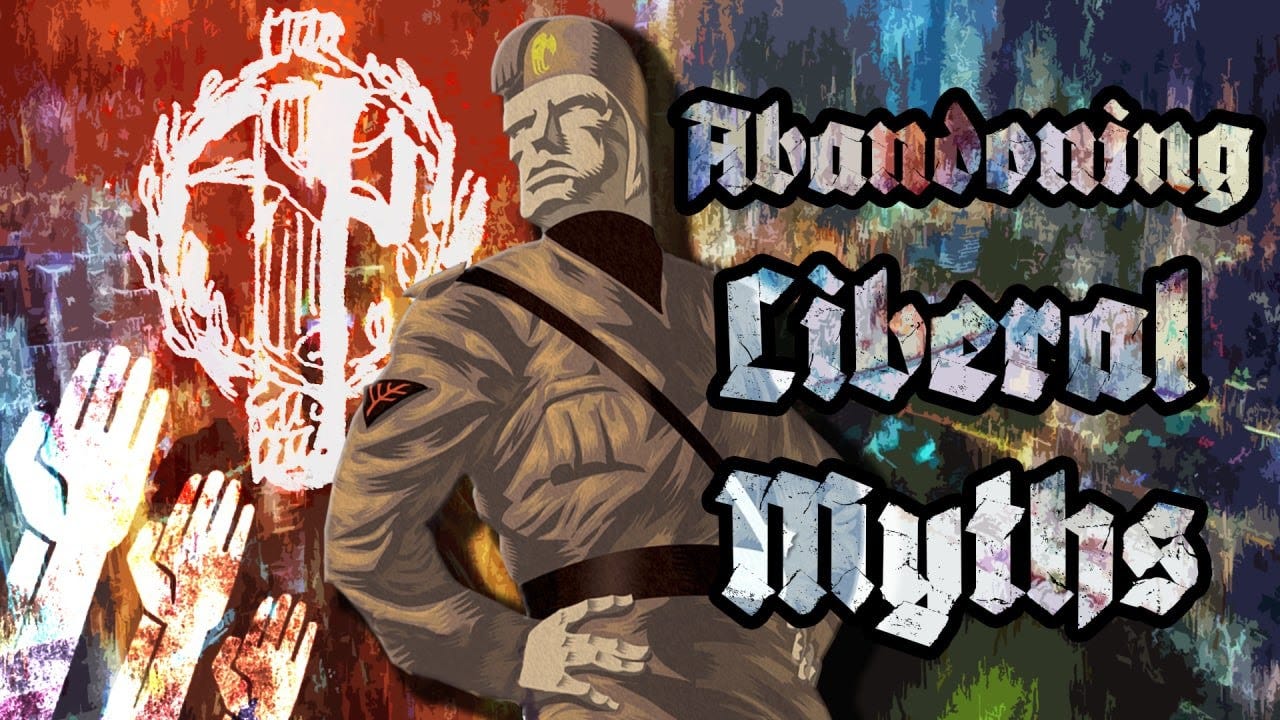
Today, we will delve into the bedrock principles of our liberal society, with a focus on the notion of liberty. This buzzword gets tossed around like it’s gospel, but it’s a shapeshifter — vague enough for anyone to claim. Does true freedom mean chasing every whim without a leash, or does that just chain us to our own dumb impulses? The stakes are higher: Are we born with a free pass to liberty, or is it a trophy we’ve got to bleed for? To cut through the noise, we’ll wield three gut-punch quotes from The Doctrine of Fascism — Mussolini’s manifesto — because nothing exposes liberalism’s flimsy spine like its polar opposite.
“The State’s functions cannot therefore be limited to those of enforcing order and keeping the peace, as the liberal doctrine had it. It is no mere mechanical device for defining the sphere within which the individual may duly exercise his supposed rights.”
“Fascism, in short, is not only a law-giver and a founder of institutions, but an educator and a promoter of spiritual life. It aims at refashioning not only the forms of life but their content – man, his character, and his faith. To achieve this purpose it enforces discipline and uses authority, entering into the soul and ruling with undisputed sway. Therefore it has chosen as its emblem the Lictors rods, the symbol of unity, strength, and justice.”
“Fascism has restored to the State its sovereign functions by claiming its absolute ethical meaning, against the egotism of classes and categories; to the Government of the state, which was reduced to a mere instrument of electoral assemblies, it has restored dignity, as representing the personality of the state and its power of Empire.”
— Benito Mussolini, The Doctrine of Fascism
This stance torches liberalism’s pet theory: the state’s just a night watchman, guarding your rights while staying out of your soul. You’re free to chase your own North Star, as long as you don’t stomp on mine — live and let live, no preaching allowed. But Mussolini calls bullshit. A state that won’t pick a side on the good life leaves us with a ghost of a common good — everyone’s got their own, and society’s just a brawl of egos. Liberalism’s neutrality sounds noble, but it’s a vacuum, and into that void creeps a rejection of anything that smells like a rule. Christianity’s on the ropes, replaced by a smug, post-religious shrug. Even some right-wingers, griping about Islam clashing with “Western values,” end up cheerleading the same progressive liberalism they claim to hate. The irony’s thick: they’re fighting for the beast that’s eating them. Gentile, Mussolini’s brain trust, sharpens the blade:
“Liberalism denied the state in the name of the individual. Liberalism and Marxism are both individualistic insofar as they both deny a reality superior to that of material life which has its measure in the individual. Materialists are always Individualists.”
— Giovanni Gentile, Origins and Doctrine of Fascism
Marxism tried to fix liberalism’s lone-wolf fetish by slotting people into class boxes, but Gentile says it’s still obsessed with the self—just dressed up in historical drag. Fascism leaps past both, welding classes into a national fist with the state as its knuckles. No more squabbling parts; it’s one body, one will.
“Of which liberalism does one wish to speak? I distinguish two principal forms of liberalism. For one…liberty is a right; for the other a duty. For one it is a gift; for the other a conquest… One liberalism conceives liberty rooted in the individual, and therefore opposes the individual to the State, a State understood as possessing no intrinsic value—but exclusively serving the well being and the improvement of the individual. The State is seen as a means, not an end. It limits itself to the maintenance of public order, excluding itself from the entirety of spiritual life—which, therefore, remains exclusively a sphere restricted to the individual conscience. That liberalism, historically, is classical liberalism—of English manufacture.”
— Giovanni Gentile, Origins and Doctrine of Fascism
If Gentile scoped today’s scene, he’d smirk. Progressivism, liberalism’s bastard child, was bubbling up in his day — some of its early fans even nodded at fascism’s grit. Now? It’s a crusade to unshackle everyone from duty, hierarchy, even judgment itself. In liberal democracies, you’ve got the hardcore libertarians, the education overlords pushing woke dogma, and even church bigwigs too timid to pick a god. Post-WWII, this moral stew — half prudish, half preachy — sank its claws into media, schools, government, and corporations. Progressives don’t just tolerate your values; they’ll steamroll them with the state’s boot — hate speech laws, diversity quotas, the works — all to erase any line you’d dare draw. Gentile saw it coming:
“The authority of the State is absolute. It does not compromise, it does not bargain, it does not surrender any portion of its field to other moral or religious principles which may interfere with the individual conscience. On the other hand, the State becomes a reality only in the consciousness of its individuals.”
“The authority of the State was not a product, but a presupposition. It could not depend on the people, in fact, the people depended on the State.”
— Giovanni Gentile, Origins and Doctrine of Fascism
Here’s the fascist fix for liberalism’s freedom trap: the state’s not your servant — it’s your maker. Liberalism’s slide into progressive tyranny proves Gentile right — power doesn’t sit still; it grabs everything. The idea of a “limited government” is a fairy tale; any state can shred its own leash when it wants. Look at the U.S. during COVID — rules bent, rights paused, all in a blink. Or Japan, neutered militarily by Uncle Sam post-war — limits aren’t self-imposed; they’re enforced by someone bigger. Mussolini laughed at the “limited state” myth, dabbling in liberal economics in the ‘20s only to ditch it for total control.
“State intervention in economic production arises only when private initiative is lacking or insufficient, or when the political interests of the State are involved. This intervention may take the form of control, assistance or direct management.”
— Benito Mussolini, The Doctrine of Fascism
Liberalism’s a dead-end worldview — pretty on paper, poison in practice. It peddles “negative freedom” — freedom from stuff, like family or tradition — fueling a selfish streak that ends in anarchy or apathy. Fascism counters with “positive freedom” — freedom to become something bigger, like the “New Man,” forged in struggle and duty. The West treats freedom like a birthright — speech, assembly, now gender roulette — piling on “rights” till duty’s a dirty word. Romans would scoff; their liberty came with a toga and a tax bill, not a tantrum. Fascism says real freedom’s in the collective grind, not some me-first wishlist.
Liberalism’s hands-off act breeds a culture of spoiled brats, hooked on shiny toys — capitalism’s wet dream, courtesy of Bernays’ propaganda playbook. It bets people will guard their freedom, but they don’t; they trade it for Netflix and a latte. The state steps in, rigging schools, laws, and screens to keep the herd docile. Secularism’s no neutral umpire either — it’s a fighter, bashing rivals to stay on top, proving power picks a side or dies.
“The authority of the State is not subject to negotiation, or compromise, or to divide its terrain with other moral or religious principles that might interfere in consciousness. The authority of the State has force and is true authority if, within consciousness, it is entirely unconditioned.”
— Giovanni Gentile, The Reform of Education
Progress isn’t some neat graph — it’s a murky god, a dialectic wrestling match across history, mystic as a Hindu Yuga. Liberals cry “coercion!” and demand the state vanish, but they need it to swing their wrecking ball — ironic as hell. China’s a case study: authoritarian tag, sure, but plenty of wiggle room — until you poke the dragon’s eye. Same in democracies — question the progressive creed, and you’re toast, from canceled to cuffed. Gentile’s take:
“For Fascism... the State and the individual are one, or better, perhaps, ‘State’ and ‘individual’ are terms that are inseparable in a necessary synthesis.”
— Giovani Gentiles, Origins and Doctrine of Fascism
No dodging it — every state shapes a vision; liberalism’s sin is pretending it doesn’t. Alfredo Rocco’s The Political Doctrine of Fascism seals the deal: society’s sovereign only as a state, not a mob of lone wolves. Fascism demands leaders ditch personal gain for the long haul — legacy over selfies. Rights? They’re state-issued, not god-given — tools to weld a nation, not coddle crybabies. Freedom’s not a handout; it’s liberation from decay, a call to fight, build, belong. Liberalism’s “neutral” state is a lie — Fascism owns its bias, crafts a common good, and dares you to live it.


