

A Critical Reevaluation of Mit brennender Sorge — Pt. 3
An unflinching critique of Pius XII's 1945 address, arguing that the Pope's denunciation of National Socialism as a "satanic" force was historically reckless and devoid of magisterial authority
“Pius XII was the drafter of the note of April 30, 1937 on the authentic interpretation of Mit brennender Sorge, analyzed above, and he therefore knew full well that National Socialism had not been condemned as such by Mit brennender Sorge, and still less declared to be of satanic origin. How is it, then, that he insinuates the contrary in his address?”
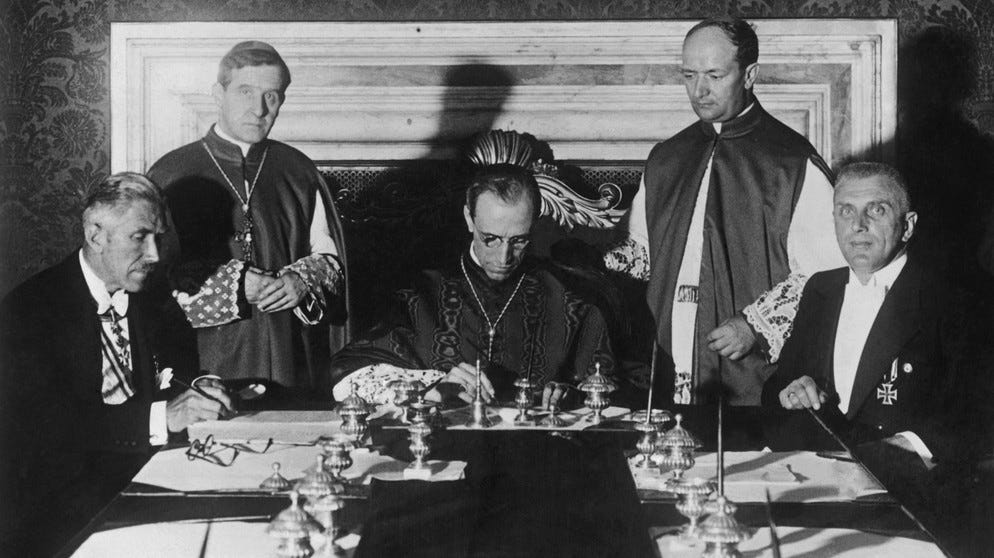
The Road to Mit brennender Sorge
On July 20, 1933, then Cardinal Eugenio Pacelli — acting on behalf of Pope Pius XI — signed a treaty with the emerging National Socialist regime. Before any other State or international actor, it was the Holy See which gave official recognition to the German government. At that time, it was under control of President Paul von Hindenburg.
The treaty which is available online and contains thirty-two articles, began as follows:
His Holiness Pope Pius XI and the President of the German Reich, moved by a common desire to consolidate and promote the friendly relations existing between the Holy See and the German Reich, wish to permanently regulate the relations between the Catholic Church and the state for the whole territory of the German Reich in a way acceptable to both parties.
After this agreement was struck, a period of relative peace was enjoyed by the two parties, unfortunately lasting far shorter than the superior party, the Holy See, would have liked. Cardinal Pacelli testified to the grim reality in the Reich with his 1937 note to Carl-Ludwig Diego von Bergen:1
After 4 long years of vain pressing for a correct observance of the Concordat;
after repeated confidential indications that the Holy See would be compelled to take a public stand if the Government continued its tactics;
after numerous attempts to substitute a solution defensible for both sides with regard to the Catholic associations in place of the weakening of the Concordat sought by the State in June 1934;
after repeated efforts, through personal contact by representatives of the Episcopate with high-ranking persons in the Government, to ease the tension that had set in;
after many unsuccessful appeals to the conciliation authority provided for in article 33 in the face of precipitate and repeated unilateral Government measures in the field of education and in various other important questions, His Holiness the Pope spoke the Supreme Pastoral Word, in accordance with his official duty and his contractual right.
Then, and only then, did Pope Pius XI choose to intervene with his Magisterium, issuing the oft misunderstood Mit brennender Sorge “With Burning Concern”.
From the first installment of this series from Mr. Pierre Moreau re-examining this document, we saw — among other things — how the usual characterization of the situation of the Catholic Church in the German Reich in 1937 is severely wanting, and many times presents counter-truths.
Further, Mit brennender Sorge was a peculiar document in that it was written in German, a vernacular language, unlike encyclicals which feature Latin. As Father Joachim Salaverri, S.J. later noted in 1952, the document had a technical character as an “Epistola Encyclica… given to those [only] addressed to part of the Episcopate, such as the Mit brennender Sorge to the German Episcopate.”
The National Socialist Regime, Though not Condemned Outright, Did Have Serious Problems
As mentioned above, by 1937 the relations between the National Socialist regime and Holy See had significantly deteriorated, to such a point that it was necessary to give a frank assessment of the facts. However, as Cardinal Pacelli remarked, “This diagnosis aims at nothing other than a more rapid, more radical, and more certain cure.” At no point was the German Reich itself questioned, nor was its legitimacy denied. Neither Hitler nor National Socialism — nor any of its derivatives like “Nazi” or “Nazism” — were mentioned. Rather Mit brennender Sorge was a medicinal document, issued “without prejudice” and having a “religious aim”, so as to condemn the neopaganism and anti-Catholic sentiment bubbling in the Reich. Despite the grave errors being advanced by radical ideologues in the party, chief offenders being Ernst Bergmannn and Alfred Rosenberg, the same Pacelli reminds us it was “devoid of political tendencies”.
Non-Catholic historians witness to the same characterization. Certainly having no sympathy for the German Reich or National Socialist system, Jewish historians Guenter Lewy and David Kertzer write in their books, respectively:
Many writers, influenced in part by the violent reaction of the Nazi government to the papal pronouncement, have hailed the encyclical letter Mit brennender Sorge as a decisive repudiation of the National Socialist state and Weltanschauung. Judicious observers have noted that the encyclical was moderate in tone and merely intimated that the condemned neopagan doctrines were favored by the German authorities (emphasis added).2
15. Pignatti conveyed the message; his memo does not directly cite Pacelli as the source but implies it: “the Holy See does not want any comments in the Italian press to emphasize that this letter reflects Vatican opposition to Nazism. (emphasis added).”
16. Pignatti said that Pacelli, whom he saw often, did “not want a break in relations and has been cheered up lately, after having seen that the other side has also hesitated to push the fight to the next level.” […] On April 17 Ciano reported to the Italian ambassador in Berlin on Cardinal Pacelli’s comments about not wanting Hitler to see the encyclical as an attack on Nazism; he attached a copy of Pignatti’s report detailing his conversation with Pacelli. Ciano remarked that the German bishops had pressured the pope into preparing the encyclical and the pope had gone ahead with it “without worrying about the consequences.” Mussolini and his son-in-law were most worried about the consequences that a papal repudiation of the Nazis would have on their own plans to bring Italy ever closer to the Third Reich. But they remained convinced that the pope approved of Mussolini and could be counted on to resist those in the Church outside Italy who wanted him to denounce Fascism along with Nazism. As Pignatti put it, “I have it from an authoritative source that some advisers of the Pontiff would have liked the papal document to strike at all totalitarian regimes. Pius XI rejected these suggestions (emphasis added).”3
In another study, Philippe Chenaux, Professor of Modern and Contemporary Church History at the Pontifical Lateran University in Rome, provides further confirmation of the encyclical’s moderation. He shows that the Holy See was prepared to countenance a healthy form of totalitarianism — provided, of course, that the National Socialist regime respected the foundations of Christian morality. As Chenaux explains, the Holy See “had no form of ideological prejudice toward the National Socialist regime, provided the latter respected the foundations of Christian morality, and that priority had to be given to the Church’s pastoral action for the good of souls.”4
In light of the shared opinion of academic historians and demonstration from the first installment, we can now turn to the another piece of evidence marshaled — sometimes dishonestly — at National Socialism and its historical application in Germany. It is none other than the address of Pope Pius XII to the Sacred College on June 2, 1945. Without further ado, The Journal of American Reform is pleased to present the third installment of Mr. Pierre Moreau’s critical reevaluation of Mit brennender Sorge and the complex relations between the National Socialist government and the Holy See.
Text: Une Encyclique Singulière sous le IIIe Reich, chp. 1-2, pgs. 51-8
A SINGULAR ENCYCLICAL UNDER THE THIRD REICH
Chapter V — The Address to the Sacred College of June 2, 1945
♦ A Traditional Assessment
It is an oral document that is often invoked against National Socialism, with the insinuation that it carries the same authority as the encyclical Mit brennender Sorge. This address is the one that Pius XII traditionally delivered on the occasion of his feast day, the Feast of Saint Eugene, on June 2, 1945, before the assembled cardinals.
Let us note on this subject that the Church has established, since apostolic times, the distinction between the Pope’s theoretical judgment and his practical judgment. This distinction was one of the subjects treated at the first council in history, in the year 50, in Jerusalem.
[T]he Council of Jerusalem [...] separated once and for all the theoretical judgment from the practical judgment; the one that bears on principles, from the one that bears on changing situations: an accommodation which, in religion, is made under the inspiration of charity. Indeed, the famous encounter at Antioch where Paul confronted Peter — after both apostles had come to agreement in Jerusalem to consider Judaic law as superseded, that is to say, obsolete — bore, as Tertullian puts it so well, “on an error of conduct, not of doctrine, conversationis vitium, non prædicationis” (De præscriptione hæreticorum, 23, R.d.J., 294), on the deductions from the principle, not on the principle itself. [...] These are disagreements over practical conduct and a concrete historical situation. These are disagreements and errors, as have perpetually arisen within the Church [...] This distinction between the disciplinary, juridical, and political sphere, which is variable, and the invariable sphere of the porro unum est necessarium (one thing alone is necessary) (Luke 10:42) almost certainly has its origin at the Council of Jerusalem, on the occasion of the first crisis of the Church: the sphere of historicity is definitively distinguished from the sphere of dogma.5
How many other faithful have had to invoke this distinction throughout the history of the Church in order to preserve and maintain their faith? Taking only the history of our own century, it suffices to examine how the Vatican did not hesitate to close out the victorious saga of the Mexican Cristeros with the shabby compromise of the arreglos of June 1929.6 And let it also be remembered that it was, broadly speaking, the same Roman personnel, and in any case the same pontiff, who was pronouncing himself in virtually the same manner in the affair of Action Française.
That said, one will understand that justice is not served by citing in succession an encyclical — in this case Mit brennender Sorge — and then the address to the Consistory of June 2, 1945, without noting that one has moved from one genre to another. This harangue reveals, both by its historical circumstances and by its content, its purely academic and ceremonial character. Consequently, it engages only the practical judgment of the Pope, and in no way his magisterial authority.
♦ The Circumstances of the Address of June 2, 1945
Less than one month after the unconditional surrender of Germany,7 the Pope speaks of the Second World War before it has even ended, as he himself expressly acknowledges. Germany had laid down its arms, but its ally, Japan, would continue to defend itself against the same belligerents, using the same methods of combat, for exactly three more months, until September 2, 1945.
Now, what do we see? We see the common father trampling upon a defeated enemy, siding with the strong against the weak who has just finished fighting for his bare survival, reinforcing the legends of propaganda by placing them on the exact same footing as authentic and verifiable facts, and drawing conclusions which, with the passage of time, grate strangely upon every Catholic ear. Add to this a few distortions applied to recent history in order to make it conform to the wishes of the victors, the conspicuous silence covering the monstrous crimes perpetrated against the vanquished — the vanquished above all — at the very moment of the address, the forever-lost memory of the benefits so recently accepted, and finally, the incredible hardness of heart betrayed by the choice of timing to admonish even a guilty party, had there been one. In short, an address that today would be received without hesitation under the label of politically correct.
♦ The Polish Preference
“We had seen this collapse coming from afar...,” Pius XII proclaims regarding the German defeat. Well, the Poles, for their part, had seen it coming from even further off, and it was moreover in this demented hope that they had set off the detonator of the conflict. The trouble was, they had foolishly believed in its immediate, profitable, and glorious realization. The thrashing they suffered changes nothing about their destructive responsibility. Pius XII would do well to remember that, all the same. It is because they felt covered by the English guarantee, and even more so in the conviction that the German people would rise up against the Reich’s government, that the Polish authorities engaged in countless provocations,8 foolish but bloody, and opposed their obstinate refusal to the numerous peaceful proposals of the Führer Chancellor.9 These provocations and refusals had no other aim than to immediately ignite the powder keg of war and, through it, to provide the occasion for a triumphant cavalry charge of Polish regiments all the way to Berlin. Let us not have the cruelty to dwell on their practical result. In the short term, it was the crushing of Polish arrogance in a defeat that the most august augurs had seen coming neither from near nor from far. And in the long term, it was the enslavement to Moscow, not only of Poland (which had perhaps brought it upon itself), but of half of Europe — an enslavement from which these countries would emerge crippled, if not forever, then at least for a very long time.
♦ A Gratuitous Imprecation
One may well ask whether June 2, 1945 was truly the moment to speak to the cardinals of the “satanic specter raised by National Socialism,” and whether there was really nothing more pressing than to join the pack, howling for the kill in such terms and thus giving it a clear conscience. “The satanic specter raised by National Socialism” is obviously not without echoes of Ledochowski’s opera del diavolo, but with the odious circumstances adding themselves to the odium of the words themselves.
One must not allow to pass without vigorous protest this invective — the gravest that can be pronounced against a man, a government, a party — of having accomplished a diabolical work. Nowhere has the sacred Magisterium pronounced itself in such a manner against National Socialism. This personal opinion of Pius XII does not constitute a condemnation, contrary to what the literature steeped in “authorized lies” likes to claim and spread. Until proven otherwise, this insult was groundless, and moreover, the circumstances made it detestable. And to top it all off, it was and has remained pronounced in absentia. The opportunity to clear one’s name will never be offered to those so insulted.10
♦ Long Live the Right of the Conqueror, Since Might Makes Right
Was it really so timely to invoke and re-invoke — “as We have already had occasion to set forth on other occasions” — the “new dignity” and the “new life” that would not fail to emerge “when the guilty parties shall have atoned for the crimes they committed”? The “guilty parties” could only be the vanquished; to say so would have been a tautology.
How can one not remain astonished at a jurist of great learning speaking of the guilty and their just punishment before they have even been judged by a legitimate and impartial tribunal? Which, in this case, never happened, and for good reason. No one, neither at the Vatican nor elsewhere, ever thought to ensure the conditions of strict justice, yet everyone ratified from the outset the juridical brigandage that brazenly flouted the most elementary principles of law, such as the non-retroactivity of laws and the impossibility of being lawfully judged in one’s own cause; which practiced on a grand scale, with general blessing, the subornation of witnesses and the extortion of confessions under torture.
One would need to make an excursus here on those procedures of what the Anglo-Saxons call Lynch Justice. Its decrees are tailored by the judges in the course of proceedings to fit their need to verbally justify their acts of vengeance. In 1993, General Telford Taylor, former American prosecutor at the “International Military Tribunal,” published a seven-hundred-page volume, The Anatomy of the Nuremberg Trials,11 in which he arrives, according to the London Spectator, at this elementary but devastating conclusion:
The Nuremberg trials were miserably conducted and became a travesty of justice. The accusers were also the judges.
And he adds that the drawn-out proceedings of these tribunals were “callous and unthinking”, such that the defense found itself disarmed by the “brutal and summary methods of the prosecution.”
But already, at the very moment these trials were taking place, the greatest jurist in America was appalled by the methods employed at Nuremberg.
The Chief Justice of the Supreme Court of the United States, Judge Harlan Fiske Stone, was remarking with irritation:
[United States Attorney General] Jackson has gone off to run his high-class lynching party at Nuremberg. I don’t mind what he does to the Nazis, but I don’t like the way he is running it as a court and proceeding according to law in the usual sense of the word.12
And in Congress, the American representative from Wisconsin, Lawrence H. Smith, declared:
The Nuremberg trials so offend the principles of Anglo-Saxon justice that we will have to be forever ashamed of this page in our history [...] The Nuremberg farce plays the role of a policy of vengeance carried to its paroxysm.13
While another member of Congress, John Rankin, from the state of Mississippi, declared:
As a representative of the American people, I wish to say that what is happening at Nuremberg, in Germany, is a disgrace to the United States [...] Two and a half years after the end of the war, a racial minority is not only hanging German soldiers at Nuremberg but putting German businessmen on trial in the name of the United States.14
A legal scholar as astute as Pius XII, occupying a uniquely privileged vantage point in the world, could he have reasonably been unaware of, or even failed to anticipate, what was going to happen?
As for the first British judge at Nuremberg, he gave a proud indication of the spirit animating these magistrates. It was Lord Justice Lawrence, soon after created Lord Oaksey, who, in an address delivered on April 27, 1948, declared, speaking of the International Military Tribunal at Nuremberg:
We had no choice but to join the other nations in putting to death our enemies in Germany.15
It was a scalp dance. No one was obliged to join in.
♦ Vengeance Upon the Innocent
If, then, in June 1945 the guilty parties still remained to be punished, the innocent, for their part, had not been spared. The ruins of Dresden and Chemnitz were still literally smoldering — to say nothing of the fact that this single bombing raid alone, in which at least 250,000 men, women, and children perished in the flames, both the elderly and the wounded (February 13 and 14, 1945).16 The hordes that had swept through and were descending upon Germany were not made up of specters or phantoms, satanic or otherwise, but of liberators in flesh and blood. Could they have been guided by a good angel? To take but one example from among thousands of such abominations, the Palestinian brigade of Russian Jews, “Juda the Avenger,” had come to the village of Judensburg to hand over to the Red Army, along with all their families, the Cossacks who had fought against the Soviets alongside the German army.17
These dramas, in which the satanic specter was nowhere invoked under that name, provide us the occasion for a remark — indeed, for several.
Pius XII was the drafter of the note of April 30, 1937 on the authentic interpretation of Mit brennender Sorge, analyzed above, and he therefore knew full well that National Socialism had not been condemned as such by Mit brennender Sorge, and still less declared to be of satanic origin. How is it, then, that he insinuates the contrary in his address? One would have needed to ask him, but those who would have had the right and the reason to put that question to him had just been “liberated”: free as game in a warren, they were shot on sight. At best, if they were not cut down or lynched on the spot, they were led into slavery, and if not that, then to the gallows.
We are then retorted that if Pius XII turns in this way, in 1945, against the regime that the whole world, roused for the kill, has just brought down, it is because its conduct had demonstrated that, far from mending its ways, National Socialism had gone from bad to worse. In the name of those silenced, one must reply with a question: how else to explain that, among all the belligerent armies of the Second World War, it was precisely those haunted in Pius XII’s memory by the satanic specter that were the only ones neither to commit nor to tolerate the most abominable crime of which troops can be guilty: rape? It was the American author Austin App who affirmed this, and it has never been contradicted:
The rape of women is the most shamefully barbaric act that occupation troops can permit themselves; it is distressing but necessary to say that this is an Allied method of barbarism, and one that was never employed by the Germans.18
♦ On the Difficulty of Being German
More generally, an adversary of Germany, the celebrated British military historian Sir Basil Liddell Hart, observed:
For a surprising feature of the next war was that the German army gained an even better reputation for its humanitarian conduct than it had acquired in 1870 and in 1914, at a time when one would naturally have expected to see “Nazism” added to “Prussianism” to make it worse. [...] In traveling through the liberated countries after the war, one heard widespread tribute paid to the conduct of the German soldier, and all too often one also heard unfavorable remarks about the conduct of the liberating troops. Better still, it even seemed that the close and prolonged contact of the occupation had engendered a better understanding between the common people on both sides, rather than a deepening of prejudice and hatred. The rapprochement between French and Germans was the most remarkable result of all.19
Sir Basil declared himself “astonished.” Very well. His astonishment, which cost him little, never rehabilitated anyone. But is it not rather for us to be stupefied when a personality of this stature, one of the best placed to keep abreast of events, comes to declare himself surprised by the truth? Who, then, had informed this expert on military affairs and on the history of the Second World War? If the father of lies played a role in this conflict, one would have to say on which side he found his most devoted partisans.
♦ On the Convenience of Being Anti-German
In the address to the Sacred College, there is not a single sign of disapproval for the truly diabolical regime put in place by the victors. It is our turn to be astonished. Could it be that Pius XII was himself mistaken about their conduct, dripping with sadism? This time, this infernal policy was perfectly planned, and even publicly announced. The multiple plans for the extermination of the German people by the Allies were circulating in the public domain. One of them, Germany Must Perish [L’Allemagne doit périr], by Theodor Nathan Kaufmann, was launched by Time Magazine.20 There were the plans of Louis Nizer,21 those of Earnest A. Hooton, of Henry Morgenthau Jr.;22 the death-howling calls and the desecration of German women by Ilya Ehrenburg. So much hatred retrospectively made honest people’s heads spin, notably Paul Rassinier, Victor Gollancz, Josef Ginsburg, Freda Utley, F.J.P. Veale, and A.K. Chesterton.
These Allied wartime and postwar crimes were neither unforeseeable nor improvised nor invisible to free minds. They unfolded with the at least tacit consent of the moral authorities of the civilized nations — those very same ones who were preparing to sit at the “International Military Tribunal.” One might even say that they were included in the program of their famous “liberation.”
END.
CONSIDER SUPPORTING THE JOURNAL OF AMERICAN REFORM!
As I intend to devote more and more time to this political project, I want to continue to provide free, educational material, whether visual (graphics) or written (essays, translations and a forthcoming book) content. If you have benefited from my work in any way, kindly consider supporting The Journal financially. On a personal note, I am married and duty-bound to provide for my family, so any help, big or small, is appreciated. Subscribe or make a one-time donation.
Regardless, the production of free material will continue, hopefully with ever-increasing quality, and I will keep all my subscribers notified of my plans.
In addition to Substack, the home of The Journal, my work, graphics and commentary can be found on the following platforms:
X: @AmericanReform_
Telegram: @American_Reform
Documents on German foreign policy, 1918-1945 Series D, Vol. I From Neurath to Ribbentrop, September 1937-1938, p. 965.
Guenter Lewy, The Catholic Church and Nazi Germany, (1964), p. 158.
David Kertzer, The Pope and Mussolini : The Secret History of Pius XI and the Rise of Fascism in Europe, (2014), p. 467.
Phillipe Cheneaux, Il cardinale Pacelli e la questione del nazismo dopo l’enciclica “Mit brennender Sorge”, (2005), p. 267. —
In a letter addressed to Cardinals Bertram, Faulhaber and Schulte on the eve of the meeting of the German episcopate in Fulda in August 1937, Cardinal Pacelli vigorously defended himself against these infamous accusations: “It is not concerned with earthly matters, but with eternal ones. He has for the land and people of Germany only ‘cogitationes pacis et non afflictionis’ (Jer 29:11).” [Pacelli to Faulhaber, Bertram and Schulte, August 2, 1937, AAEESS, box 26.] He reiterated above all as a credo, in a paragraph added in his own hand where he expressed the depth of his thought, what he was to publicly reaffirm in Budapest the following year, namely that the Holy See had no form of ideological prejudice toward the National Socialist regime, provided the latter respected the foundations of Christian morality, and that priority had to be given to the Church’s pastoral action for the good of souls. “The safeguarding and defense of such principles is independent of the respective state form of individual countries. Christ’s Church is sent to all peoples and bears holy responsibilities for all on its shoulders. And in the present time, with its dangers and distresses, with its contradictions and errors, the Church’s pastoral task and pastoral responsibility is greater than ever.” [Pacelli to Faulhaber, Bertram and Schulte, August 2, 1937, AAEESS, box 26.]
Romano Amerio, Iota unum, Etude des variations de l’Eglise catholique au XXe siècle, N.E.L., Paris 1987, pp. 20 and 21. The translation of this passage has been corrected by the present author in order to render it faithful to the Italian original and to avoid even a glaring mistranslation.
In June 1929, Pius XI yielded to the urging and suggestions of the Mexican and American bishops and ordered Catholics to lay down their arms, even as they were prevailing on the ground; the episcopal triangle Rome-Washington-Mexico drafted and signed the arreglos, a detestable compromise, a poor arrangement, a ill-fitting solution, which was to satisfy only the Revolution. Unvanquished, the Cristeros were betrayed by their pastors, and even by the supreme pastor.
May 8, 1945.
“The attitude of the Polish press,” writes Ambassador von Moltke to M. von Weizsäcker, “and other factors of Polish public opinion have recently become markedly more unfavorable toward Germany... Jewish elements, Freemasons, and Marxists, all of the left-wing opposition, the nationalist circles, and also, as might be expected in so Catholic a country, clerical influences are constantly at work, under one pretext or another, to create an atmosphere of hostility toward the Third Reich” (Akten zur deutschen auswärtigen Politik, V, 53, cited by Jacques Benoist-Méchin, Histoire de l’Armée allemande, Albin Michel, Paris 1966, tome VI, p. 183, n. 1) — Jews, Masons, Marxists, and Catholic clergy: it is all the more touching that it was the Union Sacrée which, in France in 1914, rushed to the aid of the Third Republic against the abhorred Boche, and saved it. Pierre Blet describes the Polish atmosphere in 1939 by saying that “Poland was awaiting the German attack with calm” (loc. cit., p. 27).
Count Szembek notes, on February 17, 1939: “I told Fr. Ledochowski that Hitler was genuinely working toward a lasting détente in relations with Poland.” But he immediately adds: “Despite all this, we have, in our relations with Germany, a whole series of territorial and local difficulties which would prove, however, not a lack of sincerity in the assurances of the German government, but rather that the regime is not master of all its executive organs” (op. cit., p. 420). (Editor’s note: It was in the workings of these “executive organs” that the heroes of the German Resistance were lying in wait.)
It might be noted in passing, since we are here dealing with personal opinions, that it is impossible for the same person to believe simultaneously in the authenticity of the apparitions of Fatima and in the satanic and intrinsically perverse character of National Socialism, about which Our Lady said nothing, confining herself to announcing the Bolshevik revolution in Russia. One wonders how those who simultaneously hold both opinions under discussion here reconcile the two.
Bloomsbury, London 1993.
Alpheus T. Mason, Harlan Fiske Stone: Pillar of the Law, New York, Viking, 1956, p. 716.
Congressional Record - Appendix, vol. 95, chap. 14, June 15, 1949, p. A 3741.
Congressional Record - House, vol. 93, chap. 9, November 28, 1947, p. 10938.
See F.J.P. Veale, Advance to Barbarism, 1948, p. 288. “Everyone does it, so it is licit,” says this noble judge. A fine example of what Pius XII condemned under the name of “situational ethics.”
The American bombing of Tokyo was even more recent, dating only to March 16, 1945.
See Sodalitium (Turin), December 1991, p. 32. These horrors were taking place five days before Pius XII’s address, under the baton of the half-Jewish American general Mark Clark, son of Rebecca Ezekiel, who was to powerfully assist the Communists in establishing themselves in Europe, as that general himself admitted in his memoirs. It was also he who had participated in the savage and pointless destruction of the Abbey of Monte Cassino, on February 15, 1944. The total number of Russian and Soviet nationals handed over to the USSR by the Allies falls between two and three million. Those same Allies had dropped six billion leaflets along the front lines promising that prisoners would be treated in accordance with the Geneva Convention. American General Dwight Eisenhower, Supreme Allied Commander for Europe, had already begun handing over prisoners to the Red Army soldatesque — including female auxiliaries, whose reception one can well imagine — even as leaflets promising humane treatment were still falling on the front lines (see the courageous Jewish American author Julius Epstein, Operation Keelhaul, The Story of Forced Repatriation, Devin Adair, Old Greenwich 1973, p. 28). One would also need to evoke the horrors of Tito’s army in Croatia: mass massacres at Bleiburg, May 14, 1945, and, shortly before, in Maribor, priests and civilians shot like animals, as well as the death marches (see: Bernard George, L’Occident joue et perd, La Yougoslavie dans la guerre, La Table Ronde, Paris 1968, passim).
“The foulest atrocity occupation troops can commit is rape: sad to say, it is an Allied atrocity, not a German one.” Series of Pamphlets published from 1946 to 1978 by Boniface Press, USA.
Sir Basil Henry Liddell Hart, Memoirs, Cassel, London 1965, tome 1, p. 203.
James J. Martin, The Man Who Invented Genocide, IHR, Torrance [Ca., USA] 1984, pp. 54 and 55. Could it be that Time was not read at the Vatican? Who would believe it? Let us also add what David Hoggan wrote in the JHR, Spring 1985, p. 85: “Germany Must Perish appeared before Pearl Harbor [December 7, 1941], thus before the United States entered the war. Goebbels asked Adolf Hitler, at Wolfschanze, in Rastenburg, in August 1941, to have this book made known in Germany. Hitler refused because a German victory would have no meaning if it were obtained thanks to combatants of the same type as the barbarous gangsters of the United States, or similar to English soldiers, or indeed to the Mongoloid barbarians used by Stalin.” Germany Must Perish, according to the same historian, received enthusiastic reviews in the American press.
Louis Nizer, Que faire de l’Allemagne? Brentano’s, New York/Paris 1944, whose publication was endorsed by Vice President Henry Wallace: “This book arrives at the right moment”; by future United States President Harry Truman: “Louis Nizer’s book is one of the most fascinating and most informative books I have ever read. Everyone in this country should read it.”; by Maurice Maeterlinck: “It is a profound, methodical, objective, and lucid exposé of all the problems of peace. This book will be the Bible of future peacemakers. They will consult it as one consults an encyclopedia...”. “Guide for a new world order,” Lord Vansittart titled it in the Evening Standard of London, July 14, 1944.
It is on Morgenthau’s orders that the United States issued one- and five-dollar banknotes bearing Masonic symbols: the truncated pyramid and the all-seeing eye, heralding the new world order (see Revue Internationale des Sociétés Secrètes, October 1, 1935, p. 17). All of this could and indeed should have augured nothing good to even the least astute observer.


I plan to read these articles sometime in the near future but I will just say this. Pope Pius XI said that no one at all should be branded with the stigma of crime because they contract marriage despite authorities stating that these individuals would incur hereditary diseases for their offspring, despite all the precautions they undertake. Now this was said in 1930 in Casti Connubi. Is it infallible? It appears that this may be a disputable matter. It is worth noting, however, that this same statement is now used to say that the Sacrament of Matrimony must never be denied to anyone with a serious genetic ailment such as Down Syndrome or Huntington's Disease. But having children with such genetic ailments leads to a significantly greater risk of miscarriages and thus that may gamble with the salvation of such souls, if they cannot be baptized because they have died before exiting the womb. I know that the subject of Limbo can be a messy one, but it is still a serious problem to consider.
Other than the issues with Pope Pius XI stated in this article (I skimmed through a little bit and was able to see those things), there is of course his condemnation of l'Action Francaise which quite a few people took issue with, including Abp. Lefebvre.
And then here are some issues that a few people have with Pope Pius XII as well:
1. His approval of the rhythm method only in grave circumstances, thereby asserting that it is not intrinsically immoral
2. The Holy Week Reforms
3. Certain portions of Humani Generis dealing with science, especially the assertation that theistic evolution may be possible, provided that it does not conflict with principles stated in that encyclical and that science actually manages to prove it.
Also I would like to ask a specific question to American Reform: someone once posted in a comment talking about how interracial marriage is intrinsically sinful, being more emotional than rational about it as well, and he said that Pope Pius XII lifted some of the opposition to the Italian Fascist racial laws that had taken place under Pope Pius XI. Is there anywhere I can learn more about that?