Fritz Kloppe and The Wehrwolf
by Zoltanous
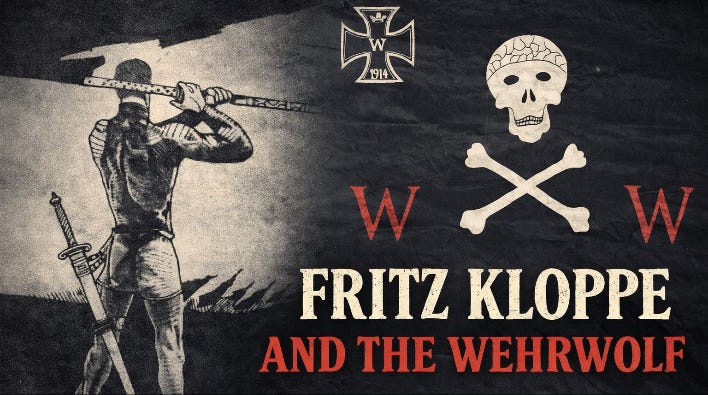
In the aftermath of World War I, amid the ruins of the German Empire and the fragile Weimar Republic, Fritz Kloppe emerged as a fellow architect of a radical nationalist resurgence that rejected both parliamentary liberalism and orthodox Marxism. Born in 1897 in Halle an der Saale to a middle-class family, Kloppe’s early life was shaped by the rigors of military service on the Western Front, where he endured multiple wounds that hardened an unyielding commitment to German revival. Those formative war experiences were not only personal trauma but political apprenticeship, producing a veteran ethos that interpreted defeat as both humiliation and mandate. For Kloppe, the armistice did not end conflict; it displaced it inward, into a domestic struggle over the meaning of Germany itself.
These experiences propelled him into the Freikorps, the freelance paramilitary bands that crushed communist uprisings in the Ruhr and elsewhere, instilling in him a profound disdain for Bolshevism’s internationalist threat while paradoxically drawing him toward revolutionary tactics that echoed Soviet resolve. That paradox mattered. Kloppe and his circle could despise Marxist theory while admiring the disciplined audacity of revolutionary action. In Weimar’s nationalist radical wing, method and worldview did not always travel together.
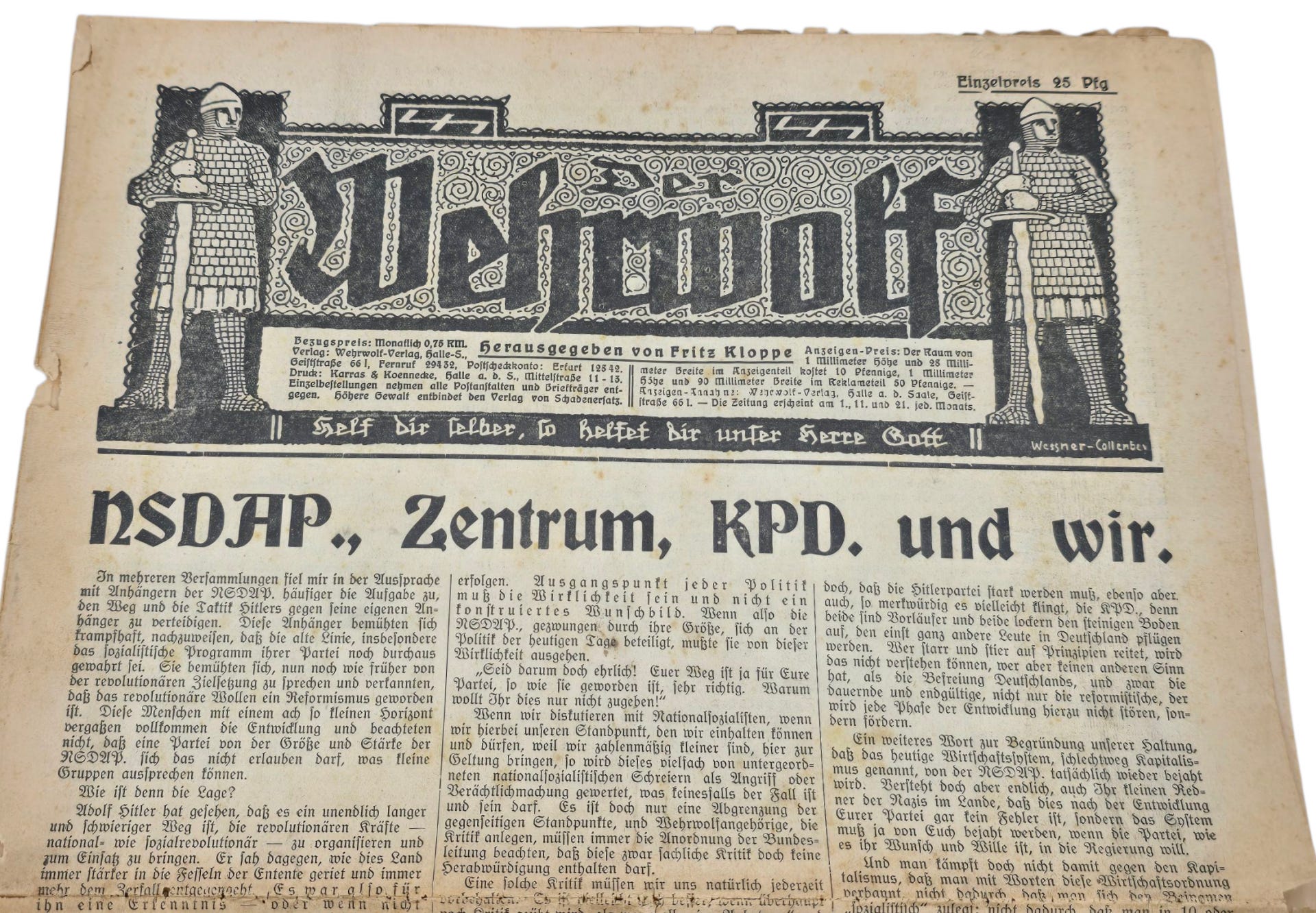
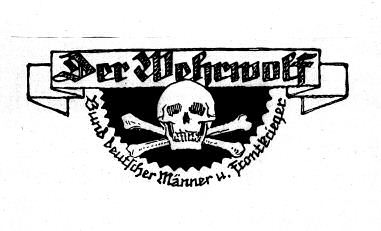
By 1923, as hyperinflation ravaged the economy and French troops occupied the Ruhr, Kloppe founded what would become the Wehrwolf. The organization was established in Halle an der Saale on January 11, 1923 as the Central German Protective Association, and prominent members of the then temporarily banned Stahlhelm League, including figures such as Theodor Duesterberg alongside Kloppe, played a key role in its formation. It was deliberately constituted as a front organization to recruit and train young members for the Stahlhelm before it evolved into a distinct force under Kloppe’s federal leadership. At a delegates’ meeting held on May 12, it was renamed Wehrwolf: Bund deutscher Männer und Frontkrieger, crystallizing the movement’s self-image as an order of disciplined men and front warriors rather than a conventional party association. The Wehrwolf’s founding moment is important not only because of economic crisis, but because 1923 consolidated the belief, across the radical nationalists, that national salvation would not come through gradualism or conventional party competition.


Duesterberg and Kloppe
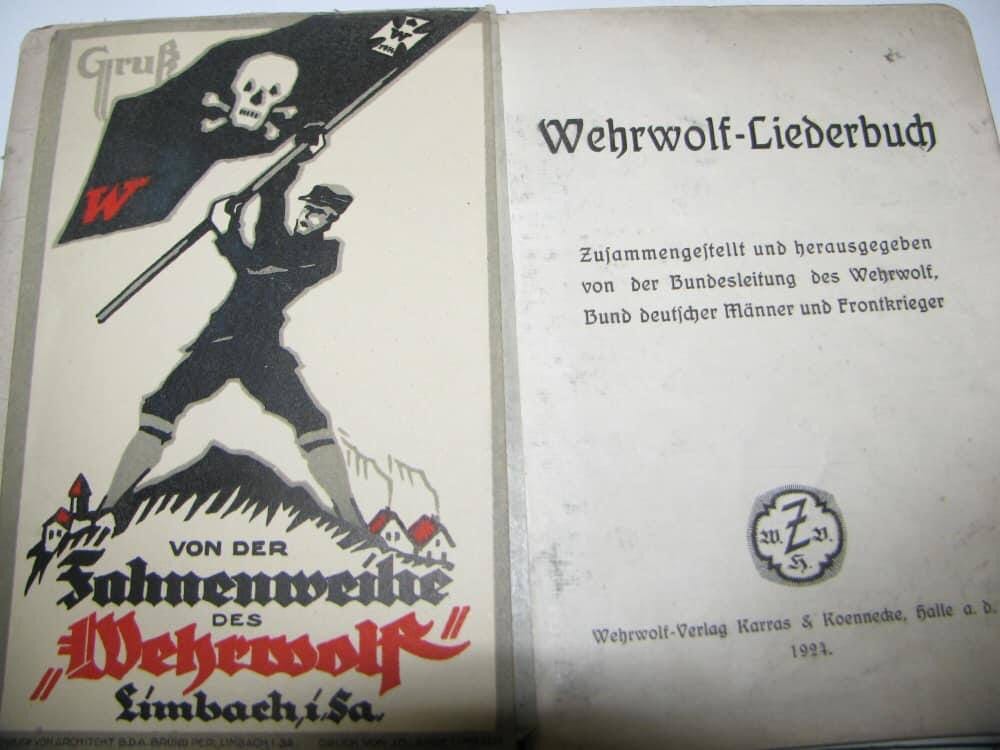
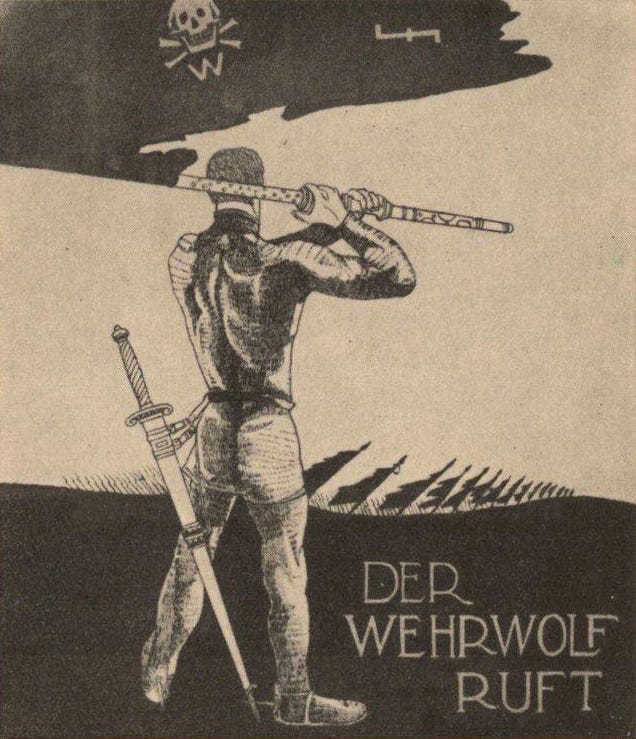
Kloppe’s vision for the Wehrwolf transcended mere militarism. It embodied a holistic ideology rooted in blood-and-soil nationalism, anti-democracy, and a call for a Third Reich grounded in Volksgemeinschaft, a people’s community unbound by class divisions yet fiercely racialist. The language of unity here was not liberal inclusion but organic collectivism. The “community” was not society in general; it was the Volk defined by ancestry, myth, and exclusion. Drawing from Freikorps traditions, the organization’s aesthetics evoked a defiant, almost piratical menace: members donned field-gray tunics adorned with white skulls on black collar patches, skull belt buckles, black-white-red armbands emblazoned with skulls, and black peaked caps. Its flags reinforced this identity. The Wehrwolf flag displayed a silver skull above crossed bones on a black background, with the letter W in red beneath or flanking the emblem, a visual grammar of death, discipline, and vow. This was not incidental decoration. In Weimar’s street politics, insignia and spectacle did ideological work. Uniformity signaled discipline, skull imagery signaled ruthlessness, and the imperial color palette signaled continuity with a pre-republican German Empire.


Key parts of the uniform
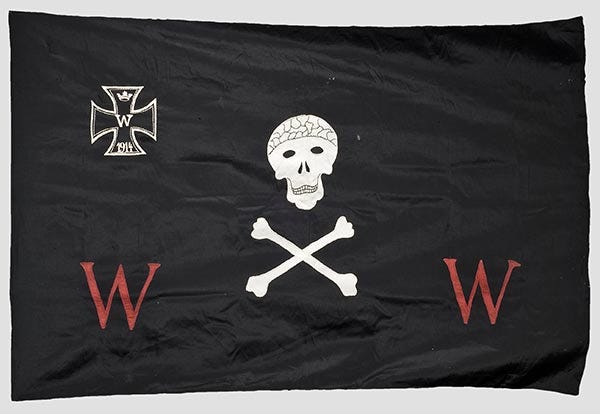
Flag of the Wehrwolf
The youth wing, Jungwolf, bore banners with the ancient Wolfsangel rune, invoking werewolf folklore as a metaphor for guerrilla tenacity against its enemies: communists, Jews, and liberal democrats alike. The Young Wolf flag, in parallel, displayed the wolf’s hook on a black background, reinforcing the cult of hardness and clandestine endurance. It is worth emphasizing that the “werewolf” motif functioned as political myth rather than just romantic nationalism. It suggested an irregular fighter who could survive defeat, dissolve into the landscape, and strike from concealment. In völkisch and conservative-revolutionary circles, mythic framing was a way to sacralize politics, turning organization into order and struggle into destiny. This visual lexicon fostered internal cohesion while projecting an aura of unrelenting loyalty to the Volk, blending Germanic paganism with modern paramilitarism.
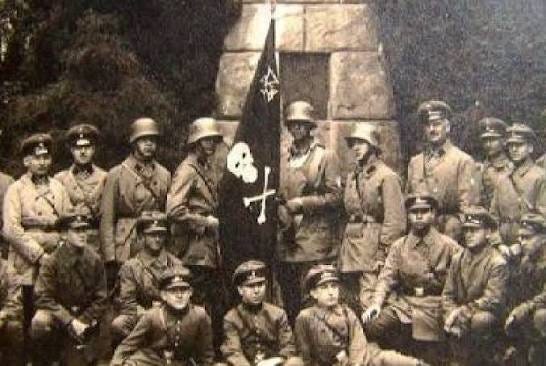
Under Kloppe’s leadership as Bundesführer, the Wehrwolf expanded rapidly from its Central German strongholds in Saxony and Thuringia, peaking at 30,000 to 40,000 members by the late 1920s. Structurally, it resembled other Weimar paramilitaries in its emphasis on camaraderie, hierarchy, drilling, and an action-first ethos, yet it distinguished itself through a stronger rural and youth orientation and a more explicit “national revolutionary” stance. It also adopted a clear internal hierarchy according to the Führerprinzip. The federal leadership oversaw the state leaderships, which in turn controlled the Gaue, and these ultimately directed the local groups. Within this system, young men between the ages of 14 and 17 were organized into the Jungwolf, while those over 24 were responsible for training younger members in a loyal cadre formation described as the Getreue Ekkehartgruppe. Women were grouped into Opfergruppen, sacrifice groups attached to the local organizations, serving as auxiliary structures rather than formal command elements.


The Wehrwolf collaborated early with elements of the Reichswehr for weapons training and tactical drills, and in doing so it moved beyond symbolic militarism into practical preparation. As early as 1923, military training for members included instruction on the Gewehr 98 rifle, the Pistole 08 pistol, the MG 08/15 machine gun, hand grenades, rifle grenades, mortars, and infantry guns. In 1926 to 1927 a paramilitary performance testing system was introduced, formalizing physical and tactical standards and reinforcing the organization’s claim to be an instrument of national renewal rather than a mere fraternity. Here the Wehrwolf sat in the shadow-zone of Versailles compliance: officially outside the state, practically intertwined with elements that tolerated and sometimes trained it, especially where anti-left violence was seen as nationally useful.
Grand rallies, such as the 1925 Wehrwolf-Thing at Leipzig’s Völkerschlachtdenkmal and the 1927 Reichstreffen in Potsdam, drew thousands for ideological indoctrination, folk rituals, and displays of martial prowess, emphasizing war as a purifying force for German rejuvenation. The “Thing” form itself carried meaning. In völkisch usage it invoked a supposed ancient Germanic assembly, reimagining politics as primordial, communal, and quasi-sacred. That ritualization made the movement feel older than the republic and therefore more legitimate than the state it sought to overthrow. The central German Wehrwolf-Thing at the Battle of the Nations Monument in 1925, in particular, worked as a symbolic fusion of national memory and paramilitary future, a stage on which myth and drill were made mutually reinforcing. Yet Kloppe’s strategy still eschewed electoral politics, favoring a “united front from below” that rallied peasants, workers, and soldiers against the Weimar system, drawing inspiration from the rural Landvolkbewegung and broader conservative revolutionary circles. This is one of the Wehrwolf’s key signals: it tried to mobilize “the nation” directly rather than win seats. It treated parliamentary success as secondary at best and corrupting at worst.
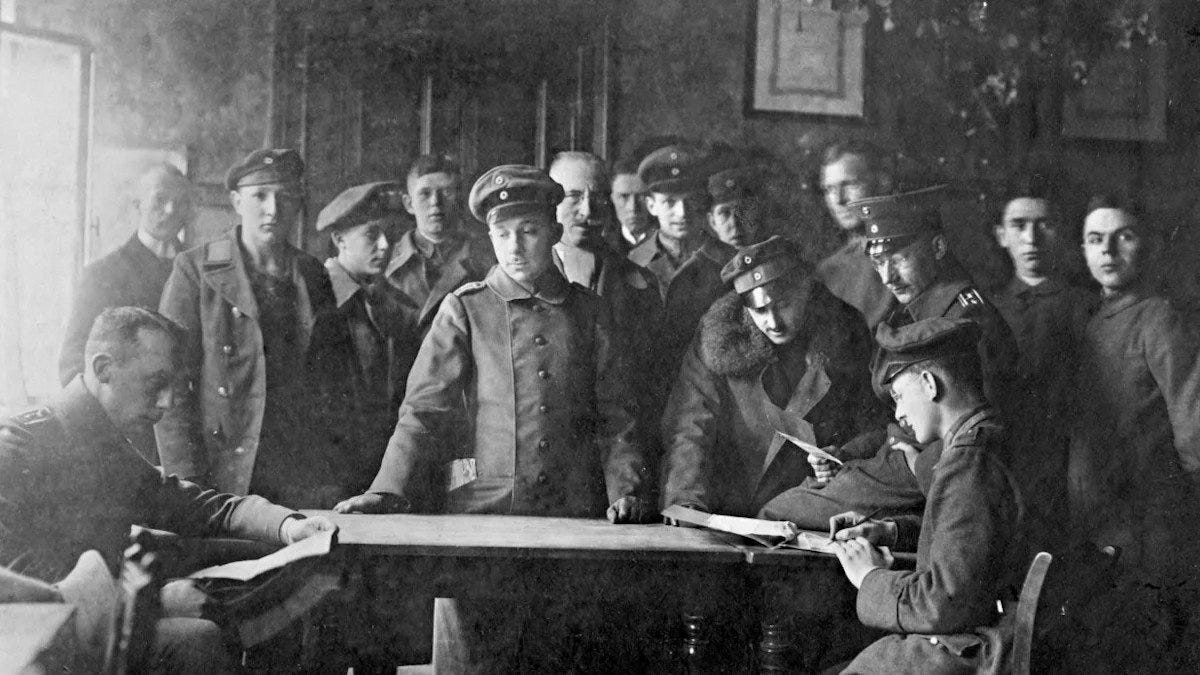
Ideologically, the Wehrwolf occupied a distinctive space in Weimar, merging völkisch nationalism with National Bolshevism. This was a syncretic blend that admired the Soviet Union’s posture as a bulwark against Western plutocracy, even while retaining an anti-communist origin story rooted in Freikorps violence. Despite its Freikorps roots, Kloppe envisioned alliances with “colonized peoples” and the USSR to dismantle international Jewish finance, viewing Moscow as a “brother nation” in the quest for autarky and eastward expansion. This pro-Soviet tilt aligned with thinkers like Ernst Niekisch, who advocated a Prusso-Bolshevik axis, yet Kloppe rejected Marxism’s class warfare, insisting on a nationalist adaptation to preserve racial purity and territorial Lebensraum. This tension is central to understanding the Wehrwolf as “national revolutionary” rather than simply conservative: it wanted a revolution, but a revolution for the Volk, not just the proletariat.
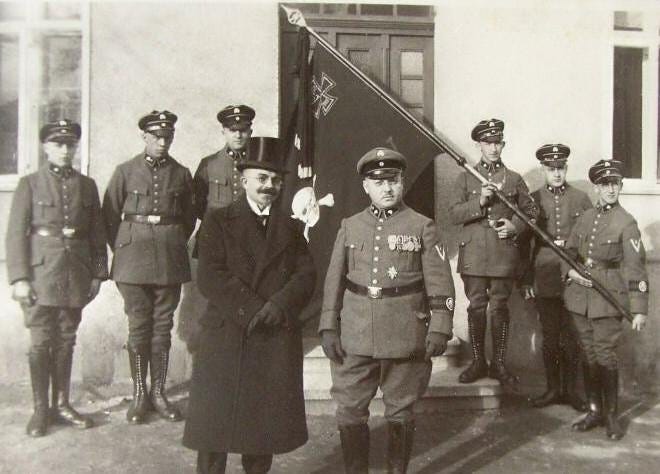
Central to this worldview was Kloppe’s economic doctrine of Possedism, unveiled in 1931 as a Third Position beyond capitalism and communism. Articulated in his book Der Possedismus: Die neue deutsche Wirtschaftsordnung and speeches like the one at the Bonn am Rhein Whitsunday Celebrations, it proposed state nationalization of land and industries, followed by their redistribution as inheritable possessions to productive Germans, ensuring collective ownership under the nation’s ultimate authority. The function of Possedism inside the Wehrwolf project was not merely economic policy. It was moral anthropology. It claimed capitalism uprooted Germans and Marxism stripped them of blood-consciousness, so only a new property order could restore both material stability and ethnic solidarity. This system aimed to eradicate wage-slavery, foster self-sufficiency through foreign trade monopolies, and liberate the Volk from Jewish international High Finance, a anti-Semitic critique of global capitalism that framed finance as both an economic and racial adversary.
“WEHRWOLF are not only revolutionaries with respect to purely social conditions. We are primarily also revolutionaries in the fields of culture and the economy. It is absolutely futile to attempt to create a New Germany simply by setting new men at the head of the nation. Nor is it of any significance if a new form of state is simply the head of the German Volk. We must give the nation itself a new substance!”
— Fritz Kloppe, speech on Possedism, Der Wehrwolf, June 1, 1931
Kloppe was explicit that Marxism, despite its revolutionary posture, remained incapable of genuine national liberation. In his view, it merely reproduced dependence under a different ideological vocabulary, failing to sever the Volk from international finance or restore organic economic life:
“Marxism is thus incapable of liberating our Volk from the clutches of international High Finance. We Wehrwolf are therefore going to the public with an economic system which should be guided by the following basic principles: Firstly, the economy should be guided by the demand of satisfying the nation’s demand for goods. Secondly, its structure must be determined so that every capable person is given the fullest opportunity for advancement, which can only be achieved through intensive selection.”
— Fritz Kloppe, speech on Possedism, Der Wehrwolf, June 1, 1931
Kloppe lambasted capitalism for uprooting the proletariat and Marxism for desensitizing them to their blood ties, arguing that true liberation required a return to nature and autarchic production. Possedism’s appeal was therefore strongest where economic grievance overlapped with cultural anxiety: rural discontents, downwardly mobile strata, and veterans who interpreted modernity as dispossession.
“This new, revolutionary will of ours is reflected economically in a new property order, one which we have called ‘Possedism’ in order to give it the sharpest differentiation from others. We have seen how capitalism has been economically undermining our Volk for a century by turning them into wage-slaves, into proletarians, into an uprooted people to whom the concepts of the Volk and the community-of-blood have become something alien.”
— Fritz Kloppe, speech on Possedism, Der Wehrwolf, June 1, 1931
In practice, Possedism was an agrarian romanticism implying a corporatist administrative structure. Kloppe envisioned economic chambers, monopolized trade channels, and enforced autarky as instruments of national sovereignty rather than market efficiency. Foreign trade, in particular, was to be stripped of private control entirely:
“The fourth source of income for the Economic Chambers comes from the monopoly over foreign trade. In addition, we demand state autarchy. I.e. the restoration of the economic independence and self-sufficiency of the German Volk. We therefore desire a state in which the German Volk will produce all the goods which they require to live themselves of commodities for use abroad.”
— Fritz Kloppe, speech on Possedism, Der Wehrwolf, June 1, 1931
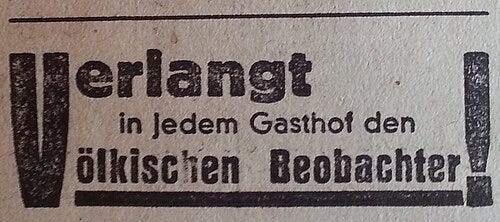
The Wehrwolf’s associations reflected its precarious position in the fractured landscape. Initially tied to the Stahlhelm, it severed its organizational ties in 1924, though some local cooperation agreements persisted. Völkisch publications endorsed the movement at different moments: in January 1926, the newspaper of the Pan-German League wished the Wehrwolf success in its efforts, and in September 1927 the Völkischer Beobachter published several articles praising the Wehrwolf or offering public good wishes. At the same time, the organization’s stance toward the NSDAP remained tense and conditional. It rejected multiple invitations to join the party and instead proposed a united front of all national revolutionary organizations. That proposal was rejected, and the dispute reveals an important ideological fault line: even sympathetic observers and militants often treated Hitler’s leadership claim as non-negotiable. In the propaganda ecosystem of the late 1920s, the logic increasingly became unity only under a single center.
Kloppe briefly moved into alliance politics as well. In the same period, he assumed the presidency of the Patriotic Opposition Bloc, an alliance centered on the German Nationalist Freedom Movement, but internal disputes soon followed and the Wehrwolf withdrew from the alliance prior to the Reichstag elections of May 1928. Meanwhile, police pressure mounted. In 1927 and 1928 the police confiscated large quantities of weapons from Wehrwolf leaders, and on December 20, 1929 the Hamburg Senate banned the association in Hamburg. These episodes show how the movement’s self-presentation as disciplined national defense was matched by state perceptions of an armed paramilitary threat.
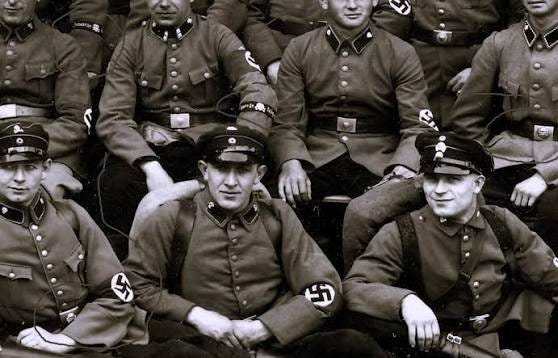
By 1930, as the NSDAP ascended, the Wehrwolf’s membership dwindled to around 10,000 amid police seizures and bans. From 1930 onward, the NSDAP increasingly took control of the Wehrwolf’s space and possibilities, whether through siphoning members, absorbing local groups, or forcing strategic dependence. Attempts in 1930 and 1931 to merge with Freikorps Oberland and Otto Strasser’s National Socialist Revolutionary Combat League failed, underscoring how hard it was to unify once Hitler’s party had become the gravitational center. Kloppe resisted straightforward merger invitations from Hitler, prioritizing a broader revolutionary alliance, but the tide of Nazi consolidation proved fatal. In the summer of 1933, at the organization’s own request, the Wehrwolf was incorporated into the SA, the Jungwolf into the Hitler Youth, and the Wehrwolf motorized transport squadron into the National Socialist Motor Corps, at which point the organization ceased to exist as a separate unit. That dissolution should be read as both defeat and absorption. The Nazi state did not simply “win” elections; it nationalized everything, subordinating rival movements through incorporation, coercion, and elimination.
Kloppe himself joined the SA briefly but faded into obscurity, his death in 1937 at age 40 attributed to war-related health issues, though whispers of purges lingered in the shadow of the Night of The Long Knives. His disappearance is emblematic of what happened to independent National Revolutionary experiments after 1933: they either became instruments of the regime or were rendered irrelevant by it. One additional clarification helps avoid a common confusion: Kloppe’s Weimar era Wehrwolf should not be conflated with the later wartime “Werwolf” concept associated with late-Third Reich sabotage fantasies. The shared name trades on the same mythic reservoir, but they belong to different political moments and organizational realities.
Kloppe and the Wehrwolf stand as a lost thread in the history of German Fascism: a National Revolutionary experiment that fused Freikorps militancy with Bolshevik-inspired methods, anticipating elements of Nazi ideology while never fully submitting to it. The Freikorps themselves, operating without unified command, were instrumental in crushing communist uprisings during the Weimar collapse, stabilizing Germany at a moment when parliamentary authority had effectively dissolved. Yet many of those same men were later sidelined, persecuted, or eliminated by the NSDAP, revealing that the Nazi consolidation of power was as much an internal reckoning as a national revival. Kloppe’s commitment to Possedism and his tactical flirtation with pro-Soviet geopolitics underscore the ideological fluidity of the period, when anti-capitalism, militant nationalism, paramilitary decentralization, and racial politics could coexist within a single revolutionary vision.