
The Origin of “Totalitarianism”
by Zoltanous
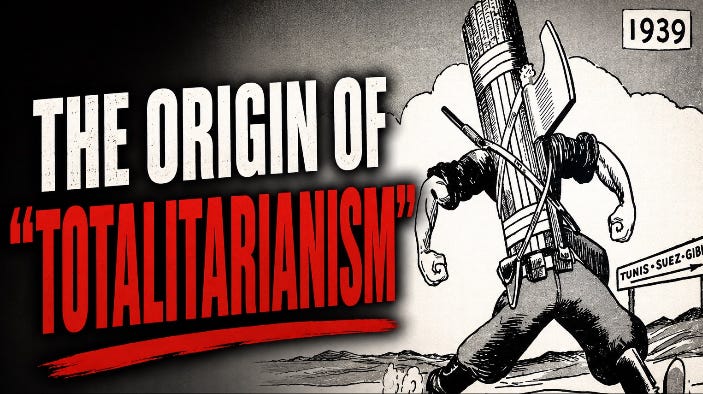
The most notorious European dictators of the twentieth century; Stalin, Mussolini and Hitler, have long overshadowed the word “totalitarian,” turning it into a shorthand for brutal one-party rule in the popular mind. Yet the word has a far more specific and surprising history than most realize. The concepts of “totalitarianism” and “totalitarian” spread widely during the last century, driven by the catastrophic real-life attempts at Communism, Fascism, and National Socialism. Scholars and political analysts have spent decades examining the idea, debating its exact boundaries, strengths, and shortcomings. Key contributions have come from thinkers such as A. James Gregor in his studies of fascist thought, Hannah Arendt’s landmark analysis of how these regimes actually function, and Zbigniew Brzezinski’s detailed comparisons across different systems.
In everyday speech today, “totalitarian” describes a government that insists on total mastery over both public life and the most private corners of people’s existence. It rejects the old restraints of custom, written constitutions, or ordinary legal limits, claiming instead the right to reach into any area it chooses. These ideologies usually cast the state as an almost sacred force moving through history, one powerful enough to rebuild society from the ground up according to a utopian blueprint that echoes religious dreams of perfection. Because the promise is total, the disappointment and destruction that follow are equally complete.
The word itself, however, was born in a very different place: the early years of Fascist Italy. Benito Mussolini’s movement had surged forward after the First World War, shattering the country’s shaky parliamentary system and frightening both liberals and socialists who viewed the Duce’s dramatic style as demagogic populism. Among the sharpest critics stood the journalist and politician Giovanni Amendola.
Born in Naples in 1882, Amendola first made his name in journalism before winning election to parliament in 1919 with the Liberal Democracy party. He was returned to office in 1921, only a short time before Mussolini’s March on Rome in October 1922. Once Mussolini took power as prime minister, Amendola became one of the most determined opponents of the new regime. In 1922 he founded the influential anti-fascist newspaper Il Mondo and used its pages to expose Fascist violence and the growing threat to democratic freedoms. It was Amendola who first wielded the word “totalitarian” as a weapon of criticism. He introduced it during the heated electoral fights of 1923 to highlight the Fascists’ ruthless efforts to wipe out any competing voices.
He first tested the term on the elections themselves. In a piece that ran in Il Mondo on 12 May 1923, he labeled the Fascist drive to block every opposition list in local administrative votes, thereby claiming both the majority and the minority seats — as a “totalitarian system,” still placed inside quotation marks. By late June the same year the phrase reappeared without quotation marks in another article that examined proposed changes to the electoral law. From then on, “totalitarian” sat at the heart of Amendola’s critique. Exactly one year after Mussolini’s takeover, in a 2 November 1923 column for Il Mondo, he wrote:
“The most striking characteristic of the Fascist movement will remain, for those who study it in the future, the ‘totalitarian’ spirit.”
— Giovanni Amendola, Il Mondo, 2 November 1923
In what turned out to be his last major public address on 15 June 1925, he warned of the “spirit of totalitarian intolerance” and the “anxious totalitarian will” that marked the movement. Soon afterward he described fascism outright as the “totalitarian reaction to liberalism and democracy.” To Amendola the word summed up the Fascist party’s unrelenting hunger for complete, unchecked power. He later stretched the idea further, applying it to any ideology that allowed the state to swallow every limit on its authority; he placed Jacobinism and Marxism in the same family as Italian Fascism. In one extended passage he explained:
“Fascism, despite its reactionary character, nevertheless obeys the dogma, born with Jacobinism, of the Leviathan State, in which individual lives are subordinate and negligible moments. The terrible phalanstery, which constituted the ideal followed both by imperial Prussia and by Marx’s socialism, tried to incarnate itself once again, both in Bolshevism and in fascism. Fascism represents, above all, the paroxysmal and monomaniacal exaggeration of the interference of executive power in all state and social life; the acrobatic inversion of the normal relations between State and Society, according to which Society exists for the State, and the State for the Government and the government for the party; in a word, the regime of the ‘Commissar’ established in all fields of life and substituted for all the laws of life.”
— Giovanni Amendola, In Defense of Liberal Italy
These insights cleared the way for the word to be used against any regime that aimed at total domination of society by the state. A striking irony followed almost immediately: instead of pushing the label away, the Fascists seized it with pride. Giovanni Gentile, the regime’s foremost philosopher and co-author of its official doctrine, composed the entry on Fascism for the prestigious Enciclopedia Italiana.
There he proclaimed:
“For the Fascist, everything is within the State and nothing human or spiritual exists, much less has value, outside the State. In this sense, Fascism is totalitarian.”
— Giovanni Gentile, Enciclopedia Italiana
Gentile knew perfectly well that the term had been coined by an enemy of the regime. By writing it into the movement’s own authoritative text, he turned Amendola’s criticism into an official part of Fascist philosophy.
"The Fascist State is a synthesis and a unity inclusive of all values, and interprets, develops, and potentiates the whole life of a people."
— Benito Mussolini and Giovanni Gentile, The Doctrine of Fascism
Amendola never lived to watch the word travel far beyond Italy or to see the full scale of the dictatorship. On 25 July 1925, roughly fifteen Blackshirts armed with clubs ambushed him in Pieve a Nievole, near Montecatini Terme in Tuscany. The beating left him with grave injuries, including a hematoma on the left side of his chest that would never fully heal. He first sought care in Paris, then moved to a clinic in Cannes, France, but his condition steadily worsened. He died on 7 April 1926 at the age of forty-three. Historians generally regard his killing as one of the earliest political assassinations carried out or quietly permitted by the Fascist regime, an obvious preview of the systematic nature that would define the dictatorship.


