

Otto Wagener’s Social Economy
by Zoltanous
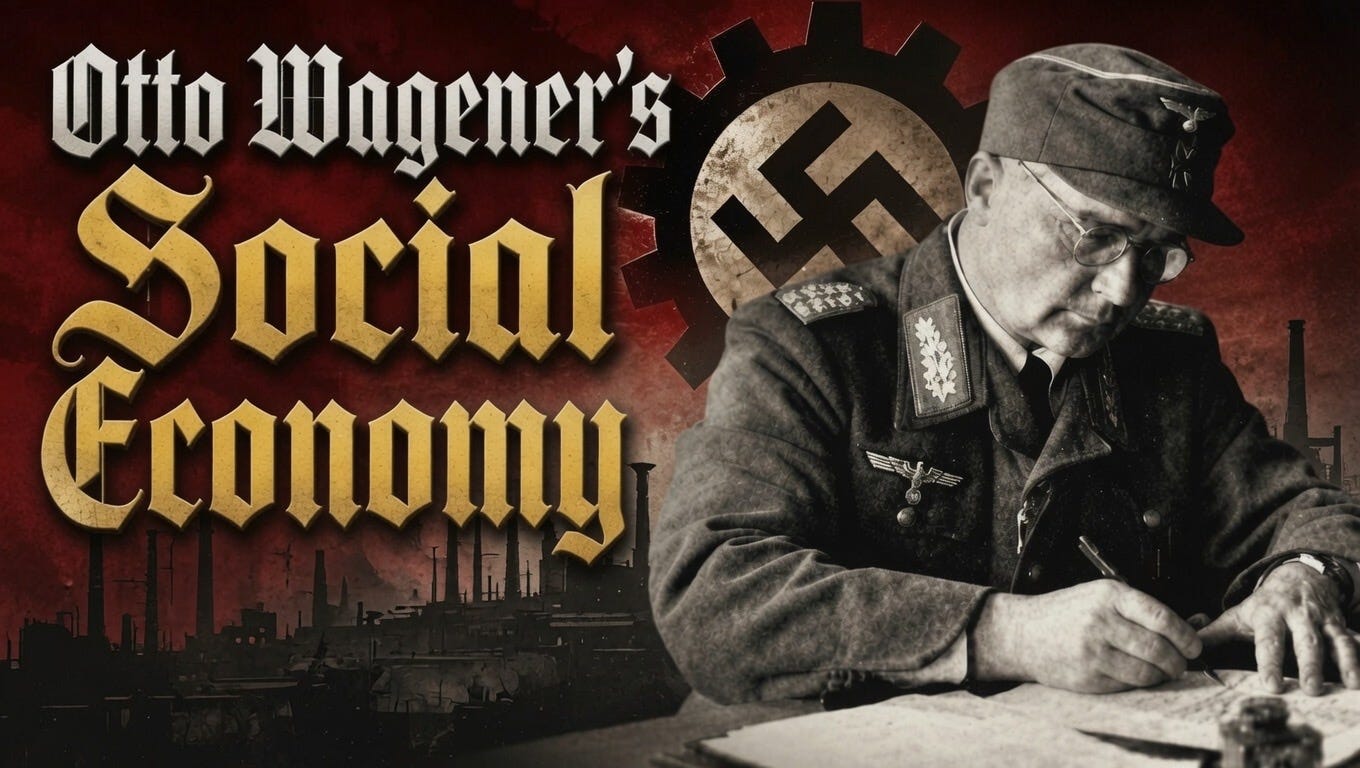
Otto Wilhelm Heinrich Wagener (29 April 1888 – 9 August 1971) was born in Durlach, in the Grand Duchy of Baden, the son of a factory owner. After earning his Abitur in 1906 he entered the Imperial German Army as an officer cadet, served with distinction in the First World War (earning the Iron Cross First and Second Class), and rose to the rank of Hauptmann. Dismissed from the army in 1918, he joined Freikorps units operating on the Polish border and in the Baltic, serving in Courland as chief of the general staff of the German Legion. Returning to Germany he briefly participated in the Kapp Putsch, was arrested, and was discharged from the Freikorps in March 1920. From 1920 to 1921 he led the Baden branch of the anti-Semitic Organization Escherich while managing his father’s sewing-machine factory in Karlsruhe as assistant manager, director, and board member. He studied economics, received an honorary Ph.D. from the University of Würzburg in 1924, lectured on economics at Würzburg and the Technische Hochschule Karlsruhe, and between 1924 and 1925 traveled abroad lecturing on economic policy. From 1925 to 1929 he was part-owner and managing director of a plywood and wood-veneer company in Villingen, practical industrial experience that later shaped his insistence that capital must remain tied to active production rather than speculation or absentee ownership. In 1929, recruited by his old Freikorps comrade Franz Pfeffer von Salomon, he joined the Nazi party and the Sturmabteilung (SA), rising almost immediately to become its first Stabschef (chief of staff) from 1929 to 1930.
By January 1931 he headed the NSDAP’s Political-Economic Department; from September 1932 he served as Hitler’s personal economic advisor. Briefly Reich Commissar for the Economy in the spring of 1933, Wagener was a central, yet now largely forgotten, figure in the party’s early efforts to forge a “Third Way” beyond liberal capitalism and Marxism. He edited the Nazi economic journal Wirtschaftspolitischen Briefe from 1931 and laid out an early party economic program in his 1932 booklet Das Wirtschaftsprogramm der NSDAP, but the fullest documentation of his theories survives in the confidential drafts and recorded conversations that form the core of his memoirs.
Wagener had long made it a habit to see in Adolf Hitler a phenomenon that had to be accepted just as it was, present among us and somehow set by Providence in the human world, and specifically in Germany. Like other radical nationalists of the era, he operated inside revolutionary groups that rejected both the anarchy of finance-driven markets and the centralized tyranny of Bolshevik planning. His fundamental foundations were rooted in a synthesis of his own industrial management experience, the earlier distinction (popularized by Gottfried Feder) between “productive” and “rapacious” capital, and a corporatist reading of pre-industrial guild (Stände) traditions. He and Hitler shared the view that the national community required vigilant order against forces of decay and parasitism. Nothing upsets such forces more than a gardener intent on keeping the garden neat and healthy. Order itself stands opposed to parasitic existence, which can only thrive amid weakness, degeneracy, and the stench of decomposition.
Wagener envisioned a distinctly German socialism or soziale Wirtschaft (social economy) rooted in the Volksgemeinschaft — the organic national community, where production served the collective will rather than private profit or class antagonism. This vision drew on corporatist and leadership (Führer) principles, seeking to fuse ownership with active labor inside the enterprise itself. Wagener formulated an original set of economic policies based on corporatist and leadership principles in confidential talks with Hitler and succeeded in recruiting many middle-echelon industrial managers and owners of small factories for the NSDAP. A confidential draft by Wagener embraced the ideal of the corporatist “company union” (Werksgemeinschaft) and described the employer as the “Führer” within his factory. All disputes over wages and working conditions would be settled within the “family” of the individual company in the National Socialist state of the future; trade unions would be limited to vocational training.
At the core of his program was a radical mechanism to keep capital perpetually “productive.”
“Every year a corporate body composed of entrepreneurs, workers and white-collar employees should supervise the confiscation of about 5 per cent of the capital stock of each industrial enterprise. These holdings would then be gradually resold in the form of special shares to the owner (provided he was working and not fooling about in Monte Carlo instead) and to his employees (provided they were industrious and loyal). This constant re-acquisition of the capital stock—the whole process would begin anew every twenty years—geared to a separate depreciation formula in each industry, would ensure that all capital was ‘productive’.”
— Otto Wagener, Hitler: Memoirs of a Confidant
Wagener himself had reached the same conclusion as Hitler regarding nationalization. Hitler stated:
“As far as this goes, the whole concept of nationalization in the form in which it has been attempted and demanded so far appears to me to be wrong, and I come to the same conclusion as Herr Wagener. We have to bring a process of selection into the matter in some way, if we want to come to a natural, healthy and also satisfying solution of the problem, a process of selection for those who should be entitled—and be at all permitted—to have a claim and the right to property and the ownership of companies.”
— Adolf Hitler quoted in Hitler: Memoirs of a Confidant by Otto Wagener
Wagener proposed additional mechanisms such as profit-sharing limited to the equivalent of one month’s wages per worker, with surpluses directed to occupational chambers of self-administration that would assume most welfare functions; a contracting currency that would lose a fixed percentage of its value annually to align with capital contraction; and the application of the same “ownership transfer” system to agrarian units above a certain size to advance capable small farmers. In presenting these plans he stressed that the enterprise must become an organic cell of the Volksgemeinschaft, where capital served production rather than speculation, and where the employer’s authority mirrored the Führer principle on a smaller scale.
These proposals were inseparable from the larger cultural and spiritual renewal both men sought. In one extended discussion Hitler explained how economic egocentrism had produced cultural stagnation and how replacing it with a socialist communal will would open the way to rebirth:
“You are familiar with The Decline of the West, in which Oswald Spengler takes note of the current decadence of painting, as well as literature and music, and concludes that the end of our cultural epoch has arrived. He is a philosopher, but one descended from the natural sciences. He arranges observations, he records insights and knowledge. He takes a graphic view of history. And if he sees that a line curves downward, he considers the trend a proven fact, so that zero must be reached at a particular time and place. And that moment represents the end, the decline of the West! But his graphing has no bearing on any of my ideas and plans as architect and politician. I study the reasons why the line curves downward, and I try to remove the causes. But at the same time, I examine the reasons why at an earlier time the line curved upward! And then I set out to restore the conditions of that day, to awake anew the creative will of that time, and to bring about a new crest in the constantly fluctuating curve of history. No doubt about it! Our culture has entered on stagnation, it looks like old age. But the reasons for this state do not lie in the fact that it has genuinely passed its manhood, but rather that the upholders of this culture, the Germanic-European peoples, have neglected it and have turned their attention to material tasks, to technology, industry, to hunger for material possessions, to rapacity, and to an economic egocentrism that overwhelms everything else. All their thinking and striving reaches its only climax in account books and in the outward show of the worldly goods they possess. I am overcome with disgust, a vexing scorn, when I see the way such people live and behave! […] But thank God, it is only the top ten thousand who think along these lines. It is true that the whole of the bourgeoisie is already strongly infected and sickly. But bourgeois youth are still healthy and can be shown the way back to nature, to a higher development, to new cultural will, provided only that they do not become enmeshed in the treadmill of meaningless and wholly materialistic contemporary life, only to drown either in the cupidity of business or in the tedium of the middle-class workaday routine or in the corruption of the big city. If we succeed in replacing the egocentric cupidity of business with a socialist communal will and a work-affirming responsibility for the common-weal; in abolishing the tedium of middle-class workaday monotony by substituting for it the potential enjoyment of personal liberty, the beauty of nature, the splendor of our own Fatherland and the thousandfold diversity of the rest of the world; and if we put an end to the corruption of omnipresent degeneracy, bred in the warrens of buildings and on the asphalt streets of the cities of millions—then the road is clear to a new life, to a new creative will, to a new flight of the free, healthy spirit and mind. And then, my dear Herr Roselius, your bricks will form themselves into entirely new shapes all by themselves. Temples of life will be built, cathedrals of a higher cult will be raised, and even thousands of years later, the walls will bear witness to the exalted times out of which even more exalted ones were born!”
— Adolf Hitler quoted in Hitler: Memoirs of a Confidant by Otto Wagener
The effect of these exchanges extended outward. After one such conversation, when Roselius left Hitler’s room with Wagener, he took Wagener’s hand and said:
“Wagener, I thank you for having made this hour possible. What a man! And how small we feel, concerned as we are with those things that preoccupy us! But now I know what I have to do! In spite of my sixty years, I have only one goal: to join in the work of helping the young people and the German Volk to find internal and external freedom!”
— Ludwig Roselius quoted in Hitler: Memoirs of a Confidant by Otto Wagener
Wagener’s role as facilitator and recorder of these meetings gave his industrial experience and drafts a direct path into the development of National Socialist economic thinking. When Wagener first laid out the full scheme during one of their economic-policy conferences, Hitler’s reaction was electric.
“I sense the philosopher’s stone in my hand… the birth-date of a completely new economic theory.”
— Adolf Hitler quoted in Hitler: Memoirs of a Confidant by Otto Wagener
He envisioned land reform to break up underutilized estates for peasant proprietorship, autarky through import substitution, and the revival of occupational guilds (Berufsstände) — pre-industrial-style Stände that would integrate workers, employers, and state oversight into self-regulating production councils. These structures were meant to restore the organic unity of the Volksgemeinschaft while preserving individual initiative under national leadership. Hitler elaborated on the broader transition and its national foundation:
“We are living in an age of great radical change, as I have said before—an evolution from individualism to socialism, from self-interest to the public interest, from the ‘I’ to the ‘we.’ After all, that’s exactly why we call ourselves National Socialists! We want to start by implementing socialism in our nation among our Volk! It is not until the individual nations are socialist that they can address themselves to international socialism.”
— Adolf Hitler quoted in Hitler: Memoirs of a Confidant by Otto Wagener
Wagener carried the same conviction that the path forward required first restoring the independence and autonomy of the nations. The international powers that penetrate and undermine national bodies — primarily Jews, but also the Catholic church, internationally oriented trade unions, international communism, and the major international trusts — stand contrary to nature and hostile to the divine order. Only after reconstructing the nations could the great socialist community of nations be created. This perspective directly reinforced the program’s focus on keeping capital tied to the producing nation and on national reconstruction before any wider arrangement.
Wagener himself framed his soziale Wirtschaft as a living synthesis that would transcend the failures of both liberalism and Marxism. Hitler described the character of that synthesis:
“And our synthesis is not a compromise… it is, instead, the radical removal of all the false results of industrialization and unrestrained economic liberalism, and the redirection of this line of development to the service of humanity and the individual.”
— Adolf Hitler quoted in Hitler: Memoirs of a Confidant by Otto Wagener
Wagener’s soziale Wirtschaft was presented not merely as a technical economic blueprint but as the practical realization of a deeper spiritual revolution. In these late-night conversations Hitler insisted that National Socialism was no innovation but the long-overdue fulfillment of the communal ethic that Jesus Christ and the prophets had established and lived in the ancient world. He portrayed true socialism as a divine worldview of self-sacrifice and collective responsibility, which the institutional churches had corrupted through power-lust and which the Bolshevik Soviets had monstrously perverted into a godless, materialist tyranny that crushed the human spirit rather than elevating it. Wagener’s mechanisms — tying capital perpetually to active labor and loyalty, profit-sharing within organic factory communities, and self-governing occupational guilds — were therefore the concrete economic instruments through which National Socialism would revive the treasures of the living Christ and create a modern Volksgemeinschaft worthy of the original Christian-socialist ideal.
“Whenever I read the New Testament Gospels and the revelations of various of the [Israelite] prophets and imagine myself back in the era of the Roman and late Hellenistic, as well as the Oriental, world, I am astonished at all that has been made of the teachings of these DIVINELY INSPIRED MEN, especially Jesus Christ, which are so clear and unique, heightened to religiosity. They were the ones who created this new worldview which we now call socialism, they established it, they taught it and they lived it!”
“For what did the falsification of the original concept of Christian love, of the community of fate before God and of socialism lead to? By their fruits ye shall know them! The suppression of freedom of opinion, the persecution of the true Christians, the vile mass murders of the Inquisition and the burning of witches, the armed campaigns against the people of free and true Christian faith, the destruction of their towns and villages, the hauling away of their cattle and their goods, the destruction of their flourishing economies, and the condemnation of their leaders before tribunals, which, in their unrelenting hypocrisy, can only be described as blasphemous. That is the true face of those sanctimonious churches that have placed themselves between God and man, motivated by selfishness, personal greed for recognition and gain, and the ambition to maintain their high handed willfulness against Christ’s deep understanding of the necessity of a socialist community of men and nations.”
— Adolf Hitler quoted in Hitler: Memoirs of a Confidant by Otto Wagener
Yet Wagener’s radicalism met swift internal resistance. In 1932 Hitler himself issued directives accepting Wagener’s resignation from the economic department and reorganizing it, splitting state economy under Gottfried Feder and private economy under Walther Funk — partly to placate rival factions and heavy industry. By mid-1933 Göring’s cultivation of big-business ties and other court intrigues had marginalized Wagener entirely. He survived the Röhm purge of 1934 (noted as “lucky to escape Göring’s blood purge”), withdrew to private life in Saxony for the rest of the decade, and largely vanished from party historiography — one of the earliest “un-persons” of the regime. When Hitler bid him farewell in early 1933, he swore Wagener to hermetic silence.
“During so many nights we discussed… so many things, and I have revealed to you… my innermost thoughts and my most fundamental ideas, as I have done perhaps to no one else. Please keep this knowledge to yourself and thus become the guardian of the grail whose inmost truth can be disclosed only to a few.”
— Adolf Hitler quoted in Hitler: Memoirs of a Confidant by Otto Wagener
Wagener obeyed. He returned to military service in 1940, rose to Generalmajor, and by 1944–45 served as military governor of the Italian Dodecanese islands. On 8 May 1945, in a modest ceremony on the island of Symi, he signed the unconditional surrender of German forces in the Aegean to British authorities aboard HMS Kimberley, an obscure footnote to the final collapse of the Reich. Held first in British custody at Island Farm in Wales, then transferred to Italian authorities on 1 July 1947, he was convicted on 16 October 1948 by the Rome Territorial Military Tribunal and sentenced to fifteen years for war crimes (including the execution of Italian prisoners and hostages), though the sentence was later commuted through the intercession of German Chancellor Konrad Adenauer and Austrian Bishop Alois Hudal; he was released on 4 June 1951. In captivity he composed his memoirs, preserving the only detailed record of those early economic conversations. Released in the late 1940s, he settled quietly in Bavaria, dabbling in conservative politics but never again seeking the spotlight. He died in Chieming, Upper Bavaria, on 9 August 1971 at age 83. His German edition appeared only in 1978; the English translation followed in 1985.
Wagener’s “social economy” remains one of the least-known yet most revealing expressions of the early Nazi left-wing. Sidelined by the pragmatic demands of rearmament after 1933, it was never implemented. Yet its intellectual audacity endures as a testament to the movement’s formative ambitions. Wagener’s industrial experience in the plywood company, his Freikorps and organizational background, and his confidential drafts on the Werksgemeinschaft and perpetual capital recirculation supplied the practical mechanisms that kept capital tied to active production and loyal participation within the organic factory community. Hitler’s philosophical views; the socialist communal will, the rejection of Spenglerian decline in favor of rebirth on a socialist basis under Nordic direction, the Christian roots of genuine community, and the necessity of first reconstructing national independence against international powers including major international trusts — supplied the historical and spiritual depth that transformed those views into part of a comprehensive “Third Way.” Their 1931–1932 exchange demonstrates genuine mutual influence: Wagener’s concrete proposals gave workable economic form to Hitler’s broader vision of the Volksgemeinschaft, while Hitler’s insistence on selection, national priority, and communal responsibility elevated Wagener’s industrial insights into a living form that rejected both liberal capitalism and Marxism. This vision reminds us that the interwar nationalist revolutions contained far more ambitious economic imaginations than post-war narratives often allow. The proprietary impulse, capital as servant of the producing nation, remains a living sacred flame.


