
tung tung epstein (pt. 3/2)
This is the last installment in my series on Tung Tung Tung Sahur and Jeffrey Epstein. I’m putting some of it behind the paywall.
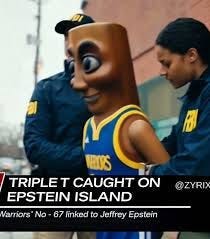
What I wanted to do with the series was bring together a few threads that have been on my mind. As this newsletter has gone on, it has strayed from close readings of particular memes to repetitive jousting at abstract themes. I annoy myself as I do this because I don’t always do it as well as I’d like to, and thank you for your patience. I see this newsletter, and my presence on other platforms, as a kind of open notebook. I’m working out ideas live in front of people largely because I can’t figure out how to work any other way.
What interested me with both Tung Tung Tung Sahur and the Jeffrey Epstein memes was this notion of “screen-crossing.” Things online become things in real life — the conspiracy jumps from the keyboard of the incel to the lips of the Senator, the reckless Twitter hype becomes the inflated stock valuation. And then they cross back to the internet, as the Senator is filmed and the valuation is posted about, and the online re-representation boomerangs back into the real world.
I discussed Tung Tung Tung Sahur and Jeffrey Epstein as serial screen-crossers — meme figures which come from a specific grounded reality, are decontextualized online into posts, recontextualized again into reality as “online things we have to talk about irl,” then decontextualized again into online posts about posting. Tung Tung is a frivolous example of this, but Epstein is a serious one. By juxtaposing the two very different cases, I wanted to highlight the mechanics they share, which are the mechanics of an indifferent system that has placed the news story on the same ground as the conspiracy theory and the shitpost on the same scroll as the heartfelt testimony.
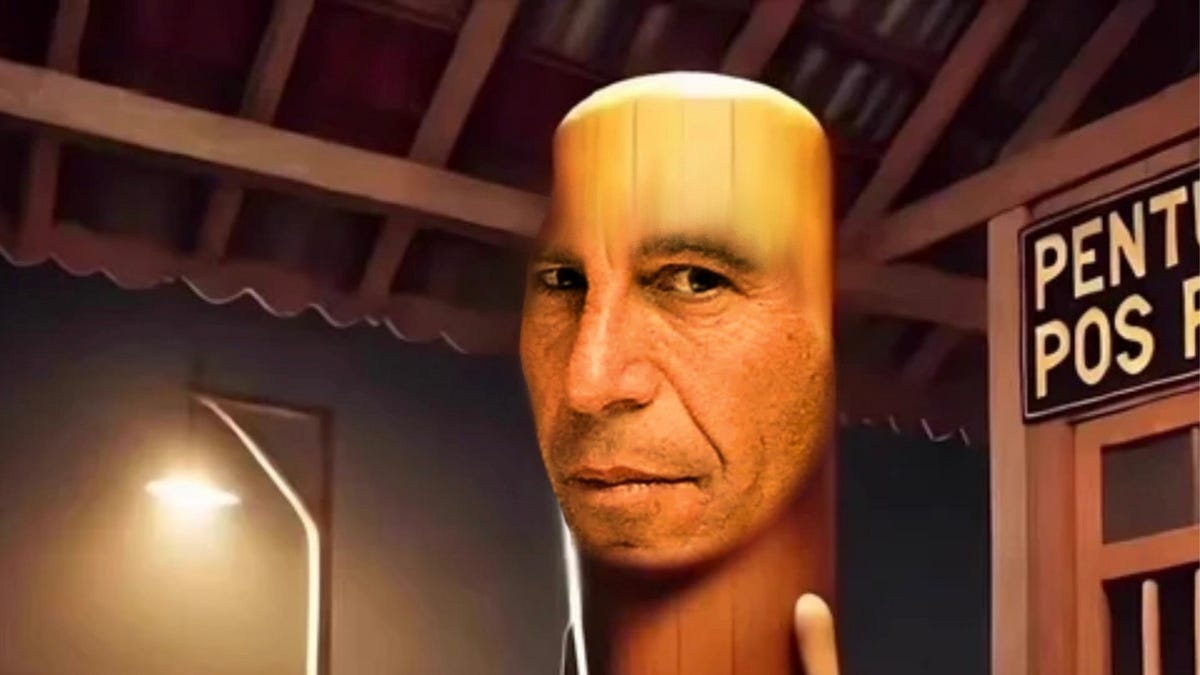
But my interest in screen-crossing is not just abstract. There are discernible, concrete mechanisms at play in this process. We can identify who or what intervenes, and at which moments, to carry Tung Tung Tung Sahur from inside joke to plastic figurine in your hand; or Jeffrey Epstein from story powerful people sought to cover up to AI-generated sprite dancing across the shitposts of America’s thirteen-year-olds. Often, these traces exist within the post itself.
In my analysis of Distracted Boyfriend as a layered image, I argued that memes carry the sedimented traces of various crossings and recrossings of the screen, reflecting the pull of these processes:
Online, a stock photo marketplace calls for specific pictures of situations that fit into algorithmically-optimized niches,
In reality, three models and a photographer in Spain make a funny picture matching one such niche in order to make money,
Online, somebody sees that picture and recognizes it as bizarre
In reality, on August 17th, 2017, that person connects the situation in the picture to their view on socialism and young voters
Online, that post circulates and is imitated as a format
In real life, the “Distracted Boyfriend meme” becomes a cultural trend that is written about.
Online, people make meta-memes about the fact Distracted Boyfriend is a meme
In real life, people now know Distracted Boyfriend is a cultural entity that people make jokes about
etc. etc. ad infinitum until the end of the world/meme
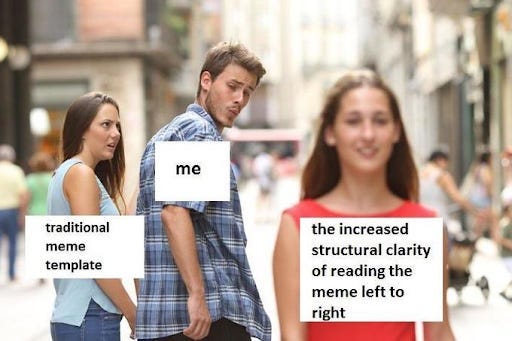
Each of these turns lives somewhere in the meme image. In the example above (let’s situate it at around step 7/8) the ironic meta-meme lives in the flipping of the image over the y axis. The meme trend lives in the convention of the labelling. Underneath that, the stock photo lives in the pure image itself. Put otherwise, the meme makes sense because as a participant, you know the meme’s maker, like you, saw this:
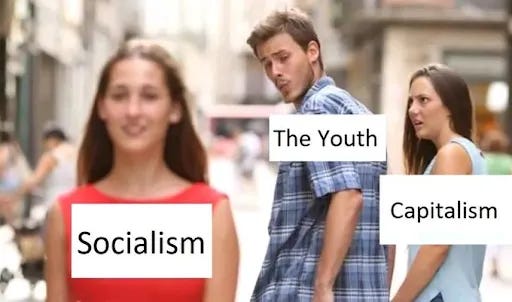
And the maker of that meme in turn saw this:
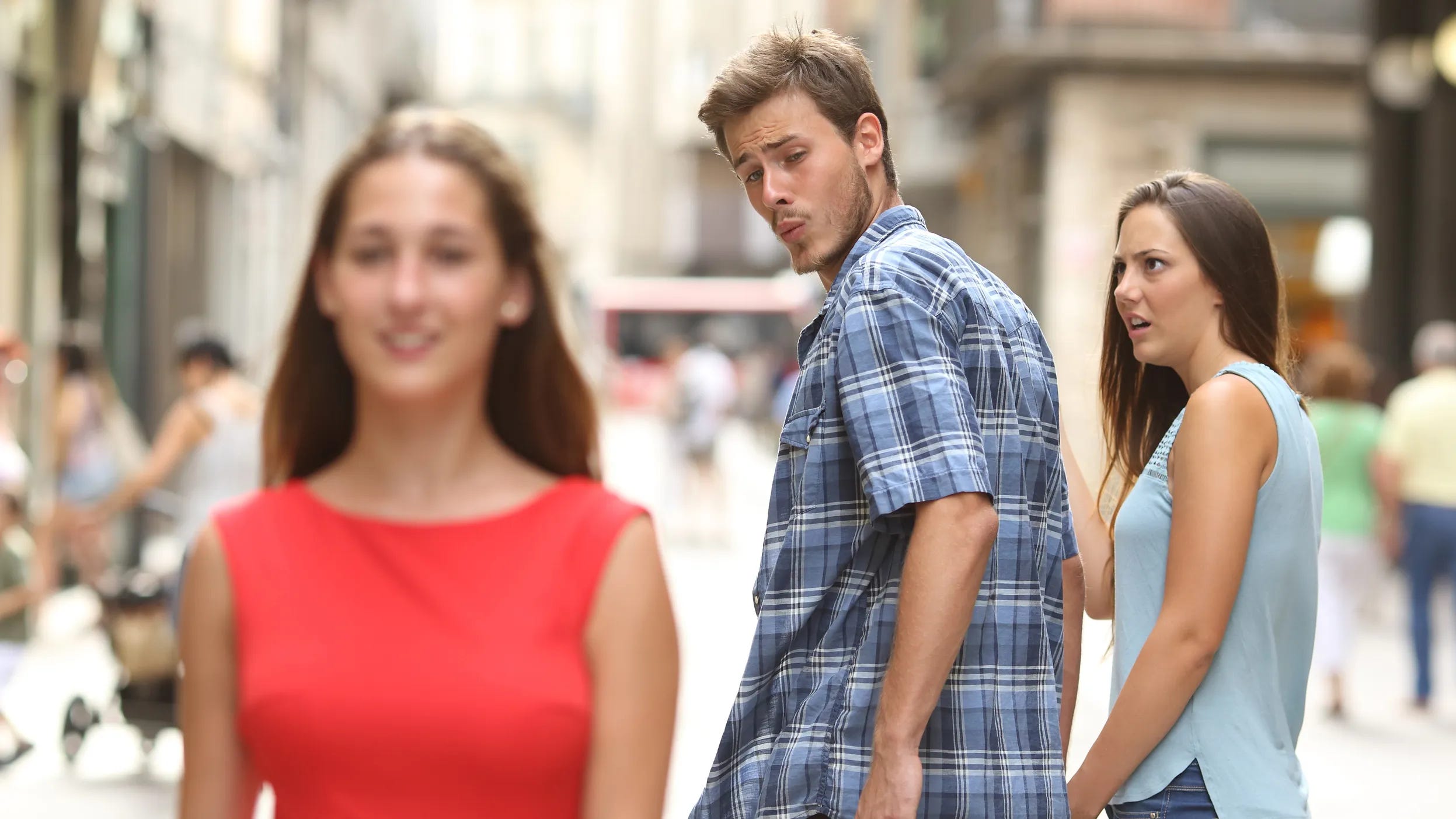
And now you are seeing a meme layered on top of these two previous versions which, practically, are records of two different strangers’ screens. In addition to features like captions or inserts, changes to the tint and resolution of image which happen when you screenshot, download, and repost also mark these crossings of the screen. Through the depth of the meme-image there is a story of reception, or more precisely, appropriation. There is a dialogue going on between the re-captioner and the original captioner, just as there is one going on between the viewer and the re-captioner — and often the content of the re-captioner’s message to the viewer is “look at what I’m saying to/about this person who used the format before me.”
Most people using a meme don’t need to know all of its lore, but they do feel it, and its presence has been aestheticized — consider the enhancement of circulation marks in deep-fried image-macro memes, or the convention of including the kind of captions used in Snapchat stories on certain kinds of images. Markers of how an image used to be on somebody else’s screen are the devices that situate it in a narrative.
Tung Tung Tung Sahur made me rethink Distracted Boyfriend. You might see these sedimented layers in the image itself as different “turns” of deterritorialization and reterritorialization. The topmost layer is made by the platform, territorializing the meme as a post. Then, the text-labelling layer territorializing the photograph as a meme. The photograph territorializes the actors as a couple. There is an apparent acceleration here, a species of compounded interest, if you’ll forgive my pun.
Keep reading with a 7-day free trial
Subscribe to How To Do Things With Memes to keep reading this post and get 7 days of free access to the full post archives.
