Mati Klarwein's mischtechnik realism: Expressing a global citizen worldview to reconcile the ideological and cultural paradoxes he experienced after migrating from Middle Eastern orthodoxy into New York’s 1960s psychedelic culture.
{Chrono Cross (1999 game)} illustrated in Mati Klarwein’s signature mischtechnik realism: {
Matthias "Mati" Klarwein (1932–2002) was born in Hamburg, Germany, on April 9, 1932, to Elsa Kühne, an opera singer, and Joseph Klarwein, a Jewish architect associated with Brick Expressionism and the Bauhaus movement. To escape the rise of Nazi Germany, his family fled to the British Mandate of Palestine in 1934, where the young Klarwein grew up immersed in Jewish, Islamic, and Christian traditions. Feeling like an outsider due to his family’s resistance to religious orthodoxy, Klarwein developed a pluralistic perspective that would shape his artistic career. Following his parents' divorce and the 1948 declaration of Israeli independence, he and his mother relocated to Paris. Between 1949 and 1951, Klarwein studied at the École des Beaux-Arts, the Académie Julian, and under Fernand Léger. While he absorbed Léger's modernism, his creative awakening came from Salvador Dalí (1904–1989) and Luis Buñuel’s (1900–1983) film Un Chien Andalou (1929), alongside his study of the Italian Renaissance and Flemish masters, leading him to appreciate surrealism's ability to challenge societal conventions.
During the mid-1950s, Klarwein settled on the French Riviera in Saint-Tropez, where he befriended artist Ernst Fuchs (1930–2015). Fuchs introduced Klarwein to the mischtechnik—a Northern Renaissance method of layering egg tempera and translucent oil glazes—which became the foundation of his "Visionary Realism," a style characterized by high-contrast, luminous detail. During this period, a seven-year partnership with a wealthy patron funded extensive travels across Asia, North Africa, and the Americas, providing Klarwein with a rich repository of visual memories. His philosophy was further deepened by Indian Tantric art, popularized by Ajit Mookerjee’s Tantra Art: Its Philosophy and Physics (1971). Embracing Tantra’s validation of physical sensuality and bodily experience as pathways to spiritual transcendence (Yantra), Klarwein incorporated concepts such as Shiva and Shakti (the union of dual energies), Bhupura (geometric grounding), and Bindu (cosmic singularity). This correlation between visual geometry and sonic vibration (Nada) bridged his art with the music industry, visually equalizing worldly illusion (Maya) and divine energy (Shakti).
Klarwein's emerging synthesis of scientific botanical precision and escapist surrealism is evident in his 1958 portrait of jazz musician Yusef Lateef, which embeds the performer in a hyper-detailed, exotic landscape that functions as a visual metaphor for vocal and creative energy, prefiguring the stylized, sensual floral portraiture later popularized by Pierre et Gilles (Pierre Commoy, b. 1950, and Gilles Blanchard, b. 1953). During this transformative period, he adopted the name Abdul Mati as a gesture of Middle Eastern reconciliation. Relocating to New York at the dawn of the 1960s sparked a period of intense creative awakening that bridged his nomadic travels with his new metropolitan life, yielding his 1959–1961 masterwork, Flight to Egypt (Benares). In this piece, he utilized the mischtechnik to generate intense inner radiance, structuring the composition around the complex, composite perspectives of Venetian Renaissance masters like Giovanni Bellini (1430–1516) and Tintoretto (1518/19–1594).
In 1961, he completed Annunciation, a veristic, multicultural reinterpretation of the biblical event that juxtaposes volumetric, sensual indigenous figures against flat, ornamental backgrounds. This deliberate contrast establishes a profound clarity of visual hierarchy and showcases rich, tapestry-like pattern qualities echoing Gustav Klimt’s (1862–1918) controversial university murals, where highly stylized, abstract geometries are used to frame and elevate organic human forms. This dialogue with Klimt’s aesthetic is also apparent in Klarwein’s 1964 painting Crucifixion (Freedom of Expression), which served his portable, 68-panel temple—the "Aleph Sanctuary"—dedicated to "the undefined religion of everything." Crucifixion echoed the public outcry surrounding Klimt’s mural Philosophy (1900–1907) by rendering an institutional, sacred theme as a paganistic, eroticized tapestry of human figures, yet organized by a rhythmic structural logic to express liberation from dogma. The Aleph Sanctuary itself became a space of profound creative meditation, notably inspiring Carlos Santana, who discovered Annunciation there and selected it for the cover of the multi-million-selling album Abraxas (1970).
This synthesis of sonic and visual energy culminated in iconic album covers during the early 1970s. For Miles Davis’s Bitches Brew (1970), Klarwein employed mischtechnik to create an otherworldly narrative of contrasting elements, utilizing a double-image composition reminiscent of Karel Thole's (1914–2000) surrealism to conceptually symbolize the metaphysical tension between human consciousness and elemental nature. For Davis's Live Evil (1971), Klarwein subverted conservative, institutional orthodoxy by transforming authoritarian iconography into a norm-transgressive, anthropomorphic caricature, employing hybrid anatomy to evoke an unsettling yet whimsical mutant fantasy style later popularized by Tim Jacobus (b. 1959). In 1971, he painted Zonked, visually manifesting cosmic interconnectedness through the transmutation of biology into a unified planetary consciousness, an image that eventually graced a release by the rap-originators The Last Poets. This period of high-saturation, multicultural surrealism also produced the cover art for the sci-fi anthology Two Views of Wonder (1973) and the painting Astral Body Awake (1974). The latter serves as a definitive visual map of his esoteric philosophy, utilizing an archetypal human anchor, dualistic environmental realism, and symbols of sacred geometry to seamlessly harmonize the macrocosm and microcosm without relying on physical collage.
These portrait-centered montages often carry a reflective, memoriam-like quality, functioning as visual shrines that symbolically capture the beauty of human life's paradoxical idealism and dualistic desires within a realistic phantasmagoria. This elegiac approach shares a conceptual affinity with the work of Ted Coconis (1927–2023), whose atmospheric illustrations similarly employed delicate, evocative portraiture to capture a haunting, nostalgic sense of memory, romance, and mortality. While Coconis utilized soft, dreamlike textures to evoke personal introspection, Klarwein scaled this commemorative instinct to a cosmic level, transforming his subjects into eternal, psychedelic icons.
By the late 1970s, Klarwein shifted toward minimalist spatial strategies and precise yet restrained semantic interventions within realistic landscapes, destabilizing conventional perspective through unnatural narrative insertions, linear graphic vectors, and subtle gradient overlays. These devices opened his compositions to indeterminate narratives charged with metaphysical tension. His 1976 painting Real Estate presents a photorealistic mountain peak subverted only by a geometric disc of moving sunlight, commenting conceptually on the illusion of material land ownership. In Soundscape (1980), he reappropriated a local topographic wonder as a metaphor for layered musical resonance, deliberately fracturing the organic rhythm of the terraces with stark, synthetic graphic intrusions. This work was later licensed for Jon Hassell’s LP Aka-Darbari-Java: Magic Realism (1983), part of a series of collaborations between 1978 and 2005 that visually represented Hassell’s primitive-futurist soundscapes, which also included Earthquake Island (1978), Dream Theory in Malaya (1981), and Maarifa Street (2005). In Wet Curve (1981), Klarwein depicted a realistic wet road, surreally subverted through the integration of surreal weather elements, evoking speculative intrigue reminiscent of pulp horror novel covers. Similarly, his 1985 painting Outline destabilizes the deep atmospheric perspective of a Mediterranean vista by fracturing the three-dimensional illusion with a taut, horizontal trompe l'oeil vector. This severe linear intervention operates conceptually as an artificial horizon, pulling a rigid spatial boundary into the absolute foreground to collapse depth perception and manifest the metaphysical border between the tangible present and the infinite unknown. This disruption of spatial logic is also visible in Mirrors Have No Taste (1980), where mischtechnik is used to fragment a kinetic composition of grassland and stony hills against flat, portal-like mirrors and an optical ziggurat pattern.
Ultimately, Mati Klarwein's hyper-detailed 'montage realism' constitutes an overarching conceptual framework that fundamentally distinguishes his work from traditional Surrealism. At its core is his signature mischtechnik realism, where the phantasmagoric juxtaposition of seemingly contradictory figures and narrative elements is densely woven together. Despite the overwhelming complexity of these compositions, they are governed by an absolute clarity of visual hierarchy, organizing hallucinatory excess into a unified symbolist whole, whose macro-structures and micro-details alike resonate with the harmonious patterning of a tapestry. It is a norm-critical visual paradox that symbolizes the climactic resolve, or never-ending dynamism, between orthodox cultural and cosmic mysticism and the peace-and-enlightenment-seeking psychedelic counterculture of 1960s New York, echoing the paradoxical beauty of an interconnected, autobiographical life. By dissolving rigid stereotypes in pursuit of a more universal, pluralistic truth, this approach creates a dynamically synergistic montage where documentary-style realism is surgically subverted and elevated into transcendent, surreal visionary grandeur.
While classical surrealists like Salvador Dalí and André Breton (1896–1966) relied on Freudian dream analysis, unconscious automation, and jarring, irrational juxtapositions to disrupt the conscious mind, Klarwein’s approach was a brilliant synthesis of fashionable, grounded futurism and the allegorical overtones of unifying cosmic forces. He conveyed a liberating global citizen perspective through dynamic graphic compositions—utilizing contrasting elemental juxtapositions to create illusionistic spatiality—alongside precise, minimalist, or patterned semantic interventions. He viewed his canvases not as passive dreams, but as "rebuses"—visual puzzles meant to stimulate intellectual inquiry rather than provide dogmatic answers. Reflecting his pragmatic artistic values, Klarwein also created what he called 'improved paintings'—a practice where he would buy existing canvases and paint over them according to his own direction, serving as a visual analog to the sampling and remixing culture of the music industry. Rooted in his experience of displacement and a multicultural upbringing, his art serves as a cartography of human consciousness, utilizing his visionary grandeur to translate paradoxical spiritualism and idealism by paralleling them with musical rhythms and the dynamic pluralism of cosmic unity.


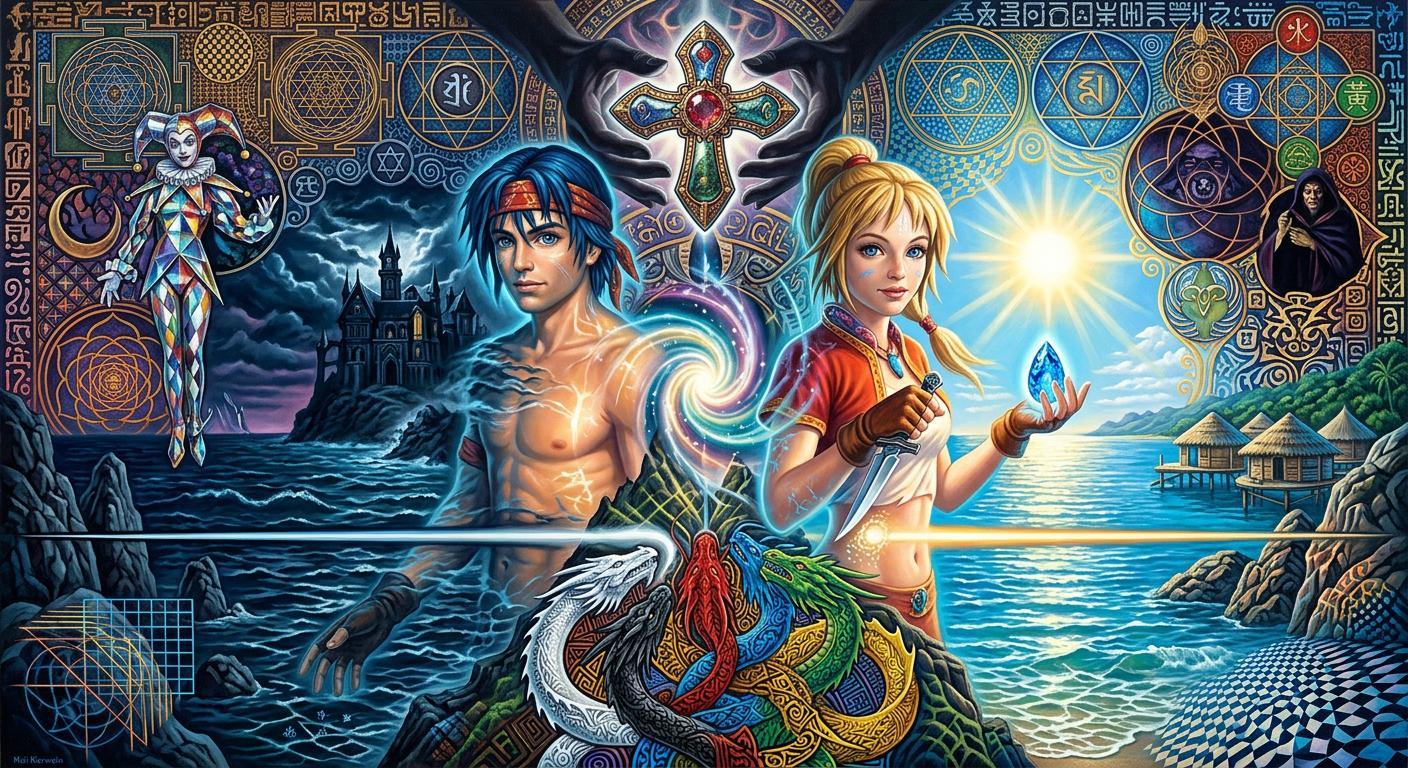
{Chrono Cross (1999 game)} illustrated in Mati Klarwein’s signature mischtechnik realism: {
Matthias "Mati" Klarwein (1932–2002) was born in Hamburg, Germany, on April 9, 1932, to Elsa Kühne, an opera singer, and Joseph Klarwein, a Jewish architect associated with Brick Expressionism and the Bauhaus movement. To escape the rise of Nazi Germany, his family fled to the British Mandate of Palestine in 1934, where the young Klarwein grew up immersed in Jewish, Islamic, and Christian traditions. Feeling like an outsider due to his family’s resistance to religious orthodoxy, Klarwein developed a pluralistic perspective that would shape his artistic career. Following his parents' divorce and the 1948 declaration of Israeli independence, he and his mother relocated to Paris. Between 1949 and 1951, Klarwein studied at the École des Beaux-Arts, the Académie Julian, and under Fernand Léger. While he absorbed Léger's modernism, his creative awakening came from Salvador Dalí (1904–1989) and Luis Buñuel’s (1900–1983) film Un Chien Andalou (1929), alongside his study of the Italian Renaissance and Flemish masters, leading him to appreciate surrealism's ability to challenge societal conventions.
During the mid-1950s, Klarwein settled on the French Riviera in Saint-Tropez, where he befriended artist Ernst Fuchs (1930–2015). Fuchs introduced Klarwein to the mischtechnik—a Northern Renaissance method of layering egg tempera and translucent oil glazes—which became the foundation of his "Visionary Realism," a style characterized by high-contrast, luminous detail. During this period, a seven-year partnership with a wealthy patron funded extensive travels across Asia, North Africa, and the Americas, providing Klarwein with a rich repository of visual memories. His philosophy was further deepened by Indian Tantric art, popularized by Ajit Mookerjee’s Tantra Art: Its Philosophy and Physics (1971). Embracing Tantra’s validation of physical sensuality and bodily experience as pathways to spiritual transcendence (Yantra), Klarwein incorporated concepts such as Shiva and Shakti (the union of dual energies), Bhupura (geometric grounding), and Bindu (cosmic singularity). This correlation between visual geometry and sonic vibration (Nada) bridged his art with the music industry, visually equalizing worldly illusion (Maya) and divine energy (Shakti).
Klarwein's emerging synthesis of scientific botanical precision and escapist surrealism is evident in his 1958 portrait of jazz musician Yusef Lateef, which embeds the performer in a hyper-detailed, exotic landscape that functions as a visual metaphor for vocal and creative energy, prefiguring the stylized, sensual floral portraiture later popularized by Pierre et Gilles (Pierre Commoy, b. 1950, and Gilles Blanchard, b. 1953). During this transformative period, he adopted the name Abdul Mati as a gesture of Middle Eastern reconciliation. Relocating to New York at the dawn of the 1960s sparked a period of intense creative awakening that bridged his nomadic travels with his new metropolitan life, yielding his 1959–1961 masterwork, Flight to Egypt (Benares). In this piece, he utilized the mischtechnik to generate intense inner radiance, structuring the composition around the complex, composite perspectives of Venetian Renaissance masters like Giovanni Bellini (1430–1516) and Tintoretto (1518/19–1594).
In 1961, he completed Annunciation, a veristic, multicultural reinterpretation of the biblical event that juxtaposes volumetric, sensual indigenous figures against flat, ornamental backgrounds. This deliberate contrast establishes a profound clarity of visual hierarchy and showcases rich, tapestry-like pattern qualities echoing Gustav Klimt’s (1862–1918) controversial university murals, where highly stylized, abstract geometries are used to frame and elevate organic human forms. This dialogue with Klimt’s aesthetic is also apparent in Klarwein’s 1964 painting Crucifixion (Freedom of Expression), which served his portable, 68-panel temple—the "Aleph Sanctuary"—dedicated to "the undefined religion of everything." Crucifixion echoed the public outcry surrounding Klimt’s mural Philosophy (1900–1907) by rendering an institutional, sacred theme as a paganistic, eroticized tapestry of human figures, yet organized by a rhythmic structural logic to express liberation from dogma. The Aleph Sanctuary itself became a space of profound creative meditation, notably inspiring Carlos Santana, who discovered Annunciation there and selected it for the cover of the multi-million-selling album Abraxas (1970).
This synthesis of sonic and visual energy culminated in iconic album covers during the early 1970s. For Miles Davis’s Bitches Brew (1970), Klarwein employed mischtechnik to create an otherworldly narrative of contrasting elements, utilizing a double-image composition reminiscent of Karel Thole's (1914–2000) surrealism to conceptually symbolize the metaphysical tension between human consciousness and elemental nature. For Davis's Live Evil (1971), Klarwein subverted conservative, institutional orthodoxy by transforming authoritarian iconography into a norm-transgressive, anthropomorphic caricature, employing hybrid anatomy to evoke an unsettling yet whimsical mutant fantasy style later popularized by Tim Jacobus (b. 1959). In 1971, he painted Zonked, visually manifesting cosmic interconnectedness through the transmutation of biology into a unified planetary consciousness, an image that eventually graced a release by the rap-originators The Last Poets. This period of high-saturation, multicultural surrealism also produced the cover art for the sci-fi anthology Two Views of Wonder (1973) and the painting Astral Body Awake (1974). The latter serves as a definitive visual map of his esoteric philosophy, utilizing an archetypal human anchor, dualistic environmental realism, and symbols of sacred geometry to seamlessly harmonize the macrocosm and microcosm without relying on physical collage.
These portrait-centered montages often carry a reflective, memoriam-like quality, functioning as visual shrines that symbolically capture the beauty of human life's paradoxical idealism and dualistic desires within a realistic phantasmagoria. This elegiac approach shares a conceptual affinity with the work of Ted Coconis (1927–2023), whose atmospheric illustrations similarly employed delicate, evocative portraiture to capture a haunting, nostalgic sense of memory, romance, and mortality. While Coconis utilized soft, dreamlike textures to evoke personal introspection, Klarwein scaled this commemorative instinct to a cosmic level, transforming his subjects into eternal, psychedelic icons.
By the late 1970s, Klarwein shifted toward minimalist spatial strategies and precise yet restrained semantic interventions within realistic landscapes, destabilizing conventional perspective through unnatural narrative insertions, linear graphic vectors, and subtle gradient overlays. These devices opened his compositions to indeterminate narratives charged with metaphysical tension. His 1976 painting Real Estate presents a photorealistic mountain peak subverted only by a geometric disc of moving sunlight, commenting conceptually on the illusion of material land ownership. In Soundscape (1980), he reappropriated a local topographic wonder as a metaphor for layered musical resonance, deliberately fracturing the organic rhythm of the terraces with stark, synthetic graphic intrusions. This work was later licensed for Jon Hassell’s LP Aka-Darbari-Java: Magic Realism (1983), part of a series of collaborations between 1978 and 2005 that visually represented Hassell’s primitive-futurist soundscapes, which also included Earthquake Island (1978), Dream Theory in Malaya (1981), and Maarifa Street (2005). In Wet Curve (1981), Klarwein depicted a realistic wet road, surreally subverted through the integration of surreal weather elements, evoking speculative intrigue reminiscent of pulp horror novel covers. Similarly, his 1985 painting Outline destabilizes the deep atmospheric perspective of a Mediterranean vista by fracturing the three-dimensional illusion with a taut, horizontal trompe l'oeil vector. This severe linear intervention operates conceptually as an artificial horizon, pulling a rigid spatial boundary into the absolute foreground to collapse depth perception and manifest the metaphysical border between the tangible present and the infinite unknown. This disruption of spatial logic is also visible in Mirrors Have No Taste (1980), where mischtechnik is used to fragment a kinetic composition of grassland and stony hills against flat, portal-like mirrors and an optical ziggurat pattern.
Ultimately, Mati Klarwein's hyper-detailed 'montage realism' constitutes an overarching conceptual framework that fundamentally distinguishes his work from traditional Surrealism. At its core is his signature mischtechnik realism, where the phantasmagoric juxtaposition of seemingly contradictory figures and narrative elements is densely woven together. Despite the overwhelming complexity of these compositions, they are governed by an absolute clarity of visual hierarchy, organizing hallucinatory excess into a unified symbolist whole, whose macro-structures and micro-details alike resonate with the harmonious patterning of a tapestry. It is a norm-critical visual paradox that symbolizes the climactic resolve, or never-ending dynamism, between orthodox cultural and cosmic mysticism and the peace-and-enlightenment-seeking psychedelic counterculture of 1960s New York, echoing the paradoxical beauty of an interconnected, autobiographical life. By dissolving rigid stereotypes in pursuit of a more universal, pluralistic truth, this approach creates a dynamically synergistic montage where documentary-style realism is surgically subverted and elevated into transcendent, surreal visionary grandeur.
While classical surrealists like Salvador Dalí and André Breton (1896–1966) relied on Freudian dream analysis, unconscious automation, and jarring, irrational juxtapositions to disrupt the conscious mind, Klarwein’s approach was a brilliant synthesis of fashionable, grounded futurism and the allegorical overtones of unifying cosmic forces. He conveyed a liberating global citizen perspective through dynamic graphic compositions—utilizing contrasting elemental juxtapositions to create illusionistic spatiality—alongside precise, minimalist, or patterned semantic interventions. He viewed his canvases not as passive dreams, but as "rebuses"—visual puzzles meant to stimulate intellectual inquiry rather than provide dogmatic answers. Reflecting his pragmatic artistic values, Klarwein also created what he called 'improved paintings'—a practice where he would buy existing canvases and paint over them according to his own direction, serving as a visual analog to the sampling and remixing culture of the music industry. Rooted in his experience of displacement and a multicultural upbringing, his art serves as a cartography of human consciousness, utilizing his visionary grandeur to translate paradoxical spiritualism and idealism by paralleling them with musical rhythms and the dynamic pluralism of cosmic unity.
}