Advertisement
Advertisement

Singapore

What is OpenClaw and what are the dangers associated with it?

The Infocomm Media Development Authority warned users against creating a single “all-powerful” OpenClaw agent with unrestricted access.

What is OpenClaw and what are the dangers associated with it?

The logo of OpenClaw, an open-source AI assistant, is seen on the software's website in this illustration picture taken on Mar 12, 2026. (Photo: Reuters/Florence Lo)

Listen
10 min
New: You can now listen to articles.

This audio is generated by an AI tool.

14 May 2026 06:42PM (Updated: 14 May 2026 06:44PM)
Read a summary of this article on FAST.
FAST

SINGAPORE: OpenClaw users should avoid deploying its open-source form in systems that are essential for an organisation’s function, the Infocomm Media Development Authority (IMDA) said in an advisory on Thursday (May 14). 

Given its experimental nature, deploying OpenClaw in systems that handle sensitive data could lead to errors with serious consequences, it said. 

Users should also avoid creating a single “all-powerful” OpenClaw agent with unrestricted access, and instead use multiple AI agents with narrow and clearly defined roles. 

Here’s what you need to know about the risks associated with OpenClaw and how it can be used safely. 

WHAT IS OPENCLAW? 

CNA Games
Show More
Show Less

OpenClaw is an AI agent. Unlike large language models such as ChatGPT and Claude that mainly answer questions, AI agents are designed to carry out tasks. 

With permission from the user, these agents can open applications, search for information, generate documents and complete multi-step processes with little supervision. 

It can automate everyday tasks – compiling research from multiple websites, drafting reports or emails, and coordinating schedules. 

For example, businesses can monitor a dashboard and create reports, or respond to customer enquiries on messaging platforms. 

OpenClaw was created by Austrian developer Peter Steinberger. Since it was released in November 2025, it has exploded in popularity.

One factor contributing to this is OpenClaw’s ease of use out of the box, IMDA said in its report. 

The AI agent’s ability to access files and systems, integrate with messaging platforms and develop skills, make it highly attractive as a productivity assistant, it added. 

These AI agents are basically what sci-fi movies have imagined AI personal assistants could be throughout the past century, said Mr Jacob Chen, the technical team lead at the Singapore University of Technology and Design (SUTD) Academy’s digital capabilities centre. 

Referencing Jarvis, who features as Iron Man’s virtual personal assistant in the movies, he noted that most people install OpenClaw on a spare computer and connect it to a large language model like ChatGPT or Claude. 

What makes OpenClaw powerful is not its ability to carry out tasks, but its ability to figure out how to do things it previously could not – or build its own skills, said Mr Chen. 

For example, a default version of OpenClaw would not be able to process videos because large language models cannot process videos directly.

However, if a user sends OpenClaw a video, it could figure out how to extract screenshots from the video to analyse them, or extract the audio and transcribe it, without the user having to give specific instructions.

WHAT ARE THE RISKS?

OpenClaw originated as a hobbyist, vibe-coding project, which did not undergo extensive security testing before it was released, said IMDA. 

It was launched with limited security controls – while many of the vulnerabilities have been patched in updated versions, new ones are still frequently being surfaced. 

By default, OpenClaw inherits the privileges of the user account that installs it.

The agent can access files anywhere on the computer where it is installed, unless sandboxing is turned on, said IMDA. 

Sandboxing is a cybersecurity practice that creates an isolated and secure environment to run, test, or analyse untrusted programs. 

If the AI agent is compromised, the attacker may have access to everything the user has access to. 

For example, if it is connected to shared programmes or apps like Slack, it may accept instructions from any participant in the channel without additional authentication, including from potential bad actors. 

Since it relies on an external AI model for reasoning and planning, everything OpenClaw has access to may be used by these models as context, and sensitive data may be shared without the user’s knowledge. 

Its use of long-term memory, which is what allows it to be an effective personal assistant, increases the risk of accidental data exposure, said IMDA. 

Storing this memory helps it to identify the user’s preferences and maintain the context of the work that it has done, which makes it more effective and personalised.

But attackers can exploit this – instructions embedded in the agent’s memory, possibly through external content such as emails, web pages or documents, can manipulate its behaviour. 

Known as memory poisoning, attackers can add inputs in fragments over time. The agent stores these fragments in its long-term memory, and they later combine into a harmful set of instructions. 

In practical terms, a user could think the agent is just preparing a report. But it could also be following hidden instructions embedded earlier through emails, webpages or documents, said Associate Professor Goh Weihan with the Singapore Institute of Technology (SIT).

OpenClaw can also learn skills from external sources, and these skills are often made by other users and do not undergo rigorous vetting, which opens up further risks. 

Applying this to practical uses, an individual may, for example, allow OpenClaw access to their personal email inbox. 

If their agent is compromised, then the information in their personal email accounts is also not safe.

In order to automate tasks, the agent knows everything about you, which allows it to give very smart answers. 

“But the thing is, that very thing also makes it very dangerous, because now it has access to all the context of what you do in your daily life. There's a lot of compromising information that it can give,” said Mr Chen.

An AI agent that has access to a person’s emails already knows who they are in contact with. It could impersonate them or reveal information about those they are in contact with, he added. 

Even if an individual only uses OpenClaw as a personal assistant, this access could still reveal that the individual works for a certain company. It could lead to a chain of events that compromises the larger organisation.

Since OpenClaw has become so popular, many people are trying to break the application and exploit it, said Mr Chen. 

“It’s just too viral for its own good at this moment right now,” he added. 

What sets agentic AI systems apart is that they can move from giving suggestions to performing actions, said SIT's Assoc Prof Goh. 

"Your normal AI chatbot may give a poor answer, and that's pretty much the end of it. An AI agent, with access to emails, files, code repositories, or cloud systems, may act on that answer," he added. 

Any unintended errors or malicious instructions can have a much larger, real-world impact, beyond just a bad answer, said Assoc Prof Goh, citing the incident where a Meta AI security researcher had her entire email inbox deleted by OpenClaw in February. 

The AI agent seemingly bypassed safety instructions to ask for permission, ignored stop commands and deleted hundreds of emails, he added. 

USING IT SAFELY

To use OpenClaw safely, IMDA advised that people avoid deploying it in its open-source form in mission-critical environments – a stance that experts also agreed with.

Mission-critical typically refers to a system, process or asset that is absolutely essential to an organisation’s core operations. If they are affected, business operations would immediately stop, resulting in severe consequences. 

OpenClaw’s configurations are permissive by default, and IMDA stressed that users should only use trusted skills and sources.  

IMDA also advised users against creating an “all-powerful” agent with unrestricted access and to avoid installing it on personal devices that contain sensitive data. 

The agent’s access to files and applications should be limited to the specific files and applications that it needs to perform its tasks, and the actions that it can perform within each application should also be restricted.

Users should identify checkpoints where the AI agent needs human approval. This could include financial transactions, executing code, deleting critical data or sending external communications on behalf of an organisation. 

OpenClaw highlights how rapidly autonomous AI tools are advancing, said IMDA, adding that they offer significant benefits but also pose real risks if used carelessly. 

“The aim is not to avoid them, but to use autonomous agents with clear limits, accountability, and safeguards.” 

Users should remember that OpenClaw still uses large language models built by providers like OpenAI and Anthropic, said Mr Chen.

“They say that they don’t use your data for training, and they have privacy policies, but there is no 100 per cent guarantee that they themselves will not be compromised or they themselves are not using the data for anything,” he added. 

Listen:

In teaching his students, he reminds them to treat OpenClaw as a personal assistant or an intern. 

Users should start with slow and simple tasks that have low stakes and are easy to verify, said Mr Chen. 

“When you get more confident with what you can do, understand its quirks, then you can kind of give it more things to do,” he added. 

He stressed that users should always be in the loop on what the agent is doing or producing. 

For example, the agent should not be reading your inbox or sending messages, said Mr Chen. 

Instead of connecting the agent to a personal email inbox, selecting and sending the information to OpenClaw is a better practice, although this reduces convenience and automation. 

Users should avoid giving OpenClaw authority to take irreversible actions, said SIT's Assoc Prof Goh. 

For example, a user may allow OpenClaw to draft an email, but the human user should always be the one reviewing and sending it. 

Users may also allow OpenClaw to suggest how to clean up a folder, but it should never be allowed to delete files without the users' approval, he added. 

Source: CNA/hw(mi)

Sign up for our newsletters

Get our pick of top stories and thought-provoking articles in your inbox

Subscribe here
Inbox
FAST
Advertisement

Singapore

As AI use grows, experts warn of risks to mental health and relationships

With AI becoming more embedded in daily life, building critical thinking skills and maintaining human connections may be key to ensuring it remains a helpful tool, rather than a harmful substitute, experts say on CNA’s Deep Dive podcast.  

As AI use grows, experts warn of risks to mental health and relationships

(Photo: iStock)

Listen
8 min
New: You can now listen to articles.

This audio is generated by an AI tool.

13 May 2026 06:48PM
Read a summary of this article on FAST.
FAST

SINGAPORE: From helping with homework to offering emotional support, artificial intelligence is increasingly becoming more than just a tool. 

For some, friendly chatbots are now a listening ear, a sounding board and even a trusted companion. 

But as reliance on AI deepens, experts are raising concerns about where the line should be drawn.

INCREASED USE OF AI

Associate Professor Swapna Verma, chairman of the medical board at the Institute of Mental Health, has observed a growing trend in her clinical practice: Many young patients now arrive at therapy sessions having already consulted AI chatbots. 

CNA Games
Show More
Show Less

“I had a patient who asked me about a specific kind of therapy. She said this was ChatGPT’s advice,” Assoc Prof Swapna recounted on CNA’s Deep Dive podcast. 

“And (the advice) was bang on, it was helpful.” 

She said the appeal is clear. Chatbots offer round-the-clock access, allowing users to seek answers and express concerns instantly. 

“I see (my patients) once every two or three months, whereas ChatGPT is available to them 24/7. It's the immediacy, the accessibility, that make it so enticing,” she noted. 

However, she cautioned that AI could pose risks, particularly for vulnerable individuals when it comes to discussions about mental health. 

“If a person has some specific vulnerabilities, they may not ask the right questions … and they end up getting wrong advice,” said Assoc Prof Swapna. 

She highlighted a key limitation: AI does not always connect intent across separate queries. 

For instance, when users indicate intentions of self-harm, AI chatbots will trigger responses of numbers to call for professional help or suggestions to de-escalate the situation such as reaching out to family and friends. 

“But at the same time, if you ask what the tallest building in Singapore is, (chatbots) will (answer with) the tallest building. They won't connect that these two could be related,” Assoc Prof Swapna said. 

AI SYCOPHANCY & RISKS FOR TEENS 

Experts say the risks are especially pronounced for young users, whose cognitive abilities are still developing. 

Those aged 12 to 18 are particularly vulnerable, as this is a critical period of brain development, said Assoc Prof Swapna. 

“That’s the time when your brain is growing at speed and the way it forms connections is by learning, by perceiving the environment, by making connections. And you’re kind of disrupting that (by dependence on AI),” she said. 

Associate Professor Jennifer Ang from the Singapore University of Social Sciences, who was on the same podcast, pointed to troubling reports overseas involving teenagers influenced by AI

“The AI companion is supposed to be very affirming. So, if you have self-destructive thoughts … the AI companion (could) reaffirm some of these thoughts as valid,” she said. 

While such cases have not surfaced widely in Singapore, she cautioned against complacency. 

A central concern is how AI interacts with users emotionally. Unlike human relationships, AI companions are often designed to affirm rather than challenge. 

“It's agreeable to everything. It affirms in a very empathic way. (Such) platforms are tailored to draw you in more and more,” said Assoc Prof Swapna, referring to AI sycophancy, a term used to describe AI models’ tendency to excessively validate users. 

This contrasts with established approaches like cognitive behavioural therapy, which emphasise questioning negative thought patterns. 

Assoc Prof Ang said: “If you're affirming everything, then it's not therapy. It's just offering very superficial support at most. This (AI) friend that is always on your side may not exactly be (offering) the best advice.” 

IMPACT ON THINKING AND RELATIONSHIP 

Beyond mental health, experts are also concerned about the impact on independent thinking. 

Assoc Prof Ang noted that students are increasingly relying on AI to complete tasks without fully understanding the material, describing this as “cognitive offloading”, where users outsource thinking to AI.

“They know very little about what actually (goes into) writing their essays, what they can remember (from) particular sources, how they evaluate and judge,” she said. 

She added that over dependence on AI may cause students to struggle to assess the reliability of information. 

“Children ought to (learn) the skills to know where to look for reliable information … make (their) own evaluation and judgment about the (credibility of) sources,” she said.  

There are also concerns about how AI may shape expectations of human relationships. 

People who rely on AI for companionship may become less willing to invest time and effort in real-world connections, experts said. 

“Rather than the traditional idea of what friendship looks like, (they could) start thinking … it’s maybe better talking to an AI friend that doesn't disagree with me, goes everywhere with me, and is readily available, unlike a human friend,” said Assoc Prof Ang. 

This could reduce patience and willingness to nurture relationships with others, she added. 

IMPACT ON SOCIETY 

At a broader level, both experts highlighted the need for greater awareness, education and AI literacy. 

“AI is not just mere technology – it's not a vacuum cleaner. We are not in full control of AI at times, and we have already allowed AI to control a lot of our lives. That recognition that we’re not … always in control … is a humbling fact that we need to learn,” said Assoc Prof Ang. 

They also raised concerns about data privacy and how personal information shared with AI could be misused. 

But rather than outright rejecting AI, both experts emphasised responsible use. 

Assoc Prof Ang suggested encouraging children to seek information from multiple sources, including textbooks, teachers and peers. 

Assoc Prof Swapna urged parents to watch for signs of over-reliance, such as children isolating themselves from real-world interactions and turning instead to devices.

“Have conversations with your child instead of ignoring those signs. Social connectedness is very important,” she said. 

“These are skills that children need to learn for later in life: how to connect with people and have conversations. If that becomes derailed, then that is a concern.” 

Back in her consultation room, Assoc Prof Swapna also uses AI discussions as a teaching moment with her patients. 

“I use the opportunity to educate them about AI, some of the perils, what to look out for, and how to use AI more ethically,” she said. 

“AI is based on available data. So, (there may be) a lot of Western slant, because the published data is predominantly from the West, so they may not get the cultural nuances, etc.” 

Ultimately, the experts agree that AI is here to stay, but its impact depends on how it is used. 

“Society has a role to play. It’s important for people to understand … the possible harms that AI can cause,” said Assoc Prof Ang, adding that over-reliance on AI for help can cause people to become more independent but lonely. 

“We are social creatures. It's okay to depend on others sometimes, to ask for help, rather than to be completely self-sufficient – that's when loneliness and isolation come about.” 

Source: CNA/dn(ca)

Sign up for our newsletters

Get our pick of top stories and thought-provoking articles in your inbox

Subscribe here
Inbox
FAST
Advertisement

Business

Tencent profit misses forecasts as higher spend offsets gaming gains

Tencent profit misses forecasts as higher spend offsets gaming gains

The Tencent logo at the company's headquarters during a government‑organised media trip in Shenzhen, Guangdong province, China, on Apr 17, 2026. (Photo: REUTERS/Go Nakamura)

13 May 2026 05:40PM
Read a summary of this article on FAST.
FAST

BEIJING: Tencent Holdings reported a 9 per cent rise in first-quarter revenue to 196.5 billion yuan (US$28.94 billion) on Wednesday (May 13), but fell short of the 198.96 billion yuan forecast by analysts.

The Shenzhen-based company's revenue growth was driven by a strong gaming performance, with domestic gaming revenue rising 6 per cent and international gaming revenue climbing 13 per cent.

Although China's largest social media and gaming company benefited from robust demand for its games and expanding artificial intelligence services, its net profit was 58.1 billion yuan, below estimates of 61.42 billion yuan.

Flagship titles including Honour of Kings and Peacekeeper Elite continued to drive user engagement, while tactical shooter "Delta Force" also contributed to the gains.

CNA Games
Show More
Show Less

Online advertising revenue increased 20 per cent to 38.2 billion yuan, boosted by AI-enhanced ad targeting capabilities.

Tencent last month unveiled Hunyuan 3.0, its most advanced large language model to date and its first major release since hiring former OpenAI researcher Yao Shunyu to lead development of its proprietary AI platform.

The launch underscores Tencent's efforts to close the gap with rivals ByteDance and Alibaba, which analysts say have been more aggressive in AI investment and deployment.

Tencent said in March it would ramp up AI spending this year, including investment in proprietary models. President Martin Lau said the company plans to increase capital expenditure in 2026, without specifying the amount.

The tech giant's total capex reached about 79 billion yuan last year, up from 77 billion yuan in 2024. First-quarter capex was 31.9 billion yuan, versus 27.5 billion yuan a year earlier.

Tencent spent 1 billion yuan promoting its Yuanbao AI chatbot during the Lunar New Year holiday period as it seeks market share in China's increasingly competitive AI sector.

Source: Reuters/ec

Sign up for our newsletters

Get our pick of top stories and thought-provoking articles in your inbox

Subscribe here
Inbox
Advertisement

Business

SoftBank profit more than triples to US$12 billion on OpenAI stake gains

SoftBank profit more than triples to US$12 billion on OpenAI stake gains

The logo of SoftBank is displayed at a company shop in Tokyo, Japan, on Jan 28, 2025. (Photo: REUTERS/Issei Kato)

13 May 2026 02:48PM (Updated: 13 May 2026 04:41PM)
Read a summary of this article on FAST.
FAST

TOKYO: Technology investor SoftBank Group reported on Wednesday (May 13) that its net profit more than tripled to ¥1.83 trillion (US$11.60 billion) in the January-March quarter, as it booked gains on its investment in ChatGPT-maker OpenAI.

It was SoftBank's fifth consecutive quarterly profit, with the Vision Fund investing arm booking an OpenAI-driven gain of ¥3.1 trillion in the quarter.

SoftBank founder and CEO Masayoshi Son is one of OpenAI's most enthusiastic backers, with the group saying its cumulative gains on the investment total US$45 billion.

But the scale of the OpenAI wager - SoftBank's most ambitious spending programme since the launch of the Vision Fund investment vehicles in 2017 and 2019 - has raised questions about financing pressures on the group.

CNA Games
Show More
Show Less

Critics also say OpenAI no longer enjoys a dominant position among large language model developers as peers such as Alphabet's Gemini and Anthropic's Claude grab market share, while the cost to train and run AI models is also rising.

SoftBank has sold off stakes in holdings such as T-Mobile and Nvidia, issued bonds and taken out loans, backed by its holdings in chip designer Arm and its domestic telecommunications arm SoftBank Corp.

SoftBank arranged a bridge loan agreement totalling US$40 billion in March. On Wednesday, it said US$20 billion was drawn down in April, primarily for the OpenAI investment, and US$2.5 billion had already been repaid.

SoftBank had previously said it had agreed to invest a further US$30 billion in OpenAI over the course of 2026, which would bring its cumulative investment to US$64.6 billion for a 13 per cent stake.

The group booked a ¥278.6 billion gain on its investment in chipmaker Intel, which is led by former SoftBank board member Lip-Bu Tan.

SoftBank has also sought to build a portfolio of robotics firms, looking to gain a foothold in an industry that is in its infancy but is seen by analysts and investors as having potential to drive profits into the future.

It agreed to acquire the robotics business of Swiss engineering group ABB in a US$5.4 billion deal last year, and created a new subsidiary within the group to hold its robotics-related stakes.

Source: Reuters/ec

Sign up for our newsletters

Get our pick of top stories and thought-provoking articles in your inbox

Subscribe here
Inbox
Advertisement

Business

South Korean shares hit all-time high on AI-led chipmaker rally

South Korean shares hit all-time high on AI-led chipmaker rally

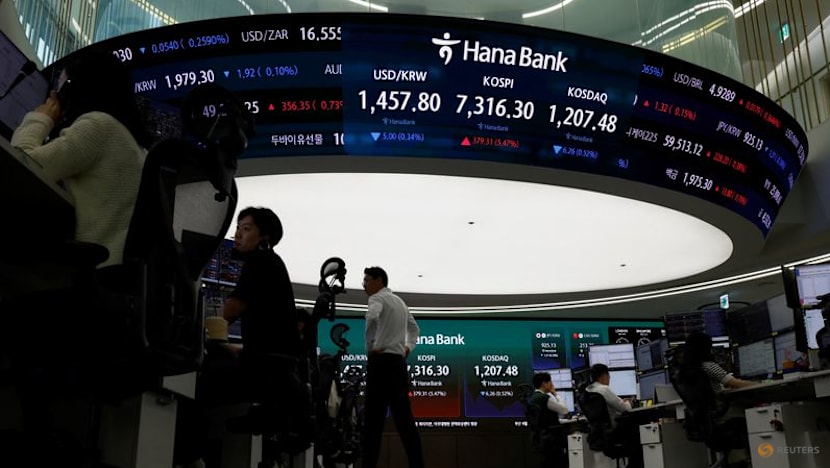
Currency dealers work as an electronic board displays the Korea Composite Stock Price Index (Kospi), the exchange rate between the US dollar and South Korean won and the Korea Securities Dealers Automated Quotations (Kosdaq) at the dealing room of a bank in Seoul, South Korea, on May 6, 2026. (File photo: Reuters/Kim Soo-hyeon)

11 May 2026 10:06AM (Updated: 11 May 2026 11:32PM)
Read a summary of this article on FAST.
FAST

SEOUL: South Korean shares hit record highs on Monday (May 11), as chipmakers extended gains amid optimism over artificial intelligence, bolstered by a rally in US peers and upbeat data.

The benchmark Kospi rose as much as 5.05 per cent in early trade to an all-time high of 7,876.60 in morning trade. During the session, a trading curb was activated by sharp gains in the index.

Samsung Electronics rose more than 5 per cent and SK Hynix gained more than 10 per cent, with both chipmakers hitting record levels.

Last week, the Kospi rose 13.6 per cent, the biggest weekly jump since late 2008. 

CNA Games
Show More
Show Less

It has risen 85 per cent so far this year, after rising 76 per cent last year, as South Korea has emerged as the world's best-performing stock market amid an AI boom. 

The Philadelphia Semiconductor Index rose 5.5 per cent on Friday, as chipmaker Micron Technology surged 15.5 per cent, while Apple and Intel also rallied on a report of their deal on chip production. 

South Korea's exports rose 43.7 per cent in the first 10 days of this month from a year earlier, led by a 150 per cent surge in chip sales, trade data showed on Monday.

"There is profit-taking pressure rising among all investor groups, so it is necessary to note that short-term volatility can grow in semiconductor stocks as the Kospi extends gains this week," said Han Ji-young, an analyst at Kiwoom Securities.

The Kospi's rally on Monday compared with Japan's Nikkei and Taiwanese stocks rising less than 1 per cent, while US stock futures fell in Asian trading hours amid uncertainty over the geopolitical conflict in the Middle East.

It was led by retail investors, whose net purchases totalled 1.2 trillion won (US$815.66 million), while foreigners were net sellers.

Among other sectors, automakers and battery manufacturers gained. Still, of the total 894 traded issues, 197 shares advanced, while 681 declined.

The won was quoted at 1,469.4 per dollar on the onshore settlement platform, 0.48 per cent lower than its previous close at 1,462.3.

The most liquid three-year Korean treasury bond yield rose by 0.6 basis points to 3.567 per cent, while the benchmark 10-year yield fell by 0.1 basis points to 3.911 per cent.

Source: Reuters/co

Sign up for our newsletters

Get our pick of top stories and thought-provoking articles in your inbox

Subscribe here
Inbox
Advertisement

East Asia

China announces Trump's visit from May 13 to 15

The summit will be the two leaders' first face-to-face talks in more than six months as they try to stabilise ties strained by trade, the US and Israeli war with Iran and other areas of disagreement.

China announces Trump's visit from May 13 to 15

US President Donald Trump and Chinese President Xi Jinping walk as they leave after a bilateral meeting at Gimhae International Airport, on the sidelines of the Asia-Pacific Economic Cooperation (APEC) summit, in Busan, South Korea, on Oct 30, 2025. (File photo: Reuters/Evelyn Hockstein)

11 May 2026 06:40AM (Updated: 11 May 2026 11:24PM)
Read a summary of this article on FAST.
FAST

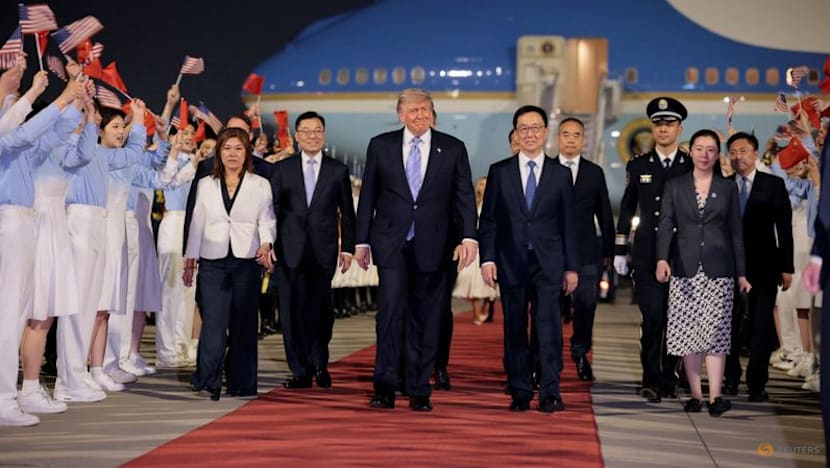
BEIJING: President Donald Trump will visit China from May 13 to 15, Beijing confirmed on Monday (May 11), with the US leader expected to discuss Iran and trade with his Chinese counterpart.

Washington and Beijing have been at loggerheads over key issues ranging from trade tariffs to the Middle East war and Taiwan, which China claims as part of its territory.

Trump was originally meant to visit in late March or early April, but postponed his trip to focus on the Iran war.

"At the invitation of President Xi Jinping, President of the United States of America Donald J Trump will pay a state visit to China from May 13 to 15," a Chinese foreign ministry spokesperson said.

The leaders of the world's two largest economies will hold their first face-to-face talks in more than six months.

Trump is scheduled to arrive in Beijing on Wednesday, ahead of talks set to take place Thursday and Friday. It will be his first trip to China since 2017.

AGREEMENTS ON PLANES, AGRICULTURE AND TRADE

The US and China are expected to agree to forums to facilitate mutual trade and investment, while China is expected to announce purchases related to Boeing planes, American agriculture and energy, the officials said.

Plans for a Board of Trade and Board of Investment may be formally announced at the meeting, but those mechanisms may need subsequent work before they can be implemented, one of the officials said.

The two countries will also discuss lengthening a truce in their trade war that allows rare earth minerals to flow from China to the US, though it is not yet clear if that agreement will be extended this week, that official said.

He nonetheless expressed confidence that the deal, which was struck last autumn and remains in effect, will eventually be extended.

"It doesn't expire yet," the official told reporters. "I'm confident we'll announce any potential extension at the appropriate time."

China's embassy in Washington declined to comment.

THORNIER ISSUES INCLUDE TAIWAN, NUCLEAR ARMS, IRAN AND AI

The Trump-Xi talks are also expected to veer into areas that have long been a source of US-China tension, including Iran, Taiwan and nuclear arms.

China maintains ties with Iran and remains a major consumer of its oil exports. Trump has been leaning on China to use its influence to push Tehran to make a deal with Washington and end the conflict that began when the US and Israel launched strikes on Iran in late February.

The Trump administration has also pressed China on its dealings with Russia.

"The president has spoken multiple times with General Secretary Xi Jinping about the topic of Iran and about the topic of Russia, to include the revenue that China provides to both those regimes, as well as dual-use goods, components and parts, not to mention the potential of weapons exports," said one of the officials. 

"I expect that conversation to continue."

Xi, meanwhile, is frustrated with Washington over Taiwan. The US remains the most important ⁠international backer and arms supplier for the democratically governed island, which Beijing claims as its own Chinese territory.

China has ramped up its military presence near Taiwan in recent years, but US policy will not change, the official said.

The Trump aides expressed increasing concern about advanced artificial intelligence models being developed in China and believed the two sides need "a channel of communication" to avoid conflicts arising from their use.

"What that looks like is yet to be determined, but we want to take this opportunity with the leaders meeting to open up a conversation and to see if we should establish a channel of communication on AI matters," said one of the officials.

Washington has also long hoped to open up talks with Beijing about nuclear weapons, though China remains reluctant to discuss its arsenal. 

The Chinese government has said privately to the US that "they have no interest in sitting down and discussing any kind of nuclear arms control or anything along those lines at this point," the official said.

Trump and Xi's last meeting was in October in South Korea, where they agreed to pause a bruising trade war that had seen the US impose triple-digit tariffs on Chinese goods and Beijing threaten to restrict the global supply of rare earths.

In February, the Supreme Court said Trump did not have the authority to impose many of his tariffs on imports worldwide. He has vowed to reimpose some levies using other legal avenues. 

Source: Reuters/co

Sign up for our newsletters

Get our pick of top stories and thought-provoking articles in your inbox

Subscribe here
Inbox
Advertisement

Singapore

Telco sector 'high-value target' for cyber attackers, firms advised on urgency of frontier AI risks: Shanmugam

The Infocomm Media Development Authority has issued an advisory to telcos on measures to protect themselves against cybersecurity threats.

Telco sector 'high-value target' for cyber attackers, firms advised on urgency of frontier AI risks: Shanmugam

Coordinating Minister for National Security and Minister for Home Affairs K Shanmugam speaks to media at Yishun Ring Road on May 9, 2026. (Photo: CNA/Raydza Rahman)

Listen
6 min
New: You can now listen to articles.

This audio is generated by an AI tool.

09 May 2026 12:00PM (Updated: 09 May 2026 02:49PM)
Read a summary of this article on FAST.
FAST

SINGAPORE: Advanced persistent threat (APT) actors are increasingly harnessing artificial intelligence (AI) to sharpen their attacks, with Singapore’s telecommunications sector a "high-value target", Coordinating Minister for National Security K Shanmugam said on Saturday (May 9).

Speaking to reporters, the Home Affairs Minister said the telco sector is “especially critical” and brought up the threat posed by APT group UNC3886, which had launched attacks on Singapore telcos last year.

Urging firms to raise their cyber posture, Mr Shanmugam said that frontier AI - referring to the most capable and cutting-edge AI systems available - is now helping these attackers wreak havoc on victims.

He added: "This has to be the responsibility at the board level, it cannot be delegated to the IT departments alone. The board of directors will have to say we are responsible for it."

CNA Games
Show More
Show Less

On how cyber attackers are adopting AI, the minister said they can attack faster, cheaper, at scale, and the attacks can be conducted by persons who are “not so skilled”.

"Some attackers are integrating AI into their cyber operations. The attackers who are the most capable, most well-resourced, will be the ones who are adapting to advanced AI, quickly integrating into their capabilities," he said.

"It's a serious issue for Singapore. It's a serious issue for other countries," said Mr Shanmugam, who was addressing the media at Yishun Ring Road.

IMDA ISSUED ADVISORY TO TELCOS

He added that the Infocomm Media Development Authority (IMDA) has issued an advisory, including guidance on measures to telecommunication firms to "reinforce the urgency of the matter".

Measures they can take include adopting AI themselves to improve their cybersecurity, as well as updating their risk management plans to account for AI-enabled threats.

In response to CNA's queries, IMDA said that the advisory was issued to telecom firms, including their boards.

It provided "additional guidance" on measures they can take to strengthen their cybersecurity defences against the potential threats posed by frontier AI models, including updating internal risk models and business continuity plans to address the faster timelines and increased complexity of AI-enabled attacks.

"This is a continuing effort, given the dynamic tech and cyber landscape, where risks can emerge and evolve. Thus, IMDA constantly keeps telcos updated of the latest threats and risks to their networks, and tangible steps they can take to address them," said the IMDA.

On Saturday, Mr Shanmugam said Singapore is also working with partners who have direct access to methods to understand the implications of frontier AI, echoing what the government had said in parliament earlier this week in a response to Members of Parliament who filed questions on the technology. 
 
On Tuesday, Senior Minister of State for Digital Development and Information Tan Kiat How said that the government views AI-enabled cyber risk as an amplification of an existing systemic risk, rather than a new category, and that agencies are on the alert for cybersecurity risks due to AI.

Anthropic’s Mythos is one example of frontier AI. Debuted early last month, its preview model is its most advanced to date and is able to identify weaknesses in computer systems and fix or exploit them in hours rather than months.

WHOLE-OF-NATION EFFORT

Apart from IMDA’s advisory, Mr Shanmugam reiterated that the Monetary Authority of Singapore has also met with the chief executives of some financial institutions to underscore the importance of cyber risks.

The Cyber Security Agency (CSA) has also issued an alert to sector leads and critical information infrastructure (CII) operators to tighten cyber hygiene measures and put in place longer-term mitigation measures.

"The government has sensitised the various stakeholders. And of course, the government itself is also taking steps," he said.

Mr Shanmugam said that this is a "whole-of-country" effort.

"They are building and experimenting with our own AI tools for cyber defence. We are also using tools that are already openly available, and we are working closely with industry partners to keep pace," he added.

The government will have to monitor all CII sectors, and those with internet-facing systems are the most exposed, Mr Shanmugam said.

Asked if the government will convene a taskforce to address AI cybersecurity threats, Mr Shanmugam said there has been focus on the issue for some time already.

He said cybersecurity efforts are overseen at multiple levels, with Minister for Digital Development and Information Josephine Teo as overall-in-charge.

Mr Shanmugam said that a permanent secretary is also coordinating the work across agencies, which CNA understands to be Permanent Secretary of Digital Development and Information Chng Kai Fong.

Asked how the technology should be regarded by the public, given that the government is encouraging its use while also stating that it is a security threat, Mr Shanmugam replied: "Would you say we can slow down on the adoption of AI? That makes no sense, right? That will make us less competitive and even more vulnerable."

"We have to do two things in parallel," he said. "First, we have to become better in defending ourselves against AI threats. Second, we must ourselves become experts at using AI for our own purposes."
 

Source: CNA/wt(nj)

Sign up for our newsletters

Get our pick of top stories and thought-provoking articles in your inbox

Subscribe here
Inbox
Advertisement

Commentary

Commentary: Chipmakers' AI boom is ignoring history

Ceaseless demand and structural supply constraints have pushed the stock market prices and profits of chipmakers like Nvidia to the moon. Can this continue?

Commentary: Chipmakers' AI boom is ignoring history

FILE PHOTO: A Nvidia logo appears in this illustration created on August 25, 2025. REUTERS/Dado Ruvic/Illustration/File Photo

08 May 2026 05:59AM
Read a summary of this article on FAST.
FAST

MIAMI, Florida: Semiconductors are pulling ahead of everything else in the stock market, including the vaunted hyperscalers that helped drive extraordinary returns from 2022 through 2025. The divergence is part of a high-stakes tussle among investors to pick the winners and losers of the artificial intelligence revolution.

In recent months, investors have piled into the companies getting rich from the technology right now - and grown less patient with those banking on big payoffs down the line. Still, history suggests the greater risk may be in assuming that today’s leading beneficiaries will remain on top.

A 144% MARKET RALLY

The S&P Semiconductors Select Industry Index - an equal-weighted gauge that treats behemoth Nvidia the same as much smaller players - has returned a staggering 144 per cent in the past year, crushing the 19 per cent advance for the equal-weighted S&P 500 and the 36 per cent gain for a basket of hyperscalers. 

That’s by far their greatest outperformance since the artificial intelligence boom got under way. On a cumulative basis since the release of ChatGPT started the AI hype, semiconductors are about to catch hyperscalers - a term for the massive cloud service providers that own and operate the data centre infrastructure required to train and deploy large-scale artificial intelligence models - as the biggest beneficiaries.

CNA Games
Show More
Show Less

It’s no exaggeration to say that semiconductors have put the US stock market on their backs: In 2026, the S&P 500 would only be up around 2.2 per cent, instead of the current 6 per cent if you zeroed out the gains from semiconductors.

And the advances are far from speculative. The sector is on pace for 83 per cent growth in earnings per share from a year earlier, early-season results show, driven by ceaseless demand and structural supply constraints that are pushing prices and profits to the moon. The gains have now spread from Nvidia, the maker of the most coveted and superior AI chips, to much more humdrum chips.

A LOOK AT HISTORY

Concerningly, however, history has shown that ultra-juicy semiconductor margins tend to lure more capacity to the market, which eventually leads to oversupply, making today’s 44 per cent net margins look suspiciously unsustainable.

It’s simply part of semiconductors’ DNA that their margins widen and narrow. Helped by smartphone adoption, they expanded for years after the financial crisis, only to cool dramatically thereafter. They boomed during the early years of COVID-19, too, as everyone’s lives went online, then shrank in 2022 when pull-forward computer demand waned and the supply glut arrived. The current margin expansion is already three years old, but could it really be that much different from prior experiences? 

The “this time is different” crowd is convinced that the AI boom is no ordinary cycle. For one thing, the hyperscalers are engaged in an arms race, and demand looks strong at least through 2026. 

Semiconductor “fabs” often take two to three years to build and get running. And AI itself is so technologically demanding that even the highly cyclical, “commodity-like” components - memory chief among them - aren’t as interchangeable as they were in previous cycles. The high bandwidth memory used for AI GPUs is essentially only produced by three companies globally. One of them, Micron Technology, is leading the charge among US semiconductor stocks.

WILL THE RALLY CONTINUE?

Nevertheless, the semiconductor family of stocks has seen such an extraordinary rally that a lot of upsides is already in the price.

Goldman Sachs Group’s Jim Covello, co-head of equity research, said last week that he recommends hyperscalers themselves as the better way to play the AI story these days. Microsoft, Oracle and Meta Platforms are all well below their recent highs and lagging the broader index.

That’s at least partially due to concerns that they’re spending too much with little to show for it. If they start to generate positive returns on their AI investments, the hyperscalers will have more upside than the semiconductor stocks, Covello reasoned. 

If they cut back on spending, investors could celebrate that as well in the short term, as it would help shore up free cash flows, he reasoned. But it would be a major headwind to the semiconductor stocks.

Ultimately, you don’t have to be an AI doomer to worry that this semiconductor rally is due for a pause, or worse. For second and third-tier semiconductor companies to keep rallying like Beanie Babies in the 1990s, they’d need demand to remain at least this extraordinary and supply constraints to remain in place. Perhaps the demand really is as strong as we’re told but never bet against human ingenuity to sooner or later help meet it.

Source: Bloomberg/zw(sk)

Sign up for our newsletters

Get our pick of top stories and thought-provoking articles in your inbox

Subscribe here
Inbox
Advertisement

World

CNA Explains: What is frontier AI and how Anthropic's Mythos is reshaping cybersecurity

Anthropic’s Mythos AI model has demonstrated advanced capabilities in coding and system analysis, raising fears over how such tools could be misused.

CNA Explains: What is frontier AI and how Anthropic's Mythos is reshaping cybersecurity

Illustration of a person using a laptop. (Illustration: iStock)

Listen
8 min
New: You can now listen to articles.

This audio is generated by an AI tool.

07 May 2026 06:00AM (Updated: 07 May 2026 10:46AM)
Read a summary of this article on FAST.
FAST

The debut of advanced artificial intelligence models such as Anthropic’s Claude Mythos is sharpening global concerns over a new class of technology known as frontier AI - and the security risks it could pose.

These systems, the most advanced AI models available today, can reason through complex problems and detect vulnerabilities at a speed and scale far beyond human capability.

While that could strengthen cybersecurity, it also introduces new threats.

Mythos in particular has drawn attention for its capabilities in coding and system analysis, fuelling fears that such tools could be misused by cybercriminals to exploit weaknesses in critical systems.

CNA Games
Show More
Show Less

As a result, regulators and policymakers are reassessing whether existing safeguards are sufficient.

Here’s what to know about frontier AI - and how it is changing the risk landscape.

What is Frontier AI?

Frontier AI refers to the most capable and cutting-edge AI systems available today.

Think of it as J.A.R.V.I.S from Iron Man – an assistant that can hold a conversation, reason through problems and act on a user's behalf, said Zscaler's Santanu Dutt, the cybersecurity firm's vice president of solutions consulting and head of technology of Asia Pacific and Japan.

What was once fictional is now widely available to anyone with an internet connection, he noted.

These models are particularly powerful in areas such as cybersecurity and software analysis. They can scan vast amounts of code, identify weaknesses and even suggest ways to exploit or fix them - in hours rather than months.

But this becomes a double-edged sword. 

While organisations can use frontier AI to fix bugs quickly, cybercriminals can also misuse the same system to exploit vulnerabilities at an unprecedented speed. 

Besides Mythos, other frontier AI models include OpenAI’s GPT-5, Google’s Gemini and xAI's Grok.

What are the risks surrounding Frontier AI? 

The concern is not just what frontier AI can do, but how quickly and widely it can do it.

Experts told CNA that these models dramatically lower the barrier to entry for sophisticated cyberattacks. Tasks that once required specialised skills - such as writing malware or crafting phishing campaigns – can now be done with simple prompts.

In terms of speed, vulnerabilities that once took weeks or months to uncover can now be identified and exploited in minutes, said Muthukumar Natarajan, field chief technology officer at cybersecurity firm TrendAI. 

In terms of scale, one person with a frontier AI model can now match what previously required a team of attackers, noted Mr Dutt. 

“The barrier to launching sophisticated attacks has effectively collapsed,” he added.

This creates a growing imbalance between attackers and defenders, said Ian Lim, chief technology officer of Asia Pacific, Japan and Greater China at Cisco Customer Experience.

“Attackers only have to find one gap while defenders have to remediate every vulnerability,” he explained.

“With frontier models significantly shrinking the time-to-exploit, organisations can no longer assume patches will arrive before exploitation occurs.”

Mr Dutt warned that frontier AI has changed the rules of the game. “Systems and instincts built for the old pace have not caught up,” he said.

Why are these risks a growing concern? 

The implications are particularly serious at a national level, experts said.

Critical infrastructure, such as banks, telecommunications networks, healthcare systems and energy grids, relies on complex interconnected digital systems. 

Many of these depend on layers of third-party and open-source software, which may contain hidden vulnerabilities.

Sophisticated state actors could leverage frontier models to launch automated and frequent attacks on critical infrastructure, Mr Lim said.

Frontier AI also allows threat actors to scan for weaknesses at scale, said Dmitry Volkov, chief executive and co-founder of cybersecurity firm Group-IB.

"Every country has many organisations that are part of its critical infrastructure," he said. “These organisations also rely on long lists of software products, many of which may contain vulnerabilities.”  

An attack on a single sector could therefore ripple across others.

In Singapore, for instance, banks, hospitals, power grid, transport networks and telcos are deeply interconnected, Mr Dutt noted, which means a potential AI-accelerated attack on any one of them would not just be an IT problem.

"For businesses, the equivalent is stark - one careless moment with an AI tool can expose years of trade secrets or an entire customer database in seconds," he said.

Which sectors are most at risk?

As cyberattacks are driven by profit, data exfiltration and disruption, Mr Lim said industries that fit the target profiles of these attacks will be most at risk. 

These include companies that move financial transactions, handle sensitive data and manage critical infrastructure, he added.

“Supply chain attacks should also be considered, as downstream organisations may not have the budget or expertise to secure their environments as rigorously as regulated industries,” Mr Lim said. 

Globally, the finance sector has been thrust into the spotlight as authorities scrutinise its ability to combat risks posed by powerful AI models. 

“Financial services and banking are highly exposed because they are digital, interconnected, and attractive to both criminals and nation-state actors,” said Mr Volkov.

“AI could accelerate fraud, phishing and attacks on banking applications.”

Are organisations keeping up?

Many organisations are not keeping pace with the rapid evolution of frontier AI, said Mr Natarajan.

He pointed out that cybersecurity today remains largely reactive, with companies responding to incidents rather than anticipating them. Policies governing AI use are also often underdeveloped or absent.

“We’re actually fixing the wheels while we’re driving,” Mr Natarajan said. “There’s a huge gap … I won’t say anybody is prepared for (attacks)."

While some banks in Asia are tightening checks on their AI tools, not everyone is moving fast enough. 

Australia’s financial system regulator has warned that the country’s banks and their information security practices are struggling to match the rate of change in AI.

Even so, global financial institutions are adopting AI at more than twice the rate of regulators, according to research published on Apr 28 by the Cambridge Centre for Alternative Finance.

In the United States, the government announced on Tuesday that it would have access to tech giants’ new AI models to evaluate them before they are released - a sign of growing concern over their potential impact.

What can be done?

The risks posed by frontier AI cannot be eliminated - but they can be managed.

At an organisational level, experts point to several priorities - understanding risk exposure, monitoring how AI tools are used, setting clear guidelines on what data can and cannot be shared with AI systems, as well as investing in AI-driven security.

At the national level, stronger coordination is needed.

Mr Natarajan suggested an international governance framework, with governments working together to develop policies and procedures around the use of frontier AI.

“This is not just one country’s problem,” he said. “If they end up in the wrong hands, it’s going to affect everybody.” 

Regular checks and governance policies should be established before even bringing AI into critical infrastructure, Mr Natarajan added.

Mr Dutt warned that cybersecurity in the age of frontier AI is no longer a back-office IT concern.

“It is a leadership issue,” he said. “Because the consequences land on customers, citizens, and the country.”

Want an issue or topic explained? Email us at digitalnews [at] mediacorp.com.sg. Your question might become a story on our site.

Source: CNA/co(gs)

Sign up for our newsletters

Get our pick of top stories and thought-provoking articles in your inbox

Subscribe here
Advertisement

Singapore

Parliament unanimously backs motion affirming that Singapore must not have jobless growth amid AI transition

A total of 24 Members of Parliament, including seven from the Workers’ Party, spoke for over seven hours on the impact of the AI transition on jobs and livelihoods.

Parliament unanimously backs motion affirming that Singapore must not have jobless growth amid AI transition

A view of Parliament House in Singapore on May 24, 2018. (File photo: Reuters/Edgar Su)

Listen
11 min
New: You can now listen to articles.

This audio is generated by an AI tool.

06 May 2026 08:55PM (Updated: 12 May 2026 10:08PM)
Read a summary of this article on FAST.
FAST

SINGAPORE: Parliament unanimously passed a motion on Wednesday (May 6) affirming that Singapore must not have jobless growth amid the artificial intelligence transition, with labour chief Ng Chee Meng hailing a "clear consensus" that the impact on workers must be collectively managed.

“All members recognise that AI adoption is not optional. If Singapore is to stay competitive, both enterprises and workers need to use AI fluency to seize new opportunities,” said the National Trades Union Congress (NTUC) secretary-general.

The private member's motion called on the House to recognise the transformative power of new technologies, emphasise that Singapore's approach should be fair and affirm that economic progress must be inclusive. 

It was moved by Mr Ng (PAP-Jalan Kayu) on Tuesday, together with Mr Saktiandi Supaat (PAP-Bishan-Toa Payoh), Ms Yeo Wan Ling (PAP-Punggol) and Nominated Member of Parliament Mark Lee. This was the first motion tabled by the labour movement in more than a decade.

CNA Games
Show More
Show Less

It passed after two days of debate spanning more than seven hours, with speeches from 24 Members of Parliament (MPs), including seven from the Workers' Party (WP) and two political office holders, Manpower Minister Tan See Leng and Minister of State for Digital Development and Information and Education Jasmin Lau. 

In his speech rounding up the debate, Mr Ng reiterated what Dr Tan and Ms Lau said on the need for collective action. “Left to market, AI growth may not automatically benefit workers,” said Mr Ng.

He also noted that other MPs warned about an outcome in which some workers gain, but others risk falling behind.

“I am therefore glad that through this motion, the government has affirmed that it will not leave outcomes to chance but will shape the direction of AI growth deliberately,” said Mr Ng, adding that he is looking forward to the government’s Economic Strategy Review (ESR) report.

“With this House standing united, I’m fully confident that we can strengthen our plans and responses at this stage of AI-enabled growth.

“Together with enabled enterprises, we will forge tripartism in the AI era for win-win outcomes, as we have done before in Singapore for Singaporeans.”
 

WORKERS’ PARTY PROPOSES 'SOCIAL DIVIDEND', REDUNDANCY INSURANCE

The seven WP MPs who spoke during the debate put forth several proposals to support workers through the AI transition. All of them ultimately said they supported the motion.

In his speech, Mr Gerald Giam (WP-Aljunied) suggested setting up a national “AI equity fund”, with part of the fund going to a “social dividend”. He said the revenue would be distributed as a direct payout to every adult Singapore citizen.

The source of the fund’s contributions could be from corporate taxes and Singapore’s net investment returns, he said.

The purpose of the dividend is to provide an additional cushion for families and allow Singapore to reap the benefits of AI without “overly exacerbating” social inequality, said Mr Giam.

He proposed an initial dividend of S$500 per adult.

Mr Giam then added that the remaining portion of the fund could be dedicated to a “mastery fund”, which will be an employer-led on-the-job training model that provides the apprentice a wage, covering 50 per cent of the gross salary capped at the median wage for six months for any Singapore citizen entering or transitioning into an AI-augmented role.

“This rewards the workers’ effort in adapting, while lowering the barrier for firms to hire, train and retain talent in this volatile market,” he said.

The mastery fund would also finance a pool of expert on-the-job consultants, which will help small and medium enterprises fill a talent gap, he added.

In another speech, Non-Constituency MP Andre Low also proposed changes to the Jobseeker Support Scheme (JSS) to better protect workers displaced by AI.

Currently, the JSS pays up to S$6,000 over six months tapering in monthly installments and is only available to workers who earned S$5,000 or less.

“A payment that starts high and slowly reduces is not a flaw. It is a countdown, and a countdown pushes a worker to take the first offer, not the right one,” he said.

Instead of the JSS, the WP has proposed a redundancy insurance scheme, where retrenched workers will receive a payout of 40 per cent of their last drawn salary, with no income ceiling and no tapering mechanism.

This will be funded by employer-employee contributions in the same model as the Central Provident Fund (CPF), and it covers every worker who pays in, he said.

In response, Dr Tan said that both Mr Giam and Mr Low's proposals rest on a more “pessimistic premise” that Singaporeans are “essentially passive passengers in the AI transition” and without agency to seize opportunities.

“I cannot hold on, and I would not hold on to such a premise,” said the manpower minister, adding that both proposals are not a form of empowerment.

“To me, it is a settlement resigned to the fact that mass displacement is inevitable and that the best we can do is soften the blow.

“We should have more confidence in the tenacity and the adaptability of our fellow Singaporeans,” he said, adding that the convention is to invest in people rather than to “compensate them for their circumstances”.

Dr Tan also took aim at a suggestion by Mr Kenneth Tiong (WP-Aljunied) to universalise the six months’ free access to premium AI tools, which is currently given out to those taking selected AI courses.

Dr Tan said not all Singaporeans require frontier AI tools and that free versions suffice.

“By tying subsidies to training, we are better able to target those who are more serious about leveling up their use of AI, and we help them to make optimal and responsible use of such powerful tools,” he said.
 

AI INEQUALITY

Several MPs, such as Mr Saktiandi, also flagged concerns that AI could worsen inequality.

Noting that many of the more capable AI tools require ongoing subscriptions, Mr Saktiandi said that despite six months of free access to premium AI tools provided by the government, a divide could emerge between those who can afford to continue using these tools and those who cannot.

“If left unaddressed, we risk creating a new form of inequality between the AI haves and have-nots,” said Mr Saktiandi.

Access to these tools directly affects productivity, learning and income potential, so unequal access will lead to unequal outcomes, he said.

In this light, he suggested providing a baseline level of subsidised access, or group-based pricing with industry partners. There could also be shared access through community centres, libraries and training hubs, or access for workers through their employers, he said.

“If AI is to be a force for inclusive growth, access cannot be a privilege, it must be broadly shared,” he said.

NTUC deputy secretary-general Desmond Tan also highlighted seniors as one group that lacks access to AI tools and training, as well as the confidence to use AI.

He said many of them “have lived through repeated cycles of change and transformation and may feel fatigued, uncertain or even question the relevance of more training”.

“We must make training more accessible for them at a suitable pace, through practical and bite-sized modules, and make AI more relevant to their job skills,” he said.

Ms He Ting Ru (WP-Sengkang) said some people face “systemic barriers” as Singapore moves toward an AI-ready future.

She pointed to persons with disabilities, women, lower-income Singaporeans and young graduates as possible groups.

Unequal access to AI tools and training could also entrench existing disadvantages, she said.

“Those without the resources or home environments conducive to learning new skills may find themselves falling further behind,” said Ms He, adding that that would risk “hardening inequality” across generations.

The government’s response to such concerns is to “raise the floor and to widen the door”, said Ms Lau.

The co-chair of the ESR’s technology and innovation committee said this will involve building AI literacy in schools so that all students, regardless of economic background, can learn about the technology safely.

Institutes of Higher Learning will offer selected AI-related courses at discounts for their alumni for a period of one year from the second half of 2026, she said, reiterating that Singaporean workers who complete selected AI training courses will get six months’ complimentary access to AI tools.

“Every Singaporean, regardless of starting point, should have the chance to experiment with AI tools and build fluency,” said Ms Lau.
 

SUPPORTING DISPLACED WORKERS

Several MPs also highlighted the need to support workers who are at risk of being displaced by AI, especially those in professional, managerial, executive and technical (PMET) roles.

This group of workers are highly exposed to artificial intelligence, NTUC assistant secretary-general Patrick Tay (PAP-Pioneer) noted.

Unlike earlier waves of automation that mostly impacted rank and file workers, many of the middle-income workers are “expected to perform like the top, but are less protected than the bottom”, he said.

“We perceive PMEs as privileged and adaptable who have resources and can take individual responsibility to upskill and also to cope with setbacks. This assumption no longer holds true,” he said.

Nominated MP Mark Lee said workers who are displaced, whether due to AI or industry consolidation, need stronger support during their transition.

“If another company is prepared to take in a displaced worker, even if the fit is not immediate, we should support that transition directly,” he said, adding that this can be done by providing temporary wage support to the employer.

Doing so would shorten the period of uncertainty for workers, while giving the firms the confidence to take in and develop new talent, he said.

NTUC assistant secretary-general Yeo Wan Ling (PAP-Punggol) said transition support must be timely, and AI grants should be tied to mandatory job redesign requirements and productivity gains linked to workers’ outcomes.

If enterprises are unable to retain workers, they should be required to notify the government early, so displaced workers can be assisted by the newly formed Tripartite Jobs Council, she said.

In her speech, Ms Lau said the ESR will identify sectors with sustained labour demand and lower AI displacement risk, and work with unions and employers in those sectors to create supported entry points for workers making a transition.

"We must make these pathways walkable, and not just visible," she said.

She gave an example of a mid-career worker in an administrative role who is worried about being displaced by AI. The worker could explore similar roles in healthcare administration, which is seeing robust labour demand.

This requires more than courses, she said. Various parties such as training providers, unions and employers must work closely together so that workers do not fall through the cracks, said Ms Lau, adding that no government has all the answers.

"What we in Singapore can commit to is this, we will not wait for perfect solutions before acting. We are starting now, and we will adjust our efforts along the way," she said.

Source: CNA/dv(nj)

Sign up for our newsletters

Get our pick of top stories and thought-provoking articles in your inbox

Subscribe here
Advertisement

Singapore

Singapore will not leave future of work, livelihoods to chance amid AI transition: Tan See Leng

Singapore must be prepared that AI’s impact on jobs could grow as adoption gains pace and scale, said the manpower minister.

Singapore will not leave future of work, livelihoods to chance amid AI transition: Tan See Leng

Manpower Minister Tan See Leng speaking during a parliamentary debate on a motion about an AI transition with "no jobless growth" on May 6, 2026.

Listen
8 min
New: You can now listen to articles.

This audio is generated by an AI tool.

06 May 2026 07:28PM
Read a summary of this article on FAST.
FAST

SINGAPORE: Amid disruption from artificial intelligence, Singapore will not leave the future of work and the livelihoods of its people to chance, Manpower Minister Tan See Leng said on Wednesday (May 6).

Instead, the country will shape a transformation that is inclusive, forward thinking and “anchored in real action”, Dr Tan told parliament.

“Singaporeans will never be helpless passengers to an AI-driven future, but Singaporeans will be our fellow co-pilots as our AI journey takes flight,” he said.

“And we will move forward in the Singapore way, with government, employers and the unions working together to ensure that our AI transformation creates good jobs, clear pathways for every Singaporean worker towards a better future.”

CNA Games
Show More
Show Less

The minister was responding to a motion about an AI transition with “no jobless growth”, which was proposed by National Trades Union Congress (NTUC) secretary-general Ng Chee Meng. More than 20 MPs debated the motion over two days.

Dr Tan said he supports the motion, which calls on parliament to: recognise AI’s transformative power; emphasise the need to anchor AI-enabled growth in fairness, resilience and opportunity for all; equip workers and businesses to seize new opportunities together; and affirm inclusive economic progress.

The Ministry of Manpower (MOM) has said that there is no indication of widespread job displacement by AI, and that early evidence suggests AI is complementing rather than displacing labour in Singapore.

According to its poll earlier this year, 6.2 per cent of firms have reduced headcount due to AI adoption, while 8.5 per cent of firms had reduced hiring activity due to AI.

But Dr Tan on Wednesday said Singapore must be prepared that AI’s impact on jobs will be greater as its adoption gains pace and scale.

The goal is to enable more businesses to use AI in such a way that workers can do their jobs better rather than be replaced, that work becomes more meaningful, and that AI’s benefits are shared between businesses and workers, he said.

Dr Tan said Singapore has weathered deep disruption in the past – through the Asian financial crisis, SARS and COVID-19 – because workers, businesses and the government stood together.

“In many countries, AI becomes a tug of war – workers on one end, business on the other. Progress contested, trust strained. Singapore does not have to go down that road,” he said.

Dr Tan acknowledged anxieties that AI may erode workers’ skills and experience and even take over jobs.

While some jobs will disappear, AI also creates new opportunities, he said.

AI can also enable new forms of flexible work and fractional work by small teams or “solopreneurs”, and Dr Tan said a tripartite work group on senior employment will explore how to scale flexible work models.

The government will also study NTUC’s proposal to raise the income ceiling of the SkillsFuture Jobseeker Support Scheme to better support higher-income individuals, said the minister.

The scheme provides temporary financial relief of up to S$6,000 and job search support to people who lost their jobs involuntarily, and currently has a salary cap of S$5,000.

IMPROVING AI SKILLS

Addressing the concerns brought up by MPs over inequality caused by AI, Dr Tan said fairness, resilience and shared opportunity in AI-enabled growth will not happen naturally, because the technology’s adoption is uneven across sectors, worker segments and business sizes.

“Without deliberate effort, the gains from AI could flow to some while others are left behind,” he said.

To this end, the new Tripartite Jobs Council will pay special attention to students and young workers anxious about AI’s impact on entry-level jobs, said the minister.

He pointed to institutes of higher learning enhancing their curricula to keep pace with AI developments and offering alumni selected AI courses at a discount.

SkillsFuture work-study programmes also allow graduates to combine classroom and on-the-job training, to build skills and experience that employers value, he said.

Dr Tan also pointed to broader efforts to prepare workers for the AI transition.

The formation of the new Skills and Workforce Development Agency (SWDA) will allow workers and employers to obtain support in skills and employment facilitation more seamlessly, he said.

The government will also do more to improve Singaporeans’ AI literacy. For example, SWDA will introduce diagnostic tools for workers to assess their level of “AI readiness” and find suitable courses.

Singaporeans in selected SkillsFuture AI courses will soon receive six months of free access to premium AI tools.

The Infocomm and Media Development Authority will also expand the TechSkills Accelerator programme to develop “AI bilingual” workers, starting with accountancy, legal and human resource professionals.

SUPPORTING BUSINESS TRANSFORMATION

Dr Tan also reiterated the support Singapore is giving to businesses through the S$400 million Enterprise Workforce Transformation Package, first announced in Budget 2025.

It will provide more funding for job redesign and workforce training – such as covering up to 70 per cent of the job redesign costs for small and medium enterprises, capped at S$150,000.

Dr Tan also pointed out that businesses accessing the grants are required to support workforce outcomes like wage growth and retention.

He then noted labour chief Mr Ng’s suggestion to expand NTUC’s company training committee (CTC) initiative, and said the government shared his ambition to elevate it to a tripartite level.

"We look forward to working with tripartite partners to jointly explore ways to make this a reality," said Dr Tan.

The CTC is a labour movement initiative first launched in 2019, in which employers are encouraged to form training committees with unions to work together on ways to boost worker career prospects and wages through structured training and technology adoption.

It is supported by grant funding from NTUC of up to 70 per cent of the qualifying cost for each project.

Mr Ng had said on Tuesday that NTUC will work with the Singapore National Employers Federation (SNEF) as part of the new Tripartite Jobs Council in order to expand the CTCs nationwide, going forward.

Finally, Dr Tan addressed NTUC’s proposal to require employers to notify authorities of retrenchment in advance, so that the labour movement can proactively support affected employees.

Currently, companies with at least 10 employees must notify MOM of any retrenchment within five working days after the affected employee is informed.

An administrative penalty of S$1,000 can be imposed if the employer fails to do so.

Previously, Dr Tan said advance mandatory notification would pose challenges for businesses and could even discourage backroom talks to save jobs.

Nominated Member of Parliament Mark Lee, who is also vice-chair of the Singapore Business Federation, on Wednesday said earlier notification alone will not solve the problem if businesses are not ready to redesign jobs or absorb workers.

Said Dr Tan: “We want to strike the right balance. Tripartite partners are already discussing shortening the retrenchment notification duration under the ongoing Employment Act review.

“We, on our part, would like to see notification to the government happening before or by the last day of work of the affected workers as far as possible.

“This would then also enable timelier employment facilitation support to workers.”

Towards the end of his speech, he assured workers, new graduates and firms that the government will support them through the AI transition.

“To our workers wondering where you stand, there will always be a place for you. Your experience, your judgment matter more than ever, and your commitment to our country, your support through the years, through the decades – we are deeply appreciative.

“To all of our young graduates, your ideas, your drive matter more than ever. Your enthusiasm, your curiosity ... matter more than ever, and we are behind you.

“For all of our businesses, if you're unsure, you're uncertain as to where to start, you don't have to figure it out alone. We will walk alongside with you,” he said.

Source: CNA/dv(nj)

Sign up for our newsletters

Get our pick of top stories and thought-provoking articles in your inbox

Subscribe here
Advertisement

Singapore

AI use in Singapore schools kept age-appropriate, with focus on learning, not shortcuts: Desmond Lee

Educational AI tools by MOE have built-in safety guardrails to protect students’ interests, privacy and well-being, Education Minister Desmond Lee says.

AI use in Singapore schools kept age-appropriate, with focus on learning, not shortcuts: Desmond Lee

A class of Primary 4 students at Palm View Primary School conducting science experiments during their E2K Science lesson on Feb 26, 2026. (Photo: CNA/Alyssa Tan)

Listen
5 min
New: You can now listen to articles.

This audio is generated by an AI tool.

06 May 2026 01:07PM (Updated: 06 May 2026 02:19PM)
Read a summary of this article on FAST.
FAST

SINGAPORE: The use of artificial intelligence in schools is kept balanced and age-appropriate to support students’ learning and development, Minister for Education Desmond Lee said on Wednesday (May 6).

Responding to parliamentary questions on AI usage among primary school students and the safeguards in place, Mr Lee said theoretical knowledge alone is not sufficient, and students need well-designed and supervised hands-on experiences by using educational AI tools.

“This spiral approach as students progress through different levels in school prepares them to harness AI to benefit their learning, critically evaluate AI output and guard against risks such as cognitive offloading.”

MOE's approach is informed by research on how children learn and develop, and what is helpful at each stage of their growth, Mr Lee said, outlining a tiered framework.

CNA Games
Show More
Show Less

From Primary 1 to 3, physical hands-on learning is prioritised as students build foundational knowledge and develop cognitive and social skills. They learn the basics of AI, but schools will not assign work that requires them to use AI directly.

From Primary 4, students may use educational AI tools under teacher supervision. By that age, Mr Lee said, students would have developed foundational literacy, numeracy and basic knowledge of AI, as well as skills such as planning, task initiation and the ability to evaluate their own thinking.

Students in Primary 4 to 6 will only use tools specifically designed for education, including AI-enabled features within the Singapore Student Learning Space (SLS).

NO SHORTCUTS

Schools will also teach students that AI must not be used to take shortcuts in place of actual learning, Mr Lee said.

“We want to provide our students with a school environment where they can develop good learning habits and understand the importance of upholding academic integrity.”

Some secondary schools may design assignments that allow AI use, with students required to disclose and properly cite any AI-assisted work. Mr Lee said this prepares them for post-secondary education and future workplaces where AI use will be more prevalent.

Students who pass off AI-generated content as their own will face consequences for academic dishonesty, he added. 

National examinations are invigilated and the use of AI is prohibited. Where AI is permitted, such as in coursework, teacher supervisors will monitor use to ensure it meets assessment objectives.

SAFEGUARDS IN PLACE

Educational AI tools used in schools have built-in safety guardrails to protect students’ interests, privacy and well-being, Mr Lee said.

Data from MOE-built AI tools is anonymised and not used to train external models. Schools using commercial off-the-shelf tools must ensure input data contains no personal or personally identifiable information, in compliance with data management guidelines.

Mr Lee also acknowledged parental concerns about exposing young children to AI, particularly around excessive screen time. Beyond sharing information on how parents can support their children's AI use, MOE provides details on how tools are used in teaching and offers avenues for parents to share their views.

“AI has been developing rapidly and is increasingly embedded into everyday systems around us," he said.

“If we’re not mindful, we may lose the consciousness in detecting the presence of, and influence that AI has in our decision making and ways of thinking, simply because it works so seamlessly. So development of AI literacy is critical and must be timely.”

In a supplementary question, MP Kenneth Tiong (WP–Aljunied) asked if parents can opt their children out of specific aspects of AI tool usage in classrooms.

Mr Lee said that it depends on whether it is an SLS-enabled tool and is used in classroom learning.

"It's part of teaching and learning. It's part of teachers' blended approach, and I think that will enable our teachers to be able to help our children learn the cognitive aspects, foundational knowledge, more deeply."

He added that if specific external tools are brought and parental consent is not obtained, schools will not allow children to use those AI tools.

Mr Lee likened restricting children’s use of AI in blended learning to saying, "I don't want my children to have a whiteboard, I want a blackboard."

"We must enable our teachers to be able to perform their role, and this is of course subject to MOE guidance and good Singapore teaching practice." 

Source: CNA/cj(sz)

Sign up for our newsletters

Get our pick of top stories and thought-provoking articles in your inbox

Subscribe here