Advertisement
Advertisement

Asia

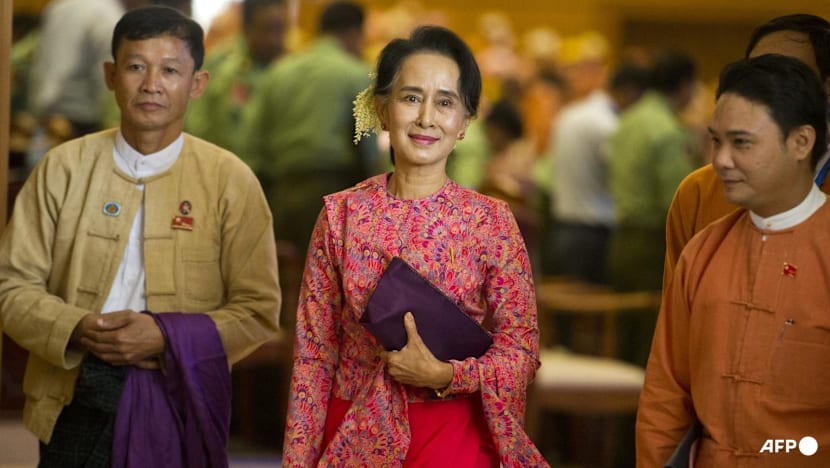
Aung San Suu Kyi's son urges Myanmar to provide 'proof of life'

Kim Aris, son of Aung San Suu Kyi, said that he has yet to hear from his mother.

Aung San Suu Kyi's son urges Myanmar to provide 'proof of life'
Kim Aris, son of Aung San Suu Kyi, speaks to supporters before taking part in a run on his mother's 80th birthday, to raise awareness of her ongoing incarceration, in Hyde Park in London on Jun 19, 2025. (File photo: AFP/Benjamin Cremel)see more
05 May 2026 08:18PM (Updated: 05 May 2026 11:49PM)
Read a summary of this article on FAST.
FAST

PARIS: The son of Myanmar's deposed leader Aung San Suu Kyi on Tuesday (May 5) demanded France's help in seeking independently verified proof of his mother's life after she was transferred to house arrest, her lawyers said.

The country's chief-turned-president Min Aung Hlaing on Thursday ordered the 80-year-old Nobel Peace Prize winner to be moved, five years after putting her into detention in a coup.

But her son, Kim Aris, says he has still not heard from his mother, who remains massively popular inside Myanmar.

"I implore France to join my call so that we may obtain independently verified proof of life, and so that her fundamental rights are guaranteed: appropriate medical care, access to her lawyers and to her family," he wrote in a letter addressed to French President Emmanuel Macron seen by AFP.

CNA Games
Show More
Show Less

Aung San Suu Kyi's lawyer, Francois Zimeray, said that Aris handed the letter to France's Foreign Minister Jean-Noel Barrot at a meeting on Tuesday.

"We have had no proof of life, no photos for years, not even any indication that she was actually transferred. We still don't know where she is," he told AFP.

The office of Min Aung Hlaing on Thursday shared an undated photograph appearing to show Aung San Suu Kyi sitting flanked by two men in uniform.

"But we don't know if it's real or if it's AI," Zimeray said.

Lawyer Catalina de la Sota, also representing Aung San Suu Kyi, added: "We cannot imagine that she is no longer alive, but why is she being kept in total secrecy, in violation of all international conventions? We are worried about her health."

Barrot during the meeting said "France would continue to work for the immediate and unconditional release of Aung San Suu Kyi", the foreign ministry said.

Min Aung Hlaing toppled Aung San Suu Kyi's elected government in 2021, detaining her on a host of charges which rights groups say were confected to sideline her.

The ensuing civil war has killed thousands and displaced millions in the southeast Asian country of roughly 50 million.

Source: AFP/dy

Sign up for our newsletters

Get our pick of top stories and thought-provoking articles in your inbox

Subscribe here
Inbox
FAST
Advertisement

Asia

Thailand vows strict tourist oversight after public sex incidents

Thailand vows strict tourist oversight after public sex incidents

A tourist lays on the sand at Nang Ram Beach in Pattaya on Feb 26, 2026. (Photo: AFP/Chanakarn Laosarakham)

06 May 2026 08:38PM
Read a summary of this article on FAST.
FAST

BANGKOK: Thailand vowed on Wednesday (May 6) to tighten oversight of tourists' behaviour after a series of incidents involving foreigners caught having sex in public, warning they damaged the country's image.

Tourism is vital to the Southeast Asian nation's economy but foreign arrivals are yet to return to their pre-COVID highs.

Visitors displaying "inappropriate behaviour", including illicit drug use, would face prosecution as it "contradicts the beautiful culture of Thailand", the prime minister's office said in a statement.

The pledge followed an incident on Monday evening on the southern island of Phuket where a couple was found performing a sexual act in a tuk-tuk in a popular tourist area.

CNA Games
Show More
Show Less

Authorities said they were working to revoke the visas of a 41-year-old Spanish man and a 43-year-old Peruvian woman, and then deport and blacklist them.

The pair admitted to the act and were charged under public indecency laws, the government statement said.

Public nudity and sexual acts in public are punishable by a fine up to 5,000 baht (US$155).

The clampdown was "intended to safeguard Thailand's beautiful cultural values", according to the prime minister's office.

Checks by authorities of entertainment venues would also be stricter, it added.

Despite its reputation as a sex tourism destination, Thailand is a mostly socially conservative society where public displays of affection are frowned upon.

But the country also decriminalised cannabis in 2022 and is popular among backpackers and young tourists for its rowdy beach raves.

Last month, a French couple was arrested and deported after footage of them having sex on a Phuket beach spread widely online, according to local media.

Another couple from France was blacklisted and had their visa revoked after a video of the pair having sex in a tuk-tuk in Phuket earlier this year triggered outrage online.

Thailand expects about 33.5 million foreign tourists this year, up from nearly 33 million visitors in 2025, the government has said.

Total tourist arrivals dropped seven per cent in April compared to the same month last year, with visitors from Europe declining nearly 16 per cent that month, according to tourism ministry figures.

Source: AFP/ec

Sign up for our newsletters

Get our pick of top stories and thought-provoking articles in your inbox

Subscribe here
Inbox
FAST
Advertisement

Asia

Why has pig farming in Malaysia’s Selangor state become a hot political issue?

The Selangor Sultan decreed in February that pig farming should not be allowed in the Malaysian state, but a politician’s recent suggestion that a modern farming system be allowed instead has sparked a political storm.

Why has pig farming in Malaysia’s Selangor state become a hot political issue?

An empty pig farm in Tanjung Sepat, Selangor. (Photo: CNA/Fadza Ishak)

New: You can now listen to articles.

This audio is generated by an AI tool.

06 May 2026 08:35PM (Updated: 06 May 2026 09:17PM)
Read a summary of this article on FAST.
FAST

KUALA LUMPUR: For decades, Selangor’s pig farmers have operated on a quiet stretch of the coast south of Kuala Lumpur.

Tanjung Sepat and its surrounding areas in the district of Kuala Langat, about a 50km drive from Kuala Lumpur International Airport, once had more than 110 farms. Today, only about 30 remain. 

The industry finds itself fighting for survival in the state, caught in the crosshairs of a political battle following a decree in February by Selangor's Sultan Sharafuddin Idris Shah to shut down.

Chen (not his real name), a second-generation farmer whose family has occupied its current site for 15 years, told CNA many of his peers are ready to move on. Facing a dead end with pig farming, they are exploring alternatives like poultry or aquaculture.

"Many just want to give up and are negotiating with the state government for transition support," said Chen, who spoke on the condition of anonymity. 

"The Sultan has already made his stance against pig farming clear; I don’t see a way forward. We have been fighting for so long and the mental anguish just isn't worth it. We are just like a ball kicked from one department to the next," he said.   

Although the state government has ordered the farmers to clear out by June, Chen is hoping for a reprieve until December. An extension would ensure his 200 pigs reach their optimal weight, preventing significant financial losses.

But the status of the farms remains unclear.

A government minister was widely quoted by local media on Wednesday (May 6) afternoon as saying that pig farms in Selangor will be allowed to operate in areas located far from residential zones and critical water sources, and must use the latest technology to manage waste and pollution.

But the news reports were taken down later, with no reasons given. 

The issue had become heavily politicised in recent weeks after a Democratic Action Party (DAP)’s state assemblyperson proposed a modern, closed system for farmers in spite of the sultan’s decree. 

Opposition politicians seized upon it, accusing her of disrespecting royalty.

Analysts say the DAP – part of the ruling Pakatan Harapan coalition – now finds itself in a "catch-22" situation, caught between its duty to defend constituents’ livelihoods, and appearing to defy the monarchy. 

CNA Games
Show More
Show Less
Selangor ruler Sultan Sharafuddin Idris Shah does not consent to pig farming in the state. (Photo: Selangor Royal Office)

HOW PIG FARMING TURNED POLITICAL

Pork production and consumption are traditionally sensitive topics in Malaysia, given that 63.5 per cent of the population is Muslim and pork is prohibited in Islam.

The latest issue surfaced in January, when the Selangor state government announced plans to move the traditional, scattered farms around Tanjung Sepat to a centralised and modern facility in Bukit Tagar, Hulu Selangor, by 2030.

The 202-hectare zero-emission closed farming system in Bukit Tagar would allow the industry to be managed systematically, improving hygiene and waste management, said State Infrastructure and Agriculture Committee Chairman Izham Hashim.

Most pig farms in Selangor – which has the third-largest pig farming industry in the country after Perak and Sarawak – currently operate open-air systems.

The future site would have a buffer zone, and Izham said the state government wanted to “ensure this industry is well-managed to guarantee food supply, hygiene, community harmony and disease risk control”. 

But Bukit Tagar was identified as a Malay-majority area and residents opposed the project.   

Selangor currently produces 30 per cent of its pork needs and imports the rest from other states. (Photo: AFP/Bertrand Guay)

Sultan Sharafuddin then decreed on Feb 10 that pig farming should not be allowed anywhere in the state. He said it could cause air pollution through foul odours and contaminate river water sources due to the discharge of waste and sewage.

There was a risk of polluting water catchment areas and rivers supplying treated water to Selangor, Kuala Lumpur and Putrajaya, the ruler said.

He also pointed to the state’s limited land availability and high property values, saying land should be prioritised for more economically beneficial uses that could better serve the community.

The government could grant licences for the import of pork to meet the demand and needs of non-Muslims in the state, he suggested.

Selangor currently produces 30 per cent of its pork needs and imports the rest from other states.  

Following the decree, the Selangor state government announced it would stop issuing new pig farming licences and accelerate the phased closure of existing farms, moving towards 100 per cent imports. 

Despite the royal decree, DAP's Seri Kembangan assemblyperson Wong Siew Ki on Apr 22 proposed a modern, closed farming system.

She said pig farming should not be treated differently from other livestock industries, noting that modern technology could address concerns like pollution, hygiene and odour.

She cited Article 8 of the Federal Constitution, which touches on equality, to argue against singling out pig farming for a total ban.

“Pig farming should not be treated differently from other types of livestock farming. The risks of pollution, as well as hygiene and health aspects in pig farming, are identical to those faced by other livestock industries,” she said. 

Wong said her proposal was based on feedback from constituents and aimed to find a sustainable way for the industry to exist within the state.

A massive backlash ensued in the state assembly and public arena, culminating in multiple police reports lodged against her for allegedly touching on sensitive issues. 

Members of the opposition coalition Perikatan Nasional (PN) attempted to table a motion to refer Wong to the Rights and Privileges Committee while the Selangor youth chapter of Parti Islam Se-Malaysia (PAS) - a party in PN - demanded her immediate suspension.

"Since the Ruler's decree is clear that pig farming is no longer permitted in Selangor, any attempt to revive the proposal — even when wrapped in modern terminology like 'zero discharge', 'closed systems', and 'biogas' — still reflects an insolent attitude and a lack of respect for the institution of the Constitutional Monarchy," Selangor PAS Youth chief Sukri Omar said in a statement on Apr 22.

PAS also staged a protest in front of Wong’s office on Apr 24.   

DAP leaders have backed Wong, with secretary-general Anthony Loke saying that while it respects the royalty, the party also defends members’ right to speak up.  

“As a member of the Legislative Assembly (Adun), they must have the space to convey views respectfully and in a proper manner. That is the responsibility of an elected representative,” Loke was quoted as saying by Bernama news agency on Apr 26.   

DAP, which is multi-racial in outlook but predominantly Chinese in composition, draws much of its support from urban voters in big towns and cities across Malaysia.

With 40 parliamentary seats in the 222-member lower house, DAP supplies the most seats to Prime Minister Anwar Ibrahim’s unity government.

LOSE-LOSE FOR DAP?

Observers said the issue has now transcended mere agricultural policy, turning into a political matter where the sensitivities of race, religion and royalty are involved. 

Because of religious sensitivities, any political support for the industry is quickly framed as a racial issue, said Ahmad Fauzi Abdul Hamid, a political science professor at Universiti Sains Malaysia (USM). 

“This approach plays into the hands of right-wing political factions by reinforcing a narrative that DAP is ‘Chinese-centric’ or ‘racially biased’,” he said.

The DAP finds itself in a tight spot advocating for Selangor’s pig farmers, analysts said.

The issue will be a "staple" in PN’s campaign at the next general election (GE), where it will portray the DAP as being rude to the royalty, they said. 

Malaysia’s GE16 must be called by February 2028, although there is speculation it could be called as early as this year

Loke himself acknowledged on Apr 26 that the opposition would seize on the issue.   

James Chin, a professor of Asian studies from the University of Tasmania, said it is largely a lose-lose situation for DAP.

“The Malay ground is becoming more Islamic and for the average person, their thinking is that, ‘Islam is not stopping (non-Muslims) from consuming pork but we don’t want you to rear pigs because Selangor is a Muslim-majority state’,” he said, adding that DAP also has to weigh political risks if it does not speak up.  

“Their opponents would argue that before joining the government, DAP was a vocal defender of Chinese education and lifestyle, but now they have grown quiet. It is an issue that is very easy to weaponise,” Chin said.

DAP's Seri Kembangan representative Wong Siew Ki addressing the Selangor State Assembly. (Photo: Facebook/Wong Siew Ki)

Azmi Hassan, a fellow at the Nusantara Academy for Strategic Research, said that while DAP wanted to signal to its constituents that the party is committed to protecting their interests, it has created an “open goal” for the opposition, particularly right-wing parties.

“For this particular issue, it should not have been raised at all because the opposition will jump on this issue,” he said.

Former DAP leader and Selangor executive committee member Ronnie Liu, who has been an advocate on the pig farming issue, said banning pig farming in the state would have political consequences for the government.  

“Those who eat bak kut teh won't stand for it. It feels like a 'damned if you do, damned if you don't' scenario,” Liu said. Bak kut teh is a pork rib soup cooked with spices, garlic and herbs.

“The best move now is for the (Selangor chief minister) and the (state executive committee) to sit down and reason with the Sultan. After all, other states are still running pig farms that are even bigger than Selangor," said the former assemblyman of Sungai Pelek, which borders the Tanjung Sepat area.  

But Ahmad Fauzi believed it may be better for DAP to "cool things down" and look to "lateral" solutions such as farming in other states.

As DAP constituents are becoming more multiracial, focusing on only one segment such as pig farmers could be "self-defeating", he said.

“DAP has done well in ministerial portfolios such as transport and human resources previously, but this issue drags them back down to ethnic politics,” he said. 

The Selangor State Legislative Assembly in Shah Alam. (Photo: CNA/Fadza Ishak)

A NEED TO MODERNISE

Politics notwithstanding, experts and observers say there is a need for the industry to modernise to ensure long-term food security.  

Malaysia’s Agriculture and Food Security deputy minister Chan Foong Hin told the Senate on Mar 12 that the country’s self-sufficiency rate for pork in 2024 was 67.8 per cent, with the government aiming to achieve 90 per cent by 2030.  

He said the ministry encouraged the transformation of the pig farming industry towards closed systems, more efficient waste management, and compliance with environmental requirements.  

Of the 355 registered pig farms nationwide, 121 farms – about a-third – operate under a closed model and zero-discharge concept. 

Liu noted that Perak is ahead of the pack, citing reports that 60 out of 83 pig farms in the state have transitioned to closed systems.

“This proves that pollution is not an unsolvable problem. It requires policy, land, financing, licensing and technological support,” he said.

“If closed-house systems, zero discharge and waste-to-biogas conversion can help address pollution, why is technological transformation not being promoted, while the issue is quickly turned into a political one?”

Chen, the pig farmer, said a small, determined minority of his peers still hopes to continue their livelihood by modernising.

Another pig farmer told CNA he was willing to invest in a closed farming system but is unable to make a decision because of the current uncertainty.

“The only thing we are told at this point is that we have to shut down and clear the land. Worse comes to worst, we will have to go to court, but that also requires money,” said the farmer who has been in the line for about 20 years now. 

The farmer who, like Chen, also requested anonymity, said pig farming was the only thing he knew and questioned if those in power cared about their plight and rights. 

“I have many commitments including bank loans,” he said, adding that he would have to start from scratch if he switched to rearing chickens or cows.   

“The only thing I can do now is to pray to God,” he lamented.

A shuttered pig farm stands behind zinc hoarding in Tanjung Sepat, Selangor. (Photo: CNA/Fadza Ishak)

Wastewater engineering expert Ahmad Ibrahim of the Tan Sri Omar Centre for STI Policy Studies at UCSI University estimated that the engineering cost to modernise Selangor’s pig sector — RM300 million (US$76.4 million) to RM500 million for a 100,000-head capacity — presents a smaller financial burden as relying on imports comes with greater price volatility.

A centralised pig farm with a waste-to-biogas facility can produce energy to offset feed cost, he said.

Relying on imports carries the risk of introduction of diseases, he said.

“No border inspection is perfect. If African Swine Fever enters Malaysia via imported meat scraps or fomites, it would decimate whatever local herd remains,” he said of the disease which remains a persistent threat to global pork supply.

Last January, an outbreak of African Swine Fever hit Tanjung Sepat, leading to the culling of pigs in about half of the farms.  

“Modern closed farms with biosecurity corridors are the best defence,” Ahmad said.

Biosecurity corridors are specialised transition zones designed to act as a "buffer" between the outside world and the clean interior of a farm. 

If Malaysia’s pork prices become more subject to import volatility, Ahmad said there could be a potential domino effect on other proteins like chicken.

He said that when pork prices rise by more than 15 per cent, consumers tend to pivot to chicken as a substitute. 

“Squeezing local pork will push chicken prices higher, because protein markets are interconnected through both consumer behaviour and feed costs,” he said. 

The ongoing saga highlights the need for greater input from scientists to bridge information gaps and reduce misunderstanding, said Ahmad.

“The Selangor case is a microcosm of a larger regional tension: how to reconcile protein self-sufficiency with environmental carrying capacity,” he added.

But it is, ultimately, a test of Malaysia’s diversity and tolerance, he said.

“The objective should not be to ‘win’ the debate, but to transform it into a model of inclusive and transparent policymaking,” said Ahmad.

Source: CNA/rv (cc)

Sign up for our newsletters

Get our pick of top stories and thought-provoking articles in your inbox

Subscribe here
Inbox
FAST
Advertisement

Sport

Malaysia's RTM, Unifi TV to broadcast World Cup: Reports

The Malaysian government allocated RM24 million to secure broadcasting rights for the 2026 World Cup, according to Communications Minister Fahmi Fadzil.

Malaysia's RTM, Unifi TV to broadcast World Cup: Reports

The FIFA World Cup trophy is seen at Felipe Angeles International Airport in Zumpango, Mexico, on Feb 27, 2026. (File photo: Reuters/Luis Cortes)

New: You can now listen to articles.

This audio is generated by an AI tool.

06 May 2026 08:19PM
Read a summary of this article on FAST.
FAST

SINGAPORE: Radio Televisyen Malaysia (RTM) and Unifi TV will broadcast the upcoming 2026 World Cup in Malaysia, Malaysian media reported on Wednesday (May 6).

Malaysia's Communications Minister Fahmi Fadzil said that Unifi TV will broadcast all 104 matches at the tournament, while RTM, the country's national broadcaster, will air the majority of the matches live or delayed, according to the reports.

Mr Fahmi said that the Malaysian government allocated RM24 million (US$6.7 million) to secure broadcasting rights for the tournament, and that several broadcast sponsors had been identified and were being finalised.

"The government is committed to ensuring all Malaysians can enjoy the 2026 FIFA World Cup in an inclusive, legitimate and comprehensive manner," The New Straits Times quoted him as saying at a weekly media briefing.

CNA Games
Show More
Show Less

"To achieve this, the government has decided to collaborate with the private sector to ensure high-quality broadcasting and wide reach."

Mr Fahmi said that public screenings of matches would also be organised to boost fan engagement.

The minister also urged all relevant parties to comply with anti-piracy regulations for content related to the tournament.

"All parties are urged to act responsibly, and enforcement actions will continue to be strengthened against any violations," he said.

On Wednesday, The Edge Malaysia also reported that pay-TV operator Astro was not able to secure local rights to the tournament.

Astro had been the Malaysian "home" of the tournament for the last 20 years, it said.

The broadcaster said it had made a "fair and competitive bid" for the broadcasting rights, but it was not accepted by football's governing body FIFA, The Edge Malaysia reported.

Astro added that rising costs, piracy and a lack of commercial value due to match timings and a short runway ahead of the tournament had contributed to its bid being unsuccessful.

The Edge Malaysia said that Astro is now in talks with RTM and Unifi TV to "explore opportunities" to carry tournament matches on its platforms.

The 2026 World Cup, co-hosted by the United States, Canada and Mexico, will take place from Jun 11 to Jul 19.

It will be the first World Cup to feature 48 participating teams, including defending champions Argentina, and will have 40 more matches than the previous edition of the tournament.

Source: CNA/kg(sn)

Sign up for our newsletters

Get our pick of top stories and thought-provoking articles in your inbox

Subscribe here
Inbox