


Jesus My Grandpa
How Manual Labor and Wisdom Hold the World Together

Imagine having Jesus for your Grandpa. What would that be like?
If you’ve ever wondered, or if you’ve never wondered, there is an oft-neglected book of the Bible that invites exactly this wondering—about the sort of super-paternity that is grand-fatherhood, and about Jesus.
Its prologue begins thus:
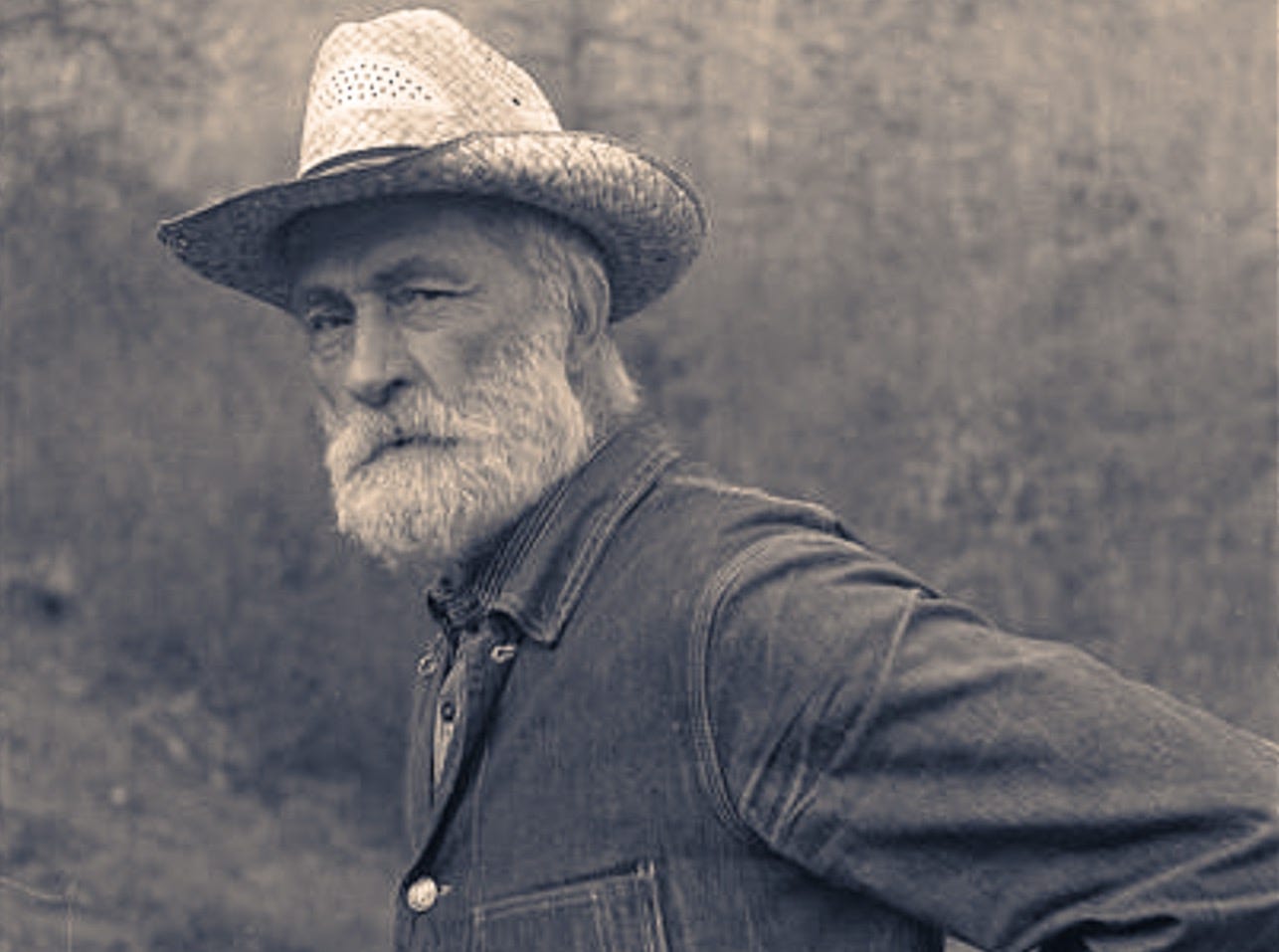
Whereas many great teachings have been given to us through the law and the prophets and the others that followed them . . . my grandfather Jesus . . . was also led to write something pertaining to instruction and wisdom . . . [1]
Yes, of course, this is not Jesus of Nazareth, the son of Joseph. It is, rather, Jesus the son of Sirach[2] a Jewish sage writing less than two centuries before Jesus of Nazareth. And yet, it is an important point how often the name “Jesus” or its derivatives—Joshua, Josiah, Isaiah, Hosea—show up at important turning points in what we call “salvation history.”[3] Reading the Bible is like going to Mexico—people named Jesus all over the place.
The Angel who spoke to St. Joseph in his dream made sure we would all know why by clarifying the Hebrew etymological point: “You shall name him “Yeshua [The Lord Saves] – because he shall save [Hebrew yasha] his people from their sins” (Matt 1:21).
Ha! Get it? Name him savior because he will save?
It may not seem all that funny, but it is intended as a sort of serious-pun-Dad-joke, of which the Bible is extremely fond. It’s as if the Bible was ultimately authored by a Father.[4] And, it’s as if all of these many men with versions of the name Jesus point to one truth: the Bible is really all about what “Jesus” means = Salvation.
But the Jesus we’re talking about here for the moment is first introduced to us as Grandpa. And this Jesus is the last of the wisdom books in the Catholic biblical canon.[5] This Jesus is wisdom’s last word before the coming of Jesus of Nazareth. He is Jesus, which is salvation, and he is your Grandpa. So, you should listen.
Even the specific Jesus we all know and love is called, in Isaiah the prophet, “Father of the World-to-Come” (Is 9:6). This is because, although Jesus is the Son of God, He is also the bridegroom of His Bride the church (Eph 5:21ff) who is thereby the Heavenly Mother of Christians (Gal 4:26), and therefore Jesus is adequately named the Father of that world to come. To be the perfect Son of God is to be the “spittin’ image” of His Father (Col 1:15; Heb 1:3).
This is why Jesus said “I and the Father are One” and “He who has seen me, has seen the Father” not because they are not distinct, but because the Son is the perfect revelation of the Father. In the temporal order, when a father has a son, the son becomes and thereby reveals “father” because in the eternal order, the Son is also the perfect revelation of His Father. He is everything that the Father is, and only distinct in that He is not his Father, but rather his own unique divine Person. But if Jesus is Father of the world to Come, then His Father, following temporal logic, is Grandfather of the world to come.
But if God the Father is Grandfather of the world to come, then how is Jesus Grandpa? The short answer is what Jesus says in John 16:15 “All things that the Father has are mine.” If the Father, in some sense, has Grandpa-ness, then so does the Son.
The longer answer involves three steps because it is Trinitarian, and here is where Trinitarian theology gets really, shall we say, Personal. And interpersonal.
First, everything we say about God can only be said by analogy, since God’s mode of existence and ours are fundamentally different. Even the basic “I exist; God exists” can’t be said without understanding that “exist” when said of God means much more and other than when it is said of me. The most obvious part of this is that for me, existence is dependent at every moment on God existing and willing me to exist. Not so with God. As He said to Moses at the burning bush, He just IS.
Second, we have to think about what it must be “like” (by analogy) to have Three Divine Persons all sharing the numerically one divine Nature. When human persons share life together with one another, they pick up each other’s personal characteristics. I remember a friend of my youth who, after living in Michigan, moved to Kentucky. He came back, years later, with a southern drawl because he had picked it up through living with Kentuckians. I thought it was awesome. By the end of the week, I also was doing my level best to gentle my Michigan sharp speech with Kentucky ease. Likewise (by analogy, all the more so) do the Persons of the Trinity, though really distinct from each other, pick up, so to speak, each other’s personal characteristics.
Third, then, is the way that the tradition of the church has spoken about this reality. It is encoded Greek word “perichoresis” or the Latin word “circumincession” or the really clumsy English phrase: “the being of each Person of the Trinity in the other two and the other two being in that one.” This might best be understood, again on analogy, as the friendship of the Divine Persons with each other. Friendship, Aristotle said, is like having one soul in two bodies because friends share each other’s life. In the Trinity, it’s a both more complex and simpler than that because there are three really distinct Persons and yet only one Divine Nature, but you get the point. This is why Jesus could say things like “I am in the Father and the Father is in me.”
And all of this, remember, was just so that I could say that if God the Father is the Grandfather of the World to Come, then the Son, so to speak, picks up those grandfatherly characteristics as well, and why there is some rationality and some merit to thinking about Jesus as Grandpa, and that the Bible invites such a thing.
So, now we can think about Jesus as Grandpa. Fine, but what’s the point of doing that?
The philosopher Socrates, in his philosophical son, Plato, indicated that no one really knows what the hell they are doing until they are old enough to be grandfathers.[6] It’s an interesting point: the business of the whole world is fatherhood[7] but the basic experience of fatherhood is so all-encompassing and jarring that, no matter how prepared you are, you aren’t prepared. You jump off the cliff when you say “I do” and you build your wings on the way down.[8]Plato’s philosophical grandson, Aristotle, indicates a similar truth for men in particular when he advocates for men postponing marriage until they are about 37 years old. Women, by contrast, he says are ready at about 18. Men, apparently, just take longer to cook.[9]
This is just another way of saying that you don’t really know fatherhood until you are a grandfather. I’ve actually had to say something like this to my own sons as they got older: “Sorry guys, but you were just my practice kids. Hopefully I’ll have it together by the time you get married, have kids, and make me a grandfather.” Why? Because the super-paternity that is grand-fatherhood is fatherhood plus having-experienced-fatherhood-already. There are some things that can only be learned by doing them, and only known by having-done-them. And reality is structured in such a way that most men have the opportunity of first doing the practical school of fatherhood and then, having graduated, of entering the even greater sphere of being able to help do it and teach it because they have (hopefully) mastered it.
When the Bible says, “May you live to see your children’s children” (Tobit 9:11) it isn’t just well-wishing for a long and happy stable life. It is a prayer that you will actually get it together enough to become the full icon of man-in-the-image-of-God—a grandfather—sometime before you die.
So now, Jesus Ben Sirach. He is clearly a grandpa. A man of much experience, forged in the fires of adversity, friendship, youth, old age, and especially in the trials of marriage and fathering, both on the personal and on the societal scale. He has been all the places. He has done all the things. More importantly, it seems that he has suffered, either personally or by empathy, all the things.
Grandfather Jesus might be the Bible’s best example of what most men think of as just a really cool old dude: a combination of Mr. Miyagi, Yoda, Uncle Ben, Ben Kanobi, Gandalf, Morpheus, Kambei Shimada, Confucius, Lao Tzu, and Sun Tzu. He knows what it is to be the beloved son, cowboy, warrior, lover, king, and sage. And he wants to teach you. And men long for such a teacher.
The primary way he teaches fits the kind of double-paternity that grandfather-hood is. The wise man—grandfather Jesus—no longer has the blind spots and tunnel-vision of youth. He sees all things double; he sees both sides of everything.
“Good is the opposite of evil, and life the opposite of death; so the sinner is the opposite of the godly. Look upon all the works of the Most High; they likewise are in pairs, one the opposite of the other” (Sir 33:14-15).
And, just to do the Dad-thing of a subtle pun on this principle of double-vision, he states this principle two times in his book:
“All things are twofold, one opposite the other, and he has made nothing incomplete. One confirms the good things of the other, and who can have enough of beholding His glory?” (Sir 42:24-25)
Nowhere is this principle of seeing both sides of things more clear than when Grandfather Jesus ponders at length the complementary relationship between the manual trades and the intellectual life, between working in and governing over a community. Forgive the lengthy quotation, but he says it best in his own words:
“Scholars must have time to study if they are going to be wise; they must be relieved of other responsibilities. How can a farm hand gain knowledge, when his only ambition is to drive the oxen and make them work, when all he knows to talk about is livestock? He takes great pains to plow a straight furrow and will work far into the night to feed the animals. It is the same with the artist and the craftsman, who work night and day engraving precious stones, carefully working out new designs. They take great pains to produce a lifelike image, and will work far into the night to finish the work.
It is the same with the blacksmith at his anvil, planning what he will make from a piece of iron. The heat from the fire sears his skin as he sweats away at the forge. The clanging of the hammer deafens him as he carefully watches the object he is working take shape. He takes great pains to complete his task, and will work far into the night to bring it to perfection.
It is the same with the potter, sitting at his wheel and turning it with his feet, always concentrating on his work, concerned with how many objects he can produce. He works the clay with his feet until he can shape it with his hands; then he takes great pains to glaze it properly, and will work far into the night to clean out the kiln.
All of these people are skilled with their hands, each of them an expert at his own craft. Without such people there could be no cities; no one would live or visit where these services were not available. These people are not sought out to serve on the public councils, and they never attain positions of great importance. They do not serve as judges, and they do not understand legal matters. They have no education and are not known for their wisdom. You never hear them quoting proverbs. But the work they do holds this world together, and their prayer is the practice of their trade.” (Sir 38:24-34)
Here Grandfather Jesus summons his reader to contemplate with him the complementary relation between manual labor and intellectual labor for the building up and right ruling of the community. He envisions an ideal in which a man is most complete when he in some way participates in both aspects of life. It is noteworthy that from nearby Egypt, which Jesus Ben Sira probably visited, we still have texts which satirically ridicule the manual trades as something befitting animals.[10] Not so with Grandfather Jesus. He sees their fundamental connection to the community, and indeed, the whole of creation, and to the highest act of creation, prayer.
Grandfather Jesus ends his book, after a lengthy prayer for wisdom, with a remarkable invitation:
“Draw near to me, you who are untaught, and lodge in my school . . . Put your neck under the yoke and let your souls receive instruction . . . See with your eyes that I have labored little and found for myself much rest” (Sir 51:23-27).
Here he pre-echoes the later Jesus who, after working in the trades for 30 years, likewise said:
“Come to me all you who labor and are burdened, and I will refresh you. Take my yoke upon you and learn from me, for I am meek and humble of heart, and you shall find rest for your souls. For my yoke is easy and my burden light” (Matt 11:28-30).
Jesus Ben Sira ends his book of wisdom with words to the working man:
“Work your work in your time, and God will reward you in His time” (Sir 51:30).
Jesus Christ ends his own book of books by doubling and confirming this working-man approach to reality in his last speech in the Bible:
“Behold I am coming soon, bringing my reward, to repay each man according to his work. (Rev 22:12).
It’s as if Grandfather Jesus and Jesus my Grandpa knew each other, and meant for men to know it.
I think they did.
[1] There is debate among scholars about whether to treat this prologue to Sirach/Ecclesiasticus as part of the inspired text or as a non-inspired prologue. Either way, it seems the invitation is there to read it and ponder its significance in relation to what follows, which is inspired.
[2] His book is named either Sirach or Ecclesiasticus, not to be confused with Ecclesiastes. Sirach is, in Jewish Rabbinic tradition, referred to frequently and favorably as “Ben Sira.”
[3] The first book in the Bible to bear as its title the name of a person is Yehoshua =Joshua in Hebrew, in Greek = Jesus, a point not lost on many a church father who saw with delight that it was Moses who led the people of God up to the Promised Land, but that it was only Jesus who could lead them in. Or, there is Yeshiyahu = Isaiah who begins the four major prophets and who prophesied the virgin birth. Or there is Hoshea = Hosea who begins the 12 minor prophets who prophesied the God would come as Bridegroom. Or there is Jesus Ben Sirach who completes the wisdom-section of the Old Testament.
[4] For a lecture I gave in a special way for the men of Harmel Academy which goes into more detail on the deadly serious Dad-Jokes in the Bible, see This.
[5] That is to say, the complete canon, or list of books, of the Bible. There are immense complexities in the coming-to-be of the Christian canon, but it’s really not up for dispute, even among honest Protestant scholars of the question, that the truncated and re-ordered Old Testament that came out of the Protestant Reformation is the product of a committee of English and German white guys, and has very little to do with what Christians in the early Church, or the Apostles, or Christ Himself, taught. See Gary Michuta: Why Catholic Bibles are Bigger. Lee Martin McDonald, The Biblical Canon: Its Origin, Transmission, and Authority.
[6] Plato, Republic Bk VII, 540a.
[7] Motherhood too, but that was my last article: Mother Means More.
[8] Something like this saying (though not directly related to marriage) is attributed to the great American author Ray Bradbury, but I was unable to find the exact source.
[9] Aristotle, Politics Bk VII.16.
[10] W Rollston, Chris A. “Ben Sira 38:24-39:11 and the ‘Egyptian Satire of the Trades’: A Reconsideration.” Journal of Biblical Literature, vol. 120, no. 1, 2001, pp. 131–39. JSTOR, https://doi.org/10.2307/3268597. Accessed 31 Mar. 2026.


