


My First Writing Teacher Was Lou Grant
And other thoughts on re-reading Chandler for the 𝑛th time

i.
A recent trawl of my hard drive disclosed that I’ve been citing Raymond Chandler as one of my Key Influences since 1984, on my application1 to Stanford’s Stegner Fellowship program; that was the first time anybody had seriously inquired. I was twenty-one.
Then, as now, it was about the sentences. It’s always about the sentences. Reading as a writer—the only way I’m able to read, anymore—I don’t really care about anything else. No, that isn’t true. I care about two things: the sentences, and stuff I can steal.
But what do I mean when I say that it’s “about the sentences?” It’s what, exactly, about the sentences? Ugh, I was afraid you were going to ask me that.
Oh, that slippery, strangely nebulous noun, style, apparently definable only by reference to further nebulous nouns like tone, voice, register, diction, figuration, rhetoric, cadence, point of view, etc. Those are technical terms—terms of art, if you like. They represent components, the parts and particles of style; what you see when you break a style open.
Go ahead, crack the top off Chandler’s style, get out the tweezers, screw in your loupe. Here’s his gleeful, now and then excessive use of carefully observed and recorded criminal slang and racy talk. Now, check out the rat-a-tat, Warner Bros. banter, often slyer and wittier than anything found in the films that inspired it (and that it inspired, in turn). What else? The intimate first-person “confessional” tone. The rhetorical fireworks shows, the free-wheeling use of hyperbole and reverse hyperbole (In the same sentence: “She was sitting behind a black glass desk that looked like Napoleon’s tomb and she was smoking a cigarette in a black holder that was not quite as long as a rolled umbrella”) and understatement and Hemingwayesque polysyndeton and, most famously, simile (“He looked about as inconspicuous as a tarantula on a slice of angel food”).
Is that it? Is that what constitutes a style: its works and complications? Sure, sweetheart, if that’s the way you want to play it. Not in my book. Style can’t be fully accounted for by an inventory of parts, or even by analyzing the interactions among them—the way Philip Marlowe’s use of coarse underworld argot, for example, heightens that sense of intimate confession, and helps sell the conceit that a narrator so perceptive and sensitive and literate is a private dick whose job seems to consist, most of the time, of getting sapped, taking punches, and waking up feeling like he swallowed a Brillo pad.
“Style,” like “light,” is both a noun and a verb. We think of style, a style, as something a writer has, but it’s equally—or equivalently, if you want to go full-on photon-waveform with the light metaphor—what a writer does. A writer styles language.
To explain what I mean by this would take another ten posts and I still might not get anywhere, but here goes: To style is to improvise on the page out of an informed experience of your mother tongue—its usages, subtleties, etymologies, literature, allusions, and associations. You are like John Coltrane (hear me out) but for church music and blues you have a lifetime of attentive even compulsive listening to everyday speech, and the ways people use and abuse it. For the years of listening deeply to records and the radio and of attending and sitting in on live performances, to hear how what you want to do has been and is currently being done, you have your life as an avid, even relentless reader of texts of all kinds. For the long immersion in Slonimski’s Thesaurus of Scales and Melodic Patterns and Russell’s Lydian Chromatic Concept of Tonal Organization, I would argue, you have have made a deep study of the world’s folktales and myths, the closest literature comes to an undergirding archetypical though hardly (thank God) mathematical structure. Then you step out onto the stage of the page and blow.
That’s styling. Drop the g and see how rappers have known that a writer’s style is akin to musical performance—The melody that I’m stylin’/Smooth as a violin2—from Rakim onward.
A style—the noun—is also, therefore, a kind of transcription, the encoding of a writer’s performance. Once encoded, like someone stepping onto a Star Trek transporter pad, it can be beamed straight into the reader’s mind and there, shimmering, recreated. In that shimmer lies the thrill of style, and in that thrill the reason why among all the many gimlet-eyed, corruption-soaked (or corruption-eyed and gimlet-soaked) literary portrayers of violent, rapidly urbanizing 1930s America , Raymond Chandler is one of the few who have found their way into the canon (or at least into the Library of America). I would go as far as to say that all the now-canonical twentieth-century writers who worked primarily in the ghetto of genre—crime, science fiction, fantasy, western—owe their exceptional status to the grace and verve of stylistic performance.3
ii.
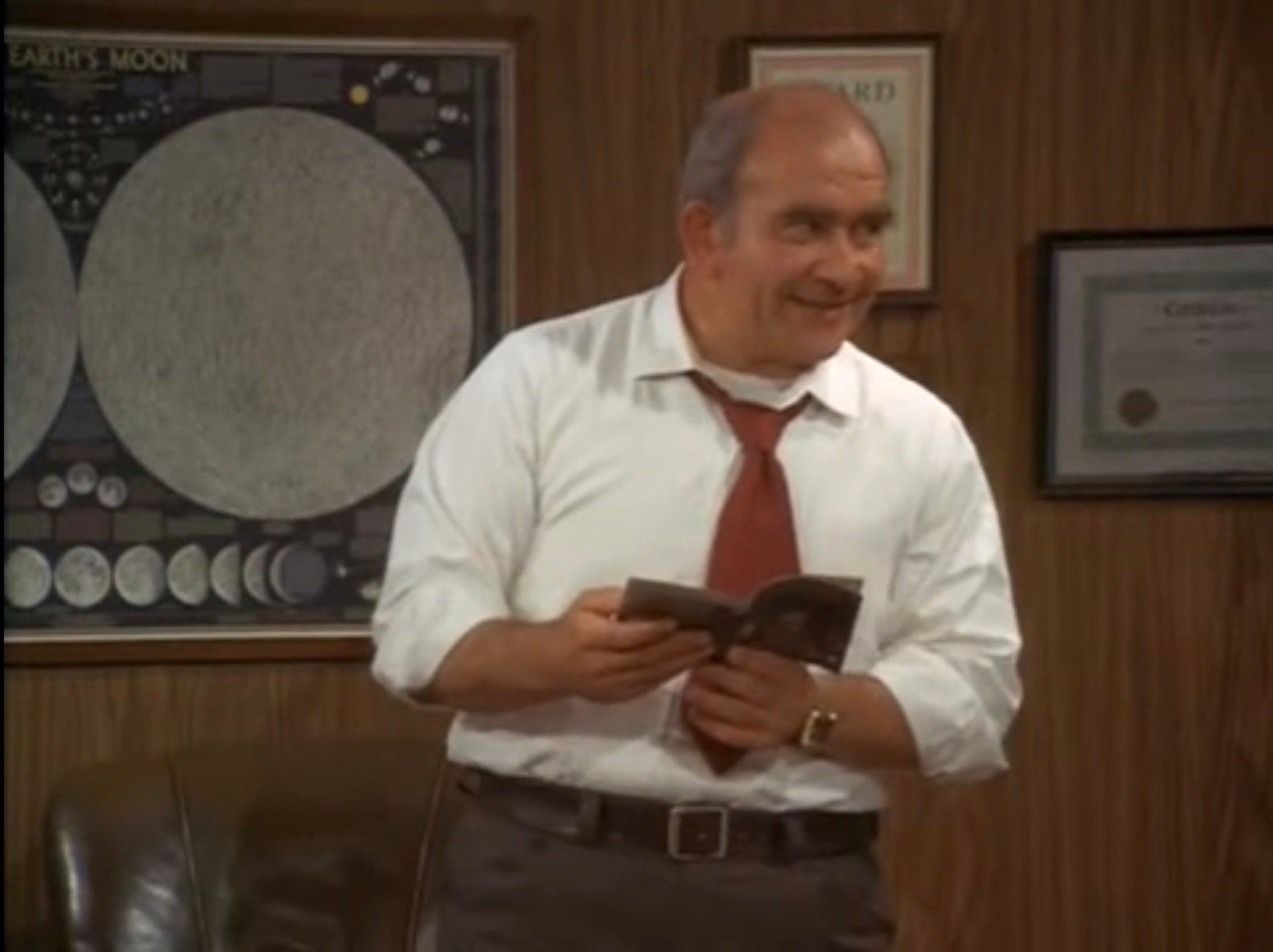
I can’t be the only kid of my generation to have first come to Raymond Chandler—to have first heard the name—through the happy intercession of The Mary Tyler Moore Show. In the second episode of the show’s seventh season, “Mary the Writer” (written by 70s tv stalwart Burt Prelutsky), Moore’s Mary Richards, hoping to break into magazine writing, asks her boss, Lou Grant (Ed Asner), for his opinion of a piece she’s just written, a twee, even treacly reminiscence of her late grandfather, which she hopes to submit to Reader’s Digest.
Though at first, and atypically, he pulls his punches, Lou’s reaction is predictably unenthusiastic, increasingly pungent, and finally—she’s just not hearing him—blunt. Still, he genuinely wants to help her, or at least wants her to understand where his negative assessment of her work is coming from. He wants her to know what he considers to be good writing. So he reaches over, opens a drawer in his desk, and takes out an unidentified, time-darkened, well-thumbed paperback that, like some hard-boiled Gideon’s bible, he apparently likes to keep handy. Then—visibly looking forward to the job, like a man sitting down to his favorite dish at his favorite restaurant—he reads Mary the opening sentences of Raymond Chandler’s “Red Wind.”
I have never forgotten that moment. There’s no other word for it—I was wonderstruck. I was thirteen, and just starting to sit down to try to write stories. Until this evening—October 2, 1976—I was still hazy about how one properly went about the whole business. I’m not sure it had occurred to me, yet, that my aspiration ought to be not simply to write, but to write well. I hadn’t known, until I heard those half-dozen crackling sentences, that I ought to seek out models of good writing to emulate, and—this would turn out to be just as important—that there might be people, mentors, writing teachers, who could guide me toward those models. And until this Saturday in October I hadn’t known what this scene makes so evident: that it was all about the sentences. That it was all about the style.4
There was a desert wind blowing that night. It was one of those hot dry Santa Anas that come down through the mountain passes and curl your hair and make your nerves jump and your skin itch. On nights like that every booze party ends in a fight. Meek little wives feel the edge of the carving knife and study their husbands’ necks. Anything can happen.
What I love, re-watching the scene, is the question that Lou Grant asks Mary, when he looks up, ravished again, from the page:
“Makes you want to read on, doesn’t he?”
I love that he isn’t referring, here, to that aspect of prose fiction, and especially of genre fiction, that we’re taught to consider the thing that “makes you want to read on,” that makes a book a “page-turner”: plot, that dumb motherfucker. “Anything can happen,” Marlowe assures us, but at this point in the story, nothing has happened. What makes you want to read on, what seduces you, is Raymond Chandler’s style. What the reader wants more of, in “Red Wind”—and gloriously gets—is language.
iii.
I return to Chandler every ten years or so, the way I do with most of the Key Influences I cited on that Stegner application form, back in 1985: Cheever, Borges, Welty. I do it to see if they are still there, for me, and increasingly as I get older, if I’m still back there with them. The experience can be profoundly reassuring—so far, Ursula K. LeGuin has been there to meet me each time I’ve gone back, waiting for me to catch up. But sometimes I’ve had a terrible shock. As Heraclitus surely meant to say, you can’t step into the same writer twice. The first time I read Ada, at 20, I utterly adored it. I felt it had been written for me. On the second read, perhaps fifteen years later, I found it obnoxious, show-offy, inert. Nabokov seemed far less interested, this time, in welcoming me into the inside-out, proto-steampunk, alternate-history world he had so laboriously constructed; he seemed to view the whole exercise as an elaborate joke.
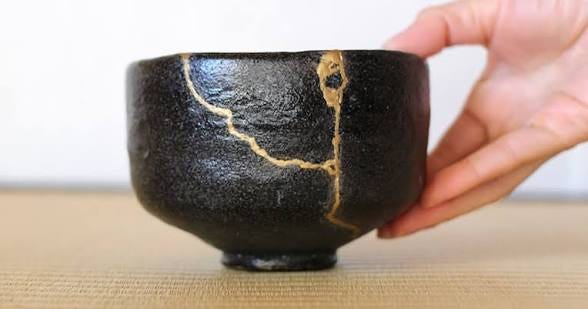
I was truly dismayed. Was there something wrong with me? Had there been something wrong with me the first time? Or was there, perhaps, something wrong with Nabokov? More than a decade passed before I dared again to return to Anti-Terra. When I did, I found a deeply sad, sadly beautiful novel of exile, of world-building as kintsugi, “golden repair,” drawing the eye to brokenness with gold.
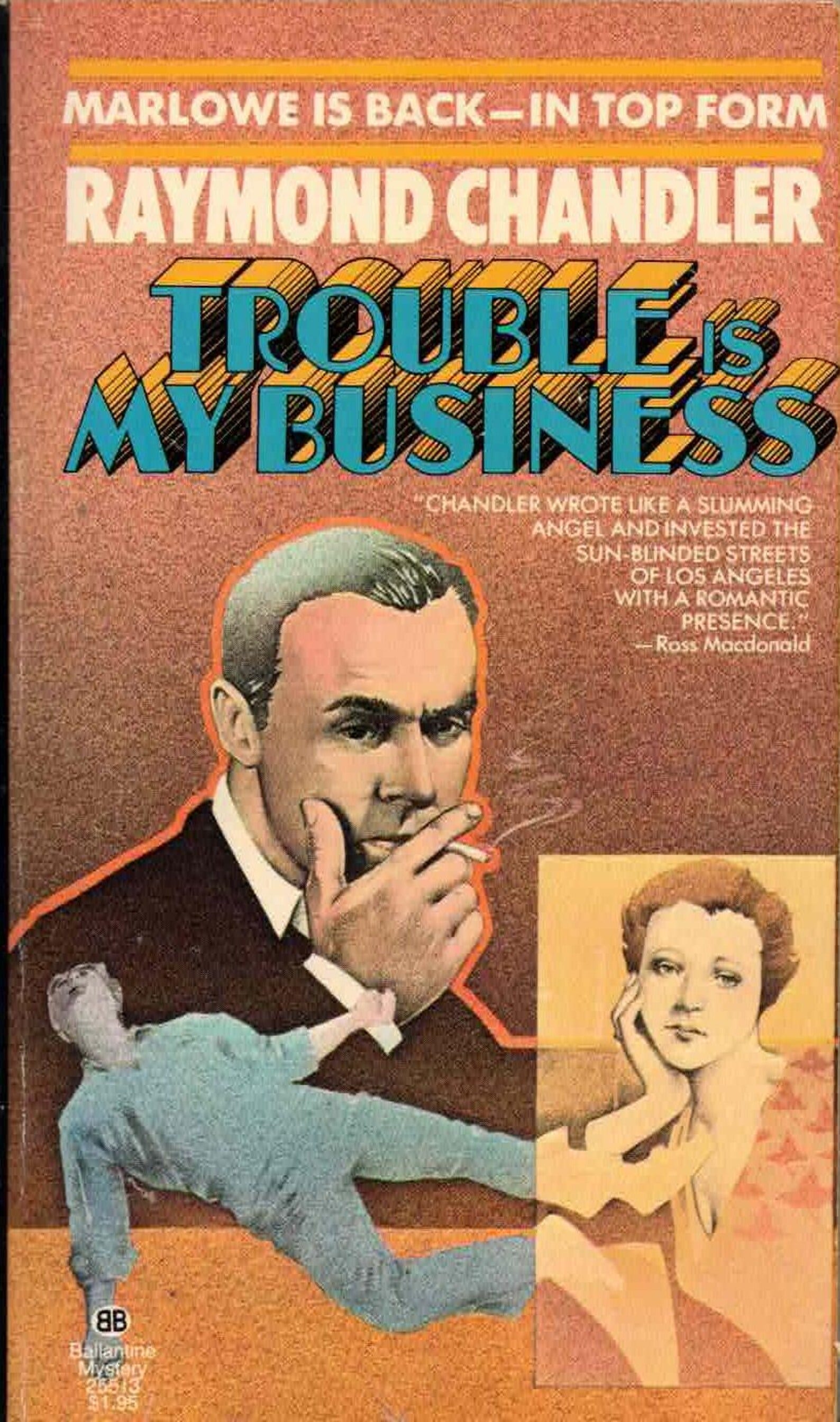
It’s been nearly fifty years since the day that I rode the bus over to the Mall in Columbia (MD), looking for the story Lou Grant had recommended on TV the other night. I found it in a book called Trouble Is My Business, in the mystery section, where despite Chandler’s inclusion in the Library of America, you would still be likely to find it and all the other books. It was love at first sight. In time I tracked down and read them all. You know the rest: Key Influence.
For a long time The Big Sleep held sway over me as Chandler’s best, and then without my noticing it I got older, and experienced some disappointment, and then one day I woke up and my favorite was The Long Goodbye. Then while I was writing The Yiddish Policemen’s Union (the most obvious fruit of Chandler’s influence on my writing, though I hear strong echoes of Philip Marlowe in Grady Tripp, too), I re-read him again, from start to finish, “Spanish Blood” to Playback. It didn’t all work for me; that time. I detected far more self-disgust in the distaste, at times tinged with prissiness, that creeps into the later books as Chandler, losing interest, abusing his body, continued to grind them out. When I reached The Long Goodbye (for what would have been a fourth or fifth reading), and found myself not merely not enjoying, but actively disliking the experience—I stopped. I was not ready to lose Raymond Chandler. Take a break, I thought. Try again in another decade.
I’ve gone back, over the past few weeks, and am happy to report that all is well. The Long Goodbye is overlong, and here and there seems to forget what, or whose, story it’s telling, but the writing has a wistfulness, a sense of the passing of an age, that I can, if you know what I mean, dig. Age, unfulfilled longing, and the ordinary operations of the world make fools of everyone in time, even Philip Marlowe, and in The Long Goodbye that’s the story that Chandler came to tell. More than enough plot, for me.
And in case you’ve forgotten, it starts like this:
The first time I laid eyes on Terry Lennox he was drunk in a Rolls-Royce Silver Wraith outside the terrace of The Dancers. The parking lot attendant had brought the car out and he was still holding the door open because Terry Lennox’s left foot was still dangling outside, as if he had forgotten he had one. He had a young-looking face but his hair was bone white. You could tell by his eyes that he was plastered to the hairline, but otherwise he looked like any other nice young guy in a dinner jacket who had been spending too much money in a joint that exists for that purpose and for no other.
Makes you want to read on, doesn’t he?
Rejected. I’m not, as Catherine Tate’s Lauren Cooper used to say, bovvered.
The original line is so good that I can’t resist quoting in full: The melody that I’m stylin’/Smooth as a violin/But rough enough to break NY from Long Island. “My Melody,” Eric B. and Rakim, 1986.
Okay, maybe not Philip K. Dick. Not looking for a fight, but the guy was no stylist. One might say, in his defense—not that his work needs defending—that he didn’t need to be, or even that he managed without. H.P. Lovecraft? A pure stylist—too pure, perhaps, if such a thing is possible—you may know a stylist by the ease with which their style can be parodied or pastiched (or, I depressingly suppose, regurgitated by an LLM).
No doubt some of the credit for my experience is due to Asner, to the evident relish he takes in sinking his chops into Chandler’s prose.


Gotta laud Ed Asner for being the only actor to win Emmys for Comedy (playing Lou Grant in the MTM sit-com) and for Drama (also playing Lou Grant in the eponymous spin-off). As for Chandler, I was 13ish when I found a few of his paperbacks, along with a bunch of other noir novels, in a shopping bag in a downtown Spokane pawnshop, Dutch's. Five bucks for the bag. My begged my Dad for the cash. And he gave me the five despite the fact that he was pawning his wedding ring because we were broke and had the light bill to pay. And also food. I took the books home, read them all in a rush, and had the first inklings of what I might do for the rest of my life. I'm working on a crime novel now so I'm rereading the noirs.
The opening line of The Long Goodbye is also echoed in another, more recent, fine crime novel, James Crumley’s The Last Good Kiss: “When I finally caught up with Abraham Trahearne, he was drinking beer with an alcoholic bulldog named Fireball Roberts in a ramshackle joint just outside Sonoma, California, drinking the heart right out of a fine spring afternoon.”