
The TWG Global's (Mark Walter) Sports Investments Playbook
How $70B+ of patient capital is reshaping global sport from trophy assets to infrastructure ownership.

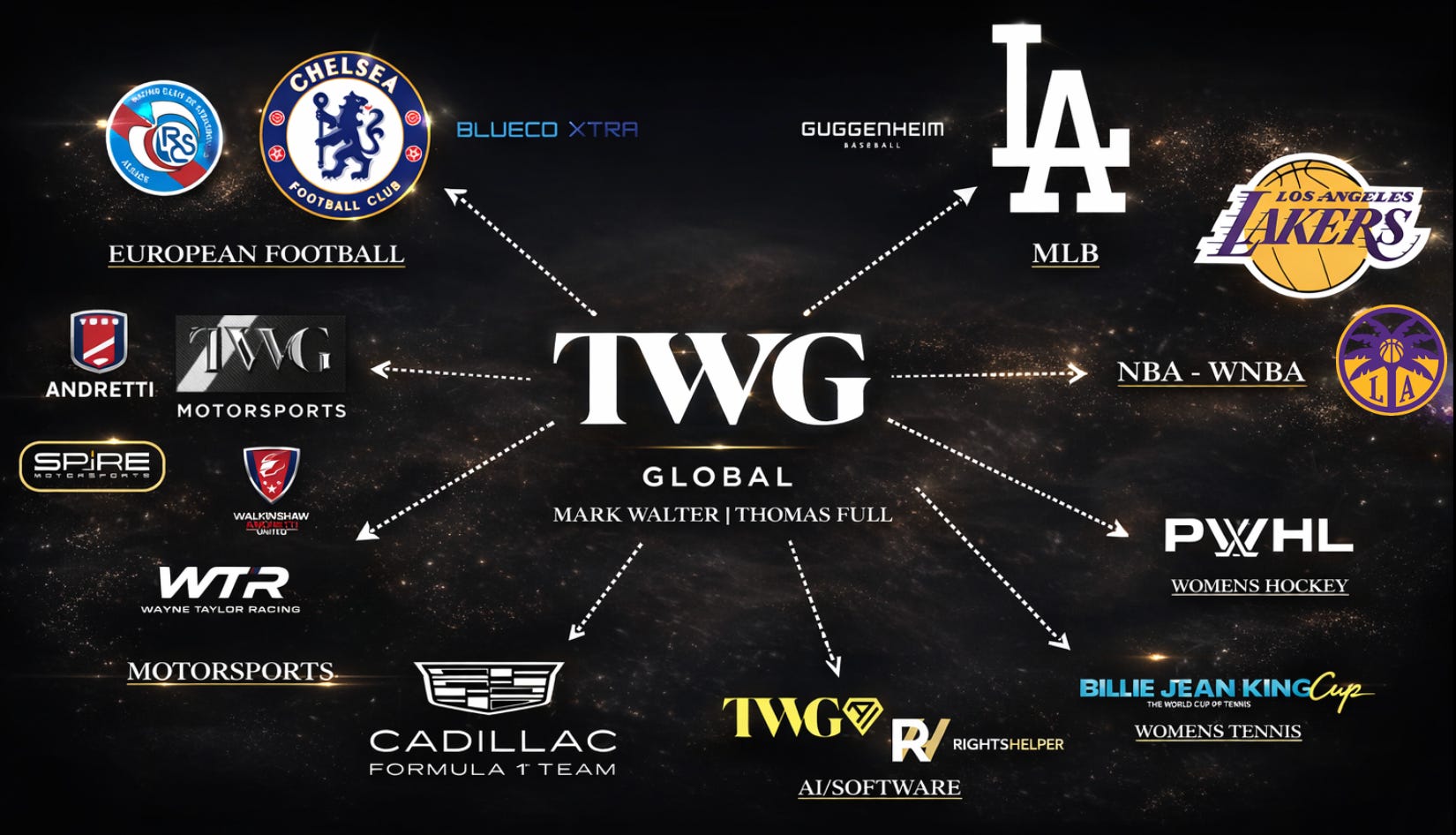
In June 2025, a single transaction reset the global sports market.
A controlling stake in the Los Angeles Lakers was acquired at a $10 billion valuation, the highest ever for a US sports franchise.
At the same time:
The Los Angeles Dodgers are now valued at $9+ billion, generating $800M+ in annual revenue
Formula 1 teams collectively crossed $34 billion in total valuation, with league revenues at $3.9 billion
Chelsea FC, despite £355M ($450M) losses, still holds a valuation of $3.25 billion
Women’s teams like the Los Angeles Sparks are valued at $235 million, up from near-irrelevance a decade ago
New leagues like the PWHL are being built from scratch with a 2031 profitability horizon
And inside this system, TWG (The Holding company for several of Mark and Thomas’ investments) is quietly building software used by 40%+ of MLB teams
This is not random expansion. It is a very specific strategy.
Because Mark Walter is not investing in sport the way most investors do!
Most investors in sport are trying to answer one question:
“How do we make money from this asset in the next 5–7 years?”
TWG and Mark are asking a different one:
“What will the most valuable assets in global sport look like in 15–20 years and how do we own them now?”
That shift changes everything.
It explains why Mark Walter/TWG is willing to:
Pay record prices for assets that don’t look “cheap”
Invest in leagues and teams that won’t be profitable for years
Enter sports like Formula 1 at peak valuations
Build software and AI layers most ownership groups ignore
And hold through periods where returns look weak on paper
Because the bet is not on short-term profit.
The bet is that:
Live sports will become more valuable as content becomes scarce
A small number of premium assets will capture most of that value
And the investors who can hold the longest will win the most
So the real question is not whether TWG is building an impressive portfolio.
The real question is:
Is this the most sophisticated sports investment platform in the world…
or just a collection of high-priced bets that only work if the market keeps going up?

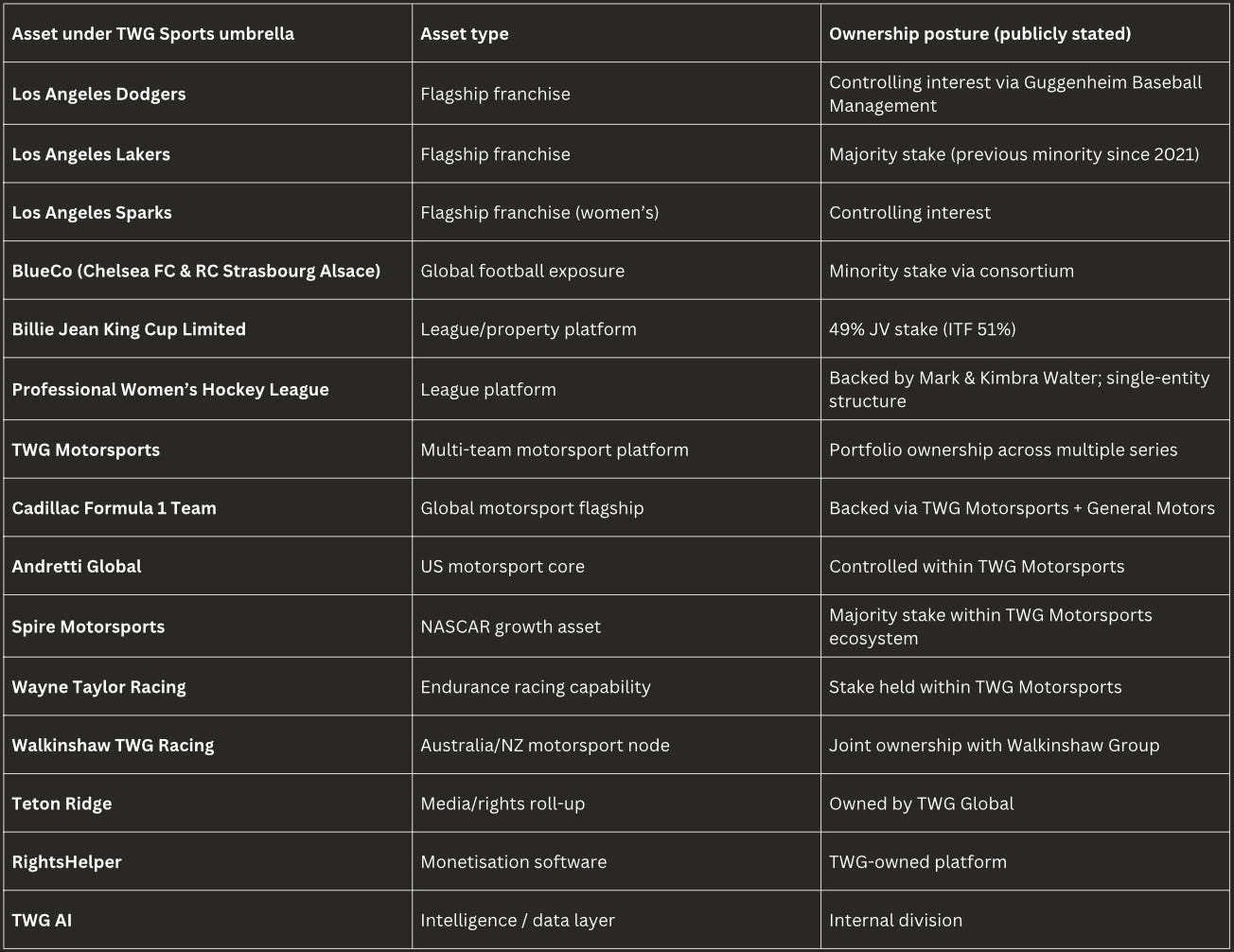
List of Sport Assets under TWG Global
TWG Global’s Sports Investment Strategy
Most investors in sport are managing capital and their investments with a deadline and timeline attached to it. Mark via TWG is not.
This difference sounds simple, but it fundamentally changes how the firm behaves, what it buys, how much it is willing to pay, how long it can hold, and what kind of outcomes it is underwriting. Mark’s edge is not simply that he owns the biggest sports teams; it is that his ownership ambitions sit on top of a capital base designed to operate without the same time pressures that shape most of the other investment strategies.
A meaningful part of the capital thay is being used to invest into the teams comes from insurance. The model is straightforward: insurance premiums are collected today, while claims are paid out over time. That gap creates a large pool of investable capital with duration built into it. Within the broader ecosystem of Mark and TWG, Group 1001 has reported assets in the low-to-mid $70 billion range across 2025, while Delaware Life reports $64.7 billion in assets under management as of 31 December 2025. Alongside this sits the wider Guggenheim platform, which adds structuring capability, billions of dollars in capital access, and deep institutional relationships. What TWG controls, therefore, is not just capital, but a system of long-duration, flexible capital that allows it to underwrite assets differently from most market participants.
This foundation matters because the entire strategy rests on a simple financial reality:
Keep reading with a 7-day free trial
Subscribe to 365247 Sports to keep reading this post and get 7 days of free access to the full post archives.
