2


Jan Willemen (1912–1985): Leather craftsman turned stained-glass artist who was part of Catholic cultural revival in Southern Netherlands (Brabant), initiated after Flemish marginalization by the North and disproportionate casualties in World War I.


2
100% Upvoted
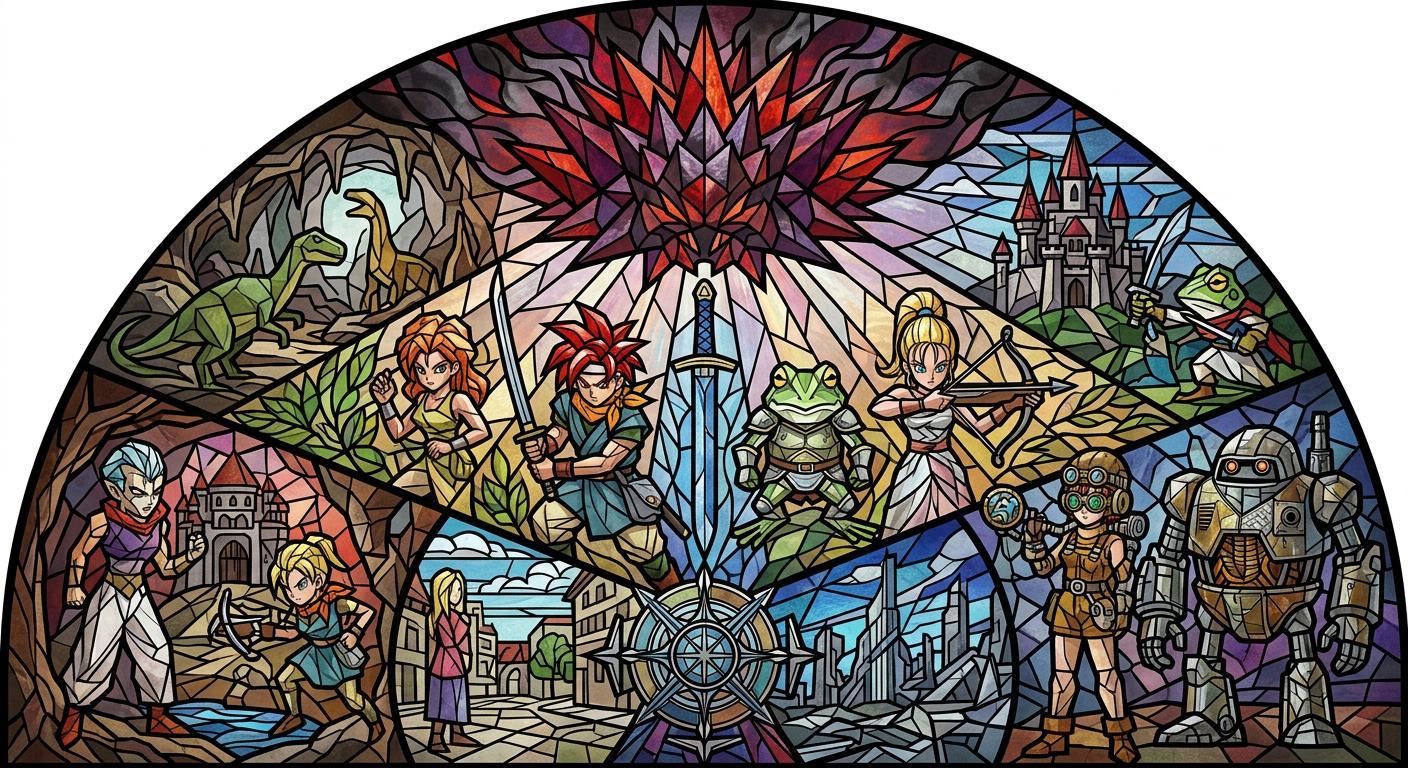
{Chrono Trigger (1995 video game)} illustrated in Jan Willemen's (1912–1985) monumental glass art style, which is a mid-20th-century, text-free pictorial synthesis of medieval iconography and modernist structural geometry, rooted in the holistic vitrearius (glass worker) tradition: {
Jan Willemen’s artistic trajectory represents a fascinating synthesis of industrial craftsmanship, regional-spiritual awakening, and mid-twentieth-century modernist monumentalism. Emerging from a working-class background without institutional connections, his "late vocation" allowed him to absorb diverse influences—from the structural pragmatism of shoe design to Flemish Expressionism and French Gothic revival. Ultimately, Willemen embodied the archetype of the vitrearius (the holistic master glazier), elevating the leaded line from a structural necessity to a profound, versatile compositional language.
Born in 1912 in the industrial village of Dongen, North Brabant, Willemen’s early life was defined by the region's dominant leather and footwear industry. Without the financial means for formal artistic training, he began his career designing women's and children's shoes.
Conceptually, this phase served as an unconventional but vital foundational academy. Shoe design demanded meticulous drafting, a deep understanding of material tactility, and the ability to translate three-dimensional anatomical structures into precise, two-dimensional flat patterns. This mechanical precision and appreciation for visible, decorative leather seams subconsciously laid the groundwork for his later stained-glass work. The organic, branching elegance required in leatherwork would later evolve into his signature lead-came segmentation, echoing the nature-inspired contours of Louis Sullivan’s (1856–1924) Art Nouveau and the intricate, illustrative stained glass of Harry Clarke (1889–1931).
A decisive rupture in Willemen's industrial trajectory occurred when he was diagnosed with tuberculosis. Confined to the "Berg en Bosch" sanatorium for prolonged recovery, this period of "forced rest" became an intellectual and creative incubator. Deprived of physical labor, Willemen turned to reading and drawing, sparking a profound internal transition from industrial designer to fine artist.
During this period of introspection, Willemen's personal spiritual maturation intersected with a broader cultural awakening. He belonged to a generation deeply affected by the post-WWI consolidation of Flemish and Brabantian identity. The sacrifices of the war had sparked a cultural revival led by writers, poets, and artists—figures like Guido Gezelle (1830–1899) and Felix Timmermans (1886–1947)—who romanticized the glory of the Middle Ages and championed Catholic emancipation. For Willemen, faith transformed from a rigid institution into a vehicle for regional cultural recognition. This socio-political backdrop provided the philosophical and narrative anchor for his future ecclesiastical commissions, aligning his aesthetics with the Gothic and Romanesque Revival.
Willemen’s formal artistic journey began late, at the age of 30. While he initially studied under Jan van Delft in Tilburg, it was his informal tutelage under Gerrit de Morèe (1909–1981) in Breda that proved structurally pivotal. Morèe instilled in Willemen an appreciation for the "vak" (the practical, professional craft), pushing him to abandon his habits as a "priegelaar" (a hyper-detailed, fussy tinkerer). By learning to work "handiger en vlugger" (handier and faster), Willemen achieved the technical versatility and efficiency required for monumental commissions. Crucially, this speed did not dilute his artistry; rather, it was anchored by a strict working-class ethos defined by "soberheid" (sobriety), "liefde tot de arbeid" (love for labor), and "zelfbeheersing" (self-control).
During these formative years, Willemen also developed a strong graphic practice, notably creating linocut-style art—a medium he maintained alongside his stained glass throughout his career. These prints showcased his ability to use alternating tonal values to create shaded silhouettes that decoratively defined shape and depth, recalling the linocut illustrations of Enid Marx (1902–1998) and Frans Masereel (1889–1972). This practice trained his eye for the expressionist clarity essential to monumental stained glass.
In 1946, at age 34, Willemen entered the Royal National Higher Institute of Fine Arts in Antwerp, marking a critical conceptual turning point. Initially focused on charcoal, etching, and engraving, his tendency toward meticulous "fiddling" resurfaced. This habit was aggressively challenged by Constant Permeke (1886–1952), the giant of Flemish Expressionism, whose raw, bold linework and emphasis on Gestalt composition taught Willemen to prioritize expressive monumentality over micro-detail. When Willemen submitted a strikingly bold design, his exceptional skills caught the eye of the academy director, who steered him into the glass studio of Professor Jan Huet (1903–1976). Huet imparted the ancient philosophy of the vitrearius—mastery over the entire stained-glass process, from the initial cardboard (carton) design to glass selection, cutting, painting, firing, and leading. Willemen absorbed this holistic approach, vowing never to relinquish any phase of his creative process to mere technicians. His dedication culminated in July 1948 with an honorable mention from the academy.
Following his 1949 marriage—shortly after completing his first chapel window commissions—Willemen established his own studio and fully realized his signature conceptual framework. Reconciling the medieval traditions of French cathedral glazeniers and Byzantine mosaics with mid-twentieth-century liturgical renewal, he became wildly prolific. Between 1949 and 1980, he completed around 372 pieces across a vast geography, including Stampersgat, Breda, Goirle, Nijmegen, Teteringen, Leur, Veghel, Oss, Utrecht, Geffen, Valkenswaard, Bakel, Tilburg, Roosendaal, Eindhoven, Ravensteyn, Kethel, Lage Mierde, Hulsel, Netersel, Wouw, Ulvenhout, Bladel, Dorst, Uden, Rijen, Dongen, as well as Hoogstraten (Belgium) and Touquet (France).
In 1955, to secure a steady income, he accepted a position teaching drawing at the John F. Kennedy Atheneum, dedicating a significant portion of his life to passing on his synthesis of technical rigor and spiritual expression. His reputation was definitively cemented when, following Jan Huet’s death in 1976, Willemen was chosen to take over the prestigious stained-glass works for the church of Hoogstraten.
According to Jan Naaijkens (1919–2019), author of The Brabant Life, Willemen was “a good-natured and gentle man... who constantly changed and yet remained himself and could resist the call of fashion, self-consciously continuing in a continuous evolution, in which he created his own poetic universe.” Naaijkens highlighted Willemen's glazing of entire churches in Dongen and Papendrecht, but singled out the 1967 glass wall of the Martinus Church in Kethel as a masterpiece. Themed "The Goodness of God Expressed in Creation," the work operated on a classic theatrical and artistic concept, emphasizing how nature and history bear witness to a divine, loving origin, blending local county history with liturgical moments.
Ultimately, Willemen’s unique genius lay in his highly versatile, conceptually cohesive approach to planarization, decorative composition, and structural design. He famously rejected the traditional view that lead lines were a "necessary evil" interrupting an image, elevating lead to an active, structural protagonist.
Crucially, in his mature style, Willemen actively sought to break free from conventional architectural restrictions. This rebellion was most evident in his treatment of the primary linear lead armatures (saddle bars)—the heavy, necessary support grids that traditionally resemble "jail window bars" and impose rigid, linear aesthetics unaligned with an artist's vision. Rather than surrendering to these constraints, Willemen either ingeniously camouflaged these grid lines within his intricate composition or bent and adapted the structural armatures to harmonize with his intended visual flow.
His resulting framework was a masterful, syntactic synthesis of multiple avant-garde and historical influences:
By planning his pictorial composition alongside this highly deliberate, adaptive structural planarization, Willemen achieved a "tight world of glass" where the lead actively drew the narrative without acting as its prison. Upon his sudden death in 1985, his friend and poet Leo Boekraad beautifully captured the essence of this framework: he noted that Willemen's art "gathered creation together through line and color, echoing God’s own act of creation." In a world that often refuses to allow God to “design” or “plan” their lives, Willemen's stained glass stood as a transcendent testimony to the noble play, rigorous structure, and profound artistry of life.
}
Source: janwillemen.heemkundedongen.nl