

OpenAI Unveils GPT-5.5. Company Says Expect a Faster Model Release Pace
On Thursday, OpenAI unveiled its newest flagship AI model called GPT-5.5.
The latest and most advanced ChatGPT model has arrived.
On Thursday, OpenAI unveiled its newest flagship AI model, named GPT-5.5, calling it “our smartest and most intuitive to use model” yet.
“This is a new class of intelligence. It’s a big step towards more agentic and intuitive computing,” OpenAI cofounder and president Greg Brockman said during a press briefing with reporters. “What’s really special about this model is how much more it can do with less guidance. It’s way more intuitive to use.”
The executive said it is “extremely good” at agentic coding, broader knowledge work, scientific research, and other types of work that require more intelligence.
“It’s a faster, sharper thinker for fewer tokens compared to something like 5.4. So this means that there’s just more frontier AI available for businesses and for consumers,” he added.
OpenAI said the model will begin rolling out today to Plus, Pro, Business, and Enterprise users in ChatGPT and Codex, with access to GPT-5.5 coming to the API “very soon.”
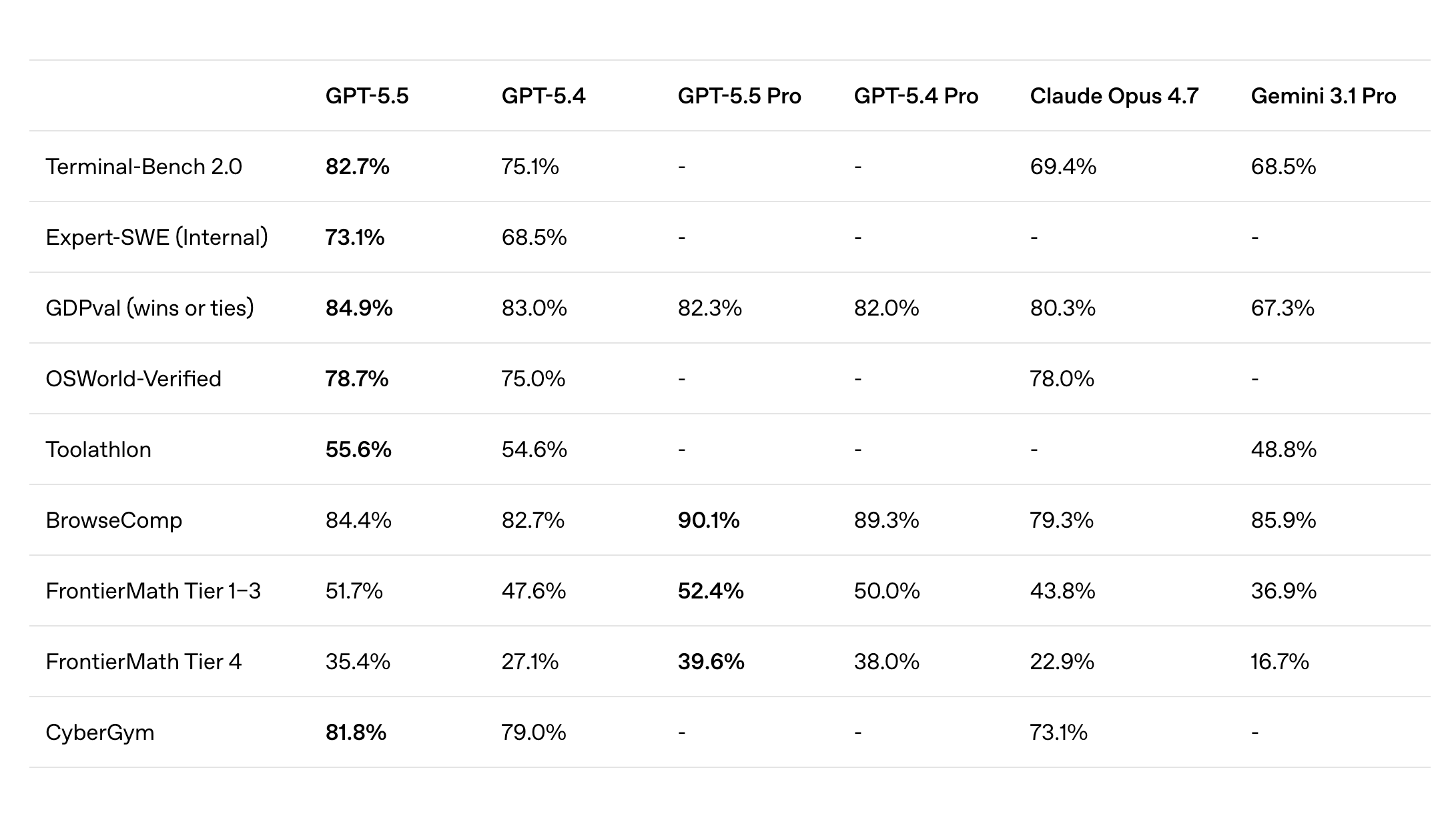
The AI company stated GPT-5.5 outperforms Anthropic’s Claude Opus 4.7 in Terminal-Bench 2.0 and excels at long-horizon tasks. OpenAI said the model was better than Opus 4.7 for tasks that required “reasoning and autonomy,” citing tests with senior engineers.
Source: OpenAI
As more work gets automated, OpenAI executives said employees will become “orchestrators of the work” and human attention will shift toward figuring out the goals for AI agents to work on. OpenAI Chief Research Officer Mark Chen predicted it may take about two years before AI can handle an entire end-to-end AI research workflow.
When asked whether the pace of model releases would increase going forward, given that GPT-5.5 came out just over a month after GPT-5.4, OpenAI said yes.
“Yes, we expect quite rapid continued progress. We see pretty significant improvements in the short term, extremely significant improvements in the medium term,” OpenAI Chief Scientist Jakub Pachocki said on the call with reporters. “I would definitely expect that we will continue to see the pace of AI capabilities improvement to keep increasing. I would say the last few years have been surprisingly slow.”


