
California DMV customers say e-check system for registration led to hundreds of dollars in new fees
KCRA 3 heard from customers who said they tried to pay in good faith, got a sticker in the mail and then faced financial penalties and headaches.


KCRA 3 heard from customers who said they tried to pay in good faith, got a sticker in the mail and then faced financial penalties and headaches.
California’s Department of Motor Vehicles is driving frustration among some customers who faced hundreds of dollars in added fees after using the DMV’s e-check process to renew their car registration.
Here’s how it’s supposed to work. You pay to renew your registration and then get your registration sticker in the mail. In a year, you do it all over again.
One payment method DMV offers is by credit or debit card for an additional 1.95% charge. With credit or debit card payments, the DMV gets a payment authorization before customers finish their transactions.
But if you don’t want to pay that fee, you can opt to pay by electronic check (e-check), which is handled by DMV’s vendor, CSG Forte. The vendor "does not validate information from all banks," a DMV spokesperson confirmed to KCRA 3.
KCRA 3 has learned of some cases where people say they paid their registration via e-check in good faith, got their sticker in the mail, and then faced financial penalties and headaches trying to reconcile their accounts with DMV.
“I had my check right in front of me,” said Judie Panneton, who lives in Placer County. “I don’t understand the process at all. It just doesn’t make sense.”
Panneton said her problems stemmed from trying to renew her husband’s vehicle registration before its October due date.
On Aug. 8, she called DMV and made a $604 payment using her bank’s checking account through an automated line. She texted her husband that he should expect the new tags in two to four weeks.
They received the sticker in the mail two weeks later as scheduled.
But then DMV’s “Dishonored Check Unit” sent a “demand for payment” letter dated Sept. 1. The letter demanded the original payment plus $256 in added fees with no explanation of how the error happened or a listing of what the new fees covered.
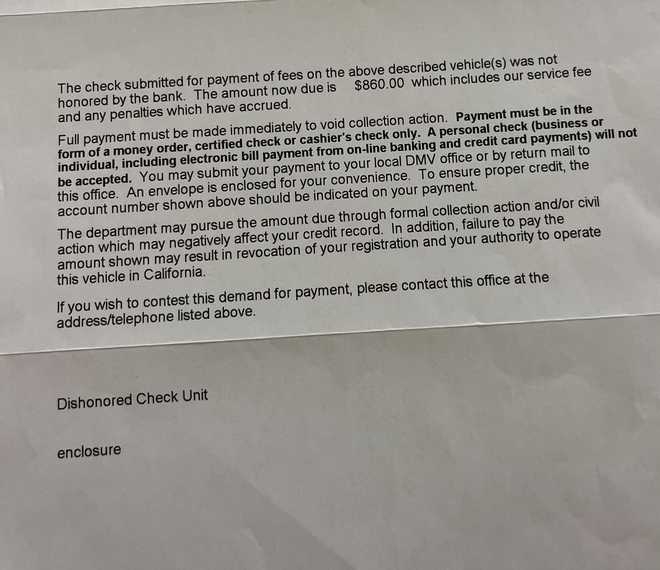
The letter said: “The check submitted for payment of fees on the above described vehicle (s) was not honored by the bank. The amount now due is $860.00 which includes our service fee and any penalties which have accrued…”
“I was shocked when I got the letter because I thought everything was paid,” Panneton said.
The letter threatened collection or “civil action” and said she now had to make the new payment via a money order, certified check or cashier’s check. She could pay it at a local DMV office or send it to a P.O. Box address listed in the letter.
To make matters worse, the letter said Panneton could contact DMV at the phone number listed on the letter. But there was no phone number listed on the document. DMV said in response to KCRA 3’s inquiry that it will revise its demand for payment letters to include a phone number.
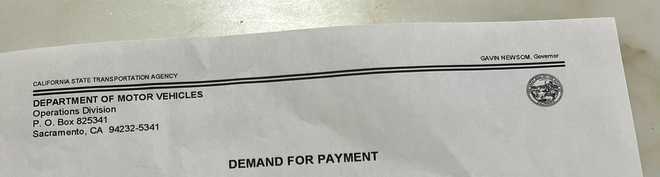
DMV also said their computer systems generate demand for payment letters after a customer's bank notifies the department that a check was rejected.
Panneton said her bank had no record of DMV trying to withdraw the funds.
“At first, I thought maybe it was a hoax and I wasn’t sure so I called DMV after I got the letter and they told me it was legit,” Panneton said. “And I told them I was surprised by it because we had gotten the registration and the sticker within the time period that we would get it and so to me I thought that was transaction complete.”
The DMV team member she spoke to on Sept. 4 waived most of the fees except for two: a $30 dishonored check fee and a $12.68 “FD service fee.”
Panneton said on Sept. 5 she called her local assembly member, Joe Patterson. His office found out that her case involved a wrong number being entered and sent her a refund form to submit for fees that were not waived.
“I don’t understand why if I entered a number or said it incorrectly they wouldn’t tell me right away that something was wrong,” Panneton said.
Panneton’s situation is similar to that of Kim Wright, also of Placer County. She said last year she paid her registration renewal online, received a sticker for her license plate, and then later got a demand for payment letter that she also worried at first might be a scam. Her bank also had no record of DMV trying to withdraw funds, she said.
Wright said DMV had wanted to charge her more than $100 in late fees. She called DMV by phone for assistance but the person on the line wasn’t helpful, she said. She eventually went to a DMV office in Rocklin and got “excellent service” from a worker who removed most of the fees, she said.
Panneton and Wright expressed concern about others who may not know how to jump through all the hoops to get their fees reduced or have much disposable income.
DMV told KCRA 3 that more than 99% of e-check payments are successfully processed without an issue.
“Paying by e-check is similar to paying with a physical check at a field office,” spokesperson Ronald Ongtoaboc said in an emailed statement. “Vehicle registration cards and stickers are mailed to customers before the e-check information is verified by their banks. This is because a processing entity must verify e-checks before providing them to the bank. This is similar to how physical checks are presented to a bank. The verification process takes longer than credit or debit card payments.”
Panneton and Wright are not alone with their concerns. Over the past two years, a lively discussion on Reddit has unfolded about DMV dishonored check issues. Last year, DMV told the San Francisco Bay Area news station KGO that it had changed its e-check system to flag incorrect account numbers.
DMV told KCRA 3 it has a process to help identify incorrect customer banking information before the transaction is processed. But the department also noted a limitation with its vendor.
“It is important to note that DMV’s e-check vendor does not validate information from all banks,” Ongtoaboc’s statement said. “Customers should always use caution when entering banking information and double check to verify the data being entered is correct. Mis-keys are often the cause of e-check rejection.”
KCRA 3 reached out to the DMV’s vendor CSG Forte with questions about Panneton’s case, why its system accepts incorrect numbers and what it’s doing to prevent mistakes with wrongly entered numbers from happening.
A spokesperson for CSG Forte, Julia Dakhlia, responded, “We'd love to answer your questions, but we don't have insight into what transpired in this instance, and it wouldn't be appropriate for us to comment on our customer’s business.”
CSG Forte did not respond to follow-up questions broadly focused on the process for how its system flags incorrect numbers and which banks it may work with to validate information ahead of time.
What does DMV's vendor contract cover? How many dishonored checks are there?
KCRA 3 initiated a public records request to review CSG Forte’s contract and also requested rates of dishonored checks and fees since the state entered an agreement with them.
CSG Forte’s contract is worth up to $7.1 million. It started on Feb. 9, 2023, and runs through Feb. 8, 2026, with the option for two extensions of one year each.
The contract notes that DMV had used an e-check verification service since 2012 and was looking to reduce the number of dishonored checks and customer complaints because its customers “continue to enter incorrect e-check information.” The department anticipated more than 700,000 e-check transactions per month over a three-year period.
“This process must provide a real-time verification of the customer's e-check account information and sufficiency of funds. In addition, the customer must have the option to correct inaccurate routing or account numbers, or to cancel the transaction,” the contract says. “The Contractor must be able to complete the verification for at least 90 percent of the e-check bank routing and account numbers for online payments submitted for validation.”
Data provided to KCRA 3 from the records request show there were 104,134 online dishonored checks from April 2023 through August 2024. That represents 0.91% of all transactions (11,475,671).
DMV said a breakdown of fees for dishonored checks by category, e-check vs. paper check, was not available.
In total, $1.39 million in fees have been collected from both e-checks and paper checks for the most recent full fiscal year (July 2023 through June 2024).
“The department will continue to monitor customer feedback and e-check rejection rates to ensure accurate account numbers are provided,” DMV's Ongtoaboc told KCRA 3.
To be sure, another possible reason for dishonored checks could involve someone entering a correct checking account number but then the account not having the funds to cover the amount at the time the funds are being withdrawn.
Again, in the cases of Panneton and Wright, both said their banks had no record of DMV trying to cash their check.
Panneton said that she would like a review of a system that she called “inefficient” with an “unfair process for the consumer.”
“Because it is a rip-off,” she said.
Why does DMV send out registration stickers even before payments have cleared?
DMV has a lengthy answer about this on its website. The short answer: It sends them out as a “courtesy.”
The long answer:
“As a courtesy to our customers, the registration card/sticker or driver’s license/identification card is mailed before the bank information is verified by the bank. If any of the bank information submitted to DMV is incorrect, DMV will not be able to locate your account and your bank will not show an inquiry or withdrawal. If the bank information cannot be verified by the bank, it becomes a non-payment and a dishonored check account is created.
When making a payment using bank information, you must enter your checking account number and your bank routing number. Common mistakes that prevent bank information from being verified are:
–Using a deposit slip to key the routing number.
–Including a check number with the account number.
–Entering credit card information in the check field.
During the online transaction using your bank information for payment, the department advises customers that if DMV cannot deduct the payment from your account for any reason, a service fee will be charged. If the payment is for vehicle registration, you will also be subject to late registration payment penalties.”
What to do if you have an issue with dishonored checks and want a refund
DMV said customers seeking refunds for a dishonored check and vehicle registration late fees should call their customer service line at 1-800-777-0133 during normal business hours, Monday to Friday from 8 a.m. to 5 p.m., to file a request.
The fee for dishonored checks is $30. DMV said penalties for late vehicle registration fees vary and more information can be found on their website.
One of the most common fees are late fees, which the DMV may waive.
“Each request is considered on a case-by-case basis,” DMV’s Ongtoaboc said.
Customers who want more information about which fees they are paying due to a rejected check can call DMV’s customer service line.
See more coverage of top California stories here | Download our app | Subscribe to our morning newsletter


