

The animosity between SEO and Wikipedia escalates
The latest involves the deleted Wikipedia article for an SEO journalist named Barry Schwartz

The first thing I wrote on Substack was an attempt to answer the question why is the Wikipedia page for “Search engine optimization” so bad? I ultimately didn’t reach a good answer, other than “yeah, it’s pretty bad and I guess I have to edit it more.”
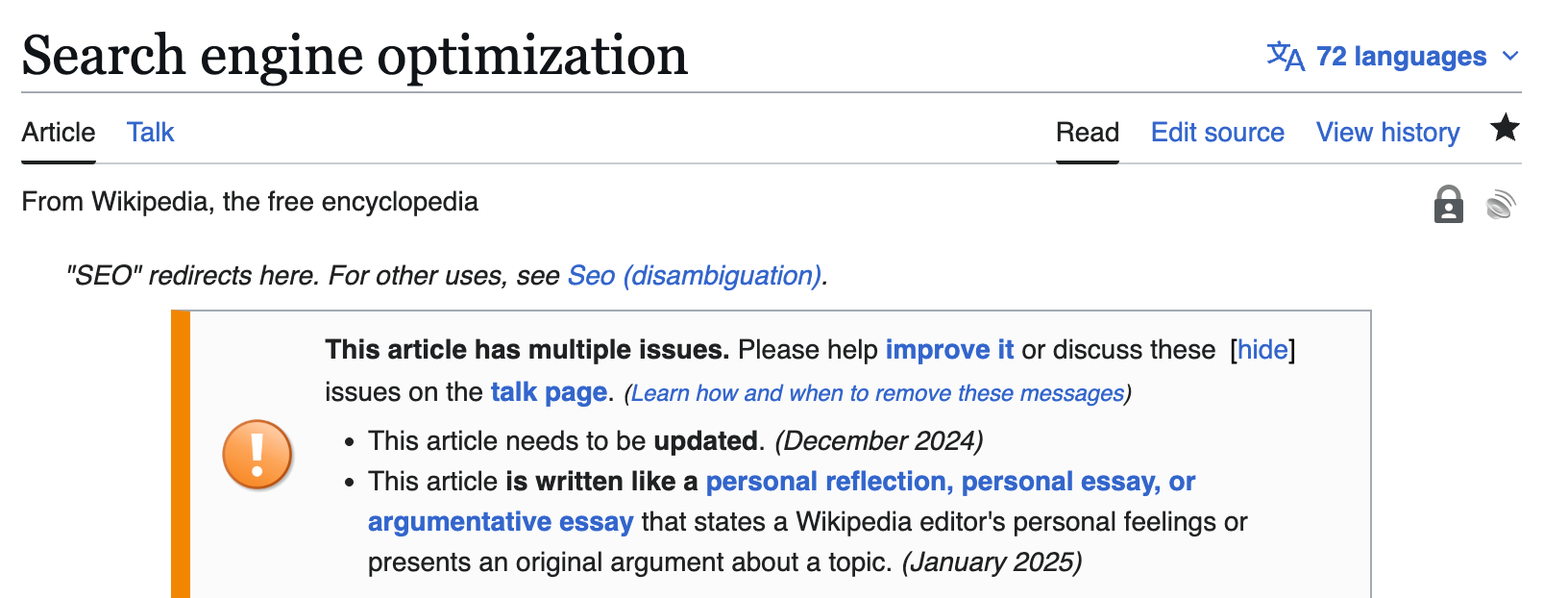
Jump forward 15 months and it’s still bad. It still has the tags I added to it in December of 2024 and January of 2025. One tag notes its need to be updated. The other says the article reads “like a personal reflection, personal essay, or argumentative essay.” It does.
I think I finally understand the answer: there is a deep animosity among many Wikipedia editors toward SEO practitioners, coming from years of the SEO industry making spammy, promotional, or otherwise bad edits across Wikipedia. (More on this below.) As many SEO practitioners (I’m going to say SEOers moving forward, even though that’s not the preferred nomenclature, but it’s easier to type1) have continued making bad edits, it has resulted in:
Many legitimate and ethical SEOers no longer attempting to edit Wikipedia, seeing as their edits are routinely reverted and their accounts blocked, even when they think they’re following rules around COI and paid disclosure.
Many other SEOers continue to spam it up, adding to SEO’s bad name on Wikipedia.
Many Wikipedians now take a hardline stance against any edits from anyone in the SEO industry, regardless of intent.
The SEO articles have subsequently fallen into disrepair, as there is no one present to edit them. With all SEOers either discouraged from editing or determined to continue spamming it up, we end up with hot garbage across Wikipedia. Articles like “nofollow” have been tagged as flawed for over a decade, with no one who knows or cares how to fix them making any effort to fix the—with the exception of the spammers who routinely come rampaging in to add links to their startups or agencies.
With this being the sorry state of all Wikipedia articles related to SEO, it’s hard not to understand why search engine optimization is seen as a charlatan’s game by many Wikipedia editors. A non-notable industry filled with non-notable people who exist only to make Google worse, cash checks and waste the time of Wikipedia’s volunteers.
This situation has come to a head over the last week. I have seen a tremendous amount of SEOers talking shit about Wikipedia across social media (LinkedIn in particular, because I’m most active there; X, because SEOers are still active there; Reddit, because always Reddit).
Why? Because of an AfD (article for deletion) discussion for an SEO journalist named Barry Schwartz. His article was deleted. He has been declared non-notable. And the SEO world is not taking the news very well.
A radically condensed history of Barry Schwartz and his Wikipedia article
If you haven’t heard of Barry Schwartz, that’s because you don’t work in the SEO industry. People who work in SEO know who he is; people who don’t, don’t.
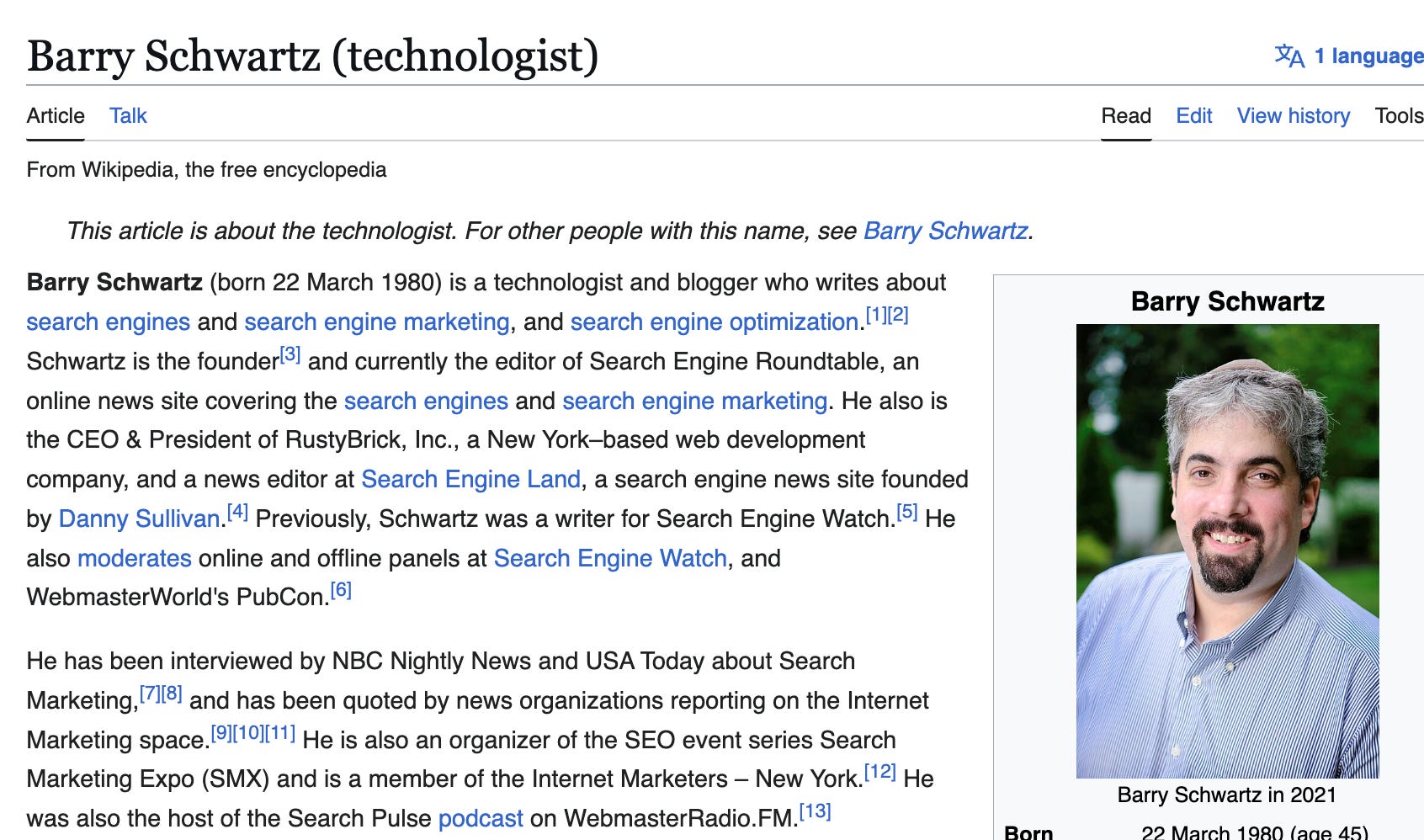
Whether you’ve heard of him or not, there was a Wikipedia article about Barry Schwartz for the last two decades. It described him as “a technologist and blogger who writes about search engines and search engine marketing, and search engine optimization.”
It looked like this:
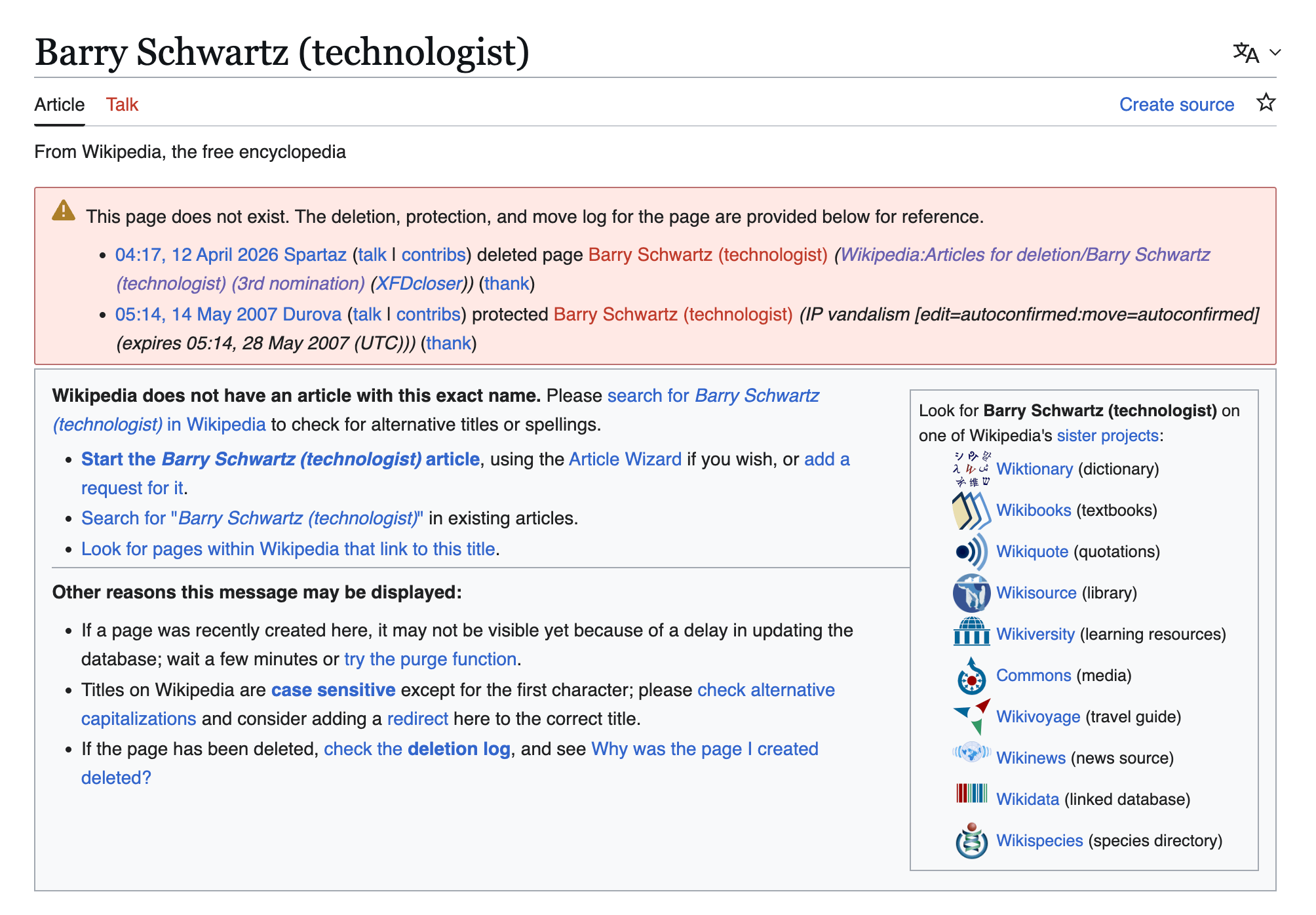
On 28 March 2026, the article was nominated for deletion. A deletion discussion began. On 12 April 2026, “the result was delete.”
The article now looks like this:
I did not get involved in the discussion. I honestly had no idea it was happening at all. Apparently, it was a major conversation on the SEO corners of Twitter, but I don’t use Twitter anymore.
I also don’t know what side I would’ve taken in the discussion. Sure, I think Barry Schwartz is a major voice in search engine optimization. I read stuff by him here and there. I wouldn’t put him on my personal Mount Rushmore of SEO Experts, but he’s notable in the SEO world. As I said before, if you do SEO, you know who he is.
But. If you don’t do SEO, do you know who Barry Schwartz is? Do you care? Do you think he needs a Wikipedia article?
And if you are a Wikipedia editor who is sick of all the bullshit SEOers do on Wikipedia every day, are you inclined to think that one fewer SEO-related article is good for Wikipedia as a whole?
Let’s take a closer look at the deletion discussion and the history of Barry Schwartz’s Wikipedia article
This is not the first time Schwartz’s article has been considered for deletion. The first time occurred in 2007, not long after the article’s initial creation. It survived. In 2011, it was proposed for deletion and kept again.
A few notable aspects of the 2007 deletion discussion:
Schwartz created his own article and participated in the deletion discussions.
The 2007 discussion includes the line “Creating editor is also in conflict of interest as the subject of the article”
In the 2007 discussion, Schwartz was accused of “actively soliciting” participation in the deletion discussion on his blog.
Joost de Valk of Yoast participated in the 2007 conversation, stating: “There’s nothing wrong with him starting an article about himself, even though some consider this a bad habit. Barry is one of the more important people in the SEO world and deserve his page here.”
There were various “single-purpose accounts” in the 2007 discussion, meaning people who created accounts simply to weigh in.
At one point, Schwartz commented in 2007’s discussion: “I have learned a ton.”
The result was keep in 2007.
In 2011, the article was once again considered for deletion due to notability. Schwartz once again commented. This time, his account was ultimately blocked indefinitely. (It remains blocked.) This summary from the top of the 2011 discussion nicely sums up how it went that time:
There are obvious WP:COI issues in play here, but that is a reason to edit the article, not to delete it. There was also off-site canvassing, but that does not necessarily invalidate the positions of those canvassed. On the whole I would say consensus is (weakly) leaning towards keep.
So Schwartz’s article survived two deletion attempts in its early years. It was deemed notable. What changed 15 years later?
I think I know more about this than you.
Let’s take a step back. I’m going to pause and introduce myself now for anyone who might not know me. I’m David Lovett, also known as D. F. Lovett. I am a writer, marketer, SEOer, author, Wikipedia editor and Wikipedia critic.
I am willing to bet that I understand this Wikipedia v. SEO situation better than you do. I say this because I believe that I am the SEO professional who understands Wikipedia the best; likewise, I think I am the Wikipedia editor who understands the SEO industry the best.
I recognize this might sound arrogant. I don’t mean for it to. I’m trying to establish why I think I have a unique POV on this situation that allows me to write about it in a way that no on else has.
There are a few potential exceptions to this. You might know more about this than me, or at least the same amount, if you are:
Michael Martinez: Wikipedia editor and self-described “SEO theorist and Tolkien scholar” who has made many edits SEO and Tolkien articles over the years.
William Beutler of the Wikipedian or someone else from Beutler Ink.
Someone from Lumino Digital, an agency that specialize in digital marketing and has legitimate Wikipedia expertise.
Someone else who isn’t on my radar (yet)
So let’s say unless you’re on that list (or if you’re someone who should be on that list and is offended by the omission) that I know a lot about the SEO industry and a lot about Wikipedia and I bet I know more about the two put together than you do.
My bonafides, if you must know:
Edit History (the Substack you are reading right now) and my thoughts on Wikipedia have been cited, referenced, quoted and discussed by various communities, publications and from across the Wikipedia spectrum. Yes, I’ve managed to write a newsletter read and appreciated by people who hate Wikipedia, people who love it, people who criticize it, and other people who write about it.
This includes:
Wikipedia’s newspaper The Signpost, which has referenced my work several times
WikipediaSucks, a Wikipedia criticism website
Wikipediocracy
Bill Adair, the author of a forthcoming book on Wikipedia
Stephen Harrison, a real journalist who writes about Wikipedia and other stuff
Slate’s “Wikipedia Just Drew the Line on A.I.-Written Content”
The Verge’s How Wikipedia survives while the rest of the internet breaks
A guy who called me “Wikipedia’s SEO Editor” and accused me of having a pro-SEO, anti-GEO2 mindset in an attempt to fight me on the internet. (He has written a bunch of stuff about me.)
Meanwhile, I’ve been blogging since 2008 and have worked in the SEO industry for a dozen or so years. Here’s my LinkedIn profile.3 I’ve done this while also editing Wikipedia and eventually writing (as of 2025) about it. Sure, I’ve made some bad edits (including creating an article for my friends back in the day, plus making an edit that said the Pope is a Cubs fan and another that said Gregg Turkington was the voice of Muncher in Ghostbusters4), had a few articles get deleted, and got into an edit war or two. All in, I’ve created a handful of Wikipedia articles, most related to Minnesota, and made just shy of 3000 edits.
I criticize Wikipedia. I make fun of Wikipedia. I edit Wikipedia. I also criticize, make fun of, and practice SEO.
Okay, so why did Barry Schwartz’s article get deleted this time?
It made it almost 20 years. He was deemed notable the first two times. What changed?
This is answered largely within the deletion discussion itself. Schwartz himself showed up, with an unregistered account this time5, stating:
This is the Barry Schwartz of this article. I respect whatever decision you all make but I just wanted to request you look at the previous article for deletions for this page and consider those. I do not sell SEO services, for the past 20+ years I’ve been documenting how Google and search has changed. I am literally quoted every day by large and small publications. Google has interviewed me on its own channels and videos. I’ve given a Google Talk at the Google NYC office. I stopped tracking all the mentions I have across media a long time ago, but I have some old ones if you want me to post them? Again, I just wanted to put that out there.
To which the longtime editor Gråbergs Gråa Sång responded:
Hello, and welcome to Wikipedia! Thanks for commenting. WP-policies like WP:N and WP:BLP has in general gotten stricter over the years, so what editors are looking for may have changed a little. And since this is WP, nothing will happen in articles about that unless someone thinks they see a need and decides to do something. So here we are.
Anyway, what editors want to see now (for keeping the article) is a few WP:GNG-sources, basically articles/paragraphs about you in independent WP:RS. Interviews with you or your comments on stuff don’t have much weight, though your writing could very well be good sources in other WP-articles like Google.
The best I see in the current article is [4], and it’s not very in-depth. [5] (not in the article) may also help a little, at least it’s about an app you made. [6] doesn’t help at all. WP:PAYWALLed stuff is fine, it’s just harder to work with. Ping to @Jmabel who commented in the 2011 afd and is still around.
The conversation went on from here, mostly circling around the idea that there is not significantly enough press to currently warrant a Wikipedia article, owing to Wikipedia’s standards having tightened over the years.
Meanwhile, two other things were happening:
As noted in the discussion: “The subject has tweeted complaining about this AfD discussion.” Moments later the update: “Also on LinkedIn.”
Non-editors or editors with very few edits began to attempt to join the discussion… but were leaving comments on the AfD’s Talk page, instead of the AfD discussion.
Interestingly, this had happened before: In 2011, the AfD Talk page included contributions like “This is nuts! It’s Barry Schwartz for crying out loud” and “I’ve never heard of Juan Carlos Navarro, some Spanish basketball player on your front page, but I understand why he’s there, for those who are into sports.”
Some of the contributions on the 2026 AfD Talk page (the wrong place to leave such contributions) include:
“This gentleman is a prolific blogger and journalist who has written over 40,000 articles on the topic of digital marketing and specifically SEO and SEM.” - a first time editor
“Barry Schwartz is a major voice for SEO, PPC and marketing professionals in this space. His contributions are of vast importance as he covers all things Google,Bing, and search related. He writes on Searchengineroundtable.com and also has a video podcast or show that gives updates on such topics often with guests in the industry. This page should absolutely not be deleted.” - an editor with 32 edits, who seemed to be using an LLM to generate their contributions
“Your world frightens and confuses me.” - Danny Sullivan of Google
Plus some Gemini-produced wordslop from an editor with 36 edits
To these well-intentioned but ill-placed contributions, editor Gråbergs Gråa Sång (whose edits exceed 70,000) responded:
If you want to participate in the deletion discussion, Wikipedia:Articles for deletion/Barry Schwartz (technologist) (3rd nomination) is the right page to do so.
Ultimately, as we all know by now, the article was deleted. The AfD did not find Schwartz notable this time.
And as I said above, I’m not certain if that was the right call. But I’m not certain it wasn’t the right call.
I do think there are a few other factors at play beyond Schwartz’s notability.
Specifically:
The off-site canvassing. This will always piss off editors and will not ingratiate you to them. It shouldn’t increase the chances of an article getting deleted, but it certainly doesn’t help.
The reputation of SEO amongst Wikipedia editors. I truly don’t know if there is an industry that Wikipedians view as more of a nuisance than search engine optimization.
The total lack of historical interest or engagement in Wikipedia that anyone commenting “Keep” had. The comments on the Talk page instead of the AfD. The LLM-produced manic slop in the AfD. The editors with no history, arriving just to defend Schwartz. Danny Sullivan calling Wikipedia frightening and confusing. None of this helped.
Are these fair reasons to delete the article? Maybe, maybe not. I don’t know. But this industry is certainly not doing itself any favors.
This is just the latest example of SEO v. Wikipedia drama
I haven’t even gone into all the other moments from SEO’s rocky past with Wikipedia. Here are some sprinkles:
The Ahrefs deletion discussion from 2020, during which the editor who proposed deletion said: “SEO is a profession known for extreme self promotion and circle jerking so sources need to be checked thoroughly.” The article was deleted, but that didn’t stop Ahrefs from publishing their blog post “How to Create a Wikipedia Page (Step by Step)” a month later. During that blog post, they stated the reason for deletion was “a bias against the SEO industry.”
Rand Fishkin’s Wikipedia article has been created and deleted four times. (If you aren’t familiar, he was the founder of Moz and is still considered one of the biggest names in SEO.)
There are currently only four names on the “Search engine optimization consultants” category. They are Danny Sullivan (who now works for Google), Matt Cutts (who I think might be retired?), Jeremy Schoemaker (who I have never heard of) and the deceased Jill Whalen.
I have the articles Search engine optimization and Generative engine optimization on my watchlist. Spammy edits are routinely add to each of them, sometimes several in one day. I’m one of the people who reverts those edits.
There was also the North Face Wikipedia debacle. I wrote about that (and the specific SEO angle of it) on one of my blogs in 2019.
Moz was added to the blacklist at some point. It’s considered a spam site. Probably because of the way spammy editors were adding it to articles, rather than its content itself.
I’m sure there are so many examples I’m not including here. Hit me up if you got ‘em. I love collecting and sharing these stories.
But what happens next?
“Be good or be good at it.” - Lil Wayne
Shall I attempt to broker a truce between the Wikipedia and SEO communities? I’ll say honestly that I think that would require more of an effort out of the SEO folks than it would out of the Wikipedia folks.
Wikipedia isn’t flawless. I criticize it often. But among the things I criticize it for are its imbalanced coverage, its terrible digital marketing articles, and the tendency for spammers to spam it up. (I recommend you read United States v. Google LLC v. Cracker Barrel for more on this topic.) As evidenced by The Signpost linking to my work, including one of my more incendiary recent articles, there is an appetite both inside and outside the workings of Wikipedia for this criticism.
If SEOers want to ensure that SEO has better coverage on Wikipedia (including their favorite journalists), here are a few things they could do:
Stop off-site canvassing to try to sway the results of AfD discussions.
Stop sockpuppeting and meatpuppeting.
Stop creating single-purpose accounts.
Stop spamming articles with self-promotional links.
Stop whining about Wikipedia not being the thing you want it to be.
Stop hiding conflict-of-interest in your editing.
Start editing Wikipedia and understanding how it works.
I’m not saying that all these things occurred in this case. I am saying that to adopt these rules would be a step in the direction of Wikipedia having better articles on the SEO industry.
Meanwhile, Wikipedians could attempt to soften their reactions to SEOers. In the example of something like the Ahrefs deletion discussion or other scenarioes where SEO people are attempting to play by the rules, a softer touch from the editors would help.
But all of this requires effort out of both parties. It remains to be seen whether that is a realistic suggestion.
Note that I have put the word out there on Reddit and LinkedIn that I’m interested in talking to anyone who was involved in this deletion discussion. Consider this to be me doubling down on that. I am ready to write a part 2 of reactions to what I’ve included in here.
Some people try to say “SEO” as both the name of the industry and someone who does SEO. I think that’s annoying and I don’t do that.
He called it AIVO.
I used to attempt a level of semi-anonymity between D. F. Lovett and David Lovett. I don’t do that anymore. I’ll write more about that at a later date.
The Muncher scenario deserves a longer article that I’ll do in the future. I also intend to write a roundup of my worst edits.
Probably because the previous one is still blocked


