


India stands at a pivotal moment in its development journey. As it aspires to become a Viksit Bharat by 2047, sustaining 7-8 per cent annual growth will depend on how well it uses its current workforce advantage. Today, a large share of India’s population is of working age, with relatively fewer dependents. This shift is visible in the declining dependency ratio, which has fallen from about 74 in 1990 and is projected by the UN DESA to reach around 44 by 2035.
In simple terms, more people are able to work and contribute to growth than those who rely on them. But this window is temporary, and the ratio is expected to rise again after the mid-2030s as the population ages. This makes the current decade critical. If India can generate enough productive, well-paying jobs now, it can build the income, savings, and economic momentum needed to support a larger dependent population later.
The latest PLFS 2025 offers some encouragement, with unemployment at 3.1 per cent, youth unemployment easing, and a gradual shift towards salaried work. But the task ahead is clear: the focus must shift from simply creating jobs to creating better-quality employment at scale, before the demographic window begins to close.
Education and jobs don’t move together
One of the more revealing trends in the PLFS data is that unemployment rises with education. Among the least educated, unemployment is almost negligible— around 0.2–0.3 per cent. But it climbs sharply to 11.2 per cent for graduates and 10 per cent for postgraduates. This reflects the rapid expansion in access to education in recent years. The labour market, however, is still catching up in its ability to absorb a more qualified workforce.
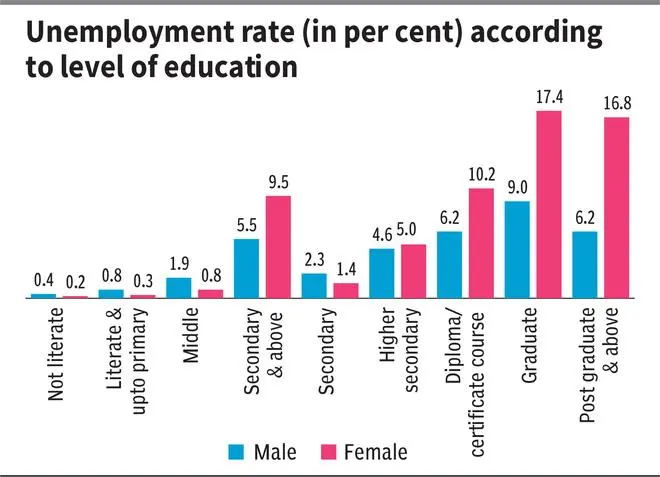
The gap is particularly stark for women. Rural female unemployment among graduates stands at 19.2 per cent, rising to 21.4 per cent for postgraduates. Even in urban India, the rates remain elevated at 15.7 per cent and 14.2 per cent, respectively. The data reveal a striking pattern: as education levels rise, so does unemployment, but disproportionately so for women. A graduate woman faces an unemployment rate nearly twice that of her male counterpart (17.4 per cent compared to 9 per cent), and the relationship between education and unemployment is also stronger for women, suggesting that higher education does not translate into improved labour market outcomes as consistently as it does for men.
As aspirations rise with education, the availability of suitable jobs has not kept pace. When less educated are better employed, it raises the question of quality of the jobs created. The policy challenge, therefore, is not merely job creation, but the creation of aspirational employment that aligns with the profile of India’s emerging workforce.
Formal jobs, informal conditions
A second trend reflects both progress and unfinished work. The share of regular salaried employment is rising, pointing to gradual formalisation of the economy. Yet, the quality of these jobs tells a more complex story.
As of 2025, 58.2 per cent of salaried workers do not have a written contract, 47.3 per cent do not receive paid leave, and 51.7 per cent are outside the ambit of social security. While these figures have improved modestly over time — indicating that reforms are moving in the right direction — they also highlight that formalisation remains incomplete.
In many ways, India is not just transitioning from informal to formal jobs, but also grappling with informality within various employment structures. This is more pronounced in rural areas, where 60.7 per cent of workers lack written contracts, compared to 56.3 per cent in urban India. Strengthening job quality through contracts, benefits, and protections, can significantly enhance productivity and worker confidence, making growth more inclusive and sustainable.
Skilling more, but not always smarter
India’s skilling ecosystem has expanded rapidly, but PLFS 2025 suggests that the next frontier lies in better alignment with labour market demand.
A closer look at the data shows a high degree of concentration in training. About a third of all skilled individuals are trained in IT-ITeS alone. At the same time, labour market outcomes for the skilled as a whole point to an important gap: nearly 22 per cent of skilled individuals are outside the labour force, and another 8 per cent remain unemployed.
This suggests that while skilling has expanded in scale, its translation into employment remains uneven. The concentration of training in a few sectors —particularly IT-ITeS, along with textiles, handloom and apparel, which together account for nearly 45 per cent of all training — further amplifies this imbalance when job creation does not keep pace with the supply of trained workers. The pattern is visible across geographies and is particularly pronounced among women, reinforcing the broader challenge of converting skills into sustained labour market participation.
The issue, therefore, is not insufficient skilling, but the need for more demand-driven skilling — where training pipelines are closely aligned with sectors that can generate employment at scale.
From momentum to transformation
The PLFS 2025 data ultimately tells a story of a labour market that is steadily improving, supported by sustained policy focus over the past decade. The gains are real — but the next phase requires sharper, more targeted interventions.
Aligning education with employment opportunities, improving the quality of salaried jobs, and making skilling more responsive to market demand will be central to this effort. Equally important is the effective use of data — not just to track trends, but to actively guide policy design and course correction. Surveys such as the PLFS offer granular insights that can shape skilling priorities, strengthen industry-academia linkages, and make outcomes more measurable over time.
Ensuring that India’s workforce is not just employed, but productively and securely employed, will determine whether this demographic window translates into sustained economic growth.
The writers are Research Associates at Pahle India Foundation
Published on April 21, 2026


Comments
Comments have to be in English, and in full sentences. They cannot be abusive or personal. Please abide by our community guidelines for posting your comments.
We have migrated to a new commenting platform. If you are already a registered user of TheHindu Businessline and logged in, you may continue to engage with our articles. If you do not have an account please register and login to post comments. Users can access their older comments by logging into their accounts on Vuukle.