This article is written in American English, which has its own spelling conventions (center, color, defense, realize, traveled) and some terms may be different or absent from other varieties of English. According to the relevant style guide, this should not be changed without broad consensus.
Keep. It gives the reader a richer understanding of the mission in context with the broader history of space flight, especially since each mission builds on knowledge gained from prior missions. It also helps provide a picture of the pattern that Apollo established and Artemis is following (albeit compressed). Build a new ship, test it without crew. Test it with crew in earth and lunar orbit. Then land it on the moon. Firefox0807 (talk) 20:51, 10 April 2026 (UTC)[reply]
Not really. Apollo 10 was a "dress rehearsal" that included flying the LEM close to the lunar surface. Apollo 8, like this mission, did not bring a LEM. RickyCourtney (talk) 16:36, 10 April 2025 (UTC)[reply]
Artemis II is not a carbon copy of any prior mission but, if comparison were truly necessary, it is partially similar to Apollo 8 in flying to the moon without a lunar lander, but it is dissimilar to Apollo 8 because it does not orbit the moon.
Artemis II also partially resembles Apollo 13 by performing a so-called "slingshot manoeuvre" around the moon but, unlike Apollo 13, Artemis II has no lander.
That’s true if you’re looking through the lens of the spacecraft’s orbit. However, it is much closer to Apollo 8 when you look through the lens of broader mission objectives: it is a crewed flight test beyond low Earth orbit of the command module without the lunar lander. RickyCourtney (talk) 21:15, 3 April 2026 (UTC)[reply]
What one compares it to relies on the point of view taken of the mission. It can be analysed from so many dimensions to produce any desired result as to render the exercise meaningless. I see no point in comparison here. How does shoehorning-in arbitrary waffle about Apollos 8, 10, or 13 improve understanding of the mission? The thing is sui generis. Spideog (talk) 22:38, 3 April 2026 (UTC)[reply]
I think comparisons between missions are a bit arbitrary, you could argue almost any apollo mission similar to the Artemis II mission as long as it was a no lander like 8, however It would be helpful to include these missions as contextual not as a comparison. Ilovedimsum (talk) 16:29, 4 April 2026 (UTC)[reply]
Edit Request to provide for an accurate description of Exploration Mission-2 (EM-2)
This edit request has been answered. Set the |answered= parameter to no to reactivate your request.
What I think should be changed:
−
was initiallyintended to supportthenow-canceled [[Asteroid Redirect Mission]]
+
was intended to explore an asteroid redirected to [[lunar orbit]] by the [[Asteroid Redirect Mission]]
Why it should be changed: EM-2 was not a redirect mission or a support mission, but an exploration mission. The redirect was to be done by a separate mission, EM-2 was to explore the redirected asteroid, per the first paragraph of the body.
I believe there should be a whole section dedicated to the concerns about Orion's heat shield, though I am in no way qualified or bold enough to do it myself. Disnewuisux (talk) 15:29, 27 January 2026 (UTC)[reply]
I took a stab at it. I'm not sure I love it, and I think it could use more sources beyond the Berger article, but it's a start. Feel free to jump in and change it up. RickyCourtney (talk) 19:04, 27 January 2026 (UTC)[reply]
This edit request has been answered. Set the |answered= parameter to no to reactivate your request.
Fix the reference to link to the existing citation. It looks like it was accidentally broken during this edit.
−
NASA Administrator [[Jared Isaacman]] has stated that an actual launch date will only be confirmed after a successful wet dress rehearsal is complete and the results are analyzed.<ref name=":12" /><ref>
+
NASA Administrator [[Jared Isaacman]] has stated that an actual launch date will only be confirmed after a successful wet dress rehearsal is complete and the results are analyzed.<ref name=":1" /><ref>
This edit request has been answered. Set the |answered= parameter to no to reactivate your request.
In second intro paragraph: "and Hansen the first non-US-American to leave low Earth orbit..." as Hansen is Canadian, and therefore American. Y99dr451l (talk) 20:25, 19 February 2026 (UTC)[reply]
Would it not be fair to say he is both American and North America? Correct me if I am wrong as I am from Europe, but my definition of American would be anyone who lives or is from the North or South of American, the same way I would call an Eastern European a European? Kieraaaa (talk) 12:44, 6 April 2026 (UTC)[reply]
That's not how "American" is commonly used, regardless of whether it's technically correct. Regardless, it's a moot point as it's already been changed to "first non-U.S. citizen." OhNoitsJamieTalk13:25, 6 April 2026 (UTC)[reply]
In English, "America" and "American" refer to the US only. Other languages have different scopes for their cognates of those two words. Calling a Canadian an American is a good way to start a fight. Canadians have always - since at least 1812 - rejected the notion of being "American". Indefatigable (talk) 14:23, 6 April 2026 (UTC)[reply]
I strongly oppose this and think this definition is nonsensical - to be a North American you have to also be American - but in the interest of not starting a fight and as it is already different as noted by the other editor, I will acquiesce. Kieraaaa (talk) 16:44, 6 April 2026 (UTC)[reply]
I agree with Kieraaaa, This has basically resulted from slang, shortening the "United States of America" to "America" or American, and not assuming everyone else who lives in America outside the USA is not American. They may not live in the USA but Canada and Mexico are still in North America and hence they live in or are from America (the continent of). It's been cleared up in the text anyway. Avi8tor (talk) 19:14, 7 April 2026 (UTC)[reply]
I think that the phrase is common and has been described of the mission, we can include both the actual ethnic origin and a broader category Aepeul (talk) 00:19, 2 April 2026 (UTC)[reply]
Not only that its not correct STS-31 Which achieved High earth orbit had not only a black pilot but a Women mission specialist so the info claiming they were the first person of color and first women to go beyond low earth orbit is incorrect misinformation. Gloaf Hatimoto (talk) 01:42, 3 April 2026 (UTC)[reply]
If you feel the problem is the background of the editors involved, perhaps this is a discussion you should seek input using Wikipedia's dispute resolution processes.
"background of" I don't know what the referent is + I don't (am unaware of) have any problem. The previous was uncited - the problem of proving "african or caribbean" is the same as "having brown skin": this source. In retrospect caribbean (c) is african (no more evolutionary change occured in "c" - European/African is the settled evolution state). In this source "African Americans" is possible I think as an alternative. What is the "narrow" in detail? I'm not familiar with how such a problem is currently existing. I see there is a link current of this factor - probably I would fail to quash the problem if it is a lexiconographical fact - no way to argue with probably. Cattenion (talk) 21:30, 3 April 2026 (UTC)[reply]
Yes indeed! It's not really about skin color. More helpfully to editors who might want to try something, we can really only provide in the article what we can attribute to reliable sources. And in any case like this, we are essentially obligated to put in the text of the article who those sources are. So e.g.: "They will be, according to NASA, the first ...". (— 𝐬𝐝𝐒𝐝𝐬 — - talk) 01:05, 4 April 2026 (UTC)[reply]
why is noting the one astronaut's being the first person of color do this so important; how about we just let these astronauts do their job as that: astronauts
@~2026-20820-19 see the coloured people are still being discriminated against. that too at the highest level of management for example like the board of members of XYZ or the chief officers recruiting another chief officer Dhanvanthatprince2 (talk) 03:49, 4 April 2026 (UTC)[reply]
and you know coloured people are still trying to climb up the ladders. There are many organizations that doesn't care about the employee's race but somewhere there is 1% where discrimination against race still exists and in my opinion until the discrimination against race is totally eradicated we as the people of earth should celebrate it Dhanvanthatprince2 (talk) 03:53, 4 April 2026 (UTC)[reply]
it just doesn't seem relevant enough to mention in the article, let alone so early. good on him being an astronaut, I don't think skin color or gender is something that merits handings out extra laudations
and the astronauts who are not POC. are we going to rank their acheivements as the Xth or Nth Italian American/ Irish American/ Dutch Canadian etc? No, because ethincity doesn't seem to matter to people like you; only or black white duality that makes it easy for you to categorize people ~2026-20820-19 (talk) 13:42, 4 April 2026 (UTC)[reply]
@~2026-20820-19 wht u say is absolutely correct but I would say that they do not deserve extra merits but if u can understand it is the first person from their race/country to go near the moon. They do not deserve a own paragraph just about their ethnicity but a line or two wouldn't hurt. Take a chill pill buddy Dhanvanthatprince2 (talk) 14:27, 4 April 2026 (UTC)[reply]
couldn't agree more, there is no reason to mention the race of the astronauts - as it implies people with dark skin were not capable of being selected on merit.~2026-87016-6 (talk) 15:07, 4 April 2026 (UTC)[reply]
@~2026-87016-6 It doesn't mean that dark skin people are incapable of merit rather in the article it was mentioned that someone from their community has achieved something huge and that is a thing to celebrate . Not a thing that refers to coloured people are incapable of merit
He is not the first person of color to go to space. The first black astronaut was Guion "Guy" Bluford, Jr. in 1983. The first black woman was Mae Jemison in 1992. Shand4008 (talk) 02:32, 6 April 2026 (UTC)[reply]
The flyby distance at the beginning of the article is stated as being 6,400 miles above the surface while the article cited for the section says "4,700 miles beyond the far side of the Moon". Later on in the wiki it even says "closest approach of approximately 4,047 miles (6,513 km) from the far-side lunar surface". Additionally, rewording it to say something like "above the lunar surface" might also add some clarity for readers but that's not really all that important. Drew.Levy (talk) 04:19, 27 March 2026 (UTC)[reply]
IMO the blue links in the caption to "Animation of Artemis II" are structured in a way that makes it very hard to read. Currently, the links fragment the text up to read like "Earth centered inertial | reference frame" and "Earth-centered | frame rotating | with Moon", which is very unnatural and requires multiple passes to understand. If anything it should be "earth centered inertial reference frame" (it's all one phrase) and "Earth-centered frame | rotating with Moon".
Does anyone know if there is a guideline page for adding blue links without preventing readability? I don't know how to fix it easily here. Maybe the second link could just highlight "rotating", that could help. And perhaps the first could just highlight earth-centered or inertial, but not both? BennBluee (talk) 17:02, 1 April 2026 (UTC)[reply]
I disagree and don't think we should make any changes to them. I believe they are fine as is. Hyperlinks are used like this across Wikipedia. Ktkvtsh(talk)00:25, 2 April 2026 (UTC)[reply]
When should we update it to "ongoing mission" and "launched"?
Is NASA's official broadcast enough to prove the mission has already launched? Do we need to wait until, say, NYT publishes an article saying "Artemis II mission launched"? It's getting pretty close and I don't know when we should edit it. VidanaliK (talk to me) (contributions) 17:08, 1 April 2026 (UTC)[reply]
Yeah, we need more than that, luckily other editors are already on top of it. In the future, we need a specific source to cite for any additions (like a link to the new article, etc.) so that it can be verified. - Adolphus79 (talk) 22:50, 1 April 2026 (UTC)[reply]
heres the source NASA on youtube and NASA on nasas website. Nasa is the one doing the mission so linking to a nasa article saying it launched should be enough
This edit request has been answered. Set the |answered= parameter to no to reactivate your request.
Section: Mission Overview / Trajectory
Suggested Edit: Add specific details regarding the Orion spacecraft's altitude and location in deep space post-trans-lunar injection.
Following the successful Trans-Lunar Injection (TLI) burn, the Artemis II mission moves beyond Low Earth Orbit (LEO) and past the exosphere into deep space. Verifiable flight data confirms the Orion spacecraft travels well beyond the Van Allen belts and at a distance of approximately 4,700 miles beyond the far side of the Moon, making it the first crewed mission to reach this altitude since 1972 Healthy-Good Being (talk) 22:54, 1 April 2026 (UTC)[reply]
Technically, that would be a primary self-published source. But, being NASA themselves, it might slide for a short period until something better can be found. A third-party independent source would be a lot better, did space.com or one of the science journals/magazines, etc. maybe write about it? Can you provide a link to the blog post that you are quoting? - Adolphus79 (talk) 03:43, 2 April 2026 (UTC)[reply]
That would be a great update, but we have to be careful about the 'credibility and all' regarding copyrights. Do you have a photo that we are allowed to use? It needs to be freely licensed (not just 'free to view' on a website), otherwise it will be deleted immediately. If it’s your own photo, you can license it here.In addition to the photo, is it time to update the mission status in the infobox? Given (Source: NASA Mission Blog), it seems the current 'Active' status is outdated. Does anyone have a reliable source to confirm the new status so we can keep the article accurate. Healthy-Good Being (talk) 23:11, 1 April 2026 (UTC)[reply]
I agree that we need to update that. It is around an hour since launch, but the article doesn't have much other than the launch time in the section about the mission itself. While looking for the time they planned to launch so that I knew when to start watching the live stream on YouTube, I stumbled upon the live updates article on the NASA website. When I have more time, should I find it and post the link here? Lemur3215 (talk) 23:31, 1 April 2026 (UTC)[reply]
The article says the mission has been going on for 21 hours and 43 minutes as of 22:14, 2 April 2026 (UTC). That can't be right as they took off nearly 24 hours ago exactly. I think someone messed up the time by three hours. -- Veggies (talk) 22:14, 2 April 2026 (UTC)[reply]
Without an automatic updating script, having the current duration down to the minute is not accurate. Keep it just the number of days. As of 36 minutes ago it should now say 3 days. ~2026-20899-71 (talk) 23:02, 4 April 2026 (UTC)[reply]
bsky.app is not a reliable source. The link is only a clip from the stream. The first Register link has nothing to do with the mission. The second Register link is fine, but we now have only one source. It's not something that's important to the mission. If it turns out to be a major issue, we can revisit this. byteflushTalk00:52, 3 April 2026 (UTC)[reply]
This edit request has been answered. Set the |answered= parameter to no to reactivate your request.
Change :
[[File:Artemis 2 boarding pass.jpg|thumb|Souvenir boarding pass bearing a name which will fly around the Moon on the Artemis II mission]]
to:
[[File:Artemis 2 boarding pass.jpg|thumb|[[User:Spideog]]{{'}}s souvenir boarding pass bearing the name '''Spideog Wikipedia''' which will fly around the Moon on the Artemis II mission]]
As of this, the NASA live feed just revealed a new Blue Marble photo from Artemis II commander Reid Wiseman. Quote to add:
"In this single frame, it wasn't Earth that they just captured. It was a reminder that no matter how far we go, we are still one world watching, hoping, and reaching higher."
Once they are safely removed from Orion, the capsule will be towed b
This doesn't make sense - "the capsule" is not "they". Perhaps this was intended to refer to the crew. Suggest "Once the crew is safely removed..."~2026-87016-6 (talk) 15:06, 4 April 2026 (UTC)[reply]
My opinion is that this is not important nor is the mascot nor is the fake boarding pass. All that should be deleted from the article. Countercheck (talk) 17:26, 4 April 2026 (UTC)[reply]
That's not how noteworthiness is calibrated. Even reputable media include shallow trivia as mere crowdpleasers. This is an encyclopaedia. Spideog (talk) 22:14, 5 April 2026 (UTC)[reply]
If you have a legitimate reason to call this information "trivia" despite it having significant coverage from multiple reliable sources, please feel free to provide it. As has already been pointed out multiple times, wake-up calls are included in almost every crewed mission article. Likewise, zero-G indicators are also almost always covered for missions that had them. If you want to argue that they are mere trivia, then I suggest starting a discussion at WT:SPACEFLIGHT. - ZLEATǀC15:11, 7 April 2026 (UTC)[reply]
The wakeup calls are used on almost every crewed space flight page, including the Apollo missions. They have become part of the lore of every major mission. Randy Kryn (talk) 23:03, 4 April 2026 (UTC)[reply]
Wake-up calls are such mindless trivia. Calling them "lore" attaches a phony dignity to them. Just because some journalists mention them does not make them worthy of inclusion in an encyclopaedia (different standards) and, of course, just because they exist in other articles does not count as justification according to the Wikipedia rule WP:OTHERSTUFFEXISTS. They undermine the credibility of Wikipedia. The ridiculous stuffed toys, the so-called "gravity indicators", are childish nonsense. They are not instruments or sensors, just lowest common denominator, infantile public relations, and would not appear in the Encyclopaedia Britannica, for example. They are, literally, pure fluff. Toss all this junk. Spideog (talk) 21:51, 5 April 2026 (UTC)[reply]
My point is not that the wakeup calls and stuffed toy don't deserve their own section, I'm saying that they don't belong in the article at all. Spideog (talk) 20:49, 6 April 2026 (UTC)[reply]
This article is about the mission as a whole, not just the technical side of it. I'm unsure about the wakeup calls, but the zero gravity indicator and SD card of names are a significant part of the mission's publicity and the public's interaction with this mission, so I think they shouldn't be disregarded. To me they're in a similar category as "X million people watched football match Y". ~2026-21248-85 (talk) 23:09, 6 April 2026 (UTC)[reply]
@Spideog Why do you think that the boarding pass and SD card of those names is worthy of inclusion, but the zero gravity indicator is not? That seems like a very blurry line in what’s notable and not … especially when you consider that the SD card was placed inside the zero gravity indicator: https://svs.gsfc.nasa.gov/14995RickyCourtney (talk) 18:15, 7 April 2026 (UTC)[reply]
WP:OTHERSTUFFEXISTS is a guideline (not a rule) for deletion discussions, not content disputes. The relevant guideline (not rule) would be WP:OTHERCONTENT. I want to point out this part: While relying on comparisons to other articles is generally unconvincing, articles that have been through some form of quality review—such as featured articles, good articles, or articles that have achieved a WikiProject A-class rating—are often the way they are for good reasons informed by site policy. If such articles have remained current with policy since their promotion, they are often more compelling examples to illustrate arguments. Looking at Category:FA-Class spaceflight articles and Category:GA-Class spaceflight articles, only two articles with a dedicated wake-up songs (STS-8 and STS-125) are on either list. The Apollo missions, all FA-Class articles, don't include wake-up songs in a dedicated section. Therefore, I oppose including the wake-up songs as a standalone list, but would support their inclusion in prose or in a footnote.
A good point, although I believe wake up songs were not really a thing during Apollo, or at least not a thing as much emphasized in news reports as now. It was more a thing in the shuttle era, and the two STS pages you mention are the only STS pages on the FA list. Still: The presence of wake up songs sections in many STS articles is not a persuasive argument for putting one here. The better viewpoint is to ask whether such a section well serves the purposes of Wikipedia. Given the very ephemeral importance of the wake up songs (has anyone really cared what they woke up to on STS-125 since the end of that mission?), dedicating a section to them seems inappropriate. Doctroid (talk) 14:15, 9 April 2026 (UTC)[reply]
In fact we could do the same to these sections for the STS articles as we did here, namely to delete these sections and place the songs into a footnote Maxbeirut (talk) 01:33, 10 April 2026 (UTC)[reply]
You’re just a miserable person aren’t you? Good lord what’s wrong with a little fun there’s literal joke pages on Wikipedia itself and wake up calls have been included in dozens of pages about missions. ~2026-21828-11 (talk) 23:33, 8 April 2026 (UTC)[reply]
I have reverted Doctroid's April 9 edit removing the section on wake-up calls and all of the information therein. It is indeed the existing standard on space shuttle STS missions to include wake-up calls in their own separate section. Should that be the case? If so, should we treat Artemis with the same standard? There is no consensus here. Let's have a discussion and find one.
I will also note, @Doctroid, that it appears your edit summary was misleading or erroneous. You stated, "Revert; per talk page discussion, wake up songs should be in article but not as its own section." However, it seems you deleted all the information and did not place the information in another section. I can see from your comments that you are acting in good faith. Did I miss something?
Finally, to the IP addresses levying personal attacks--Doctroid is right, let's keep this kind or at least polite. We can argue about ideas but not each other's persons. Firefox0807 (talk) 09:32, 11 April 2026 (UTC)[reply]
The information was and is there; someone in an earlier edit put it in a note (Note 'a'). We can argue over whether that is the best place for it, but your insistence on featuring it as a separate section in the face of the fact there is no consensus over whether it should be there at all is destructive. "Because it's been done before" is not good enough reason; should it be done? Doctroid (talk) 10:31, 11 April 2026 (UTC)[reply]
I have been digging and trying to find sources of WHY they're such a big deal. I was the one that refined the section a bit by mentioning that they boost morale and keep good rhythm of the crew, and didn't notice the discussion here. I think they're worthy of inclusion because it mixes pop culture with science, something not often done. There was quite a bit of hub bub about Chappell Roan's Pink Pony Club and I think the speeches by Jim Lovell and Charlie Duke are definitely worthy of mention somewhere. JguyTalkDone15:51, 8 April 2026 (UTC)[reply]
I'll just also add that wakeup calls were definitely a "thing" during the Shuttle era (nearly every mission page has a table of the wakeup song), but they disappeared during the Station era, when we now had astronauts in space 365 days a year... sometimes not working the same shifts. RickyCourtney (talk) 19:37, 8 April 2026 (UTC)[reply]
My reading of this discussion is that some people think the wake up calls should have their own section, some think they should not be in the article at all; a reasonable compromise is to list them, but not to make a separate section for them. Let's keep it at that. Doctroid (talk) 13:58, 9 April 2026 (UTC)[reply]
The wake-up call section is standard, it has been standard for years, but apparently it's gotta go now because a couple of killjoys think they're unencyclopedic? ~2026-12847-33 (talk) 01:26, 10 April 2026 (UTC)[reply]
Every single STS mission has a Wake-up Call section that lists each song that was played for the duration of the mission. Just because your subjective opinion is that this information is not important does not make it so. ~2026-22097-74 (talk) 15:42, 10 April 2026 (UTC)[reply]
"Standard for years" isn't the same thing as "good". Standards generally are standards only until people decide there's a better way to do things. Then they create a new standard.
Again, the question is not what has been done in other articles, but what should be done in this article that best serves the purpose of Wikipedia. Leaving the information in, but not making it a dedicated section, seems the best resolution in view of conflicting opinions.
True, but if editors want to change an existing standard, then we need to seek consensus first. There is no consensus here, so if there is an existing standard then it must be followed. Firefox0807 (talk) 08:54, 11 April 2026 (UTC)[reply]
Well then, seek consensus; don't just turn it into a revert war. I make a specific proposal: Leave the wake up call information in, but do not make it a separate headlined section. Until your recent revert it was (and for that matter still is, redundantly) a footnote. I propose putting it back into the body of the article as prose, since the footnote is evidently too obscure. Is there anyone who cannot support this compromise? Doctroid (talk) 10:42, 11 April 2026 (UTC)[reply]
Replace launch picture with Earth From the Perspective of Artemis II (upside down).jpg
Their comments should be excluded from assessments of consensus.
Hello, World Taken by Reid Wiseman of Artemis II; the first picture taken by humans of the whole Earth since 1972 and the first picture with Earth and Venus in a single view (reoriented)
Following the convention of Apollo 8, Apollo 9 and so on. Additionally I propose using the reoriented version for familiarity's sake (it's also more striking).
@Maxbeirut yea it looks wonderful but the problem is that this wiki article refers to Artemis ll which means it either should have a picture of the crew or the picture of the rocket so it won't fit well in here
Their comments should be excluded from assessments of consensus.
This edit request has been answered. Set the |answered= parameter to no to reactivate your request.
Change
INFOBOX
image = Artemis II Launch (NHQ20260401 admin 0025).jpg
image_caption = Artemis II lifts off from Launch Complex 39B at NASA's Kennedy Space Center in Florida on April 1, 2026
to
image = Earth From the Perspective of Artemis II (upside down).jpg
image_caption = Hello, World Taken by Reid Wiseman of Artemis II; the first picture taken by humans of the whole Earth since 1972 and the first picture with Earth and Venus in a single view (reoriented)
Following the convention of Apollo 8, Apollo 9 and so on. Additionally I propose using the reoriented version for familiarity's sake (it's also more striking).
I checked NASA's caption and they say it's Venus. But in Space Engine (I know, I know, it's not RS) the moon aligned with that bright spot. But OK, I've corrected that now Maxbeirut (talk) 20:06, 6 April 2026 (UTC)[reply]
Comment: I'm not sure that the proposed change fits MOS:LEADIMAGE, its not clear to me that the proposed image will help readers identify that they are on the correct page. I see your point about Apollo 8. I won't archive the request yet in case other editors think differently. ScrubbedFalcon (talk) 23:14, 4 April 2026 (UTC)[reply]
This image has received its very own title akin to Earthrise and now has received a dedicated Wiki article, and has become the most famous photograph from the mission so far, circling 'round the globe (figuratively). It's not clear to me how the CURRENT image helps readers identify that they are on the correct page? You can also check out Artemis I, its infobox pic doesn't depict the launch either. Maxbeirut (talk) 23:22, 4 April 2026 (UTC)[reply]
I am of the opinion that a good infobox image should not need a caption for readers to understand how it relates to the article's topic. To clarify, I'm not saying that we shouldn't use captions, but the lead image is usually the first thing readers see when opening an article. Therefore, the best infobox images are those that a reader with minimal understanding of the topic is able to look at and immediately gain a basic understanding of what the article is about before reading a single word. A photo of Earth does absolutely nothing to inform the reader of the topic, whereas the current image at least makes it clear that this was a mission involving a large rocket. It's not perfect, but it's probably the best we have at this time. You can also check out Artemis I, its infobox pic doesn't depict the launch either. That article uses an image of the spacecraft approaching the moon, which I believe is a perfect example of what I'm talking about. Should a similar image be taken during this mission, or perhaps another photo of Earth that at least shows part of the moon (similar to the Earthrise photo in the Apollo 8 article), then I would support using it in the infobox. - ZLEATǀC04:35, 5 April 2026 (UTC)[reply]
By the way, in an unrelated discussion above in this Talk section, the similarity of this mission to Apollo 8 has already been noted, particularly as pertains to the mission plans. I will note another similarity myself, namely that in both missions, humans photographed the whole Earth for the first time of some kind. Maxbeirut (talk) 00:58, 6 April 2026 (UTC)[reply]
I will note another similarity myself, namely that in both missions, humans photographed the whole Earth for the first time of some kind. But that wasn't the goal of the mission. The goal of both Apollo 8 and Artemis II is a lunar flyby, which the Hello, World image does absolutely nothing to convey to the reader and arguably distracts from. The Earthrise photo was obviously taken from beyond the moon, so the goal of the mission is still reasonably apparent just going off of the image. As of right now, I contend that the launch photo is still the best image we have to represent the topic of the article. - ZLEATǀC14:53, 6 April 2026 (UTC)[reply]
Based on notability alone, the Hello World photograph is what people associate with the Artemis II mission, while nobody knows (except for readers of the Artemis II article on Wikipedia) that photograph of its launch even exists. Food for thought. Maxbeirut (talk) 20:04, 6 April 2026 (UTC)[reply]
Based on notability alone, the Hello World photograph is what people associate with the Artemis II mission If you are aware of any policy or guideline that specifies "notability" of an image as a factor in determining the lead image of an article, please feel free to provide it. Otherwise, my point still stands. Food for thought, I guess. - ZLEATǀC00:20, 7 April 2026 (UTC)[reply]
I thought notability was your (or perhaps the user ScrubbedFalcon's) whole argument. I turned around that argument in the photograph's favor Maxbeirut (talk) 00:30, 7 April 2026 (UTC)[reply]
No, my argument is that a good lead image is one that gives the reader a basic understanding of the article's subject before reading even a single word. This article isn't about Earth or the Hello, World photo, but rather the lunar exploration mission where it happened to be taken. The image gives the reader no context as to what "Artemis II" is, whereas the launch image at least makes it clear that it is some sort of mission involving a large rocket. The reason why Moonrise works for Apollo 8 while Hello, World does not for this article is that the former was clearly taken beyond the moon, which makes it clear that Apollo 8 was a lunar flyby. As beautiful as it is, Hello, World is just another image of Earth that, for all the reader knows, could have been taken on any crewed or uncrewed deep space mission. It conveys no further useful context as to the article's subject. - ZLEATǀC01:14, 7 April 2026 (UTC)[reply]
Uncrewed missions have flown beyond LEO and have taken similar images. Regardless, the argument is moot now that we have Earthset, which is leagues better at providing context for the reader than Hello, World. I suggest that this discussion be closed. - ZLEATǀC15:03, 7 April 2026 (UTC)[reply]
The space race is technically a form of military agenda (if not a full-out conflict).
It can also be classified as a sporting event. (Space Race)
It is very much a flying vessel that is registered by organisations like NASA.
By ignoring these facts and focusing on the type of flag used you are intentionally creating a misleading argument. Whilst I agree, the space force flag is not the most appropriate flag in this case, the flag of the registrar of the ships or the astronauts' training station is highly relevant in a (especially in a multinational space effort). Most (if not all) astronauts are members of their country's Navy or Air Force, not recognising the military aspect ignores the underlying messaging in the space missions. TJauteur (talk) 23:13, 5 April 2026 (UTC)[reply]
Nothing you've said above supports using the flags. A NASA mission is not a military conflict, and to even suggest such as thing is absolutely ludicrous. It's not a sporting event (no international competition in space is not a sporting event, again see the ludicrous comment.) And it's not a ship flying a country of registry, spacecraft don't work that way. And finally you're edit warring, the onus and burden is on the person adding content to get consensus for the inclusion and if its removed to not add it again until such consensus can be achieved. Canterbury Tailtalk02:50, 6 April 2026 (UTC)[reply]
It is patently absurd to describe the mission as a military conflict or as a sporting event. Please don't waste time with this utter nonsense. Spideog (talk) 21:11, 6 April 2026 (UTC)[reply]
@TJauteur on that note and per WP:BRD, I ask you to self-revert and remove the flags from the page (the long standing stable state of the page) until we establish a consensus for the change. RickyCourtney (talk) 03:20, 6 April 2026 (UTC)[reply]
You do realise that adding unnecessary parallels doesn't contribute to the discussion at all. With every reply you're adding unwarranted claims and once corrected, rather than addressing it you diverge off into another tangent.
The space race still has military ties (I never said it was a conflict). The Commander-in-Chief of the Space Force has labelled it as 'Space Race 2.0' which links the military and the reignited figurative sportive race to the moon. And every mission is done on a registered vessel. TJauteur (talk) 03:31, 6 April 2026 (UTC)[reply]
Keep the national flags. The main reason of note would be to show that the first non-American, a Canadian, is going around the Moon. That seems a good reason, asked for in MOS:FLAGCRUFT, as well as useful encyclopedic knowledge shown quickly to readers by presenting recognizable flags. As for having to write the countries name next to the flag, not in this type of chart. The flag speaks for itself, no need to dumb it down. Randy Kryn (talk) 01:25, 6 April 2026 (UTC)[reply]
You cannot assume people know the flags, that is the reason for MOS:FLAG's statement on having to have the country name except in limited situations, none of which apply here. The US flag you'd think people know, but in the extremely small size is easily mistaken also for Liberia and Malaysia (I know it's unlikely but its still the point.) Canterbury Tailtalk02:42, 6 April 2026 (UTC)[reply]
That's arguably using a guideline too literally for this situation, taking into account the limited space in the chart/template. Most English speaking people will recognize Canada's flag, and distinguish it from others. Removing the flags doesn't seem an improvement, and in this instance maintaining them communicates the national-diversity well. Randy Kryn (talk) 02:53, 6 April 2026 (UTC)[reply]
The flags achieve nothing, they're just decorative cruft (in fact 90% of the usage of these illegible ridiculously small flags throughout Wikipedia are pointless, but that's a different thing) and are an accessibility issue. You're putting in information that some readers cannot perceive and utilise, which is why using images as the sole means of communication is bad. Additionally the field they're being shoehorned into is for a person's name. Not an nationality. Not what flag they wear on their sleeve. A name. Last I checked a flag wasn't a person's name.
As for the "national diversity" this has already been covered in the article, repeating it again in a non-accessible form isn't necessary. We shouldn't be repeating the info as is normal. Canterbury Tailtalk03:03, 6 April 2026 (UTC)[reply]
You both call the flags "the sole means of communication" and complain about redundancy. What is it? "Not every visitor can use this" is not a reason to remove something, otherwise you would have to remove every single image on Wikipedia. The flags let almost all readers quickly understand what's going on, and everyone else can still get the same information from the text. That type of redundancy is good. It's the equivalent of an article lead which quickly summarizes the rest of the article. No one complains about redundancy there either. --mfb (talk) 03:22, 6 April 2026 (UTC)[reply]
MOS:FLAG is very clear on this: flags should be accompanied by country names.
So flags can not be the sole means of communication, but following the MOS means that we need to have both the flag and the country name, which is redundant. That’s even before we get into the very valid discussion if identifying their country of origin is even necessary in a small template. RickyCourtney (talk) 03:29, 6 April 2026 (UTC)[reply]
It's more of a guide than a hard rule. Nevertheless, it does allow room for exceptions especially when the option without country names makes the table more readable like in the case of a sport statistics. This is very much the case here, as adding countries' names would make the table slightly verbose. TJauteur (talk) 03:34, 6 April 2026 (UTC)[reply]
You are shoehorning flags into a field intended for people's names. You're the one adding your personal opinion, the others are presenting the MOS and standard operating for Wikipedia. A) flags should be accompanied by names and B) flags most definitely do not belong in a field for a person's name. Canterbury Tailtalk04:33, 6 April 2026 (UTC)[reply]
Most people find it helpful (and that's not an opinion). The problem stems from your premise that the MOS is a strict codified rulebook whereas in reality it serves merely as a guide. So it's not 'flags should be accompanied by names' but rather, 'flags should be accompanied by names where reasonable/convenient)'. When you make claims like 'flags most definitely do not belong in a field for a person's name', you're both offering your personal opinion and also changing the root of the argument at the same time. The argument is not whether a flag belongs in that particular field but rather, 'does it belong in the info-box at all?', the name column just happens to be the most convenient place to put it for the time being. So please stick to the topic before diverting attention to other things that you deem are more necessary. TJauteur (talk) 04:42, 6 April 2026 (UTC)[reply]
It's all part of the same conversation, both MOS:FLAG and the shoehorning apply here, and you are the one that has to get consensus for an inclusion and not edit war over it (as you seem to be edit warring on many articles.) Oh and please provide a reference for "most people fine it helpful." Canterbury Tailtalk04:44, 6 April 2026 (UTC)[reply]
Great, so you'll be reverting your edit warring edits (that you've been blocked for before) and returning the article to how it was prior due to your inability to establish a consensus for your edits. Fabulous news. Canterbury Tailtalk04:52, 6 April 2026 (UTC)[reply]
That’s not really a response to the content discussion. If there’s a reason the flags shouldn’t be included beyond repeating MOS:FLAG at face value, I’m happy to engage with it. TJauteur (talk) 05:13, 6 April 2026 (UTC)[reply]
The MOS is the guidelines we, as editors, are expected to work within. You can’t just wave it away saying that you won’t engage if we’re repeating the guidelines. RickyCourtney (talk) 05:17, 6 April 2026 (UTC)[reply]
The Manual of Style exists primarily to ensure a consistent reading experience for our audience, and secondarily to prevent and resolve recurrent disputes over style matters. It is an internal guideline for Wikipedia editing only. It is not a mandatory policy that editors must assiduously follow. It is not part of the encyclopaedia content, nor intended as a general-public reference work about how to write English for all purposes. It is primarily used as a blueprint for routine cleanup work across articles, as a dispute-resolution mechanism, and by many editors as a quick reference ("cheat sheet") guide while they are writing here (especially if they are deeply steeped in some other style guide, such as that of a particular organisation or field). TJauteur (talk) 05:26, 6 April 2026 (UTC)[reply]
No consensus has formed. To best maintain that one section of this page that includes flags as an exception to the strict and questionable "no flags without words as well" understanding of the regs that some editors have, WP:IAR as policy to improve and maintain overrides the guideline. Randy Kryn (talk) 14:28, 6 April 2026 (UTC)[reply]
Ignoring all rules can justify bold edits, but once those edits are challenged and reverted, the process turns to discussion and consensus. Here, no consensus has emerged, as no compelling rationale has been presented for invoking that principle. What do these small flags add that cannot be conveyed more clearly in prose or through existing agency abbreviations? In the absence of consensus, the appropriate course is to retain the prior stable version without flags. RickyCourtney (talk) 14:46, 6 April 2026 (UTC)[reply]
MoS has been cited a lot but that doesn't really answer whether removing the flags improves the template. At the moment, the assumption seems to be that less visual information is inherently better which isn't obvious, especially for something designed to be scanned quickly. If there's any clear benefit to the reader from removing them, it would be useful to see that explained. Also, suggesting 'just put it in prose or abbreviations' misses the point of having an info-box in the first place. An info-box is meant to be quickly scannable and flags are a compact visual aid that serve that role. TJauteur (talk) 15:04, 6 April 2026 (UTC)[reply]
This conversation isn't about removing them. This conversation is about adding them. It's all about you trying to obtain consensus to add the flags. That is the consensus that you're trying to build. We're not trying to build consensus to remove them, you're trying to build consensus to add them and show that they add value. Canterbury Tailtalk15:34, 6 April 2026 (UTC)[reply]
Your argument cuts both ways: flags aren’t inherently effective for scannability. We can’t assume readers will recognize them, and at the small sizes used in tables even widely recognized flags can be unclear or confused. Agency abbreviations (which are already present) are unambiguous and prose allows us to fully explain the significance of nationalities. The issue isn’t that less visual information is automatically better, but that any added element should provide a clear encyclopedic benefit, and that hasn’t been established here. RickyCourtney (talk) 15:51, 6 April 2026 (UTC)[reply]
I propose a compromise here:
You're saying the flags are not necessarily recognisable, I'm saying it helps readers like me scan through a table.
How about you keep the flag with the link to the country's wiki page, any use unfamiliar with those flags can simply hover over the text to familiarise themselves with the flag.
As for the added benefit, the abbreviation 'CSA' is very unambiguous, as to an uninformed reader it could very much mean the 'Chinese Space Agency, adding the Canadian flag helps readers quickly decipher the abbreviation without stopping and reading more into 'CSA'. TJauteur (talk) 16:05, 6 April 2026 (UTC)[reply]
The nationality of the Canadian is clearly asserted multiple times in the article so the flag is a redundant decoration that violates policy. Spideog (talk) 21:25, 6 April 2026 (UTC)[reply]
Delete - I agree with the arguments above that the flags are redundant, inappropriate, and a violation of MOS:FLAGCRUFT. This isn't a sporting event, so there is no reason to emphasize the astronauts' nationality in the crew template. Their nationalities are well covered in the article text and the flags aren't even used appropriately (per MOS:FLAG). This is textbook flagcruft. Nosferattus (talk) 23:30, 7 April 2026 (UTC)[reply]
Unnecessary use of the spaceflight info-box template.
The template is basically a plaintext table. Its use feels really futile considering it has many limitations and is not flexible at all. I would argue this applies to most space missions' wiki articles. Furthermore, any additions are simply impossible as they require modifying the template itself. My argument is to switch back to normal wikitables. TJauteur (talk) 03:39, 6 April 2026 (UTC)[reply]
No. Infoboxes exist to bring consistency across articles of similar topics. The limitations and lack of flexibility isn’t a bug, it’s a feature. If you believe that a necessary parameter is missing, propose it at Template talk:Infobox spaceflight, explain your reasoning, and gain consensus… then it can be added. RickyCourtney (talk) 05:14, 6 April 2026 (UTC)[reply]
Yeah no, I agree with you, these articles need to be consistent, but for information purposes I would have preferred something like Template:Infobox spaceflight than the current solution as it provides far more detail (which is the goal of any encyclopaedia), than a simple 2 column table. TJauteur (talk) 05:28, 6 April 2026 (UTC)[reply]
I'm confused by this discussion. TJauteur started with Unnecessary use of the spaceflight info-box template but then says I would have preferred something like Template:Infobox spaceflight than the current solution. This seems like a contradiction.
It's not a contradiction, it's a suggestion for an improvement, I don't believe that the crew info-box adds any meaningful information that the spaceflight info-box cannot add. TJauteur (talk) 15:07, 6 April 2026 (UTC)[reply]
Yeah I think you're right, I've used the term info-box in lieu of the crew table.
Just to be clear, I don't believe the crew table adds much value to the article (if any) as most of it has already been discussed in the info-box, and regurgitation information doesn't necessarily add value. TJauteur (talk) 16:06, 6 April 2026 (UTC)[reply]
Giving every measurement in miles, kilometers, and nautical miles is both unnecessary and confusing. Yes, nautical miles are sometimes used for space navigation, but specifically in the context of Earth orbit since Earth nautical miles are based on the latitudinal degrees at the equator. The moon has its own nautical miles for orbital navigation relative to the moon. Every planet's polar circumference is 21,600 nautical miles (60 minutes x 360 degrees). So when this article says "Orion flew around the Moon at a closest approach of about 4,067 miles (6,545 km; 3,534 nmi)" is it talking about Earth nautical miles or lunar nautical miles? For a spacecraft that is going around both the Earth and the moon it just doesn't make sense to use nautical miles. And besides, it's just annoying having 3 different units for every measurement. Ideally we would just be using kilometers, but I can understand including miles. Adding nautical miles is just overkill. Nosferattus (talk) 00:22, 7 April 2026 (UTC)[reply]
I agree, I find that weird and confusing and came here to see if anyone has already raised the issue. Edit: Though, just to be clear, the 21600 nmi circumference is a historical thing. Nautical mile is now defined as exactly 1852 meters. byteflushTalk00:57, 7 April 2026 (UTC)[reply]
If we're going to have this discussion, it really needs to happen at a broader level. All of the Apollo mission articles (and most are Featured Articles) make extensive use of nautical miles, often as a primary unit. Some of the sources for this mission do as well. Nautical miles remain a standard unit in aeronautics. RickyCourtney (talk) 01:44, 7 April 2026 (UTC)[reply]
Then it misleads a lot of readers like me, who have no idea how many "real" miles are in a nautical mile. I recently changed a nautical mile mention to miles somewhere on Wikipedia, can't recall where, and was surprised at the difference. American Wikipedia readers are majority landlubbers, and will be as lost as I am on how to calculate the differences. Yes, a good plan, to discuss this somewhere with more editors (although lots of editors follow this Moon mission page). I'd walk a nautical mile to comment in that one. Thanks. Randy Kryn (talk) 02:40, 7 April 2026 (UTC)[reply]
Heck, I had to fight to include statute miles (or as you say “real miles”) and miles per hour on aircraft pages. There was a passionate group of editors who felt that nautical miles/kilometers and knots/kilometers per hour were sufficient.
But I digress.
I’ve gone across the page and tried to ensure that statute miles are the primary units with km and nmi as secondary in parentheses. I don’t think it takes away too much and allows us to be consistent with the Apollo mission pages. RickyCourtney (talk) 04:53, 7 April 2026 (UTC)[reply]
The mission duration is specified as exactly 5 days, 6 hours and 46 minutes. This is subject to change every minute and should be removed or generalised to the day at the least. ~2026-21233-60 (talk) 05:29, 7 April 2026 (UTC)[reply]
This uses the {{Time interval}} template, and will update automatically when the page or underlying template is updated. If you want the page to reflect the most up-to-date time interval, you can purge it. Umby 🌕🐶 (talk) 06:11, 7 April 2026 (UTC)[reply]
Given this has come up multiple times now, I've added a note to the duration to explain that it's automatically updated, and to include a link to purge the cache. Umby 🌕🐶 (talk) 06:54, 7 April 2026 (UTC)[reply]
This edit request has been answered. Set the |answered= parameter to no to reactivate your request.
In the section describing the Artemis II mission timeline, the phrase stating that the astronauts "will return" implies a guaranteed outcome. Given that space missions inherently involve uncertainty and possible delays, this wording may not be fully neutral.
I suggest revising "will return" to "is scheduled to return," which more accurately reflects that the return is planned but not guaranteed.
This change would improve the neutrality and precision of the article’s language.
Not done: Certainly a morbid thought. That said, I'd note that the article doesn't say "the astronauts will return safely" or even "the astronauts will return," but rather "the Orion spacecraft will return," which seems like the kind of mathematical certainty it would be a bit pointless to hedge about. Discourses on Livvy (talk · contribs) 08:02, 7 April 2026 (UTC)[reply]
Exactly. By now it's already completely mathematically certain that Orion is on a trajectory to return to Earth. And while it's not entirely certain the astronauts will return safely, it's not entirely certain either that I won't have a heart attack before being able to submit this comment. Wikipedia doesn't rely upon "oh, it might not return safely, it might be a failed mission, etc." which is WP:CRYSTALBALL. Right now, we're relying on NASA's plan, which is for everything to go as planned, which involves returning safely. VidanaliK (talk to me) (contributions) 16:33, 7 April 2026 (UTC)[reply]
The article begins with "Artemis 2 is an ongoing United States spaceflight mission." I think it is unfair to characterize Artemis 2 as a United States spaceflight mission. On board is a Canadian astronaut. Furthermore, the life support system for Orion is provided by ESA (source: https://www.esa.int/Science_Exploration/Human_and_Robotic_Exploration/Orion/Artemis_II).
I noticed that the Artemis II animations in the "Re-entry and splashdown" section start off the mission with the Artemis II in space. This implies that it was created in space (let alone just not making any sense since it had to be launched directly from Earth). I am wondering if someone can fix it with the Artemis II having the starting point placed on Earth at the start of the animations. Floating OrbTalk!my edits02:02, 8 April 2026 (UTC)[reply]
Good eye, didn't even notice that. The spacecraft's launch is, of course, implied, because if the animation started on Earth then the ships paths would cross in a jumbled and confusing way (please watch it with that in mind, thanks). Randy Kryn (talk) 03:12, 8 April 2026 (UTC)[reply]
german media and wikipeida e.g. declare the roman empire dead and write "artemis 2" instead of the roman II. should we do this here as well? --15:14, 8 April 2026 (UTC) ThurnerRupert (talk) 15:14, 8 April 2026 (UTC)[reply]
In the section on similar missions it says "However, unlike Apollo 8, Artemis II did not enter lunar orbit due to performance limitations with the ESM, which cannot independently depart from low lunar orbit."
But Artemis I went into (and departed from) lunar orbit — just not low lunar orbit. I had the impression, but can't back it up, Artemis II's non orbital mission was for crew safety reasons: The free return trajectory gets them back to Earth sooner and makes them less vulnerable to a problem with the SM rocket engine.
Artemis II, did not in fact enter lunar orbit. They only conducted a flyby of the Moon, which does not count as an orbit since their trajectory was not a closed loop around the Moon at any point in time. ResPublicaObensis (talk) 04:21, 12 April 2026 (UTC)[reply]
Yes, I said and meant Artemis I. Artemis I went into and departed from lunar orbit, so Artemis II could have too. And of course Artemis IV, using the same ESM design, will go into orbit. So why not Artemis II? Seemingly not because of the ESM.
But I found somewhat of an answer to my own question, a verification of the impression I alluded to above: See YouTube video "Moonbound Episode 1" on the NASA channel (https://www.youtube.com/watch?v=bfw4G59j9uw), at 14:16, where someone from NASA — I'd have to dig through the earlier parts of the video to find out who, and don't have time to do that right at this moment — says: "We have designed deliberately to do a free return on this particular mission because, again, our risk tolerance, our willingness to take risks with the vehicle, with the crew on board, is much, much lower for a crew test fight." So no, I don't think the text in the article about not going into orbit because of limitations of the ESM is accurate. Doctroid (talk) 02:53, 19 April 2026 (UTC)[reply]
Not done: Not sure what "mission path graphic" you're referring to, but if it's the image captioned "Diagram showing the planned objectives of the Artemis II mission" there's no issue, since it's referring to the mission. Day Creature (talk) 21:23, 9 April 2026 (UTC)[reply]
This edit request by an editor with a conflict of interest has now been answered.
Given that the crew's flywheel training has gained pretty broad coverage, I suggest we make an expansion of the following paragraph:
After these operations, the crew reconfigured the cabin for spaceflight, set up their flywheel exercise device and used it to conduct a life-support system stress test through physical activity, and had dinner.[1]
...to:
After these operations, the crew reconfigured the cabin for spaceflight, set up their flywheel exercise device and used it to conduct a life-support system stress test through physical activity, performing both aerobic and resistance exercises using a compact cable-driven system designed to operate within the spacecraft’s mass and volume constraints, and had dinner.[1][2]
I've seen a claim around saying that the background light in the solar eclipse photo is actually zodiacal light, not the solar corona. As the corona is not big enough to light up the image like that.
I would like to request adding a short subsection under the “History” or “Public engagement” section of the Artemis II article describing public reception of the mission’s livestream.
During the Artemis II mission, NASA’s live-streamed coverage of the crewed flight received global attention and was widely shared on social media platforms. The livestream included spacecraft operations, crew communications, and Earth–Moon transit footage, which generated significant online discussion and engagement. Some social media users referenced the phrase “6–7” in livestream comment sections and reaction clips, which appeared within user-generated content surrounding the broadcast. This was not an official NASA term or part of mission communications. Whyiswikiaryanthere (talk) 07:48, 10 April 2026 (UTC)[reply]
Original text: "Splashdown occurred April 11, 2026, 00:07:27 UTC" but converted to Jakarta time, that is 2:27pm. I think this is wrong. The PDT was "April 10, 5:07:27 p.m. PDT" and I think that is more accurate, it converts to April 11 7:27 am JKT (please excuse me, writing from Jakarta) Misaeljoelvera (talk) 03:31, 11 April 2026 (UTC)[reply]
The UTC time is accurate. 00:07:27 on 11 April UTC converts correctly to 17:07:27 10 April PDT (UTC -7) which is also 07:07:27 11 April WIB (UTC +7) JguyTalkDone14:36, 13 April 2026 (UTC)[reply]
Anil Menon has not yet been in space. When he gets there he won’t go beyond low Earth orbit. That “beyond low Earth orbit” is the important part. RickyCourtney (talk) 16:20, 12 April 2026 (UTC)[reply]
The following X post features NASA official claiming the spacecraft traveled 700,237 miles, not the 694,481 mi posted in the infobox, finding the archived video by a more reputable source and correcting the data seems like the correct thing to do/
The present name of the article is Artemis 11 (for Artemis two), while the name of the article for the Apollo moon mission is Apollo 11 (for Apollo eleven).
I think that the use of 11, to represent both the numbers "two" and "eleven", might tend to be a bit confusing. Should this article, therefore, be renamed as Artemis 2 to prevent such confusion? Figaro (talk) 13:55, 13 April 2026 (UTC).[reply]
The page is semi-protected, so I cannot make this change.
In the "Public Outreach" section, it says this:
The crew openly showing the human side of the mission, became soon into the mission a widely recognized and cherished quality of the crew and journey, giving rise to the term Moon joy.
This wording is clunky, and should be changed to something like the following:
The crew openly showing the human side of the mission, quickly became a widely recognized and cherished quality of the crew and journey, giving rise to the term Moon joy.
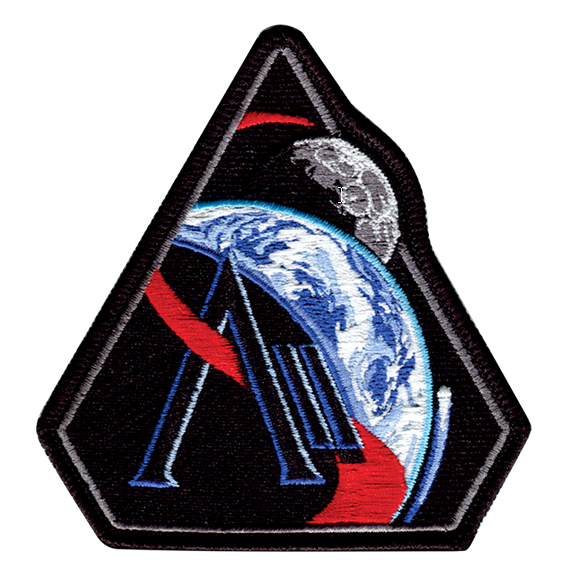
Thank you Hektor. But a question. The outgoing mission patch includes the names of the crew, and the flipped version doesn't. Is the photo you've linked an accurate reproduction of the patch that the crew wore? Thanks. If so it could be included in the infobox, I'm just wary about the absence of the astronauts names. Randy Kryn (talk) 11:50, 17 April 2026 (UTC)[reply]
@NeoSyria, to be clear per the BOLD, revert, discuss cycle... you boldly added the location as west of Rosarito, I reverted you, so the onus is on YOU to bring it to the talk page, not revert me back to your preferred location with a hidden note telling people to get consensus for your bold edit.
On that note, find a reliable source (americocentric or not), that gives the location as Rosarito, then we can talk about changing the location. Until then we are going with the multitude of reliable sources that say San Diego. RickyCourtney (talk) 20:36, 13 April 2026 (UTC)[reply]
Combine 'Public outreach' and 'In culture' sections
Currently it feels like there is a lot of overlap in the 'Public outreach' and 'In culture' sections. Specifically about the talk of "moon joy" and "collective effervescence". Anyone oppose merging these sections? RickyCourtney (talk) 17:53, 14 April 2026 (UTC)[reply]
Interesting idea, maybe move the major overlaps, but the culture section may expand in the future when more popular culture examples occur. Mentions in films, songs, and other cultural communication, such as a postage stamp or two, will likely occur. Randy Kryn (talk) 00:54, 15 April 2026 (UTC)[reply]
This edit request has been answered. Set the |answered= parameter to no to reactivate your request.
In the section on Public Outreach, there is a typo in paragraph 4 where it says "[...] for later retrieval for later retrieval, [...]" when it was likely supposed to be just 1 instance of "for later retrieval." ~2026-22930-51 (talk) 18:45, 14 April 2026 (UTC)[reply]


.jpg)


 Not done: please provide reliable sources that support the change you want made. GearsDatapack (talk) 09:52, 23 January 2026 (UTC)
 Done –CopperyMarrow15 (talk • edits) 21:51, 5 February 2026 (UTC)
.jpg)
 Comment: I'm not sure that the proposed change fits MOS:LEADIMAGE, its not clear to me that the proposed image will help readers identify that they are on the correct page. I see your point about Apollo 8. I won't archive the request yet in case other editors think differently. ScrubbedFalcon (talk) 23:14, 4 April 2026 (UTC)


 The redirect Artemis Three has been listed at redirects for discussion to determine whether its use and function meets the redirect guidelines. Readers of this page are welcome to comment on this redirect at Wikipedia:Redirects for discussion/Log/2026 April 9 § Artemis Three until a consensus is reached. SeaHaircutSoilReplace 21:33, 9 April 2026 (UTC)


![[1]](https://images-assets.nasa.gov/image/orientale_tgt_pg_135mm%202/orientale_tgt_pg_135mm%202~medium.jpg?w=1280&h=850&fit=clip&crop=faces%2Cfocalpoint)

 Fixed. Thanks. -- RickyCourtney (talk) 20:16, 14 April 2026 (UTC)