

the iranian inkblot part 2
some additional perspectives

“what game were you watching?” it’s a common sports bar refrain, a simple expression of “i cannot believe you just watched the same game i did and are saying what you’re saying.” we’ve all been there. but this one seems special.
i’m honestly not sure i’ve ever seen a disconnect like the iran war in terms of the way so many people are looking at the same things and coming to such radically different conclusions and, to be brutally honest, in many cases flat out abandoning sense, core principles, and even basic discernment in their pursuit of wild, questionable conclusions.
it feels like derangement.
it’s an environment of bias, confirmation and otherwise, crashing into outright propaganda and egged on by myopia and hyperfixation that is, frankly, missing huge parts of what is going on as everyone says “this is simple and my singular hobby horse explains it all.” but as i said in my last piece on this:
now some of what is going on is clearly a one time world order centered around the soft power of ideas like “international law” and “the UN” being shoved aside for a return to something more akin to the “great game” of the bad old days.
those who lament this have a point, which is that it’s better and more pleasant to live in a soft power world of suasion and deterrence, and it’s a good point. but it’s also, once across certain rubicons, irrelevant. it only works if there is deterrence and deterrence only works if there is a fear of real, hard power. europe forgot this and now they are about as relevant as a fart in a hurricane. and the game has moved on.
this seems to be the first divide that people segment across with respect to iran: is this some violation of international law, UN norms, our post ww2 international structure? was that system undermined here or simply revealed to have died a decade ago and just getting carried around like international law as weekend at bernie’s? useful questions all.
i suspect this to be very much one of those “where one stands depends entirely upon where on sits” kind of situations. of course the EU and the liberals of america with their new model army of fuchsia-haired transfolk want the soft power world: it’s all they have and if you won’t stop when they threaten to say “stop!” again in an even more sternly worded communiqué, well, they wind up a bit pantsed, don’t they?
this seems to be a lesson they are learning everywhere from the streets of london and toronto to the learing centers of minneapolis: those who choose hard power over soft, who take without apology and see appeasement as submission and weakness and therefore take more, who steal and lie and use violence and rape as weapons against those they seek to dominate do not care about “your rules.” they use them against you and demand that you follow what they flout. and that is a great way to get your ass kicked. it’s a great way to lose your way of life and your world.
the simple fact is this: much of the west forgot what underpins real power and the soft power, high trust, rules for rule following people systems it created are wholly unsuited to deal with a great game sort of world. they no longer afford protection but rather embed deep, catastrophic vulnerability. and many of the players at the board, russia, china, iran, the middle east, africa, israel, they know this.
civilizations die by forgetting the obvious things. they revive by remembering them. and so, unlike for much of the rest of this piece, on this one issue, i’ll come down hard on a side: the new world order is here and it has no place for the UN and all the other soft power norms at home and abroad that once served but have now been turned against not just the west but the actual idea of the west.
if you believe in exceptionalism, that western civ was a signal achievement in human flourishing and progress (and i do) then the time has come to choose and if you would preserve your social contract and your liberty, sometimes the social contract must go to war against those who refuse to be bound by it, especially those who seek to destroy it from within by demanding its protection while refusing to afford the reciprocal to others.
but this is not simple.
what does that war look like? to what does it extend? when can one reasonably and morally exercise agency and force? this debate seems to rage on every axis. is it moral to expel all “illegals” who came into your country without permission and must one wait for them to violate the rights of someone within your borders? or perhaps (to hear the left tell it) we should not expel them even then.
this gets much more complex when one looks at international affairs and the great game. when should one attack? what is self defense and what is aggression? what can be allowed and tolerated, what cannot? these are hard questions and have complex, trade off driven answers. objectivity (which so many lay claim to) becomes difficult to sustain because so much of what drives the calculus of these decisions are determinations about capability and about intention.
consider iran.
many now lament the price of oil and the “see the world in one big square” thinkers say things like “this war has given iran control of the strait of hormuz!” but this is flatly wrong. iran already had control of the strait of hormuz. they had more weapons, more missiles, an air force, and a navy a month ago. their control then was vastly greater than it is now. that is a fact. they were simply not exercising it.
why did they not exercise it? here we get into speculation. the two broad schools of thought seem to look like this:
iran had no intention to threaten oil transport and just wanted to live in peace
iran was held in check by fear of what would happen to them if they did exercise such control
those espousing the former view describe iran as simply trying to survive in a hostile neighborhood and needing weapons to keep the imperialists or enemies at bay. they simply want to sell their oil like anyone else and sanctions and threats keep putting this at risk.
they threatened to close the strait in 2018-19 based on “if our oil does not pass, neither shall anyone else’s.” they want their tankers to have free right of way to china and need the export currency those sales bring.
they are only closing it now because they have nothing to lose and need to find a way to force a peace. we could have deterred them indefiniately.
those espousing the latter point to threats from the 80’s and 2012, seizures in 2015 and 2024, and the huge buildup of offensive missiles in iran of late mostly fueled by money, tech, and components from china. they see iran as a china catspaw and a regional mess maker and trouble stirrer (more on this in a minute) and say “do you seriously want to see iran have the power to close hormuz at whim while also having too great an arsenal for anyone to stop it?”
this is the “north korea” model: the soviets and chinese flooded NK with conventional weapons so vast that seoul could be reduced to rubble in an artillery barrage. this rendered NK safe and allowed them to pursue their nuclear ambitions. now they are an untouchable trouble makeing beachhead. iran appears to have been looking to pursue a similar model and were getting to the point of “the next doubling will make intervention too costly.”
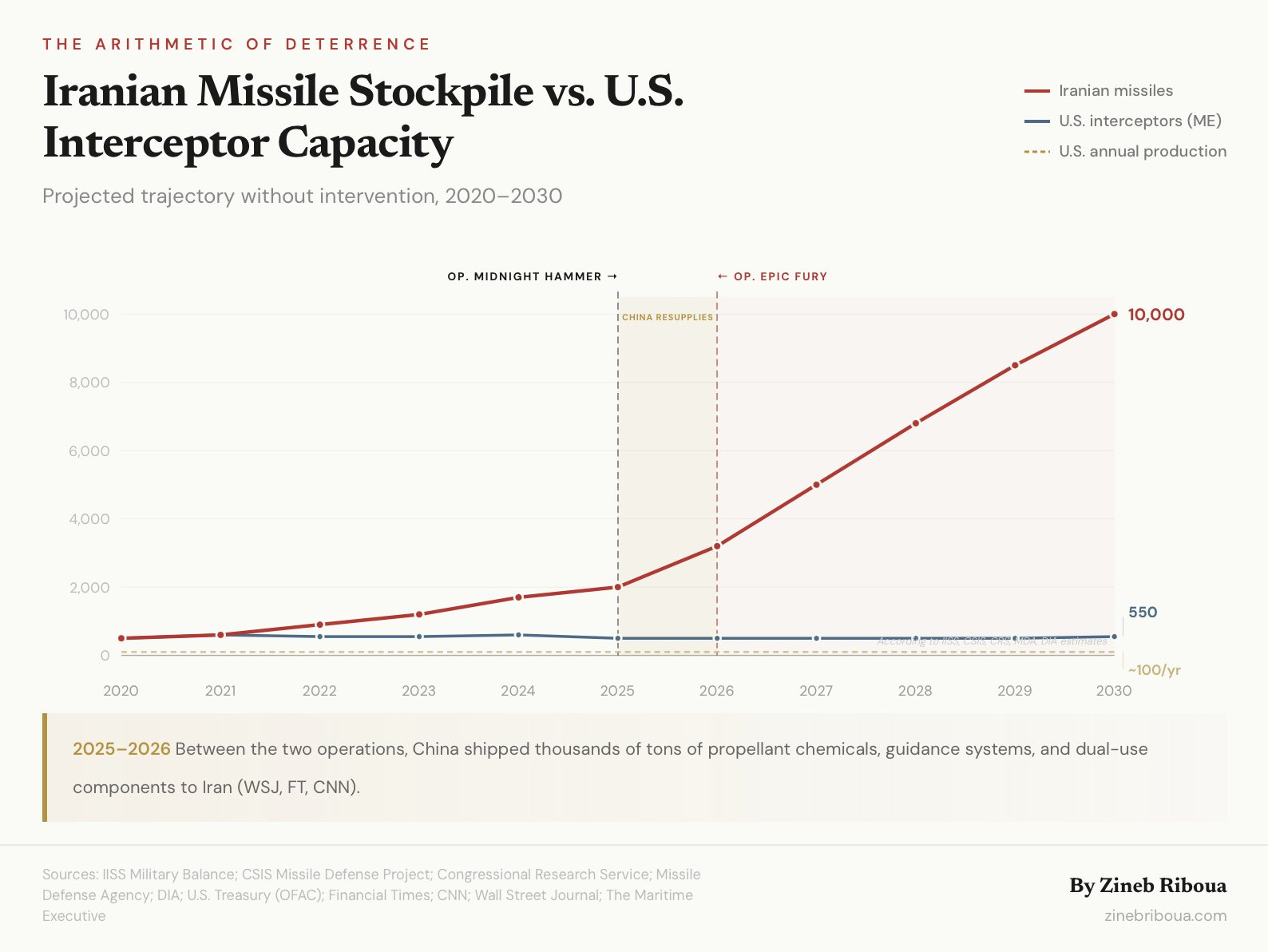
so, the first key divide here is “what do you think of iran and its intentions?” are they a country that would just like to be left alone to trade and ship oil to china (or others if sanctions were dropped) or do they have aspirations to regional power and control and would they be under the sway of china as they exercised it?
whatever one thinks on that, the timing forced a choice: if you wait another year, you probably cannot stop it anymore and iran will have too great an arsenal to attack without the cost being too great. if you thought they wanted peace, this seems like bad, imperial aggression, if you think they wanted to dominate the region, then this may have been the moment to preempt. and because one is arguing about a hypothetical, there is no “truth.” we don’t get to see what would have happened in 2 years had there been no war.
so what? say others. even if they had such aspirations to regional hegemony and interference with trade, why is it our problem? why must our treasure and sons carry the day? why must we get involved and meddle? and even if we do, will it even work? again, all good questions.
this is where the next divide opens up: even if they did this, would it threaten us? so what if china wants to be golbal hegemon. they cannot and will not invade the US. let the rest of the world be the rest of the world and let’s do our own thing. “it does not work like that,” reply others. you may not be interested in the great game, but it is ongoing nonetheless, and those who fail to join have had poor histories. you let the others grow too powerful and so, when you are finally forced to play, like chamberlain, your appeasement has left you with a rotten hand. these are also good points. and again, this pivots on a hypothetical: what will the gameboard look like in 10 years, what are the intentions and capabilities of the other players, and what will they be then? do they not attack us and our interests out of peacefulness or out of fear?
because that’s always the pivot: was iran not dominating the strait and restricting and taxing traffic because it did not want to or because it didn’t think it could get away with it?
the answer to that question gives the next 3,000 ballistic missiles in inventory a very different character. it also gives a very different perspective on china and raises complex multi-step questions like “could you use the guaranteed access to iran oil and the ability to choke off the rest of the strait as a card in the game to cross the channel into taiwan?” or other such geopolitical hard power assertion like “here, have an oil price shock” used anytime they do not get what they want.
allowing a competitor, rival, or enemy to have a power embeds a choice about what you think they plan to do with it.
if you find yourself in a room with a stranger and there is a gun on the table between you, if the stranger reaches for it, what do you do? maybe they are just scared and if you calm them and show you are peaceful, they’ll put it down or refrain from threatening you once they have it and feel safe. or maybe not. but once they reach, you have to choose. that’s how it works. and once they pick it up, the world is a different place.
most of the EU seems to want no part of this. one can see why: they have little to offer and much to lose as the soft power regimes in which they seek to retain global clout are rendered less credible by such actions. they stand where they sit. “but they are our allies, our cultural and economic friends, cutting them loose is a great cost and a great loss!” this is certainly a viewpoint and one with history and truth behind it. but it’s also mitigated by “really?” the EU has become an exporter of globalist ideology, socialism, green economics, and censorship. many countries there are losing internal cultural battles and resorting to political suppression and totalitarian tactics to suppress the populism they are setting off. are these our friends at this point? what are they bringing to the table? (this gets even more complex when you seek to separate the european people from the european elites who are driving policy. the two seem increasingly at odds.)
again, interesting questions and one can feel lots of ways about that, but in amongst all this hair pulling and rending of garments and gnashing of teeth i think the bigger issue and the bigger alliance is getting lost and this is why, to my mind, a great many people are not seeing the totality of the picture here.
i remember the question, asked again and again early in this conflict: “why would iran respond to this attack by the US and israel by shooting at bahrain, saudi arabia, UAE, qatar, kuwait, oman, jordan, iraq, tukey, and syria?” and also interesting: “why are none of those countries seemingly angry with the US over it?”
well, let me tell you: it’s because the whole region hates iran, they were on board with this attack and happy to see it, and they would love to see the reign of the ayatollahs ended.
this attack did not spark outrage in “the muslim world.” they wanted it. iran is the regional troublemaker, the exporter of strife, instability, and terrorism. they are the sort of nexus of the shi’a wasp’s nest that keeps sending stings all over the area. they make a hot mess in gaza (hamas, palentinian islamic jihad, bonyad shaid, al-ansar), lebanon (hezbollah, actual IRGC), syria (IRGC), iraq (militias), jordan (terrorism), yemen (houthis), and saudi (also houthis). the list goes on.
and most of the middle east wanted the wasps gone and feared that, very soon, they would lose the ability to go into the neighbor’s yard to burn the nest.
many of these nations have difficult to deal with an integrate shi’a minorities (10-20%) who iran loves to stir up. they do the same in the EU, perhaps another reason the EU with its rapidly growing muslim population feels afraid to stand in opposition to iran. they are actively operating in the UK, denmark, sweden, and the netherlands. likely france and spain as well.
iran attacked the middle eastern neighbors because, unlike the US and EU who get their news from some truly silly newspapers and TV who would not know which end of a geopolitics to hold if you handed it to them and would certainly spin it if they did, by some mischance, happen to grasp it right way around, iran knew that the neighbors supported the war and understood the nature of the war that has been ongoing in the middle east not just for hearts and minds but for spheres of cultural alignment, economic domination, and frankly, for what century we feel like inhabiting (the 21st or the 12th).
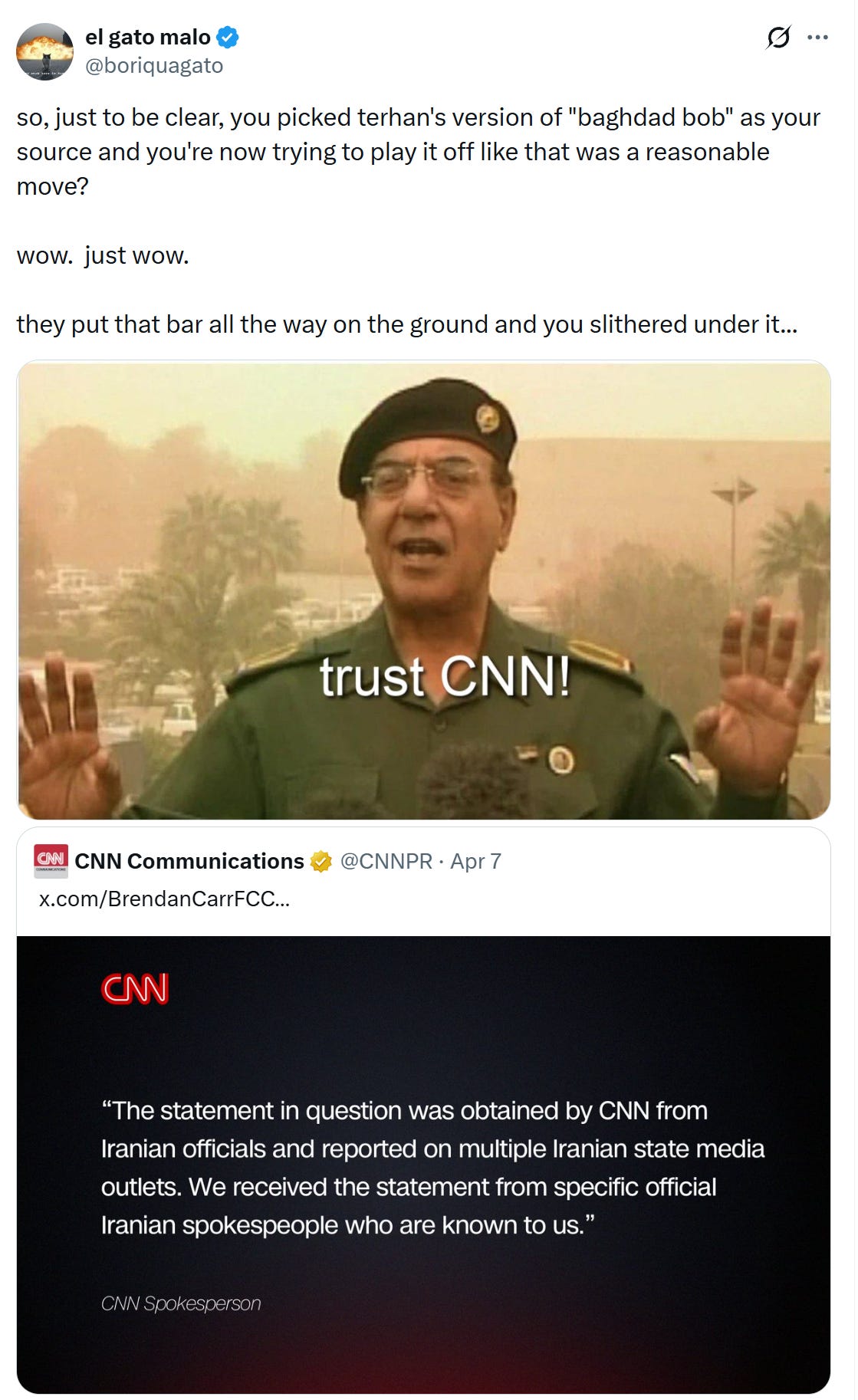
it’s pretty wild the extent to which this is not even being discussed in the west where the media is too busy making stuff up and citing iranian propoganda. CNN literally misreported that “iran claims victory, says it forced US to accept 10-point plan” as though losing whole branches of one’s military and the top several layers of one’s government is how one prevails at war. (these same people were ghoulishly rooting against the recovery of a downed US airman)
so, as ever, there’s lots one can disagree or diverge about going on here, but anyone who thinks they hate the media enough should think again.
that, perhaps, is a fact we can agree upon. this sort of hyper partisan mendacity serves nothing good.
but if you listen to these people and their sideshow, you’re missing the real story:
the attacks of october 7th, 2023 where hamas came into israel and murdered, raped, filmed it, took hostages, and generally did everything in their power to be as brutally provocative as possible get cast as some sort of “resistance to israeli aparthied” but they were not. they were stirred up by iran (and china) as a direct provocation and attack and the timing was intentional.
they were not going for subtle, they wanted to destroy and to force israel to respond and before people start howling about “genocide” ask yourself this: if mexcian drug cartels came in force into texas and filmed themselves raping and murdering girls at a music festival, killing babies in homes, and bragging and laughing about it, what would the US have done? what would anyone do? they killed 1,200 people, dragged naked women through the streets behind trucks, and took 250 hostages. they fired 3000-5000 rockets. be serious. we’d have paved the whole country of mexico down to durango and toppled their government. so, sorry, but the “they should not have responded like that” argument is a tough one to make.
the hamas attack was not about “liberation” is was about cannon fodder useful idiocy. it was to derail a new order emerging in the middle east where israel and saudi were looking to extend the abraham accords normalizing relations and, under a new and more forward looking saudi government, start to move the center of middle eastern gravity into the west. in a rare bout of the brandon admin doing something useful in foreign policy, talks were reportedly “nearing completion” and would ease conditions in palestine. neither iran nor hamas wanted this and neither did china (who wields so much clout in iran and funds so much of iran’s terror exports). and it worked. this derailed the talks.
that is the iranian and chinese goal: to keep the middle east away from the west, iran because they want sharia and fundamentalism and china because they do not wish to see a rival strengthened. iran is their local proxy (as venezuela was becoming in south america) and the US move into iran (and VZ) was both about getting back on track with the middle east turning west and knocking china out of the game/threatening their access to oil.
everyone seems to want to scream about israel here as some master core manipulator, but the reality is this was (in a great game sense) about a core US interest that also serves israeli interests and the alliance was natural. both want to see the middle east turn west and normalize peaceable existence and both see iran as the core impediment thereto: the regional pot stirrer and terror funder always making peace impossible and trying to push for theocracy and 12th century acid in the face if you show your hair levels of women’s rights. watching the left line up with that one has been fascinating, but we all know “the graph” by this point, so, here we are.
a lot of the middle east has reached a point of “we’d be happy to live next door to israel, it’s the ayatollahs we want out of the neighborhood.”
and this is not new.
“There will come a day that we will see far more radical extremists and terrorists coming out of Europe because of lack of decision making, trying to be politically correct… assuming that they know the Middle East and Islam better than we do. I’m sorry, but that’s pure ignorance.”
-UAE Foreign Minister Sheikh Abdullah bin Zayed Al Nahyan, 2017
they have, on the basis of a great deal of local knowledge and firsthand experience, made their choice about this. it’s fascinating watching the western media simply refuse to see it, acknowledge it, and engage in bizarre, tortuous inversions around it.
it’s all “but we’re losing the EU alliance and falling prey to some cunning jewish perfidy!” but the reality is the US is building a large scale arab alliance against these radicals and their chinese patrons and that alliance includes israel.
absent iran, lebanon might be governable again. syria too. the general level of strife would collapse all over.
the west may not know this, but the locals do. why do you think they took the missile hits and (mostly) stayed on side with the bombing?
it’s difficult to find any media even looking at this from a realistic angle. everything is hyper-partisan hyperventilating.
for those seeking perspective, i think this piece is excellent. it’s long, but detailed, well reasoned, and nuanced.
i suggest taking the time to read it (or at least dialing down the stridence of opinions if one will not)

and as ever, one can agree or disagree, but i will wager this represents a perspective many have never seen nor considered.
i exerpt it here:
Three Things the West Cannot See
The first is the Arab relationship with Iran. From the vantage point of Brussels or London, Iran presents itself as a resistance movement with a grievance against American hegemony and Israeli occupation, and this presentation maps comfortably onto familiar Western anticolonial frameworks.
What it does not map onto is the lived experience of Arab populations in Lebanon, Iraq, Yemen, Bahrain, Syria, and across the Gulf. In those countries, Iran’s presence meant Hezbollah holding the Lebanese state hostage to Tehran’s decisions, thirty-five armed factions in Iraq drawing salaries from Iranian funds channeled through the Iraqi national treasury, and Houthi commanders answering to the Islamic Revolutionary Guard Corps while firing on Arab civilians from Yemeni soil. Freedom is not the word any serious Arab observer would use for what Iran brought.
Indeed, the Arab world’s quarrel with Iran runs far deeper than American bases or Israeli airstrikes. What drives it is the systematic subversion of Arab sovereignty by a foreign power that uses the language of Islamic solidarity as cover for an imperial project conducted through proxies.
The second dimension is the proxy question itself, where Western analysis fails most comprehensively. Iran goes far beyond supporting armed groups. Parallel state structures get built inside Arab countries, financial systems get captured, and political figures get installed who owe their existence and survival entirely to Tehran.
The Iranians who have administered this project understand it as the export of a revolution, but what Arab populations have experienced is closer to a colonial occupation conducted through intermediaries, and as of now, they’re not mourning the Islamic Republic.
When Westerners treat these proxy networks as instruments of legitimate resistance rather than as mechanisms of subjugation, they endorse an imperial project while believing themselves to be opposing one, and as a matter of fact, make themselves the legitimizing force behind Iran’s war against the Arab world.
The third dimension is the most counterintuitive for a Western audience, and it is the one most consequential for how the current war is understood and misunderstood. For Arab nationalists, including secular nationalists and even those with deep reservations about Israeli policy, Iran represents a greater and more immediate threat than Israel does.
This is a position that Western media are structurally ill-equipped to render intelligible, because Western discourse on the Middle East has been organized for decades around the Israeli-Palestinian conflict as the primary axis of regional injustice.
The result is that when Western governments and Western publics take strong positions against Israel’s actions against Iran’s operations, they believe themselves to be standing with the Arab world. In reality, they are advancing a position that the Arab world does not share and has not asked for, while ignoring the threat that Arab governments and Arab populations actually live with.
The rhetorical use of Israel as a perpetual alibi for Iranian aggression has been one of the Islamic Republic’s most durable tools, and Western opinion has served as the unwitting amplifier of that tool across the entire duration of the Islamic Republic’s existence.
if this piques your interest, read the whole of it (or at least the early part and skim the interviews, though, if you are anything like me, their frankness and direct address of issues will draw you in. you can agree or disagree with the positions, but it’s jarring how few speak like this in the west anymore)
the bottom line is that much, probably most of the middle east wants to see the iranian regime fall and its manyfold proxies fall with it. they are tired of dealing with it in their regional and domestic politics and would like to make some progress into modernity and the western sphere. they and their people choose this. it’s worth keeping that in mind and, perhaps, asking “what is it they see that i have not looked at?” such issues should inform decision and opinion.
none of this, of course, mitigates the risks of adventurism and excursions like this. the US is phenomenal at war, better than any country in history has ever been and the vividness of that display requires a very special form of ignorance to deny. that said, the US tends to be simply godawful at what comes next from eastern europe in 1945 on down to iraq and afghanistan. win the war, lose the peace. create a vacuum and let it fill with something awful. and it takes a very special form of idiocy to deny that as well.
and here we are again. who knows what will come out of pakistan? maybe something useful, probably something problematic, possibly something stupid.
will the framework leave enough iran intact to let them keep playing the neighborhood problem? will china remain entrenched? did they just get the message? was it worth sending? was it needful? did this enhance the likelihood of future peace or war?
i’m not here to tell you the answer nor to answer the “intentions vs capabilities” idea or the “we can ignore global politics” vs the “if the game is being played we have to get in” idea.
my goal here is not to tell anyone to support or oppose this war (a refusal that, if last time was any guide, just winds up pissing everyone off) but rather to provide perspective to frame questions and generate an informed opinion.
my goal is to add information and remind people that, like standing still when the stranger picks up a gun from the table, failing to act is also a choice and one that can (but does not necessarily) have serious consequences.
of course, so too can action.
there is rarely a perfect answer. there are trade offs.
with iran, we were probably lost past the days of “there’s a good choice here” and well into “least bad” but again, i suppose one could argue that depending upon one’s priors.
what does seem clear to me is this:
iran, funded and supported by china, has long had aspirations to nuclear weapons and voluntary agreements around this were flouted. they were building up a large and increasingly potent missile and drone capability and have a long history of threatening, terrorizing, and stirring up dissent in the neighbors through a large network of proxies. the country is run by radical theocrats of a seriously vicious and anti-rights disposition and face significant internal resistance that is put down with mass murder.
so, not great folks.
does this mean that it’s 1. our business and 2. that we needed to attack them? those are matters of debate and discernment. does it mean, that even if we do attack them that it will wind up serving our goals rather than just making a godawful mess? ditto.
i leave that to you to chew on and i suspect that the reason this issue seems so fractious is that we’re dealing in hypotheticals around what might have been.
what would have happened in two years had we done nothing? (now, we’ll never know) gets weighed against “well is this working?” and “what will it look like in two years?” (we don’t know yet)
is it our right? is it anyone’s? when is preemption justified? does our reaching for the gun make a previously peaceful stranger hostile?
all real questions.
that’s political science for you.
the politics is certain, the science, not so much…
but just remember this: if you are not seeing nuance and every inkblot looks the same to you, you’re probably not seeing the picture and you might want to take a step back and assure that you do.


I'm a libertarian so I am almost always against conflict/ interventionalism. So apologies in advance for the length of this comment. But I feel like I need to explain my inkblot(s)..cuz it's more than just one blot. And before I'm attacked in the comments about Trump I'm happy to share dozens of comments where I have criticized him.
So let me try to create some coherence out of myriad inkblots running through my head.
First, I feel like I've had to compromise some of my ideals over the last 6 years, starting with the scamdemic...BUT, I also did not realize the extent to which if I stood by some of those ideals on paper I may lose agency to be a libertarian in the country I love.
The fact is, people sleep peaceably at night only because rough men stand ready to do violence on their behalf
When it comes to Iran ,I'm old enough to have figured out that Iran’s regional strategy relies on a multilayered system of coercion:
- ballistic missiles
- proxy militias
-maritime intimidation
- nuclear brinkmanship
Does that sound like a threat?
I suppose we could just drop pallets of cash instead of bombs....
The most convincing argument for the Iranian "war" is the good people of Iran. If you doubt me go on X and read their comments. Its heartbreaking. They truly want the bombing to continue so they have a chance of taking back their country without hundreds of thousands being mowed down by the Mullahs henchmen.
Bottom line: I've come to the conclusion this action is a net benefit because I believe the alternative to this action is more risky than trying to dismantle a theocracy that believes the "infidel" has no right to live.
Another fact:
Every president over the last 40 years has had the same intelligence Trump has had, the difference is he had the political courage to do what none of his predecessors would do.
Maybe the war was a mistake, but to say we are "losing" is so beyond myopic.
We won so much more:
- We effectively control the EU and Chinas future. Why do you think China literally forced Iran into this ceasefire?
- We exposed the EU and NATO for the frauds they are.
-We exposed the fact that Iran, did indeed, have intermediate-range ballistic missiles that could threaten every country within 800-1000 miles, while at the same time exposed them as the paper tiger they are.
-We reshuffled the geopolitical map in our favor.
-We demonstrated we can destroy any country, at minimal cost to us, with terrifying precision, and thereby put the fear of God into our adversaries.
-We totally decimated Iran's military. We splintered the mullahs in 31 Provinces (mosaic strategy) where they are close to being weakened to the point that the Iranian people could possibly take their country back.
-The IRGCs communication and transportation between the provinces has effectively been cut off.
Lastly, nobody seems to truly understand this has as much to with China as Iran. You just have to read between the lines, over the last 20 years, with Trumps comments.
TRUMP JUST DECLARED WAR ON CHINA
Nobody is calling this what it actually is. 50% tariff on ANY country supplying Iran weapons, effective immediately, no exceptions.
Sounds like an Iran policy. It's not.
Russia barely trades with the US. North Korea doesn't at all. The only country this actually destroys is China.
China funneled $75 billion into Iran's war machine.
China sent AI intelligence on US carrier positions directly to Tehran.
5 Chinese ships were caught delivering missile fuel chemicals while the bombs were still falling.
The tariff isn't just 50%. China is already at 145% from the ongoing trade war. Add 50% on top. That's 195% total. On $500 billion in annual trade.
That's not a tariff. That's an economic execution.
Trump got a 14-day ceasefire with Iran the other day. That ceasefire was never going to hold...and Trump knew it. This potentially gives him moral authority to rain down hellfire.
Iran was the cover story imo.
This is the US-China economic war going to the next level.
Gato, sorry, Israel has tons of nukes and is a genocidal warmonger. Iran has every right to enrich uranium, as it has been doing, or to have nukes, for that matter - genocidal warmongering Israel has them, and is the biggest terrorist state in the Middle East, or anywhere. And Trump flagrantly broke his promise not to start a war with Iran, or anyone.
We don't attack N Korea because they have nukes. Nuclear weapons are a deterrent. I hope Iran gets them soon, because Israel wants them to be a failed state, in service of the genocidal project of Eretz Israel.
We started this war with a despicable Pearl-Harbor style attack, and our Zionist bootlicker president continues to take his orders from Tel Aviv. We committed war crimes in Iran, and of course, Israel commits horrific war crimes every day. Along with genocide, ethnic cleansing, torture....
Time to free ourselves from Zionist occupation. It's coming. Majorities of Republicans, Indies, and Democrats under 50 are there. Only the brainwashed Boomers continue to lap up the hasbara.
- Christian Republican Boomer Trump voter, now thoroughly disgusted.