

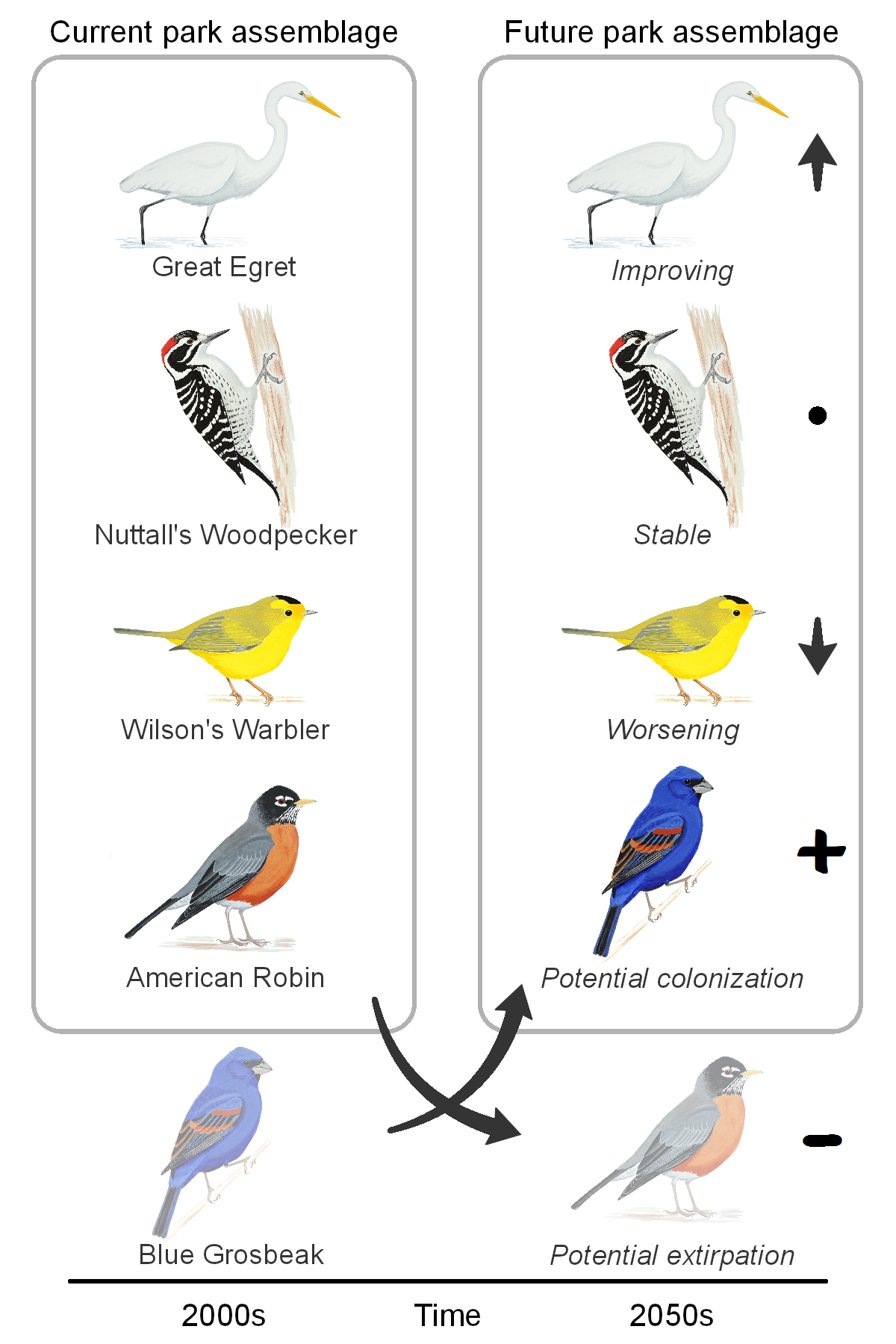
This page summarizes model-based projections of changes in climate suitability by mid-century for birds across 274 natural resource national parks under two climate change scenarios (for more information regarding how climate suitability is characterized, see Langham et al. 2015). Results throughout this page focus primarily on the high-emissions pathway (RCP8.5) because it is the scenario most consistent with current greenhouse gas emissions rates; however, comparisons are made to results for the low-emissions pathway (RCP2.6) as a contrasting, best-case scenario for emissions reductions (see Methods).
This study focuses exclusively on changing climatic conditions for birds over time. But projected changes in climate suitability are not definitive predictions of future species ranges or abundances. Numerous other factors affect where species occur, including habitat quality, food abundance, species adaptability, and the availability of microclimates (see Caveats). Therefore, managers should consider changes in climate suitability alongside these other important influences.
Use the panels below to download project briefs for each park and learn more about this study.
Here you can download individual PDF briefs for each national park unit covered by this study.
Source: NPS DataStore Collection 8066. To search for additional information, visit the NPS DataStore.
Additional resources
- Download this page's information in a printable PDF handout.
- View the project homepage on the Audubon Society website.
- Read the original journal article in PLOS ONE.
Related articles
Showing results 1-1 of 1

On the heels of a recent NPS-National Audubon Society study of potential climate change-driven shifts in bird species distributions, Audubon is launching a new community science program – Climate Watch – to test the science and monitor for expected changes. Climate Watch surveys take place in the winter (January 15 – Feb 15) and in the summer breeding season (May 15 – Jun 15).
Last updated: January 13, 2025
