


Ecstasy & The Gifts of Madness (I/III)
Part I: Theater, Masks, and Animism

The following is the first of a three-part series detailing a theory of religious experience, involving commentary on the Greeks, Nietzsche, and others on the principle of “ecstasy” and the divine gifts of madness. The fundamentally irrational nature of religious experience will be illustrated, as well as how to practically approach it today.
This section will be updated with a directory as the series finishes. Please consider subscribing for more!


Banish the personality of the famous actor, and there enters a host of other figures, at the bidding of the playwright alone, a very multitude to delight your gaze.
—Goethe, Was wir Bringen (1802)
In any inquiry into the religiosity of long-departed peoples, the matter revolves around the question of, “what did these people believe?” Yet already, just a single grain of sand into the investigation, we have covered ourselves in the chains of modern assumptions. Belief, to the modern heart, is everything: “What things soever ye desire, when ye pray, believe that ye receive them, and ye shall have them.” All are called to simply believe, to believe in miracles and theophany, in history and prophecy, and in law and morality. Given the fundamentally Abrahamic nature of this view, specifically a “belief in belief”, we cannot pour this assumption over the whole of humanity as perennial virtue. On the contrary, the ruling value of the pre-Christian world was not belief, but action1, animation. Therefore, we must instead ask, “what did these people do?” In an affirmation of this distinction, the fires and censures of zealots made it so that while we have plenty to read and observe today in regards to ancient myth, which those early fathers understood as harmless tales, we have very little in regards to ancient practice. Yet, as the Greek understood all daily activities to be in essence religious acts, the Early Church could not wholly destroy his religion—we need only some creativity in deciding where to look for it.
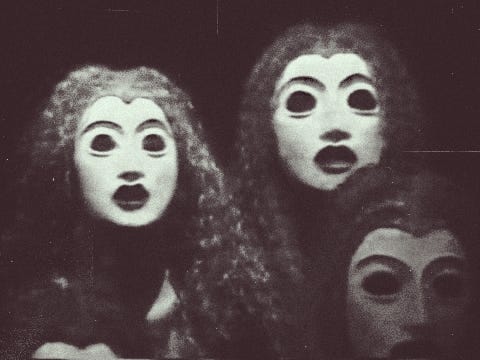
One area of “action” in regards to Greek culture that has been remarkably preserved over these thousands of years is its magnificent corpus of drama and tragedy. The original texts of Oresteia and Antigone are preserved in a number of tattered manuscripts, imagery of performances is found painted on amphorae, and even the masks of performers can be found safely preserved in modern museums. Those masks!—delightful, inquisitive, scornful, maddening, lustful, terrifying—and yet, empty; looking into the hollow eyes of these masks feels like peering into the soul of ancient Greece itself. From the blank expressions of these masks a world of character and emotions emerge, similar to the experience one obtains from a staring contest with marble statues, yet the feeling is far more of one of strangeness, and distance. The statue intends to solidify and immortalize a face; the mask intends to destroy it entirely. The persona of the actor, however important his voice and talents may be to the performance of Greek tragedy, does not exist on the stage—only the mask is seen.
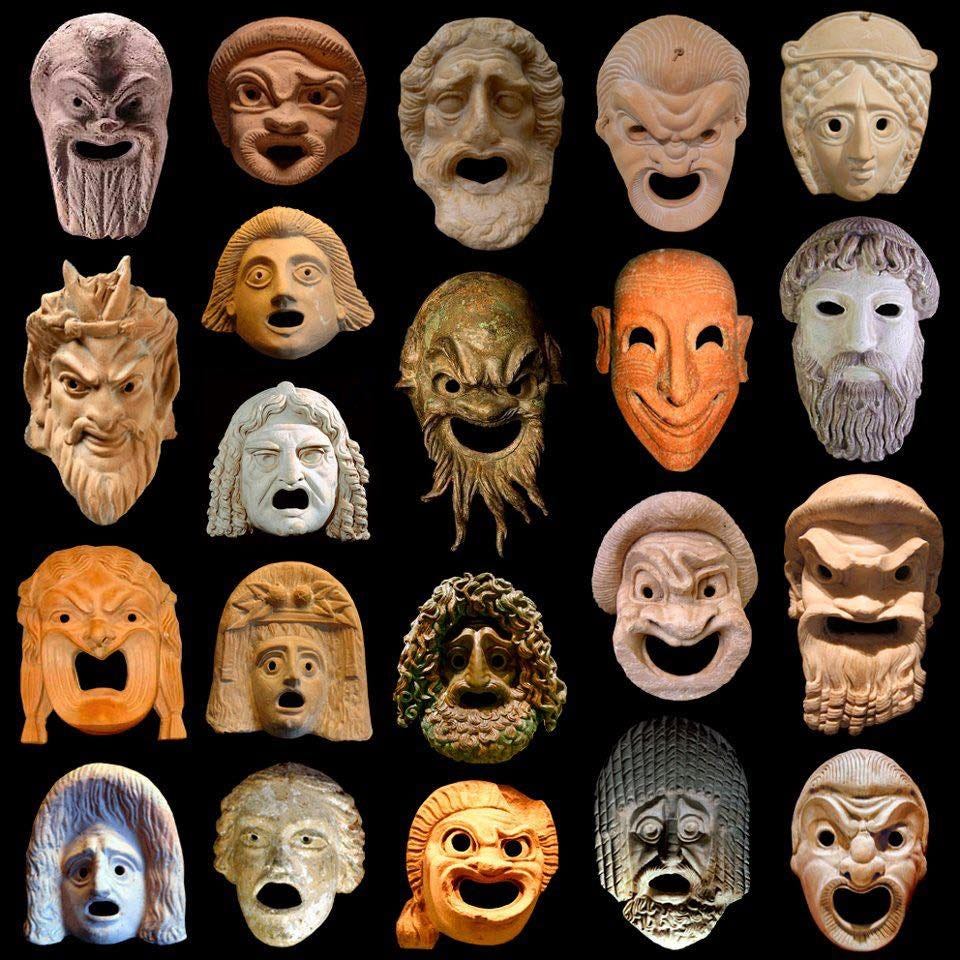
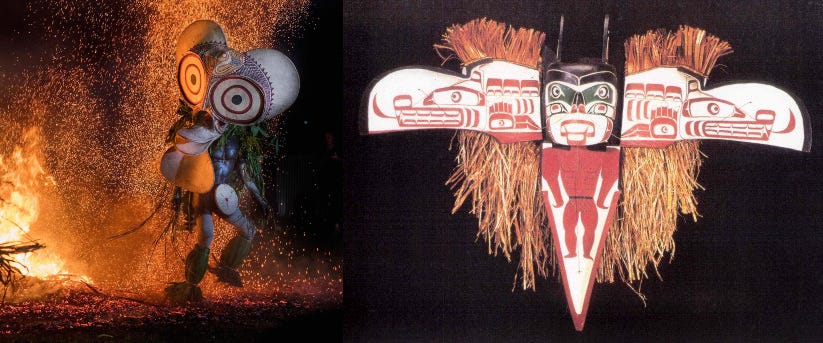
This destruction of the wearer at the hands of his mask, or perhaps the union between the two, gives us one of these hidden insights into ancient religiosity that was not apparent enough to be destroyed alongside altars and groves. Indeed, masks are ubiquitous across all spatiotemporal lengths in religious rite and ceremony, be it the death masks of Rome, the towering headsets of the Baining fire dance, or the Potlatch masks of the natives of the Pacific Northwest, which they tellingly referred to as “transformation masks”. The point of the mask in these cultures, and too was it for the stage of Greek drama, was to serve as a conduit and anchor for the soul of the depicted being. The mask is an object of becoming, of participation, and possession: when a native puts on the mask of Sisiutl or a Greek actor dons the mask of Apollo, the persona of its wearer effectively ceases to exist. Only the soul which is expressed by the mask, put into motion by the body of the actor, shines forth from the stage. It was for this reason that Ezra Pound, in his days of fascination with the closely related Japanese Noh performances, described these as “god-dances”.2
Theatre and efficacious ritual are intertwined because not only are the gods and ancestors invited to visit the temple unseen, in spirit, but they are also revealed and embodied through the Topeng drama. The performer is the link between the two worlds, a human being who, through the mask, gives form to the gods.
— David Wiles, Mask and Performance in Greek Tragedy (2007), pp. 190-191
Our assumptions run deep, revealed in our frustrations with understanding the furthest reaches of religion, casting what we do not understand into the trash bin labels of “mysticism”, “animism”, or “primitive”. The traditional model of ancient religion situates man on one end, and a universe away, the god. We conceive a world of a finite number of individual and irreducible souls which meet and interact with one another. Yet these are relatively recent developments in the long history of man, first seen in faint sparks with the Platonist and Hermetic, and thrusted into dominance by the monotheism and dualism of the Abrahamic religions. Indeed, the mask itself is foreign to the Abrahamic tradition3. In a nearly polar contrast to the view of antiquity, we are instructed to be fearful of idolatry and possession. The mask came to be associated with harlequins and the devil, and similar treatment was given to those statues of antiquity which were “defaced” in accordance with the Jewish practice of idol nullification. These assumptions are unhelpful at best, and more likely prohibitive, in understanding a world that entails a plurality of uncountable gods and souls, which blend and transform in a world defined by flux, rhythm, and ceaseless change.
Thus the mask, in its service of the alteration of psychological states, the destruction of the actor’s persona and the blending of souls in a cosmic unity between form and animation, gives us an exceptionally old window into the religion and ritual acts of mankind. Here we do not see the establishment of concrete pantheons which are lofty and untouchable by man, but beings which must necessarily manifest themselves in the world, and to such an extent that there can be little distinction between “the natural” and “the supernatural”. Such beings are not typically offered gifts in exchange for some form of intercession (though we would of course not claim sacrifice to be a “new” inclusion to religious action), but rather invited to possess. Greg Hicks, the actor for Orestes in Sir Peter Hall’s Oresteia performance, remarked that even with the mechanics of the performance the mask compels the actor: “The body wants to go with the mask… I have to move in a particular way because the mask compels me to move that way."
It is on this distinction that Robert Bellah differs primitive religion from archaic religion4, and the rule which Lucien Lévy-Bruhl defined Aboriginal religion through the law of participation—participation mystique—or what Klages called the principle of transformation. Both illustrate the idea that the practitioner is possessed by a soul or being which releases him from himself, allowing the soul or being to be animated through material once more. This view of the furthest reaches of man’s religious concepts, and indeed his subconscious, would be picked up and championed by Carl Jung:
The further we go back into history, the more we see personality disappearing beneath the wrappings of collectivity. And if we go right back to primitive psychology, we find absolutely no trace of the concept of an individual. Instead of individuality we find only collective relationship or what Lévy-Bruhl calls participation mystique.
—Jung, Psychological Types (1921)
Among such [primitives], whose consciousness is at a different level of development from ours, the “soul” (or psyche) is not felt to be a unit. Many primitives assume that a man has a “bush soul” as well as his own, and that this bush soul is incarnate in a wild animal or a tree, with which the human individual has some kind of psychic identity. […] This identity takes a variety of forms among primitives. If the bush soul is that of an animal, the animal itself is considered as some sort of brother to the man. A man whose brother is a crocodile, for instance, is supposed to be safe when swimming a crocodile-infested river. If the bush soul is a tree, the tree is presumed to have something like parental authority over the individual concerned. In both cases an injury to the bush soul is interpreted as an injury to the man. In some tribes, it is assumed that a man has a number of soul; this belief expresses the feeling of some primitive individuals that they consist of several linked but distinct units. This means that the individual’s psyche is far from being safely synthesized; on the contrary, it threatens to fragment only too easily under the onslaught of unchecked emotions.
—Jung, Man and His Symbols (1964), pp. 6-7
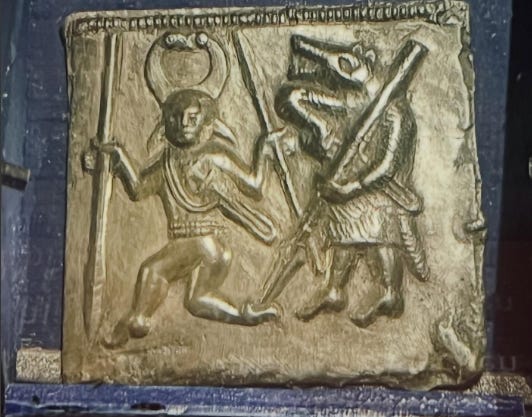
The principle of transformation, and with it bringing souls into the power of the waking mind, is the ancient goal of all theurgists, spirit conjurers, and necromancers, and one of the pro-ethnic roots of mysticism, whose original form, untainted by any spiritualistic debauchery, we can grasp. For example, in the self-transformation of Germanic heroes into werewolves and berserkers, of the Zeylonian devil dancers into demons, of the ancient Thracian Sabos mystists into the rapturous thiasos of the raging bull god.
—Klages, Of Cosmogonic Eros5
The lack of all individuality, in which man is ensnared in communion with the cosmos, can only be described with one word: ecstasy. The term has its roots in the ancient Greek use of ἐξίστημι, existemi, to be displaced or driven out of something. While the term has modern connotations with psychedelics or sexual activity, it must necessarily be identified with the whole of religious experience: man, when come upon by a god, is “driven out” of and dissolved of his own personality and ego. He and the god or spirit become one, and there is no confusion in the contradiction that man could be simultaneously himself and someone else—be it an animal spirit, gods, ancestors, daemons, or all of the above. The result is madness, with the possessed acting as if he is no longer himself. The whole enterprise of ritual action—from the most primitive of man, to the ulfhednar of Iron Age Germanic peoples, to the modern Christian practice of “speaking in tongues”—must be and can only be seen through the seeking and invitation of ecstatic rapture. Religion may be credited with the generation of many things, and much is associated with religious belief and activity, but without ecstasy, it is nothing.
Of course, Dionysus is conveniently the god of theater, masks, ecstasy, and all aforementioned related themes. Yet this series will not be an investigation into the cult of Dionysus, but to argue that what is most traditionally associated with his cult is in fact intrinsic to all religious experience: ecstasy—not morality, not reason, not tradition—is the ruling principle of all that is religious. It is from here that we must completely dispense with the conception of religious and ritual act as a fundamentally rational effort: ritual and religious experience itself serves to annihilate the sober ego, driving the practitioner into a maddened state of uncontrollable frenzy. As important as corollaries such as tradition and ethics are to the larger coherence and stability of man himself and his relationship with the world, they have no bearing or importance to the undeniably irrational religious experience which precedes and maintains them.
The stage of strange and titled masks gives us a faint glimpse into the mode of thought that dominated the psyche, the soul, of primitive man—and thus the fertile soil of what man calls “religion”, his relationship with a fully divine world. In ecstatic rapture the performers cease to be the studious actors that had trained and prepared verses for years before, but form an animated union with the soul that shines through the hollow eyes of the mask. The performance of Greek tragedy or of Japanese Noh appears as a perfected form of the religious dances of American Indians or Papuans because it is precisely from these ritualistic ceremonies where the performance finds its forefather. This tells us a great deal about Greek tragedy and masks, but more so about the essence of religious experience: ecstasy, possession, and union.
In future installments, we will further explore the concepts of ecstasy and divine madness—highlighting a rare area of agreement between Socrates and Nietzsche.
Some debate persists about the extent to which orthopraxy ruled over orthodoxy in ancient religion, as ancients certainly demanded a level of correctness in the telling of their myths and description of their gods. Some contemporary pagans erroneously believe that a properly conducted ritual is possible regardless of the underlying orthodoxy. Our use of the concept here is principally to differentiate ancient religion from various strains of contemporary religious thinking, i.e., “by faith alone”.
One sole exception is evident in the carnival masks of Venice or France, but the appearance and purpose of these masks are radically different than any ancient conception. These masks, such as the bauta, were meant to conceal and anonymize, and did not represent any particular intended persona or expression. Thus, Romantics such as Goethe or Schlegel were keen to illustrate the differences between these masks and the statues of antiquity: one is meant to conceal shame, the other to reveal something (see David Wiles’ Mask and Performance in Greek Tragedy, p. 74).
Returning to a World-Accepting Religiosity

Civilization is an organism - morphing, living, dying, reproducing - it adapts to the context and setting in which it finds itself. Above all else, they undergo a process of evolution that leads to increasingly differentiated forms. Though we can see civilizations of morphological similarity to Rome, like bulls to the auroch, Rome truly only exists in t…
Klages on Death and Ancestor Worship

Open are the double doors of the horizon, unlocked are its bolts


