In posting that a whole civilization would die if no deal was struck, the president sparked a frantic global guessing game.
Published on: Apr 08, 2026 11:30 AM IST
WSJ
Share via
Copy link
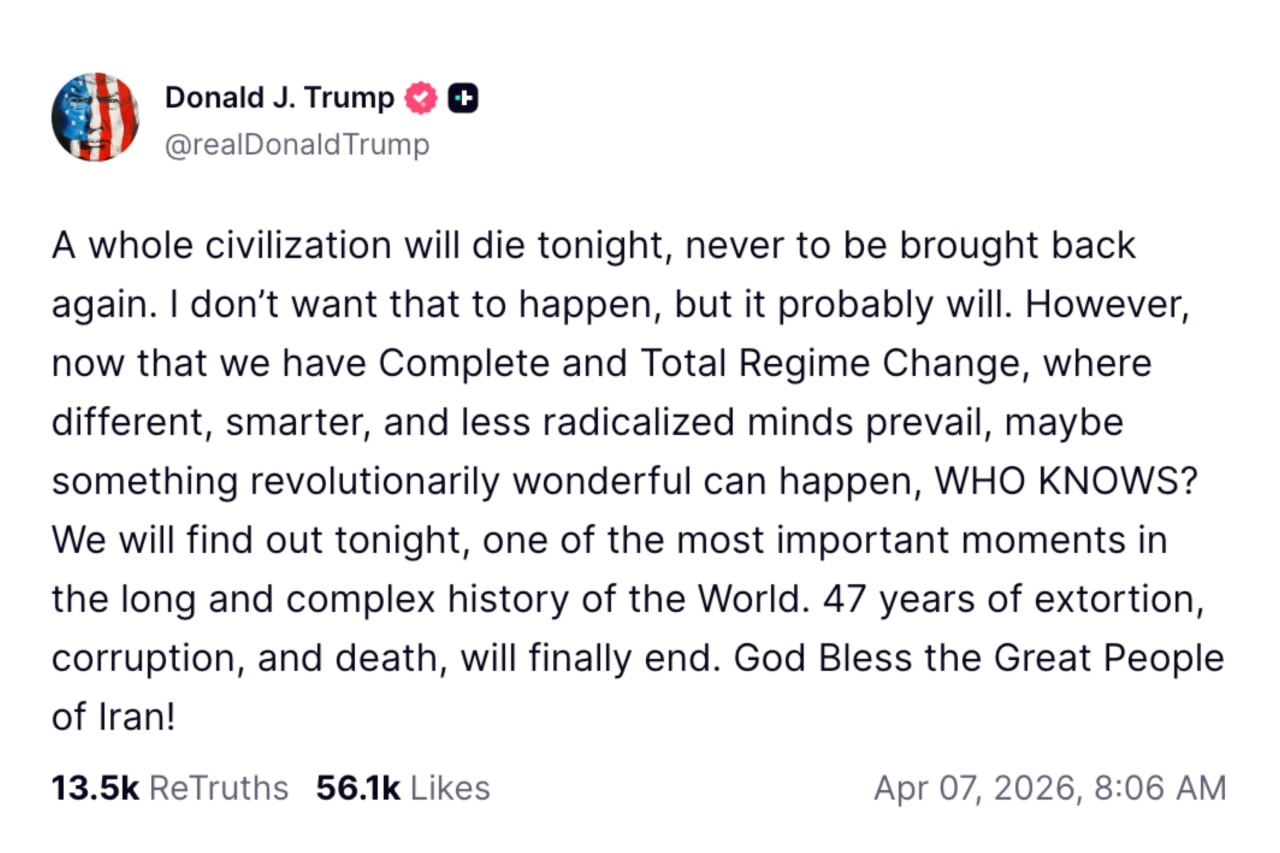
At 8:06 a.m. Tuesday, President Trump issued the most dramatic ultimatum of his presidency: Unless Iran struck a deal in the next 12 hours, “a whole civilization will die tonight, never to be brought back again.”
Even for a president who has long relied on maximalist threats, the 85-word post was startling. It ricocheted from the Oval Office to foreign embassies and corporate suites, setting off a countdown to Trump’s 8 p.m. deadline.
Even for a president who has long relied on maximalist threats, the 85-word post was startling. It ricocheted from the Oval Office to foreign embassies and corporate suites, setting off a countdown to Trump’s 8 p.m. deadline and a frantic global guessing game over what the world’s most powerful man was prepared to do.
Download Hindustan Times App to read this story for FREE!
Less than ninety minutes before his deadline, Trump backed down, writing in a social-media post that he had agreed to a two-week cease-fire with Iran and would suspend his threatened strikes subject to the immediate reopening of the Strait of Hormuz.
Trump had spent days warning that he would bomb Iran’s bridges, power plants, and other civilian infrastructure, insisting the country’s people “would be willing to suffer that in order to have freedom.” As he appeared to threaten to destroy a country of 93 million people, he also seemed to leave the door open to a deal to avert the calamitous strikes.
“WHO KNOWS?” he wrote. “We will find out tonight, one of the most important moments in the long and complex history of the World.”
As the hours ticked by, everyone from Pope Leo to actor Ben Stiller called on Trump to back down. Administration officials fielded phone calls from executives and political allies trying to decipher whether Trump’s threat was a bluff or a prelude to an escalation.
European officials huddled on a call and largely convinced themselves that Trump would back off. On Wall Street, traders and executives treated the day like other Trump deadlines that have come and gone: as a negotiating tactic they largely expected to pass without catastrophe.
Scrambling for an off-ramp
Trump’s social-media post lighted up group chats across the globe and set off a scramble by U.S. allies and mediators to find an off-ramp or buy more time.
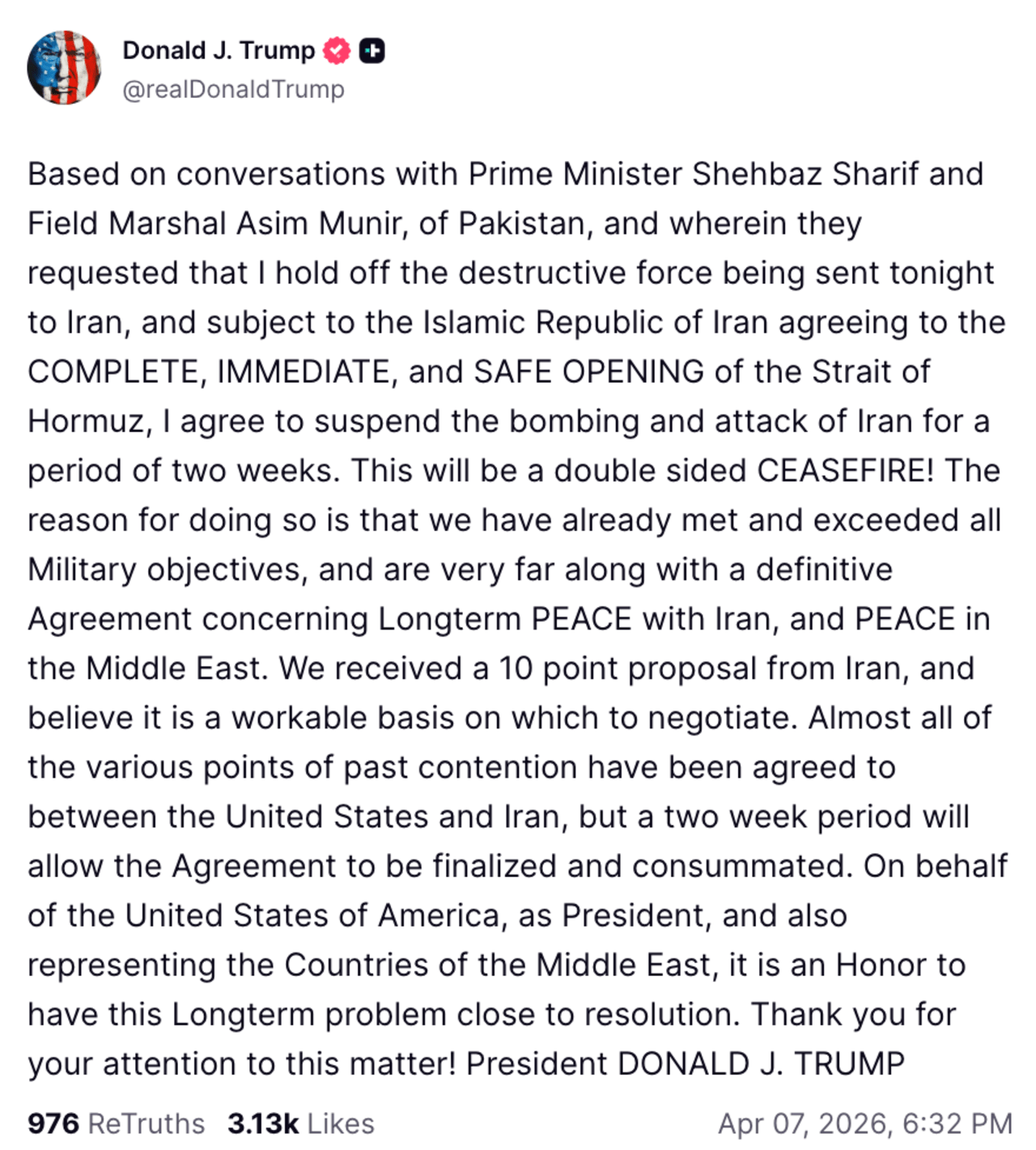
Trump's truth social on April 7, 2026.
As his threat made the rounds in Iran, many residents prepared for power and gas to go out and debated whether it would be safer to stay in the city or decamp for the countryside. Some dusted off old camping stoves and refilled oil canisters. “When the pain becomes deep enough, the fear fades,” a 42-year-old Iranian woman said, citing five weeks of war and years of repression and economic crisis in the country.
Less than 30 minutes after Trump’s post, Iranian officials told Egypt that Tehran had cut off direct communications with U.S. negotiators, according to officials from an Arab government. Officials from multiple Arab governments warned that the president’s threat would likely have the opposite effect on Iran’s hardline Islamic Revolutionary Guard Corps, which had signaled that it would plunge the region into darkness if Iranian infrastructure was attacked.
Trump’s post made headlines in Israel as people there were getting ready for the end of Passover. Former Israeli Prime Minister Ehud Olmert read the message just before sirens warning of an Iranian missile threat went off in central Israel and sent him into his home’s bomb shelter. “I tend not to accept the statement by President Trump at face value,” Olmert said from his shelter. “I want to believe what he meant is we will destroy the regime. I don’t think we can accept any destruction, total or partial, of Iranian civilization.”
At 9 a.m., Defense Secretary Pete Hegseth and Joint Chiefs Chair Gen. Dan Caine logged on to their daily secure videoconference with Adm. Brad Cooper, the commander of U.S. Central
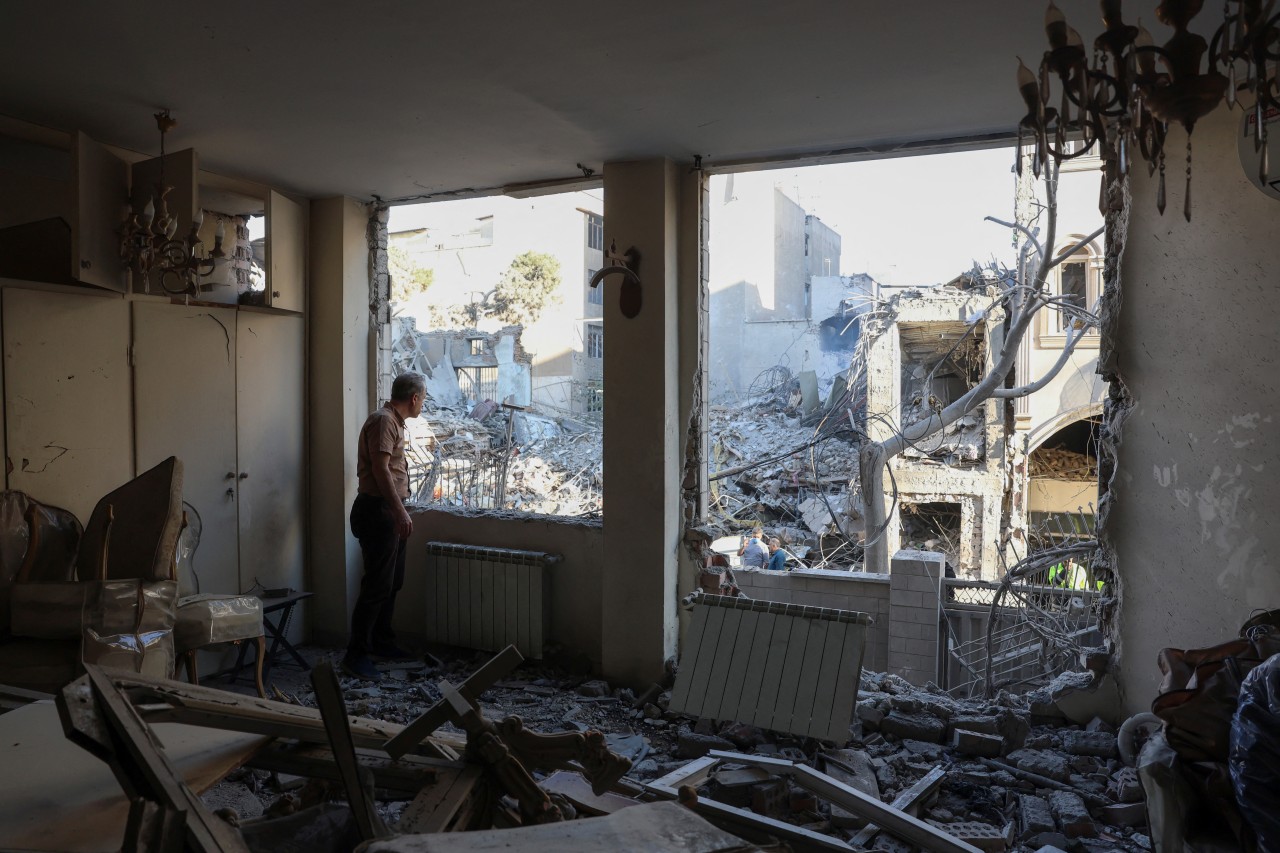
An Iranian resident looks out the window of his damaged home after Israeli-American strikes on April 7.
Command. Cooper and military planners at the Pentagon had been preparing for potential strikes on Iran’s energy infrastructure, according to two U.S. officials. Military planners pulled out existing target lists that had already been reviewed and vetted by military lawyers.
Officials said the list of targets was far fewer than Trump’s threat that “every power plant in Iran will be out of business, burning, exploding.” Each target was legally viable, officials said, because it had a clear connection to Iran’s military and security forces and wouldn’t harm the civilian population excessively. Overnight, the U.S. military pounded more than 50 targets on Kharg Island, but didn’t strike oil infrastructure, according to U.S. officials.
“The entire Department serves at the direction of the President and will execute his military objectives without fail,” Pentagon spokesman Sean Parnell said.
‘We will see the emperor has no clothes’
Trump’s threat set off similar discussions among Trump allies and influencers, who engaged in furious speculation on live-streams and podcasts. “He’s trying to sound threatening and crazy,” Tim Pool, a social media personality with more than two million followers, said in an interview with The Wall Street Journal. If Trump fails to follow through, “we will see the emperor has no clothes…This will be his final gambit,” he said in a video he later filmed for his followers.
NATO Secretary-General Mark Rutte was in the air en route to Washington when Trump published his social-media post. He was set to meet on Wednesday with Trump, Hegseth and Secretary of State Marco Rubio.
Some European officials huddled on a call to discuss the fallout from the president’s threat. The consensus was that Trump was going to back off, two of the officials on the call said.
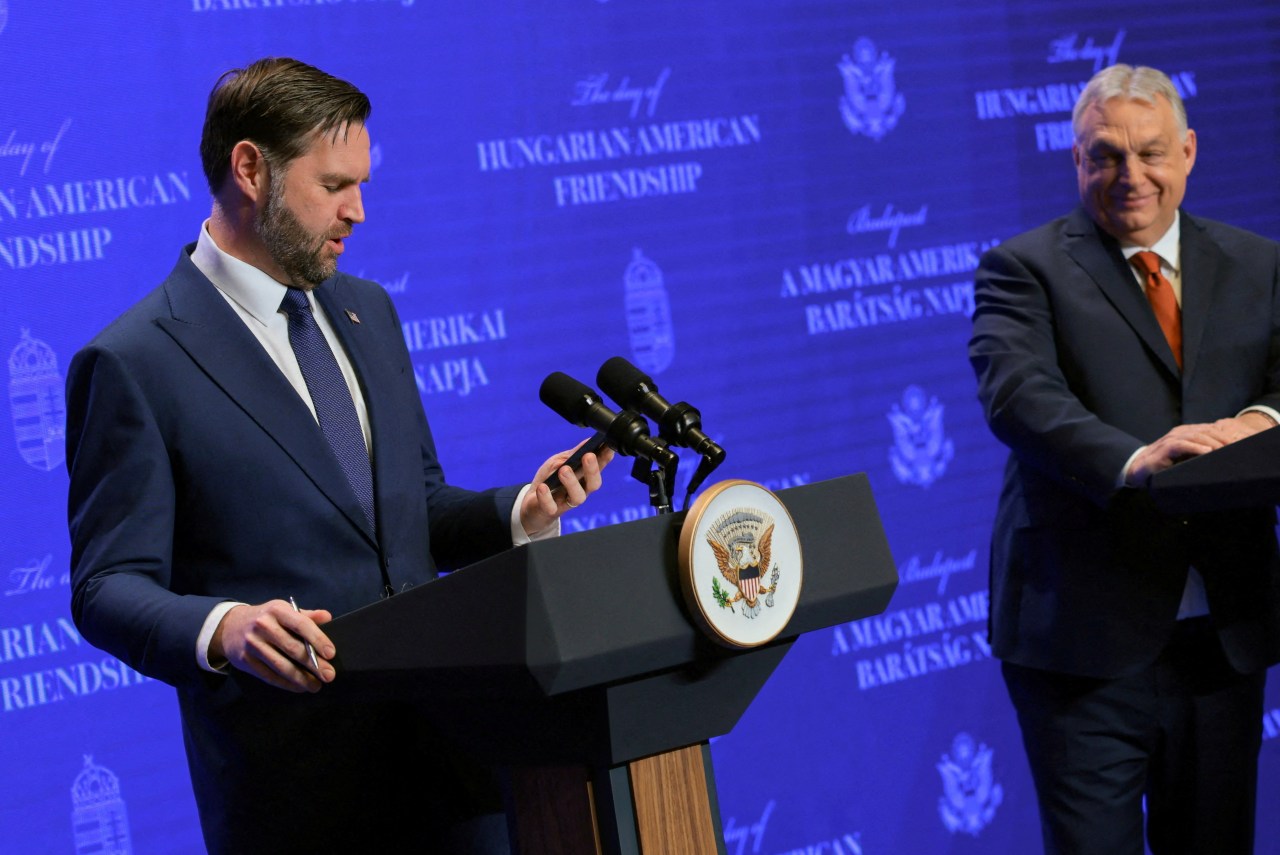
In Budapest, Vice President JD Vance took the stage with Hungarian President Viktor Orban. “I hope they’re smart,” Vance said about the Iranians. “The president has set a deadline for about 12 hours from now in the United States. We’re going to find out but there’s going to be a lot of negotiation between now and then.”
U.S. Vice President JD Vance delivers joint remarks with Hungarian Prime Minister Viktor Orban.
At 10:30 a.m., Fox News host Bret Baier appeared on air with a message from the president. He said Trump had told him that “8 p.m. is happening,” adding, “If we get to that point, there is going to be an attack like they have not seen.”
With the clock ticking on his self-imposed deadline, Trump seemed to vacillate between last-minute diplomacy to head off a major escalation and more mundane activities. In the morning, he phoned into a rally at a sports arena in Budapest headlined by Vance, who displayed his cellphone on stage before thousands of Orban supporters.
He held meetings with tech investor David Sacks and Justice Department officials at the White House, according to a person familiar with the matter. He fired off more than two-dozen Truth Social posts endorsing candidates for Indiana state legislative races.
Inside the Trump administration, some officials privately expressed concern about the president’s threat. One White House official called Trump’s post disturbing, adding that the president’s focus on foreign affairs is distracting from domestic priorities that could win over the public.
Other senior administration officials and Trump allies said they viewed the Truth Social post as a negotiating tactic.
Text chains that included tech CEOs and investors lighted up with concern about the potentially destabilizing effects of the president’s threats after five weeks of war that have driven up oil prices and rocked the global economy, people on the threads said.
Sovereign-wealth funds located in Gulf countries—several of which have been bombed by Iran in recent weeks—have been major investors in the AI revolution that has been powering both the tech sector and U.S. economic growth during Trump’s second term. If they had to invest more in defense, they would not be able to invest as much in America’s AI boom, people who have talked to the funds’ leaders said.
On Wall Street, traders were hesitant to be out on a limb when Trump had so often changed direction and while many expected Trump to launch an attack, few were betting the most realistic scenario was widespread destruction.
Citigroup amended protocols much like it does around a presidential election, such as pausing any minor coding updates to its trading tools or anything else that could slow operations, people familiar with the matter said.
“It’s been dizzying,” said Peter Boockvar, chief investment officer at OnePoint BFG Wealth Partners. “There is one eye on the market screens and one on Trump’s Truth Social page.”
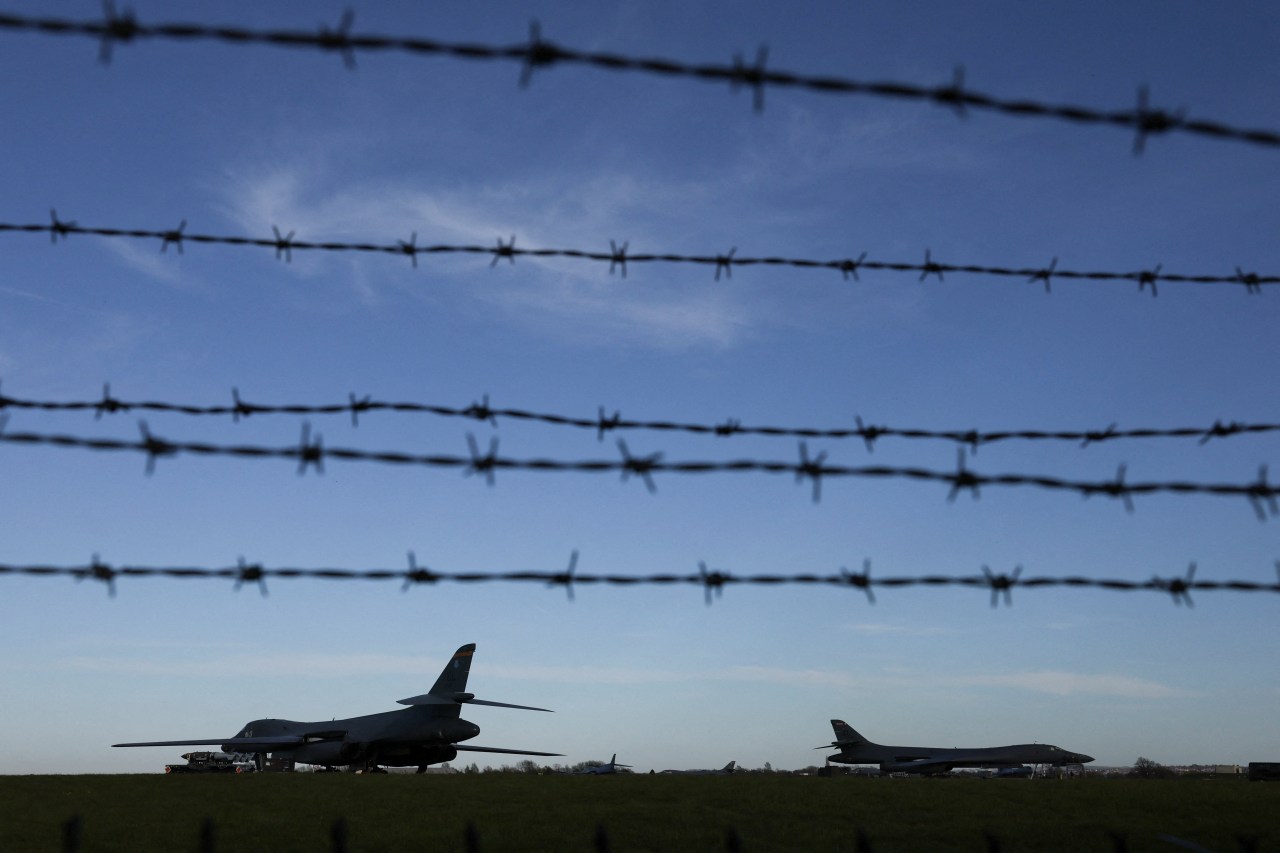
B‑1B Lancer military aircraft parked on the tarmac at RAF Fairford air base in Britain.
Carlyle Vice Chairman James Stavridis, a retired U.S. Navy admiral, gave an internal briefing to executives saying he believed that the chances of a cease-fire in the next few weeks were about 65% because both sides are incentivized to negotiate. But he cautioned there was a 35% chance of further conflict, more escalation from both sides, and the Strait of Hormuz staying closed.
Bryan Lanza, a former Trump adviser who is now a corporate consultant, received a wave of inquiries from clients—including executives in the energy and finance sector—after Trump’s post went up, according to a person with direct knowledge of the matter. Lanza fielded inquiries while he was on vacation in the Turks and Caicos, urging calm and arguing that Trump wouldn’t follow through on his threat.
As the day wore on, Trump’s threat drew reactions from all corners. “Stop the escalation. End the war now. No one wants this,” actor Ben Stiller posted. Pope Leo, who has been critical of the U.S. war in Iran, called Trump’s threats “truly unacceptable.”
A last-ditch push for a deal
By midafternoon, with little progress, some European officials weighed in publicly. “One does not erase a civilization,” French Foreign Minister Jean-Noël Barrot said in a local television interview.
Italian Prime Minister Giorgia Meloni, one of Trump’s closest European allies, also issued a rare criticism. “It is crucial to clearly distinguish between the responsibilities of a regime and the fate of millions of ordinary citizens,” she said. “Iran’s civilian population cannot and must not pay the price for the sins of its leaders.”
This message was echoed from Capitol Hill. It would be a “huge mistake” if Trump attacks civilian targets, Trump ally Sen. Ron Johnson (R., Wis.) said, adding that he hoped Trump was trying to “use his unpredictability” to make a deal. Dozens of Democrats called for Trump to be removed from office via the 25th Amendment or other means.
Soon after, there were the first signals that Trump’s deadline could slip as U.S. allies pushed for more time for diplomacy. Shortly after 3 p.m., Pakistani Prime Minister Shehbaz Sharif publicly called on Trump to extend his ultimatum by two weeks and back a U.S.-Iran cease-fire, urging Tehran in turn to reopen the Strait of Hormuz for the same period as a goodwill gesture.
“The President has been made aware of the proposal, and a response will come,” White House press secretary Karoline Leavitt said in response to Pakistan’s appeal. Trump later told Fox News the U.S. was in “heated negotiations” to reach a deal with Iran.
The president spent most of the afternoon holed up with key aides in the Oval Office, taking calls and listening to pros and cons of the proposal.
At 6:32 p.m., Trump announced on Truth Social that he would hold off on his planned strikes. “[S]ubject to the Islamic Republic of Iran agreeing to the COMPLETE, IMMEDIATE, and SAFE OPENING of the Strait of Hormuz, I agree to suspend the bombing and attack of Iran for a period of two weeks,” he wrote.
A Truth Social post from President Donald Trump on April 7, 2026.
Some U.S. officials said they were worried Iran wouldn’t fully meet Trump’s demands, potentially bringing both Washington and Tehran back to the brink in two weeks.
Get the latest headlines from US news and global updates from Pakistan, Nepal, UK, Bangladesh, Russia, and get all the latest headlines in one place on Hindustan Times.
Home/World News/The Day Trump’s Iran Threat Gripped The World
Next Story
Nita Ambani's elegance shines in pink silk suit and diamond jewels as offers prayers at Maa Kamakhya Temple in Guwahati
Nita Ambani visited Maa Kamakhya Temple in Guwahati with her mother to seek blessings. She wore a rani pink suit and accessorised with diamond jewellery.
Nita Ambani visited the Maa Kamakhya Temple in Guwahati to offer her prayers to the goddess Kamakhya on Tuesday. The founder and chairperson of Reliance Foundation visited the temple with her mother, Purnima Dalal. They were seen seeking the goddess's blessings. The videos of her visit were shared widely on social media.
Nita Ambani visits the Maa Kamakhya Temple in Guwahati.
For her temple visit, Nita Ambani picked a rani pink suit from her stunning Indian wear collection. Though the Reliance Foundation chairperson is known for her exquisite sarees – from designer wear to couture and handwoven masterpieces by Indian craftsmen – her pink suit did not disappoint.
The rani pink ensemble features a kurta with a crew neckline, quarter-length sleeves with slits, a relaxed flowy silhouette, and slits on the side. She paired the kurta with matching straight-fit pants with a flared design and a hem embroidered with gold brocade.
Next Story
Trump White House ballroom using foreign steel: Report causes massive outrage; 'so much for America First'
President Donald Trump, who's championed local industries is coming under fire after a report revealed his new White House ballroom is using foreign steel.
President Donald Trump is facing a lot of flak online after a report revealed that his new White House ballroom is using foreign steel. They have reportedly secured tens of millions of dollars worth of donated foreign steel for Trump's $400 million ballroom project, which is coming up in the East Wing.
President Donald Trump has come under fire after a report claimed his White House ballroom would use foreign steel. (REUTERS)
ArcelorMittal, a Luxembourg-based firm, which is the world's second-largest steel maker is providing the steel for Trump's new project, New York Times reported. Notably, Trump has championed the local steel industry, promising to strengthen it and even threatening stiff tariffs on foreign metals to protect manufacturers from foreign competitors.
Given the president's earlier stance, the White House actions have been viewed as hypocritical by many, who are now slamming the Republican head of state for not walking the talk.
Trump ballroom using foreign steel: Report causes outcry
One person reacted to the report of the Trump ballroom using foreign steel and wrote on X “The donated steel is reportedly produced in Europe, despite Trump’s strong push for “America First” steel policies.”
Another added “WHY IS DONALD TRUMP USING FOREIGN STEEL FOR HIS VANITY BALLROOM? What happened to 'America First?'.”
Next Story
Candace Owens slams Pentagon-Pope row: ‘Need to know who exactly threatened Vatican envoy’
Conservative podcaster Candace Owens reacted to reports of senior Pentagon officials summoning Pope Leo XIV’s ambassador amid growing tensions with the Vatican.
Conservative podcaster Candace Owens shared her opinion on reports of Pentagon officials summoning the Pope's envoy. (Facebook/Candace Owens)
As per The Free Press and The Letters from Leo reports, US Under Secretary of Defense for Policy Elbridge Colby and other officials met with Cardinal Christophe Pierre after the pope’s “State of the World” address. In his speech, the pope had criticized “diplomacy based on force,” “imperialist occupation,” and the pursuit of global dominance.
During the meeting, it was allegedly conveyed to the religious head's envoy “America has the military power to do whatever it wants in the world. The Catholic Church had better take its side.” This incident reportedly led to the scrapping of the American-born pope's plan to visit the US during the 250th anniversary celebrations, as per reports.
While this report remains unverified by the Vatican and the Trump administration, Owens made her opinion on the matter known.
The report of the alleged row between the Trump administration and the Vatican also comes at a time when the Pope has openly criticized the Iran war. Trump's US joined Israel to carry out strikes on Iran, which took out their Supreme Leader Ayatollah Khamenei. It prompted a conflict in the Middle East, which only yesterday hit pause as Trump announced Iran had agreed to a ceasefire deal.
Next Story
‘We had no idea’: US officials claim to be ‘in the dark’ till Trump finalised Iran truce, says report
Hours before Trump's deadline, Iran's Supreme Leader Mojtaba Khamenei directed his negotiators to make efforts to move towards a deal.
The United States, Iran and Israel have agreed to a two-week ceasefire in a last-minute deal before the deadline given by US President Donald Trump, threatening to begin a bombing campaign which he said would destroy the Iranian civilisation.
US defence officials were in the dark till the decisive call was made by Trump. (AFP)
However, US defence officials were in the dark until Trump made the decisive call regarding the truce with Tehran.
“We had no idea what was going to happen. It was wild,” Axios cited a defence official as saying. According to the Axios report, in the hours before the ceasefire was announced, US forces in the Middle East and officials in the Pentagon had been preparing for a massive bombing campaign on Iranian infrastructure. They were also trying to figure out which way Trump was leaning.
Following Pakistani Prime Minister Shehbaz Sharif publishing the terms of a potential ceasefire on X and calling for both sides to accept, Trump immediately started getting a flurry of calls and text messages.
He was allegedly urged by hawkish allies and confidants to reject the deal. Owing to this, even those among his close aides who might have spoken to him an hour or two before the truce believed that he would not accept the ceasefire terms.
Next Story
Did Trump employ ‘Madman Theory’ to negotiate ceasefire with Iran? POTUS says ‘I used…’
President Donald Trump denied using the Madman Theory in negotiations with Iran, announcing a two-week ceasefire.
President Donald Trump rejected the idea that he used the "Madman Theory" in negotiations for a cease-fire with Iran, asserting that he was ready to authorize strikes capable of destroying civilization.
Trump rejected the 'Madman Theory' in negotiations with Iran, emphasizing military strength. (AI generated image)
Trump declared a two-week ceasefire with Iran this evening — shortly after he had warned that “a whole civilization will die tonight” and approximately 90 minutes before a deadline he established for Tehran to come to an agreement with the United States.
“Based on conversations with Prime Minister Shehbaz Sharif and Field Marshal Asim Munir, of Pakistan, and wherein they requested that I hold off the destructive force being sent tonight to Iran, and subject to the Islamic Republic of Iran agreeing to the COMPLETE, IMMEDIATE, and SAFE OPENING of the Strait of Hormuz, I agree to suspend the bombing and attack of Iran for a period of two weeks,” he stated on Truth Social.
During a a phone interview with NY Post, Trump was questioned about the “madman” theory. He provided a different perspective, emphasizing the strength of the US military and his readiness to deploy it.

 E-Paper