Israeli lawmakers led by National Security Minister Itamar Ben-Gvir have been filmed cheering and rejoicing at the passing of a controversial death penalty bill. Rights groups, foreign nations, and even the UN warned that the newly adopted legislation is discriminatory and would disproportionally target Palestinians in the occupied West Bank.
Under the law that was passed 62-47 in the Knesset on Tuesday, Palestinians found guilty of deadly terrorist attacks aimed at “ending Israel’s existence” would be executed by hanging. In the occupied West Bank, military courts would rule on such cases. In Israel, they are to be processed under the criminal law. Sentences are to be carried out within 90 days of the ruling, with no right of clemency. Judges can only switch death penalty with life imprisonment under some unspecified “special circumstances.”
Ben-Gvir, who is seen in a video released by the Knesset producing a bottle of alcohol in the chamber, lauded the development as a “day of justice for the victims and a day of deterrence for our enemies.” Prime Minister Benjamin Netanyahu also appeared at the Tuesday parliament session in person to vote for the law but did not take part in the celebrations.
“Such laws and measures will not break the will of the Palestinian people or undermine their steadfastness,” the office of Palestinian President Mahmoud Abbas stated.
The law has drawn criticism and condemnation from rights groups, foreign nations and the UN. Germany, France, the UK, Italy, and Australia issued a joint statement on Monday expressing “deep concern” over the “de facto discriminatory nature” of the legislation and urged West Jerusalem to abandon its plans.
A group of UN experts also called the legislation discriminatory in early February and warned that “Israeli military trials of civilians typically do not meet fair trial standards.” “Denial of a fair trial is also a war crime,” they added.
Israel abolished death penalty for murder in 1954. The only execution carried out in the Jewish state was that of a Nazi Holocaust architect Adolf Eichmann on genocide charges in 1962.

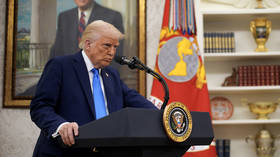
US President Donald Trump has lashed out at NATO and key European leaders, deepening tensions within the bloc over the war against Iran. According to the Financial Times, Washington has also threatened to curb weapons supplies to Ukraine to pressure European countries into involvement in the war in the Middle East.
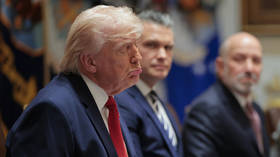
At a White House Easter lunch on Wednesday, Trump described NATO as a “paper tiger” and voiced frustration that other bloc members have not joined the US-Israeli war on Iran. He said he had sought European backing as a test of their reliability, which they failed to prove and that the US could leave the bloc over the issue.
“I learned about NATO. NATO won’t be there if we ever have the big one,” Trump said.
Trump also recounted conversations with French President Emmanuel Macron and British Prime Minister Keir Starmer. Both leaders declined to commit forces to secure the Strait of Hormuz, a strategic chokepoint which Iran effectively took under control in retaliation for the US-Israeli offensive launched in late February.

Macron, Trump remarked, is “still recovering from the right to the jaw” from his wife – referring to a familial quarrel caught on camera last May. Starmer, he added, has “two old broken down aircraft carriers” at his disposal that he cannot deploy unless his cabinet agrees.
The Financial Times reported on Wednesday that Trump has warned behind closed doors he could suspend deliveries of US-made weapons purchased by Ukraine’s Western backers for Kiev’s forces. NATO Secretary-General Mark Rutte pushed for a joint statement on March 19 committing to future efforts to safeguard maritime routes in response, sources told the outlet, describing Trump as “rather hysterical.”
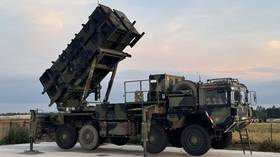
The Prioritized Ukraine Requirements List (PURL), introduced in July 2025 after Trump declined to fund Ukraine aid directly, allows European states to purchase US arms for Kiev. Among the most critical items are Patriot interceptor missiles, which are now in especially high demand due to the Middle East crisis.
Trump linked the two conflicts on Wednesday, arguing that the US “gave so much away to Ukraine” and is now facing a shortage of munitions. But at least the Europeans are “good for paying” for American arms, he added.

The Washington Post has reported that the administration is considering redirecting NATO funds from the PURL program to meet the Pentagon’s immediate needs.