

A Response To Critics Of My AI Article And An Apology To Librarians
As usual everyone is wrong except for me, somewhat, except for when I’m wrong too

There were a lot of responses to my Monday piece about (what I consider to be) artificial intelligence denialism on the left. I want to address some of them.
But first: I didn’t mean to imply that librarians just search their catalogs or Google stuff. I wrote too quickly and flippantly. In fact, I made the same mistake I think Emily Bender and Alex Hanna are making: They are letting their moral outrage about AI color their assessment of its utility. The tail is wagging the dog.
Here, because I thought Bender’s argument that Robert Wright should consult a librarian rather than use AI to develop a first-pass understanding of why Rome fell was so silly (okay, technically the word I used was asinine), I then went a bit oversimplistic in my description of what librarians do. A good librarian wouldn’t just type “Rome” into a catalog and be like THERE CHECK OUT THOSE BOOKS — they’d be able to offer a more tailored set of suggestions, in part depending on who they were talking to (professional journalist versus high school student), how in-depth the person was seeking to get, and other considerations. I don’t think any of this derails my main points about why this was a silly suggestion but, just for the record, I apologize to librarians.
On to the responses. A lot of them were thoughtful and I only have time today to reply to a few. Let’s start with a snarky one: “The perfect Singal post,” wrote a Substack user named StPaulite. “Here is a titanic development in the political economy, with trillions at stake, directed by the most powerful people alive. What’s important to know? The left isn’t talking about it the right way. That’s the problem.”
To be fair, I’m not necessarily sure academics have all that much power to steer the development of big events. But if we are going to have people meaningfully researching and theorizing and critiquing (what I believe will be) an extremely disruptive economic meteor, who else do you suggest? It’s lefties who are most concerned with the concentration of power and unfair hoarding of resources, so I think they should take these events seriously.
Here’s an exchange I had with Osita Nwanevu (lightly cleaned up), which was kicked off by his quote-repost of my piece:
Nwanevu (quote-reposting): The question of whether LLMs can actually think is only a pointless distraction if you assume the answer has no bearing upon what and how many jobs they can plausibly replace, or how many individuals and firms will be willing to use them. It materially matters and obviously so, which is why AI firms insist their models are intelligent and steps toward superintelligence in the first place.
Me: So much leans on your definition of “actually think”. . . when you typed that, which specific definition did you have in mind?
And to be clear, I don’t think it’s a pointless distraction in some universal sense — I think AI raises utterly fascinating questions. But yes, I do think in terms of its economic impact — whether it can simulate being a living assistant who completes various tasks competently is what matters most, regardless of what is going on “under the hood.”
Nwanevu: I have no specific definition, which is why I think those boring philosophy of mind debates are important! I don’t think most people do, and yet it seems clear to me that there are material implications to how we think about what it’s actually doing under the hood. Because when we ask whether it can actually think or reason, we are also functionally asking, “Can it be a tool for doctors or a doctor?” “Can it be an artist’s assistant or an artist?” “Can it be a reference for intelligence analysts or an analyst?” Etc. That shifts the character of the economic disruptions and the number and nature of the job losses we’re talking about.
My (limited) understanding of the situation is that modern AI systems are going to remain more or less black boxes for a very long time, and maybe forever. An LLM from this generation, for example, consists of about a trillion “weights” (numerical values that help determine how it processes information, to oversimplify) and responds to your input by multiplying 12,000-ish-dimensional vectors, over and over and over. There’s a sheer level of mathiness here that makes it extremely hard for humans to actually understand, in a detailed way, what’s going on under the hood. That’s part of what the Gideon Lewis-Kraus New Yorker article I touted was about, and part of why researchers are often surprised by what their own creations are capable (or incapable) of.
Generally speaking, I think there have been surprises about AI’s capabilities in both directions — it’s better at certain things than experts thought, and in some areas has lagged behind where those experts hoped we’d be by 2026. The general trajectory, though, has been rapid improvement, especially lately. For my purposes, what matters is the number and nature of tasks that AIs have achieved what some wonks call human parity: that is, they can compete with paid humans at completing that task. This is not necessarily the same as being able to do a job (which consists of both many tasks and other forms of executive functioning), but it’s obviously an important benchmark and the first step toward full-blown job replacement. It seems undeniable that in just the last two years, AI has reached human parity and in some cases significantly exceeded it at various types of coding, copy-editing, translation, summarization, image generation, and other situations.
Here’s a photorealistic image of “an ape protecting its favorite toaster. the toaster has been through some stuff. they are in the high desert of texas.”

That took less than 20 seconds for ChatGPT to create for me.
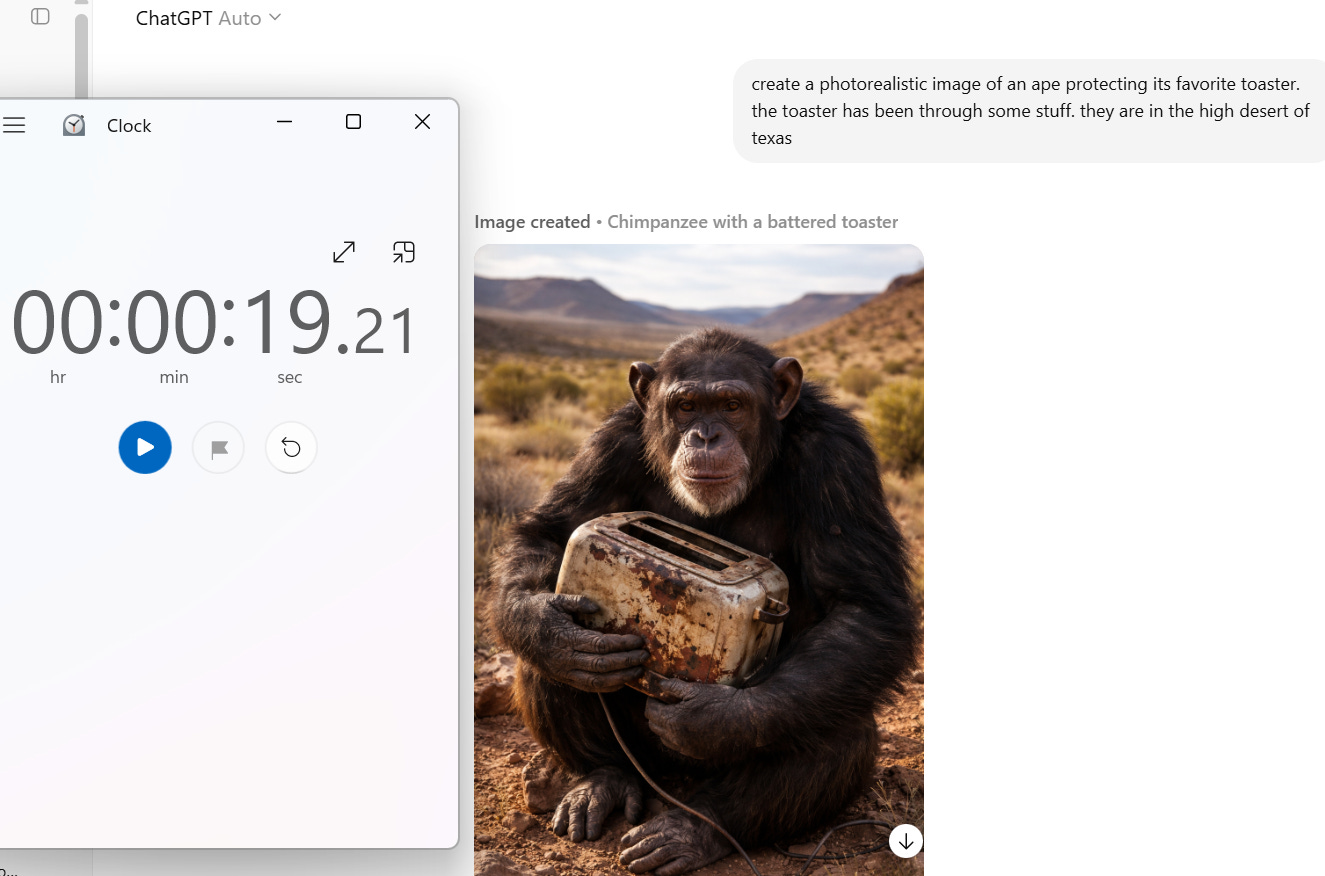
Because we get so used to new technology so quickly, I think there are a lot of people who don’t understand how remarkable this is, how much of an improvement it is over the technology we had two years ago, the extent to which it represents improvement in areas of computing that were frustratingly stagnant for a very long time — and how threatening this is to human labor.
It’s threatening to human labor because there are so many other tasks where we’ve seen recent, explosive improvement. Surely you’ve had an infuriating encounter or 10 with those voice-automated customer-service systems? They’ve been the subject of hackish stand-up routines for what, 10 years? Twenty? Have you talked to one of those systems recently? They aren’t perfect, and in fact during my last interaction with one, belonging to a car rental company, it gave me false information. But there has been clear, obvious, holy shit improvement. They are about as fluent as a human tech-support employee.
That’s why I’m skeptical of Nwanevu’s framing, and that’s why I raised the point, in my last post, about drinking in a bar and discussing the nature of intelligence versus actually using these systems. If I broke down the ape image-generation task to its constituent parts, it would sound like something that couldn’t possibly generate a photorealistic image of an ape guarding its favorite toaster in the Texas high desert. “Whatever that is, it isn’t thinking!” you’d say. Maybe you’ll add “It definitely isn’t creating,” a bit haughtily. Nwanevu’s question, I think, is geared at generating some definition of actually think that will “prove” AIs will be incapable of this, that, or the other thing.
But my argument, over and over and over, is that if we’re talking about the impact all of this will have on human labor and human society, the only meaningful answer here is: It doesn’t matter whether “the computer” is actually thinking, actually creating, or can in any sense be said to “understand” what an ape, a toaster, or the Texas high desert is. It doesn’t matter. What matters is the usefulness of this technology, and that it has reached or exceeded human parity at an ever-growing number of tasks that used to help people make a living. To repeat myself: At a certain point, a new invention is so obviously, indisputably useful — that’s the only claim I’m making, useful — that it requires sticking your head deep into the sand to deny that it is going to have a major impact on society.
Which brings us to Freddie deBoer’s response, which, true to FdB form, was also accompanied by a separate, somewhat vituperative email. But here’s what he posted publicly, slightly cleaned up. There’s a lot here, so I’ll bold the few points I’m going to respond to directly.
What’s denialism? Is pointing out that high-profile examples like protein folding have hit a massive wall denialism? Is it denialism to point out that AI company ghouls like Dario Amodei keep making outlandish short-term predictions that keep not coming to fruition? Is it denialism to point out that it’s increasingly clear that LLMs can’t be built without inducing repetitive and serious hallucinations, hallucinations that make their deployment in mission-critical situations potentially impossible? Is it denialism to point out that even if we take the most outsized claims about what AI is theoretically capable of seriously, the entire history of technology demonstrates that seemingly minor implementation issues can totally wreck projections about the adoption and use of a given technology? Is it denialism to point out the the widely predicted and much ballyhooed claims of massive productivity and GDP growth stemming from the internet never ever arrived, and that the 2020s have seen another half decade of anemic growth compared to the mid-20th century, and that none of the promise of productivity or GDP gains show up in the data whatsoever? Is it denialism to point out that even the most enthusiastic proponents now admit that the scaling “laws” are broken? Is it denialism to point out that LLMs cannot continue to be fed more data at similar scales because there simply has not been anything close to as much written language produced in the history of the world that would be required for that to happen? Is it denialism to point out that people keep declaring problems like machine translation over, only for end-user solutions like Apple translation via AirPods to keep failing in real-world applications? Is it denialism to point out that every single time new technologies have been predicted to result in massive job losses, over time, any short-term losses have been overcome and in fact have led to greater job gains, repetitively, over and over again throughout the history of modern technology? Is it denialism to point out that saying “this time it’s different” is exactly what people said about the loom, the printing press, the telegraph, the computer, or the internet, and yet in every case those technologies eventually caused job growth rather than job loss? Is it denialism to point out that the history of futurism is a history of immense failure and wrong predictions, again repetitively, over the course of centuries, and that the research tells us that human beings have not gotten better at futurism and prediction over time? Is it worth saying that, again, every single person of every generation that has predicted sudden immense technological change has felt sure that this time it was different? Is it denialism to point out that the future almost always ends up being very, very similar to the recent past, and that there’s no reason to think that we’re among this weird blessed generation who gets to experience this sudden tremendous change? Is it denialism to say that extraordinary claims require extraordinary evidence? Is it denialism to point out that your consciousness system works overtime to convince you that you live in a very special time, even though definitionally no pressure of time is transcendently special and that all of human life eventually collapses into the mundane? Really? That’s all pure denialism?
I have no idea what’s “lefty” about any of that, and frankly the word “denialism” now just seems to mean “opinion held by anyone that is not identical to my own when it comes to AI.”
For each of these I’m going to respond not only to the claim itself but to what I view as the style of silly AI-denialism reasoning underpinning it.
“Is it denialism to point out that it’s increasingly clear that LLMs can’t be built without inducing repetitive and serious hallucinations, hallucinations that make their deployment in mission-critical situations potentially impossible?”
The basic move here is to endlessly shift the goalposts. LLMs hallucinate, yes. Perhaps they always will (as some experts have argued). But it’s very easy to train people to be on guard for these hallucinations, in the same way you can train people never to cite Wikipedia directly. As for “mission-critical situations,” that’s obviously very important in a maybe-it-will-kill-us-all sense, but it also doesn’t defeat my argument at all. If AI progress froze right where it is now, it would end up having a hugely disruptive effect once hirers fully understood how, why, and when to use it. We don’t need to bring terrifying autonomous ICBM systems into this.
“[S]eemingly minor implementation issues can totally wreck projections about the adoption and use of a given technology.”
A lot of things could happen! Surely some areas of AI will flame out, in some cases before they even get to public users. Again, how does this defeat what I’m saying?
“[P]eople keep declaring problems like machine translation over, only for end-user solutions like Apple translation via AirPods to keep failing in real-world applications.”
Everyone has to watch or rewatch Louis CK’s famous airplane bit on Conan before reading another word of my nonsense, and if you haven’t seen it, I can’t be held responsible for the references you won’t get:

Give it a second! It’s going to space! Can you give it a second to get back from space?
This is my favorite one because it really highlights the amazement-treadmill aspect of this. Until recently, the idea of real-time translation via earbuds was strictly sci-fi. It was something that, while by no means impossible in theory, would be very hard to pull off in practice, especially in an affordable way. Now we have it — because of advances in AI — and Freddie deBoer believes it has “fail[ed].” Has it? If you want, you can check out “Airpods Pro 3 Live Translation Demo & Review” from five months ago. The reviewer indeed is wearing tiny little earbuds in his ears linked to his phone that can, in fact, translate spoken language in real time.
The problem is. . . there’s a bit of a delay.
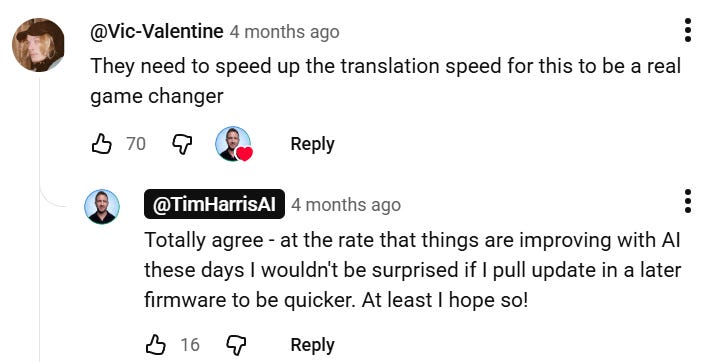
Oh, really? What happened next? Did you fly through the air, incredibly, like a bird? Did you partake in the miracle of human flight, you noncontributing zero?
I want to make sure I’m not misunderstood here: I am not some slop hog for the latest Apple or Google or Meta invention. I have never owned a VR headset, I still have an Android phone despite how much it sucks and destroys my group texts, and I haven’t and never will be an “early adopter.” My point is not that we should trust tech companies when they tell us they’ve created something amazing. My point is that when they do create something amazing — and something that seems very likely to have real-world economic consequences — we should acknowledge that rather than shifting the goalposts. “Oh yeah, it translates Spanish in near real-time? Well. . . I don’t see it manifesting a hot Puerto Rican girlfriend for me out of thin air, so what use is it?”
This is silly.
Finally:
“Is it denialism to point out that every single time new technologies have been predicted to result[ ] in massive job losses, over time, any short-term losses have been overcome and in fact have led to greater job gains, repetitively, over and over again throughout the history of modern technology?”
This is probably deBoer’s strongest point, and where I am on the weakest ground due to my lack of any firm grounding in economics. So I’ll proceed cautiously.
A lot is leaning on “over time” here. Let’s stick to the United States for simplicity’s sake. The Great Recession and Covid were both economically devastating. They both left giant scars on people’s material well-being and had strange, largely deleterious impacts on our politics. Speaking quantitatively, we “bounced back” from both, but that doesn’t really undo the damage to individual victims of these events, or to our “national fabric” or whatever you want to call it.
If I’m right and AI is going to cause some sizable shock, we should be concerned about that. “Eventually it’ll work out” isn’t really an answer, especially because things seem rather precarious at the moment.
I am generally a believer in the idea that humans have made real progress over time. I think it’s silly to ignore the fact that fewer babies die, people live longer, and there’s less suffering in general. That being said, 2026 America is a fragile place. We have a historically bizarre and authoritarian president who represents a party that is, even in the best of times, opposed to meaningful redistribution; an absolutely pathetic, feckless, weakling, loser opposition party; and we’re still living in the shadow not only of Covid and the Great Recession but of forms of economic dislocation and hollowing-out that preceded all that by decades. If any developed country and its political system is ill-equipped for a new economic shock, it’s ours. I think there are a lot of reasons to be worried; I think we’re a once-proud prizefighter swaying like a drunk in the seventh round.
And that’s just if AI causes a regular economic shock. I’m not going to pretend I’m deep enough in the technical weeds to know whether some of the more ambitious potential capabilities of AI are actually going to come to pass. Will it actually be able to improve itself and consistently invent new, useful things, rather than “just” achieve human parity at preexisting, well-understood tasks? Given how much is riding on this for the giant firms with which our economy is hopelessly entangled, it wouldn’t surprise me. And if these slightly more far-out realities come to pass, it could simply be that this represents a new sort of technological advancement we have no real blueprint for, that even the best economist can’t meaningfully forecast.

