Good Bad Guys: the movies that influenced Chad Stahelski’s fourth John Wick chapter

The Wong Kar-wai influence runs deep in the primary colors and “true black” infused through John Wick: Chapter 4. 
The Wong Kar-wai influence runs deep in the primary colors and “true black” infused through John Wick: Chapter 4

The director of all the John Wicks tells us about the movies—from The Grandmaster to The Warriors to Amélie—that influenced Chapter 4.

In action movies it’s always the bad guy versus the good guy. In our world, everybody’s a bad guy, you just have good bad guys and bad, bad, bad guys. So what’s more interesting? Keanu fighting Generic Bad Guy 2.0 or John fighting his best friend?

—⁠Chad Stahelski

When it was released in 2014, the original John Wick was a breath of fresh, grounded-action air in an action movie landscape defined by increasingly unrealistic, CGI-enhanced outlandishness. Although every sequel has upped the ante considerably, the franchise still stands as the embodiment of a certain philosophy towards action cinema, one that entails extensive use of practical stunts, expertly choreographed martial arts and a leading man ready to embrace both.

That philosophy flows directly from Chad Stahelski, the stuntman (he doubled Brandon Lee on The Crow and Keanu Reeves on The Matrix) turned stunt coordinator (87 Eleven, the “action design” company he owns with Bullet Train director David Leitch, which creates action set–pieces for blockbusters) turned director (after directing the first John Wick alongside an uncredited Leitch, Stahelski has helmed every subsequent entry by himself).

Chad Stahelski and Keanu Reeves during the production of John Wick: Chapter 4 in Paris.

The ante-upping reaches something of a crescendo in John Wick: Chapter 4, a 169-minute operatic epic that sees John square off against legions of enemies in Osaka, Berlin, and most significantly, Paris. The guest action stars this time include Scott Adkins, Hiroyuki Sanada, Clancy Brown, Marko Zaror, and Donnie Yen as blind swordsman/hitman ‘Caine’, an old friend of John’s who is undoubtedly the deadliest opponent the man in black has ever faced.

By this point in the series, these gleefully uncompromising movies are speaking directly to their fanbase, and early reaction has been typically superlative: “A jaw dropping showcase of brutality & futility,” Griffin Schiller waxes. Cris Parker agrees: “A wild spectacle of pure mayhem out doing everything done previously in the series.” “Every action set piece just feels like you just stepped into a brand new movie,” writes MarMar. The latter review speaks to how much variety there is in the film, and the list of cinematic inspirations that Stahelski provides in our conversation belies that variety.

Shortly before the film’s world premiere—and just prior to the unexpected death of Wick co–star Lance Reddick—Stahelski jumped on Zoom to discuss the six movies he says most influenced John Wick: Chapter 4, among other topics. 

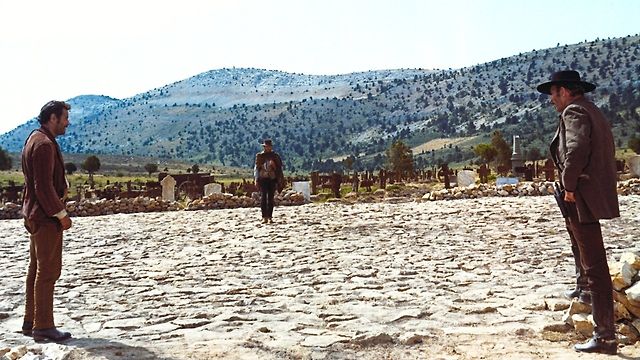
Eli Wallach, Clint Eastwood and Lee Van Cleef in The Good, the Bad and the Ugly (1966).

First on Stahelski’s list is Sergio Leone’s 1966 Western epic The Good, the Bad and the Ugly, possibly the first action movie that could legitimately be described as ‘operatic’. “I’m a huge Sergio Leone fan,” Stahelski tells me. “I love the style, the composition, all the story stuff. Clint Eastwood, I mean, come on! That’s the original stoic [action hero].” The director says the complicated relationships between the three titular figures in Leone’s film informed the dynamics in Chapter 4.

“In action movies it’s always the bad guy versus the good guy. In our world, everybody’s a bad guy, you just have good bad guys and bad, bad, bad guys. So what’s more interesting? Keanu fighting Generic Bad Guy 2.0 or John fighting his best friend? In The Good, the Bad and the Ugly you kind of have the concept of frenemies. At some point Lee Van Cleef has to work with Clint Eastwood. At some point, Eli Wallach has to. They’d all shoot each other, but they have common goals. That’s what makes that movie so fun, and there is a little bit of love between all of them. It’s just very skewed by greed and ego and I’m fascinated by that whole loyalty, code thing, honor amongst thieves.”

The second film on Stahelski’s list is unsurprising: Kenji Misumi’s The Tale of Zatoichi from 1962, the first of many, many films about the blind swordsman created by Japanese writer Kan Shimozawa. Yen’s character Caine is a pretty direct homage.

Shintarō Katsu, with swords, in The Tale of Zatoichi (1962).

“You’ve seen the blind swordsman before,” concedes Stahelski. “Donnie’s actually done it before, in Hero, as the blind staffsman in that wonderful film.” (Yen also played a similar character in Rogue One). “Zatoichi never sees himself as handicapped,” he continues. “He didn’t play it up. He used it. He played the fool when it suited him and he was super cool when it didn’t. Shintarō Katsu plays it in a really strange way: He’s this ‘ha ha ha’ kind of guy and then he gets super serious about code and ethics and he’s a protector. He is very John Wickesque in a way. It’s almost the myth of Ichi, that’s what he projected in front of him. So we love that whole character mythos and the way he created a legend about himself. There’s something epically romantic about that character.”

Stahelski says Yen requested changes to the character before accepting the role. “I had this idea of a Zatoichi-ish [character], but then you get Donnie Yen, who is obviously not Japanese and wants to infuse a lot of Chinese culture and tradition and his form and his style. He didn’t take the job right off the bat, there was a lot of back and forth. One of the first things he said was: ‘Love the movies, love the idea of the part, but why isn’t he cool?’ And I’m like, ‘What do you mean? I think he’s cool.’ He’s like: ‘Yeah, but John Wick wears the suit, he’s super cool and he’s got this attitude. I don’t want to be the quiet Zen guy, I want my personality [to come through]. I’m not that Zen, I’m a ball of energy.’

“Then he sent me a picture of Bruce Lee in a screen test in a suit with a skinny tie and I would send him pictures of Chow Yun Fat in The Killer and we were like: alright: that’s pretty fucking cool. So [we decided] we’re gonna make this guy the coolest thing since John Wick. We’re gonna make Caine the John Wick of his world.”

Donnie Yen as Caine in John Wick: Chapter 4.

It becomes clear throughout John Wick: Chapter 4 that on their respective best days, John wouldn’t stand a chance against Caine, whose nimble, deadly precision makes Wick look like a lumbering beast. Stahelski reveals that when Yen started doing his thing in their first scene together, Reeves wanted to adjust how John reacted to Caine.

“I’ve worked with some of the best stunt men, some of the best martial artists, and Donnie is one of the fastest humans I’ve ever seen go—and he’s so chill about it. When he goes, you’re like, ‘Jesus Christ, Donnie!’ He started spinning the sword and shooting and Keanu comes up to me afterwards and says ‘This is not gonna work, man. I’m slowing him down. We should just let him go and have John Wick go ‘fuck this’.

“That’s when we changed the choreography to make it like: Caine is so fucking badass that even Wick’s gonna do the hide-and-seek game. That’s what makes Keanu so awesome: he’s not worried about how that affects his ego, he wants John to have this [unbeatable enemy]. He needs Goliath. Donnie poured it on and Keanu poured it on, and that’s what’s great about those guys. They get it.”

Carrie-Anne Moss and Keanu Reeves in The Matrix (1999).

The next film Stahelski brings up is one he worked on—one that has always had some degree of association with the John Wick series and, like the Wicks, now runs to four chapters: The Matrix. “What can you say? Still one of the greatest movies, regardless of genre, ever made. I think it still holds up. It’s amazing. The attention to detail that is in it. It’s very obvious when you look at any of the Wicks or me or Dave [Leitch] or the stunt teams that we use or anybody that worked on the original Matrix and into the trilogy, if you go find out where they are nowadays, they’re doing pretty good.

“We call it the Wachowski film school. Having been out in the industry since then, the level of intelligence and the level of attention to detail from those individuals and what they passed on to us, it changed my life, it changed Keanu’s life. The Wicks don’t exist without The Matrix. Without the Wachowski influence, they don’t exist, I don’t exist. All the action design that we’ve done since the Matrix [films] and how we brought wirework and pre–viz and choreography into mainstream Hollywood, that does not exist without the Matrix films. That’s pretty much why it’s on the list. I think my DNA as a filmmaker is from them. I don’t know how I’d be the person I am without them.”

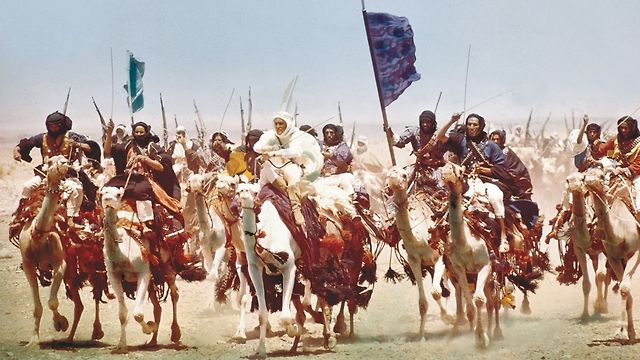
Chapter 4’s opening set-piece has John on a horse pursuing three men across the desert against a blazing sunrise, so it’s also not surprising to see the 35th Academy Award best picture winning Lawrence of Arabia on Stahelski’s list. He says the scene was directly inspired by David Lean’s 1962 epic.

Peter O’Toole leads the pack in Lawrence of Arabia (1962).

“That’s one of the first movies I remember seeing with my dad, just in awe. Aqaba by land. The performances, Omar Sharif and obviously Peter O’Toole. It’s got one of the most famous edits in cinema history, the blowing out of the match [to a desert sunrise]. That’s why you see [a similar cut] in Wick. It moved me in a weird way. Because I’m from Massachusetts, in a small town on the east coast of the States and had never been to the desert, never been to the Middle East, never [seen] that kind of scale and to see the train and know it’s all practical, it’s always stayed with me.”

Stahelski’s next cited influence is Wong Kar-wai’s The Grandmaster (2013), which is one of several films that center on the martial artist who taught Bruce Lee: Ip Man, played in this take by legendary Hong Kong heartbreaker Tony Leung Chiu-wai. Although Donnie Yen famously also portrayed the character in a popular series of films, the use of neon-hued primary colors throughout Chapter 4 makes it clear why Stahelski chose this particular Ip Man movie.

Tony Leung Chiu-wai in The Grandmaster (2013).

“Wong Kar-wai defines color,” enthuses Stahelski. “Him and his cinematographer Chris Doyle. You can talk to [Roger] Deakins and [Grieg] Fraser and all these DPs, but Wong Kar-wai's use of color in storytelling, I think, is unparalleled. You watch In the Mood for Love and how he used reds to make you feel several different things with just the lighting, it’s fucking amazing.

“Then you go to something like The Grandmaster, and I’m not just saying it because it’s a kung fu movie. I love the choreography. I love the editing. I love Zhang Ziyi and all the great cast members. But [the] use of blacks. My favorite painter is Caravaggio, and the closest thing I’ve ever seen to real black, like true black, has been in The Grandmaster. I’m still fascinated by how he sculpted those beautiful shots just out of all black. It’s hypnotic how beautiful that movie is.”

The final film on Chad Stahelski’s list is Walter Hill’s The Warriors (1979), and you don’t have to think too hard to discern how the once-controversial gang movie stands as a notable antecedent to Wick, from a secret underworld filled with colorful characters and strange rules to the radio announcer keeping track of the protagonists’ progress. 

Michael Beck (far right) leads The Warriors (1979).

“I’ve never met Walter Hill,” Stahelski explains. “I’m a big fan. I just love his work. I think he’s ballsy to do Streets of Fire, to do The Warriors and to do that mythos of a hidden world beneath a hidden world in New York City. The Warriors is one of the first movies I can remember from my teenage years that was just the coolest thing. Then later on, you go back and watch Streets of Fire, and you’re like, that is a ballsy move man! To do a fucking rock and roll opera about gangs in the ’50s? I’m like, right on man. I’ve always respected him for that.”

(There are minor spoilers for John Wick: Chapter 4 from this point onwards.)

Just as the Warriors must traverse New York City while beset from all sides by innumerable pursuers, the last hour or so of Chapter 4 sees John Wick doing something similar in Paris across three distinct locations, on his way to a final showdown at the Sacré-Cœur.

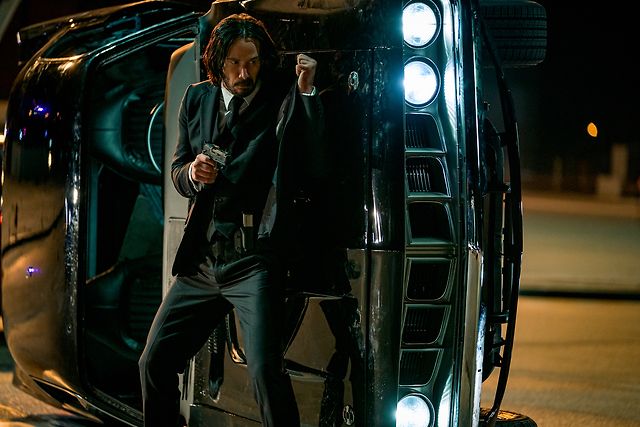
This spectacular third act begins with a ‘car fu’ sequence that sees John beat up a bunch of dudes with his automobile, losing the doors in the process. It builds on a similar sequence seen in Chapter 2 that came about because they couldn’t afford to do something bigger.

“In the second John Wick we didn’t have any money, so we couldn’t do a car chase,” says Stahelski. “To shut down streets and actually bash your car you’re looking at three to five million minimum, just to come up with an average car chase. So me and Darrin Prescott, the stunt coordinator on that one, we were like: ‘Okay, well, if we can’t do a car chase, we’ll do a car fight. We’ll do bumper cars, demolition derby for five minutes.’ We investigated all this tactical driving stuff and [how the car’s] gonna be an extension of his fist, we’re just gonna hit shit. That’s how we came up with car fu.”

John Wick (Keanu Reeves) engages in car fu.

“So [for the new one] we were like: ‘Okay, how do we make this interesting? Well, we’re going to take the doors off, but let’s take the doors off in an interesting way. Let’s hit people with them. Let’s just use our car fu mentality.’ We found that little intersection, and then it was me and the stunt team trying to figure out what [are] the most brutal ways to hit people with a car.”

That car fu sequence leads into an epic battle royale in the middle of traffic on the most famous traffic island in the world: the Arc de Triomphe. “I knew I wanted to do a traffic sequence and we just went: ‘What’s the most fucked up roundabout in the world? Oh, the Arc de Triomphe. It’s chaos. Okay, that’s where we’re going.’”

The third location is a long staircase leading up to Sacré-Cœur that John must ascend with extreme difficulty. Stahelski says the notion of a staircase sequence hit him when he was scouting locations and ended up at the famous church because of his affection for a certain French modern classic.

Nino (Mathieu Kassovitz) takes a call below the Sacré-Cœur in Amélie. 
Nino (Mathieu Kassovitz) takes a call below the Sacré-Cœur in Amélie

“I watched the movie Amélie, which I’m a huge fan of. I love Amélie for some reason.

I looked at the front steps [of Sacré-Cœur] where they shot the merry-go-round, and they’re a little tame but it’s an impressive shot. Then me and my stunt coordinator Scott Rogers came down the side steps. We looked down, it was nighttime, the sun had just set, and we were like: ‘Oh my God, this is like William Friedkin’s The Exorcist steps!’ Me and Scott looked at each other and go: ‘That’s a shit–eater.’”

To detail any further what occurs on those steps would be irresponsible, but it’s arguably the most memorable sequence in the film. And they really are the steps leading up to the Sacré-Cœur. “You’re seeing real geography,” enthuses Stahelski. ”You walk up the steps, turn right, and [Sacré-Cœur] is right there. For some reason, geography has always been very important to me. I don’t know why. I don’t have a legit argument other than it’s an aesthetic I feel good about.”

Stahelski on location in Paris with Laurence Fishburne (The Bowery King) and Keanu Reeves.

Stahelski says one of the most important aspects of action set-pieces is for the spatial geography to be clear to the audience. “Mel Gibson did it in Hacksaw Ridge. You knew the cliff, you knew where we had to get to. He was very good with geography. [In] Braveheart, we see the battlefield. Game of Thrones did it great with ‘The Battle of the Bastards’. The audience knows what the goal is. Jackie Chan’s great at showing it, he shows you the maze of doors and shows you the problem. Everybody gets it from silent film. Geography to me is [about] introducing the audience to the question and then the interesting part is watching me figure out how to answer it. So geography’s very important in fight stuff.”

Amongst the many distinctive-looking characters in Chapter 4 is a bald, tattooed henchman who shows up in a sequence that takes place in a Berlin nightclub and only ever says the words “I am Klaus.” As my time with Stahelski comes to an end, I ask him to confirm that this person is played by Sven Marquardt, infamous doorman for the legendary (actual) Berlin nightclub Berghain, as a fellow audience member had suggested following the screening of the film I attended. 

“It is Sven,” smiles Stahelski. “He was the doorman for I think thirty-something years at Berghain. I was in Berlin doing a film fifteen years ago and I got introduced to Sven. He never remembers me. We couldn’t actually scout [Berghain] and they don’t let you shoot there, but we wanted to go in for the vibe, so they let us in on one of their nights just to see the energy and the vibe. That kind of stuck with me.”

“He’s a photographer, I saw one of his art exhibits [in Berlin]. He’d never acted before. We wanted him to be the doorman. He said yes, and it was brilliant.”

And if you were wondering, yes, his dialogue is an homage to a certain MCU tree. “Every line in the script was just ‘I am Klaus’, because we couldn’t think of any dialogue because we hadn’t cast it yet. Then we were like: ‘Oh that’s kind of funny, we’ll just keep it.’ I’ve met James Gunn and I think he’s a hilarious guy, so we’ll just tip off ‘I am Groot’.”


John Wick Chapter 4’ is now in theaters worldwide.

Further Reading

Tags

Share This Article

Security check

We’ve detected a massive gravitational anomaly. Please complete this challenge to continue.