Shrink Visceral Fat by Feeding Your Microbiome
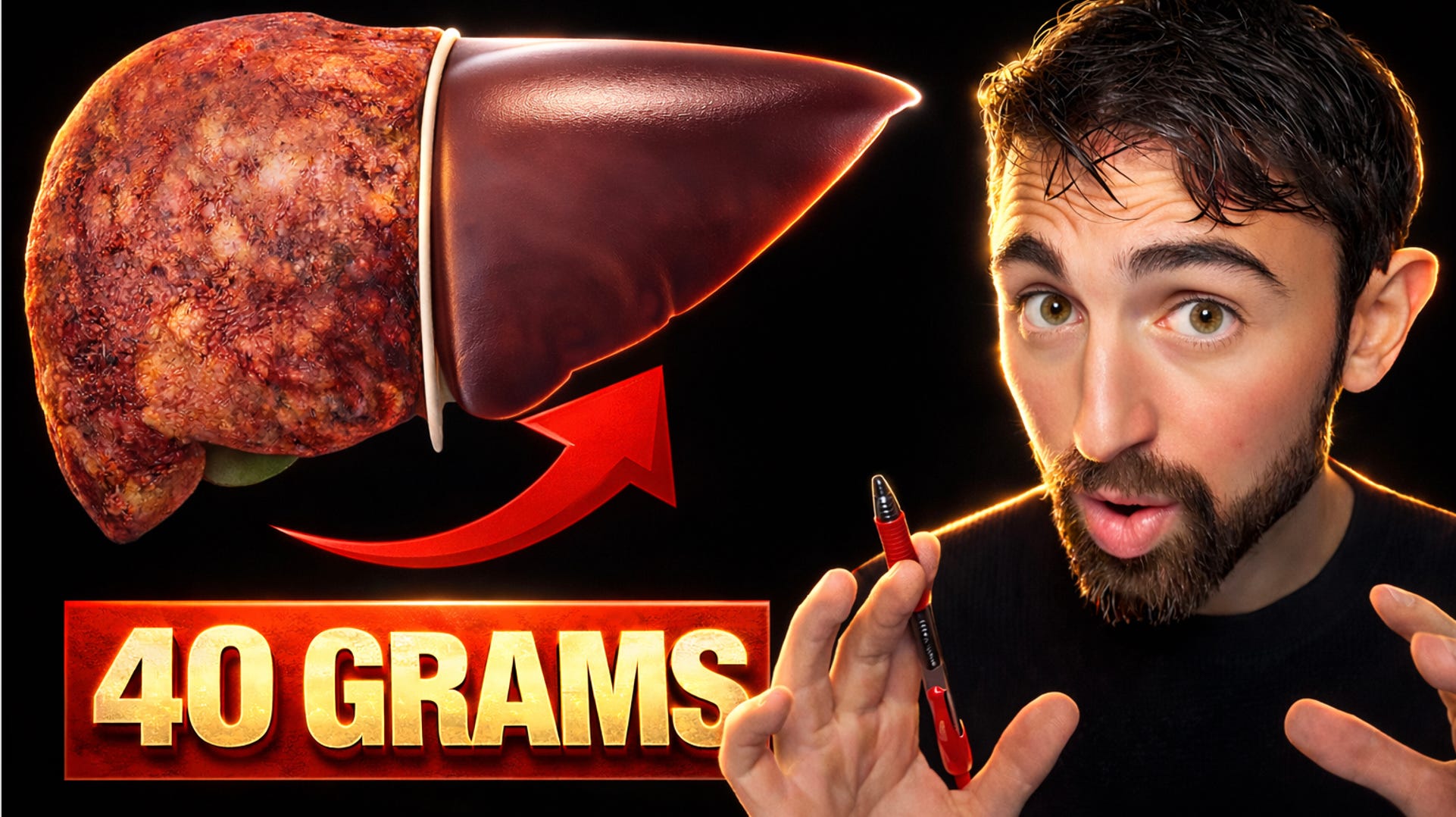
There is a food that has been shown in multiple human randomized controlled trials to improve metabolic health, reduce liver fat, and even drive weight loss independent of calorie intake.

There is a food that has been shown in multiple human randomized controlled trials to improve metabolic health, reduce liver fat, and even drive weight loss independent of calorie intake.
It’s a food you may have heard of—but probably don’t fully understand.
Resistant Starch.
Resistant starch is a type of starch that resists digestion in the small intestine and reaches the large intestine intact, where it alters the gut microbiome in clinically meaningful ways— mechanisms we’ll return to as our scientific story evolves.
Roadmap
What Is Resistant Starch?
Randomized Controlled Trial: Resistant Starch Causes Fat Loss
Mechanism of Action: Causal evidence showing the effects of resistant starch are mediated by the gut microbiome & other benefits, including improved “leaky gut”
Responder vs. Non-responder Biology: Why some individuals experience dramatic benefits while others see minimal effects
Actionable Insights: How to apply these findings starting today
What is Resistant Starch?
First, what the heck is resistant starch?
Chemically, starch is just a chain of glucose molecules linked together. That’s it.
Under normal circumstances, enzymes made by your body (like salivary and pancreatic amylase) break starch down efficiently into glucose. That glucose gets absorbed in the small intestine and becomes readily available energy. Fast. Efficient. Straightforward.
Enter resistant starch. There are different types of resistant starch, but we’re focusing on “type 2” resistant starch, which is what the studies we about to review examine. I can be found in raw potato, green banana, and high-amylose Maize. Type 2 resistant starch is chemically identical to regular starch — same glucose units, same bonds. The difference is not chemical. It’s structural.
It’s tightly packed. Highly crystalline. Poorly hydrated. The glucose chains are arranged in a way that digestive enzymes can’t easily access.
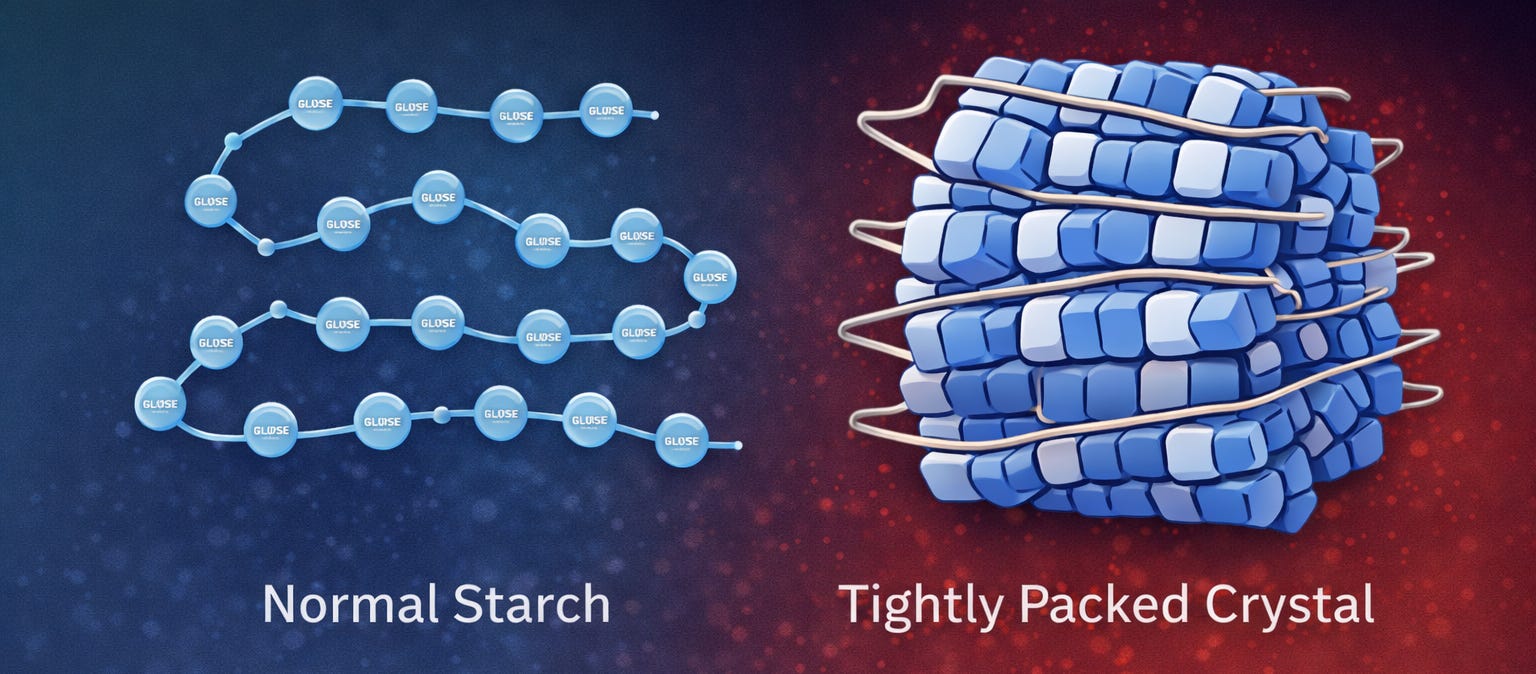
Think of it like a bundle of raw spaghetti taped together.
It’s still spaghetti. Same material. But because it’s tightly packed and rigid, it’s much harder to eat and digest. That’s resistant starch. Same chemistry. Different architecture.
So instead of being digested quickly in the small intestine, it resists digestion. It slips past our salivary and pancreatic amylase largely intact and travels to the colon.
And this is where the next question naturally arises: If we can’t break it down… how can bacteria?
Here’s the nuance.
Our bodies have a limited set of starch-digesting enzymes.
Gut bacteria, on the other hand, collectively produce dozens of carbohydrate-active enzymes. They have a greater diversity of tools that are able to autonomously separate the strands of raw spaghetti and process them — an ability we humans don’t have.
So once resistant starch reaches the colon, bacteria can slowly erode that tightly packed crystalline structure and ferment it.
But instead of turning into glucose absorbed in the small intestine, it reaches the large intestine (colon) and becomes fuel for gut microbes, modifying the microbiome and the hormones microbes produce that communicate to our bodies. This is how resistant starch works.
Make sense? Good!
Resistant Starch Randomized Controlled Crossover Trial
Now, let’s begin with the first study, published in Nature Metabolism.
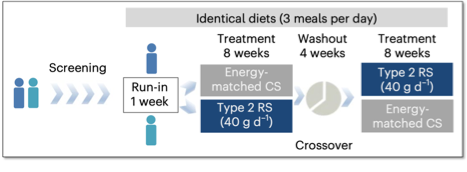
This was a randomized controlled crossover trial involving adults with a BMI > 24 kg/m2 and an average age of 33 years (22 men, 15 women).
A crossover design means that each participant served as their own control: everyone completed two phases—a ‘resistant starch’ (RS) phase, including 40 grams/day of type 2 resistant starch, and a calorie-controlled ‘control starch’ (CS) phase.
Each phase was 8 weeks with a 4-week washout period in between.
*Nuance note on Washout Periods
The purpose of a washout period is to effectively reset metabolism between study phases, ensuring that adaptations from one phase do not “bleed into” the next. When washout periods are inadequate, they can introduce a powerful source of bias known as a carryover effect. As we’ve shown in this paper my colleagues and I published re-analyzing data from a famous Nature Medicine trial, carryover effects can be so strong that they can completely invert the apparent results of otherwise rigorous trials. The relevance of this nuance note as relates to this resistance starch trial is that among participants who were randomized to the resistant starch phase first, followed by the washout period, and then the control starch phase, obesity-related outcomes did return to baseline after washout. For our purposes, this means there was an effective washout.
Double-Blinded and Controlled Feeding
This was also especially rigorous study because the participants’ background diets were controlled.
And, even more importantly, the study was double-blinded. To quote the authors:
“RS and CS were packaged in identical sealed bags with an identical appearance, and participants and investigators were blinded to group allocations.”
This design effectively eliminates placebo effects and minimizes experimental bias.
TL;DR: This was an exceptionally well-designed study.
Results: Resistant Starch Causes Weight Loss, Fat Loss, and Visceral Fat Loss
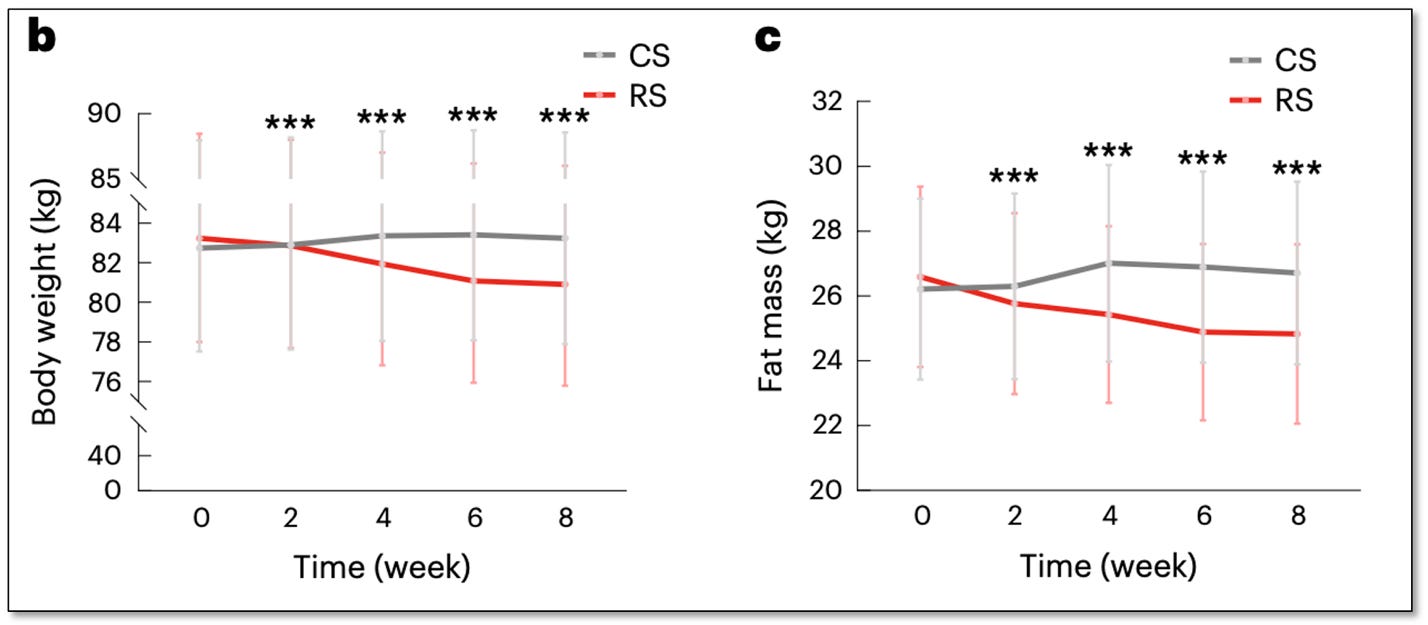
During the resistant starch phase, body weight decreased significantly (b) compared to both baseline and the blinded control phase.
Fat mass also declined (c), with a specific and meaningful reduction in visceral fat—the inflammatory fat that surrounds internal organs and drives cardiometabolic disease.
In additional to the numeric values, I want to show you representative MRI so you can see the raw data signal for yourself.
You can see the “before” and “after” (below, right) of the abdominal cavity of a people ‘sliced’ like a piece of bread.
And, after just 8 weeks of resistant starch supplementation, there’s a substantial reduction in visceral fat!
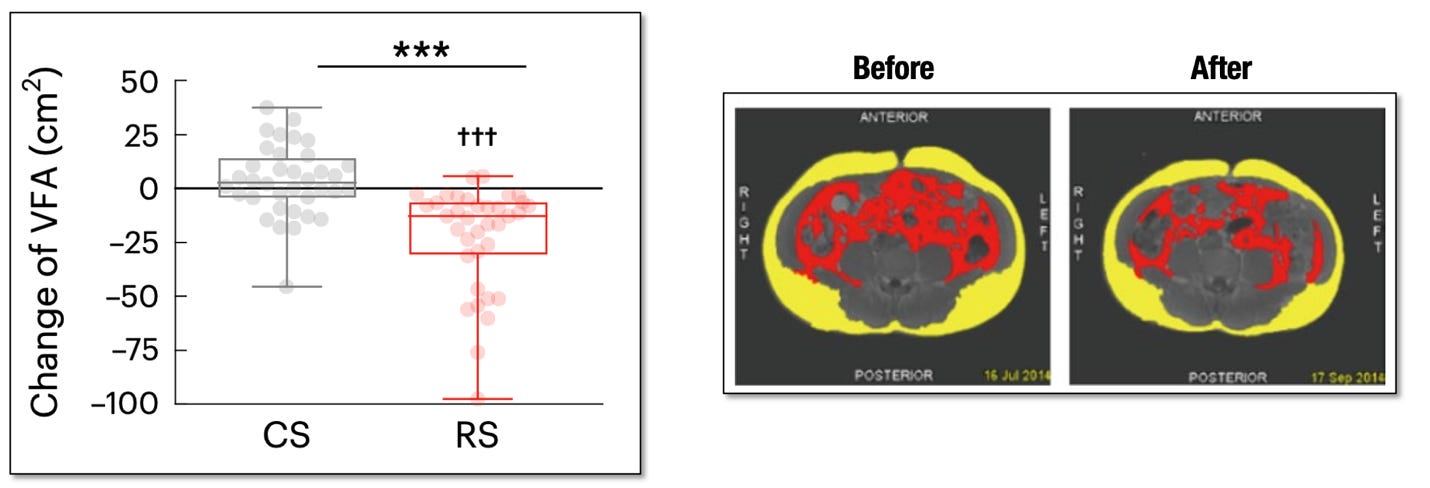
Congratulations! You’re now a radiologist!
Now, when you look at the quantitative data spread, you’ll notice some variability (red, above and to the left).
Some participants experienced modest (but still significant) reductions, while others had dramatic responses.
One individual saw a decrease of ~100 cm² of visceral fat, an exceptionally large change for such a short timeframe.
We’ll discuss why some people respond more strongly than others shortly.
So… move to the edge of your seat with your bucket of resistant starch popcorn in hand. (Is that a thing? Someone please tell me or, better yet, go invent it.)
Additional Benefits of Resistant Starch
But the benefits didn’t stop there.
Resistant starch also:
Improved insulin sensitivity
Reduced inflammatory markers, including TNF-α
Improved levels of proteins involved in lipid metabolism, including ANGPTL4 (although that’s a rabbit hole I’ll leave for another time)
Increased fecal lipid excretion—yes, participants literally excreted more fat, including fatty acids, triglycerides, and cholesterol.
Now, if your curiosity is piqued, GREAT! — because I’ve deliberately saved the most important insights for the back half.
Next, we’ll go deeper into:
Data showing that the gut microbiome causally mediates the benefits of resistant starch.
The intestines themselves, and uncover additional benefits—including improvements in gut barrier integrity and “leaky gut.”
Then we get to the most consequential questions:
Why some people benefit dramatically while others barely respond?
Are you a high responder or a low responder to resistant starch?
What actually determines the difference?
Finally, I’ll translate all of this into clear, actionable protocols you can use to apply these findings in your own life.
If you’d like to continue, I invite you to join the premium community and see why StayCurious Metabolism is a top bestseller in science—and why members consistently describe this community as an “oasis of nuanced, actionable insights,” and “the best investments I’ve made in my health.”