search
Miles Damone Mackay

Why KCL Suspended Usama Ghanem: The Full Context
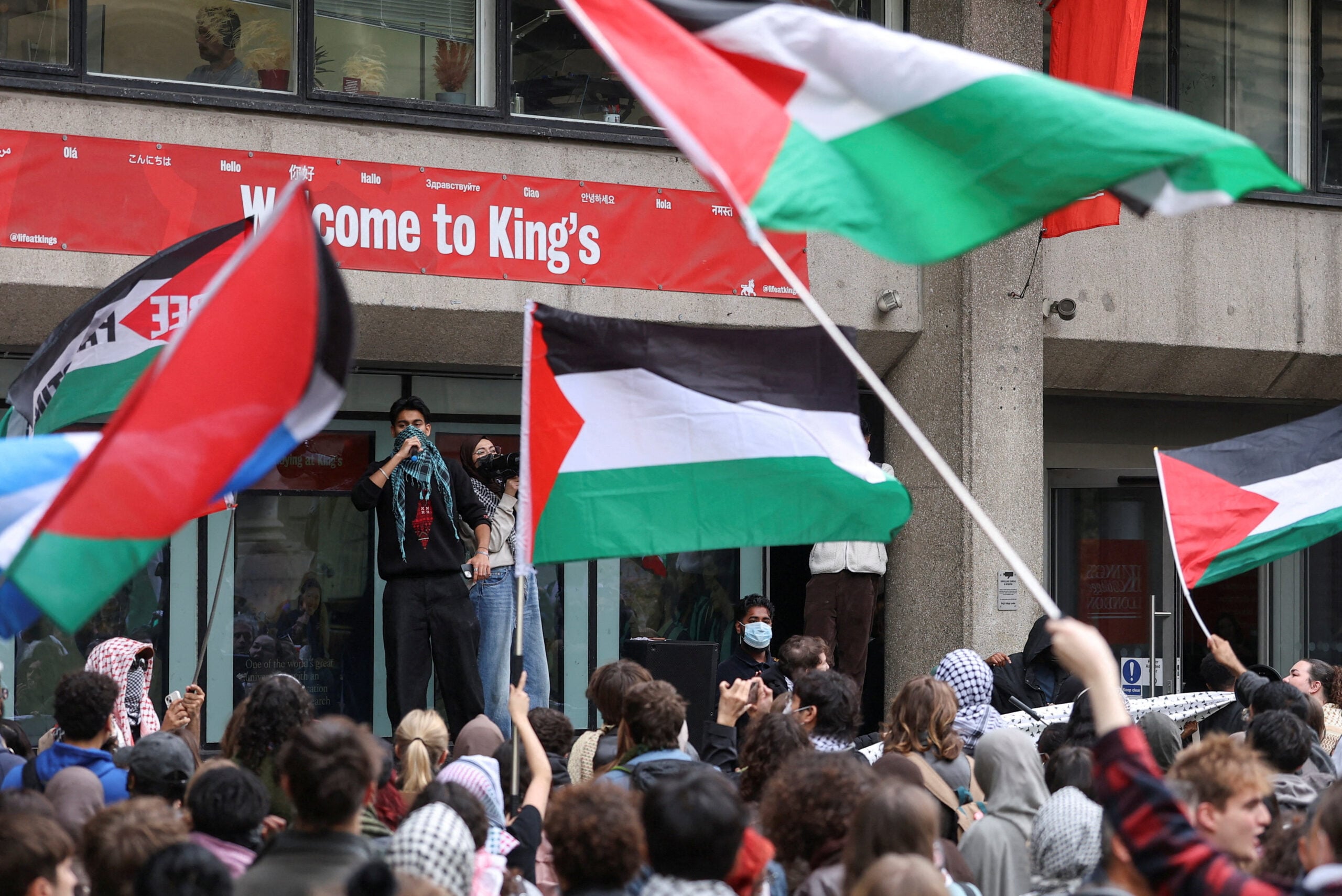
Pro-Palestinian protest on King's College London campus (Credit: Novara Media)

Last month, King’s College London (KCL) drew attention from the press over its decision to revoke student visa sponsorship of a 21-year-old International Relations student, Usama Ghanem, over “pro-Palestine” activity. Activists and public figures, including Jeremy Corbyn and Greta Thunberg, quickly condemned the decision, claiming Ghanem was being targeted solely for “pro-Palestine” activity. Corbyn even called the situation “deeply disturbing.” But this narrative is profoundly misleading. 

Disrupting academic events, confronting speakers, intimidating Jewish students, and taking part in unauthorised overnight occupations do not advance the cause of Palestinians. Instead, such actions undermine the academic environment and damage the reputation of one of London’s leading universities.

It reduces several violations of university regulations and disciplinary cases to a political slogan and misrepresents how British universities handle disciplinary matters. As affirmed by KCL, no student loses their visa for expressing a political view or engaging in lawful protest. What does trigger university intervention are behavioural breaches and clear violations of university policy. 

Ghanem’s suspension was not the result of political expression but followed a series of clear and documented breaches of King’s College London regulations. In June 2024, he joined the pro-Palestinian encampment on the Strand Campus, erecting tents in direct violation of university policy, which prohibits overnight sit-ins and encampments on university grounds. On 11 June 2024, he then forced entry into the King’s Alumni Awards ceremony, disrupting the event while demanding that the university sever ties with Israel. A formal disciplinary process was initiated after this incident.

Despite that ongoing process, Ghanem later participated in the disruption of a campus event in February 2025, a discussion intended to foster dialogue between Iranians and Israelis. The talk featured guest speaker Faezah Alavi, a Muslim Iranian woman speaking about life under the Iranian regime. Twenty minutes into the talk, protesters stormed the room, chanting “Shame!” and “From the River to the Sea, Palestine will be Free,” ultimately shutting down the event and forcing both Alavi and the event chair to be escorted out by security. I witnessed what went from heckles to blatant harassment that day. Protestors didn’t stop, they continued until every last person had left the room.

The chanting was endless, leaving the Jewish event chair to seek refuge in a university chaplaincy room. As the incident gained traction on social media and the concerns of Jewish students at King’s grew, British charity Campaign Against Antisemitism (CAA) wrote to King’s College London’s vice chancellor and President Shitji Kapur, describing the behavior of the protestors as “antisemitic”, demanding the university take concrete action to ensure a “safe and inclusive environment” for its Jewish students. The university swiftly opened an investigation.

Just months later, as King’s was still investigating Usama’s actions, he joined a large protest against the London Defence Conference (LDC) being held on KCL’s Strand Campus in May 2025. As leaders, such as Keir Starmer, announced an increase in defence spending, masked anti-Israel protestors occupied and blocked entrances. Despite numerous warnings, the protestors refused to leave, shouting at each individual entering the building. As police and security arrived, the protest turned violent. When security attempted to move the protest, Usama allegedly assaulted one of the KCL security guards. This incident led to Usama undergoing a third disciplinary hearing for, once again, breaching institutional rules on protest.

Ultimately, after concluding their three-month-long investigation, KCL decided to indefinitely suspend Usama, therefore, ending the sponsorship of his student visa.

Even after his suspension from King’s, Ghanem continued escalating his activism beyond the KCL campus. He helped lead a campaign calling for the removal of Michael Ben-Gad, an Israeli economics professor at City St George’s, University of London, targeting him largely because he had completed mandatory service in the Israeli Defence Forces over four decades ago. During one of the professor’s lectures, Ghanem invaded the classroom while wearing a keffiyeh and chanting slogans, disrupting the session and leaving students and staff visibly unsettled. One of the students even threatened to behead the professor, calling him a war criminal and a Nazi.

Usama Ghanem disrupting a lecture at City University (Credit: Jewish Chronicle)

Days away from his court date where he is expected to be deported, Usama continued to show no regard for university regulations and the law. He has taken advantage of his suspension by escalating his protests and terrorising more students and staff. Ironically, during this incident, masked anti-Israel protestors intimidated Professor Ben-Gad, calling him a “terrorist” and a “criminal,” despite external protestors conducting an unlawful and unpeaceful protest.

For weeks, various media outlets have promoted a narrative portraying Usama’s suspension as an act of political repression. The story has been distorted, reduced to a simplistic claim that King’s targeted him for expressing pro-Palestinian views. King’s Students for Justice in Palestine (SJP) asserted that he was “silenced for speaking out,” while Usama himself described the university’s actions as “Trumpian-style repression.”

In reality, Usama repeatedly refused to take responsibility for a pattern of behaviour that violated multiple university regulations and, in every instance, went far beyond what any institution could reasonably classify as protected activism. 

Across the span of a year, Usama faced three separate disciplinary hearings. Each time, he was given due process under King’s College London’s formal procedures. Yet he continued to escalate, engaging in conduct that the university found incompatible with its rules, its duty of care toward students, and its responsibility to maintain a safe campus. His indefinite suspension, and the immigration consequences that followed, were not the product of “Trumpian-style repression,” as he claims, but the direct result of KCL policy operating in conjunction with standard UK visa regulations.

About the Author
Miles is a British-Italian undergraduate student at King's College London. He is a fellow at CAMERA, passionate about international affaires, British-Israeli relations and the ever-changing landscape of the Middle East.
Related Topics
Related Posts

Why Britain’s Activists Ignore Iran’s Brutality

Protestors Wave Islamic Republic Flags and Ayatollah Photos at Pro-Palestine Rally (Photo: Author)
Protestors Wave Ayatollah Photos and Regime Flags at Pro-Palestine Rally

The current Iran war has exposed an uncomfortable truth in Britain. In a country that prides itself on defending freedom, some have taken to the streets waving the flag of a regime that violently suppresses it.

At the end of January, I spotted one of the regular pro-Palestine marches heading through London. But things were different this time. Rather than the usual advocacy for Palestinian rights, people were marching through London’s streets chanting in support of the murderous anti-British Iranian regime, proudly waving Iranian flags and displaying photos of Ayatollah Khamenei with the words, “Be On The Right Side of History” written neatly on the placards. The irony could hardly be starker. After the Iranian regime massacred more than 30,000 protesters, dozens of people in Britain took to the streets, freely exercising their right to protest, to wave Iranian flags and voice support for the very regime that brutally slaughtered its own demonstrators.

Iranians have a diaspora of over 114,000 people in Britain with many Iranians having fled Iran in the last decade. January and February marked one of the hardest months for the Iranian diaspora amidst the protest crackdowns and internet blackouts across Iran. To this day, the true scale of the crackdown remains unknown, with sources putting the death toll even higher. Yet, in Britain, with such a strong Iranian community, many of the British people sat idly as everything unfolded in Iran. The sad truth slowly became clear: for many on the hard left, Iranian freedom is not aligned with left-wing values. As Israel’s war raged on in Gaza and as ICE agents harmed and even killed protestors in America, modern progressives took to the streets immediately, protesting the actions of their respective governments. In Britain, after the ban on Palestine Action, thousands went out to protest, claiming the ban went “against free speech.” The protests went on for weeks, with over 2700 protestors arrested as a result. For months, the Western world was filled with progressive protestors demanding to end police ‘repression’ and call for government reforms to stop harming and arresting protestors.

This is where the irony comes in.

In Iran, as citizens went out to protest its repressive government, they were gunned down and violently butchered in the thousands by their own police. Tens of thousands were arrested and faced either execution or torture. But for some reason, the vast majority of Western progressives failed to address the horrifying situation in Iran. In Britain, America and Iran, people went out to protest against the actions of their government. In one country, those protestors were slaughtered en masse. And there was complete silence across the West, particularly in Britain.

The reasoning behind this is relatively simple. Those on the hard left are anti-Capitalist, anti-Western and anti-Israel. The Iranian regime ticks two of those boxes in full. Whilst Iran is technically Capitalist, it is an Islamic theocracy, whose members of Parliament often call for “death to America,” regularly burning the American flag in government sessions. But what has been more attractive for the hard left is Iran’s stance on Israel. For years, Iran has set up Middle Eastern proxies in Gaza, Lebanon, Yemen and Iraq to attack Israel and kill Israeli civilians. The October 7th attack was successful primarily thanks to Iran’s support and funding. As a result of Iran’s stances against Imperialism, America and Israel, Western progressives often finding themselves linking arms with anti-British Islamists, who often infiltrate pro-Palestinian rallies. 

As someone who is proudly gay, I found the silence amongst my ‘community’ sickening. After two years of jumping on every fashionable anti-Western cause, from Palestine to Pakistan to defending Maduro, I assumed that a regime that executes gay people might finally snap the woke crowd out of it. Apparently not. Instead of defending the Western freedoms that allow people to love whom they choose, many in Britain’s gay community seem content to align themselves with radical Islamist regimes that would happily persecute—or kill—them for who they are.

About the Author
Miles is a British-Italian undergraduate student at King's College London. He is a fellow at CAMERA, passionate about international affaires, British-Israeli relations and the ever-changing landscape of the Middle East.
Related Topics
Related Posts

Why Jews Flourished in Hindu India

Photo Credit: Pradeep Gaur

In May 2025, I had the opportunity of visiting India’s high commission in Central London, just weeks after the Islamist terror attack in Kashmir, which claimed the lives of 26 innocent tourists. Whilst I was there, I listened to harrowing testimonies of those that had lost friends or family as a result of terrorism in India’s disputed Kashmir region. Having never been to India or Pakistan, I was certainly no expert on the conflict between the countries, yet I started to see a parallel reality.

Almost day-after-day, pro-Pakistan protestors, including students from my university, gathered outside India’s high commission, in protest of its ‘occupation’ of Kashmir and its government. There was no sympathy for the innocent lives stolen that day. Not even a minute of silence. It was just straight condemnations of India, its government and its policies. I found this to be almost identical to how many in the pro-Palestine movement acted in the wake of Hamas’ deadly attack on Israeli civilians. Whilst Hamas was still in Israeli territory, butchering civilians, protestors in London were already on the streets chanting.

Joint Hannukah-Dwali celebration at a Hindu Temple in Detroit (Photo Credit: Detroit Free Press)

But, the threat of terrorism is not the only thing Hindus and Jews have in common. Both religions share rich cultural traditions, that have been practiced for centuries. For example, Hannukah and Diwali, two beautiful festivals of light. Both holidays have been celebrated for over 2000 years and both celebrate the triumph of light over darkness, lighting Menorahs and Diyas respectively. In true Jewish and Indian fashion, these festivals involve lots of food, family and fun.

As I found out, however, the Jewish-Hindu bond stretches even further than similar traditions and customs. In fact, Judaism was one of the first foreign religions to reach the Indian subcontinent over 2000 years ago. Many settled in cities like Kerala after the destruction of the Second Temple in 20 CE. This community of Jews, known as Cochin Jews, developed close ties with Hindu rulers, sharing the same rights and privileges as their Hindu neighbours. Unlike many Jewish communities, Cochin Jews experienced no expulsions or pogroms under Hindu rule. For centuries, the few Jews in India were able to practice their religion free of persecution and expulsion, even under British colonial rule.

The only time Indian Jews were under threat was during the Portugese Inquisition, which forced many Jews, Hindus and Muslims in Goa to undergo forced conversion to Orthodoxy in the 16th century.

Photo Credit: JUF

The rich story of Indian Jews reflects how prosperous, welcoming and diverse Hindu culture truly is.  Jews arrived in India before the existence of Islam and Christianity over 2000 years ago. Yet, unlike medieval Europe, the Middle East and Africa, there were no mass expulsions, no ghettos and no pogroms.

Instead, Jewish communities such as the Cochin Jews of Kerala and the Bene Israel of Maharashtra were permitted to live openly as Jews, building synagogues, preserving Hebrew liturgy, observing Shabbat and maintaining their communal courts. In Kerala, copper plate charters granted Jewish leaders land and trade privileges, a rare sign of royal recognition in diaspora history.

For centuries, Jews became an integral part of India’s commercial and cultural life: trading spices along the Malabar coast, serving in the armed forces of the Maratha and later British administrations, and contributing to the development of cities like Mumbai and Kolkata. Their distinct identity was preserved not through isolation, but through peaceful integration within a wider civilisational mosaic.

The Jewish experience in India stands out in global history. It demonstrates that strong religious identity and pluralism need not be in tension. In India, Jews did not merely survive – they flourished.

About the Author
Miles is a British-Italian undergraduate student at King's College London. He is a fellow at CAMERA, passionate about international affaires, British-Israeli relations and the ever-changing landscape of the Middle East.
Related Topics
Related Posts
Sign in or Register
Please use the following structure: example@domain.com
Or Continue with
By registering you agree to the terms and conditions
Register to continue
Or Continue with
Log in to continue
Sign in or Register
Or Continue with
check your email
Check your email
We sent an email to you at .
It has a link that will sign you in.
Please note that the posts on The Blogs are contributed by third parties. The opinions, facts and any media content in them are presented solely by the authors, and neither The Times of Israel nor its partners assume any responsibility for them. Please contact us in case of abuse.