
Why Europeans Didn’t Die of New World Diseases (but did from diseases in Africa and Asia)

I was recently asked why Europeans didn’t end up suffering as much at the hands of New World diseases compared to how the Native Americans were impacted by the likes of smallpox, measles, malaria, and yellow fever. It boils down to the disease ecology of the pre-contact Americas and what that ecology was missing (you can check out my pieces on what was infecting the natives of North America and South America pre-contact here). When reading about the infectious diseases present precontact, it’s hard not to notice the lack of crowd-based diseases. This is mostly due to a few main factors: first, the lack of carrying domesticated animals. The Old World had domesticated large herd animals at least 10,000 years ago, with zoonotic diseases from the likes of cattle, pigs, sheep, goats, horses, and camels being widespread by 5,000 years ago. Camelpox gave us the likes of smallpox, rinderpest from cattle gave us measles, and influenza came from various birds or pig species to name a couple of sources.
Compare that to the domesticated species in the Americas with llamas, alpacas, turkeys, and ducks (anywhere from 5,000 to 7,000 years ago) being the most prominent and apparently not transmitting many diseases to the Americans. The Americas also had much more dispersed patterns of settlement much longer, meaning far fewer diseases were floating around. One major infectious disease does seem to have made its way over from the Americas to Europe, and that is syphilis. At least 80,000 people per year from 1980 to 2007 died of syphilis with modern death rates at 74,000 deaths per year, the vast majority of which are in children, and about half of which are in Africa.
There’s also an important epidemiological concept called the “critical community size” which is basically an imperfect measure that estimates the required minimum population for a specific disease to persist (I say imperfect because vaccination, sampling period, and reporting makes it difficult to measure well). That said, the number for measles is anywhere from 250k to 500k individuals in well-connected networks and about 200k-300k for smallpox. Most of the population clusters within the Americas would have likely seen similar, highly infectious diseases burn out. Trade connectivity was also different in the Americas, with fewer dense urban centers being connected by regular maritime trade than Eurasia had which allowed more diseases to spread in the latter. All that to say, the Americas were a much friendlier disease environment for European explorers and colonial efforts than the likes of Africa and Asia.
The Regional Comparisons: Africa and Asia
Those who ventured into tropical Africa or South/South East Asia in the colonial era encountered a disease environment far more lethal and difficult than anything they would have faced across the Atlantic. While the post-Columbian Exchange Americas experienced a devastation by way of the European crowd and mosquito borne diseases like smallpox or yellow fever, the reverse pattern emerged in the Old World tropical regions, where Europeans died at incredible rates from the endemic African and Asian infections to which those populations had acquired immunity to in childhood or through a long-fought evolutionary battle leaving genetic immunity like the malaria-sickle cell link.
Africa
Europeans had been exposed to the temperate mosquito-borne parasites like Plasmodium vivax, but the P. falciparum species encountered in tropical regions was far more deadly. That’s because the falciparum version infects all red blood cells it encounters as opposed to just young RBCs like the vivax variant. The sub-Saharan African groups of the region had developed a genetic resistance over time, whereby individuals with a single copy of the sickle cell gene had a 90% reduced susceptibility to the local variant. It’s important to note that this is a huge trade-off because in populations where that gene becomes too common, a higher percentage of children are born with a fatal sickle cell disease.
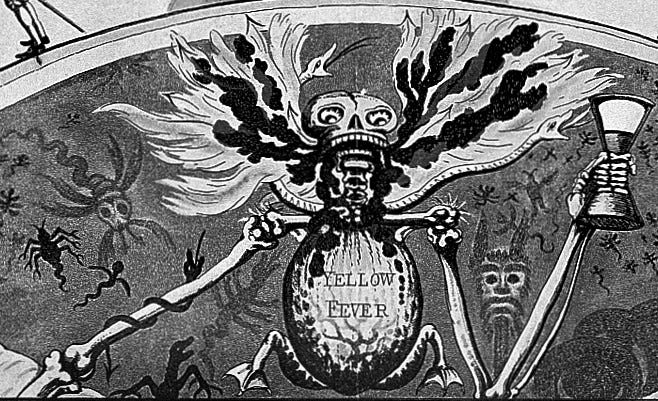
Europeans, who lacked that genetic adaptation and any childhood immunological exposure, ended up facing malaria as a virgin-soil disease akin to what the Native Americans did with Old World diseases. Those in the “Gold Coast” (modern day Gulf of Guinea in West Africa) faced death rates up to 67% in a single year earning it the nickname “White Man’s Grave” with rates of 30% being relatively common. In the 1800s quinine became the way Europeans would combat the newly encountered parasites, reducing mortality from malaria by between 50-75% and was what enabled the further colonial expansion that was previously blocked by high-malaria density areas. Yellow fever was another African mosquito-borne disease, this time transmitted by the Aedes aegypti mosquito, which killed Europeans at similar catastrophically high rates in West Africa and the Caribbean (where it had been introduced via the slave trade).
African sleeping sickness, transmitted by the tsetse fly, was another disease that halted European expansion into areas of sub-Saharan Africa. Indigenous groups already knew to avoid these areas but colonial economic activities like rubber harvesting meant groups who had avoided the areas for centuries or more were forced into the fly-infested areas leading to epidemic waves of sleeping sickness. Apart from the relatively high 30% mortality rate for late-stage patients, survivors were often left with neurological damage for life. The difference with this disease was a lack of selectivity between the death rates of native Africans and Europeans. However, because of the power structure forced upon the native groups with Europeans avoiding the deeper bush and rivers where the disease was endemic, the African laborers had higher rates of contact and thus sleeping sickness became known as an “African disease.”
South/Southeast Asia
India was one of the major epicenters of infectious disease in South Asia, with cholera, malaria, leishmaniasis, and even plague either being endemic to specific areas or having been spread along trade routes. Cholera was endemic to the Bengal region, with Calcutta being one of the major epicenters. Cholera caused a roughly 1% annual mortality among British soldiers in India but could be worse for those traveling by sea, with up to 10% dying in transit. A cholera pandemic erupted in 1846 and lasted until about 1860, causing more than 23k deaths in Great Britain (leading to John Snow’s 1854 water pump study in London and showing waterborne transmission), over a million in Russia, and even made its way across the United States in the decades before the civil war. Cholera, dysentery, and enteric fevers caused by the Salmonella typhi and paratyphi species formed a deadly trio that killed colonial troops throughout the region and had major impacts on the Crimean War (a topic that will be getting its own post).
Malaria in India was caused by multiple species in the Plasmodium family and again was a major killer of Europeans. The British army had a roughly 7% annual mortality in the mid 1800s. A Royal Commission on public health documented that unsanitary barracks, poor drainage, and bad irrigation schemes were major reasons for the endemicity of those mosquito species. Florence Nightingale, statistician and mother of modern day nursing practices, suggested sanitary reforms for cleaner water, improved drainage, and hygiene ended up reducing mortality by over 50% in the following decades, giving some great evidence that infrastructure was a major determinant of survival.
Visceral leishmaniasis, called “kala-azar” meaning black disease in Hindi, was a major killer in 19th century colonial India. Transmitted by sandflies, the disease had killed more than 750k people over three years in the 1820s, and another 200k from the 1880s to the 1930s. Untreated, it had a rather high case fatality rate (commonly cited as close to 100%, but I can’t track down the original citation there so take that with a grain of salt). However, this high fatality rate was due to the immunocompromised state it put its victims in, leading to opportunistic infections like tuberculosis, pneumonia, or dysentery which would then kill off the patient as opposed to the original pathogen being the “killer”.
The Third Plague Pandemic, originating in Yunnan, China in 1772 had reached India by the late 1890s and killed roughly 10-12 million there. Panic ensued among Europeans at the thought of the Black Death returning, with the first European cases prompting an emergency international conference on sanitation practices in Venice. Thankfully, this wasn’t a second Black Death, and Europe reported just under 1700 cases and 457 deaths, mostly concentrated in port towns, between 1899 and 1947.
Conclusion
European expansion into Africa and Asia meant confronting disease environments with incredible lethality. Annual mortality rates were roughly 30-45 times higher in places like West Africa compared to home. Colonial ambitions had driven them into disease zones that their ancestors had either avoided, or slowly adapted to through genetics, childhood exposures, and avoidance of the habitats associated with certain vectors. The Europeans, who largely lacked these adaptations and knowledge-based habits, died as a result. Quinine prophylaxis, sanitation reforms, and vector control efforts gradually reduced European mortality rates which enabled the colonial projects that had been previously blocked by diseases, but until then, tropical Africa and Asia remained a far more dangerous place for Europeans than the Americas.


Isn’t syphilis considered to be a new world disease that was brought back to Europe? Syphilis was fatal until the advent of antibiotics. Not only fatal, but increasingly horrible as the disease progressed.
I’ve long thought that penicillin had as much to do with the sexual revolution as did the birth control pill.
Interesting. Couple questions. What about disease transfer from Europeans to Asia and Africa? I guess precolonial exchange had already allowed mutual exposure to most disease vectors, except for ecologically isolated ones like malaria? You provide explanations for the lack of disease vectors in North and South America. But if, upon introduction to the Americas, smallpox could spread, then why couldn't similarly infectious viruses arise endogenously? I get the xoonotic argument, but it doesn't seem sufficient. Weren't the population densities of Mexican and South American cultures sufficient to support infectious vectors? Perhaps they did, and the dispersed, low-density population structure in North America was the result of previous epidemics?