Advertisement
Advertisement

World

Trump signature to appear on US currency, ending 165-year tradition

The redesigned notes will also drop the signature of the US treasurer for the first time in 165 years.

Trump signature to appear on US currency, ending 165-year tradition

US President Donald Trump holds up a signed Bill at the White House on Jul 4, 2025, in Washington. (File photo: AP/Julia Demaree Nikhinson)

27 Mar 2026 08:21AM (Updated: 27 Mar 2026 08:26AM)
Read a summary of this article on FAST.
FAST

WASHINGTON: US paper currency will bear President Donald Trump's signature starting this summer, the first time a sitting president has signed American money, the Treasury Department said on Thursday (Mar 26).

The redesigned notes, planned to mark the 250th anniversary of American independence, will also for the first time in 165 years drop the signature of the US treasurer, who reports to the Treasury Secretary and oversees the Bureau of Engraving and Printing, the US Mint and other Treasury functions.

The first US$100 bills with Trump's signature and that of US Treasury Secretary Scott Bessent will be printed in June, followed by other bills in subsequent months. The new bills may take several weeks to circulate through banks.

The Treasury is still producing notes bearing the signatures of former President Joe Biden's Treasury secretary, Janet Yellen, and former Treasurer Lynn Malerba.

CNA Games
Show More
Show Less

Malerba will be the last of an unbroken line of treasurers whose signatures have appeared on US federal currency since 1861, when the US government first issued it.

The signature change is the latest effort by the Trump administration and its allies to put the president's name on buildings, institutions, government programs, warships and coins. A federal arts panel, whose members Trump appointed, approved last week the design for a commemorative gold coin with Trump's image.

Bessent said in a statement that the move was appropriate for the US 250th anniversary, given strong US economic growth and financial stability during Trump's second term.

"There is no more powerful way to recognise the historic achievements of our great country and President Donald J Trump than US dollar bills bearing his name, and it is only appropriate that this historic currency be issued at the Semiquincentennial," Bessent said.

An effort for a circulating US$1 Trump coin was set back by laws prohibiting the depiction of living individuals on US coins.

A statute governing the printing of Federal Reserve notes gives the Treasury broad discretion to change designs to guard against counterfeiting. The law requires keeping certain elements, including the words In God We Trust, and only allows portraits of deceased individuals.

The overall designs of bills will not change, except for Trump's signature replacing the Treasurer's, Treasury officials said. A mock-up of the US$100 bill with Trump's signature was not immediately available.

Malerba, the former treasurer, declined to comment on the Trump administration's move.

Her predecessor, Jovita Carranza, who served as treasurer in Trump's first term, called the change "a powerful symbol of American resilience, the enduring strength of free enterprise and the promise of continued greatness".

The current treasurer, Brandon Beach, whose name has not appeared on the currency, also issued a supportive statement, saying Trump was the architect of a "golden age economic revival".

Source: Reuters/nh

Sign up for our newsletters

Get our pick of top stories and thought-provoking articles in your inbox

Subscribe here
Inbox
FAST
Advertisement

World

Cyclone triggers outages at major Australian LNG plants

The two affected gas plants collectively supply more than five per cent of the world's liquefied natural gas, according to Chevron figures.

Cyclone triggers outages at major Australian LNG plants

The offices of Chevron in Perth, Western Australia, on Sep 3, 2025. (File photo: AFP/Antony Dickson)

27 Mar 2026 09:47AM (Updated: 27 Mar 2026 09:54AM)
Read a summary of this article on FAST.
FAST

SYDNEY: A cyclone off Australia triggered outages at two of the world's largest LNG plants, energy giant Chevron said Friday (Mar 27) as Middle East turmoil stoked soaring demand for the fuel.

The Gorgon and Wheatstone gas plants in Australia collectively supply more than five per cent of the world's liquefied natural gas, according to Chevron figures.

Both suffered outages on Thursday afternoon as Tropical Cyclone Narelle lurked off the coast of Western Australia.

"Chevron Australia is working to restore production at the Gorgon and Wheatstone gas facilities following production outages," Chevron said in a statement.

CNA Games
Show More
Show Less

"We will resume full production at both facilities once it is safe to do so."

The Gorgon gas plant - which is the larger of the two - was continuing to operate at a reduced capacity, Chevron said.

It was not immediately clear to what extent supply might be impacted.

Tropical Cyclone Narelle was inching towards the coast of Western Australia on Friday morning, according to the government Bureau of Meteorology.

The category four system was forecast to bring "destructive wind gusts and heavy rainfall" to some coastal areas, the bureau said.

A sprawling industrial complex sitting just off Australia's western coast, the Gorgon plant is capable of pumping out more than 15 million metric tonnes of gas each year.

At full capacity, the smaller Wheatstone project produces almost nine million metric tonnes.

MAJOR DISRUPTIONS

Australia is one of the world's largest LNG exporters - and is a particularly crucial supplier to import-reliant northern Asia.

Some 40 per cent of Japan's LNG comes from Australia, according to the Asia Natural Gas and Energy Association.

The US-Israel war on Iran has caused major disruptions to global supplies of both oil and LNG.

Qatar, the world's second-largest LNG producer, has seen LNG exports plunge as fuel tankers steer clear of the Strait of Hormuz.

LNG prices in some parts of Asia have more than doubled.

Chevron is one of two major natural gas producers in Western Australia, alongside Woodside Energy.

Between them, the two companies account for more than 15 per cent of international natural gas exports.

With LNG profits set to soar on the back of the Middle East crisis, Australia is reportedly mulling a new windfall tax on fuel exporters.

Source: AFP/co

Sign up for our newsletters

Get our pick of top stories and thought-provoking articles in your inbox

Subscribe here
Inbox
FAST
Advertisement

World

Trump orders government to pay airport security workers

Trump orders government to pay airport security workers

A TSA agent checks a passenger's ticket and boarding pass at Ohare Airport in Chicago, Thursday, Mar 26, 2026. (Photo: AP/Paul Beaty)

27 Mar 2026 07:09AM (Updated: 27 Mar 2026 07:28AM)
Read a summary of this article on FAST.
FAST

WASHINGTON: President Donald Trump said on Thursday (May 26) he will take executive action to pay 50,000 airport security workers as a deal stalled in Congress to address staff shortages that have snarled travel around the country.

Trump said he was instructing the Homeland Security Department "to immediately pay our TSA Agents in order to address this Emergency Situation, and to quickly stop the Democrat chaos at the airports. It is not an easy thing to do, but I am going to do it".

Nearly 500 airport security officers have quit since the start of a partial government shutdown in February, the Homeland Security Department said, as a congressional dispute over the department's funding forces Transportation Security Administration officers to work without pay.

It is unclear how long the funding will last or if Trump is tapping funding for the Homeland Security Department approved last year as part of a massive tax and spending bill.

CNA Games
Show More
Show Less

Democrats in Congress have held up funding for DHS while demanding a change in rules governing its immigration operations, after agents in Minneapolis shot and killed US citizens Renee Good and Alex Pretti.

Republicans have rejected repeated Democratic proposals to fund the TSA separately while negotiating reforms to how Immigration and Customs Enforcement agents operate.

The TSA reiterated on Wednesday that the agency could be forced to close smaller airports if staffing issues worsened.

More than 11 per cent of TSA officers, or 3,120 agents, did not show up for work on Wednesday, while much higher absentee rates of 30 per cent or more were seen at New York's JFK, Houston's two airports, and airports in Baltimore, New Orleans and Atlanta.

Chris Sununu, CEO of airline trade group Airlines for America, on Thursday reiterated his call for Congress to quickly resolve the issue. He warned that, even if the US Senate reaches a deal on DHS funding by Friday, "you're still probably looking at a very tough weekend, because it's not going to get finalised" immediately.

Trump has said he could deploy National Guard troops to airports to address security needs.

Senate Republicans and Democrats continue to debate a proposal that would allow funding to resume for TSA and other Department of Homeland Security agencies while keeping some immigration enforcement funding on hold.

TSA is grappling with a school spring-break travel surge that is about 5 per cent higher in volume than last year's. Absences have spiked above 10 per cent in recent days, leading to hours-long delays to get through security checkpoints at some airports.
Hundreds of US immigration agents and Homeland Security Investigations officers began deploying at 14 US airports on Monday to aid security screening.

Some of those agents are now checking IDs with TSA equipment, guarding entrances and exits, assisting with logistics, and engaging in crowd control.

ICE and other law enforcement personnel at DHS are getting paid during the shutdown.

Source: Reuters/nh

Sign up for our newsletters

Get our pick of top stories and thought-provoking articles in your inbox

Subscribe here
Inbox
Advertisement

CNA Insider

Lies were told about who they were. Now these South Korean ‘orphans’ are reclaiming their truth

A system built on demand and stigma sent more than 200,000 Korean children overseas. CNA’s One “Orphan” Every Hour follows adoptees as they retrace fragmented pasts, find lost siblings and uncover long-buried truths about their origins.

Lies were told about who they were. Now these South Korean ‘orphans’ are reclaiming their truth

The moment when biological siblings Chase Malmgren and Mary Bowers, Korean adoptees in the United States, first met in 2024.

New: You can now listen to articles.

This audio is generated by an AI tool.

27 Mar 2026 06:00AM (Updated: 27 Mar 2026 07:57AM)
Read a summary of this article on FAST.
FAST

STOCKHOLM/DALLAS/SEOUL: A Korean children’s song plays — a little girl’s voice, recorded decades ago.

Anna Samuelsson does not recognise it. “It’s like another child,” she says. “It’s not me.”

But it is her voice, when she was five years old and newly arrived in Sweden from South Korea. Today, that child feels distant, her language gone, her memories out of reach.

Catherine Harned knows that feeling too. When she arrived in Texas at age seven, she spoke only Korean. “When I came to America, it was stressed to me — speak English,” she recalls.

CNA Games
Show More
Show Less

Within years, she lost not only the Korean language but much of her early life.

Harned and Samuelsson are sisters by birth, adopted weeks apart in 1974 from different orphanages in Seoul. They grew up continents apart, unaware of each other’s existence.

Biological sisters Anna Samuelsson (left), 59, and Catherine Harned, 57, on a video call with CNA.

They are among more than 200,000 South Korean children who, through the decades after the Korean War, were placed with families overseas. Many of them were conveniently labelled as “orphans”.

“The production of ‘orphans’ had everything to do (with) facilitating the movement of children and had very little to do with the actual circumstances of the child,” says Eleana Kim, a professor of anthropology and Asian American studies at the University of California, Irvine.

International adoption became a solution to social pressures, from stigma around mixed-race babies and unmarried mothers, to poverty and rapid modernisation. It was also driven by demand from the West, where fewer children were becoming available for adoption.

By the 1970s, transnational adoptees — most commonly from South Korea — made up the equivalent of 1 to 2 per cent of newborns in Sweden.

In the United States, evangelical Christians saw adoption as a way to “hasten the kingdom of God”, cites author and scholar Soojin Chung at the Princeton Theological Seminary.

Harned was adopted through Holt Children’s Services, where Bertha Holt (right), a devout evangelical, played a key role in bringing South Korean adoptees to families overseas.

Often, the children’s stories were simplified or rewritten as something more palatable: abandoned, rescued, given a better life.

But many adoptees have since uncovered records that did not add up, documents with missing details, repeated narratives and even the names of parents where none were supposed to exist.

Last year, South Korea’s Truth and Reconciliation Commission found that the decades-long adoption programme had been rife with fraud including falsified records and cases of children being mislabelled as orphans.

Months later, President Lee Jae Myung issued a public apology to adoptees and their families, acknowledging the country’s role in what he described as “unjust human rights violations”.

He said in a Facebook post that he felt “heavy-hearted” thinking about the “anxiety, pain and confusion” many had experienced and pledged support for adoptees attempting to trace their origins.

For many, that search is long overdue. Across continents, adoptees are trying to reclaim what was lost, seek their biological families and make sense of identities shaped by absence.

From Sweden to the US and back to South Korea, CNA’s One “Orphan” Every Hour follows their journeys as they piece together their past and confront the forces that took them from it.

WATCH: South Korea’s fake orphans — How adoptions to USA and Sweden tore families apart (1:32:04)

THE LIES OF THE PAST

Mary Bowers had always believed she was an orphan. Her birth certificate says so, with no recorded birth parents. “When I left for college, I asked for my adoption papers,” she recalls.

That was the first time that I saw two people’s names, a mother and a father in my documents.”

The deeper she looked, the more uncertain her background story became. According to the records, Bowers’ mother realised she was pregnant only after her relationship had broken down, and she was too poor to raise a child.

But when Bowers compared her documents with those for other adoptees from the same agency, she found that account repeated “a dozen times over”.

“It was word (for) word the same,” she says. “So I don’t really know what the true story is.”

Bowers, 44, was adopted by a family in Colorado, USA, when she was six months old.

Then in 2024, she discovered she had a full-sibling: Chase Malmgren, adopted in Utah as an infant, 23 years after her. But her brother’s adoption record raised more questions.

His adoptive parents had been told his mother was married, that her husband had lost his trucking business and the family had fallen into financial hardship.

After a one-night stand with a businessman, she got pregnant and gave up the child to preserve her family’s reputation. It was a complete account. But it did not match Bowers’.

For others, the truth is more painful.

Madeleine Bjork grew up believing she had been given up owing to post-war hardship, even though she was born 30 years after the Korean War.

When she met her birth family, a different picture emerged. Her parents were unmarried, her abusive father left when she was two months old, and her mother struggled to raise her.

Madeleine Bjork, 43, was adopted by a family in Sweden at the age of two.

It was her grandmother who placed her in an orphanage without her mother’s consent. When her mother tried to get her back, it was “too late” as her adoption papers had been signed.

“I thought a lot about that, especially because I had my kids when I found out about this,” Bjork says, choking back a sob.

When I met her, it was so clear that this person had suffered. I think a lot of her struggles in life came from this.”

In more extreme cases, there was no consent at all. Han Tae-soon — the first biological mother to sue South Korea’s largest adoption agency, Holt Children’s Services, and the government — lost her daughter when the latter was four years old.

LISTEN: Victims of South Korea’s controversial adoption system search for answers — and birth mothers

“They took her away while she was playing in front of the house. They kidnapped her,” Han says. “After seven months in the orphanage, she was adopted in the US.

“She used to live with the thought that I’d sold her.”

For all Philip Pellouchoud knows, his story may not be so different. Adopted in Colorado in 1971 through Holt, he has spent years trying to trace his origins.

The only record of his early life was a name in a ledger from the Centre for Lost Children, with no explanation for how he came to be there. “Was it an unwed mother? Was it a divorce?” he wonders.

Philip Pellouchoud, 58, was adopted by a family in Colorado at age three.

Kim Do-hyun, the president of non-profit organisation KoRoot, which supports adoptees returning to South Korea to trace their origins, thinks it is unlikely that Pellouchoud will find clear answers as there is “no record, no clue”.

“We don’t believe that parents usually brought their child to (the Centre for Lost Children). Police could’ve taken … foundlings on the street (to the centre),” Kim says.

“The first action should’ve been (to look) for … the parents. But (at) that time, (it was) not done seriously.”

Instead, children could be declared adoptable with minimal investigation. Financial incentives may have played a role. “It wasn’t simply cynical (but) criminal,” Kim says. “The adoption agents could make money — one person’s yearly salary (from) one child.”

The result was a system where records were often incomplete, incorrect or missing altogether.

Kim Do-hyun has more than 20 years’ experience in supporting adoptees through his work in KoRoot.

THE FAIRY TALE THAT WASN’T THEIRS

Whatever the system was trying to solve, there was often no fairy-tale ending after these children were sent to the West. “Almost every day you’d be reminded that you’re different,” Samuelsson says.

People would … say (things) like, ‘You should be so thankful. You’re so lucky to be in Sweden.’”

Being different “didn’t make a difference”, Bjork was told. But for her, it did. “Until I was maybe 13, I just wanted to be like everyone else,” she says. “My biggest wish was to be blonde and have blue eyes.”

Others faced overt racial stereotypes. Malmgren recalls being called “snake eyes” as a child, while Harned remembers her adoptive mother calling her long, jet-black hair “a rat’s nest”.

Joel Peterson, who is mixed, faced stigma on both sides. In his early childhood in South Korea, people would “pull their children away” and call his mother a prostitute, he remembers. He was also bullied and beaten by other children.

An old photograph of Joel Peterson during a visit to his biological mother.

The prejudice did not end after he was adopted in Minnesota at age seven in 1970.

“I was ostracised and made fun of and picked on and bullied for being Korean, for being Asian, so I worked consciously at not having an accent,” he recounts.

Many adoptees internalised harmful narratives about why they had been given up. “Your mother was probably a prostitute” was something Bowers also heard — a stigma that Korean adoptees carried well into the 1980s.

Then there was the loss of a shared childhood that can never be recovered.

Bowers once flew all the way to South Korea to find her brother. Their eventual reunion in 2024 came with a quiet awareness of what had been missed.

“Even in this great scenario that Chase and I are in, … we don’t have that connection any more.

“There’s a sense of guilt because with the lost time,” she says through her tears, “I won’t get to teach him to ride a bike or see him in the school play.”

Malmgren, 21, who is on the autism spectrum, grew up in Utah.

As they rebuild their relationship, Bowers describes a need — shaped by a lingering fear — to prove her worth to her brother.

“There’s almost like a trauma response in all (my) talking and outgoingness,” she says. “Some of it comes from (hoping that) if I prove that I’m good enough, then I won’t be abandoned. Like you can’t leave me.”

In 2022, she filed a case with the Truth and Reconciliation Commission, ticking seven out of more than 50 categories of human rights violations, including the right to identity, family, country and access to information.

Whereas adoption is often framed as a happy ever after, many Korean adoptees may have had a different lived experience. “You’re like the fairy tale for everybody,” Samuelsson says, “except for yourself.”

WATCH: Labelled an “orphan”, she discovers a biological brother 23 years younger — Is it too late? (20:29)

RETRACING THEIR ROOTS

In the search for answers, Pellouchoud recently travelled to South Korea to visit adoption agencies, community centres and even police stations.

“I’ve taken every DNA test that you can,” he says. “Now I want to do this one last thing, and then I’m going to be done. And whatever happens happens.”

With help from CNA, he met Bu Chung-ha, who led Holt Children’s Services in the 1970s and may have personally processed his case, along with thousands more.

Pellouchoud was told, however, that these adoption decisions were not made in South Korea but in offices in the US or France, where the children were matched with families there.

Bu Chung-ha was chairman of Holt Children’s Services of Korea from 1972 to 1979 and was an orphan himself.

KoRoot also helped him obtain a document showing his birth name, Park Won-il, and that he was only three days old when a shop clerk brought him to the Centre for Lost Children.

When he took the document to a government agency, however, he was told it belonged to someone else with the same name, with no further explanation given. There is no other record of his first two years and a half.

For now, he is not continuing his search, unless a future DNA match offers new leads.

As for Samuelsson, she is looking for her birth family, but her search has stalled. Her sister, having built a life in the US, has not lent a hand yet and sees no reason to look back.

“I have no desire to pursue it, I really don’t,” Harned says contentedly. “This is my home.”

Malmgren is hesitant too, but for a different reason. He worries about “what happens if we do find our parents”. Asked if he fears finding that they might have truly abandoned him, he replies: “Yeah, that’s one fear.”

An old photograph of Malmgren with his adoptive family.

Last year, a Swedish commission recommended ending international adoptions after its investigation uncovered decades of fraud, abuse and illegal practices.

In the same year, South Korea finally banned private agency adoptions. The country now plans to end overseas adoptions by 2029.

Watch the documentary One “Orphan” Every Hour here.

Source: CNA/fl(dp)

Sign up for our newsletters

Get our pick of top stories and thought-provoking articles in your inbox

Subscribe here
Inbox
Advertisement

Commentary

Commentary: Gold is seen as a ‘safe haven’ in uncertain times. Why is it crashing amid a war?

Over the past few months of geopolitical chaos and market panic, gold has moved more like a roller coaster than a steady ship at anchor, says a finance professor.

Commentary: Gold is seen as a ‘safe haven’ in uncertain times. Why is it crashing amid a war?

FILE PHOTO: UK gold bullion bars are stacked at Baird & Co in Hatton Garden in London, Britain, October 8, 2025. REUTERS/Hiba Kola/File Photo

27 Mar 2026 05:59AM
Read a summary of this article on FAST.
FAST

QUEENSLAND, Australia: Gold has long enjoyed a reputation as a financial “safe haven” during stormy times. But over the past few months of geopolitical chaos and market panic, the precious metal has moved more like a roller coaster than a steady ship at anchor.

In late January, the gold price surged to an all-time high near US$5,600 per ounce – effectively double what it was a year earlier. It’s lost about 20 per cent since then, sliding sharply while major conflict broke out in the Middle East.

To be clear, gold is still at lofty heights by historical standards, up almost 300 per cent over the past decade. Much of this surge has been driven by “financialisation”. Put simply, more ways of investing in gold on paper – with complex financial products called derivatives and funds that track its price – have seen a boom in speculation by institutional and retail investors.

But this year’s wild swings in price should shatter any remaining illusion that gold is always a safe haven. To understand why, we need to look at how modern financial markets work – and in particular, why an oil shock is different to other crises.

UMBRELLAS AND STORM SHELTERS

To protect their wealth, investors often seek assets that are either “hedges” or “safe havens”.

A hedge is an investment that generally moves in the opposite direction to the rest of the market on average over a normal, long-term period. Think of a hedge like holding an umbrella above your head every single day. You’ll stay drier than everyone else when it rains, but you’ll also block out on some of the sunshine (potential gains) when it doesn’t.

A safe haven, on the other hand, is an investment that generally moves in the opposite direction to the rest of the market only during sudden periods of extreme stress or crashes. It’s like a storm shelter you only run to during a hurricane.
 

WHERE DOES GOLD FIT?

In a 2016 research study, colleagues and I found gold had some of the qualities of a safe haven, particularly for share markets in Australia, the United States, Germany and France.

During the 2008 global financial crisis, gold was the most stable commodity among the precious metals we studied. Its price did drop, but it avoided the catastrophic losses seen in other precious metals.

It had similar safe haven qualities in 2011, when ratings agency Standard & Poor’s (S&P) downgraded the US’ AAA credit rating to AA+ for the first time in history and many global stock markets fell.

Importantly, those market shocks came out of the financial system itself (a banking system failure and a credit downgrade).

Today, the world faces something fundamentally different: a massive energy shock due to interrupted oil supplies and major damage to oil and gas facilities in the Middle East.

WHY AN OIL SHOCK IS DIFFERENT 

Traditional finance textbooks will tell you that when a war breaks out, inflation spikes or stock markets crash, investors typically engage in what’s called a “flight to quality” – fleeing riskier assets and moving their money somewhere seen to be safer (such as gold).

In a 2025 research paper, colleagues and I offer a more nuanced view. Crucially, we incorporated data from more recent periods of stock market turbulence, including the COVID-19 pandemic, where gold’s safe haven properties were more muted.

We found gold is still a go-to choice for investors moving out of riskier investments. But it is not an untouchable storm shelter.

Instead of standing completely separate from the panic during a crisis, gold absorbs some of the volatility from both the stock market and energy markets, which can cause its price to fall.

RIPPLE EFFECTS

Why? For one, market chaos means some large investors may be forced to sell gold to cover other losses or meet financial obligations, such as margin calls (where a lender demands funds to cover the falling value of an asset).

For other large investors, the recent price rally may have created an opportunity to sell high and take profits, or rebalance their investment portfolios.

But there is also the fact gold does not have as much essential intrinsic value as something like oil. There is not much industrial demand for it compared to other commodities.

In a severe crisis, forced to chose between a commodity like oil and gold, what does global industry really need? Oil.

ROCK, PAPER, GOLD

The different ways people are investing in gold is another important factor. Over several decades, gold has become increasingly “financialised”.

Now, it can be bought and sold with ease on “paper” via speculative, complex financial instruments called derivatives, or in increasingly popular exchange traded funds which track the price of gold.

With these funds, you aren’t buying gold itself. You’re buying an asset whose price is designed to track the price of gold in some way.

Today, a massive rise in speculative investment means that commodity prices depend on far more than real-world supply and demand.

Because global investors now hold gold derivatives and conventional stocks at the same time, the risk of exposure to common market shocks has drastically increased.

Rand Low is Associate Professor of Quantitative Finance at Bond University. This commentary first appeared on The Conversation.

Source: Others/sk

Sign up for our newsletters

Get our pick of top stories and thought-provoking articles in your inbox

Subscribe here
Inbox
Advertisement

World

Oil climbs, stocks slide as Iran war uncertainty reigns

Oil prices rise as US-Iran tensions grow, with US President Donald Trump threatening strikes despite ongoing talks.

Oil climbs, stocks slide as Iran war uncertainty reigns

Oil pump jacks work at sunset near Midland, Texas, US, Aug 21, 2019. (Photo: REUTERS/Jessica Lutz)

27 Mar 2026 05:29AM (Updated: 27 Mar 2026 12:05PM)
Read a summary of this article on FAST.
FAST
NEW YORK: Oil prices jumped and equities slid Thursday (Mar 26) as hopes for a peace deal between the United States and Iran wavered, with US President Donald Trump threatening to "obliterate" the country even as he claimed negotiations to end the conflict were ongoing.

Markets had been buoyed at the start of this week by Trump saying that strikes targeting Iran's energy infrastructure would be postponed, adding that the two sides were in peace talks.

But uncertainty over the talks, continued strikes by all sides in the conflict, and the virtual closure of the Strait of Hormuz - through which around 20 per cent of oil and liquefied natural gas normally passes - have cast a shadow over market sentiment.

On Thursday, Trump said Iran had allowed 10 oil tankers to sail through the waterway as a "present," and pushed back a deadline for strikes on Iranian power plants to April 6.

His comments on delaying strikes came after the US close, with oil paring the massive gains it had made through the day.

Earlier, Brent crude closed up 5.7 per cent at US$108.01 per barrel, and West Texas Intermediate ended up 4.6 per cent at US$94.48. 

Kim Forrest, chief investment officer at Bokeh Capital Partners, said the war makes "for really nervous investors."

"Every day there's only one or two stories that are really driving stocks and all else falls from there. So when they're in a sour mood, it's going to be a big, bad selling day."
Wall Street's main stock indices were down, with the Nasdaq furthest in the red, losing 2.38 per cent. European and Asian markets also ended with losses.

"When the oil price surges, the market playbook stays the same: stocks and bonds sell off," said Kathleen Brooks, research director at XTB.

The yield on government bonds rose across the board.

Conflicting messages from the US and Iran are "raising questions about whether there is really an off-ramp to the conflict in the days ahead," said Deutsche Bank's Jim Reid.

RIVAL PLAN

Washington was said to have presented a 15-point plan to end the war. Tehran's state-run TV reported officials had put forward their own five conditions for hostilities to end.

On Thursday, Trump said taking control of Iran's oil was an option, as Washington had done after ousting Venezuela's leader in a military operation.

Pakistan's Foreign Minister Ishaq Dar confirmed Thursday that indirect negotiations between the United States and Iran were being held, using Islamabad as an intermediary.

"Pressure on energy prices, shipping flows and broader financial conditions remains one of the few meaningful sources of leverage (Iran) retains," said Saxo Markets' Charu Chanana.

"There is therefore little incentive to relinquish that leverage prematurely, particularly if market stress strengthens its negotiating position," she added.

The OECD on Thursday cut its eurozone growth outlook and forecast higher inflation for 2026 as energy prices have skyrocketed.

The conflict has also weighed on German consumer sentiment heading into April, a survey showed Thursday, adding to the woes facing Europe's top economy.
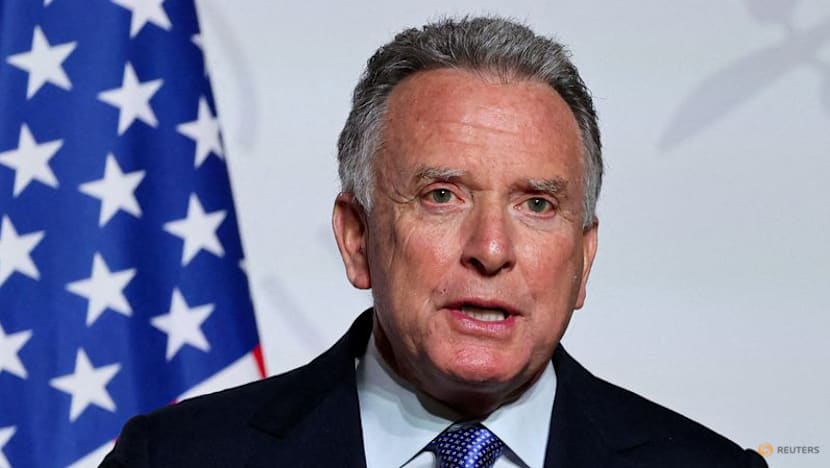

France, which holds the G7 Presidency, will on Monday host a meeting bringing together the group's finance ministers, energy ministers and central bank governors. 

Source: AFP/fs

Sign up for our newsletters

Get our pick of top stories and thought-provoking articles in your inbox

Subscribe here
Inbox
Advertisement

World

Olympic women's sport to be limited to 'biological females'

The IOC has decided to bar transgender athletes from women’s Olympic events and will introduce a one-time gender test starting in 2028.

Olympic women's sport to be limited to 'biological females'

IOC President Kirsty Coventry speaks during the Olympic opening ceremony at the 2026 Winter Olympics, in Milan, Italy, Friday, Feb 6, 2026. (Photo: AP/Yves Herman)

27 Mar 2026 04:54AM
Read a summary of this article on FAST.
FAST
GENEVA: The International Olympic Committee said on Thursday (Mar 26) only "biological females" will be allowed to compete in women's events, preventing transgender women from competing.

The IOC is re-introducing testing for gender to determine eligibility to take part in women's events from the 2028 Los Angeles Olympics onwards.

The move will also rule out many athletes with differences in sexual development (DSD).

In a major shift of policy, the IOC is abandoning rules it brought in in 2021 which allowed individual federations to decide their own policy and is instead implementing a policy across all Olympic sports.

"Eligibility for any female category event at the Olympic Games or any other IOC event, including individual and team sports, is now limited to biological females, determined on the basis of a one-time SRY gene screening," the IOC said in a statement.

They will be carried out through a saliva sample, cheek swab or blood sample. It will be done once in an athlete's lifetime.

IOC president Kirsty Coventry said: "The policy we have announced is based on science and has been led by medical experts.

"At the Olympic Games even the smallest margins can be the difference between victory and defeat.

"So it is absolutely clear that it would not be fair for biological males to compete in the female category. In addition, in some sports it would simply not be safe."

In a press conference later, Coventry added: "I do feel that this policy is a policy that is supporting equality and fairness and the protection of the safety on the field of play."

REMOVES POTENTIAL TRUMP CLASH

The new policy removes a potential source of conflict between the IOC and US President Donald Trump as the Los Angeles Olympics comes onto the horizon.

Trump issued an executive order banning transgender athletes from women's sport soon after he came to office.

While sports such as swimming, athletics, cycling and rowing have brought in bans, many others have permitted transgender women to compete in the female category if they lowered their testosterone levels, normally through taking a course of drugs.

World Athletics welcomed the change of tack.

"We have led the way in protecting women's sport over the last decade," said a spokesperson for track and field's international body.

"Attracting and retaining more girls and women into sport requires a fair and level playing field where there is no biological glass ceiling.

"This means that gender cannot trump biology. A consistent approach across all sport has to be a good thing."
Gender testing was first introduced at the 1968 Olympics and last used at the 1996 Atlanta Games but then scrapped after criticism from the scientific community.

The new policy is set to face some opposition too, especially in relation to athletes with DSD, the rare condition in which a person's hormones, genes and reproductive organs may have a combination of male and female characteristics.

The British Journal of Sports Medicine said in an article this month there was "no scientific data of acceptable quality regarding sport performance advantage of people with DSDs possessing an SRY gene."

It added: "Evidence regarding their athletic performance is extremely limited and problematic."

The best-known DSD athlete of recent years is South African runner Caster Semenya, the two-time Olympic women's 800m champion who has male XY chromosomes.

The IOC is bringing in the new policy after the women's boxing competition at the 2024 Paris Olympics was rocked by a gender row involving Algerian fighter Imane Khelif and Lin Yu-ting of Taiwan.

Khelif and Lin were excluded from the International Boxing Association's 2023 world championships after the IBA said they had failed eligibility tests.

However, the IOC allowed them both to compete at the Paris Games, saying they had been victims of "a sudden and arbitrary decision by the IBA". 

Both boxers went on to win gold medals.

Lin has since been cleared to compete in the female category at events run by World Boxing, the body that will oversee the sport at the 2028 Los Angeles Olympics.
Source: AFP/fs

Sign up for our newsletters

Get our pick of top stories and thought-provoking articles in your inbox

Subscribe here
Inbox
Advertisement

World

Nepal's PM-in-waiting raps first post-election message, urges unity

"My heart is full of courage, my red blood is boiling; my brothers stand with me, this time we will rise,” Nepal’s incoming Prime Minister Balendra Shah sung in his first post-election rap.

Nepal's PM-in-waiting raps first post-election message, urges unity

Balendra Shah, a rapper-turned-politician and the prime ministerial candidate for RSP, celebrates with his supporters after winning the election, in Damak, Jhapa district, Nepal, Mar 7, 2026. (Photo: REUTERS/Adnan Abidi)

27 Mar 2026 04:24AM (Updated: 27 Mar 2026 04:26AM)
Read a summary of this article on FAST.
FAST

KATHMANDU: Nepal's rapper-turned-politician Balendra Shah, set to be sworn in as the new prime minister, issued his first post-election message via a rap song on Thursday (Mar 26), urging unity.

"The strength of unity is my national power," Shah, better known as Balen, sang in the track, which racked up tens of thousands of views within minutes of being released on social media and streaming sites.

"Undivided Nepali, this time, history is being made," the 35-year-old added, singing in Nepali.

The sharply dressed Shah, who usually sports trademark dark sunglasses, has emerged as a symbol of youth-driven political change and will formally become premier on Friday.

His Rastriya Swatantra Party (RSP) won March 5 polls in a landslide, the first elections since a deadly youth-led uprising in September 2025.

At least 77 people were killed in the anti-corruption protests, which began over a brief social media ban but tapped into longstanding fury over economic hardship.

Shah, who had maintained a public silence since his election victory, delivered a message of solidarity in his track "Jay Mahakaali", named after a powerful Hindu goddess.

"My heart is full of courage, my red blood is boiling; my brothers stand with me, this time we will rise," he sang, over a video of him campaigning for election.

"This time, joy and happiness will burst in every home. Like wood from a green forest, I will break whatever comes. May my breath not run out, I will run like a leopard."

He took the oath of office as a lawmaker earlier on Thursday, but will be sworn in as prime minister on Friday.

It caps a bold gamble by the reformist, who resigned as Kathmandu mayor to challenge KP Sharma Oli, the 74-year-old four-time premier, in his own seat.

Shah not only unseated Oli, but the RSP also secured a powerful parliamentary majority, securing 182 of 275 seats in the lower house.

Source: AFP/fs

Sign up for our newsletters

Get our pick of top stories and thought-provoking articles in your inbox

Subscribe here
Inbox
Advertisement

World

Zelenskyy to ink air security deal with Saudi Arabia on surprise visit

Ukrainian President Volodymyr Zelenskyy is on an unannounced visit to Saudi Arabia to boost security ties and share Ukraine’s drone‑defence expertise amid the ongoing Middle East conflict.

Zelenskyy to ink air security deal with Saudi Arabia on surprise visit

Ukraine's President Volodymyr Zelenskyy meets Deputy Governor of Makkah Region Prince Saud bin Mishaal bin Abdulaziz during his visit to Jeddah, Saudi Arabia, Mar 26, 2026. (Photo: REUTERS/Ukrainian Presidential Press Service)

27 Mar 2026 03:54AM (Updated: 27 Mar 2026 03:56AM)
Read a summary of this article on FAST.
FAST

KYIV: Ukrainian President Volodymyr Zelenskyy arrived in Saudi Arabia Thursday (Mar 26) for an unannounced visit, as the war in Iran spurs interest among Gulf countries in Ukrainian arms technology.

The two countries are set to sign an agreement on "security cooperation - in particular, the protection of the skies", later on Thursday, a senior official told AFP, speaking on condition of anonymity.

They did not provide further details of what was set to be in the accord.

Kyiv has sought to leverage its expertise in downing Russian drones to help Gulf nations, which are being attacked with the same Iranian-designed Shahed drones that Russia fires on Ukraine.

Zelenskyy has said that more than 200 Ukrainian anti-drone experts have been deployed to several countries in the Middle East, including Saudi Arabia, since the US-Israel strikes on Iran spurred retaliatory drone and missile attacks from Tehran.

"Arrived in Saudi Arabia. Important meetings are scheduled," Zelenskyy wrote on social media, publishing a video of him meeting a regional official in Jeddah.

"We appreciate the support and support those who are ready to work with us to ensure security," Zelenskyy added.

Ukraine's President Volodymyr Zelenskyy meets Deputy Governor of Makkah Region Prince Saud bin Mishaal bin Abdulaziz during his visit to Jeddah, Saudi Arabia, Mar 26, 2026. (Photo: REUTERS/Ukrainian Presidential Press Service)

Saudi Arabia, which has close security ties with the United States, has been targeted by Iranian drones.

Kyiv is touting its mix of cheap drone interceptors, electronic jamming tools and anti-aircraft guns to down Russian drones as an effective air defence tool.

Ukraine has proposed swapping its interceptors for the vastly more expensive air-defence missiles that Gulf countries are currently using to down Iranian drones. Kyiv argues it needs more of them to fend off Russian missile attacks.

Last year, Saudi Arabia also hosted US officials for separate talks with Ukrainian and Russian delegations in a bid to find an end to the four-year war triggered by Moscow's Feb 2022 invasion.

Source: AFP/fs

Sign up for our newsletters

Get our pick of top stories and thought-provoking articles in your inbox

Subscribe here
Inbox