

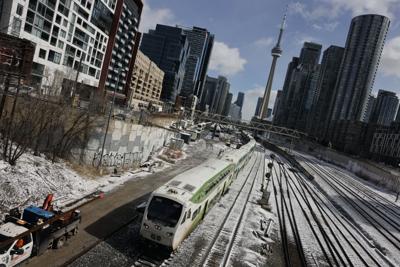


Metrolinx’s promise of two-way, all-day GO service has been delayed, internal documents from the provincial transit agency show.
Meanwhile, under the reframed vision for what’s known as GO Expansion, some riders on the province’s train system could find their trips getting slower, not faster.
Announced in 2018 and originally meant to be done by 2032, the $27-billion GO Expansion plan would have effectively transformed GO from a commuter railway into a European-style rapid rail system boasting 15 minutes-or-better service on core parts of the network.
However, the documents — obtained via a freedom of information (FOI) request made by the Ontario NDP and provided to the Star — show a new, proposed 10-year plan for GO Expansion that seemingly acknowledges a decade delay in electrifying and modernizing the network.
The 10-year plan drafted in March 2025 is a proposed plan for GO Expansion created to update the Metrolinx board of directors. It outlines an electrified network with faster travel times on the Lakeshore West and East lines, but no electrification on the Stouffville, Kitchener and Barrie lines.

Neither the provincial transit agency nor its political boss has given any sign they want to transform the system so it works as good as the
Neither the provincial transit agency nor its political boss has given any sign they want to transform the system so it works as good as the
The Kitchener and Barrie lines could also have slower travel times, according to the proposed plan, because of additional stations. The Kitchener Line has new stops at Mt. Dennis, Woodbine, St. Clair-Old Weston and Kitchener-Central. The Barrie Line is now expected to connect Innisfil to Caledonia Station on Line 5, St. Clair-Old Weston, Bloor-Lansdowne and Spadina-Front.
Replacing diesel trains with electric ones can mean less pollution, better efficiency, and quicker stopping and starting at stations.
Even when the benefits to the Lakeshore lines materialize, they will be later than promised.
The electrification of the GO network was initially expected to finish by 2032. Now, according to the confidential Metrolinx documents, only partial electrification on two lines will be delivered within the next decade.
In response to questions about the FOI documents, Metrolinx spokesperson Lyndsay Miller said, “GO Expansion is continuing, including service increases, signalling and electrification work, with the design and phasing of electrification for core segments of the GO network continuing to be developed.”
Miller pointed to completed works on twin rail tunnels under Highway 401 and 409, four new stations, upgrades at Union Station, grade separations and station improvements as examples of work progressing on GO Expansion.
Dakota Brasier, a spokesperson for Transportation Minister Prabmeet Sarkaria, said the province is “phasing our work to ensure we are building in a way that is practical and delivers real results for riders.”
Neither Brasier nor Miller provided a timeline for GO Expansion.
Expansion plans take shape
GO Expansion, previously known as regional express rail, is the province’s single largest transit project and was launched under the Ontario Liberals.
It has struggled to get off the ground since its announcement in 2018, according to two sources who worked on the project and spoke on condition of anonymity because they continue to work in the rail industry.

The internal Metrolinx documents show the regional transit agency and Infrastructure Ontario had
The Ford government, in 2019, renewed efforts to modernize the GO system, and in 2022 signed a public-private partnership (P3) contract with a consortium of companies collectively known as ONxpress Transportation Partners. The group included Canadian construction company Aecon, French rail company Alstom, German state rail agency Deutsche Bahn, Spanish construction group Fomento de Construcciones y Contratas, and consulting firms WSP and Hatch.
In 2020, private-sector bidders warned Metrolinx and Infrastructure Ontario about the P3 model used for GO Expansion, with concerns about how much financial risk they were being asked to take on. Those concerns were revealed in documents at the time, which warned that changing course could delay procurement for the expansion.
Problems appear in 2022
Problems started soon after the contract was awarded to ONxpress in 2022.
Deutsche Bahn, Aecon and Metrolinx were at odds from the start, according to sources, and a clear-cut plan for the execution of GO Expansion was never agreed upon.
Both ONxpress and Metrolinx overpromised in their visions for GO Expansion, said one GO Expansion source with knowledge of the relationship between Metrolinx and the ONxpress consortium. That led to delays and the eventual termination of Deutsche Bahn and Aecon’s 23-year operations-and-maintenance contract last year.
“I think Metrolinx came up with a business case that presented grand visions … but did not come up with clear execution plans,” according to the source, adding that ONxpress was “incentivized to promise a lot of service and promise great things.”
Another source, who worked for the ONxpress consortium, described how after the P3 agreement started, “almost immediately the partners disagreed on the way to deliver the Metrolinx requirements.”
When Deustche Bahn and Aecon were dropped, it seemed to bring those concerns to life.
According to the report in the FOI documents, “an incremental process of restructuring due to commercial and financial challenges has transferred key program risks back to Metrolinx. The restructuring has created the need for Metrolinx to step in as the single integrator and guiding mind.”
“While the physical civil and track work on the corridors is largely agreed, the signaling, electrification and fleet still require development,” the report says.
Other projects conflicting
Another reason for GO Expansion’s delay, according to the report, is the growing number of other Metrolinx projects. Besides the expansion, the provincial transit agency is also building new GO stations, GO rail extensions for four lines and the Ontario Line, which will overlap with 3.2 kilometres of the GO network.
Those additional projects introduced “new construction complexities at critical sites or added demand pressure to compete for limited construction access on the railway,” according to the report.
“Simultaneous progression of these programs has increased the number of interfacing projects (including state-of-good-repair), triggered more intricate network planning, added pressure to the supply chain, expanded workforce management needs and intensified safety oversight,” the report authors added.
Critics call for transparency
Opposition parties at Queen’s Park are calling for more transparency on the timeline for GO Expansion’s rollout.
“Ontarians have no idea what is going on inside Metrolinx, how they’re making decisions, or even what they have planned for these lines that people heavily rely on,” NDP Leader Marit Stiles said in a statement to the Star. “The only way to get any information from Metrolinx is through FOIs. It’s unacceptable.”
The Ontario Liberals echoed that sentiment, with MPP Andrea Hazell adding, “Ontario has nearly 16 million people, and most live outside Toronto, yet we continue to see a disproportionate focus on projects like the Lakeshore GO line and the expansion of Billy Bishop airport. Meanwhile, communities served by Kitchener, Stouffville, and Barrie are being pushed to the back of the line.”




To join the conversation set a first and last name in your user profile.
Never miss the debate! Receive daily email notifications when users reply to your comments. Sign up for alerts here!
Sign in or register for free to join the Conversation
Conversation
Top Comments
All Comments
Active Conversations
The following is a list of the most commented articles in the last 7 days.
A trending article titled "Doug Ford’s Tories table record $244B Ontario budget amid hefty deficit" with 70 comments.
Doug Ford’s Tories table record $244B Ontario budget amid hefty deficit
70
A trending article titled "Ontario education minister vows to 'root out' bad teachers, ruffles feathers at reception with unions" with 160 comments.
Ontario education minister vows to 'root out' bad teachers, ruffles feathers at reception with unions
160