Randomized Controlled Trial
. 2023 Mar;131(3):37012.
doi: 10.1289/EHP10757. Epub 2023 Mar 22.

The Health Effects of 72 Hours of Simulated Wind Turbine Infrasound: A Double-Blind Randomized Crossover Study in Noise-Sensitive, Healthy Adults

Affiliations
Randomized Controlled Trial

The Health Effects of 72 Hours of Simulated Wind Turbine Infrasound: A Double-Blind Randomized Crossover Study in Noise-Sensitive, Healthy Adults

Nathaniel S Marshall et al. Environ Health Perspect. 2023 Mar.

Abstract

Background: Large electricity-generating wind turbines emit both audible sound and inaudible infrasound at very low frequencies that are outside of the normal human range of hearing. Sufferers of wind turbine syndrome (WTS) have attributed their ill-health and particularly their sleep disturbance to the signature pattern of infrasound. Critics have argued that these symptoms are psychological in origin and are attributable to nocebo effects.

Objectives: We aimed to test the effects of 72 h of infrasound (1.6-20 Hz at a sound level of 90 dB pk re 20μPa, simulating a wind turbine infrasound signature) exposure on human physiology, particularly sleep.

Methods: We conducted a randomized double-blind triple-arm crossover laboratory-based study of 72 h exposure with a >10-d washout conducted in a noise-insulated sleep laboratory in the style of a studio apartment. The exposures were infrasound (90 dB pk), sham infrasound (same speakers not generating infrasound), and traffic noise exposure [active control; at a sound pressure level of 40-50 dB LAeq,night and 70 dB LAFmax transient maxima, night (2200 to 0700 hours)]. The following physiological and psychological measures and systems were tested for their sensitivity to infrasound: wake after sleep onset (WASO; primary outcome) and other measures of sleep physiology, wake electroencephalography, WTS symptoms, cardiovascular physiology, and neurobehavioral performance.

Results: We randomized 37 noise-sensitive but otherwise healthy adults (18-72 years of age; 51% female) into the study before a COVID19-related public health order forced the study to close. WASO was not affected by infrasound compared with sham infrasound (-1.36 min; 95% CI: -6.60, 3.88, p=0.60) but was worsened by the active control traffic exposure compared with sham by 6.07 min (95% CI: 0.75, 11.39, p=0.02). Infrasound did not worsen any subjective or objective measures used.

Discussion: Our findings did not support the idea that infrasound causes WTS. High level, but inaudible, infrasound did not appear to perturb any physiological or psychological measure tested in these study participants. https://doi.org/10.1289/EHP10757.


Figures
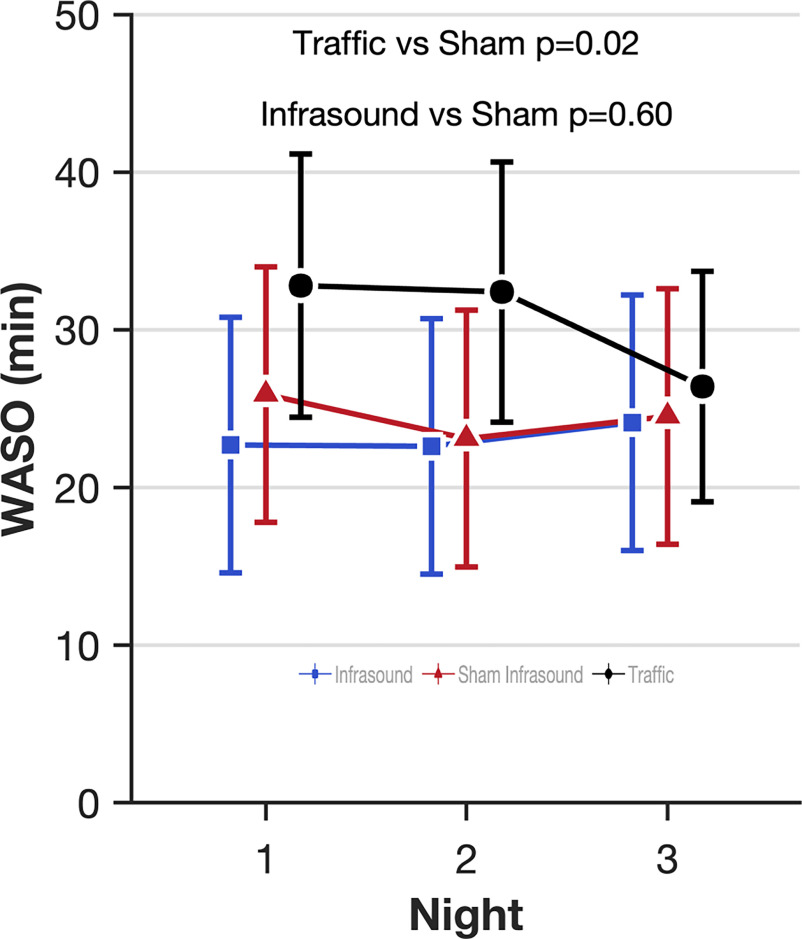
Figure 1 is an error bar graph, plotting W A S O (minute), ranging from 0 to 50 in increments of 10 (y-axis) across night, ranging from 1 to 3 in unit increments (x-axis) for infrasound, sham infrasound, and traffic.
Figure 1.
Effect estimates of infrasound and traffic on wake after sleep onset (WASO) over 3 nights in the laboratory-based study of the three-arm crossover study of 72 h of exposure to simulated wind turbine infrasound, sham infrasound, and traffic noise. The mixed model estimates of the effect of infrasound and traffic noise on electrophysiologically measured human WASO. The primary outcome of this study was WASO as a measure of the effects of noise on sleep perturbation. WASO is the amount of time spent awake between sleep onset and final wake-up time. We measured sleep for 3 nights under each of the three exposures [infrasound in blue squares, sham infrasound in red triangles, and traffic noise in black circles; 1.36 min difference between infrasound and sham infrasound (95% CI: 6.60, 3.88, p=0.601); Table 2]. Error bars indicate the 95% CIs. Effects estimates are derived from mixed models of repeated measures where the participants were classed as random effects and exposure (3 levels), the order the exposure was received (1, 2, 3), the night of exposure (1, 2, 3), and interactions between the exposure by night and night by order as fixed effects. The least squares means procedure was used to address missing data. The exact numerical values for the estimated means and 95% CIs can be found in Table S3. Note: CI, confidence interval.
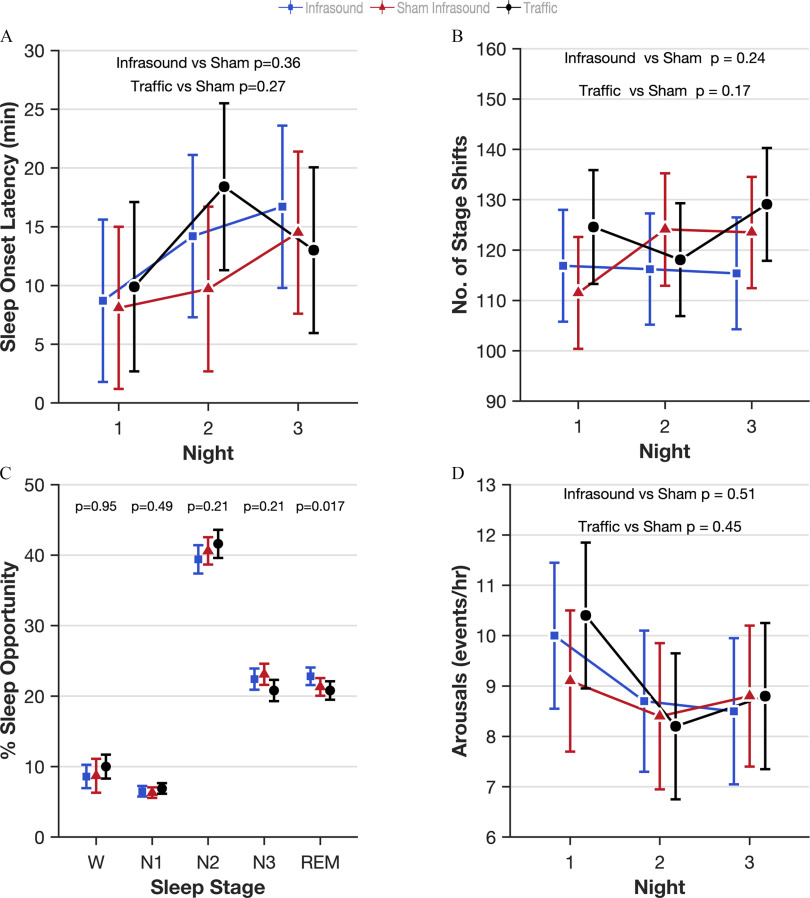
Figures 2A, 2B, and 2D are error bar graphs, plotting sleep onset latency (minute), ranging from 0 to 30 in increments of 5; number of stage shifts, ranging from 90 to 160 in increments of 10; and arousals (events per hour), respectively, ranging from 6 to 13 in unit increments (y-axis) across night, ranging from 1 to 3 in unit increments. Figure 2C is an error bar graph, plotting percentage of sleep opportunity, ranging from 0 to 50 in increments of 10 (y-axis) across Sleep stage, ranging from wake, N 1, N 2, N 3, rapid eye movement (x-axis). All for infrasound, sham infrasound, and traffic.
Figure 2.
Effect estimates of infrasound and traffic on measures of sleep quality over 3 nights in the laboratory-based study of the three-arm crossover study of 72 h of exposure to simulated wind turbine infrasound, sham infrasound, and traffic noise. Infrasound is represented in blue squares, sham infrasound in red triangles, and traffic noise in black circles. Error bars are 95% CI. Effects estimates are derived from mixed models of repeated measures where the participants were classed as random effects and exposure (3 levels), the order the exposure was received (1, 2, 3), the night of exposure (1, 2, 3), and interactions between the exposure by night and night by order as fixed effects. The least squares means procedure was used to address missing data. The exact numerical values for the estimated means and 95% CIs can be found in Table S3. (A) Sleep onset latency is the amount of time taken to fall asleep [2.48 min difference between infrasound and sham (95% CI: 2.87, 7.82, p=0.36); Table 2]. (B) Number of sleep stage shifts is a measure of sleep stability [3.5 shifts difference between infrasound and sham (95% CI: 9.5, 2.4, p=0.24)]. (C) Proportions of the sleep period scored as each of the traditional sleep stages plotted together to test whether infrasound causes perturbation to sleep depth. Numerical values above each plot are the p-values for the difference between infrasound and sham infrasound. p-Values above the stacked columns are comparing infrasound to sham infrasound. (D) Arousal index is the number of cortical arousals detected during each hour of sleep as a measure of sleep quality [0.29 events/h difference between infrasound and sham (95% CI: 0.58, 1.16, p=0.51)]. Note: %, percentage; 1, non-REM sleep stage 1; 2, non-REM sleep stage 2; 3, non-REM sleep stage 3; CI, confidence interval; REM, rapid eye movement stage; SEM, standard error of the mean; W, wake.
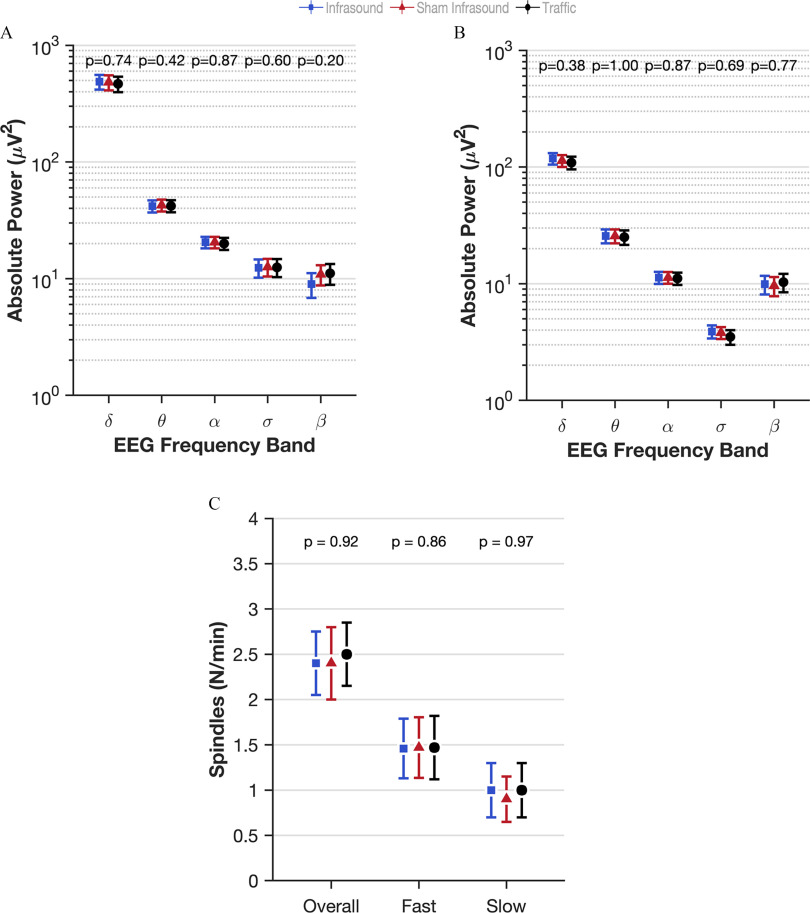
Figures 3A, 3B, and 3C are error bar graphs, plotting absolute power (microvolt squared), ranging from 10 begin superscript 0 end superscript, 10 begin superscript 1 end superscript, 10 begin superscript 2 end superscript, and 10 begin superscript 3 end superscript; absolute power (microvolt squared), ranging from 10 begin superscript 0 end superscript, 10 begin superscript 1 end superscript, 10 begin superscript 2 end superscript, and 10 begin superscript 3 end superscript; spindles (Number per minute), ranging from 0 to 4 in increments of 0.5 (y-axis) across electroencephalographic frequency band, ranging as lowercase delta, lowercase theta, lowercase alpha, lowercase sigma, and lowercase beta; electroencephalographic frequency band, ranging as lowercase delta, lowercase theta, lowercase alpha, lowercase sigma, and lowercase beta; overall, fast, slow (x-axis), respectively, for infrasound, sham infrasound, and traffic.
Figure 3.
Effect estimates of infrasound and traffic on quantitative measures of electroencephalography during sleep in the laboratory-based study of the three-arm crossover study of 72 h of exposure to simulated wind turbine infrasound, sham infrasound, and traffic noise. Infrasound is represented in blue squares, sham infrasound in red triangles, and traffic noise in black circles. Absolute power derived from overnight electrophysiology transformed into five frequency bands as a measure of cortical activity in (A) NREM and (B) REM (delta δ=0.54.5 Hz, theta θ=4.58 Hz, alpha α=812 Hz sigma σ=1215 Hz, beta β=1532 Hz). Sleep spindle density in NREM overall and density of fast and slow spindles in NREM. (C) Fast spindle=1316Hz and slow spindle=1113 Hz. Numerical values above each plot are the p-values for the difference between infrasound and sham infrasound. Effects estimates are derived from mixed models of repeated measures where the participants were classed as random effects and exposure (3 levels), the order the exposure was received (1, 2, 3), the night of exposure (1, 2, 3), and interactions between the exposure by night and night by order as fixed effects. The least squares means procedure was used to address missing data. The exact numerical values for the estimated means and 95% CIs can be found in Table S3. Point estimates are indicated graphically by the shapes and 95% CIs indicated by the bars. Note: CI, confidence interval; NREM, non-REM sleep; REM, rapid eye movement sleep.

Similar articles

Cited by

References

    1. Ageborg Morsing J, Smith M, Ögren M, Thorsson P, Pedersen E, Forssén J, et al. 2018. Wind turbine noise and sleep: pilot studies on the influence of noise characteristics. Int J Environ Res Public Health 15(11):2573, PMID: , 10.3390/ijerph15112573. - DOI - PMC - PubMed
    1. Lechat B, Scott H, Decup F, Hansen KL, Micic G, Dunbar C, et al. 2022. Environmental noise-induced cardiovascular responses during sleep. Sleep 45(3):zsab302, PMID: , 10.1093/sleep/zsab302. - DOI - PubMed
    1. Michaud DS, Keith SE, Guay M, Voicescu S, Denning A, McNamee JP. 2021. Sleep actigraphy time-synchronized with wind turbine output. Sleep 44(9):zsab070, PMID: , 10.1093/sleep/zsab070. - DOI - PubMed
    1. Smith MG, Ögren M, Thorsson P, Hussain-Alkhateeb L, Pedersen E, Forssén J, et al. 2020. A laboratory study on the effects of wind turbine noise on sleep: results of the polysomnographic WiTNES study. Sleep 43(9):zsaa046, PMID: , 10.1093/sleep/zsaa046. - DOI - PMC - PubMed
    1. Liebich T, Lack L, Hansen K, Zajamšek B, Lovato N, Catcheside P, et al. 2021. A systematic review and meta‐analysis of wind turbine noise effects on sleep using validated objective and subjective sleep assessments. J Sleep Res 30(4):e13228, PMID: , 10.1111/jsr.13228. - DOI - PubMed

Publication types