

The Data Grab Hidden Inside “Protect the Kids” Bills

By Julie Barrett, Founder, Conservative Ladies of America
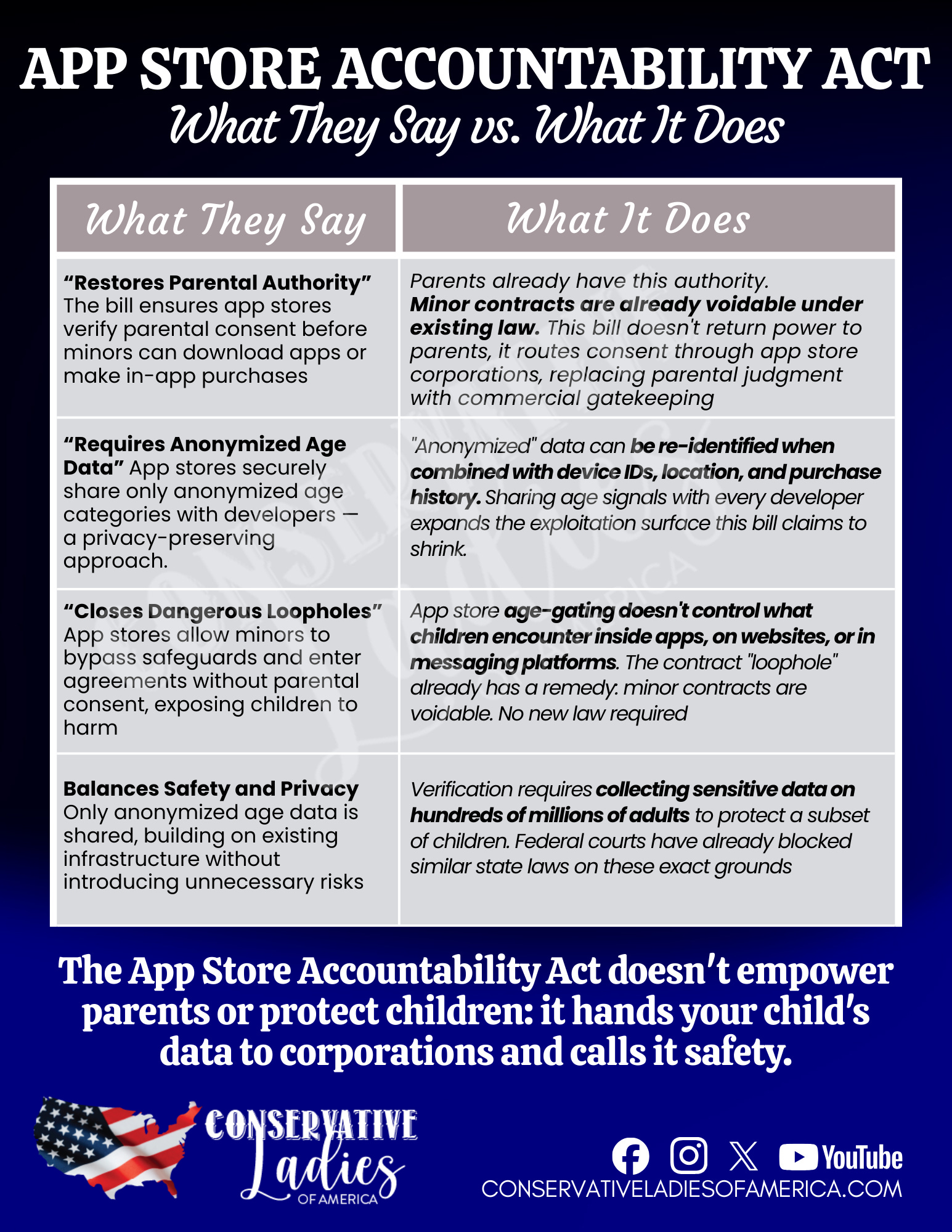
Last week I testified before the Kansas House committee on Federal and State Affairs in opposition to Senate Bill 372, also called “App Store Accountability Act.” This model policy is being pushed in states across the country, and in Congress. It’s pitched as a way to “protect children and empower parents” but it does neither.
It’s Not Just About App Downloads Anymore
Here’s what’s different about SB 372 that I want to make sure is on your radar: this bill doesn’t just regulate apps you choose to download from an app store (Arizona’s HB 2920 is very similar).
It covers pre-installed apps, the ones that come baked into your device before you ever turn it on.
Safari. Messages. Mail. FaceTime.
Under this bill, anyone setting up a new phone would be blocked from opening these basic built-in tools until they complete a state-mandated identity verification and parental consent workflow. Not an app you sought out. Not a social media platform. The browser and the text messaging app that come standard on every device.
That’s a scope of government control I don’t think most people, including most legislators, have fully absorbed.
The “One-Size” Problem Is Worse Than It Sounds
SB 372 makes no distinction between a 12-year-old and a 17-year-old. Between a kid who needs more guardrails and one who is already working a job and driving a car.
A 17-year-old with a driver’s license, someone our laws already recognize as mature enough to operate a vehicle, cannot open a pre-installed browser or download a homework app without a parent available on the spot to approve it.
This is not a parental tool; it is a parental burden. And it’s built on the assumption that government knows your child better than you do.
The Data Question Nobody Is Answering
This is the part I most wanted the committee to sit with, because I think it gets lost in the broader debate.
SB 372 mandates identity verification for every user and it provides no real framework for what that means in practice. The bill uses the phrase “commercially reasonable methods,” which is doing enormous work. That language could authorize government IDs, biometric scans, facial analysis, or third-party identity databases.
And then it goes silent on everything that matters most:
What specific information will be required from your child or from you?
How long can that data be stored?
Who is permitted to access it?
What security standards apply?
How and when must it be deleted?
The bill answers none of these questions. It creates a mandate to collect sensitive data on children and families and then leaves every critical protection undefined.
We’ve seen this pattern before. The policy gets passed on good intentions, and the details get filled in later by people we never voted for.
The Fight Ahead
These universal age-verification policies are essentially a de facto Digital ID and they are popping up all over the country - from app stores, social media platforms, AI chatbots, to even the OS level. They’re strategically being pushed as a way to protect children, which has gotten citizens to support them without fully understanding what they actually do and what the consequences will be for American citizens…EVERY American.
In the last couple months, we have testified against these bills in Arizona, Washington, Florida, Georgia, South Dakota, Wisconsin, Kansas, and Tennessee. We believe these deceptive policies are not just an attack on our First Amendment rights, but an attack on parental rights and family autonomy.
And the fight has only just begun.
If you’ve been following our work and believe parents, not the government, should be making decisions for their families, we need your support to keep showing up. Testifying in eight states in two months takes resources, and there are more hearings coming.
Will you chip in to help us fight back? Every dollar goes directly toward getting boots on the ground in statehouses across the country before these bills become law.
Every contribution, no matter the size, helps us stay in this fight.

Julie
As a teacher, I would sign students up for websites, and I'd use my information as the consenting parent. There is always a workaround. The proposed bill will not stop students from joining social sites.